SOIL PREPARATION AND NUTRIENT LOSSES
BY EROSION IN THE CULTURE OF CUCUMBER
Nelson Moura Brasil do Amaral Sobrinho*; Nelson Mazur
UFRRJ/IA - Depto. de Solos, BR 465, km 7 - 23890 000 - Seropédica, RJ - Brasil. *Corresponding author <[email protected]>
ABSTRACT: Minimum tillage reportedly reduce erosion, avoid soil degradation and improve crop productivity. This study aimed to determine how tillage operations may affect either nutrient accumulation or nutrient losses by erosion. The study was, carried out from December, 2000 to March, 2001, in the watershed of the Caetés River, in Rio de Janeiro State, Brazil (22º25’43"S, 43º25’07"W). The experiment was set up in sandy clay Kandiudult soil, 60% slope, under cucumber (Cucumis sativus L.) crop. Soil samples were collected before planting and after harvest, on 22.0 × 4.0 m Greeoff plots. After each rainfall, fine sediments carried by runoff were deposited into two collecting tanks in a row, installed at the end of each plot, and were later dried, weighed and stored for analyses. Treatments (n = 4) were characterized by different tillage systems: (i) downhill plowing followed by the burning of crop residues (DPB); (ii) downhill plowing with no burning of the crop residues (DPNB); (iii) animal traction contour plowing, with strips of guinea grass planted at a spacing of 7.0 m (AT); and (iv) minimum tillage (MT). Samples of the soil-plowed layer were collected before planting and after harvest, between the rows and from the plants. Total concentration of Ca, Mg, K and P were determined after extraction with nitric perchloride digestion. Labile P and exchangeable K were extracted with the Mehlich 1 extractant solution. The MT system reduced losses of both exchangeable bases (15%) and P (8%), and affected the distribution of labile and organic P. Crop residues left on soil surface in the MT system, resulted in increased organic matter content. Downhill plowing, the most used tillage operation in the region, resulted in the greatest losses of Ca, Mg, K, and P.
Key words: watershed of the Caetés, fractionation of P, losses due to erosion
PREPARO DO SOLO E PERDA DE NUTRIENTES POR
EROSÃO NA CULTURA DO PEPINO
RESUMO: O cultivo mínimo reputadamente reduz a erosão, evita a degradação do solo e melhora a produtividade das culturas. Este trabalho teve por objetivo determinar a influência de diferentes métodos de preparo do solo sobre o acúmulo e perdas por erosão de nutrientes. O experimento foi realizado na microbacia de Caetés, município de Paty do Alferes RJ, (22º25’43"S, 43º25’07"O) durante os meses de dezembro de 2000 a março de 2001 no ciclo de cultivo do pepino (Cucumis sativus L.). O experimento foi localizado em Argissolo Vermelho Amarelo, intermediário latossólico textura argila arenosa/argilosa e declividade de 60%. Foram instaladas parcelas do tipo Wischmeier, numa área de 22,0 × 4,0 m com diferentes sistemas de preparo de solo. Ao final de cada parcela foram instalados dois tanques para o armazenamento das águas pluviais e dos sedimentos carreados pela enxurrada. Os tratamentos (n = 4) utilizados foram: (i) aração com trator morro abaixo e queima dos restos vegetais (MAQ); (ii) aração com trator morro abaixo não queimado com restos de vegetação natural entre as linhas (MANQ); (iii) aração com tração animal em nível, faixas de capim colonião a cada 7,0 m (AA) e (iv) cultivo mínimo (CM). Nas linhas e nas covas de cada parcela foram coletadas amostras da camada arável do solo antes do plantio e depois da colheita. Após cada chuva os sedimentos carreados pela erosão foram recolhidos, secos, pesados e guardados para posterior análise. As concentrações totais de Ca, Mg, K e P em solo e sedimentos foram determinadas em extratos nitro perclóricos. O CM reduziu as perdas das bases trocáveis e do P e também influenciou na distribuição nas formas lábil e orgânica de P. O aproveitamento dos resíduos vegetais, na parcela sob CM, propiciou aumento no teor de matéria orgânica. O tratamento MAQ, típico da região, foi o que apresentou as perdas mais elevadas de Ca, Mg, K e P.
Palavras chave: microbacia de Caetés, fracionamento de fósforo, perdas por erosão
INTRODUCTION
One of the most used tillage operations in Brazil is the plowing with furrow slices, known to degrade soil
incorpo-rated into the soil, while in minimum tillage fertilizers are applied to the soil surface, which results in the accu-mulation of fertilizers on the soil surface, added of nu-trients derived from crop residues. (Klepker and Anghinoni, 1995).
Santos et al. (2003) reported the accumulation of exchangeable Ca+2
, Mg+2
and K+
, and available phospho-rus (P), on the top soil layer after three years of no till, but no significant differences in soil pH were observed between conventional and no-tillage systems. In steep-sloped croplands, P is lost mostly due to erosion (Resende et al., 1996). The phosphorus carried into water systems may be either in the soluble or protected form. Since P is strongly adsorbed to clay, the highest portion of P car-ried by the water in croplands is in the adsorbed form (Sharpley & Smith, 1994).
The Paty do Alferes county, in the mountains of Rio de Janeiro State, is an agricultural area. About 40% of the tomatoes (Lycopersicon esculentum Mill.) produced in the State are grown in Paty de Alferes, as well as other crops, such as cabbage, cucumber, peas, sweet pepper, etc. Despite great investments, local ag-ricultural production has decreased over the last decade, particularly due to deforestation and the use of unsus-tainable agricultural practices. The use of non-conser-vationist practices, such as plowing up and down slopes
≥ 45%, results in high losses of soil and nutrients (Núñez et al., 1999; Santos, 2001; Santos et al., 2002; 2003. This study targeted (i) estimating both accumu-lation and losses of soil nutrients due to tillage erosion and (ii) determining how tillage operations affect the separation of chemical forms of P.
MATERIAL AND METHODS
A four-months study, set up in the watershed of the Caetés river evaluated soil losses caused by heavy rainfall, under cucumber (Cucumis sativus L.) crop. Plots were installed on a sandy clay Kandiudult soil, typical for this region, 60% slope. Fertilizers usage is showed in Table 1. The runoff plot was established according to Wischmeier design, 22.0 m length by 4.0 m width (88 m2). Plots were limited by metal sheets placed 40 cm deep in the soil, spaced 4.0 m. The runoff was collected directly to the end of the plot and then to a water tank, were
samples were collect after every rainfall event resulting in runoff. The volume of the suspension in the tank was measured for latter calculations and the sample was taken to the laboratory for analysis. Soil was then weighted to estimate the amount lost by erosion. At the end of the crop cycle, all soil sediments samples collected were pro-portionally mixed according to the losses estimated for each rainfall, and a composite soil sample transported by runoff was obtained for each plot.
Field trials compared four tillage systems: (i) downhill plowing followed by the burning of crop resi-dues (DPB); (ii) downhill plowing with no burning of the crop residues (DPNB); (iii) animal traction contour plow-ing, with strips of guinea grass (Panicum maximum Jacq.) planted with a spacing of 7.0 m (AT); and (iv) minimum tillage (MT). Trials were set up in a randomized, com-plete block with four blocks and four treatments (n = 4). Fertilization and pest and weed control were the same for all the treatments. One composited sample (twenty indi-vidual samples) was collected from the plowed player (0-20 cm) before planting and after harvest, between the rows and from the plants.
Dried soil and sediment samples were first sieved trough 2 mm sieve, milled in agate vessel, and stored for further analyses, total Ca, Mg, K and P contents, after the nitric perchloride digestion, using a digestion block and a mixture of HNO3 + HClO4 (Tedesco et al., 1997). La-bile P and exchangeable K were extracted with the Mehlich 1 solution; exchangeable Ca and Mg were ex-tracted with 1.0 mol L-1 KCl solution (EMBRAPA, 1997). For the determination of organic and inorganic P fractions in soil and sediment samples, a sequential extraction tech-nique was used, as described in Bowman (1989). Organic carbon was analyzed by the Walkley Black wet digestion method (EMBRAPA, 1997). Statistical analyses were per-formed by the software SAEG 5.0, and Tukey test was used to compare means (α = 0.05).
RESULTS AND DISCUSSION
Soil organic matter (OM) contents measured be-fore planting and after harvest in the four tillage systems and the amount of soil lost by erosion (kg ha 1) are shown in Table 2. The OM contents in DPB, DPNB and AT treat-ments were significantly lower than in the MT system,
Table 1 - Fertilization practices and rainfall along the cucumber (Cucumis sativus L.) cropping cycle.
Fertilizer Amount
applied N P
Total precipitation
Maximum intensity - - - k g ha-1 - - - - mm mm h-1
Cattle manure 40,000 752 385 456 84
Castor bean manure 2,000 70 14
Yoorin thermophosphate 800 49
that is, minimum tillage reduced soil losses compared to conventional tillage (Figure 1). The low OM contents ob-served in DPB and DPNB treatments may be related to soil losses due to organic matter erosion, which were ob-served to be about three to six times greater than losses observed in treatments AT and MT, respectively. High soil disturbance reduces soil aeration, humidity and tempera-ture, also making soil aggregates very susceptible to breakdown, increasing the risks of surface exposure, and promoting crop residues breakdown and incorporation (Bayer & Mielniczuk, 1997). Tillage systems are likely to have affected the rate of accumulation of organic mat-ter, because of losses due to erosion (Figure 1) and OM mineralization; OM contents have already been found to be lower in tillage systems where soil was greatly dis-turbed (De Maria & Castro, 1993).
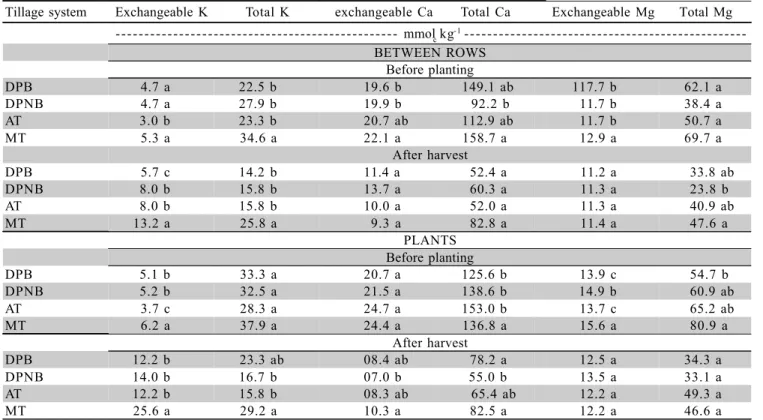
The accumulation of both total and exchangeable K was significantly higher in MT than in the other three plowing systems (Table 3). Centurion et al. (1985) also
found minimum tillage systems to accumulate more ex-changeable K+ in the top 5 cm layer than in conventional tillage. High contents of K+ also observed in subsurface may have resulted from high leaching. For the other till-age systems where there was soil disturbance, K was more uniformly distributed. Despite the decrease in the total K content after harvest, there was an increase in the ex-changeable K content, both between rows and in the plants. In the first growth stages, the high contents of K adsorbed by plants caused a decrease in soil available K was contents; in the following stages, K was washed off the leaves and stalks by the rainfall, and accumulates in the soil (Klepker & Anghinoni, 1995).
MT is known to reduce losses of K (Table 4). DPB system caused a great loss of K. Losses by leach-ing are also significant, since K has high solubility, es-pecially in sandy soils. The accumulation of exchange-able Ca+2 and Mg+2 was also observed in the MT system (Table 3), despite the fact that no lime was applied be-fore planting. The increase in the contents of those nu-trients may be related to fertilization practices (Yoorin thermophosphate and manure) or to the crop residues left on the soil surface.
Soil pH increased in both no-till and mulch till-age systems, as well as the contents of Ca, Mg and K. Those findings may be associated to the release of nutri-ents by crop residues on the soil surface (Sidiras & Pavan, 1985). Losses of Ca and Mg due to erosion were lower than losses of K, and the lowest losses of those nutrients were observed in the MT system (Table 4).
Higher contents of total P were observed in the minimum tillage system, both between the rows and in the plants; the system favored P accumulation by reduc-ing soil losses (Figure 1). Tillage system affected the dis-tribution of labile, organic and inorganic P in the soil (Table 5). Higher contents of labile P were registered in the MT system, since greater soil disturbance in the other systems move likely increased P availability.
Ultisols have clayey subsurface horizons, clay be-ing mostly kaolinite and Fe and Al oxides (Núñez et al., 1999), with specific sites for P adsorption. The more the
Table 2 - OM contents and loss due to tillage erosion under different systems*.
*Means followed by the same letters on columns do not differ (Tukey test; P < 0.05).
1Before planting, 2After harvest
Organic matter content Tillage
system Between rows
1 Between rows2 Plants1 Plants2 Soil loss due
to erosion - - - g kg-1 - - - - kg ha- 1
DPB 26.7 b 25.2 b 28.8b1 23.6 b2 1543 a
DPNB 24.5 b 24.1 b 24.1 b 17.9 c 1465 b
AT 28.3 b 25.0 b 30.0 b 26.9 a 536 c
MT 42.2 a 35.3 a 42.2 a 29.8 a 319 d
Figure 1 - Soil losses due to tillage erosion in cucumber (Cucumis sativus L.) crop (Letter in the columns do not differ Tukey test, P < 0.05).
DP DPN AT MT
0 10 20 30 40 50 60 70
Mg ha
-1
a
b
c
soil is disturbed, the greater the contact between sub-surface horizons and soluble phosphates, increasing the fixation of the most labile P into non-labile forms (Novais et al., 1985). Inorganic P accounted for almost 70% of total P in all the tillage systems, while in the MT system organic forms accounted for about 29% of total P, and labile P for about 28% and 30%, for samples collected between the rows and in the plants, respec-tively. Lower portions (14% and 8%) of this greatly available form were observed in the DPB system. A de-creasing in the percents of organic P in samples col-lected after harvest was also observed, for the three con-ventional tillage systems. Organic P contents in the MT system remained around 28%, because of the greater or-ganic matter contents.
Remaining crop residues on the soil surface in the MT system favors the accumulation of OM (Figure 1), and consequently of organic P (Table 3). Since most resi-dues are P-rich, the decomposition and mineralization of
Table 4 - Losses of K, Ca and Mg due to tillage erosion under four different systems*.
*Means followed by the same letters on columns do not differ (Tukey test; P < 0.05).
Tillage system Exchangeable Ca Total Ca Exchangeable Mg Total Mg Exchangeable K Total K - - - k g ha-1
-DPB 18 a1 75 a 16 a 41 a 32 a 198 a
DPNB 13 b 42 b 11 a 20 b 24 b 100 b
AT 5 c 17 c 4 b 12 c 7 c 59 c
MT 2 d 10 d 2 b 6 d 5 c 32 d
organic P supply inorganic P for microbial assimilation, plant absorption, and interaction with mineral compounds. Organic P may either be stable in the OM or interact with the soil mineral compounds (Guerra, 1993).
The contents of organic and labile P fractions slightly increased in all systems, probably due to the min-eralization and release of soil’s organic P. The content of total P lost due to erosion was quite lower in the MT sys-tem than in the other three syssys-tems (Table 6). Losses of P in the DPB system were found to be 12 times greater than losses in the MT system. Just by leaving crop resi-dues between the rows, as in the DPNB system, P total losses were reduced by 36% when compared to the tra-ditional local system (DPB).
Minimum tillage system was more effective in conserving P applied to the soil, as it reduced P losses due to erosion. The second more effective system was AT, which suggests that little soil disturbance and the use of natural barriers are effective agricultural practices for soil Table 3 - Contents of exchangeable bases before planting and after harvest*.
*Means followed by the same letters on columns do not differ (Tukey test; P < 0.05).
Tillage system Exchangeable K Total K exchangeable Ca Total Ca Exchangeable Mg Total Mg - - - mmolc kg-1
-BETWEEN ROWS Before planting
DPB 4.7 a 22.5 b 19.6 b 149.1 ab 117.7 b 62.1 a
DPNB 4.7 a 27.9 b 19.9 b 92.2 b 11.7 b 38.4 a
AT 3.0 b 23.3 b 20.7 ab 112.9 ab 11.7 b 50.7 a
MT 5.3 a 34.6 a 22.1 a 158.7 a 12.9 a 69.7 a
After harvest
DPB 5.7 c 14.2 b 11.4 a 52.4 a 11.2 a 33.8 ab
DPNB 8.0 b 15.8 b 13.7 a 60.3 a 11.3 a 23.8 b
AT 8.0 b 15.8 b 10.0 a 52.0 a 11.3 a 40.9 ab
MT 13.2 a 25.8 a 9.3 a 82.8 a 11.4 a 47.6 a
PLANTS Before planting
DPB 5.1 b 33.3 a 20.7 a 125.6 b 13.9 c 54.7 b
DPNB 5.2 b 32.5 a 21.5 a 138.6 b 14.9 b 60.9 ab
AT 3.7 c 28.3 a 24.7 a 153.0 b 13.7 c 65.2 ab
MT 6.2 a 37.9 a 24.4 a 136.8 a 15.6 a 80.9 a
After harvest
DPB 12.2 b 23.3 ab 08.4 ab 78.2 a 12.5 a 34.3 a
DPNB 14.0 b 16.7 b 07.0 b 55.0 b 13.5 a 33.1 a
AT 12.2 b 15.8 b 08.3 ab 65.4 ab 12.2 a 49.3 a
Tillage system Labile P Inorganic P Organic P Total P --- kg ha-1
-MAQ 4.9 (10.3) aD 29.2 (62.0) aB 17.8 (37.8) aC 47.0 aA
MANQ 3.3 (11.1) bD 18.8 (62.8) bB 11.1 (37.2) bC 29.9 bA
AA 1.3 (11.4) cD 7.4 (65.9) cB 3.9 (34.1) cC 11.2 acA
CM 0.5 (13.0) dD 2.7 (70.0) dB 1.2 (30.0) dC 3.9 dA
Table 6 - Losses of labile P, organic and inorganic P due to tillage erosion. Numbers in parenthesis indicate the percentage based on total P*.
*Means followed by the same small letters on the columns, and capital letters on the rows, do not differ (Tukey test; P < 0.05).
conservation and soil fertility sustainability. The results of this study clearly suggest that the DPB system, widely used in the studied watershed, is not sustainable.
REFERENCES
BAYER, C.; MIELNICZUK, J. Características químicas do solo afetadas por métodos de preparo e sistemas de cultura. Revista Brasileira de Ciência do Solo, v.21, p.105 112, 1997.
BOWMAN, R.A. A sequential extraction procedure with concentrated sulfuric acid and dilute base for soil organic phosphorus. Soil Science Society of America Journal, v.53, p.362 366, 1989.
CENTURION, J.F.; DEMATTÊ, J.L.I.; FERNANDES, F.M. Efeitos de sistemas de preparo nas propriedades químicas de um solo sob cerrado cultivado com soja. Revista Brasileira de Ciência do Solo, v.9, p.267 270, 1985.
DE MARIA, I.C.; CASTRO, O.M. de. Fósforo, potássio e matéria orgânica em um latossolo roxo, sob sistemas de manejo com milho e soja. Revista Brasileira de Ciência do Solo, v.17, p.471 477, 1993.
EMPRESA BRASILEITA DE PESQUISA AGROPECUARIA. Manual de métodos de análise de solo. 2.ed.. Rio de Janeiro: EMBRAPA, CNPS, 1997. 212p.
GUERRA, J.G.M. Produção sazonal de Brachiaria Decumbens Stapf, conteúdo de fósforo orgânico e microbiano em solos tropicais de baixa fertilidade natural. Itaguaí: UFRRJ, 1993. 234p. (Tese - Doutorado). KLEPKER, D.; ANGHINONI, I. Características físicas e químicas do solo
afetadas por métodos de preparo e modos de adubação. Revista Brasileira de Ciência do Solo, v.19, p.395 401, 1995.
NOVAIS, R.F.; BAHIA FILHO, A.F.C.; RIBEIRO, A.C.; VASCONCELOS, C.A. Solubilização de fosfatos incubados com amostras de latossolo submetidas a diferentes números de revolvimento. Revista Brasileira de Ciência do Solo, v.9, p.23 26, 1985.
NÚÑEZ, J.E.V. Acúmulo e perdas por erosão de nutrientes e metais pesados afetado pelo metodo de preparo do solo. Seropédica: UFRRJ, 1997. 125p. (Dissertação - Mestrado).
NÚÑEZ, J.E.V.; AMARAL SOBRINHO, N.M.B.; PALMIERI, F.; MESQUITA, A A. Consequências de diferentes sistemas de preparo do solo sobre a contaminação do solo, sedimentos e água por metais pesados. Revista Brasileira de Ciência do Solo, v.23, p.981-990, 1999.
Table 5 - Content of labile P and fractions of P in the systems, before planting and after harvest. Numbers in parenthesis indicate the percentage based on total P*.
*Means followed by the same letters on the columns, for samples collected in the same place and in the same period, for each P chemical form, do not differ (Tukey test; P < 0.05).
Tillage system Labile P Inorganic P Organic P Total P
- - - mg kg-1
-BETWEEN THE ROWS Before planting
MAQ 33.3 (14.6) b 161.8 (71.0) b 66.2 (29.0) b 228.1 c
MANQ 38.8 (14.8) b 185.0 (70.7) a 76.7 (29.3) a 261.8 b
AA 39.6 (18.6) b 151.1 (70.9) b 62.0 (29.1) c 213.1 d
CM 78.8 (28.9) a 193.2 (70.8) a 79.7 (29.2) a 268.6 a
After harvest
MAQ 27.0 (14.6) b 145.8 (78.9) c 39.0 (21.1) d 184.8 c
MANQ 27.0 (12.4) b 166.8 (76.4) b 51.5 (23.6) b 218.2 b
AA 27.7 (15.0) b 140.5 (76.2) d 43.9 (23.8) c 184.4 c
CM 76.9 (30.9) a 179.2 (71.9) a 70.4 (28.3) a 249.6 a
PLANTS Before planting
MAQ 42.4 (8.0) c 357.9 (70.9) d 146.8 (29.1) b 504.7 b
MANQ 48.1 (9.0) c 379.2 (70.9) b 155.3 (29.1) ab 534.6 a
AA 79.8 (15.2) b 370.7 (70.0) c 151.4 (29.0) ab 522.2 ab
CM 121.8 (22.1) a 390.3 (70.7) a 161.7 (29.3) a 552.1 a
After harvest
MAQ 44.6 (10.1) c 347.8 (78.6) c 94.7 (21.4) d 442.5 d
MANQ 47.3 (10.2) c 347.8 (75.4) c 113.4 (24.6) c 461.3 c
AA 77.1 (15.9) b 357.7 (73.6) b 128.3 (26.4) b 486.0 b
Received October 25, 2004 Accepted November 03, 2005 RESENDE, S.B. de; RESENDE, M. Solos dos Mares de Morros: ocupação
e uso. In: ALVAREZ, V.H.; FONTES, L.E.F.; FONTES, M.P.F. (Ed.) O solo nos grandes domínios morfoclimáticos do Brasil e o desenvolvimento sustentado. Viçosa: SBCS; UFV, DPS, 1996. p.261 288.
SANTOS, F.S. Contaminação de um Agroecossistema por Metais Pesados em Função do uso de Agroquímicos em diferentes Manejos Agrícolas. Seropédica: UFRRJ, 2001. 95p. (Tese - Mestrado). SANTOS, F.S.; AMARAL SOBRINHO, N.M.B.; MAZUR, N. Influência
de Diferentes Manejos Agrícolas na Distribuição de Metais Pesados no Solo e em Plantas de Tomate. Revista Brasileira de Ciência do Solo, Viçosa:, v.26, p.535-543, 2002.
SANTOS, F.S.; AMARAL SOBRINHO, N.M.B.; MAZUR, N. Consequências do Manejo do Solo na Distribuição de Metais Pesados em um Agrossistema com Feijão de Vagem (Phaseolus vulgarisL.).
Revista Brasileira de Ciência do Solo, v.27, p.191-198, 2003.
SHARPLEY, A.N.; SMITH, S.J. Wheat tillage and water quality in the Southern Plains. Soil Tillage Research, v.30, p.33-38, 1994. SIDIRAS, N.; PAVAN, M.A. Influência do sistema de manejo do solo no
seu nível de fertilidade. Revista Brasileira de Ciência do Solo, v.9, p.185 286, 1985.