Antimicrobial susceptibility of
Streptococcus
pneumoniae
isolated from patients in the
northeastern macroregion of São Paulo state,
Brazil, 1998-2013
Suscetibilidade antimicrobiana de
Streptococcus pneumoniae
isolados de pacientes na
macrorregião nordeste do estado de São Paulo, Brasil, entre 1998 e 2013
Marta Inês C. Medeiros1; Samanta Cristine G. Almeida1; Sérgio Bokermann1; Evandro Watanabe2; Maria Luiza L. S. Guerra1; Denise de Andrade2
1. Instituto Adolfo Lutz (IAL), São Paulo, Brazil. 2. Universidade de São Paulo (USP), São Paulo, Brazil.
First submission on 14/09/16; last submission on 14/09/16; accepted for publication on 19/04/17; published on 20/06/17
ABSTRACT
Introduction: There are reports worldwide about the increase in infections caused by Streptococcus pneumoniae resistant to antimicrobials.
Objective: Evaluate the susceptibility proile of serotypes of Streptococcus pneumoniae associating them with pneumococcal invasive diseases (PID), as well as antimicrobial therapies. Method: This is a retrospective cross-sectional research involving secondary data from 1998 to 2013, in the northeastern macroregion of São Paulo state, Brazil, composed of Araraquara, Barretos, Franca and Ribeirão Preto regions, with 90 municipalities. At Instituto Adolfo Lutz (IAL), isolated strains from patients with PID were subjected to identiication, serotyping and antimicrobial susceptibility testing. Results: From 796 strains analyzed, 14.8% (n = 118) were resistant to penicillin, being 3% (n = 24) with intermediate resistance and 11.8% (n = 94) with full resistance, especially in patients with meningitis. Moreover, resistance to ceftriaxone was 5.3%: 34 (4.3%) with intermediate resistance and 8 (1%) with full resistance. We point out that the greatest level of resistance proiles was observed against sulfamethoxazole/trimethoprim (SMT): 350 (49.4%). On the other hand, antimicrobial susceptibility was described above 90% to chloramphenicol: 99.6% (n = 696), erythromycin: 94.7% (n = 664), ceftriaxone: 94.7% (n =
754) and fully susceptible to vancomycin. Among the 18 most common serotypes, 9V and 14 showed less susceptibility to SMT, to penicillin and ceftriaxone; 19A to SMT and penicillin; 1 to SMT; 12F and 3 to chloramphenicol; 6A to SMT; 6B 23F to erythromycin and penicillin.
Conclusion: Monitoring of Streptococcus pneumoniae antimicrobial resistance is essential to guide the appropriate empirical treatment of pneumococcal disease.
Key words:Streptococcus pneumoniae; serotyping; antibacterial agents.
INTRODUCTION
Infections by Streptococcus pneumoniae persist as an important health problem worldwide(1), despite the extensive investment in vaccines and the availability of appropriate antibiotic therapy. We must highlight that pneumococcus is part of human nasopharyngeal microbiota and can be isolated including in healthy adults and children who attend institutions of early childhood education. In Brazil, the prevalence of pneumococcus carriers ranges from 13% to 72%, depending on age and presence of associated diseases(2).
In the decade of 1940s, the advent of penicillin apparently controlled pneumococcal diseases. However, as years went by, an increase in resistant strains was observed, both to classical and to the latest-generations treatments(3-10). In Brazil the irst report of resistance to pneumococcus was delivered in 1988(11).
The indiscriminate use of antibiotic drugs is considered a risk factor for the increase in the resistance proile of S. pneumoniae, favoring colonization of nasopharynx and the occurrence of pneumococcal invasive diseases (PID) by resistant strains(1, 6). Researches about PID exhibit regional and seasonal speciicities, what determines the need of periodic monitoring for the
establishment of interventions and control policies. Additionally, surveillance of the antimicrobial susceptibility pattern of strains is enormously valuable in the choice of the initial empirical treatment, as well as for the rational use of antimicrobials(12).
This study was aimed at evaluating the susceptibility proile of different serotypes of S. pneumoniae isolated from individuals
with PID in the northeastern macroregion of São Paulo state, Brazil, during a period of 16 years.
METHOD
This is a retrospective cross-sectional research focusing secondary data on the antimicrobial susceptibility proile of
S. pneumoniae isolated from patients with PID in a period of 16
years. Those patients were from the northeastern region of the state of São Paulo, Brazil, registered at the Regional Healthcare Network 13 (RRAS 13), which is part of the Regional Health Department (DRS) of Araraquara, Barretos, Franca, and Ribeirão Preto, with 90 municipalities(13).
Information about serotypes and antimicrobial susceptibility proile were collected from 1998 to 2013 at the Center of Regional Laboratory (CLR) of Instituto Adolfo Lutz in Ribeirão Preto (IAL-RP) and Central IAL/São Paulo. It is appropriate to stress that the Bacteriology Center of IAL acts as a reference laboratory at state and national level for meningitis and pneumococcal infections.
The IAL laboratory uses Gram stain, optochin test and bile
solubility test(14), serotyping by the quellung reaction(15) and antimicrobial susceptibility proile according to the Clinical and Laboratory Standards Institute (CLSI)(16-18).
Data were analyzed by the Statistical Package for the Social Sciences (SPSS), version 19.0, for the chi-square association test between distribution of cases according to period, clinical diagnosis, serotype, or susceptibility of each antimicrobial drug.
The project was approved by the Human Research Ethics Committee (report no. 26759714.80000.5393).
RESULTS
During a 16-year period, the results were analyzed of 796 cultures of S. pneumoniae from patients with PID, with ages ranging from 1 month to 94 years, and meningitis (45.7%) and pneumonia (45%) being the most common PID. Serotypes 14, 3, 19F, 1, 6A, 6B, 23F, 9V, 18C, 19A, 12F, 4, 7F, 5, 11A, 22F, 8 and 9N
were the most frequently isolated in the northeastern macroregion of the state of São Paulo, Brazil.
A total of 69.2% of S. pneumoniae were susceptible to penicillin and ceftriaxone according to the oxacillin disk screening test. For 30.8% of oxacillin-resistant strains, the minimum inhibitory concentration (MIC) was determined.
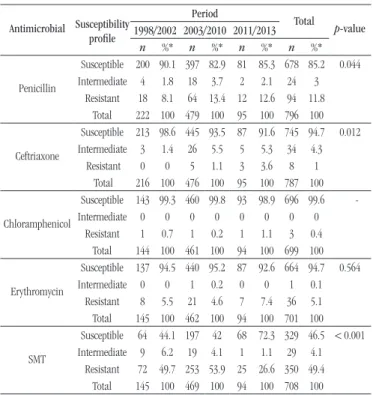
For chloramphenicol erythromycin, and sulfamethoxazole/ trimethoprim (SMT), the disk-diffusion test deined the proile of susceptibility of S. pneumoniae. There was an increase in the pneumococcus susceptibility to SMT after vaccination in 2010
(Table 1).
TABLE 1 − Susceptibility proile of S. pneumoniae to antimicrobials in isolates of patients with PID treated at RRAS 13, according to year of isolation,
1998-2013
Antimicrobial Susceptibility proile
Period
Total
p-value 1998/2002 2003/2010 2011/2013
n %* n %* n %* n %*
Penicillin
Susceptible 200 90.1 397 82.9 81 85.3 678 85.2 0.044
Intermediate 4 1.8 18 3.7 2 2.1 24 3
Resistant 18 8.1 64 13.4 12 12.6 94 11.8
Total 222 100 479 100 95 100 796 100 Ceftriaxone
Susceptible 213 98.6 445 93.5 87 91.6 745 94.7 0.012
Intermediate 3 1.4 26 5.5 5 5.3 34 4.3
Resistant 0 0 5 1.1 3 3.6 8 1
Total 216 100 476 100 95 100 787 100
Chloramphenicol
Susceptible 143 99.3 460 99.8 93 98.9 696 99.6
-
Intermediate 0 0 0 0 0 0 0 0
Resistant 1 0.7 1 0.2 1 1.1 3 0.4
Total 144 100 461 100 94 100 699 100
Erythromycin
Susceptible 137 94.5 440 95.2 87 92.6 664 94.7 0.564
Intermediate 0 0 1 0.2 0 0 1 0.1
Resistant 8 5.5 21 4.6 7 7.4 36 5.1
Total 145 100 462 100 94 100 701 100
SMT
Susceptible 64 44.1 197 42 68 72.3 329 46.5 < 0.001
Intermediate 9 6.2 19 4.1 1 1.1 29 4.1
Resistant 72 49.7 253 53.9 25 26.6 350 49.4
Total 145 100 469 100 94 100 708 100
%*: refers to the total of strains tested in each period.
PID: pneumococcal invasive disease; RRAS 13: Regional Healthcare Network 13; SMT: sulfamethoxazole/trimethoprim.
Among the non-susceptible S. pneumoniae (intermediate
and resistant), rates of 53.5% for SMT, 14.8% for penicillin, 5.2% for erythromycin, and 0.4% for chloramphenicol occurred. A decrease was evident in susceptibility of pneumococcus to penicillin from 1998-2002 to 2003-2010. Susceptibility to ceftriaxone remained above 90%; however there was a progressive reduction of these rates during the studied period (Table 1).
TABLE 3 − Main PID in patients at the RRAS 13, according to the proile of susceptibility to penicillin and ceftriaxone, 1998-2013
Antimicrobial PID Susceptible Intermediate Resistant Total
n %* n %* n %* n %*
Penicillin
Meningitis 271 34 - - 93 11.7 364 45.7
Pneumonia 336 42.2 21 2.6 1 0.1 358 45
Bacterium/sepsis 47 5.9 2 0.3 0 0 49 6.2
Others** 24 3 1 0.1 0 0 25 3.1
Total 678 85.2 24 3 94 11.8 796 100
Ceftriaxone
Meningitis 330 41.9 23 2.9 8 1 361 45.8
Pneumonia 343 43.6 11 1.4 0 0 354 45
Bacterium/sepsis 48 6.1 0 0 0 0 48 6.1
Others** 24 3 0 0 0 0 24 3
Total 745 94.7 34 4.3 8 1 787 100
%*: refers to the total of strains tested for each antimicrobial; **: abscess, arthritis, peritonitis, pancreatitis, cirrhosis, surgical site infection, and appendicitis. PID: pneumococcal invasive disease; RRAS 13: Regional Healthcare Network 13. TABLE 2 − Serotypes of S. pneumoniae more frequently isolated in patients
with PID treated at RRAS 13, according to the proile of susceptibility to penicillin, 1998-2013
Serotype Susceptible Intermediate Resistant Total
n %* n %* n %* n %*
14 90 11.3 19 2.4 36 4.5 145 18.2
3 73 9.2 0 0 0 0 73 9.2
19F 35 4.4 1 0.1 10 1.3 46 5.8
1 43 5.4 0 0 0 0 43 5.4
6A 33 4.4 0 0 6 0.8 39 4.9
6B 29 3.6 2 0.3 7 0.9 38 4.8
23F 24 3 2 0.3 11 1.4 37 4.6
9V 24 3 0 0 10 1.3 34 4.3
18C 33 4.4 0 0 0 0 33 4.1
19A 24 3 0 0 9 1.1 33 4.1
12F 28 3.5 0 0 0 0 28 3.5
4 24 3 0 0 0 0 24 3
7F 21 2.6 0 0 0 0 21 2.6
5 17 2.1 0 0 0 0 17 2.1
11A 15 1.9 0 0 0 0 15 1.9
22F 15 1.9 0 0 0 0 15 1.9
8 12 1.5 0 0 0 0 12 1.5
9N 10 1.3 0 0 0 0 10 1.3
Others** 128 16.1 0 0 5 0.6 133 16.7
Total 678 85.2 24 3 94 11.8 796 100
%*: refers to the total of cases; **: 29, 10F, 11A, 11C, 12A, 13, 15A, 15B, 15C, 16F, 17A, 17F, 18A, 18B, 18F, 20, 21, 23A, 23B, 24F, 25A, 28A, 31, 34, 35B, 35F, 37, 38, 42, 6B/D, 6C, 7C, Pool G.
PID: pneumococcal invasive disease; RRAS 13: Regional Healthcare Network 13.
Regarding the 364 meningitis cases, 25.5% (n = 93) of pneumococci presented penicillin resistance, with MIC between 0.125 and 4 µg/ml. For the other non-meningeal pneumococcal infections, 3.1% of the strains were not susceptible to penicillin (3% with intermediate resistance, and 0.1% with full resistance). Among the 358 S. pneumoniae associated with pneumonia, 93.9% (n = 336) were susceptible to penicillin; 5.9% presented intermediate resistance (MIC = 4 µg/ml); and 0.3% (n = 1), full resistance (Table 3).
Out of the 796 pneumococcus strains evaluated, 94 (11.8%) were totally resistant to penicillin, with 11.7% isolated from meningitis and just 0.1% from pneumonia. Only 3% of the
S. pneumoniae isolated from non-meningeal infections presented
intermediate resistance to penicillin (Table 3).
Out of the total of 787 strains tested for susceptibility to ceftriaxone, 1% (n = 8) presented full resistance and was associated with meningitis cases. In the evaluation of 361
S. pneumoniae isolated from meningitis, 8.6% (n = 31) were
not susceptible to ceftriaxone, with 6.4% (n = 23) of intermediate resistance (MIC = 1 µg/ml) and 2.2% (n = 8) of full resistance (MIC = 2 µg/ml) (Table 3).
Seven cases (0.9%) of multi-resistant S. pneumoniae occurred (resistance to three classes of antimicrobials), with four being isolated from meningitis, two from pneumonia, and one from sepsis. In all of them, simultaneous resistance to penicillin, erythromycin, and SMT was observed, with 14, 19F, 6A, and 6B being the most involved serotypes.
Concerning the most frequent serotypes, the antimicrobial susceptibility evaluation demonstrated that 9V (p = 0.014), 14 (p≤ 0.001), 19A (p = 0.04) and 23F (p≤ 0.001) were less sensitive to penicillin; 9V (p = 0.003), 14 (p < 0.001), 1 (p < 0.001), 19A (p = 0.001) and 6A (p = 0.024) to SMT; 12F (p = 0,009) e 3
(p = 0,001) to chloramphenicol; 6B (p < 0.001) to erythromycin; 9V (p = 0.001) and 14 (p < 0.001) to ceftriaxone.
Compared with the other serotypes, 1 (p = 0.005), 3 (p < 0.001), 18C (p = 0.014), 7F (p = 0.053), 12F (p = 0.025) and 4 (p = 0.038) were more sensitive to penicillin; and serotypes 3 (p < 0.001), 8 (p < 0.001), 7F (p = 0.001), 12F (p < 0.001), 22F (p = 0.001), 4
(p < 0.001) and 3 (p = 0.033) to ceftriaxone.
DISCUSSION
Monitoring antimicrobial resistance of S. pneumoniae is
fundamental to guide the empirical treatment of PID, as well as to encourage relections to support public immunization policies.
Lineages of penicillin-resistant S. pneumoniae are not
to penicillin(19), a percentage higher than the one found in the current research (14.8%).
Regarding S. pneumoniae susceptibility to chloramphenicol, erythromycin, and SMT, Santos et al. (2013)(20), evaluating the periods before and after introduction of the 10-valent pneumococcal conjugate vaccine (PCV10), in São Paulo, found a similar result to that of the region in this study. In that research, S. pneumoniae were less resistant to erythromycin than those presented in Germany (19.9%)(8) and United States (35.3%)(21).
In the present research pneumococcus demonstrated higher level of resistance to SMT, data compatible with the evidences of other national researches(12, 20, 22). Soeters et al. (2011)(12), in South Africa, showed evidence that non-susceptibility of pneumococcus to SMT is generally associated with resistance to multiple drugs, a fact observed in patients with the human immunodeiciency virus (HIV) that use SMT as a prophylactic drug for prevention of opportunistic infections.
In Porto Alegre, the susceptibility values of S. pneumoniae were higher than those of our study for SMT (68%), penicillin (28%), erythromycin (15%), and chloramphenicol (3%). However, for ceftriaxone just 1% of the isolated S. pneumoniae were not susceptible(9), while in our research 5.3% presented that proile. In both researches all strains were sensitive to vancomycin, a therapeutic option that can be associated with other antimicrobials for the treatment of pneumococcal meningitis(23).
The reduction of susceptibility of pneumococcus to penicillin from 1998-2002 to 2003-2010, which was evidenced in this study, is compatible with what was reported in Rio de Janeiro in 2000-2002 (8%), 2003-2005 (12%), and 2006-2008 (20%)(4).
Penicillin resistance restricted to serotypes 14, 23F, 19F, 9V, 19A, 6B e 6A coincides with serotypes traditionally described as penicillin-resistant in other researches(4, 7, 22, 24, 25). Serotypes 19A and 6A are not part of PCV10, available in public health care centers, but there is cross-reactivity between serotypes 6B/6A and 19F/19A(26). These serotypes are related to nasopharyngeal colonization in children(27), thus being more prone to develop reduced susceptibility to penicillin and to macrolides because these are antimicrobials routinely used in the community(21).
In the period before the introduction of conjugated vaccines, the emergency and dissemination of international clones Spain9V-ST156 and Tennessee14-ST67 increased resistance to antimicrobials(25) both here and in other Latin American countries(7). In Brazil, those clones express the capsule of serotype 14(25). In Rio de Janeiro, Barroso et al. (2012)(4) isolated, from patients with meningitis, penicillin-resistant S. pneumoniae (clone Spain9V-ST156) linked to serotype 14.
Several authors reported rates of penicillin resistance of S. pneumoniae, isolated from patients with meningitis, ranging
from 21.4% to 27.1%(3, 7, 22, 28), compatible with the 25.5% rate found here. On the other hand, lower values were observed in the state of Paraná (15%)(23) and in Salvador (13%-19%)(29), and higher than 50% in Cuba, El Salvador, Honduras and Mexico(7).
For the other non-meningeal pneumococcal infections, our research detected 3% of strains with intermediate resistance and 0.1% with full resistance to penicillin. According to Negrini (2010)(28), in the municipality of Ribeirão Preto, children younger than 5 years presented 3.5% of S. pneumoniae with intermediate resistance, and none presented full resistance to penicillin. In 2012, in Brazil, full resistance was not observed to penicillin either, and intermediate resistance was 7.5% and 3.9% for children younger and older than 5 years, respectively. In Argentina, for children younger than 5 years, 100% of the strains were susceptible to penicillin(7).
In this study, among the pneumococci isolated from patients with pneumonia, just 0.1% was totally resistant to penicillin, and 3% of the isolates from non-meningeal infections presented intermediate resistance to penicillin. This piece of data reinforces the consensus of some researches that concluded that patients with pneumonia treated with penicillin presented similar clinical evolution, regardless of whether the in vitro susceptibility test result was resistant or sensitive to penicillin(28). Therefore, for non-meningeal infections, penicillin continues to be the treatment of choice for pneumococcal diseases(30).
In order to treat intermediate resistance infections, habitual doses of penicillin and derivatives are eficient in the treatment of community-acquired pneumonia. However, for the treatment of acute community-acquired bacterial meningitis, third-generation cephalosporin is the empirical initial treatment(23).
With the introduction of conjugated pneumococcal vaccines, besides the expressive reduction in PID, the decline of infections by strains non-susceptible to penicillin was documented, due to decreased serotypes associated with resistance present in the composition of vaccines(1, 7).
In the city of Uberlândia (MG), 27.8% strains with diminished susceptibility to oxacillin were detected, a result similar to the 30.8% of this study. However, for ceftriaxone, the study in Uberlândia detected 12.5% resistance, a rate much higher than the one found in the current study(3). In Guatemala and Mexico, a superior proportion of S. pneumoniae resistant to ceftriaxone (16.7% and 16.5%, respectively)(7) for non-meningeal infections was veriied.
In general, the resistance proile of S. pneumoniae to
ceftriaxone is low, yet, the importance of monitoring resistance levels is stressed due to the excellence of this antimicrobial for treatment of bacterial meningitis(29).
Strains of S. pneumoniae resistant to penicillin are frequently associated with resistance to other classes of antimicrobials, especially SMT(12). In Porto Alegre, among the 18 penicillin-resistant pneumococcus strains, seven were resistant to at least two other
drugs(9). In this research, 0.9% of multi-resistant S. pneumoniae was reported, with simultaneous resistance to penicillin, erythromycin, and SMT, conirming the most frequent proile of S. pneumoniae with resistance. The isolation of multi-resistant lineages represents a world threat; in the USA it commonly relates to serotype 19A after the introduction of the 7-valent pneumococcal conjugate vaccine (PCV7)(30). Our results indicate that serotypes 14, 19F, 6A and 6B were involved in this multi-resistance proile. Besides, S. pneumonia with full and simultaneous resistance to penicillin and ceftriaxone were observed in eight (1%) of the patients with meningitis, a value lower than the 13% detected in Rio de Janeiro in isolates of patients with meningitis(4).
According to Hausdorff et al. (2005)(24), serotype 1 is considered sensitive to antibiotics, as well as serotypes 3, 18C, 15 and 35. In the present research, compared with other serotypes, 1, 3, 18C, 7F, 12F and 4 were veriied to be more sensitive to penicillin; 3, 8, 7F, 12F, 22F, 4 and 3, to ceftriaxone.
Additionally, the relationship of serotype 1 with PID and with colonization of nasopharynx just in short periods is stressed. It is less exposed to the selective antimicrobial pressure, and consequently, it has a lower level of resistance to penicillin(24).
CONCLUSION
S. pneumoniae lineages presented susceptibility above 90% to chloramphenicol, erythromycin and ceftriaxone during the whole studied period, with total susceptibility to vancomycin. Non-susceptibility to penicillin stands out, detected in 14.8% of the strains, with 11.8% with full resistance, mainly in patients with meningitis. Resistance to penicillin was restricted to serotypes 14, 23F, 19F, 9V, 19A, 6B and 6A. The highest level of resistance was detected for SMT.
Serotypes 9V, 14, 19A and 23F were less susceptible to penicillin than the other serotypes, while 7F, 1, 12F, 18C, 3, 4 and 5 were more susceptible to penicillin than the most frequent serotypes in the region.
ACKNOWLEDGEMENTS
We thank the Academic Excellence Program (PROEX)-Coordenação de Aperfeiçoamento de Pessoal de Nível Superior (CAPES) for the inancial support to this study.
RESUMO
Introdução: Em todo o mundo existem relatos de aumento das infecções causadas por Streptococcus pneumoniae resistentes
aos antimicrobianos. Objetivo: Avaliar o perfil de suscetibilidade dos sorotipos de Streptococcus pneumoniae, associando-os com
as doenças invasivas pneumocócicas (DIP), bem como com as terapias antimicrobianas. Método: Trata-se de um seguimento
retrospectivo com enfoque em dados secundários de 1998 a 2013, na macrorregião nordeste do estado de São Paulo, Brasil, composta pelas regiões de Araraquara, Barretos, Franca e Ribeirão Preto, com 90 municípios. No Instituto Adolfo Lutz (IAL), as cepas isoladas de pacientes com DIP foram submetidas a identificação, sorotipagem e teste de suscetibilidade aos antimicrobianos.
Resultados: Das 796 cepas analisadas, 14,8% (n = 118) apresentaram resistência a penicilina, sendo 3% (n = 24) com resistência
intermediária e 11,8% (n = 94) com resistência plena, principalmente em pacientes com meningite. Para ceftriaxona, a resistência
foi de 5,3%: 34 (4,3%) com resistência intermediária e 8 (1%) com resistência plena. Há de salientar que o maior nível de resistência das cepas foi observado para sulfametoxazol/trimetoprima (SMT): 350 (49,4%). Por outro lado, a suscetibilidade foi
descrita acima de 90% para cloranfenicol: 99,6% (n = 696); eritromicina: 94,7% (n = 664); ceftriaxona: 94,7% (n = 754) e
total para vancomicina. Entre os 18 sorotipos mais frequentes, 9V e 14 apresentaram menor suscetibilidade a SMT, penicilina
e ceftriaxona; 19A a SMT e penicilina; 1 a SMT; 12F e 3 a cloranfenicol; 6A a SMT; 6B a eritromicina e 23F a penicilina. Conclusão:
O monitoramento da resistência antimicrobiana do Streptococcus pneumoniae é fundamental para direcionar o tratamento
empírico das doenças pneumocócicas.
REFERENCES
1. Centers for Disease Control and Prevention (CDC). Epidemiology and prevention of vaccine-preventable diseases. Pneumococcal Disease [Internet]. 2011. Available at: http://www.cdc.gov/vaccines/pubs/ pinkbook/downloads/pneumo.pdf. [Accessed on: 13 Jul. 2015]. 2. Lamaro-Cardoso J, de Lemos AP, Carvalho MDAG, et al. Molecular epidemiological investigation to determine the source of a fatal case of serotype 22F pneumococcal meningitis. J Med Microbiol. 2012; 61: 686-92. 3. Alvares JR, Mantese OC, Paula A, et al. Prevalence of pneumococcal serotypes and resistance to antimicrobial agents in patients with meningitis: ten-year analysis. Braz J Infect Dis. 2011; 15: 22-7.
4. Barroso DE, Godoy D, Castiñeiras TM, et al. β-lactam resistance, serotype distribution, and genotypes of meningitis-causing Streptococcus pneumoniae, Rio de Janeiro, Brazil. Pediatr Infect Dis J. 2012; 31: 30-6. 5. Cornick JE, Bentley SD. Streptococcus pneumoniae: the evolution of antimicrobial resistance to beta-lactams, luoroquinolones and macrolides. Microbes Infect. 2012; 14: 573-83.
6. Franco CM, Andrade AL, Andrade JG, et al. Survey of nonsusceptible nasopharyngeal Streptococcus pneumoniae isolates in children attending day-care centers in Brazil. Pediatr Infect Dis J. 2010; 29: 77-9.
7. Organização Pan-Americana da Saúde (OPAS). Informe regional de SIREVA II, 2012. Tecnologia de Salud para la Calidad de la - (THR/HT), OPS/OMS [Internet]. Washington, DC; 2012. Available at: http://www. paho.org/hq/index.php?option=com_content&view=category&layout= blog&id=369&Itemid=3953. [Accessed on: 20 Jun 2014].
8. Reinert RR. The antimicrobial resistance proile of Streptococcus pneumoniae. Clin Microbiol Infect. 2009; 15: 7-11.
9. Weber FT, Dias C, Costa M. Antimicrobial susceptibility of Streptococcus pneumoniae and genotypic characterization of erythromycin-resistant strains in Porto Alegre. Braz J Microbiol. 2010; 41: 1-5.
10. Yoshioka CRM, Martinez MB, Brandileone MCC, et al. Analysis of invasive pneumonia-causing strains of Streptococcus pneumoniae: serotypes and antimicrobial susceptibility. J Pediatr. 2011; 87: 70-5. 11. de Sousa Marques HH, Yamamoto M, Sakane PT. Relatively penicillin-resistant pneumococcal meningitis in a Brazilian infant. Pediatr Infect Dis J. 1988; 7: 433-4.
12. Soeters HM, Gottberg AV, Cohen C. Trimethoprim-sulfamethoxazole prophylaxis and antibiotic nonsusceptibility in invasive pneumococcal disease. AAC. 2011; 56: 1602-5.
13. Secretaria de Estado da Saúde (SES). Mapa regional de Saúde. RRAS 13. Araraquara-Barretos-Franca-Ribeirão Preto [Internet]. São Paulo; 2012. Available at: http://www.saude.sp.gov.br/saude/.saude/mapa_de_saude_ rras13_exemplo. [Accessed on: 6 Dec 2013].
14. Winn WC, Allen SD, Janda WM. Koneman: diagnóstico microbiológico: texto y atlas en color. 6 ed. Buenos Aires; 2008.
15. Sorensen UB. Typing of pneumococci by using 12 pooled antisera. J Clin Microbiol. 1993; 31: 2097-100.
16. Clinical and Laboratory Standard Institute (CLSI). Performance standards for antimicrobial susceptibility testing. CLS. Institute. Wayne: Publication M100-S23. 2013.
17. Clinical and Laboratory Standard Institute (CLSI). Performance standards for antimicrobial disk susceptibility test; Approved standard – 11th edition. M02-A11. 2012.
18. Clinical and Laboratory Standard Institute (CLSI). Methods or dilution antimicrobial susceptibility test for bacteria that grow aerobically; Approved standard – 9th edition. M07A9. 2012.
19. Melo-Cristiano JL, Santos M, Ramirez M. The Viriato study: update of antimicrobial susceptibility data of bacterial pathogens from community-acquired respiratory tract infections in Portugal in 2003 and 2004. Rev Port Pneumol. 2006; 12: 9-30.
20. Santos SR, Passadore LF, Takagi EH, et al. Serotype distribution of Streptococcus pneumoniae isolated in Brazil before and after ten-pneumococcal conjugate vaccine implementation. Vaccine. 2013; 31: 6150-4.
21. Hicks LA, Monnet DL, Roberts RM. Increase in pneumococcus macrolide resistance, USA. Emerg Infect Dis. 2010; 16: 896-7.
22. Menezes APO, Campos LC, dos Santos MS, et al. Serotype distribution and antimicrobial resistance of Streptococcus pneumoniae prior to introduction of the 10-valent pneumococcal conjugate vaccine in Brazil, 2000-2007. Vaccine. 2011; 29: 1139-44.
23. Rossoni AMO, Costa LMD, Berto DB, et al. Acute bacterial meningitis caused by Streptococcus pneumoniae resistant to the antimicrobian agents and their serotypes. Arq Neuro Psiquiatr. 2008; 66(3a).
24. Hausdorff WP, Feikin DR, Klugman KP. Epidemiological differences among pneumococcal serotypes. Lancet Infect Dis. 2005; 5: 83-93. 25. Mantese OC, de Paula A, Almeida VVP, et al. Prevalence of serotypes and antimicrobial resistance of invasive strains of pneumococcus in children: analysis of 9 years. J Pediatr. 2009; 85: 495-502.
26. Anvisa. Ministério da Saúde. Biomanguinhos [Internet]. Available at: http://www.anvisa.gov.br/datavisa/ila_bula/frmVisualizarBula. asp?pNuTransacao=64457120 5&pIdAnexo=2753243. [Accessed on: 20 May 2016].
27. Kaur R, Casey JR, Pichichero ME. Emerging Streptococcus pneumoniae strains colonizing the nasopharynx in children after 13-valent pneumococcal conjugate vaccination in comparison to the 7-valent era, 2006-2015. Pediatr Infect Dis J. 2016; 35: 901-6.
28. Negrini BVM. Doenças invasivas causadas pelo Streptococcus pneumoniae em crianças: sorotipos, resistência à penicilina in vitro e inluência dessa resistência sobre o prognóstico de crianças tratadas com penicilina. [Thesis]. Ribeirão Preto, São Paulo: Faculdade de Medicina de Ribeirão Preto/USP; 2010.
29. Gouveia EL, Reis JN, Flannery B, et al. Clinical outcome of pneumococcal meningitis during the emergence of penicillin-resistant Streptococcus pneumoniae: an observational study. Infect Dis. 2011; 11: 323.
30. March MF. Resistência antimicrobiana do pneumococo aos antibióticos betalactâmicos. Rev Pulmão. 2013; 22: 9-13.
CORRESPONDING AUTHOR
Marta Inês Cazentini Medeiros