ORIGINAL
RES
EAR
CH
Correspondence to: Joyce Ribeiro Rothstein – Rodovia Admar Gonzaga, 2.765 – CEP: 88034-001 – Florianópolis (SC), Brazil – E-mail: [email protected]
Presentation: April 2012 – Accepted for publication: Jan. 2013 – Financing source: SENAI SESI for Innovation 2010. SESI National Department, and National Council for Scientific and Technological Development (CNPq) – Conflict of interest: nothing to declare – Approval at the Ethics Committee n 83/2011.
ABSTRACT | Ergonomics has demonstrated
advance-ments by being proactive in the conception of ergonomi-cally adequate spaces, and by promoting awareness of the correct use of work spaces. In this context, the role of ergonomics awareness is highlighted, which confers a central role to the individual in the process of health edu-cation. The present study aimed at evaluating the impact of an interactive methodology for ergonomics awareness upon the knowledge of workers in a textile factory. The sample was selected from the report provided by the com-pany’s ergonomics committee. 328 workers participated in the study (age: 33.94±9.15 years old). Interactive interven-tions were applied on the topics: the Human Body, Vision, Hearing, Vertebral spine, Upper Limbs, and Lower Limbs. The impact of the methodology was measured through the application of a questionnaire created and validated for this study. For the comparison of the score before and after the interventions, the Student t test was used (paired) and analyzed with the statistical package SPSS 19.0 for Windows with significance of p<0.05. The qualitative
ques-tions were categorized, and the frequency of information verified. An increase in the total score of the questionnaire was observed (from 8.07±1.03 to 8.76±0.50; p<0.001), which demonstrates that the program had an impact upon the workers’ acquisition of knowledge in relation to safety and health.
Keywords | human engineering; workers’ health; knowledge; textile industry.
Impact of an interactive methodology for
ergonomics awareness
Impacto de uma metodologia interativa de ergonomia de conscientização
Impacto de una metodología interactiva de ergonomia de concientización
Joyce Ribeiro Rothstein1, Angélia Berndt2, João Carlos de Souza Moraes3, Fábio Juner Lanferdini4
Study carried out at the Social Services of the Industry of Santa Catarina – SESI (DR) – Florianópolis (SC), Brazil.
1Physical therapist, MSc in Human Movement; Consultant at SESI/SC; Director of the Project Ergonomics Awareness – Florianópolis (SC), Brazil. 2PhD in Production Engineering; Coordinator at the Social Technology Center at SESI/SC – Florianópolis (SC), Brazil.
3MSc in Environmental Engineering; Civil and Work Safety Engineer at Marisol, Professor at the Franciscan Education Association Senhor Bom Jesus – Blumenau (SC), Brazil.
4Physical Educator, MSc in Human Movement – Florianópolis (SC), Brazil.
RESUMO | A ergonomia tem demonstrado avanços ao
ser pró-ativa com a concepção de ambientes ergono-micamente adequados e com a conscientização do uso correto dos postos de trabalho. Nesse contexto, destaca--se o papel da ergonomia de conscientização, que confe-re ao indivíduo papel central no processo de educação em saúde. O presente estudo teve como objetivo avaliar o impacto de uma metodologia interativa de ergono-mia de conscientização no conhecimento de trabalha-dores de uma indústria têxtil. A amostra foi selecionada a partir do parecer do comitê de ergonomia da empre-sa. Participaram do estudo 328 trabalhadores (idade: 33,94±9,15 anos). Foram aplicadas intervenções interativas nos temas: Corpo Humano, Visão, Audição, Coluna verte-bral, Membros Superiores e Membros Inferiores. O impac-to da meimpac-todologia foi mensurado com a aplicação de um questionário criado e validado para o estudo. Para a com-paração da pontuação antes e após as intervenções foi utilizado o teste t de Student (pareado), analisado no pa-cote estatístico SPSS 19.0 para Windows com significância de p<0,05. As questões qualitativas foram categorizadas, e a frequência das informações constatada. Observou-se aumento na pontuação total do questionário (8,07±1,03 para 8,76±0,50; p<0,001), o que demostra que o programa teve impacto na aquisição de conhecimento por parte dos trabalhadores em relação a segurança e saúde.
INTRODUCTION
Brazil has the highest rate of occupational illnesses and work accidents in Latin America1; these are responsible for high social security costs and production decrease2-5.
One of the ways of preventing occupational ill-nesses is the adoption of ergonomic practices6-9. Bom Sucesso10 reports that ergonomic practice is essential to a company’s success because it impacts its workers’ life quality. Scientiic literature has indicated that the majo-rity of ergonomic programs ofered by companies focus on ergonomic correction and conception. In summary, these programs aim at creating and planning the work space, respecting production low and the individual’s physical features, as well as making adaptations to the work space when necessary11.12.
Ergonomics awareness13 complements ergonomic conception and correction, given that, by means of trai-ning sessions, workers will be able to learn the adequate way of using the work space, caring for his/her body through the adoption of correct posture during the per-formance of tasks, as well as how to use protection gear, among other necessary measures for the prevention of illnesses and accidents. While ergonomic correction and conception focus on the alterations in the work space, ergonomics awareness brings to light the impor-tance of having the individual as the central focus, and the necessity of prompting awareness13,14.
It is possible to verify the description of programs that involve ergonomics awareness in scientiic litera-ture4,7,11.13,15; however, the interventions described are usually partial and informative, such as lectures or dia-logued expositional classes, and the worker is a mere spectator, which evokes the necessity of interactive and diferentiated interventions, inserted in a structured
methodology in which the worker is an active agent in the construction of knowledge, with a central role in the process of health promotion.
Based on the aforementioned factors, the present study aimed at evaluating the impact of an interactive methodology for ergonomics awareness upon the kno-wledge of the workers of a textile factory.
METHODOLOGY
he present study is characterized as pre-experimental research because its objective was to investigate the cause-efect relation between the phenomenon investi-gated and its consequences16,17. he study was developed at Marisol Clothing Industry Ltd., a textile company and one of the largest national industries in the clothing segment, at its head oice in Jaraguá do Sul (SC).
he project was approved by the Research and Ethics Committee of the Santa Catarina State University (number 83/2011). he sample was not probabilistic and intentional, given that the choice of the produc-tion sector was based on the decisions made by the company’s ergonomics committee.
Seeking the prevention of muscle-skeletal illnesses, the company performed an ergonomic analysis, and ela-borated and executed a plan of adequacy of its work spaces. he implementations initially occurred in the confection and folding sectors of the company, chosen to be part of this study when the ergonomics committee observed the necessity of making their workers aware of the importance of using the ergonomic resources im-planted, considering that the team responsible for ob-serving the workers’ posture or performing ergonomic
RESUMEN | La Ergonomía tiene demostrado avances al ser
proactiva con la concepción de ambientes ergonómicamen-te adecuados y con la concientización del uso correcto de los puestos de trabajo. En éste contexto, se destaca el papel de la ergonomía de concientización, que confiere al individuo el papel central en el proceso de educación en salud. El presente estudio tiene como objetivo evaluar el impacto de una metodología inte-ractiva de ergonomía de concientización en el conocimiento de trabajadores de una misma industria textil. La muestra fue selec-cionada a partir de la opinión del comité de ergonomía de la em-presa. Participaron del estudio 328 trabajadores (Edad: 33,94±9,15 años). Fueron aplicadas educaciones interactivas en los temas: Cuerpo Humano, Visión, Audición, Columna Vertebral, Miembros
Superiores y Miembros Inferiores. El impacto de la metodología fue medido con la aplicación de un cuestionario creado y valida-do para el estudio. Para la comparación de la puntuación Pre y Post intervenciones fue utilizado el Test t de Student (pareado), analizado en el paquete estadístico SPSS 19.0 para Windows con significancia de p<0,05. Las preguntas cualitativas fueron catego-rizadas y la frecuencia de las informaciones constatadas. Se ob-servó aumento en la puntuación total del cuestionario (8,07±1,03 para 8,76±0,50; p<0,001), el que demostró que el programa tiene impacto en la adquisición del conocimiento por parte de los tra-bajadores en relación con la seguridad y salud.
analysis reported, several times, the lack of use or the incorrect use of the resources available.
400 workers were part of the study population, and the sample was composed of 328 of them. he criteria for the sample selection were the following: being an active member of the company’s staf during the period of inter-ventions, signing the free and informed term of consent, and being willing to participate in the ergonomics aware-ness interventions. he sample loss of 72 workers was due to lay-ofs, sector transfer, or sickness or parental leave.
In order to test the methodology for ergonomics awareness, these steps were followed: pre-evaluation, sensitization, interventions, and inal evaluation.
he pre-evaluation of the workers’ level of knowled-ge was performed through a questionnaire composed of nine closed questions, four objective multi-choice ques-tions, and the support of illustrations that clariied each option. As well as the interventions, the questionnaire was devised by an interdisciplinary team (engineer, sa-fety technician, physiotherapist, physical educator, and psychologist, all with experience in the area of ergo-nomics), and the validation of face (0.88) and clarity (0.98) was performed18,19.
Question 1 (Q1) approached the Vision topic; ques-tion 2 (Q2) the hearing topic; quesques-tions 3 (Q3), 5 (Q5), 6 (Q6) and 7 (Q7) the Vertebral Spine topic; questions 4 (Q4) and 8 (Q8) the Upper Limbs topic, and question 9 (Q9) approached the Lower Limbs topic. More spe-ciically, Q1 questioned aspects of vision care; Q2, he-aring care; Q3, posture care when picking up an object of the loor; Q4, posture care when reaching for a high object; Q5, posture care while sitting down; Q6, posture care while sleeping; Q7, posture care when standing up; Q8, care while carrying objects; Q9, care while sitting down on the loor for a few minutes.
he questionnaire also had two descriptive questions about the workers’ opinion on whether they found that the knowledge acquired during the project’s interven-tions had helped them to improve the way they per-formed their tasks at work and at home. he second question sought information on the aspects of the in-tervention that could be improved. he questionnaire was applied before and after the interventions, and the two descriptive questions were answered during the se-cond evaluation only.
If the worker answered all the closed questions (from Q1 to Q9) correctly, he/she would score nine, the ma-ximum score. For data analysis, besides the total score, the percentage of right answers given by the workers in each of the questions was also considered.
A sensitization by means of theatre and challenge dynamics was performed in order to inform the objec-tive and characteristics of the project, accompanied by 13 educational interventions with 20 minutes of dura-tion about the following topics and respective resour-ces: the Human Body (games); Vision (experimental activity and obscurity challenge game); Hearing (visit to an inlatable ear, and sound intensity game); Human Movement, Vertebral Spine (prototypes and spine games); Upper Limbs (video and activity with woo-den puppet); and Lower Limbs (video and real postu-re game). he interventions occurpostu-red from August to December 2012.
In relation to the topics, focus was placed on postures in general and on individual protection measures, with emphasis on the necessity of self-care in regards to mo-vements on the worker’s part, regardless of the context.
All activities performed had the diferential fac-tor: brief, experiential interventions, with innovati-ve pedagogical resources and accessible language. he worker was an active agent in the process of knowledge construction.
he results analysis was performed through the Student´s t test for dependent samples (paired). he signiicance level deined for the present study was 0.05 (5%). For the statistical analysis, the software SPSS 19.0 for Windows was used.
In regards to the analysis of qualitative data, an analysis of content and meaning was performed20. In possession of the categories, a codiication of the ma-terial gathered was performed, and the frequency of information was veriied. he categories obtained after the codiication were: (A) improvement in the perfor-mance of tasks at work and/or at home; (B) knowled-ge appropriation; (C) improvement in health care; (D) improvement of posture care; (E) change of habits; (F) other (reduction of body pains, improvement of life quality, dissemination of the knowledge acquired).
RESULTS
Regarding the socio-demographic characteristics of the sample, there was predominance of female individuals (n= 326, 99%), and the individuals’ age varied between 17 and 44 years, average of 33.94±9.15.
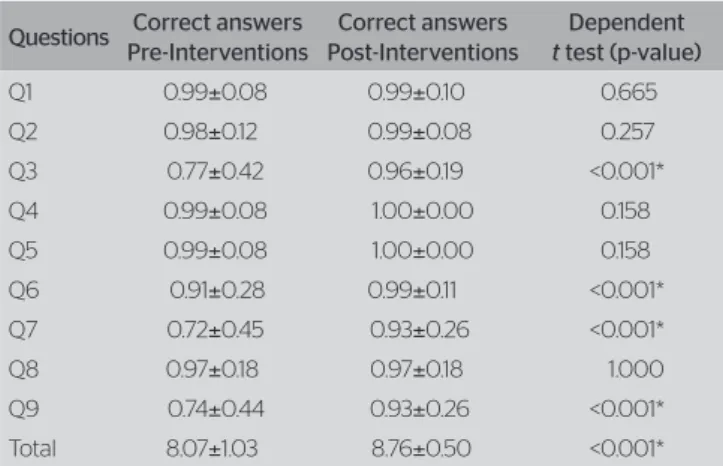
increase in the score of questions: Q3; Q6; Q7; Q9 and in the total questionnaire score (Table 1).
By observing the questions according to the topic they referred to, we veriied that there was an increa-se in the number of right answers to the questions related to the topics Vertebral Spine (from 4.39±0.79 to 4.88±0.34; p<0.001), and Lower Limbs (from 0.74±0.44 to 0.93±0.26; p<0.001).
When questioned about whether the knowledge ac-quired through the project helped them to improve the way they perform their activities, 10 workers did not answer the question and 318 workers answered air-matively. In addition, 233 described upon which aspects this knowledge impacted their lives (Figure 1).
DISCUSSION
he results observed demonstrated that there was a sig-niicant increase in the percentage of correct answers to the questionnaire questions (Table 1), which conirms that the workers increased their level of knowledge in relation to safety and health.
hese results indicate the importance of the impact of the Methodology for Ergonomics awareness upon the workers’ knowledge, given that, according to re-searchers21,22, the knowledge acquired might lead to a change of habits, and, as a consequence, to an impro-vement in life quality due to the prevention of lesions and accidents.
he questions that identiied a signiicant gain of knowledge dealt with the topics: picking up an object of the loor, sleeping, sitting on the loor. he questions that did not show signiicant impact dealt with the the-mes: vision care, hearing care, posture care when sitting down, and reaching for high objects. Possibly, the im-pact on the questions was not so expressive because the company had initiated, in the past, educational practices that might have approached the topic in question, pro-viding the workers with previous knowledge.
Another possibility that might have interfered with this impact is the workers’ personal lack of interest in a given topic because s/he is not exposed to those risks in the work place — for instance, sound exposure. It is possible that the efect of this intervention in sec-tors that require caution in regards to hearing is more signiicant.
Besides the impact on their knowledge, the workers demonstrated improvement in other aspects, such as
the way they use their bodies in labor activities and in daily life, seeking to accomplish them more correctly. hey also reported improvement in life quality, and re-duction of pain, among other positive impacts. Similar discoveries to the ones in this study have been unveiled by other researchers21-23.
However, it is important to highlight that the programs described by other researchers diferentia-te themselves from the methodology for ergonomics awareness in that they relied on physical exercises and relaxation sessions, regarding the educational aspect as complementary, which prevents a speciic evaluation of the impact of educational interventions.
Researchers24-26 describe programs of the Back School method. In the studies selected, the fact that this method focuses on people with a history of back pain and that it is composed of theoretical classes complemented by
Figure 1. Results of the answer to the question: Do you think that the kno-wledge acquired in the Project Ergonomics Awareness helped to improve the way you perform your tasks at work and at home? (A) Improvement of task performance at work and/or at home; (B) knowledge appropria-tion; (C) improvement of health care; (D) improvement of posture care; (E) change of habits; (F) other (reduction of body pains, improvement of life quality, dissemination of the knowledge acquired)
150
A (112) 120
90
60
30
0
Number of Answ
er
s
Categories B (93)
C (54) D (50)
E (46)
F (22) Table 1. Percentage of correct answers in relation to the questionnaire questions about health and safety in the work environment before and after the interventions for ergonomics awareness
Questions Correct answers
Pre-Interventions
Correct answers Post-Interventions
Dependent t test (p-value)
Q1 0.99±0.08 0.99±0.10 0.665 Q2 0.98±0.12 0.99±0.08 0.257 Q3 0.77±0.42 0.96±0.19 <0.001* Q4 0.99±0.08 1.00±0.00 0.158 Q5 0.99±0.08 1.00±0.00 0.158 Q6 0.91±0.28 0.99±0.11 <0.001* Q7 0.72±0.45 0.93±0.26 <0.001* Q8 0.97±0.18 0.97±0.18 1.000 Q9 0.74±0.44 0.93±0.26 <0.001* Total 8.07±1.03 8.76±0.50 <0.001*
physical exercises is observed. As in the present study, the authors observed a positive impact of the program upon their objectives, which, in their case, were the sensation of well-being, improvement of spine mobility, and im-provement of functional capacity. Heymans et al.27, ho-wever, report that the majority of studies related to the Back School method presented positive results in relation to a decrease in pain and improvement in functional per-formance when compared to other programs that relied solely on exercises, which leads one to believe that this result must be related to the fact that the Back School method considers the individual as an active agent that participates in the health process.
On the other hand, studies conducted by Lim et al.28, and Garmer, Sperling and Forsberg14 were composed of essentially educational interventions. he methodology used in both studies is similar to the one proposed here because it provides learning practical experiences that ge-nerated positive impact. Lim et al.28 analyzed the impact of an intervention program for ergonomics awareness on the prevention of repeated patient handling injuries; they found reduction in body pain and a reduction of 38.1% in the probability of occurrence of lesions in the experimental group. Garmer, Sperling and Forsberg14 proposed to work with the workers’ relexive choice in relation to the choice of hand tools, naming the program “learning by doing”.
Nogueira e Navega29 mention that the impacts of health education programs are extremely relevant to he-alth promotion and to the improvement of life quality. In order to promote health and safety education in a di-ferentiated way, the methodology for ergonomics awa-reness dealt with technical content by means of brief, interactive and ludic interventions with contents that portrayed the workers’ reality. his methodology fulil-led a need mentioned in the scientiic literature, which is that of health workers contemplating the reality in which the individuals are inserted, and replacing the traditional forms of knowledge transmission through interactive strategies that made the transferred know-ledge meaningful to the receptor13,28,30.31.
Weintraub, Hawlitschek and João emphasize that, for more eicient learning, it is necessary to sensitize the individual to the knowledge imparted, taking into consideration its active construction and promoting its synthesis. Pedagogical resources, such as games, provide concept ixation and dynamic learning due to the use of animation and images, which attracts more attention from the individuals. Knowledge retention goes from 20% during an exhibition that uses multimedia resour-ces to 75% in an activity focused on practice.
herefore, the efectiveness of Ergonomic programs is intimately attached not only to the presence of a safe work environment, but equally to the presence of an informed staf capable of utilizing their potentialities and knowing their restrictions. Such result leads to the thought that the educational process has a determining role in the improvement of ergonomic conditions, given that, several times, the company might invest in the improvement of the conditions in the work environ-ment but the workers are not capacitated to deal with the proposed improvements. A company’s investment might be put at risk if the workers do not know the way their own bodies function and their limits.
Lastly, it is worthy highlighting that, with the mobi-lization and sensitization of a small part of the popula-tion to health problems, such as muscle-skeletal injuries, the irst step is taken towards small modiications that will gradually unchain new actions that will be relected on the whole12.
CONCLUSION
he results of the use of the Methodology for Ergonomics Awareness pointed to its efectiveness in regards to the level of knowledge. We conclude that in-forming industry workers about safety and health, er-gonomics, and body conscience, with the support of in-teractive and ludic didactic resources that contemplate the individuals’ reality, might be a promising alternative in the prevention of occupational illnesses, considering that it is necessary to sensitize them to the question of self-care in and out of the work environment.
REFERENCES
1. Schubert B. Problemas actuales del seguro obligatorio de accidentes a escala mundial. Associación Internacional de la Seguridad Social. Estocolmo: 27ª Asamblea General, 2001.
2. Mossink JCM. Prevención de trastornos musculoesqueléticos en el lugar de trabajo. Organización Mundial de La Salud, 5; 2004.
3. Cunha JB, Blank VLG, Boing AF. Tendência temporal de afastamento do trabalho em servidores públicos (1995-2005).Rev Bras Epidemiol. 2009;12(2):226-36.
5. Brasil. Ministério da Saúde. Doenças relacionadas ao trabalho: Manual de procedimentos para os serviços de saúde. Brasília: Ministério da Saúde, 114(A); 2001.
6. Smedley J, Trevelyan F, Inskip H, Buckle P, Cooper C, Coggon D. Impact of ergonomic intervention on back pain among nurses. Scand J Work Environ Health. 2003;29(2):117-23.
7. Hartvigsen J, Lauritzen S, Lings S, Lauritzen T. Intensive education combined with low tech ergonomic intervention does not prevent low back pain in nurses. Occup Environ Med. 2005;62(1):13-7. 8. Hakala PT, Saarni LA, Ketola RL, Rahkola ET, Salminen JJ, Rimpelä AH.
Computer-associated health complains and sources of ergonomic introductions in computer-related issues among Finnish adolescents: a cross-sectional study. BMC Public Health. 2010;10(1):11.
9. Haukka E, Pehkonen I, Leino-Arjas P, Viikari-Juntura E, Takala EP, Malmivaara A, et al. Efect of a participatory ergonomics intervention on psychosocial factors at work in a randomized controlled trial. Occup Environ Med. 2010;67(3):170-7.
10. Bom Sucesso EP. Trabalho e Qualidade de Vida. Rio de Janeiro: Qualitymark/Dunya; 1997.
11. Deliberato PCP. Fisioterapia Preventiva: fundamentos e aplicações. São Paulo: Manole; 2002.
12. Lida I. Ergonomia: Projeto e Produção. São Paulo: Blucher; 2005.
13. Abrantes AF. Atualidades em ergonomia: logística, movimentação de materiais, engenharia industrial, escritórios. São Paulo: IMAM; 2004. 14. Garmer K, Sperling L, Forsberg A. A hand-ergonomics training
kit: development and evaluation of a package to support improved awareness and critical thinking. Appl Ergon. 2002;33(1): 39-49.
15. Thornton LJ, Stuart-Buttle C, Wyszynski TC, Wilson ER. Physical and psychosocial stress exposures in US dental schools: the need for expanded ergonomics training. Appl Ergon. 2004;35(2):153-57.
16. Gaya A. Ciências do movimento humano: introdução à metodologia de pesquisa. Porto Alegre: ArtMed; 2008.
17. Minayo MCS. O desafio do conhecimento: pesquisa qualitativa em saúde. 7. ed. São Paulo: Hucitec; 2000.
18. Silveira FL. Validação de instrumentos de medida aplicados à pesquisa em ensino de Física. Porto Alegre: Edipucrs; 1993.
19. Rothstein JR, Tamborindeguy AC. Validação de Clareza de um questionário sobre saúde e segurança no trabalho. Anais do XIX Congresso Brasileiro de Fisioterapia. Florianópolis; 2011.
20. Turato ER. Tratado da Metodologia da Pesquisa Clínica-Qualitativa. Petrópolis: Vozes; 2003.
21. Garcia AN, Gondo FLB, Costa RA, Cyrillo FN, Costa LOP. Efeitos de duas intervenções fisioterapêuticas em pacientes com dor lombar crônica não específica: viabilidade de um estudo controlado aletorizado. Rev Bras Fisioter. 2011;15(5):420-7.
22. Pinafo E, Nunes EFPA, González AD, Garanhani ML. Relações entre concepções e práticas de educação em saúde na visão de uma equipe de saúde da família. Trab Educ Saúde. 2011;9(2):201-21.
23. Andrade SC, Araujo AGR, Vilar JP. A Escola de Postura. Revisão história e suas aplicações na lombalgia crônica. Rev Bras Reumatol. 2005;45(4):224-8.
24. Alexandre NMC, Moraes MAA, Corrêa Filho HR, Jorge SA. Avaliação de um programa para reduzir dores nas costas em trabalhadores de enfermagem de um Hospital Universitário. Rev Saude Publica. 2001;35(4):356-61.
25. Kim P, Hayden JA, Mior AS. The cost-efectiveness of a back education program for firefighters: a case study. J Can Chiropr Assoc. 2004;48(1):13-9.
26. Tsukimoto GR, Riberto M, Brito CA, Battistella LR. Avaliação longitudinal da Escola de Postura para dor lombar crônica através da aplicação dos questionários Roland Morris e Short Form Health Survey (SF-36). Acta Fisiatr. 2006;13(2):63-9.
27. Heymans MW, van Tulder MW, Esmail R, Bombardier C, Koes BW. Back schools for nonspecific low back pain: a systematic review within the framework of the Cochrane Collaboration Back Review Croup. Spine (Phila Pa 1976). 2005;30(19):2153:63.
28. Lim HJ, Black TR, Shah SM, Sarker S, Metcalfe J. Evaluating repeated patient handling injuries following the implementation of a multi-factor ergonomic intervention program among health care workers. J Safety Res. 2011;42(3):185-91.
29. Nogueira HC; Navega MT. Influência da escola de postura na qualidade de vida, capacidade funcional, intensidade de dor e flexibilidade de trabalhadores administrativos. Fisioter Pesq. 2011;18(4)353-8.
30. Stroschein KA, Zocche DAA. Educação permanente nos serviços de saúde: um estudo sobre as experiências realizadas no Brasil. Trab Educ Saúde. 2011;9(3):505-19.