Licenciado sob uma Licença Creative Commons DO): http://dx.doi.org. . / - . . .AO
[T]
Evaluation of functional capabilities in
children with Down Syndrome
[)]
Avaliação das habilidades funcionais de
crianças com Síndrome de Down
[A]
Desirée F. Scapinelli[a], Érica Martinho Salvador Laraia[b], Albert Schiaveto de Souza[c]
[a] Universidade Anhanguera UNAES , Campo Grande, MS, Brazil [b] Universidade Anhanguera UN)DERP , Campo Grande, MS, Brazil
[c] Universidade Federal do Mato Grosso do Sul UFMS , Campo Grande, MS, Brazil
[R]
Abstract
Introduction: Down Syndrome DS is a chromosomal abnormality characterized by mental retardation of varying degrees and is one of the most commonly found chromosomal aberrations, presenting motor delay such as muscular hypotonic, balance disorders, motor coordination and gait changes. Objective: To evaluate the functional capabilities in children with Down syndrome through the Pediatric Evaluation of Disability )nventory PED) . Methods: children of both sexes, with normal motor development Control group and with Down syndrome. The functional capabilities were evaluated by PED) part ): functional capabi-lities, part )) and ))): caregiver assistance and change in environment through interviews with caregivers.
Results: Signi icant differences were observed in Part ), regarding functional capabilities in self-care p = . , mobility p = . and social function p = . , and in Part )), regarding caregiver assis-tance, the domains of self-care and mobility had p < . and p = . . )n Part ))), changes in environ-ment were more frequent when related to Down group. Conclusion: The Down syndrome group has lower
functional performance in both functional capabilities and caregiver assistance, when compared to control group. (owever, it is clear that this questionnaire provides subsidies to make an early stimulation treatment in order to perform daily skills with the least possible help from their caregivers.
Keywords: Down syndrome. Capability. Evaluation.
Resumo
Introdução: A Síndrome de Down (SD) é uma anomalia cromossômica caracterizada pelo retardo mental de grau variável e constitui uma das aberrações cromossômicas mais comumente encontradas, apresentan-do, assim, atraso motor caracterizado por hipotonia muscular, déϔicit de equilíbrio, coordenação motora e alterações na marcha. Objetivo: Avaliar as habilidades funcionais de crianças com SD através do Pediatric Evaluation of Disability Inventory (PEDI). Materiais e métodos: 20 crianças de ambos os sexos, sendo 10 com desenvolvimento motor normal (grupo controle) e 10 portadoras de Síndrome de Down. As habilidades funcio-nais foram avaliadas através do PEDI (parte I: habilidades funciofuncio-nais, parte II e III: assistência do cuidador e modiϔicação do ambiente) por meio de entrevista com os cuidadores. Resultados: Foram observadas diferen-ças signiϔicativas na Parte I, correspondente a habilidades funcionais nas áreas de autocuidado (p = 0,0007), mobilidade (p = 0,0007) e função social (p = 0,0002), bem como na parte II, referente a assistência do cuidador, nas áreas de autocuidado e mobilidade com p <0,0001 e p= 0,001. Já a parte III demonstrou maior frequência de modiϔicações do ambiente relacionadas ao Grupo Down. Conclusão: O grupo de Síndrome de Down pos-sui desempenho funcional menor tanto nas habilidades funcionais quanto na área de assistência ao cuidador quando comparado ao Grupo Controle. Contudo, é visível que através deste questionário são fornecidos subsí-dios para realizar um tratamento de estimulação precoce, conseguindo assim, realizar suas habilidades diárias com a menor ajuda possível de seus cuidadores.
Palavras-chave: Síndrome de Down. Habilidade. Avaliação.
Introduction
Studies on children with normal development and with Down Syndrome follow the same trends . The cerebrospinal luid and proximal-distal devel-opment is directly related to nerve, muscle and hor-monal maturation . Motor development refers to movement patterns and capabilities that are acquired throughout life and the age of the individual .
Motor development is an orderly, continuous, se-quential and progressive process, which takes place from maturation and continues to develop throughout life . At each stage, there is a peculiar organization, in which the level of development sequences evolves into more complex levels . The motor acquisition in the early years of life is an important factor for predicting the overall development of the child, as the period between birth and the end of the irst year of life is characterized by changes that culminate in mobility functions such as crawling and independent walking, respectively at and months of age .
Regarding the development of motor skills, evidence reveals that children with Down syndrome delay in the
acquisition of basic motor markers, indicating that they emerge later than in children with normal development due to the disorder in chromosome constitution in this case, the presence of an extra chromosome , featur-ing a simple trisomy , , . From the cognitive stand-point, it is observed that these children show greater commitment in the area of languages . Their motor development occurs more slowly than in other children, taking longer to crawl, sit and walk . This may be related to muscle hypotonia due to shortage of down-ward impulses, which demand a set of motor neurons of the spinal cord. )n addition, other studies claim that the excitability of motor neurons are within the normal range during the irst months of life and may be due to the delay in cerebellum maturation, cortical pathways
trunk , . (owever, besides the neuromotor de icits, developmental delays may also result in limitations of functional capabilities.
The Pediatric Evaluation of Disability )nventory PED) is a North-American standardized testing tool administered through structured interview with the caregiver. )t is divided into three parts: Part ) - assesses the functional capabilities of the child to perform ac-tivities in the domains of self-care items , mobility
items and social function items . For each item of Part ), in this test, a score of is assigned one point if the child is able to perform the functional activity, or, a score of zero if the child is unable. The total score obtained in each scale of this part is the result of the total scores made by the child in the activities included in each function area , .
Part )) assesses the child's independence to per-form functional tasks in the same three domains, with
, and items, respectively. Each item of this section is scored on an ordinal scale, ranging from score ive , if the child performs the task independently, to score zero , if the child needs full assistance of their caregiver . The third part informs the neces-sary modi ications for the performance of functional tasks in the same three domains described above , . )n this part, changes in environment are documented by frequency of responses in nominal scale, which includes four distinct categories: none, child-centered, rehabilitation or extensive. This third part of the test is not characterized as a quantitative scale, since the modi ications are not scored .
The objective of this study was to evaluate the functional capabilities in children with Down syn-drome, and aimed at verifying the independence, mo-bility, social function and self-care of these children, compared to children with normal motor develop-ment for performing functional tasks, and observe the caregiver perception to functional capabilities of children with Down syndrome through PED).
Materials and methods
The sample was composed of children from both sexes, children with normal motor devel-opment, corresponding to control group, mean age
. ± . months, and children with Down syndrome corresponding to Down Group, mean age . ± . months. )nclusion criteria for the study were ages between and years, normal motor
development for the Control Group and clinical diag-nosis of Down syndrome for Down group. Exclusion criteria were the children with any kind of associated diseases, as well as disorders such as physical dis-abilities, hearing, visual or speech.
As a tool, it was used the Pediatric Evaluation of Disability )nventory PED) questionnaire, which as-sesses the functional performance of children with any neurological dysfunction. )t documents quanti-tatively the functional capability of the child, and the independence to carry out activities in their daily life from months to years and months old. )t is conducted through structured interview with the parents, or the person who spends most of the day with the child, lasting from to minutes , .
The PED) is divided into three parts as follows: Part ) evaluates the child's functional capabilities to per-form activities in the domains of self-care items , mobility items and social function items . Part )) assesses the child's independence to perform functional tasks in the same three domains, with , and items, respectively. Part ))) describes the neces-sary modi ications for the performance of functional tasks in the same three described domains , .
The research project was approved by the Research Ethics Committee in human beings Universidade Anhanguera - Uniderp protocol n. - .
Results
Twenty children were evaluated, divided into two groups. The control group had mean age of . ± . months, and Down group . ± . months p = . , Student's t-test for indepen-dent samples .
Table represents the distribution of values, re-garding age and normative score of PED) between control group and Down group, showing that the functional capabilities in self-care p = . , mo-bility p = . and social function p = . had signi icant values p < . . Concerning caregiver’s assistance, also related to self-care p < . , mo-bility p = . and social function p = . , only the last domain was not signi icantly different.
p = . and social function p = . were signi icant p < . , compared to Down group.
)n relation to igure , a comparison was made between the mean scores of normative score values in Part )) - Caregiver assistance between the two groups. The control group excelled in the domains of self-care p < . and mobility p = . and, only in social function, the Down group obtained a value p = with no signi icant difference p < . .
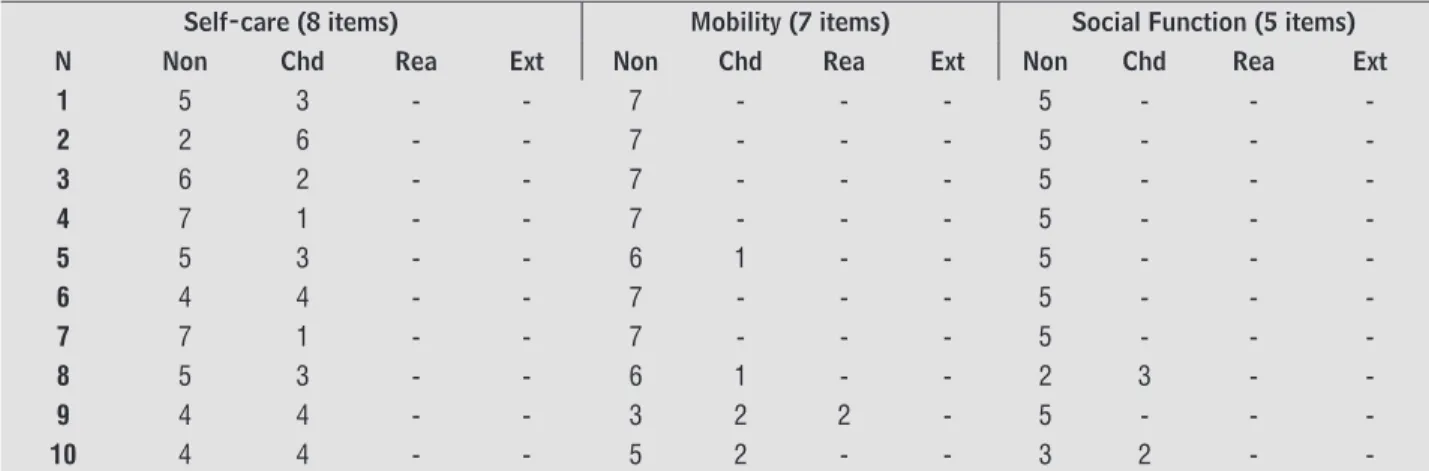
The results of responses relating to Part ))), which shows the necessary modi ications for the performance of functional tasks in the three domains of control group, is described in Table . )t was found that all children had higher scores in none , which means no assistance
Figure 1 – Comparison between mean and standard deviation of the normative score values of Part I – Functional Capabilities of PEDI between both groups. (n = 20)
Table 1 - Distribution of age and normative score values (mean ± SD) from PEDI between both groups, 2009. (N = 20)
Control Group
Down Group “p”
Functional Capabilities
Self-Care 39.7±15.1 17.7±8.0 0.0007*
Mobility 46.1±13.7 19.4±15.4 0.0007*
Social Function 54.4±14.5 27.7±11.3 0.0002*
Caregiver Assistence
Self-Care 52.0±7.1 29.0±12.2 <0.0001*
Mobility 37.0±19.8 11.1±3.5 0.001*
Social Function 36.5±5.9 24.6±20.0 0.1620 ns
Note: Source: research data
*p<0.05; ns (not signifi cant)
Figure 2 – Comparison of mean scores for normative score in Part II - Caregiver Assistance of PEDI between both groups. (n = 20)
from the caregiver to perform tasks in the three domains self-care, mobility and social function .
development is not constant. That con irms the study by Ramalho et al. , which shows that children with DS follow the same sequence of movements, going through the same motor milestones, though there may be differences in the pace by which such milestones are reached , . This is due to the changes in the nervous system, which re lect the inability to produce and control appropriate muscle contractions for move-ment performance, and this in luences the walking development, since it depends on the evolution of progressive corticalization of the central nervous .
Given the importance of the evaluation of func-tional capabilities PED) , one should take into ac-count that it constitutes an integrated process involv-ing several steps such as mobility, social function and self-care .By correlating the study by Pazin et Discussion
Chromosomes may undergo, occasionally, some modi ications during the meiotic and mitotic process, leading to chromosomal changes. Aneuploidy is known as clinically signi icant chromosomal abnormality ab-normal number of chromosomes due to an extra or missing copy . The presence of an extra chromo-some is called trisomy three instead of the usual pair of a chromosome . )t is a result of chromosomal non-disjunction, occurring, mostly, during the meiotic pro-cess ) one , thus leading to Down syndrome. This is one of the disorders of genetic etiology recognized for more than a century by John Langdon-Down , , , .
Despite showing that the functional performance of children with DS is lower than that of children with normal development, in this study, continuous
Table 2 - Frequency of responses concerning Part III - Change in Environment for control group (n = 10)
Self-care (8 items) Mobility (7 items) Social Function (5 items)
N Non Chd Rea Ext Non Chd Rea Ext Non Chd Rea Ext
1 6 2 - - 3 4 - - 2 3 -
-2 8 - - - 2 4 - - 3 2 -
-3 6 2 - - 2 5 - - 2 3 -
-4 5 3 - - 4 3 - - - 5 -
-5 8 - - - - 7 - - 2 3 -
-6 8 - - - 1 6 - - 1 4 -
-7 5 3 - - 4 3 - - 2 3 -
-8 4 4 - - 4 3 - - 2 3 -
-9 6 2 - - 3 4 - - 3 2 -
-10 5 3 - - 3 4 - - 2 3 -
-Note: = none; Chd = child; Rea = rehabilitation; Ext = extensive
Table 3 - Frequency of responses concerning Part III - Change in Environment for Down group (n = 10)
Self-care (8 items) Mobility (7 items) Social Function (5 items)
N Non Chd Rea Ext Non Chd Rea Ext Non Chd Rea Ext
1 5 3 - - 7 - - - 5 - -
-2 2 6 - - 7 - - - 5 - -
-3 6 2 - - 7 - - - 5 - -
-4 7 1 - - 7 - - - 5 - -
-5 5 3 - - 6 1 - - 5 - -
-6 4 4 - - 7 - - - 5 - -
-7 7 1 - - 7 - - - 5 - -
-8 5 3 - - 6 1 - - 2 3 -
-9 4 4 - - 3 2 2 - 5 - -
-10 4 4 - - 5 2 - - 3 2 -
close to normality and, by correlating with children with Down syndrome, they obtained values below nor-mal resulting that they need caregiver assistance . By correlating chronological age versus social function within the functional capabilities part ) , there was no signi icant correlation, a result which con irms the literature by highlighting that the performance of these children is lower in activities involving expres-sive communication, understanding and socialization, characteristics inherent to the pathology which affects the cognitive development of these children.
Conclusion
The PED) questionnaire proved to be effective for the objectives proposed in this study for featuring satisfactorily the functional pro ile in the areas of mobility, self-care and social function of children with Down syndrome. So, it was considered a very use-ful tool in the evaluation, besides enabling a critical analysis of this work.
The results presented in this study provide subsidies to state that children with DS have functional perfor-mance level lower than control group in both functional capabilities and in the ield of caregiver assistance, ex-cept in the area of social function. )n the latter, it was found that the two groups need the same assistance from the caregiver. )t is also noticeable that, through this questionnaire, subsidies are provided to contemplate an early stimulation treatment, causing these children to be stimulated to perform their daily skills with the lowest possible help from their caregivers.
References
. Araújo AGS, Scartezini CM, Krebs RJ. Análise da mar-cha em crianças portadoras de Síndrome de Down e crianças normais com idade de a anos. Fisioter Mov. ; : - .
. Ferreira MEC. Desenvolvimento perceptivo motor de crianças com Síndrome de Down e paralisia cerebral. Sobama. ; : - .
. Connolly K. Desenvolvimento motor: passado, pre-sente e futuro. Rev Paul Educ Fís. ; Supl : - . . Perrotti AC, Manoel EJ. Uma visão epigenética do desen-volvimento motor. ver Bras Ciên e Mov. ; : - .
al. with the present study, in relation to functional performance, children had lower scores, compared to children with normal development in the three functional domains. These indings con irm evidence in the literature regarding the psychomotor retarda-tion in children with DS .
Regarding functional capabilities part ) , there were no statistically signi icant differences in the domains of mobility, self-care and social function. )n the study by Coppede et al. on self-care, children with DS also scored lower than usual, con irming the hypotheses . These results are similar to pre-vious studies, which have attributed such delay to the syndrome characteristics and to overprotective parents, who restrict the participation of children in self-care activities , . For the part referring to caregiver assistance part )) , there was no statisti-cally signi icant difference in the domain of social function, concluding that children with DS need the same caregiver assistance in relation to children with normal development control group .
(owever, in the study by (allal et al., conducted with children with Down syndrome, it was observed by means of normative scores than in the domain of mobility, they had progressed through early stimu-lation treatment compared to most children with normal motor development , . Moreover, ac-cording to Guérios & Gomes, the matrix analysis of the movement patterns showed that patients with DS, when stimulated early, can have normal motor levels or even higher than the ideal maturity, in accordance with some studies , , .
)n this study, the results were signi icant in rela-tion to mobility in the domain of funcrela-tional capabili-ties showing that these children with Down syndrome acquire them over time. According to Pazin
, the development and maturation of children with Down syndrome are near those presented by children with normal development as regards the overall motor skills. These results suggest that, as the child with DS acquires capabilities in the area of mo-bility, they are incorporated in their daily activities, and thus, getting less help from caregiver , , .
. Mancini MC, Silva PC, Gonçales SC, Martins SM. Comparação do Desempenho funcional de crianças portadoras de Síndrome de Down e crianças com de-senvolvimento normal aos e anos de idade. Arq Neuro-Psiquiatr. ; -B : - .
. Marinho APS, Souza MAB, Pimentel AD. Desempenho Funcional de crianças com paralisia cerebral diparé-ticas e hemiparédiparé-ticas. R Ci Méd Biol. ; : - .
. Lyer LV, (aley SM, Watkins MP, Dumas (M. Establishing minimal clinically important differences for scores on the pediatric evaluation of disability inventory for in-patient rehabilitation. Phys Ther. . : - . . (errero, D, Monteiro, CBM. Veri icação das
habili-dades funcionais e necessihabili-dades de auxílio do cuida-dor em crianças com paralisia cerebral nos primeiros meses de vida. Rev Bras Crescimento Desenvolv (um. São Paulo; : - .
. Nakadonari EK, Soares AS. Síndrome de Down: con-siderações gerais sobre a in luência da idade materna avançada. Arq Mudi. ; : - .
. Moreira LMA, El-(ani CN, Gusmão FAF. A síndrome de Down e sua patogênese: considerações sobre o deter-minismo genético. Rev Bras Psiquiatr. ; : - . . Lorena S(T. Síndrome de Down: epidemiologia alte-rações oftalmológicas. Rev Bras Oftalmol. São Paulo. 2012; 71(3): 188 - 90.
. Ramalho CMJ, Pedremônico MR, Perissinoto J. Sín-drome de Down: avaliação do desempenho motor, coordenação e linguagem entre dois e cinco anos . Team Desenvol. ; : - .
. Kasari C, Freeman SFN. Task-related social behavior in children with Down syndrome. Am J Ment Retard.
; : - .
. Pazin AC, Martins MR). Desempenho funcional de cri-anças com Síndrome de Down e a qualidade de vida de seus cuidadores. Rev Neurocienc. ; : - . . Silva NL, Dessen MA. Crianças com síndrome de
Down e suas interações familiares. Psicol Re lex Crit. ; : - .
. Guérios LC, Gomes NM. Análise de um programa para desenvolvimento dos padrões fundamentais de movi-mento em crianças portadoras de Síndrome de Down. Rev Dig. ; : - .
. Gimenez R, Manoel EJ, Oliveira DL, Basso L. Combina-ção de padrões fundamentais de movimento: crianças portadoras de Síndrome de Down. Rev Bras Educ Fís Esp. ; : - .
. (errero D, Monteiro CBM. Veri icação das habilidades funcionais e necessidades de auxílio do cuidador em cri-anças com paralisia cerebral nos primeiros meses de vida. ver Bras Crescimento Desenv (um. ; : - .
. Mancini MC, Teixeira S, Araujo LG de, Paixão MC, Mag-alhaes LC de, Coelho ZAC, et al. Estudo do desenvolvi-mento da função motora aos e meses de idade em crianças pré-termo e a termo. Arq Neuropsiquiatr.
; : - .
. Silva NLP, Dessen MA. Síndrome de Down: etiologia, caracterização e impacto na família.)nteração em Psicologia. ; : - .
. Bahniuk ME, Koerich MS, Bastos JC. Processos fonológicos em crianças portadoras de Síndrome de Down. Distúrbios Comun. ; : - .
. Lara MA, Rodrigues ME. Desenvolvimento motor em crianças portadoras de Síndrome de Down de a anos. Rev Digital Buenos Aires. ; . . Garcias GL, Roth MGM, Mesko GE, Boff TA. Aspectos
do desenvolvimento neuropsicomotor na Síndrome de Down. REv Bras Neurol. ; : - . . Freitas FC, Oliveira SJ. )ntervenção isioterápica
pre-coce e seu efeito para aquisição de marcha em cri-anças com Síndrome de Down. Rev Univ Cat Goiás.
; : - .
. Benda RN, Ugrinowitsch (. Desenvolvimento motor e a perspectiva ecológica de Gibson. Rev Univ Guar Ciên Biol Saú. ; : - .
. Sarro KJ, Salina ME. Estudo de alguns fatores que in lu-enciam no desenvolvimento das aquisições motoras de crianças portadoras de Síndrome de Down em trata-mento isioterápico. Fisioter Mov. ; : - . . Fidler DJ, (epburn SL, Mankin G, Rogers SJ. Praxis capa-bilities in young children with Down Syndrome, other developmental disabilities, and typically developing children. Am J OccupTher. ; : - . . (allal CZ, Marques NR, Braccialli LMP. Aquisição de
. Coppede AC, Campos AC, Santos DCC, Rocha NACF. Desempenho motor ino e funcionalidade em cri-anças com síndrome de Down. Fisioter Pesq. ;
: - .
. Moreira LMA, El-(ani CN, Gusmão FAF. A síndrome de Down e sua patogênese: considerações sobre o deter-minismo genético. Rev Bras Psiquiatr. ; : - .
Received: / / Recebido: 05/07/2013