Executive function and processing
speed in Brazilian HIV-infected
children and adolescents
Vitor Geraldi Haase1, Nelsa Carol Nicolau2, Virgínia Nunes Viana3, Gustavo de Val Barreto3-5, Jorge Andrade Pinto2
ABSTRACT. Background: Cognitive disorders in infants and children who are vertically infected with human immuno-deficiency virus (HIV) have been recognized since the inception of the epidemic. Objective: The present study investigated neuropsychological performance in a cohort of vertically infected Brazilian children and adolescents who underwent antiretroviral therapy. The neuropsychological tasks were designed to evaluate executive function and processing speed. Methods: Children and adolescents were recruited at a major research and treatment reference center for human immuno-deficiency virus/acquired immunoimmuno-deficiency syndrome (HIV) in Minas Gerais, Brazil. Forty-one individuals aged 5 to 17 years were enrolled. Twelve were mildly symptomatic (HIV-infected group, Centers for Disease Control and Prevention [CDC] class A or B), and 29 had advanced clinical disease (AIDS group, CDC class C). Results: The results showed that HIV-infected children and adolescents exhibited lower performance on neuropsychological tasks than sociodemographically comparable, typically developing controls. Motor and cognitive processing speed and executive function appeared to be the most discriminative domains. Conclusion: HIV-infected individuals with more-advanced disease stages exhibited lower performance levels and had greater performance heterogeneity on neuropsychological tasks. Thus, the observed neuropsychological impairments, although more pronounced in participants with more advanced stages of the disease, did not correlate with the variable used (CDC stage).
Key words: HIV, AIDS, neuropsychology, executive function, processing speed.
FUNÇÕES EXECUTIVAS E VELOCIDADE DE PROCESSAMENTO EM CRIANÇAS E ADOLESCENTES BRASILEIROS INFECTADOS POR HIV RESUMO. Introdução: Comprometimentos cognitivos em crianças e adolescentes verticalmente afetadas por HIV são reconhecidos desde do início da epidemia. Objetivos: O presente estudo investigou o desempenho neuropsicológico em uma coorte de crianças e adolescentes verticalmente infectadas por HIV e que fazem uso da terapia antirretroviral no Brasil. As tarefas neuropsicológicas foram selecionadas para avaliar, principalmente, funções executivas e velocidade de processamento. Métodos: As crianças e adolescentes foram recrutados em um grande centro de referência de pesquisa e tratamento para o vírus da imunodeficiência humana / síndrome da imunodeficiência adquirida (HIV / AIDS), em Minas Gerais, Brasil. Quarenta e um indivíduos com idade entre 5 e 17 anos foram selecionados. Doze estavam com sintomas leves (grupo infectado pelo HIV, Centros para Controle e Prevenção de Doenças [CDC] Classe A ou B), e 29 tiveram a doença clínica avançada (grupo AIDS, CDC classe C). Resultados: Os resultados mostraram que as crianças e adolescentes infectados pelo HIV apresentaram menor desempenho em tarefas neuropsicológicas quando comparadas com o grupo controle pareado socio-demograficamente. Habilidades motoras, velocidade de processamento e função executiva são os domínios mais discriminativos. Conclusão: Indivíduos infectados pelo HIV com estágios da doença mais avançados apresentaram níveis mais baixos de desempenho e tiveram maior heterogeneidade no desempenho em tarefas neuropsicológicas. Entretanto, os prejuízos neuropsicológicos observados, apesar de se mostrarem mais pronunciados com estágios mais avançados da doença, não se correlacionaram com a variável utilizada (estágio do CDC).
Palavras-chave: HIV, AIDS, neuropsicologia, funções executivas, velocidade de processamento.
1Faculdade de Filosofia e Ciências Humanas - Universidade Federal de Minas Gerais, Minas Gerais, Brasil. 2Faculdade de Medicina, Programa de Pós-Graduação
em Saúde da Criança e do Adolescente, Universidade Federal de Minas Gerais, Brasil. 3Instituto de Ciências Biológicas - Pós-Graduação em Neurociências,
Universidade Federal de Minas Gerais, Brasil. 4 FEAD - Minas; 5Centro Universitário UNA.
Virgínia Nunes Viana. Rua Imbé, 800 – 32400-000 Ibirité MG – Brasil. E-mail: [email protected] Disclosure: The authors report no conflicts of interest.
INTRODUCTION
C
ognitive disorders in infants and children who are vertically infected with human immunodeiciency virus (HIV) have been recognized since the inception of the epidemic. Most notable have been the early mani-festation of compromised central nervous system func-tion, a high incidence of severely impairing encepha-lopathy characterized by brain atrophy, calciications, spasticity, and mental retardation, and the high mortal-ity associated with the disease.1 he adoption ofmoth-er-to-infant transmission prevention measures2 and
introduction and widespread access to antiretroviral therapy3 in the mid-1990s in developed countries and
some developing countries, such as Brazil,4,5 represent a
radical epidemiological transition. Antiretroviral thera-py consists of the use of a set of drugs to treat retrovirus infections, especially HIV. Highly active antiretroviral therapy is known as HAART. As the number of new vertically transmitted cases decreases and children and adolescents survive longer and approach adulthood, the focus of care turns to treatment adherence, drug resis-tance, quality of life, and disease-associated morbidities, such as cognitive and behavioral disorders.6
Neuropsy-chologically, the most relevant transition is related to the decreasing incidence of HIV-associated encepha-lopathy and increasing incidence of minor cognitive and behavioral disorders frequently observed in adults.7
here is a lack of information about more subtle forms of neuropsychological impairment in older youths with HIV/acquired immunodeiciency syndrome (AIDS) during adolescence. A systematic review by8 selected
54 empirical studies that investigated neurodevelop-ment in the pediatric population. hirty-one studies fo-cused on infancy and preschool age. hirty-four studies were restricted to psychopathological manifestations or lacked a neuropsychological clinical-anatomical as-sessment framework and used only global measures of development, intelligence, and school achievement. Five studies investigated the cognitive and behavioral aspects of HIV/AIDS associated with blood product transfusion in children. Finally, eight studies employed a neuropsychological structural-functional assessment framework, four of which were published before the ef-fective treatment era.9-12 In addition to the four
neuro-psychological studies reported by,8 we were able to
iden-tify a ifth study that was published afterward.13
All ive post-efective treatment era antiretroviral therapy neuropsychological studies used cross-sectional designs and several cognitive measures that covered dif-ferent performance domains13-15 or analyzed intelligence
test data in a manner that makes structural-functional
interpretations viable.16,17 With the exception of
partici-pants in the study16 who showed no neuropsychological
impairment, the results of the other studies converged, showing that psychomotor and cognitive processing speed, visuospatial abilities, and executive function were the cognitive domains most frequently impaired in individuals who presented with AIDS.
Visuospatial and visuomotor disorders in the pedi-atric population are frequently observed in conditions such as shunted congenital hydrocephalus, in which damage occurs to subcortical white matter tracts.18
Deicits in psychomotor/cognitive speed and executive function are ascribed to fronto-striatal connection dam-age, constituting the so-called subcortical white-matter pattern of impairment.19
Some anatomical evidence indicates that fronto-stri-atal white matter may be a privileged locus of impair-ment in HIV-infected individuals, both in adults20 and
children.21 A sophisticated investigation of 300 infected
adults that utilized factor- and cluster-analytic methods conirmed the existence of isolated executive function and processing speed patterns of impairment.22 he
overall picture, however, is more complex. Two subcor-tical patterns of impairment coexist with other forms of neuropsychological compromise, proportionally mix-ing deicits in verbal episodic and visuospatial memories with deicits in executive function, working memory, and processing speed.
he present study investigated neuropsychological performance in a cohort of vertically infected Brazil-ian children and adolescents who underwent HAART regimens. Speciically, we investigated the hypotheses that1 HIV-infected children and adolescents exhibit
lower performance on neuropsychological tasks than sociodemographically comparable, typically developing controls,2 that motor and cognitive processing speed
and executive function are the most discriminative do-mains, and3 that HIV-infected individuals in
more-ad-vanced CDC disease stages exhibit lower performance levels or have greater performance heterogeneity on neuropsychological tasks.
METHODS
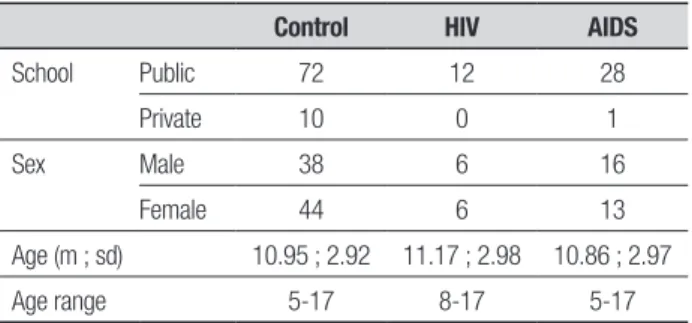
clini-Table 1. Descriptive data sample by group.
Control HIV AIDS
School Public 72 12 28
Private 10 0 1
Sex Male 38 6 16
Female 44 6 13
Age (m ; sd) 10.95 ; 2.92 11.17 ; 2.98 10.86 ; 2.97
Age range 5-17 8-17 5-17
cal disease (AIDS group, CDC class C). he mean ages of the HIV-infected group and AIDS group were 11.17 years (SD=2.98 years) and 10.86 years (SD=2.97 years), respectively. he descriptive data sample is shown in Table 1. No indication of peripheral neuropathy that could potentially inluence performance was found in the clinical group. he exclusion criteria adopted was de-lay in development, mental illness, mental retardation, learning disabilities, physical or sensory impairments, chronic disease or motor disabilities.
Subjects for the comparison HIV-uninfected group were recruited in Belo Horizonte, the state capital with 2.4 million inhabitants. he control group was com-posed of 82 typical controls, pseudo-matched to the HIV/AIDS patients with regard to age, gender, school type and z-scores on the intelligence test. hey were recruited and assessed randomly in public and private schools in Belo Horizonte. he proportion used for the pairing was 2:1. he results of the intelligence test were converted to z-scores because the Brazilian versions of the Raven test are not the same for the entire age group (5 to 17 years).
General luid intelligence was assessed with age-ap-propriate, Brazilian-validated versions of Raven’s matri-ces.23 Visuoconstructional abilities were assessed using
a modiied Bender Gestalt Test,24 in which the child has
to copy nine geometric igures of increasing complexity.
Executive function. he test selection for the
neuropsycho-logical assessment of executive function was inspired by the trifactorial model of executive function.25,26 Latent
variable analyses showed that executive function may be described by an overarching general factor and three hierarchically subordinated and partially dissociable components.27 he chosen tasks may not be considered
pure measures of each component, but performance on the backward Digit-Span task is taken as an index of working memory, and the Stroop paradigm assesses inhibition. Test selection was biased toward easier tasks that could assess individuals within broader age and
performance level ranges. he task battery was previ-ously validated in children of preschool age.28 Also, no
adjustments in the tests used in older subjects were per-formed. he main objective was to describe which tasks have the greatest potential to discriminate the perfor-mance of the participants of the clinical group according to the parameters of the disease. he following execu-tive function tasks were used:
Digit-Span task – he direct and reverse Digit-Span tasks were used to assess working memory according to procedures of the Brazilian Wechsler Intelligence Scale for Children, 3rd edition.29 Total scores were used as
de-pendent measures.
Day-night Stroop test – he Day-night Stroop test30
was used to assess the monitoring/error detection com-ponent of executive function.
Semantic word luency task – he semantic luency task was adapted from.31
he children were asked to name as many exemplars from a given category as fast as possible in 60 s, taking care not to repeat any names. he categories included animals, body parts, and food.
Visual Search task – Two visual search tasks were used to tap selective attention. he object search task was adapted from,31 and the square search task was
adapted from.32 In both tasks, the stimuli consisted of
line drawings and were presented on A4 sheets of paper.
Tower of Hanoi task – he Tower of Hanoi task was used as a measure of more complex executive function, tapping planning, strategy use, and set-shifting abili-ties. he procedures were adapted from.33
List Discrimination Test – he List Discrimination Test was adapted by34 from procedures described by.35
he test assesses both recognition memory and a form of recency or temporal order memory related to the dor-solateral prefrontal region.36
Processing speed. Both adult37 and pediatric13,17 studies
Nine-hole Peg Test (9-HPT) – he 9-HPT assesses the time required to take nine pegs, one by one, from a concavity, place them in respective holes, remove them, and return them to the original holder. Two trials are conducted for each hand, beginning with the dominant hand. he 9-HPT has become standard in the context of multiple sclerosis,38 but standardization studies have
been conducted with children and adolescents.39,40
Simple articulatory speed – his was assessed by de-termining the mean time to complete three tasks. In the irst task, the color naming phase of the Victoria Stroop test was used according to.41 Articulatory speed was also
assessed by measuring the time required to count from 1 to 6 in forward and reverse orders. Finally, the chil-dren were asked to name as fast as possible a series of line drawings displayed on an A4 sheet of paper (moon, cup, ribbon, and candy), pseudorandomly repeated in a 5 column × 3 row matrix.
he study procedures were approved by the UFMG Institutional Review Board. Participation required an informed consent form signed by the children’s parents or legal guardians. Participants in the clinical samples (HIV and AIDS) were assessed at their regular clinic visits. he testing of the clinical participants was con-ducted by a trained psychologist. he testing of typical participants was conducted by a psychologist and group of ive undergraduate psychology students who were trained in the study procedures. Testing procedures oc-curred in the participating schools.
Statistical methods. Where allowed by the test design, a
series of Cronbach’s alpha coeicients were estimated to separately assess the scores’ internal consistency in the clinical group and control pool. All alpha values were situated above 0.7.
In addition to descriptive statistics, ANOVA was used to compare the performance of the three groups (controls, HIV and AIDS). Receiver Operating Charac-teristic (ROC) curve analysis was employed to investi-gate the discriminative power of neuropsychological tests used as reference based on only two groups, con-trol and clinical (HIV and AIDS).
RESULTS
Group comparisons. Central tendency and dispersion
es-timates for the neuropsychological test scores in each group are shown in Table 2. Global intergroup com-parisons using analysis of variance (ANOVA) revealed signiicant diferences in major neuropsychological pa-rameters. A Bonferroni correction for three multiple
comparisons was used. Most of the post hoc compari-sons were signiicant, with the exception of the Tower of Hanoi – total number of moves and number of rule violations, respectively (F=2.93, p=0.061; F=1.32, p= 0.43), List Discrimination Test- recognition (F=2.705, p=0.284), abstract Stroop (F=2.206, p=0.124),and se-mantic word luency-perseverative errors (F=0.459, p=1.00; Table 2).
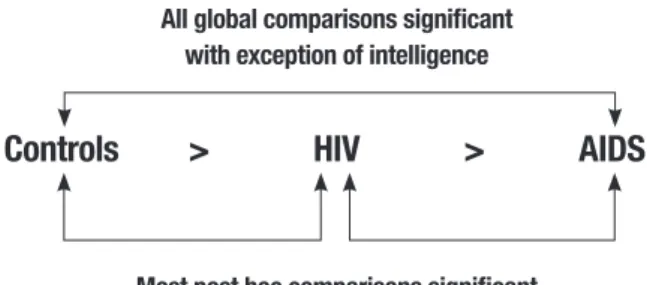
Many of the diferences were related to the control vs AIDS groups. his result is in agreement with indings in the literature that indicate more advanced stages of the disease are related to worse outcomes in neuropsycho-logical evaluations. Regarding the diferences between the control group and HIV group, the measures that diferentiated the two groups were number recitation (Total time in direct order) and boxes search, both tasks related to processing speed. he only task that showed signiicant diferences between the HIV vs AIDS groups was the task of picture naming (total time).
In summary, HIV-infected children and adolescents exhibited lower performance on neuropsychological tasks than sociodemographically comparable typically developing controls while AIDS children presented lower performance than both these two groups (Figure 1). Motor and cognitive processing speed and executive function appeared to be the most discriminative do-mains, and HIV-infected individuals with more-ad-vanced CDC disease stages (AIDS group) had lower per-formance levels and greater perper-formance heterogeneity on the neuropsychological tasks.
Effect sizes. he accuracy of neuropsychological test
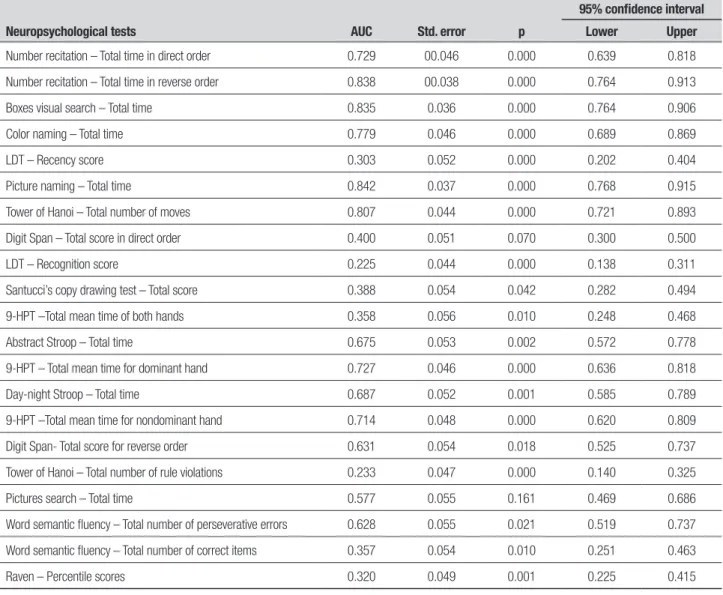
scores in discriminating controls from clinical individu-als (HIV + AIDS) was examined using Receiver Operat-ing Characteristic (ROC) curve analysis. he results are shown in Table 3. Considering an area-under-the-curve of 0.70, seven measures of processing speed and
execu-All global comparisons significant with exception of intelligence
Controls
>
HIV
>
AIDS
Most post hoc comparisons significant
Table 2. Neuropsychological test score distribution in control, HIV and AIDS groups. ANOVA in the neuropsychological tests, F values, p level of significance and post hoc tests.
Neuropsychological tests
Controls HIV AIDS
F p
Post
hoc
n Mean SD n Mean SD n Mean SD
Raven z score 82 –0.786 1.76 12 –0.80 1.58 29 –1.71 1.90 2.982 0.053 –
9-HPT – Total time for dominant hands
82 19295.98 3417.40 12 21932.92 4868.38 29 22983.57 6356.39 8,159 0.001 b
9-HPT – Total time for nondominant hands*
82 21030.12 4588.71 12 22133.33 4344.95 29 26072.32 9866.51 6.957 0.001 b
9-HPT – Mean total time for both hands*
82 20163.05 3501.41 12 22033.13 4335.13 29 24527.95 7795.62 8.460 0.001 b
Color naming – Total time* 82 77353.79 22946.58 12 103113.85 44046.15 29 116231.17 48011.53 16.92 0.001 b
Picture naming – Total time*
82 34019.02 7374.65 12 42420.00 9242.62 29 52725.24 19465.28 28.696 0.001 b, c
Number recitation – Total time in direct order*
82 1829.60 605.14 12 2739.17 2020.92 29 2566.55 987.14 10.132 0.001 a, b
Number recitation – Total time in reverse order*
82 2993.05 1275.49 12 5245.00 4691.51 29 8898.62 8930.20 17.322 0.001 b
Picture search – Total time* 82 69939.16 32629.23 12 82961.67 55069.49 29 99100.38 54026.37 5.524 0.004 b
Boxes search – Total time* 82 53576.77 33330.10 12 91724.17 41731.51 29 106745.17 61017.45 18.820 0.001 a, b
Semantic word fluency – Total correct items
82 52.65 11.73 12 46.67 14.76 29 44.48 15.55 4.691 0.013 b
Semantic word fluency – perseverative errors
82 1.14 1.47 12 1.00 1.48 29 0.86 1.12 0.459 1.000 b
Word semantic fluency – Total efficiency
82 0.97 0.04 12 0.98 0.02 29 0.98 0.03 – – –
Day-night Stroop – Total time*
82 23732.93 9869.96 12 26155.83 6649.46 29 30733.45 9678.87 5.748 0.003 –
Abstract Stroop – Total time*
82 21498.05 9372.15 12 23426.67 4166.53 29 25129.66 4864.53 2.206 0.124 b
Digit span – Total score in direct order
82 12.40 4.09 12 9.75 3.57 29 8.03 2.37 15.870 0.001 b
Digit span – Total score in reverse order
82 9.11 2.99 12 7.75 3.19 29 5.86 2.31 13.898 0.001 b
List discrimination test – Total recognition score
82 19.12 1.97 12 19.33 0.78 29 18.14 2.63 2.705 0.089 –
List discrimination test – Total recency score
82 15.45 2.70 12 13.92 3.15 29 12.93 3.14 8.884 0.001 b
Tower of Hanoi – Total number of moves
82 10.35 5.37 12 8.92 3.20 29 7.97 2.57 2.930 0.061 –
Tower of Hanoi – Total number of rule violations
80 0.27 0.63 12 0.54 0.88 29 0.40 0.67 1.32 0.430 –
Bender Gestalt Test 82 31.29 5.22 12 30.42 4.81 29 26.17 9.04 7.121 0.001 b
tive function reliably discriminated between the control and clinical groups: number recitation in forward and reverse orders, color naming, visual search of boxes, pic-ture naming, Tower of Hanoi (total number of moves), and 9-HPT (nondominant hand).
DISCUSSION
he main goals of the present study were to investigate neuropsychological function in a cohort of Brazilian HIV/AIDS-infected individuals who were on HAART regimens. Compared with community-derived, sociode-mographically pseudo-matched controls, AIDS patients exhibited lower performance on several cognitive mea-sures. he diferences were generally not greater than one standard deviation, showing a tendency of the clini-cal group to decline in several cognitive domains
accord-ing to advanced stages of the disease. Psychomotor and cognitive speed and executive function tests revealed greater accuracy for discriminating the clinical sample from the control group, relected by areas under the ROC curve that were greater than 0.70. A group of psy-chomotor/cognitive speed and executive function tests were also weakly correlated with the CDC stage of dis-ease evolution. hus, the observed neuropsychological impairments, although found to be more pronounced in participants with more advanced stages of the disease, did not correlate with the variable used (CDC stage). his may be because the current CDC neuropsychologi-cal indicator does not relect actual losses incurred, since only clinical and immunological parameters for the dei-nition of categories, without the presence of cognitive indicators for the implementation, are used.
Table 3. ROC estimates for accuracy of neuropsychological tests in discriminating between controls and clinical group (HIV + AIDS).
Neuropsychological tests AUC Std. error p
95% confidence interval
Lower Upper
Number recitation – Total time in direct order 0.729 00.046 0.000 0.639 0.818
Number recitation – Total time in reverse order 0.838 00.038 0.000 0.764 0.913
Boxes visual search – Total time 0.835 0.036 0.000 0.764 0.906
Color naming – Total time 0.779 0.046 0.000 0.689 0.869
LDT – Recency score 0.303 0.052 0.000 0.202 0.404
Picture naming – Total time 0.842 0.037 0.000 0.768 0.915
Tower of Hanoi – Total number of moves 0.807 0.044 0.000 0.721 0.893
Digit Span – Total score in direct order 0.400 0.051 0.070 0.300 0.500
LDT – Recognition score 0.225 0.044 0.000 0.138 0.311
Santucci’s copy drawing test – Total score 0.388 0.054 0.042 0.282 0.494
9-HPT –Total mean time of both hands 0.358 0.056 0.010 0.248 0.468
Abstract Stroop – Total time 0.675 0.053 0.002 0.572 0.778
9-HPT – Total mean time for dominant hand 0.727 0.046 0.000 0.636 0.818
Day-night Stroop – Total time 0.687 0.052 0.001 0.585 0.789
9-HPT –Total mean time for nondominant hand 0.714 0.048 0.000 0.620 0.809
Digit Span- Total score for reverse order 0.631 0.054 0.018 0.525 0.737
Tower of Hanoi – Total number of rule violations 0.233 0.047 0.000 0.140 0.325
Pictures search – Total time 0.577 0.055 0.161 0.469 0.686
Word semantic fluency – Total number of perseverative errors 0.628 0.055 0.021 0.519 0.737
Word semantic fluency – Total number of correct items 0.357 0.054 0.010 0.251 0.463
Raven – Percentile scores 0.320 0.049 0.001 0.225 0.415
Considering the dispersion of both ages and neuro-psychological scores in the clinical group, the consisten-cy of the results is noteworthy (Table 2). Remarkably, al-though they were relatively lower, Raven z-scores in the HIV/AIDS group did not surpass one standard devia-tion below the controls’ means, and the diferences were not statistically signiicant. he relatively mild nature of neuropsychological impairment and preservation of in-telligence is consistent with data reported from devel-oped countries13-15,17 but diverge from common
observa-tions of more severe neuropsychological impairment in children and adolescents from developing countries.42,43
his discrepancy can most likely be attributed to success-ful AIDS treatment program implementation in Brazil since 1996.44 Moreover, the disparities may be due to
the diferent measures of intelligence used in the stud-ies.42 he measure of intelligence used was the Kaufman
assessment battery for children (K-ABC) and the dif-ferences found were related to the areas of sequential processing, simultaneous processing, mental processing and nonverbal skills. hus, regarding the other cogni-tive measures employed, no diferences between groups were found, including for intelligence. In the study,43 the
observed changes occurred mainly in verbal skills mea-sured, without changing the performance of execution tasks. his raises questions over the ability of HAART to protect/improve the cognition of the HIV-infected chil-dren. Data on the protective efects of HAART on cog-nition in HIV-infected persons are not a consensus in the scientiic literature. A recent meta-analysis49 showed
only moderate efects on the conservation and improve-ment of cognitive performance, whereas some other studies have shown no signiicant efects.50
he lack of speciicity of the results also warrants consideration. Although accuracy estimates were higher for psychomotor and cognitive processing speed and ex-ecutive function tasks, practically all of the group com-parisons reached statistical signiicance, with the excep-tion of the Tower of Hanoi and semantic word luency task. hese results suggest that although psychomotor, cognitive processing speed and executive function rep-resent important domains of impairment in pediatric HIV/AIDS, other areas, such as visuospatial memory and language function, are also frequently impaired. Consis-tent with our indings,45 results indicate that although
relatively subtle, neuropsychological impairment in ad-equately treated HIV/AIDS-infected children and ado-lescents may be broader and not restricted to functions subserved by fronto-striatal reentrant connections.22
In addition to the impact of neuropsychological impairment on school performance, other issues that
merit clariication in future research are related to the neural basis and speciicity of such impairments. he data are still scarce but suggest that neuropsychologi-cal deicits in adequately treated HIV/AIDS-infected children and adolescents extend beyond the subcortical white matter proile. his issue can be addressed only in the context of neuroimaging studies and larger samples that allow factor and cluster analyses.22
Some of the main strengths of the present study de-serve qualiication. he study design was neuropsycho-logically conceived, generating data that may contribute to the elucidation of the neural basis of subtle cogni-tive impairments observed in adequately treated HIV/ AIDS-infected children and adolescents. Important in the present context is the sociodemographically compa-rable control group of normally developing individuals that was derived from a larger community-derived pool of participants. he sample size was also considerably larger than, or at least equivalent to, the sample sizes presented in other similar reports.13-17
he limitations of the present study should also be mentioned. he number of HIV-infected individuals who did not develop AIDS was relatively small, restrict-ing comparisons between this group and AIDS patients or typical controls. herefore, we were unable to evalu-ate the impact of subtle disclosed neuropsychological impairment on this important outcome measure. his study corroborates recent indings on cognitive related losses, especially in the ields of executive functions and processing speed.
he choice of executive function tests should also be optimized by incorporating more pure and theoretical-ly-oriented measures according to the trifactorial mod-el25,26 Larger samples should allow analyses of the factor
structure of executive function to identify domains of any selective impairment. Ideally, dependence analysis should also be performed to elucidate the role of pro-cessing speed in cognitive development,46 intelligence,47
and working memory.48
REFERENCES
1. Allison S, Wolters PL, Brouwers P. Youth with HIV/AIDS: neurobehav-ioral consequences. In: Paul RH, Sacktor NC, Valcour V, Tashima, KT. (Eds). HIV and the brain. New challenges in the modern era. New York: Humana; 2009:187-211.
2. Centers for Disease Control and Prevention. Reduction in perinatal transmission of HIV infection. United States:1985-2005. MMWR Morb Mortal Wkly Rep 2006;55:592-597.
3. Nachman SA, Chernoff M, Gona P, et al.; PACTG 219C Team. Inci-dence of noninfectious conditions in perinatally HIV-infected children and adolescents in the HAART era. Arch Pediatr Adolesc Med. 2009; 163:164-167.
4. Kakehasi FM, Pinto JA, Romanelli RM, et al. Determinants and trends in perinatal human immunodeficiency virus type 1 (HIV-1) transmission in the metropolitan area of Belo Horizonte, Brazil: 1998 - 2005. Mem Inst Oswaldo Cruz 2008;103:351-357.
5. Matida LH, Ramos AN Jr, Heukelbach J, Hearst N. Brazilian Study Group on Survival of Children with AIDS. Continuing improvement in survival for children with acquired immunodeficiency syndrome in Brazil. Pediatr Infect Dis J 2009;28:920-922.
6. Hazra R, Siberry GK, Mofenson LM. Growing up with HIV: children, ado-lescents, and young adults with perinatally acquired HIV infection. Annu Rev Med 2010;61:169-185.
7. Woods SP, Moore DJ, Weber E, Grant I. Cognitive neuropsychology of HIV-associated neurocognitive disorders. Neuropsychol Rev 2009; 19:152-168.
8. Sherr L, Mueller J, Varrall R. A systematic review of cognitive develop-ment and child human immunodeficiency virus infection. Psychol Health Med 2009;14:387-404.
9. Frank EG, Foley GM, Kuchuk A. Cognitive functioning in school-age children with human immunodeficiency virus. Percept Mot Skills 1997; 85:267-272.
10. Levenson RL Jr, Mellins CA, Zawadzki R, Kairam R, Stein Z. Cognitive assessment of human immunodeficiency virus-exposed children. Am J Dis Child 1992;146:1479-1483.
11. Piazza F, Astori MG, Maccabruni A, Caselli D, Bossi G, Lanzi G. [Neu-ropsychological development of children born to HIV-positive mothers]. Pediatr Med Chir 1995;17:331-333.
12. Tardieu M, Mayaux MJ, Seibel N, et al. Cognitive assessment of school-age children infected with maternally transmitted human immunodefi-ciency virus type 1. J Pediatr 1995;126:375-379.
13. Koekkoek S, de Sonneville LM, Wolfs TF, Licht R, Geelen SP. Neurocog-nitive function profile in HIV-infected school-age children. Eur J Paediatr Neurol 2008;12:290-297.
14. Bisiacchi PS, Suppiej A, Laverda A. Neuropsychological evaluation of neurologically asymptomatic HIV-infected children. Brain Cogn 2000; 43:49-52.
15. Blanchette N, Smith ML, King S, Fernandes-Penney A, Read S. Cogni-tive development in school-age children with vertically transmitted HIV infection. Dev Neuropsychol 2002;21:223-241.
16. Bagenda D, Nassali A, Kalyesubula I. Health, neurologic, and cognitive status of HIV-infected, long-surviving, and antiretroviral-naive Ugandan children. Pediatrics 2006;117:729-740.
17. Martin SC, Wolters PL, Toledo-Tamula MA, Zeichner SL, Hazra R, Civi-tello L. Cognitive functioning in school-aged children with vertically ac-quired HIV infection being treated with highly active antiretroviral therapy (HAART). Dev Neuropsychol 2006;30:633-657.
18. Hasan KM, Eluvathingal TJ, Kramer LA, Ewing-Cobbs L, Dennis M, Fletcher JM. White matter microstructural abnormalities in children with spina bifida myelomeningocele and hydrocephalus: a diffusion tensor tractography study of the association pathways. J Magn Reson Imaging 2008;27:700-709.
19. Filley CM. The Behavioral Neurology of White Matter. 2nd ed. New York: Oxford University Press; 2002:448.
20. Patel SH, Inglese M, Glosser G, Kolson DL, Grossman RI, Gonen O. Whole-brain N-acetylaspartate level and cognitive performance in HIV infection. AJNR Am J Neuroradiol 2003;24:1587-1591.
21. Gabis L, Belman A, Huang W, Milazzo M, Nachman S. Clinical and imaging study of human immunodeficiency virus-1-infected youth re-ceiving highly active antiretroviral therapy: pilot study using magnetic resonance spectroscopy. J Child Neurol 2006;21:486-490.
22. Dawes S, Suarez P, Casey CY, et al. Variable patterns of neuropsycho-logical performance in HIV-1 infection. J Clin Exp Neuropsychol 2008; 30:613-626.
23. Angelini, AL, Alves ICB, Custódio EM, Duarte WF, Duarte JLM. Raven. Manual Matrizes Progressivas Coloridas de Raven: Escala especial. São Paulo: Centro Editor de Testes e Pesquisas em Psicologia; 1999. 24. Santucci H. Prova gráfica de organização perceptiva para crianças de
4 a 6 anos. In: Zazzo R (Eds.) Manual para o exame psicológico da criança. São Paulo: Mestre Jou; 1981;1:396-438.
25. Fuster, J. The prefrontal cortex.4th Ed. San Diego: Academic; 2008:424.
26. Garon N, Bryson SE, Smith IM. Executive function in preschoolers: a review using an integrative framework. Psychol Bull 2008;134:31-60. 27. Miyake A, Friedman NP, Emerson MJ, Witzki AH, Howerter A, Wager
TD. The unity and diversity of executive functions and their contribu-tions to complex “Frontal Lobe” tasks: a latent variable analysis. Cogn Psychol 2000;41:49-100.
28. Natale LL, Teodoro MLM, Barreto G V, Haase VG. Propriedades psico-métricas de tarefas para avaliar funções executivas em pré-escolares. Psicol Pesquisa 2008;2:23-35.
29. Wechsler D. WISC-III: Escala de Inteligência Wechsler para crianças: Manual. São Paulo: Casa do Psicólogo; 1991.
30. Gerstadt CL, Hong YJ, Diamond A. The relationship between cognition and action: performance of children 3 1/2-7 years old on a Stroop-like day-night test. Cognition 1994;53:129-153.
31. Welsh MC, Pennington BF, Ozonoff S, Rouse B, McCabe ER. Neuro-psychology of early-treated phenylketonuria: specific executive function deficits. Child Dev 1990;6:1697-1713.
32. Zimmermann P, Fimm B. Test for Attention Performance (TAP). Psytest, Würselen; 1995.
33. Klahr D, Robinson M. Formal assessment of problem solving and plan-ning processes in preschool children. Cognitive Psycholog 1981;13: 113-148.
34. Haase VG, Lacerda SS, Wood GMO, Daker MV, Lana-Peixoto MA. Estudos clínicos iniciais com o Teste de Discriminação de Listas (TDL-UFMG). Psicologia: Reflexão e Crítica 2001;14:289-304.
35. LeFever FF, Kumkova EI. The recency test: clinical adaptation of an ex-perimental procedure for studying frontal lobe function with implications for lateral specialization and different modes of temporal judgment. Brain Cognition 1996;30:286-289.
36. Milner B, McAndrews MP, Leonard G. Frontal lobes and memory for the temporal order of recent events. Cold Spring Harb Symp Quant Biol 1990;55:987-994.
37. Hardy DJ, Hinkin CH. Reaction time performance in adults with HIV/ AIDS. J Clin Exp Neuropsychol 2002;24:912-929.
38. Fischer JS, Jak AJ, Kniker JE, Rudick RA (eds.) Multiple Sclerosis Func-tional Composite (MSFC): Administration and scoring manual. New York: National Multiple Sclerosis Society; 2001.
39. Poole JL, Burtner PA, Torres TA, et al. Measuring dexterity in children using the Nine-hole Peg Test. J Hand Ther 2005;18:348-351. 40. Smith YA, Hong E, Presson C. Normative and validation studies of the
Nine-hole Peg Test with children. Percept Mot Skills 2000:823-843. 41. Strauss E, Sherman EMS, Spreen O (eds.). A compendium of
Neuro-psychological Testes: Administration, Norms and Commentary 3rd ed. New York: Oxford University Press; 2006:1240.
42. Abubakar A, Van Baar A, Van de Vijver FJ, Holding P, Newton CR. Pae-diatric HIV and neurodevelopment in sub-Saharan Africa: a systematic review. Trop Med Int Health 2008;13:880-887.
43. Puthanakit T, Aurpibul L, Louthrenoo O, et al. Poor cognitive functioning of school-aged children in thailand with perinatally acquired HIV infection taking antiretroviral therapy. AIDS Patient Care STDS 2010;24:141-146. 44. Berkman A, Garcia J, Muñoz-Laboy M, Paiva V, Parker R. A critical
analysis of the Brazilian response to HIV/AIDS: lessons learned for con-trolling and mitigating the epidemic in developing countries. Am J Public Health 2005;95:1162-1672.
45. Brackis-Cott E, Kang E, Dolezal C, Abrams EJ, Mellins CA. The im-pact of perinatal HIV infection on older school-aged children’s and adolescents’receptive language and word recognition skills. AIDS Pa-tient Care STDS. 2009;23:415-421.
46. Kail RV, Ferrer E. Processing speed in childhood and adolescence: lon-gitudinal models for examining developmental change. Child Dev 2007; 78:1760-1770.
47. Deary IJ. Reaction time and psychometric intelligence: Jensen’s con-tribution. In Nyborg H (Eds). The scientific study of general intelligence: tribute to Arthur R. Jensen. New York: Elsevier; 2003:53-75.
48. Bayliss DM, Jarrold C, Gunn DM, Baddeley AD. The complexities of complex span: explaining individual differences in working memory in children and adults. J Exp Psychol Gen 2003;132:71-92.
49. Al-Khindi T, Zakzanis KK, van Gorp WG. Does antiretroviral therapy im-prove HIV-associated cognitive impairment? A quantitative review of the literature. J Int Neuropsychol Soc 2011;17:956-69.