Dement Neuropsychol 2014 March;8(1):3-13
Views
&
Reviews
3 Silva HS, et al. Action/verb processing
Action/Verb processing
Debates in neuroimaging and the contribution of
studies in patients with Parkinson’s disease
Henrique Salmazo da Silva1, Juliana Machado1, André Cravo1,
Maria Alice de Mattos Pimenta Parente1, Maria Teresa Carthery-Goulart1,2
ABSTRACT. The objective of the current review was to verify whether studies investigating lexical-semantic difficulties in
patients with Parkinson’s disease (PD) support the Embodied Cognition model. Under this framework, it is predicted that patients with PD will have more difficulties in the semantic processing of action concepts (action verbs) than of motionless objects. We also verified how and whether these studies are following current debates of Neuroscience, particularly the debate between the Lexical and the Embodied Cognition models. Recent neuroimaging studies on the neural basis of the semantics of verbs were presented, as well as others that focused on the neural processing of verbs in PD. We concluded that few studies suitably verified the Embodied Cognition theory in the context of PD, especially using neuroimaging techniques. These limitations show there is much to investigate on the semantic difficulties with action verbs in these patients, where it is particularly important to control for psycholinguistic variables and the inherent semantic characteristics of verbs in future studies.
Key words: Parkinson’s disease, language disorders, semantics.
PROCESSAMENTO DE VERBOS DE AÇÃO: DEBATES SOBRE NEUROIMAGEM E CONTRIBUIÇÃO DE ESTUDOS EM PACIENTES COM DOENÇA DE PARKINSON
RESUMO. O objetivo deste trabalho foi verificar se estudos sobre dificuldades léxico-semânticas de pacientes com doença
de Parkinson (DP) confirmam o modelo da Cognição Incorporada. Este propõe que pacientes com DP terão mais dificuldade no processamento semântico de conceitos de ações (verbos de ação) do que de objetos estáticos. Também verificamos se estes estudos seguem os debates atuais da Neurociência, e especialmente o debate entre o Modelo Lexical e a Cognição Incorporada. Estudos recentes sobre as bases neurais da semântica de verbos coletados através de neuroimagem foram descritos e após, foram apresentados aqueles que focalizaram o processamento neural de verbos em pacientes com DP. Concluímos que ainda existem poucos estudos que verificaram adequadamente a teoria da Cognição Incorporada no contexto da DP, especialmente utilizando neuroimagem. Estas limitações mostram que ainda existe muito para ser investigado sobre dificuldades semânticas de verbos nestes pacientes, principalmente controlando variáveis psicolinguísticas e características semânticas inerentes dos verbos.
Palavras-chave: doença de Parkinson, distúrbios de linguagem, semântica.
INTRODUCTION
C
ognitive Neuropsychology has largely fo-cused on the study of cognitive processes involved in higher order functions, such as language, memory, movement/praxis and so on. During the past 40 years, studies have progressed to also look into the relationshipamong diferent functions, a relevant point in current research about the semantics of verbs. he dissociation between verbs and nouns frequently found in studies of patients with cerebral lesions has been criticized by a number of Neuroimaging researchers (for a review, see Vigliocco, Vinson, Druks, Barber
1UFABC – Federal University of ABC. Center of Mathematics, Computation and Cognition. Neuroscience and Cognition Post-graduation. Language and Cognition
Research Group (GELC-UFABC), Santo André, SP, Brazil. 2Behavioural and Cognitive Neurology Unit, University of São Paulo, School of Medicine, São Paulo, Brazil.
Maria Alice de Mattos Pimenta Parente. Universidade Federal do ABC / Centro de Matemática, Computação e Cognição – Av. dos Estados, 5001 – 90035-003 - Santo André SP – Brazil. E-mail: [email protected].
Disclosure: The authors report no conflicts of interest.
Dement Neuropsychol 2014 March;8(1):3-13
4 Action/verb processing Silva HS, et al.
& Cappa).1 In this confrontation, three diferent
theo-retical models were proposed:2 [1] a lexical model that
argues in favor of a total distinction of the two gram-matical classes. In this model, the left temporal lobe underlies the lexicon of nouns, and frontal areas the verb lexicon; [2] a combinatory model that proposes diferentiation restricted to context, but that does not apply to single words. Temporal regions, including the fusiform gyrus, are responsible for the integration of nouns while the left inferior frontal lobe and its medial part are responsible for the integration of verbs; [3] an emergent model proposing that grammatical classes do not have distinct neural systems. Diferences occur due to distinct semantic properties shared by action verbs and events but not by concrete nouns.
he Embodied Cognition theory is one of the subdi-visions of the latter approach and assumes that the body plays a fundamental role, being the cause or condition for cognitive development and establishing an interde-pendency relationship between cognitive processes and the body experiences with the world.2 his approach
suggests a diferent view about the acquisition and de-velopment of psychological abilities, including motor operations, language and perception, and borrows from neurobiological concepts about neuron connections, in particular the Associative heory3 which postulates that
“what ires together, wires together”. Focusing on body parts involved in performing particular movements, this approach proposes diferent networks for mouth, hand and leg movements. Mouth movements are sup-posed to be represented cortically by more restricted areas in inferior frontotemporal regions; hand move-ments by inferior and medial frontotemporal areas; and leg movements by superior frontal areas in a more extended way. hus, according to Embodied Cognition, words that represent actions (verbs) are connected to sensorimotor experiences and the representation is ful-ly integrated to its corresponding action, which means that when a person says “walk” the mental homuncu-lus actually “moves”. It also proposes an integration of
perceptual, attentional, linguistic and motor functions during several activities such as talking about an action, performing the action or simply planning it.4
hese principles of the Embodied Cognition theory yield a irst hypothesis in the Neuroscience ield: cogni-tive tasks involving movement concepts, especially ac-tion verbs result in the activaac-tion of frontal motor ar-eas. A second hypothesis concerns neuropsychological pathologies: degenerative movement disorders lead to more severe diiculties in action concepts (action verbs) than in motionless objects.
hus, for the purposes of testing the Embodied Cognition theory and the role of the motor system in Semantics, words need to be classiied according to their motor content. For instance, action verbs depict a certain amount of movement (e.g. “to run”), whereas emotional, intellectual or sensory verbs (for example “to please”, “to think” and “to see”) do not necessarily in-volve movement. he irst group of verbs is also labeled as concrete and the second as abstract verbs. Moreover, nouns have also been analyzed according to movement semantic features. In this sense, the words “car” and “animal” for instance, carry movement semantic infor-mation whereas “table” is considered a static/motion-less noun. Other features have also been taken into ac-count such as the association between nouns and action verbs (e.g. “a hammer” and “to hammer”).
he present review sought to verify how and wheth-er the lexical-semantic studies on lexical-semantic dif-iculties in patients with Parkinson’s disease (PD) are following the current debates in Neuroscience. We start by presenting recent studies on the neural basis of the semantics of verbs followed by investigations about the neural processing of verbs in PD. Lastly, we discuss the state of the art of the two hypotheses mentioned above and outline the investigation possibilities of lexical se-mantic abilities in these patients.
NEURAL BASIS OF THE SEMANTIC OF VERBS
Two recent reviews about neuroimaging experiments conducted with cognitively unimpaired adult partici-pants pointed to conlicting results in the literature.1,4
However, both studies have shown that the tasks requir-ing greater semantic processrequir-ing amplify the diferences between two grammatical classes -nouns and verbs, and that there is a trend of more activation areas for verbs when compared to nouns, suggesting that the former have a higher semantic complexity.4
EEG studies, due to their temporal precision, have shown an anticipation of electrophysiological regis-trations in tasks using verbs when compared to tasks that used nouns. Activations at around 350-450 milli-seconds (N400 efect, considered a signal of semantic processing) showed a similar pattern between verbs and nouns.5 ERP evidence showing an N400 efect on the
right hemisphere and early activation of motor areas for action word processing, corroborated the Embodied Cognition theory and indicated a somatotopic organiza-tion of language.6 Conirming the early activation in verb
Dement Neuropsychol 2014 March;8(1):3-13
5 Silva HS, et al. Action/verb processing
and N400 components seem to be sensitive to semantic properties of the presented stimuli. However, while the N400 has been found with the use of diferent kinds of stimuli (such as words that violate the semantic context of a sentence, or words not semantically related to a pre-vious list of words, or even pictures that are not related to an olfactory prime), the N300 appears to be speciic to semantic incongruence between a word and a subse-quent picture. Given that there was a diference in N300 only for objects, the authors of the study suggested that action verb representations continue to solidify through middle childhood. Noteworthy diferences between ac-tion verbs and visual nouns (not related to movements) were found at around 120-220 milliseconds after stimu-lus presentation, but no diferences were observed be-tween verbs and nouns referring to actions.8
Studies that took into consideration movements involving diferent body parts have demonstrated that diferences among verbs performed with diferent body parts are evident around 250 milliseconds after stimuli presentation.3 In spite of the low spatial resolution of
electrophysiological data, legs and mouth movement verbs conirmed the associative theory model yet hand verbs did not. Frequency and familiarity, factors that can inluence the speed of lexical access and semantic processing, have been controlled in several studies, but one of the reasons for the absence of coherence between hand/arm verbs and their respective motor areas could be that numerous stimuli are needed for an electroen-cephalography (EEG) experiment, and in some studies, semantic criteria for hand verbs were not fully satisfac-tory. Hand/arm verbs have many semantic variations, such as verbs of change of state (E.g. “to cut”) and verbs that need tools (E.g. “to hammer”) among others, and these peculiarities were not always taken into account. Another possibility could be the lack of diferentiation of the speciicity levels of action verbs, evidenced dur-ing acquisition10 and during linguistic degeneration
pro-cesses.11 In the example above, “to cut” is a generic verb,
since there are many forms of cutting, and “to saw” is a speciic verb, since there is only one way of doing this: with a saw in a speciic manner. Speciicity criteria do not overlap with the distinction between manner/in-strument verbs; since several actions that do not require instruments can also be speciic (such as “to chew”).
Magnetoencephalography (MEG) studies about the lexical semantic properties of verbs remain scarce. How-ever, due to their temporal and spatial precision, they were able to conirm the early activation of action con-cepts and suggested better results regarding location. Semantic category distinctions were found around 150
milliseconds after stimulus onset, with action words activating frontocentral motor areas more strongly whereas more visual words (not related to any move-ment) activated the occipitotemporal cortex, conirm-ing the sensorimotor activation for action verbs.12 When
comparing the processing of verbs that involve diferent body parts in a lexical semantic retrieval task and the proper movement of that part, the Embodied Cognition theory was also conirmed, with a correlation found be-tween the verbs and the actual movements.13 herefore,
the few MEG studies included in the current review were in accordance with the Embodied Cognition theory. Per-haps, as this technique allows the use of fewer stimuli to detect activation, these studies were able to control the semantic variables and the use of prototypical verbs.
On the other hand, fMRI studies have shown di-vergent results. he counterpoint between the Embod-ied Cognition and the lexical model has been the most frequent topic of discussion. Based on Pulvermüller’s associative theory, as expected, representations involv-ing mouth actions activated the inferior prefrontal gy-rus.14,19 When investigating leg movements, the majority
of indings pointed to prefrontal and superior frontal activations, coinciding with the homunculus motor
repre-sentation, despite medial prefrontal activation observed for pressure movements of the legs.20 hese studies
showed that the representation of hand movements and leg movements overlap, incongruent with the theoretical model. However, when there was a semantic distinction between “to hit” and “ to cut” (both hand related) verbs, the former activated superior motor areas and the latter medial premotor areas.19 According to the authors, the
involvement of the premotor area is justiied by a higher degree of planning, since the majority of “cutting” verbs need tools. Moreover, body action verbs (“to run”) have been shown to depend upon the motor and premotor cortex; face movements, including speaking, upon pos-terolateral temporal cortex; change of state (“to crush”) verbs upon ventral cortex, and use of tools (“to dig”) on the frontoparietal and temporal network.
he role of the posterior-lateral-temporal cortices (PLTC) was also reported in comprehension of action words when compared with comprehension of nouns.19
his activation was explained by a network in which the PLTC is connected to the middle temporal area – which processes visual motion – and to the right superior tem-poral sulcus, which is important for biological motion perception. From this point of view, the PLTC is impor-tant for verb processing because the comprehension of action concepts requires visual-motion representations.
Dement Neuropsychol 2014 March;8(1):3-13
6 Action/verb processing Silva HS, et al.
studies have shown that PLTC are considered regions where all grammatical classes can be recruited, and thus their activation relects the retrieval of modality-inde-pendent representations of event concepts, including nouns and verbs.20 his position was conirmed in an
fMRI experiment after semantic-relatedness judgments on word pairs with diferent amounts of visual-motion information. After these judgments, the stimuli were divided into high-motion words (which included action verbs and nouns representing animals), and low-motion words (that included verbs referring to mental activi-ties and nouns representing inanimate natural items). Whole-brain analyses showed that no region was more active for high-motion compared to low-motion words at the corrected threshold. Moreover, random efects analyses replicated greater activity for action verbs than names of animals in the PLTC. he authors concluded that all concepts were abstracted at posterior parts of the brain and were independent of the degree of movement. Finally, supporting the lexical theory, fMRI experi-ments have compared congenitally blind individuals and controls in a word processing task. Controls showed greater activation of the left medial temporal gyrus.21
Congenitally blind subjects had similar activation pat-terns in a semantic judgment task of action verbs. Ac-cording to this group of authors, lexical semantic knowl-edge is independent of sensorimotor experience and is organized according to conceptual properties. However, researchers form the same group,22 who had late-blind
and congenitally blind participants perform a task of tool-size evaluation, observed speciicity in blood-ox-ygen-level-dependent responses for tools in the left in-ferior parietal lobule and the left anterior intraparietal sulcus in the blind group. his result was interpreted as a possibility that sensorimotor processes are responsible for tool representation speciicity in parietal cortex areas. herefore, since the methodological criticism of Vi-gliocco et al.2 and Crepaldi et al.,4 there has been stricter
control on stimulus choice in fMRI studies and control over the kind of semantic processing demanded by the task. For instance, diferences in deeper processing were shown by studies using naming picture tasks that produced higher activation in more extended areas,7,23
whereas verbs compared to nouns in morphologic cue-ing tasks (“to+verb” or “the+noun”) strongly activated the medial temporal gyrus and left superior temporal gyrus.24 Nevertheless, the results of fMRI studies are
still conlicting and their interpretation relects the complexity of the semantic of verbs and the underlying theoretical approaches.
Research using Transmagnetic Stimulation
tech-niques (TMS) have shown the involvement of the frontal cortex, more speciically the medial frontal gyrus and the inferior frontal gyrus, in the processing of action words:1
[1] slower latency times have been found for the produc-tion of verbs and pseudoverbs (which is a pseudoword with the morphological structure of a verb, for instance “he wugs”) when compared to nouns after prefrontal cortex suppression; [2] the use of repetitive TMS in the left prefrontal cortex (medial frontal gyrus) pointed to a speciic interference in motor cortex in the processing of verbs and action nouns when compared to abstract verbs and nouns regarding objects; and [3] the stimulation in primary motor cortex promoted facilitation efects in recognizing action words at around 500 milliseconds.
Another study, through inhibition of left primary motor cortex related to hand area stimulation, promot-ed a greater inhibition of concrete verbs comparpromot-ed to ab-stract verbs. his efect showed the involvement of the motor cortex in action verb processing.25 However,
an-other study using the same procedures showed that mo-tor stimulation increased the momo-tor evoked potentials only when TMS was applied 300 milliseconds after an action-related verb. However, the results also suggested that with repetition, the primary motor cortex was no longer necessary for these verbs.26 Moreover, also using
TMS techniques, participation of the PLTC was found for action and abstract verbs as well in semantic analy-ses of both verbs and nouns.27
A recent meta-analysis,28 however, which sought to
verify the embodied cognition theory consistency in TMS studies, showed signiicant agreement between brain re-gions within or adjacent to visual motion areas, but no consistency was found in motor or premotor cortices.28
To sum up, controversies between lexical and em-bodied accounts continue but have promoted a high output of neuroimaging studies. hese studies have discussed grammatical diferences and sensorial-motor area participation in verb processing and also contrib-uted to the understanding of verb processing and its semantic organization. he earlier neurophysiological activation for action verbs found in adults but not in children conirms the semantic complexity of the verbs, and studies that took into account the diferent seman-tic classes of verbs resulted in a better understanding of verb processing. hese advances have contributed to the diagnosis and cognitive intervention of patients with verb processing diiculties.
VERBS AND ACTIONS IN THE BRAIN:
INSIGHTS FROM PD
con-Dement Neuropsychol 2014 March;8(1):3-13
7 Silva HS, et al. Action/verb processing
stitute an interesting model to investigate the role of motor areas in the processing of action verbs. he great-est number of studies in this ield has been undertaken on patients with PD, although some important contri-butions have come from studies conducted on other movement disorders.29,30
PD is a neurodegenerative disease characterized by bradykinesia (slowness of movement), rigidity, tremor, gait and posture problems. It is caused by a progressive loss of dopamine in the nigrostriatal tract, reducing the projections of the basal ganglia to the frontal motor re-gions.31 he deicits in the dopaminergic pathways cause
hypo-activation of the supplementary motor area and primary motor cortex, and hyper-activation of the ven-tral premotor cortex, relecting a compensatory mecha-nism.31,32 PD is an interesting framework for
investiga-tions into the semantics of verbs due to the possibility of modulating motor deicits by exploring the efects of medication (patients ON and OFF Levodopa) and also of surgical interventions in the performance of pa-tients. In this section we will summarize the indings in this area and discuss their contributions to support the Embodied Cognition theory.
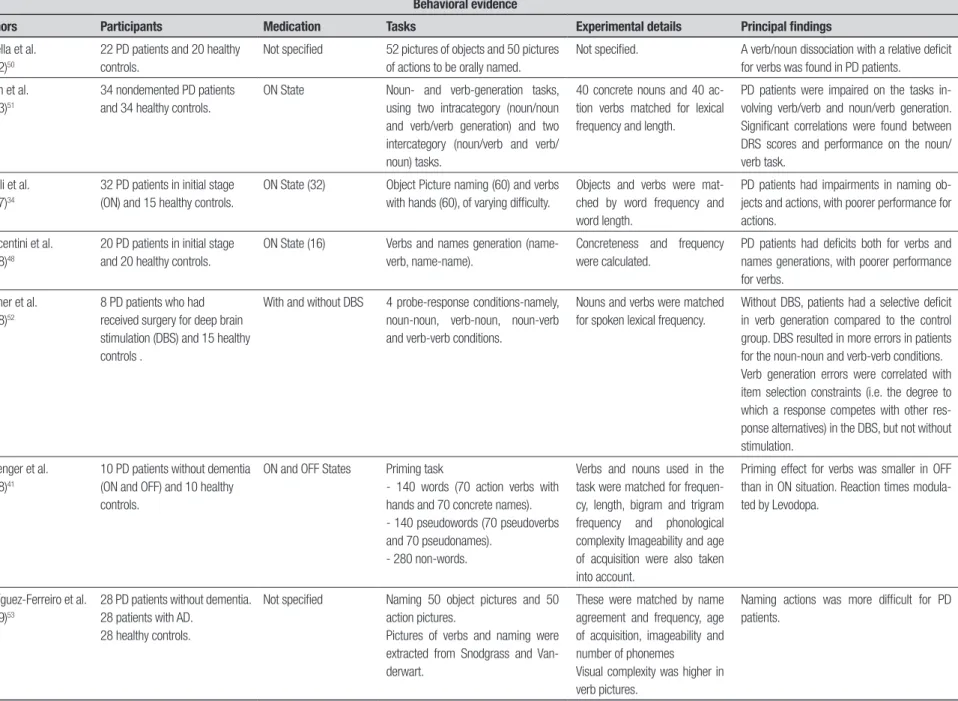
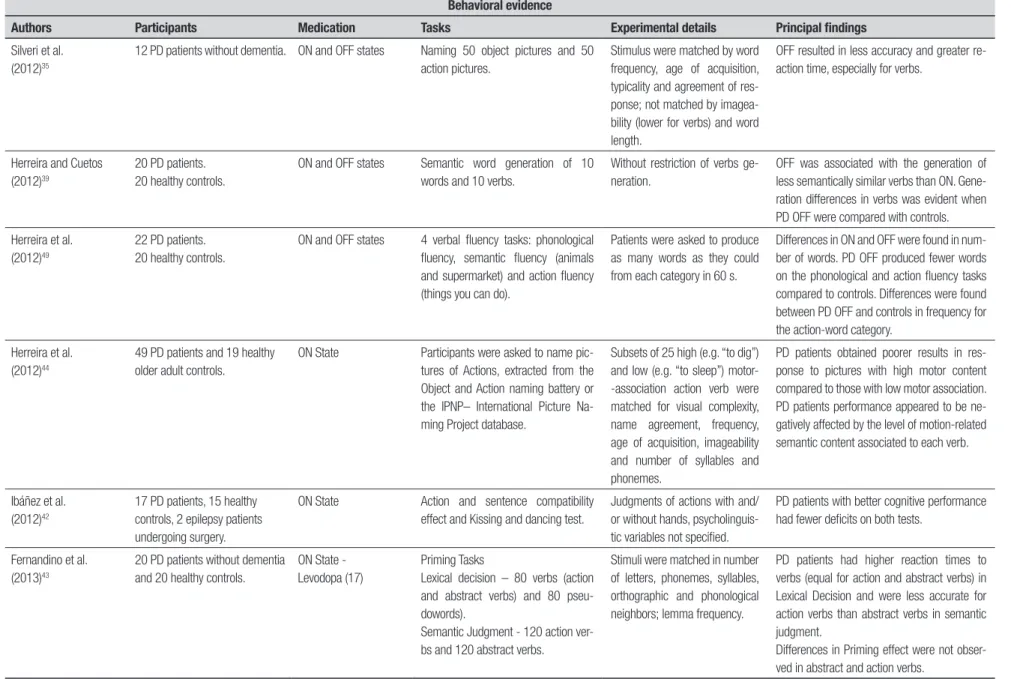
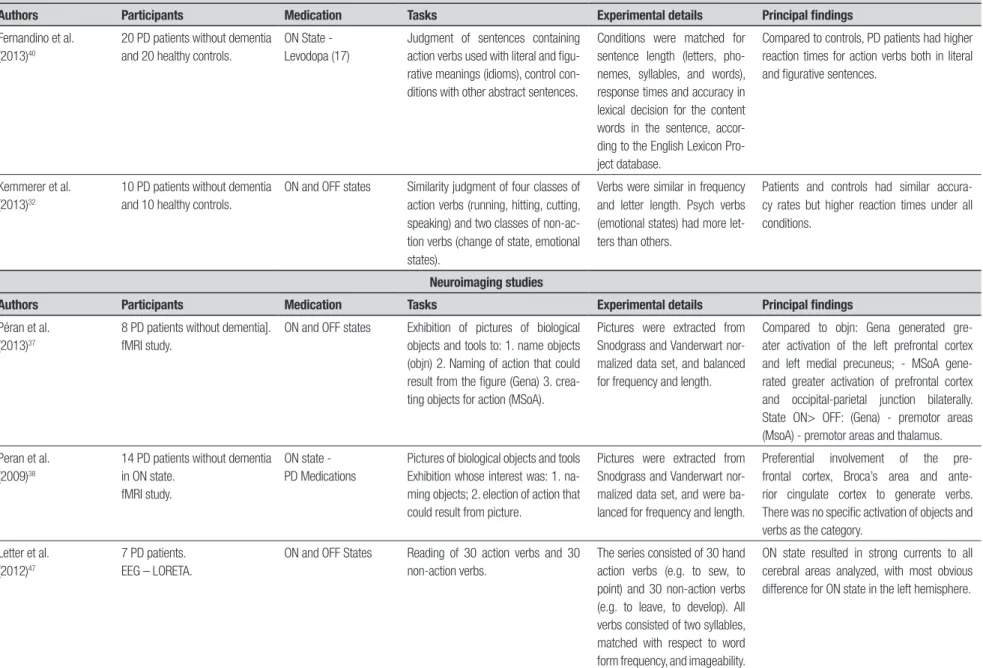
As mentioned previously, semantic deicits have been more extensively studied in PD than in other dis-eases predominantly afecting the motor system. How-ever, the literature in this ield is still scarce. A Pubmed and Scopus search conducted in February/2014 using the terms “action verb” OR “verb” OR “verbs” AND “Parkinson’s disease” with no time restriction retrieved only 30 studies. After excluding reviews and studies not related to action/verb semantics in PD, the number of manuscripts totaled 18 studies. Table 1 summarizes the methodologies and main indings of these studies ana-lyzed in the present review to determine their contri-butions to the debate on how action/verb semantics is represented in the brain, particularly with regard to the Embodied Cognition versus lexical/grammatical class theories.
Apparently not all of these studies were method-ologically designed to test the Embodied Cognition as-sumptions and this represents a major limitation for the current review. However, results are often explained/ discussed as supportive of this theory and it is not al-ways clear why alternative explanations were not con-sidered. A common inding of the studies reviewed here is that PD afects verb processing and therefore frontal cortical-subcortical circuits and structures are engaged in action/verb processing. he deicits are more intense in the absence of L-dopa (OFF state), predisposing pa-tients with PD to longer reaction times in naming tasks,
decisions and semantic judgments of action verbs com-pared to patients under the inluence of medication (ON state) and to healthy controls matched for age, sex, and education.33-35 Levodopa is believed to play an important
role in restoring activity of the motor circuitry involved in the semantic processing of actions/verbs.33,34 he
ex-tent and nature of the contribution of these areas to ac-tion/verb semantic processing however, is less clear in the literature. Some issues of intense debate in cognitive neuroscience and cognitive neuropsychology related to this topic are discussed below.
he irst question in the debate is: Do patients with motor disorders have impairment in the processing of action semantics or are their diiculties due to a prob-lem restricted to the grammatical class of verbs? To dem-onstrate that the diiculty involves “action semantics” and not purely “verbs”, studies need to demonstrate that other types of verbs are unimpaired. Dissociation between action and non-action verbs would favor the Embodied Cognition claim whereas verb/noun dissocia-tions, although elucidating, cannot rule out the lexical hypothesis.36
Comparison between verbs and nouns was used in the 15 studies reviewed and all of them yielded behav-ioral evidence of a disproportionate deicit for verbs compared to nouns. A host of diferent tasks have been employed, such as naming of action verbs,34,35,37,38
gen-eration of semantically similar verbs,39 judgments of
semantic similarity32 and of literal and igurative
sen-tences involving body action verbs,40 identiication of
action verbs41 and the interaction between contextual
understanding of action verbs and motor responses.42
However, bar a few exceptions,32,40,43,44 these studies
did not investigate processing diferences between dis-tinct types of verbs (action, non-action, emotional and abstract verbs) while some did not control for many psy-cholinguistic variables, such as length, frequency, im-ageability, age of acquisition, visual complexity, among others. Another limitation is the absence of healthy control groups.35 his is an important issue, considering
that verbs are more demanding of cognitive resources (for a review see Matzig et al.).45
Dement Neuropsyc
hol 2014 Mar
ch;8(1):3-13
8
Action/verb
processing
Silva HS,
et al.
Table 1. Summary of studies investigating action/verb semantics in patients with Parkinson’s disease.
Behavioral evidence
Authors Participants Medication Tasks Experimental details Principal findings
Bertella et al. (2002)50
22 PD patients and 20 healthy controls.
Not specified 52 pictures of objects and 50 pictures of actions to be orally named.
Not specified. A verb/noun dissociation with a relative deficit for verbs was found in PD patients.
Péran et al. (2003)51
34 nondemented PD patients and 34 healthy controls.
ON State Noun- and verb-generation tasks, using two intracategory (noun/noun and verb/verb generation) and two intercategory (noun/verb and verb/ noun) tasks.
40 concrete nouns and 40 ac-tion verbs matched for lexical frequency and length.
PD patients were impaired on the tasks in-volving verb/verb and noun/verb generation. Significant correlations were found between DRS scores and performance on the noun/ verb task.
Cotelli et al. (2007)34
32 PD patients in initial stage (ON) and 15 healthy controls.
ON State (32) Object Picture naming (60) and verbs with hands (60), of varying difficulty.
Objects and verbs were mat-ched by word frequency and word length.
PD patients had impairments in naming ob-jects and actions, with poorer performance for actions.
Crescentini et al. (2008)48
20 PD patients in initial stage and 20 healthy controls.
ON State (16) Verbs and names generation (name-verb, name-name).
Concreteness and frequency were calculated.
PD patients had deficits both for verbs and names generations, with poorer performance for verbs.
Castner et al. (2008)52
8 PD patients who had received surgery for deep brain stimulation (DBS) and 15 healthy controls .
With and without DBS 4 probe-response conditions-namely, noun-noun, verb-noun, noun-verb and verb-verb conditions.
Nouns and verbs were matched for spoken lexical frequency.
Without DBS, patients had a selective deficit in verb generation compared to the control group. DBS resulted in more errors in patients for the noun-noun and verb-verb conditions. Verb generation errors were correlated with item selection constraints (i.e. the degree to which a response competes with other res-ponse alternatives) in the DBS, but not without stimulation.
Boulenger et al. (2008)41
10 PD patients without dementia (ON and OFF) and 10 healthy controls.
ON and OFF States Priming task
- 140 words (70 action verbs with hands and 70 concrete names). - 140 pseudowords (70 pseudoverbs and 70 pseudonames).
- 280 non-words.
Verbs and nouns used in the task were matched for frequen-cy, length, bigram and trigram frequency and phonological complexity Imageability and age of acquisition were also taken into account.
Priming effect for verbs was smaller in OFF than in ON situation. Reaction times modula-ted by Levodopa.
Rodríguez-Ferreiro et al. (2009)53
28 PD patients without dementia. 28 patients with AD.
28 healthy controls.
Not specified Naming 50 object pictures and 50 action pictures.
Pictures of verbs and naming were extracted from Snodgrass and Van-derwart.
These were matched by name agreement and frequency, age of acquisition, imageability and number of phonemes
Visual complexity was higher in verb pictures.
Dement Neuropsyc
hol 2014 Mar
ch;8(1):3-13
9
Silva HS,
et al.
Action/verb processing
Table 1. Continuation.
Behavioral evidence
Authors Participants Medication Tasks Experimental details Principal findings
Silveri et al. (2012)35
12 PD patients without dementia. ON and OFF states Naming 50 object pictures and 50 action pictures.
Stimulus were matched by word frequency, age of acquisition, typicality and agreement of res-ponse; not matched by imagea-bility (lower for verbs) and word length.
OFF resulted in less accuracy and greater re-action time, especially for verbs.
Herreira and Cuetos (2012)39
20 PD patients. 20 healthy controls.
ON and OFF states Semantic word generation of 10 words and 10 verbs.
Without restriction of verbs ge-neration.
OFF was associated with the generation of less semantically similar verbs than ON. Gene-ration differences in verbs was evident when PD OFF were compared with controls.
Herreira et al. (2012)49
22 PD patients. 20 healthy controls.
ON and OFF states 4 verbal fluency tasks: phonological fluency, semantic fluency (animals and supermarket) and action fluency (things you can do).
Patients were asked to produce as many words as they could from each category in 60 s.
Differences in ON and OFF were found in num-ber of words. PD OFF produced fewer words on the phonological and action fluency tasks compared to controls. Differences were found between PD OFF and controls in frequency for the action-word category.
Herreira et al. (2012)44
49 PD patients and 19 healthy older adult controls.
ON State Participants were asked to name pic-tures of Actions, extracted from the Object and Action naming battery or the IPNP– International Picture Na-ming Project database.
Subsets of 25 high (e.g. “to dig”) and low (e.g. “to sleep”) motor--association action verb were matched for visual complexity, name agreement, frequency, age of acquisition, imageability and number of syllables and phonemes.
PD patients obtained poorer results in res-ponse to pictures with high motor content compared to those with low motor association. PD patients performance appeared to be ne-gatively affected by the level of motion-related semantic content associated to each verb.
Ibáñez et al. (2012)42
17 PD patients, 15 healthy controls, 2 epilepsy patients undergoing surgery.
ON State Action and sentence compatibility effect and Kissing and dancing test.
Judgments of actions with and/ or without hands, psycholinguis-tic variables not specified.
PD patients with better cognitive performance had fewer deficits on both tests.
Fernandino et al. (2013)43
20 PD patients without dementia and 20 healthy controls.
ON State - Levodopa (17)
Priming Tasks
Lexical decision – 80 verbs (action and abstract verbs) and 80 pseu-dowords).
Semantic Judgment - 120 action ver-bs and 120 aver-bstract verver-bs.
Stimuli were matched in number of letters, phonemes, syllables, orthographic and phonological neighbors; lemma frequency.
PD patients had higher reaction times to verbs (equal for action and abstract verbs) in Lexical Decision and were less accurate for action verbs than abstract verbs in semantic judgment.
Dement Neuropsyc
hol 2014 Mar
ch;8(1):3-13
10
Action/verb
processing
Silva HS,
et al.
Table 1. Continuation.
Behavioral evidence
Authors Participants Medication Tasks Experimental details Principal findings
Fernandino et al. (2013)40
20 PD patients without dementia and 20 healthy controls.
ON State - Levodopa (17)
Judgment of sentences containing action verbs used with literal and figu-rative meanings (idioms), control con-ditions with other abstract sentences.
Conditions were matched for sentence length (letters, pho-nemes, syllables, and words), response times and accuracy in lexical decision for the content words in the sentence, accor-ding to the English Lexicon Pro-ject database.
Compared to controls, PD patients had higher reaction times for action verbs both in literal and figurative sentences.
Kemmerer et al. (2013)32
10 PD patients without dementia and 10 healthy controls.
ON and OFF states Similarity judgment of four classes of action verbs (running, hitting, cutting, speaking) and two classes of non-ac-tion verbs (change of state, emonon-ac-tional states).
Verbs were similar in frequency and letter length. Psych verbs (emotional states) had more let-ters than others.
Patients and controls had similar accura-cy rates but higher reaction times under all conditions.
Neuroimaging studies
Authors Participants Medication Tasks Experimental details Principal findings
Péran et al. (2013)37
8 PD patients without dementia]. fMRI study.
ON and OFF states Exhibition of pictures of biological objects and tools to: 1. name objects (objn) 2. Naming of action that could result from the figure (Gena) 3. crea-ting objects for action (MSoA).
Pictures were extracted from Snodgrass and Vanderwart nor-malized data set, and balanced for frequency and length.
Compared to objn: Gena generated gre-ater activation of the left prefrontal cortex and left medial precuneus; - MSoA gene-rated greater activation of prefrontal cortex and occipital-parietal junction bilaterally. State ON> OFF: (Gena) - premotor areas (MsoA) - premotor areas and thalamus.
Peran et al. (2009)38
14 PD patients without dementia in ON state.
fMRI study.
ON state - PD Medications
Pictures of biological objects and tools Exhibition whose interest was: 1. na-ming objects; 2. election of action that could result from picture.
Pictures were extracted from Snodgrass and Vanderwart nor-malized data set, and were ba-lanced for frequency and length.
Preferential involvement of the pre-frontal cortex, Broca’s area and ante-rior cingulate cortex to generate verbs. There was no specific activation of objects and verbs as the category.
Letter et al. (2012)47
7 PD patients. EEG – LORETA.
ON and OFF States Reading of 30 action verbs and 30 non-action verbs.
The series consisted of 30 hand action verbs (e.g. to sew, to point) and 30 non-action verbs (e.g. to leave, to develop). All verbs consisted of two syllables, matched with respect to word form frequency, and imageability.
ON state resulted in strong currents to all cerebral areas analyzed, with most obvious difference for ON state in the left hemisphere.
Dement Neuropsychol 2014 March;8(1):3-13
11 Silva HS, et al. Action/verb processing
action verb processing, then patients may present no clear deicits when compared to controls, or exhibit time but not accuracy diferences.32 he latter would not
re-fute the Embodied Cognition claim but would challenge the strong form of this theory. Controversies persist in this area with some researchers favoring the strong version of the theory,40,43 stating that integrity of the
motor system is necessary to process action verbs even when used with igurative meaning whilst others sup-port (albeit with some reservations) the weak version of embodied cognition (motor representations may en-rich the semantics of verbs but are not necessary for the comprehension/production of verbs).32 However,
Kem-merer et al.32 mentioned that if they had considered
only one type of action verb (the category “cutting”) and ignored the other action verbs addressed in their study, the indings would support the Embodied Cogni-tion theory in the sense that patients were less accurate on these verbs compared to controls. he results of this study raises the question of whether speciic (verbs with precise and detailed kinetic movements and that usually require a tool)46 vs. general verbs have diferent neural
representations and whether this question could help clarify PD action/verb deicits and cast light on issues regarding the Embodied Cognition theory.
Moreover, if the Embodied Cognition theory is cor-rect, neuroimaging studies with PD should point to somatotopic organization of action verbs related to speciic body parts or diferent patterns of activation for action verbs compared to other verbs. However, no studies addressing the question in this population are available. Only two studies used fMRI techniques to study action verb processing in PD.37,38 heir results
conirmed the hypothesis of a relationship between mo-tor striatofrontal dysfunction and impairment of verb processing, either due to higher level of diiculty with action verbs compared to nouns37 or to the observation
of a relationship between increased activation during a verb generation task and increased motor-frontal dys-function in diferent brain regions.38 One study
em-ployed EEG techniques47 and suggested that dopamine
(patients in ON state) had elevated diferences in coher-ent neural activity when processing action compared to non-action verbs. Taken together, the indings with neuroimaging techniques are diicult to relate directly to the Embodied Cognition heory.
Finally, a common challenge in these types of studies is to address the inluence of psycholinguistic variables known to have an impact on language performance such as frequency, familiarity, imageability, extension, visual complexity and age of acquisition, when
com-paring diferent categories of verbs. If these factors, or at least most of them, are not taken into account then diferences between verbs cannot be explained without limitations. Studies often report frequency and exten-sion but overlook other aspects.
In summary, few studies were appropriate to verify the Embodied Cognition theory in the context of PD, especially using neuroimaging techniques. hese limita-tions show that there is much to investigate on the se-mantic representation of action verbs. Considering the hypotheses mentioned in the introduction, the studies conducted so far have been able to show a disadvantage for verbs compared to motionless objects (nouns) in PD. However, evidence of a causal relationship between mo-tor processing and action semantics can be derived from only two studies40,43 and requires further investigation.
CONCLUSIONS AND FINAL CONSIDERATIONS
Our review about neural representations in verb pro-cessing has shown that: [1] the debate between Em-bodied Cognition and Lexical models continues. It has resulted in a great number of neuroimaging studies and their results are interpreted following the authors’ posi-tions in most of the experiments; [2] control of stimuli and of the cognitive processing elicited by the tasks has been improving over recent years, but in general, tasks requiring more semantic processing amplify the difer-ences between the two grammatical classes (nouns and verbs), resulting in greater activation in more areas for verbs compared to nouns, consistent with the higher semantic complexity of verbs; [3] when the researchers focused on the body parts performing the movement, similar neurophysiological activation with the coun-terpart motor representation was readily found for leg and mouth actions, but not for arm actions. Hand/Arm movements in human beings comprise a large variety of actions, thus semantic classiication needs to be taken into account, such as the use of instruments and the de-gree of speciicity.
Dement Neuropsychol 2014 March;8(1):3-13
12 Action/verb processing Silva HS, et al.
Finally, some questions remain open in the lit-erature, such as: [1] the possible diferences in neural representation of verbs of diferent parts of the body; [2] the processing of action verbs in literal and igura-tive language;40 [3] comparisons between action and
non-action verbs, speciic and generic verbs and verbs which evoke emotional responses (“to feel lonely”, “to love”), visual processing (“to color”, “to dye”) and oth-ers (“to rain”); [4] associations between the degree of severity of PD and the loss of semantic characteristics of the verbs, such as speciicity, concreteness, force of movement, etc.; and [5] he impact of executive func-tions and working memory on motor representation of
semantics. With regard to this last question, dissocia-tions between verbs and objects seem to be related with poorer performance on tasks of visuospatial and verbal memory34 as well as executive functions.48
In sum, much more work must be carried out to understand how the brain represents the complex se-mantics of verbs and to ascertain which semantic strat-egies can help patients with speciic diiculties in verb processing.
Support. his study had support of CNPq (n.), FAPESP,
CAPES and the PROPES UFABC.
REFERENCES
1. Vigliocco G, Vinson DP, Druks J, Barber H, Cappa S. Nouns and verbs in the brain:A review of behavioural, electrophysiological, neuropsycho-logical and imaging studies. Neurosci Biobehav R 2011;35:407-426. 2. Shapiro L. Embodied Cognition: New problems of Phiosophy.
Rout-ledge, New York, 2011.
3. Pulvermüller F., Härley M, Hummel F. Walking or Talking?: Behavioral and Neurophysiological correlations of action verb processing. Brain Lang 2001;78:143-168.
4. Crepaldi D, Berlingeri M, PaulesuE, Luzzatti C. A place for nouns and a place for verbs? A critical review of neurocognitive data on grammatical-class effects. Brain Lang 2011;116:33-49.
5. Barber HA, Kousta ST, Otten LJ, Vigliocco G. Event-related potentials to event-related words: Grammatical class and semantic attributes in the representation of knowledge. Brain Res 2010;1332:65-74. 6. Lu A, Liu J, Zhang JX. Event-related potentials reveal early activation of
body part representations in action concept comprehension. Neurosci Lett 2012;511:74-78.
7. Maguire MJ, Magnon G, Ogiela DA, Egbert R, Sides L. The N300 ERP component reveals developmental changes in object and action identi-fication. Dev Cogn Neurosci 2013;5:1-9.
8. Pulvermüller F, Mohr B, Schleichert H. Semantic or lexico-syntactic fac-tors: what determines word-class specific activity in the human brain?. Neurosci Lett 1999;275:81-84.
9. Boulenger V, Roy AC, Paulignan Y, Deprez V, Jeannerod M, Nazir TA. Cross-talk between language processes and overt motor behavior in the first 200 msec of processing. J Cognitive Neurosci 2006;18:1607-1615. 10. Tonietto L, Villavicencio A, Siqueira M, Sperb TM, Parente, MAMP. A
especificidade semântica como fator determinante na aquisição de ver-bos. Psico 2008;39:343-351.
11. Kim M, Thompson, CK. Verb deficits in Alzheimer’s disease and agram-matism: implications for lexical organization. Brain Lang 2004;88:1-20. 12. Moseley, R. L., Pulvermüller, F., & Shtyrov, Y. (2013). Sensorimotor se-mantics on the spot: brain activity dissociates between conceptual cat-egories within 150 ms. Sci Rep 2013;3:1928.
13. Klepp A, Weissler H, Niccolai V, Terhalle A, Geisler H, Schnitzler A, Bier-mann-Ruben K. Neuromagnetic hand and foot motor sources recruited during action verb processing. Brain Lang 2014;128:41-52.
14. Hauk O, Johnsrude I, Pulvermüller F. Somatotopic representation of action words in human motor and premotor cortex. Neuron 2004;41: 301-307.
15. Tettamanti Herrera E, Rodriguéz-Ferreiro J, Cuetos, F. The effect of mo-tion content in acmo-tion naming by Parkinson’s disease patients. Cortex 2012;48:900-904.
16. Bak TH, Crawford LM, Hearn VC, Mathuranath PS, Hodges JH. Sub-cortical dementia revisited: similarities and differences in cognitive function between Progressive Supranuclear Palsy (PSP), Corticobasal Degeneration (CBD) and Multiple System Atrophy (MSA). Neurocase 2005,11:268-273.
17. Rüschemeyer S.-A, Brass M, Friederici AD Comprehending prehend-ing: Neural correlates of processing verbs with motor stems. J Cognitive Neurosci 2007, 19, 855-865.
18. Tettamanti M, Buccino G, Saccuman MC, et al. Listening to action-related sentences activates fronto-parietal motor circuits. J Cognitive Neurosci 2005;17:273-281.
19. Kemmerer D, Gonzalez-Castillo J, Talavage T, Patterson S, Wiley C. Neuroanatomical distribution of five semantic components of verbs: Evidence from fMRI. Brain Lang 2008;107:16-43.
20. Bedny M, Caramazza A, Grosman E, Pascual-Leone A, Saxe R. Con-cepts are more than perCon-cepts: the case of action verbs. J Neurosci 2008;28:11347-11353.
21. Bedny M, Caramazza A, Pascual-Leone A, Saxe R. Typical neural representations of action verbs develop without vision. Cereb Cortex 2012;22:286-293.
22. Mahon BZ, Schwarzbach J, Caramazza A. The representation of tools in left parietal cortex is independent of visual experience. Psychol Sci 2010;21:764-771.
23. Sitnikova T, Holcomb PJ, Kiyonaga KA, Kuperberg GR. Two Neuro-cognitive Mechanisms of Semantic Integration during the Comprehen-sion of Visual Real-world Events. J Cognitive Neurosci 2008;20:2037- 2057.
24. Burton, MW, Krebs-Noble D, Gullapalli RP, Berndt RS. Functional neu-roimaging of grammatical class: Ambiguous and unambiguous nouns and verbs. Cognitive Neuropsych 2009, 26:148-171.
25. Repetto C, Colombo B, Cipresso P, Riva G. The effects of rTMS over the primary motor cortex: The link between action and language. Neu-ropsychologia 2013;5:8-13.
26. Innocenti A, De Stefani E, Sestito M, Gentilucci M. Understanding of action-related and abstract verbs in comparison: a behavioral and TMS study. Cognitive processing 2014;15:85-92.
27. Papeo L, Lingnau A, Agosta S, Pascual-Leone A, Battelli L, Caramazza, A. The Origin of Word-related Motor Activity. Cereb Cortex 2014 [Epub ahead of print].
28. Watson CE, Cardillo ER, Ianni GR, Chatterjee A. Action concepts in the brain: an activation likelihood estimation meta-analysis. J Cognitive Neurosci 2013;25:1191-1205.
29. Bak TH, Hodges JR The effects of motor neuron disease on language: Further evidence. Brain Lang 2004, 89:354-361.
30. Bak T, Yancopoulou D, Nestor PJ, et al. Clinical, imaging and patho-logical correlates of a hereditary deficit in verb and action. Brain 2006; 129:321-332.
31. Goetz CG. Charcot and Parkinson’s Disease. In: Factor SA, Weiner WJ (Edited by) Parkinson’s Disease: Diagnosis and clinical management. New York: Demos Medical Publishing, 2008. cap.3, p.21-32. 32. Kemmerer D, Miller L, MacPherson MK, Huber J, Tranel D. An
Inves-tigation of semantic similarity judgments about action and non-actions verbs in Parkinson’s disease: Implications for the embodied cognition framework. Front Human Neurosci 2013;7:1-19.
33. Cardona JF, Gershanik O, Gelormini-Lezana C, et al. Action-verb pro-cessing in Parkinsons disease: new pathways for motor-language cou-pling. Brain Struct Funct 2013;218:1355-1373.
Dement Neuropsychol 2014 March;8(1):3-13
13 Silva HS, et al. Action/verb processing
35. Silveri MC, Ciccarelli N, Baldonero E, et al. Effects of stimulation of sub-thalamic nucleus on naming and reading nouns and verbs in Parkin-son’s disease. Neuropsychologia 2012;50:1980-1989.
36. Mahon BZ, Caramazza A. A critical look at the Embodied Cognition Hypothesis and a new proposal for grounding conceptual content. J Physiol-Paris 2008;102:59-70.
37. Péran P, Nemmi F, Méligne D, et al. Effect of levodopa in both verbal and motor representation of action in Parkinson’s disease: A fMRI study. Brain Lang 2013;125:324-329.
38. Péran P, Cardebat D, Cherunbini A, et al. Object naming and action-verb generation in Parkinson’s disease: A fMRI study. Cortex 2009;45: 960-971.
39. Herrera E, Cuetos F. Semantic disturbance for verbs in Parkinson’s disease patients off medication. Journal of Neurolinguist 2013;26: 737-744.
40. Fernandino L, Conant LL, Binder JR, et al. Where is the action? Action-sentence processing in Parkinson’s disease. Neuropsychologia 2013; 51:1510-1517.
41. Boulenger V, Mechtouff L, Thobois S, Broussolle E, Jeannerod M, Nazir TA. Word processing in Parkinson’s disease is impaired for action verbs but not for concrete nouns. Neuropsychologia 2008;46:743-756. 42. Ibáñez A, Cardona JF, Santos YV, et al. Motor-language coupling: direct
evidence from early Parkinson’s disease and intracranial cortical record-ings. Cortex 2013;49:968-984.
43. Fernandino L, Conant LL, Binder JR, et al. Parkinson’s disease disrupts both automatic and controlled processing of action verbs. Brain Lang 2013;127:65-74.
44. Herrera E, Rodríguez-Ferreiro J, Cuetos F. The effect of motion
con-tent in action naming by Parkinson’s disease patients. Cortex 2012;48: 900-904.
45. Mätzig S, Druks J, Masterson J, Vigliocco G. Noun and verb differences in picture naming: past studies and new evidence. Cortex 2009;45: 738-758.
46. Van Dam WO, Rueschemeyer S-A, Bekkering H. How specifically are action verbs represented in the neural motor system: An fMRI study. NeuroImage 2010;53:1318-1325.
47. Letter MD, Borsel JV, Santes, P. An electrophysiological investigation of the effects of levodopa in semantic comprehension of actions words in Parkinson’s disease. J Neurolinguist 2012;25:95-103.
48. Crescentini C, Mondolo F, Biasutti E, Shallice T. Supervisory and routine processes in noun and verb generation in nondemented patientes with Parkinson’s disease. Neuropsychologia 2008;46:434-447.
49. Herrera E, Cuetos F, Ribacoba R. Verbal fluency in Parkinson’s disease patients on/off dopamine medication. Neuropsychologia 2012;50: 3636-3640.
50. Bertella L, Albani G, Greco E, et al. Noun verb dissociation in Parkin-son’s disease. Brain Cogn 2002;48:277-280.
51. Péran P, Rascol O, Démonet JF, et al. Deficit of verb generation in nondemented patients with Parkinson’s disease. Mov Disord 2003;18: 150-156.
52. Castner JE, Chenery HJ, et al. Effects of subthalamic deep brain stimula-tion on noun/verb generastimula-tion and selecstimula-tion from competing alternatives in Parkinson’s disease. J Neurol Neurosurg Psychiatr 2008;79:700-705. 53. Rodríguez-Ferreiro J, Menéndez M, Ribacoba R, Cuetos F. Action