Original Article
Artigo Original
Suppression effect of otoacoustic emissions
in term and preterm infants
Efeito de supressão das emissões
otoacústicas em lactentes termo e pré-termo
Natália Oliveira de Jesus1
Rosanna Giaffredo Angrisani1
Elaine Colombo Maruta1
Marisa Frasson de Azevedo1
Keywords
Audiology Auditory Pathways Newborn Premature Otoacoustic Emissions
Descritores
Audiologia Vias Auditivas Recém-nascido Prematuro Emissões Otoacústicas
Correspondence address:
Natália Oliveira de Jesus
Universidade Federal de São Paulo – UNIFESP
Rua Laurindo Corrêa Malheiros, 20, Jardim D’Abril, Osasco (SP), Brazil, CEP: 06040-070.
E-mail: [email protected]; natalia_ [email protected]
Received: May 18, 2015
Study carried out at Ambulatório de Distúrbios da Audição do Departamento de Fonoaudiologia, Universidade Federal de São Paulo – UNIFESP - São Paulo (SP), Brazil.
1 Universidade Federal de São Paulo – UNIFESP - São Paulo (SP), Brazil.
Financial support: Fundação de Amparo à Pesquisa do Estado de São Paulo (FAPESP), process nº 2013/23578-8.
Conlict of interests: nothing to declare.
ABSTRACT
Purpose: This research aims at verifying the occurrence and magnitude of suppression effect of otoacoustic emissions evoked by transient stimulus in term and preterm infants, setting a benchmark for clinical use. Methods: The study
sample consisted of 40 infants, with a rage of age from ive days to four months, without any risk indicators for hearing loss and otoacoustic emissions present at birth: the 20 term and 20 preterm infants spent more than ive
days in the Neonatal Intensive Care Unit. Linear click was presented at 65 dB Sound Pressure Level, in blocks of 15 seconds without noise, and with contralateral noise at 60 dB Sound Pressure Level. The reduced response in the presence of noise indicates positive suppression effect. Mean values of suppression were established and the comparison between the groups was analyzed statistically. Results: Suppression occurred in 100% of the children and did not vary as a function of ear side and between the groups. Conclusion: All children presented suppression regardless of the group. The average suppression obtained on the total population was 0.85 dB. The minimum recommended criterion for clinical use was a reduction of 0.20 dB in the overall response.
RESUMO
Objetivo: Veriicar a ocorrência e a magnitude do efeito de supressão das emissões otoacústicas evocadas por
INTRODUCTION
The function of the efferent pathways has been known for a long time and its studies began when research examined how the mechanical movement of the outer hair cells (OHC) is controlled by the efferent medial olivocochlear system(1). This system can be activated by electrical stimuli, by chemical stimuli, or by noise, inhibiting contractions of the outer hair cells and consequently reducing the level of responses of optoacoustic emissions(2). The system deals with the abilities of sound localization, selective attention, frequency selectivity, detection of acoustic signals in noise, as well as acting in the protection against temporary or permanent damage by elevated acoustic levels(3). These skills are essential for proper processing of auditory information.
Transient-evoked otoacoustic emissions (TEOAE) can be used for the investigation of the functioning of the medial efferent auditory system through the analysis of the levels of the response obtained with and without noise. A decreasing response in the presence of ipsilateral contralateral or bilateral competitive noise relects the activation of the efferent pathways in the olivocochlear system, a phenomenon called the suppression effect of otoacoustic emissions(4-6).
An analysis of the suppression effect can be performed using as a stimulus the “clicks” or the “tone burst”. This click can be presented in a linear or non-linear mode. In the linear click, four pulses of 60/65 dB SPL in the same polarity are presented. In the non-linear technique, three pulses of 80 dB SPL are presented in the same polarity, while a fourth pulse is presented out of phase to the irst three ones and with a 10 dB increase in intensity(6).
The non-linear click stimulus chosen for the irst suppression studies performed in infants. Currently, literature states that presented linearly click obtains more satisfactory results(6-8).
In fact, the suppression effect of TEOAE with linear clicks was studied in infants with and without risk, conirming the effectiveness of the use of linear technique for this population(7,8). On the other hand, a study comparing the linear and non-linear technique in neonates demonstrated the presence of the suppression effect regardless the type of click used(9).
Following technological advances, new techniques of capturing the efferent system responses were developed, allowing the use of linear clicks, presented in alternating blocks with and without noise. For the use of this new technique, it was necessary to establish benchmarks for the adequate clinical application.
As a consequence, this study aims at verifying the occurrence and magnitude of the suppression effect of otoacoustic emissions evoked by transient stimulus in term and preterm infants, establishing reference levels for clinical use.
METHODS
This is an observational, quantitative and cross-sectioned study, developed in a public university in São Paulo State – Universidade Federal de São Paulo/UNIFESP - and approved by the Comitê de Ética em Pesquisa da UNIFESP (approval number 451543). Parents or guardians of the children were
accordingly informed about the research purposes, and agreed with the participation of their children in the study by means of a signed consent form.
The following inclusion criteria were adopted: ive-day to four-month old infants, with no risk for neurological and hearing loss and otoacoustic emissions evoked by transient stimulus present at birth were accepted. The criteria for the presence of TEOAE responses were: signal/noise ratio> 3 dB at 1000 Hertz (Hz), and> 6 dB in 2000, 3000 and 4000 Hz, reproducibility and stability of at least 50% and 70%, respectively. Infants who met the inclusion criteria were submitted to transient otoacoustic emissions suppression test and divided into two groups:
Group I - composed of 20 term infants (37 to 42 week gestational age).
Group II - composed of 20 preterm infants (up to 36 weeks and six days of gestation) who spent more than ive days in the Intensive Care Unit (NICU).
All children were in natural sleep and placed in the mother’s and/or guardian’s lap. The test was conducted in a soundproof booth with Otodynamics - ILO USB - V6 equipment. The equipment is provided with two probes, adapted to the external acoustic meatus of the infant, one displaying linear clicks at 65 dB SPL, and other broadband noise to 60 dB SPL. The presentation took place in alternate blocks of 15 seconds of linear clicks without noise and 15 linear clicks with contralateral noise. the test was initiated on the right ear for 50% of the sample and on the left ear for the remaining 50%.
The overall response with and without noise and differences were established by the equipment. It was considered the presence of suppression when there was a reduced response in the presence of noise. The suppression values were established and compared between the groups analysed statistically by applying the Analysis of Variance (ANOVA) in order to check whether there was any difference between the groups and between the ears. The signiicance level was 5% (p <0.05).
RESULTS
The sample consisted of 40 infants, 20 term infants, nine females and 11 males, and 20 preterm infants, 11 females and nine males. Gestational age group for the term children ranged from 37 to 41 weeks, with an average age of 39 weeks. In the preterm infants group, gestational age ranged from 27 to 36 weeks with an average age of 33 weeks. From this group, 90% (n = 18) were Appropriate for Gestational Age (AGA), 5% (1) Small for Gestational Age (SGA) and 5% (1) Large for Gestational Age (LGA). The ages of the infants, during the evaluation, ranged from four to 60 days in children born at term, and from 14-120 days in the preterm group. It is worth mentioning that the preterm children were evaluated with post-conceptual age equal/or superior to 37 weeks, with an average of about 39 weeks.
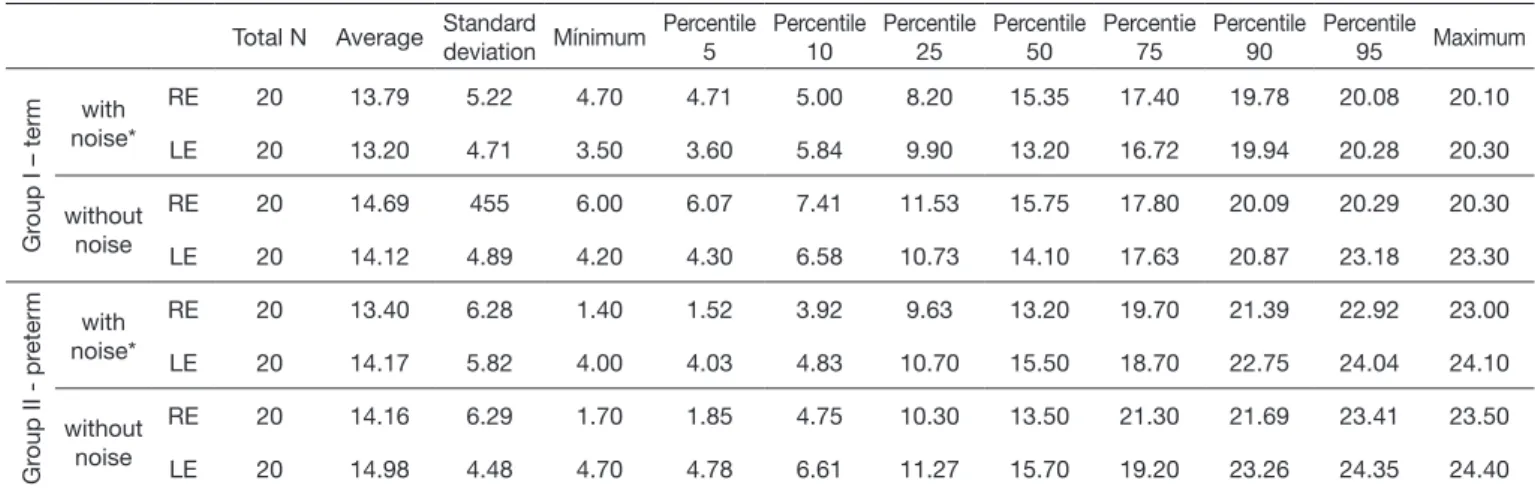
The average values of the responses for TEOAE with and without noise are described in Table 1.
The average difference for the responses obtained with and without noise (general suppression) for both groups can be seen in Table 2.
As there was no statistically signiicant difference between the ears and between the groups, it was decided to consider a sample of 40 infants. The average values for the responses with and without noise and the average differences obtained for the total sample are presented in Table 3.
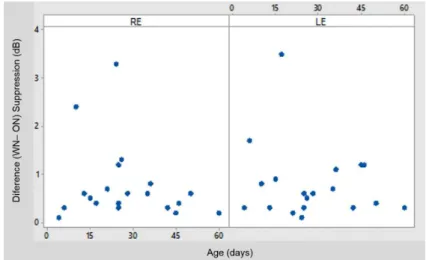
In order to verify whether the suppression values differed in relation to age, the Spearman’s rank correlation coeficients were obtained, as shown in Table 4 and illustrated in Figures 1 and 2.
Average values for the responses from otoacoustic emissions with and without noise (deletion) were recorded in the frequency bands 2000 Hz, 3000 Hz and 4000 Hz, observing statistically signiicant difference with and without noise (p = 0.006) in both ears and groups. The 1000 Hz band could not be analysed due to low frequency response. The average difference for the responses in the bands 2000 Hz to 4000 Hz, with and without noise (general suppression), are presented separated by group and ears in Table 5.
DISCUSSION
TEOAE suppression has been considered as an important, fast and non-invasive clinical procedure for evaluating cochlear function and operation of the efferent Olivocochlear Medial system(10). The efferent system in humans, descends from the cortex to the cochlea, and at lower levels, the ibers cross from the superior olivary complex and follow towards the internal ear(11). These ibers are formed by two bundles: the medial, predominantly contralateral, projects its endings to the outer hair cells, modulating their contractions; lateral, predominantly ipsilateral, projects its endings to the inner hair cells. The efferent system operates by noise acoustic stimulation presented in an ipsilateral, contralateral or bilateral way, reducing the activity of the outer hair cells.
The efferent auditory pathways are responsible for diminishing the response level to the otoacoustic emissions, decreasing the cochlear nerve potential and acting in the improvement of sound localization skills and selective attention, as well as protecting the system against intense noise(3,6,9). Suppression of emissions may be absent or reduced in cases of retrocochlear changes.
Table 1. Mean values for overall response (in dB) of otoacoustic emissions with and without noise, in both groups, by ear
Total N Average Standard
deviation Mínimum Percentile 5 Percentile 10 Percentile 25 Percentile 50 Percentie 75 Percentile 90 Percentile 95 Maximum Gr
oup I – term
with noise*
RE 20 13.79 5.22 4.70 4.71 5.00 8.20 15.35 17.40 19.78 20.08 20.10
LE 20 13.20 4.71 3.50 3.60 5.84 9.90 13.20 16.72 19.94 20.28 20.30
without noise
RE 20 14.69 455 6.00 6.07 7.41 11.53 15.75 17.80 20.09 20.29 20.30
LE 20 14.12 4.89 4.20 4.30 6.58 10.73 14.10 17.63 20.87 23.18 23.30
Gr
oup II - pr
eterm noise*with
RE 20 13.40 6.28 1.40 1.52 3.92 9.63 13.20 19.70 21.39 22.92 23.00
LE 20 14.17 5.82 4.00 4.03 4.83 10.70 15.50 18.70 22.75 24.04 24.10
without noise
RE 20 14.16 6.29 1.70 1.85 4.75 10.30 13.50 21.30 21.69 23.41 23.50
LE 20 14.98 4.48 4.70 4.78 6.61 11.27 15.70 19.20 23.26 24.35 24.40
Caption: Difference between ears p = 0.610. Difference between groups p = 0.788. Noise Effect * p <0.001. dB - decibel. RE - right ear. LE - left ear. Total N - total number of sample by ear
Table 2. Mean values for the difference in overall response without noise - Noise (suppression effect) in dB by ear in each group
Total N Average Standart
deviation Mínimum Percentile 5 Percentile 10 Percentile 25 Percentile 50 Percentile 75 Percentile 90 Percentile 95 Maximum Group I –
term
RE 20 0.760 0.791 0.10 0.10 0.20 0.30 0.55 0.77 2.29 3.25 3.3 LE 20 0.765 0.767 0.10 0.10 0.21 0.30 0.55 1.05 1.65 3.41 3.5 Group II -
preterm
RE 20 0.760 0.879 0.20 0.20 0.20 0.20 0.45 0.90 2.59 3.36 3.4 LE 20 0.815 0.833 0.20 0.20 0.21 0.42 0.55 0.77 1.89 3.70 3.8
Caption: Difference between ears = difference between groups: p0833. dB - decibel. RE - right ear. LE - left ear. Total N - total number of samples by ear
Table 3. Mean values of the responses (in dB) of the total sample removal effect
Total N Average Standart
deviation Mínimum Percentile 5 Percentile 10 Percentile 25 Percentile 50 Percentile 75 Percentile 90 Percentile 95 Maximum Suppression effect
40 0.85 0.72 0.20 0.20 0.25 0.40 0.62 0.99 1.93 3.14 3.25
The choice of the applied stimulus inluences the suppression of otoacoustic emissions. Studies conducted between 2001 and 2004 used the non-linear click to investigate the contralateral suppression of otoacoustic emissions in infants(12-14). This stimulus guarantees an almost total elimination of acoustic artifacts related to the ear canal and the probe of the equipment and it is also indicated because it achieves better neonatal screening results(15,16). In recent years, studies have revealed that the use of linear low intensity click provides the best suppression of responses. From these studies, the OAE equipment began to capture the TEOAE suppression with linear click the 60/65 dB SPL and 5dB contralateral noise above or below the test stimulus, presented in alternating blocks of linear clicks with no noise and with noise. As a consequence, in this study, it was decided to record the effect of TEOAE suppression with linear click at 65 dB SPL, as recommended in literature(17-21). As a suppressor stimulus, it was used the noise broadband at 60 dB SPL, considered the most effective to cause a suppression effect(5,22).
The occurrence of the suppression effect was 100% for both sides and both groups. Such an occurrence was higher than literature discoveries, using the non-linear stimulus (Chart 1). Table 4. Values for Spearman’s rank correlation coefficients for the pair
of variables age (days) and suppression effect (dB) per group and ear Variables Coefficient P Value Age x Difference (WN-ON)
Suppression - GI - RE
-0.116 0.626
Age x Difference (WN-ON) Suppression - GI - LE
0.027 0.911
Age x Difference (WN-ON) Suppression - GI - RE
-0.129 0.586
Age x Difference (WN-ON) Suppression - GI - LE
-0.025 0.916
Caption: WN- with noise ON - without noise. RE - right ear. LE - left ear. GI - group I (term). GII - group II (preterm). dB – decibel
Table 5. Mean values of the suppression effect of the total sample for the frequency bands of 1000 Hz, 2000Hz, 3000Hz and 4000 Hz
Band Frequency (Hz) 1000 2000 3000 4000
Total N 3 21 27 35
% 7.5 52.5 67.5 87.5
VARIATION
Average suppression effect -- 0.77 1.06 0.94
Caption: Hz – Hertz. % - Porcentage
Caption: ON – Without noise. WN – With noise. dB - decibel
Figure 1. Dispersion graph for age (days) and suppression effect (dB) for term infants group
Caption: ON – Without noise. WN – With noise. dB - decibel
This difference was expected and corroborates the literature discoveries that indicate higher incidence of suppression with linear click of low intensity.
There was no variation in the average suppression obtained according to the ear analysed: in the group of term infants born, the average removal was 0.76 dB SPL for both ears. In the group of preterm infants, the average removal was 0.76 dB SPL for the right ear and 0.81 dB SPL for the left ear. A variation according to the side analysed in the suppression studies has been controversial: some studies found average values of greater suppression on the right ear(8,11,14,23) while others found no differences between ears(10,24). The advantage of the right ear in suppressing the EOAT reinforces the concept of laterality of olivocochlear system function and could relect a delay in sound driving the left olivocochlear tract as compared to the right one(22). The most frequent suppression for right handed individuals could also be related to hemispheric dominance(8).
Studies in infants with linear click suppression obtained values close to those obtained in this study (Chart 2)(7,8,12,25) These values were lower than the values obtained with no linear click(10,12,26).
In this research, the suppression did not vary between the groups of term and preterm infants. In studies investigating the maturation of the efferent olivocochlear system, higher suppression values were found in full-term infants in relation to preterm, probably because the structures of the brain stem are less developed in premature infants, resulting in lower amplitude inhibition of the response(14,20,25). Suppression study in infants showed that at the 40th gestational week the medial efferent system already has its full maturity(27). In fact, children in this study were evaluated at the 37-week post-conceptual age, which is why this difference did not occur.
The aim of this work was to establish the suppression values in the four frequency bands studied. However, due to the low incidence of responses in the bands of 1000 Hz (7.5%) only the bands of 2000Hz, 3000Hz and 4000Hz could be analysed, demonstrating the presence of deletion in all analysed bands (Table 5). The low frequency of responses for the 1000Hz band can be related to the presence of respiratory noises, sucking and/or swallowing in infants. Studies have revealed the interference of the suction noise in otoacoustic emissions affecting mainly the bands of 1000Hz, 1500Hz and 2000Hz(28,29). In fact, previous
Chart 1. Description of mean values for the suppression effect using nonlinear click stimulus according to research in the literature with infants
AUTHOR (S) Durante and Carvallo26
Durante and
Carvallo13 Morlet et al.14
Viveiros and Azevedo24
Durante and Carvallo10
YEAR 2001 2002 2004 2004 2006
SAMPLE (N) 25 term infants 120 term infants
46 infants (24 preterm and 22
termos)
51 infants
(37 term and 14 preterm) 25 term infants
STIMULUS Non-linear click Non-linear click Non-linear click Non-linear click Non-linear click SUPPRESSION
OCCURENCE 88.5%
22% preterm
52.4% term 75% not referred not referred SUPPRESSION
AVERAGE
2.32 dB feminine 3.28 dB masculine
Term = 0.90 dB
Preterm = 0.52 dB > 1 and 1.5 dB Superior to 1.5 dB
2.81 dB infant 1.41 dB 6th month
BAND FREQUENCY Not analysed Not analysed
slight increase between 2000Hz and
3000Hz
Not analysed
2000Hz 4.71 dB masculine
3.15 dB feminine 3000Hz 3.41 dB masculine
3.20 dB feminine 4000Hz 4.32 dB masculine
3.04 dB feminine
Caption: % - percentage. dB - decibel. Hz - Hertz
Chart 2. Description of the suppression effect average values using linear click stimulus found in research described in the literature with infants AUTHOR Morlet et al.8 Gkoritsa et al.25 Amorim et al.9
YEAR 1999 2006 2010
SAMPLE (N) 49 infants (38 preterm and 11 term)
70 infants (27 preterm and
43 term) 15 preterm born infants
STIMULUS Linear click Linear click Linear click
SUPPRESSION OCCURENCE not referred
> 1dB 22% preterm
52.4% term
71.4% bilaterally
SUPPRESSION AVERAGE RE = 1.44 dB LE = 1.05 dB
Term = 0.90 dB
Preterm = 0.52 dB 1 to 1.5 dB
BAND FREQUENCY Suppression between 1000Hz
and 3000Hz not analysed Not analysed
studies had reported that breathing noises interfered in the capture of otoacoustic emissions, generating no response in 11.3% of infants(30).
From the results, it was noticed that the presence of white noise, presented contralaterally, which reduces the response level of otoacoustic emissions evoked by transient stimulus, demonstrating the involvement of the efferent system olivocochlear in the suppression effect for both term and in preterm infants, assessed at 37 week post-conceptual age.
CONCLUSIONS
The proposed evaluation technology of the TEOAE suppression effect proved to be effective, since 100% of the sample presented such effect.
The average suppression obtained for the total population was 0.85 dB SPL, which presented not difference from group to group and between the ears. The benchmark recommended for clinical use was a minimum reduction of 0.20 dB in the overall response.
REFERENCES
1. Rasmussen GL. The olivary peduncle and other fiber projections of the superior olivary complex. J Comp Neurol. 1946;84(2):141-219. http:// dx.doi.org/10.1002/cne.900840204. PMid:20982804.
2. Liberman MC, Kujawa SG. The olivocochlear system and protection from acoustic injury: acute and chronic effect. In: Berlin CI. The efferent auditory system-basic science and clinical applications. San Diego: Sing Pub Group; 1999. p. 1-27.
3. Guinan JJJR Jr. Olivocochlear efferents: anatomy, physiology, function and measurement of efferent effects in humans. Ear Hear. 2006;27(6):589-607. http://dx.doi.org/10.1097/01.aud.0000240507.83072.e7. PMid:17086072. 4. Veuillet E, Collet L, Duclaux R. Effect of contralateral acoustic stimulation on active cochlear micromechanical properties in humans subjects: dependence on stimulus variables. J Neurophysiol. 1991;65(3):724-35. PMid:2051201.
5. Berlin CL, Hood LJ, Wen H, Szabo P, Cecola RP, Rigby P, et al. Contralateral suppression of non-linear click evoked otoacoustic emissions. Hear Res. 1993;71(1-2):1-11. http://dx.doi.org/10.1016/0378-5955(93)90015-S. PMid:8113128.
6. Sousa EC, Garcia MV, Azevedo MF. Ocorrência e amplitude do efeito de supressão das emissões otoacústicas evocadas por cliques lineares. Distúrb. Comum. 2008;20(1):51-9.
7. Durante AS, Carvallo RMM. Contralateral suppression of linear and nonlinear transiente evoked otoacoustic emissions in neonates at risk for hearing loss. J Commun Disord. 2008;41(1):70-83. http://dx.doi.org/10.1016/j. jcomdis.2007.05.001. PMid:17585930.
8. Morlet T, Goforth L, Hood LJ, Ferber C, Duclaux R, Berlin CI. Development of human cochlear active mechanism asymmetry: involvement of the medial olivocochlear system? Hear Res. 1999;134(1-2):153-62. http:// dx.doi.org/10.1016/S0378-5955(99)00078-7. PMid:10452385.
9. Amorim AM, Lewis DR, Rodrigues GRI, Fiorini AC, Azevedo MF. Efeito de supressão das emissões otoacústicas evocadas por estímulo transiente em lactentes de risco para perda auditiva nascidos pré-termo. Rev. CEFAC. 2010;12(5):749-55.
10. Durante AS, Carvallo RMM. Mudanças das emissões otoacústicas por transientes na supressão contralateral em lactentes. Pro Fono. 2006;18(1):49-56. PMid:16625871.
11. Sahley TL, Nodar RH, Musiek FE. Efferent auditory system: structure and function. San Diego: Singular Publishing Group; 1997.
12. De Ceulaer G, Yperman M, Daemers K, Van Driessche K, Somers T, Offeciers F, et al. Contralateral suppression of transient evoked otoacoustic emissions: normative data for a clinical test set-up. Otol Neurotol. 2001;22(3):350-5. http://dx.doi.org/10.1097/00129492-200105000-00013. PMid:11347638. 13. Durante AS, Carvallo RMM. Contralateral suppression of otoacoustic
emissions in neonates. Int J Audiol. 2002;41(4):211-5. http://dx.doi. org/10.3109/14992020209078333. PMid:12154810.
14. Morlet T, Hamburger A, Kuint J, Ari-Even Roth D, Gartner M, Muchnik C, et al. Assesment of medial olivocochlear system function in pre-term and full-term newborns using a rapid test of transient otoacoustic emissions. Clin Otolaryngol. 2004;29(2):183-90. http://dx.doi.org/10.1111/j.0307-7772.2004.00786.x. PMid:15113308.
15. Kemp DT, Ryan S. Otoacoustic emissions tests in neonatal hearing screening programs. Acta Otolaryngol. 1991;482(Supl):73-84. http:// dx.doi.org/10.3109/00016489109128029.
16. Newmark M, Merlob P, Bresloff I, Olsha M, Attias J. Click evoked otoacoustic emissions interaural and gender differences in newborns. J Basic Clin Physiol Pharmacol. 1997;8(3):133-9. http://dx.doi.org/10.1515/ JBCPP.1997.8.3.133. PMid:9429982.
17. Hood LJ, Berlin CI, Hurley A, Cecola RP, Bell B. Contralateral suppression of transient evoked otoacoustic emissions in humans: intensity effects. Hear Res. 1996;101(1-2):113-8. http://dx.doi.org/10.1016/S0378-5955(96)00138-4. PMid:8951438.
18. Pialariss PR, Rapoport PB, Gattaz G. Estudo da supressão das emissões otoacústicas com a utilização de estímulos sonoros contralaterais em indivíduos de audição normal e em pacientes com doenças retrococleares. Rev Bras Otorrinolaringol. 2000;6(66):604-11.
19. Ferguson MA, O’Donoghue GM, Owen V. Contralateral suppression of transient evoked otoacoustic emissions in patients with cerebello-pontine angle tumor. Ear Hear. 2001;22(3):173-81. http://dx.doi.org/10.1097/00003446-200106000-00001. PMid:11409853.
20. Hood LJ, Berlin CI, Bordelon J, Rose K. Patients with auditory neuropathy/ dys-synchrony lack efferent suppression of transient evoked otoacoustic emissions. J Am Acad Audiol. 2003;14(6):302-13. PMid:14552424. 21. Durante AS. Supressão das emissões otoacústicas por transientes em
neonatos com risco para alteração auditiva [tese]. São Paulo: Universidade de São Paulo; 2004.
22. Ryan S, Kemp DT. The influence of evoking stimulus level on the neural suppression of transient evoked otoacoustic emissions. Hear Res. 1996;94(1-2):140-7. http://dx.doi.org/10.1016/0378-5955(96)00021-4. PMid:8789819. 23. Gkoritsa E, Korres S, Segas I, Xenelis I, Apostolopoulos N, Ferekidis
E. Maturation of the auditory system: Transient otoacoustic emission suppression of the medial olivocochlear bundle maturation. Int J Audiol. 2007b;46(6):277-86. http://dx.doi.org/10.1080/14992020701261405. PMid:17530512.
24. Viveiros CM, Azevedo MF. Estudo do efeito de supressão das emissões otoacústicas evocadas transitórias em recém-nascidos a termo e pré-termo. Fono Atual. 2004;29(7):4-12.
25. Gkoritsa E, Tsakanikos M, Korres S, Dellagrammaticas H, Apostolopoulos N, Ferekidis E. Transient otoacoustic emissions in the detection of olivocochlear bundle maturation. Int J Pediatr Otorhinolaryngol. 2006;70(4):671-6. http:// dx.doi.org/10.1016/j.ijporl.2005.08.022. PMid:16198429.
26. Durante AS, Carvallo RMM. Emissão otoacústica transitória não-linear com estímulo contralateral em lactentes. Pró-fono Revista Atualização Científica. 2001;13(2):271-6.
27. Lisowska G, Namyslowski G, Orecka B, Misiolek M. Influence of aging on medial olivocochlear system function. Clin Interv Aging. 2014;9:901-14. http://dx.doi.org/10.2147/CIA.S61934. PMid:24959071.
28. Almeida VF, Oliveira CACP, Venosa AR, Zanchetta S. Emissões Otoacústicas Evocadas Transitórias em Recém-nascidos a Termo Durante Amamentação. Arq Otorrinolaringol. 2004;8(2):120-6.
30. Kei J, McPherson B, Smyth V, Latham S, Loscher J. transient evoked otoacoustic emissions in infants: effects of gender, ear asymmetry and activity status. Audiology. 1997;36(2):61-71. http://dx.doi.org/10.3109/00206099709071961. PMid:9099404.
Author contributions