The generation of visual
inferences in normal elderly
Inluence of schooling and visual complexity
Ariella Fornachari Ribeiro
1, Maria Isabel d’Ávila Freitas
2, Márcia Radanovic
3, Letícia Lessa Mansur
4Abstract – The generation of inferences makes the construction and comprehension of discourse easier, and integrates representations which add coherence to the arguments. Visuoperceptual and inferential deicits merge in the attempt to explain the diiculties that some individuals have in the comprehension of certain kinds of visual stimuli. Objectives: a) To examine the performance of cognitively healthy elderly subjects in the execution of visual inferences using pictures of diferent levels of complexity; b) To compare the performance of subjects according to schooling level. Methods: A total of 45 normal elderly aged from 61 to 82yrs (M=68; SD=0.57) were examined. The subjects were divided into three groups according to schooling level: Group 1 (1 to 4 years); Group 2 (5 to 8 years) and Group 3 (9 or more years). Each subject had to create a narrative based on four igures with controlled visual complexity. The narratives were transcribed, analysed and scored. Results: For the essential inferences, the high educated group (3) had a better performance in both visually simple and complex conditions. On the visually complex igures, the medium educated group (2) was statistically equivalent to the high educated group for one igure and equivalent to the less educated group (1) for the other. There was no diference among the groups for the accessory propositions. Conclusions: Visual complexity interferes with the subject’s ability to make inferences in low and medium educated individuals. High educated subjects maintain the same performance in making inferences, regardless of the visual complexity level.
Key words: visual inference, normal elderly, visual and inferential complexity.
A geração de inferências visuais em idosos normais- inluência da escolaridade e complexidade visual Resumo – A geração de inferências facilita a construção e a compreensão do discurso, e integra representações que dão maior coerência aos argumentos. Os déicits visuoperceptuais e inferenciais confundem-se na tentativa de explicar as diiculdades de alguns indivíduos em compreender alguns tipos de estímulos visuais. Objetivos: a) Investigar o desempenho de indivíduos idosos normais, na realização de inferências visuais, a partir de iguras de diferentes graus de complexidade visual; b) Comparar o desempenho dos sujeitos de acordo com os níveis de escolaridade. Métodos: Foram examinados 45 idosos normais com idades entre 61 e 82 anos (M=68; DP=0.57). Constituiu-se 3 grupos segundo nível de escolaridade: grupo 1 (de 1 a 4 anos); grupo 2 (de 5 a 8 anos) e grupo 3 (9 ou mais anos). A cada indivíduo foram apresentadas 4 iguras, com graus de complexidade visuoespacial controlados para elaboração de discurso. Os itens colhidos foram transcritos, analisados e pontuados. Resultados: No que diz respeito às proposições essenciais, o grupo de maior escolaridade (3) apresentou melhor desempenho na descrição de ambas as iguras (simples e complexas). Nas iguras visualmente complexas, o grupo com escolaridade média (2) apresentou resultados estatisticamente equivalente ao grupo de alta escolaridade para uma igura e resultado estatisticamente equivalente ao grupo de menor escolaridade (1) para outra igura. Em relação às informações acessórias, não houve diferenças entre os grupos. Conclusões: A complexidade visual interfere na capacidade de realizar inferências nos indivíduos com baixa e média escolaridade. Indivíduos com alta escolaridade mantêm o mesmo desempenho na realização de inferências, independentemente do grau de complexidade das iguras. Palavras-chave: inferência visual, idosos normais, complexidade visual e inferencial.
1Speech Pathologist, Specialist in Neurolinguistics, Speech Pathology Course, Faculty of Medicine, University of São Paulo (FMUSP), São Paulo SP, Brazil. 2Speech Pathologist, Specialist in Neurolinguistics, Speech Pathology Course, FMUSP. 3MD, MSc, PhD, Department of Neurology, FMUSP. 4MSc, PhD,
Assistant Professor. Department of Physiotherapy, Speech Pathology and Occupational Therapy, FMUSP.
Ariella Fornachari Ribeiro – Faculty of Medicine / University of Sao Paulo - Rua Evangelista de Souza, 1451- 09260-411 Santo André SP - Brazil. E-mail: [email protected]
Disclosure: The authors report no conlicts of interest.
A message conveyed through images stands out from the textual message because it is universal linguistic infor-mation of immediate understanding, being understood by people with diferent languages and cultures. The process-ing of these images requires the use of lprocess-inguistic inferences that are directly associated to an individual’s cultural and
academic background.1
Inferences can be regarded as mental representations made by the subject, through the integration between ex-plicit linguistic information and semantic knowledge.2,3
Adequate inferential processing depends on the activa-tion of bilateral large-scale cognitive networks,4 including
those areas related to visual processing. Visual stimuli are used in most language tests to evoke discourse generation. However, little is known about the criteria adopted in the selection of pictures for this purpose.
Picture description tasks evaluate how fast and accu-rately the subject can interpret extralinguistic and con-textual information.5 In addition, the generation of
infer-ences facilitates the construction and comprehension of discourse, ills the gaps of available information and inte-grates representations that give continuity and coherence to the arguments.2,6
For this whole circuit to complete properly, the cortex is activated with information coming from the long term semantic memory, which will promote an organized dis-cursive structure during the inferential process.4
Therefore, from the beginning of the inferential pro-cessing, there is in an organized order, the semantic encod-ing and the creation of mental models, culminatencod-ing in the proper understanding of the stimulus ideas.7,8 These mental
models involve a set of propositions that combine implicit and explicit stimulus information, which are culturally de-termined and learned from our experience in society.9
Furthermore, studies report that areas from both hemispheres are involved in this process, each area ac-counting for diferent conditions and levels of inferential processing.10,11 These conditions involve the complexity of
visual stimuli presented, the individual’s familiarity with the stimulus, the stimulus frequency (high or low), and its contextualization, among others. This means that de-pending on the presented stimulus and its characteristics, the inferential processing will occur in diferent levels and brain regions, and the verbal expression of these individu-als will individu-also occur diferently.12
Studies such as that of Kintsch and Van Dijk13 that
in-cluded a production model through analysis and synthe-sis, called a situational model, described that the thematic propositions that are essential to the comprehension of a stimulus are stored in working memory longer than those considered less important. Kintsch and Van Dijk termed
relevant propositions “macropropositions”, while the the-matic structure is called “macrostructure”.
This model reinforces the idea that the various areas ad-dressing the issue of stimuli comprehension and discourse production indicate a trend of research in the importance of prior knowledge, and the strategies for transforming information into knowledge, and contextual variables, among others.13
It is well known that schooling also interferes directly in skills involving perceptual and inferential tasks.12,14 Among
the losses commonly associated with aging is the decline in cognitive function, particularly regarding memory and speed of information processing.15-17 However, the efect
of education may lead to a false impression of cognitive decline in people with little education.18,19
In this perspective, the visual comprehension of stimuli is important for proper verbal expression, and the visual complexity of the material presented interferes with the subject’s performance.12 Visuoperceptual and inferential
deicits merge in the attempts to explain the impairment that some individuals have in comprehending certain kinds of visual stimuli. However, we do not know which of these deicits plays the major role in discourse production.
The interest in the neuropsychological processes among the normal population is increasing and this issue is be-coming more and more frequently the focus of research in Psychology and Linguistics, in order to detect possible language modiications that might be due to the aging pro-cess in its interaction with cultural aspects.20,21 In a previous
study, our group veriied that the elderly subjects in our sample had an intriguing diiculty in naming actions when the stimuli were presented as pictures. In this task, age had a negative impact on the subjects’ performance.22
Based on the data outlined, this study aimed to: a) Investigate the performance of normal elderly on tasks
of visual inference using pictures of diferent degrees of visual complexity;
b) Compare the performance of subjects according to schooling level.
Methods
Casuistics
A total of 45 normal elderly subjects (24 females and 21 males) were examined. The sample was divided into three groups according to educational level: Group 1 (1 to 4 years); Group 2 (5 to 8 years) and Group 3 (9 and above).
Inclusion criteria
their mother tongue. Subjects were included only if they had normal scores (for the Brazilian population) on the following batteries:
• Mini-Mental State Examination (MMSE):23 the cutof
score was 23/24 for subjects with 4 to 8 years of formal education; 25/26 for subjects with 8 to 11 years of edu-cation; 27/28 for subjects with more than 11 years of education.
• Pfefer Functional Activities Questionnaire (PFAQ):24
the cutof score was 4/5.
• Informant Questionnaire on Cognitive Decline in the Elderly (IQCODE):24 the cutof score was 3.41.
Exclusion criteria
Subjects were excluded if one or more of the following conditions were present: previous language disorder, past / present history or clinical evidence of neurological disease that could impair perceptual or cognitive functions (such as cerebrovascular disease, Parkinson’s disease), past / pres-ent history or clinical evidence of psychiatric disease, use of alcohol or drugs that could interfere with mental function, and visual or auditory impairment that could interfere with the subject’s performance on the tests.
Instrument
The pictures were taken from a pool of illustrations chosen by a consensus of 15 speech therapists to compose a set of four pictures drawn in black and white, targeting an adult audience, and representing scenes that difered from each other in visual complexity (number of objects in each picture) but were similar in inferential complexity (level of inferential processing necessary to understand the scene). Caricatures and stylized drawings were excluded. The pictures were divided into two groups, each composed by two scenes:
1) Visually simple / Inferentially simple (VSIS); 2) Visually complex / Inferentially simple (VCIS).
All pictures represented actions (drinking, smoking, running, looking). The complexity was determined by the number of items, according to the criteria deined by Myers.12 A visually simple picture had fewer items and
re-quired less interpretation (Figure 1), the opposite being true for a visually complex picture (Figure 2). Each igure presented four essential propositions that were supposed to be made by the subjects. Each proposition scored two points, giving a total of 8 points per igure.
Procedure
Subjects were tested individually, and were told to look carefully at the pictures and describe what was happening in each of them. There was no time restriction to perform
the task. All narratives were tape-recorded and transcribed by the irst author for later analysis.
Data analysis
The same group of 15 judges mentioned in the Instru-ment Section acted as judges in order to establish the num-ber of items of essential information for each picture and to agree upon the minimum score for each one. The items obtained from the subjects’ transcriptions were analyzed and scored according to an adapted version of Joanette’s proposal for the evaluation of discursive abilities based on pictures.25 This study used a model of analysis called
“propositional analysis” in which the discourse is analyzed according to the number of propositions, i.e. information that is emitted during the generation of an oral narrative from a pictorial history. The author divides propositions into “simple” and “complex”, corresponding to essential and accessory propositions in our study. Essential proposi-tions correspond to the inferential production itself. Thus, to discriminate these propositions from other types of in-formation, the following scores were created:
1) Essential information: minimal information that allow the development of the description; these are essential to comprehension (2 points each);
2) Accessory information: pertinent information, which add relevant data, but are not necessary for the com-prehension; they add accuracy or explain data that can be inferred (1 point each);
3) Non-pertinent information: personal interpretation; items that do not belong to the original scene, but that are not incoherent nor change the meaning of the scene (0.5 point each);
4) Incoherent information: items that, whether related to the scene or not, reveal lack of understanding, diiculty in reporting the elements, or ruptures; these can be in-trusions, elements from other stories or confabulations (0.5 point each).
Furthermore, the total number of words emitted by the subjects during the discourse production was computed. Examples of the igures and the narrative production of the subjects and their scores are displayed in the Appendix.
Statistical analysis
signii-cance adopted was 5%. The statistical software used was MedCalc® version 11.0.1.
Results
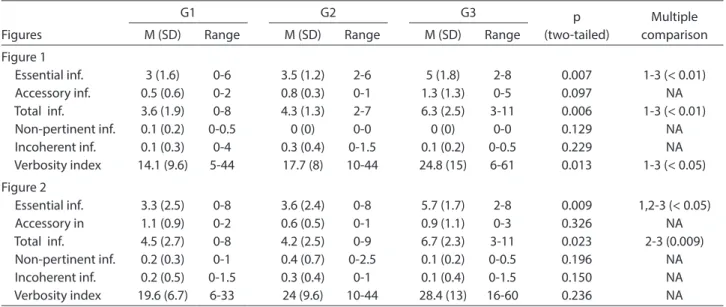
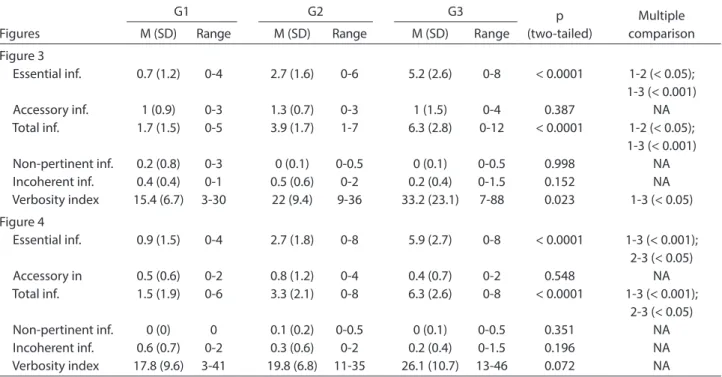
As shown in Table 1, there were no signiicant difer-ences in the subjects’ demographic variables regarding gender and age, except for educational level, as expected. Tables 2, 3 and 4 show that the groups performed difer-ently in the generation of inferences, according to school-ing, both on VSIS and VCIS pictures. Lower educated sub-jects performed worse on making essential inferences and in terms of total scores than did higher educated subjects for both visually simple and complex pictures. There were no diferences among the groups in making accessory, non-pertinent and incoherent inferences. In two groups (1 and 3), there was a statistically signiicant diference in the number of words generated (verbosity index) by the highest educated group compared to the lowest educated group for the narrative production, but this diference was not found in Figures 2 and 4 (Tables 2 and 3). Intragroup
comparison showed that visual complexity exerted a pow-erful negative efect on the lowest educated group, which performed poorer on the VCIS pictures (Table 4).
Discussion
The main purpose of our study was to verify the efect of schooling on the process of inference generation in a sample of elderly people, and this was achieved by control-ling the visual and inferential complexity of the pictures used as stimuli.
In the inference processing involving visually and infer-entially simple pictures, we observed that only the highly educated group (Group 3) had better performance in de-scribing the pictures. However, in the visually complex pic-tures, the three groups performed diferently. With regard to the essential propositions, the higher educated group (3) performed better in the description of both igures (simple and complex). For the visually complex igures, the medium educated group (2) performed similarly to the group with high schooling level on one igure and similarly
Table 1. Demographic characteristics of the sample.
Group
G1 G2 G3
p (two-tailed)
M (SD) Range M (SD) Range M (SD) Range
Age (yrs) 68.4 (4.2) 61-75 69.8 (5.8) 61-82 68.4 (7.3) 61-85 0.758 Schooling (yrs) 3.2 (1.3) 1-4 7 (1.2) 5-8 12.8 (2) 11-15 < 0.0001 Gender M F 7 8 6 9 7 8 0.913
M: mean; SD: standard deviation.
Table 2. Comparison among groups in making of inferences for Figures 1 and 2 (Visually simple and inferentially simple - VSIS).
Figures
G1 G2 G3 p
(two-tailed)
Multiple comparison M (SD) Range M (SD) Range M (SD) Range
Figure 1 Essential inf. Accessory inf. Total inf.
Non-pertinent inf. Incoherent inf. Verbosity index 3 (1.6) 0.5 (0.6) 3.6 (1.9) 0.1 (0.2) 0.1 (0.3) 14.1 (9.6) 0-6 0-2 0-8 0-0.5 0-4 5-44 3.5 (1.2) 0.8 (0.3) 4.3 (1.3) 0 (0) 0.3 (0.4) 17.7 (8) 2-6 0-1 2-7 0-0 0-1.5 10-44 5 (1.8) 1.3 (1.3) 6.3 (2.5) 0 (0) 0.1 (0.2) 24.8 (15) 2-8 0-5 3-11 0-0 0-0.5 6-61 0.007 0.097 0.006 0.129 0.229 0.013
1-3 (< 0.01) NA 1-3 (< 0.01)
NA NA 1-3 (< 0.05) Figure 2
Essential inf. Accessory in Total inf.
Non-pertinent inf. Incoherent inf. Verbosity index 3.3 (2.5) 1.1 (0.9) 4.5 (2.7) 0.2 (0.3) 0.2 (0.5) 19.6 (6.7) 0-8 0-2 0-8 0-1 0-1.5 6-33 3.6 (2.4) 0.6 (0.5) 4.2 (2.5) 0.4 (0.7) 0.3 (0.4) 24 (9.6) 0-8 0-1 0-9 0-2.5 0-1 10-44 5.7 (1.7) 0.9 (1.1) 6.7 (2.3) 0.1 (0.2) 0.1 (0.4) 28.4 (13) 2-8 0-3 3-11 0-0.5 0-1.5 16-60 0.009 0.326 0.023 0.196 0.150 0.236
1,2-3 (< 0.05) NA 2-3 (0.009)
NA NA NA
to the group with lower schooling level (1) on the other igure. In relation to accessory information, there were no diferences among the groups. With regard to the non-pertinent and incoherent propositions, the three groups behaved similarly.
Previous studies report that, in elderly subjects with an average schooling of 14 years, visual complexity does not interfere with picture description or inference generation abilities.12 These subjects had a slightly lower performance
in the generation of inferences for visually complex pic-tures compared to visually simple picpic-tures, but this difer-ence was not statistically signiicant. Our indings are in accordance with the data available not only for the highly educated individuals (over 11 years of schooling), but also for the lower and intermediate educated groups (Groups 1 and 2). In the latter, we noted lower performance of the less educated group (Group 1), even on those pictures which were visually simple. This group comprises subjects who, in
most cases have basic reading skills, but do not use these on a daily basis or for professional purposes. Our results con-irmed previous indings regarding the efect of schooling on verbal tasks that demand cognitive processing.26-28
The fact that we did not ind any diferences between the groups when considering the accessory propositions indicates that it is not necessary to subdivide the discourse when scoring the task. We did not ind any studies dealing with this issue. Therefore, we hypothesize that this inding is due to the fact that these propositions do not require complex integrations and associations, as do those involved in the inferential process itself. This information is merely a complement, and occurs independently to adequate infer-ential processing. Thus, not only does educational level play no part in it, but also the number of accessory propositions does not improve the subjects’ ability to make inferences. A study involving oral discourse production from graphic stimuli showed that the essential propositions
re-Table 3. Comparison among groups in making of inferences for Figures 3 and 4 (Visually complex and inferentially simple - VCIS).
Figures
G1 G2 G3 p
(two-tailed)
Multiple comparison M (SD) Range M (SD) Range M (SD) Range
Figure 3 Essential inf. Accessory inf. Total inf. Non-pertinent inf. Incoherent inf. Verbosity index 0.7 (1.2) 1 (0.9) 1.7 (1.5) 0.2 (0.8) 0.4 (0.4) 15.4 (6.7) 0-4 0-3 0-5 0-3 0-1 3-30 2.7 (1.6) 1.3 (0.7) 3.9 (1.7) 0 (0.1) 0.5 (0.6) 22 (9.4) 0-6 0-3 1-7 0-0.5 0-2 9-36 5.2 (2.6) 1 (1.5) 6.3 (2.8) 0 (0.1) 0.2 (0.4) 33.2 (23.1) 0-8 0-4 0-12 0-0.5 0-1.5 7-88 < 0.0001 0.387 < 0.0001 0.998 0.152 0.023
1-2 (< 0.05); 1-3 (< 0.001)
NA 1-2 (< 0.05); 1-3 (< 0.001)
NA NA 1-3 (< 0.05) Figure 4 Essential inf. Accessory in Total inf. Non-pertinent inf. Incoherent inf. Verbosity index 0.9 (1.5) 0.5 (0.6) 1.5 (1.9) 0 (0) 0.6 (0.7) 17.8 (9.6) 0-4 0-2 0-6 0 0-2 3-41 2.7 (1.8) 0.8 (1.2) 3.3 (2.1) 0.1 (0.2) 0.3 (0.6) 19.8 (6.8) 0-8 0-4 0-8 0-0.5 0-2 11-35 5.9 (2.7) 0.4 (0.7) 6.3 (2.6) 0 (0.1) 0.2 (0.4) 26.1 (10.7) 0-8 0-2 0-8 0-0.5 0-1.5 13-46 < 0.0001 0.548 < 0.0001 0.351 0.196 0.072
1-3 (< 0.001); 2-3 (< 0.05)
NA 1-3 (< 0.001);
2-3 (< 0.05) NA NA NA
M: mean; SD: standard deviation; NA: not applicable.
Table 4. Comparison among groups in the making of inferences for visually simple and inferentially simple (VSIS) and visually complex and inferentially simple (VCIS) igures.
Group
VSIS VCIS
p
M (SD) Range M (SD) Range
1 4 (2.3) 0-8 1.6 (1.7) 0-6 < 0.0001
2 4.2 (1.9) 0-8 3.6 (1.9) 0-8 0.141
mained in memory longer than accessory information. In the cited study, even after a time interval, the subjects failed to emit accessory propositions during the discourse pro-duction. The subjects did however, maintain the emission of macropropositions and the general text macrostruc-ture.13 Our indings corroborate these data.
An important point to be highlighted is that our re-sults suggest that the two visually simple (1 and 2) and complex (3 and 4) figures do not seem to be equiva-lent. This becomes evident especially on the analysis of the performance of the medium educated group, which resembled either the higher or the lower educat-ed groups in igures with the same degree of complexity. These results can be partially explained by the process of picture selection. The lack of standardized pictorial materi-al and inferentimateri-al tests in Brazilian Portuguese required the selection of igures according to an expert consensus, but these igures were not the subject of any prior pilot study.
Regarding the total number of words emitted by the subjects, our results showed that as educational level im-proved, the number of words emitted also increased and there was a continuum among the groups. However, sig-niicant diferences were found only between Groups 1 and 3 on one visually simple and one visually complex igure. These data also point to the fact that the two igures in the same category might not be perfectly equivalent, as previ-ously mentioned. Moreover, the computation of non-rele-vant and incoherent propositions, in which the three groups performed similarly, suggested that the subjects’ narratives were equivalent in pertinent content and, therefore school-ing seemed to exert a positive efect on the verbosity index.
A narrative or coherent report is a complex cognitive task that requires good organization and planning of language aspects including word and sentence ordering, correct use of articles, pronouns and conjunctions, as well as concor-dance and conjugation of verbs. These elements constitute the oral discourse cohesion, enabling the narrative to have relevance according to the proposed theme.21 The elderly
may acquire a high degree of cognitive expertise, derived from cultural inluence, which allows them to overcome the biological limitations of aging as well as to compen-sate for educational deicits and environmental hazards.21
There is a well known relationship between the abil-ity to comprehend and produce the macrostructure of the discourse and the ability to make inferences, with various levels of processing ranging from perception of the indi-vidual items to integration and association of relevant clues to previous experience.5
Most studies disclose the central importance of the context, understood as a collection of suppositions (infor-mation) that comes to the subjects’ mind as the inferential
process occurs. These suppositions may come from the environment (through the linguistic code or perceptual stimuli), from the long-term semantic memory (which stores our knowledge and beliefs) and from deductive rea-soning. These suppositions are then interpreted, leading to valid conclusions, by means of intuitive, qualitative and comparative judgments.29 In other words, the context will
contribute allowing the subject to adequately go through each step of the inferential process, allowing correct infer-ences to be made.
The inluence of schooling in the generation of infer-ences is conditioned by diferent types of context, as follows: a) Cultural context, formed by cultural principles and the inluence of knowledge within the limits of the particular representational units and the extracted inferences;30
b) Situational context, the circumstance of action, by which the subject’s intentions and perspectives are af-fected, and that contributes to stimulus processing; c) And principally, the personal context, which includes
the knowledge, attitudes, and emotional characteristics of the individual. For instance, subjects apprehend the meaning of a text by analyzing the details of the stimuli, linguistic rules and conventions in general, which in turn are conditioned by several elements: gender, age, education, occupation, etc.31
Our indings can be summarized as follows:
• Visual complexity interfered with the low and medium educated subjects’ ability to make inferences: the more complex the picture, the lower the performance in making inferences.
• Highly educated subjects maintained the same efec-tiveness in the making inferences, independently of the picture complexity. The process of inference generation in these subjects was superior for all pictures compared to low and medium educated subjects.
• Our results suggest a continuum in inferential process-ing, which is directly related to the schooling level. • In relation to the accessory information, there was no
in-luence of schooling level on performance of the subjects. These data should be taken into account in the devis-ing and/or selection of visual instruments for evaluation purposes in neuropsychological testing using visual mate-rial, or in the selection of visual material as a source of information for the public in general (such as signals and signboards), since these variations in interpretation related to schooling level probably occur in daily life situations.
References
em Discurso. 2005; 5. Available at: http:// www3. unisul.br/ paginas/ensino/pos/ linguagem/0503/05.htm. Acessado em 09.02.2009.
2. Lopez A, Alfredo O. Information and Inference as combined cognitive processes. Interdisciplinaria 2004;(n.esp):23-34. 3. Fonseca RP, Parente MAMP. Inferences and metaphor
com-prehension in aging. [Inferências e compreensão de metáforas no envelhecimento]. In: Parente MAMP. Cognição e envel-hecimento. Porto Alegre: Artmed; 2006:169- 80.
4. Kuperberg GR, Lakshaman BM, Caplan DN, Holcomb PJ. Making sense of discourse: an fMRI study of causal inference across sentences. Neuroimage 2006;1:343-61.
5. Myers PS. Communication disorders associated with right hemisphere damaged. In: Chapey R. Language interventions strategies in adult aphasia. 5th ed. Baltimore: Williams &
Wilkins; 2001:809-827.
6. Singer M, Remillard G. Retrieving text inferences: controlled and automatic inluences. Mem Cognit 2004;8:1223-1237. 7. Sternberg RJ. Psicologia cognitiva. Porto Alegre: Artmed; 2000. 8. Koch IGV, Travaglia LC. A coerência textual. 11. ed. São Paulo:
Contexto; 2001.
9. Johnson- Laird P. Mental models. Cambridge, MA: Harvard University Press; 1983.
10. Virtue S, Haberman J, Clancy Z, Parrish T, Jung Beeman M. Neural activity of inferences during story comprehension. Brain Res 2006;1084:104-114.
11. Sundermeier BA, Virtue SM, Marsolek CJ, Van den Broek P. Evidence for dissociable neural mechanisms underlying infer-ence generation in familiar and less-familiar scenarios. Brain Lang 2005;95:402-413.
12. Myers PS, Brookshire RH. Efect of visual and inferential vari-ables on scene descriptions by right-hemisphere-damaged and non-brain-damaged adults. J Speech Hear Res 1996; 39:870-80. 13. Kintsch W, Van Dijk TA. Strategies of discourse
comprehen-sion. New York: Academic Press; 1983.
14. Pereira Junior A. Comentário a respeito das bases neurobi-ológicas da aprendizagem. Interface (Botucatu). 1998;2. 15. Fonseca RP, Ferreira GD, Liedtke FV, Müller JL, Sarmento
TF, Parente MAMP. Alterações cognitivas, comunicativas e emocionais após lesão hemisférica direita: em busca de uma caracterização da síndrome do hemisfério direito. Psicologia USP. 2006;17:241-262.
16. Bartolo A, Benuzzi F, Nocetti L, Baraldi P, Nichelli P. Humor comprehension and appreciation: an FMRI study. J Cogn Neurosci 2006;18:1789-1798.
17. Bibby H, McDonald S. Theory of mind after traumatic brain injury. Neuropsychologia. 2005;43: 99-114.
18. Blonder LX, Heilman KM, Ketterson T, Rosenbek J, Raymer A, Crosson B, et al. Afective facial and lexical expression in aprosodic versus aphasic stroke patients. J Int Neuropsychol Soc 2005;11:677-685.
19. Kucharska-Pietura K, Phillips ML, Gernand W, David AS. Perception of emotions from faces and voices following uni-lateral brain damage. Neuropsychologia 2003;41:1082-1090. 20. Springer SP, Deutsch G. Left brain, right brain [Cérebro es-querdo, cérebro direito]. 2ed. São Paulo: Summus; 1998. 21. Brandão L, Parente MAMP. Studies on elderly language in the
last century. Interdisciplinary studies on aging [Os estudos de linguagem do idoso neste último século. Estudos interdisci-plinares sobre o envelhecimento] 2001;3:37-54.
22. Mansur LL, Radanovic M, Taquemori L, Greco L, Araújo GC. A study of the abilities in oral language comprehension of the Boston Diagnostic Aphasia Examination - Portuguese ver-sion: a reference guide for the Brazilian population. Braz J Med Bio Res 2005;38:277-292.
23. Brucki SMD. Suggestions for utilization of the Mini Mental State Examination in Brazil [Sugestões para o uso do Mini-Exame do Estado Mental no Brasil]. Arq Neuropsiquiatr 2003;61:777-781.
24. Bustamante SEZ, Bottino CMC, Lopes MA, Azevedo KD, Ho-totian SR, Litvoc J, Jacob Filho W. Combined instruments on the evaluation of dementia in the elderly: preliminary results. [Instrumentos combinados na avaliação de demência de ido-sos]. Arq Neuropsiquiatr 2003;61: 601-606.
25. Joanette Y, Goulet P, Ska B,Nespoulous JL. Informative con-tent of narrative discourse in brain-damaged right-handers. Brain Lang 1986;29:81-105.
26. Mansur LL, Radanovic M, Araújo GC, Taquemori LY, Greco LL. Boston Naming Test: performance of Brazilian population from São Paulo. Pró Fono. 2006;18:13-20.
27. Radanovic M, Mansur LL, Scaf M. Normative data for the Brazilian population in the Boston Diagnostic Aphasia Exam-ination: inluence of schooling. Braz J Med Biol Res 2004;37: 1731-1738.
28. Silveira JRC. The image: interpretation and communication [A imagem: Interpretação e comunicação]. In: Linguagem em Discurso. 2005; 5.
29. Machado MAR. The role of inferential process in the com-prehension of written texts. Thesis. [Portuguese]. Campinas, São Paulo: University of Campinas, 2005:65-67.
30. Dell’Isola R ilable at: http:// www3.unisul.br/paginas/ensino/ pos/linguagem/0503/05.htm./
31. LP. Reading: inferences and sociocultural context. [Leitura: inferências e contexto sociocultural]. 2001. 2. ed. Belo Hori-zonte: Formato Editorial.
Example 1
“Tem um homem com um vaso de plantas ou um café. É um vaso que estava no suporte”
[There is a man with a lowerpot or a cofee. It is a pot that was on a support.]
Scoring:
• Essential propositions: 0 • Accessory propositions: 0 • Non pertinent propositions: 0 • Incoherent propositions: 1
• Total number of words: 18 (in Portuguese) Example 2
“Aí tem um homem. Ele está sozinho. Ele está vestindo uma camisa pólo aberta no pescoço. Tem uma xícara em sua mão, que tem um líquido escuro que parece ser café, e está derramando porque ele sacode a xícara. Poderia se deduzir que ele colocou a xícara nos lábios para beber. Pela sua expressão de dor, ele deve ter queimado a boca.”
[There is a man. He is alone. He is wearing a polo shirt open at the neck. He has a cup in his hand, which has a dark liquid that appears to be cofee, and it is spilling out because he is shaking the cup. One could deduce that he placed the cup against his lips to drink. By his expression of pain, he must have burnt his mouth.]
Scoring:
Essential propositions: 8 Accessory propositions: 3 Non pertinent propositions: 0 Incoherent propositions: 0
Total number of words: 61 (in Portuguese)
APPENDIX
Examples of narratives based on the inferential processing and the respective scores.
In all examples, subjects had the same schooling level (Group 3-high).
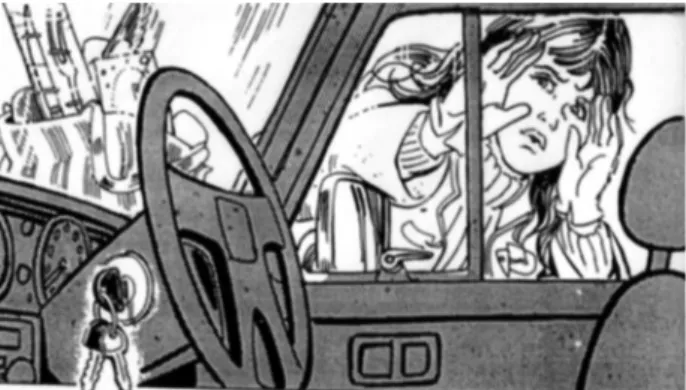
Figure 2. VCIS (Visually complex and inferentially simple).
Figure 1. VSIS (Visually simple and inferentially simple).
Example 1
“Aqui está uma chave pra abrir o porta-malas. A menina vai tirar a chave pra abrir atrás pra pegar alguma coisa.”
[Here is a key to open the trunk. The girl will get the key to open up the back and get something out.]
Scoring:
• Essential propositions: 0 • Accessory propositions: 1 • Non pertinent propositions: 0 • Incoherent propositions: 1
• Total number of words: 22 (in Portuguese) Example 2
“É o interior de um carro. É um carro inglês porque o volante está do lado direito. A chave está na ignição. A pes-soa que saiu bateu a porta com a chave lá dentro. O rosto é de uma menina, ela ta do lado de fora, com as mãos no vidro, olhando pra dentro. Tem compras no capô do carro, uma cartela com garfo e faca. Ela deve estar se perguntando “como será que eu vou entrar se a porta está trancada e a chave está lá dentro?”
[It is the interior of a car. It is an English car because the steering wheel is on the right. The key is in ignition. The per-son who left slammed the door with the key inside. The face is of a girl, she is outside, her hands on the glass, looking in-side. There are shopping items on the hood of the car, a card with a knife and a fork. She must be asking herself “how will I get in if the door is locked and the key is in there?]
Scoring:
Essential propositions: 8 Accessory propositions: 4 Non pertinent propositions: 0 Incoherent propositions: 0