© 2012 Dental Press Journal of Orthodontics 4 Dental Press J Orthod. 2012 Sept-Oct;17(5):4-7
orthodontic insight
Carlos Alexandre Câmara1
It is fundamental for orthodontists and all professionals related with facial, oral and dental esthetics to know how the in-dividuals observe dentofacial structures. Thus, it will be the purpose of this Orthodontic Insight to present and describe the Interest, Reference and Discrepancy. Points With the knowledge and perception of these points it will be easier for orthodontists to create a convergent canal of communication with their patients.
Keywords: Esthetics. Beauty. Orthodontics.
How to cite this article: Câmara CA. Esthetics in Orthodontics: Interest points, ref-erence points and discrepancy points. Dental Press J Orthod. 2012 Sept-Oct;17(5):4-7.
Submitted: June 22, 2011 - Revised and accepted: August 10, 2012
Contact address: Carlos Alexandre Leopoldo Peersen da Câmara E-mail: [email protected]
1 Specialist in Orthodontics (UERJ).
» The author reports no commercial, proprietary or financial interest in the products or companies described in this article.
Esthetics is the rational study of beauty, from the possibility of its definition,to the diversity of emotions and feelings that it raises in man.1
This definition, apparently simple, of the mean-ing of the word Esthetics, which can be found in sev-eral dictionaries,1 hides an extremely broad sense. The study and search of its real meaning in the West-ern world goes back to the greek philosophers such as Plato, Aristotle and Plotinus. The complexity of the term Esthetics is the result of several philosophi-cal theories that sought a consistent explanation for its meaning. The word Esthetic came to designate the general field of Esthetics, which included all cat-egories for which the artists and thinkers had shown
interest, such as Tragic, Sublime, Gracious, Laugh-able, Humorous etc.; saving the word Beauty for that special type, characterized by harmony, by the sense of measure, by the calm and serene fruition.2 Esthetic is, then, this kind of reformulation of the entire Phi-losophy in relation to Beauty. And, considering the complexity of the esthetic field comes the dilemma created by the irrational temptation: Beauty is in the eyes of the beholder or it is intrinsic to the object? Although this question cannot be solved in an easy way, for it is about a philosophical approach that each individual interprets in their own manner, it can and must be assisted on its conception, especially for orthodontists that work with dentofacial esthetics.
Esthetics in Orthodontics: Interest points,
reference points and discrepancy points
É fundamental para os ortodontistas e todos os profissionais que estão envolvidos com a estética facial, bucal e dentária conhecer a forma como os indivíduos observam as estruturas dentofaciais. Sendo assim, será o objetivo desse artigo apresentar e descrever os pontos de Interesse, de Referência e de Discrepância. Com o conhecimento e percepção desses pontos, será mais fácil para os ortodontistas criar canais convergentes de comunicação com os seu pacientes.
© 2012 Dental Press Journal of Orthodontics 5 Dental Press J Orthod. 2012 Sept-Oct;17(5):4-7
Câmara CA
Thus it is important that every professional that deals with orthodontic treatments with esthetical purpose is aware and alert to the parameters that affect the perception of Beauty, the type of beauty that really matters in an orthodontic treatment. Among these parameters there are concepts of es-thetic evaluation that are very important for its per-ception. From these concepts the Interest Points, Reference Points and Discrepancy Points will be presented in this insight. Although the examples presented in this insight are in the sagittal view, the Interest Points, reference and discrepancy are pre-sented in all plans of observation.
INTEREST POINTS
It is fundamental for orthodontists and all pro-fessionals that are involved with facial, buccal and dental esthetics to know how people observe a face. By tradition the clinician uses his own experience and empathy to predict what the observer can or must extract from a facial analysis, but he does not
always obtain the correct result. The eye-tracking technique provides an experimental proof about how people observe a scene or an image. In the pio-neer study performed by Yarbus,3 in 1967, the au-thor observed that the eye scans the image in quick jumps, moving from a focus of interest to another. These eye movements he denominated saccades and each point where the eye stops and observes “Interest Points”. The explanation for this phe-nomenon is due to the fact that the central part of the retina, the fovea, has high resolution; and the succession of saccades allows the brain to build a total view on the short term memory. It is possible to follow the saccadic eye movements and register the course of the look. However, this process is so quick (the saccades last between 20 to 200 millisec-ond) that most people do not notice their observa-tion pattern. In approximately one second it is pos-sible to focus in two or three Interest Points, also called points of fixation. The steady look pattern is affected by factors as news, complexity and incon-gruity. The moments of eye fixation, that occur dur-ing the observation of simple pictures, indicate that the Interest Points correspond to the angles of the picture. Other points that also call attention are the point of maximum curvature, unusual details and unpredictable contours.3
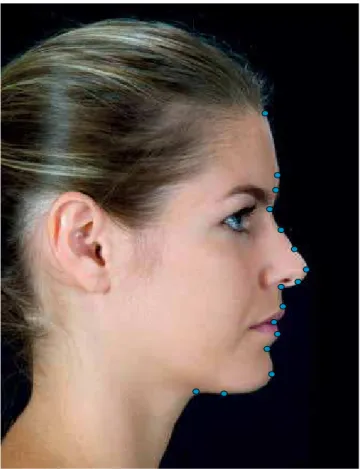
This acquaintance of the Interest Points created by the visualization of objects leads to the necessity to comprehend which are the Interest Points in a dentofacial esthetical analysis. As said before, the studies that sought an understanding of the main Interest Points show that the eye searches for spots and lines that are within three main characteristics: angles, maximum curvature (concave and convex) and unpredictable contours. The acquaintance of this information allows a facial analysis much more objective and effective. Recognizing the observed areas it is possible to evaluate more accurately the facial regions and characteristics that directly in-terfere on the dentofacial analysis, assisting and facilitating the comprehension of factors that af-fect positively and/or negatively for the creation of Beauty. From the Interest Points it can be derived another two concepts that assist and explain better its perception. They are: Reference Points and Dis-crepancy Points.
© 2012 Dental Press Journal of Orthodontics 6 Dental Press J Orthod. 2012 Sept-Oct;17(5):4-7
Esthetics in Orthodontics: Interest points, reference points and discrepancy points
orthodontic insight
REFERENCE POINTS
Reference Points are to locate, guide and limit structures of study units. They allow to see in a dif-ferent way the studied structures.
When we observe an object we have the tendency to stick to the whole image. That is natural, for an un-pretentious look search the information in a global way. However, for those who seek to interpret rigor-ously, the attention to details is fundamental for a correct evaluation. In these cases the recognition of Reference Points is necessary for the structure to be analyzed accurately and deeply. In an esthetical anal-ysis the determination of Reference Points is the ini-tial step for a correct interpretation of the structure. To determine these points must be the first accom-plishment of the analysis. With the Reference Points identified, the study of the object becomes simpler. It is possible to delimit the structure, as well as to per-ceive its proportions. Reference Points give condi-tions to observe the limits of the analyzed structures facilitating the study of the object, because with the delimitation of what is been observed it is much eas-ier and objective to analyze its components. Worth remembering that Reference Points used in facial
analysis are from craniofacial anthropometry and to facilitate the orientation and assure uniformity on the anthropometric terminology the points are named in Greek or Latin.4
DISCREPANCY POINTS
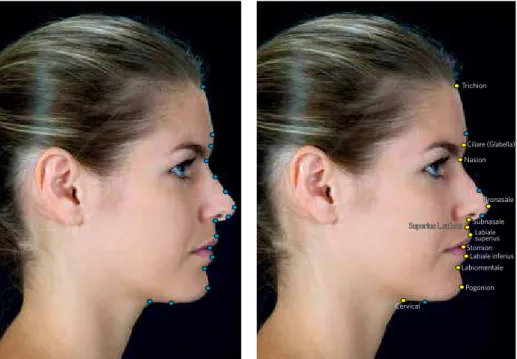
The human cerebral observation and interpre-tation is capable of evaluating both what pleases us and what displeases us. However, we frequently find difficulty to identify and measure the details that makes an object beautiful or ugly. In another words, although the general perception of beautiful and ugly is easy and inherent to all individuals, the capacity to identify the specific location of the er-ror is not always easy. Therefore, the Discrepancy Points are derivative from Interest Points and fa-cilitate the visualization of flaws. These points are seen every time that a solution of continuity occurs in lines that design and delimit specific structures. While the Reference Points indicate the location of the points that delimit the structures, the Discrep-ancy Points show the flaws. That is, every time that an unexpected or unwanted interruption occurs on the tracing of a line that represents the picture of Figure 2 -Sagittal view with Interest Points (in blue) and points of anthropometric references (in yellow) located in the facial profile line. Notice that the Interest Points include all Reference Points and some other points (in blue) that call attention from the observer.
Trichion
Nasion
Pronasale
Subnasale Labiale superius Superius L sulcus
Stomion Labiale inferius Labiomentale
Pogonion
Cervical
© 2012 Dental Press Journal of Orthodontics 7 Dental Press J Orthod. 2012 Sept-Oct;17(5):4-7
Câmara CA
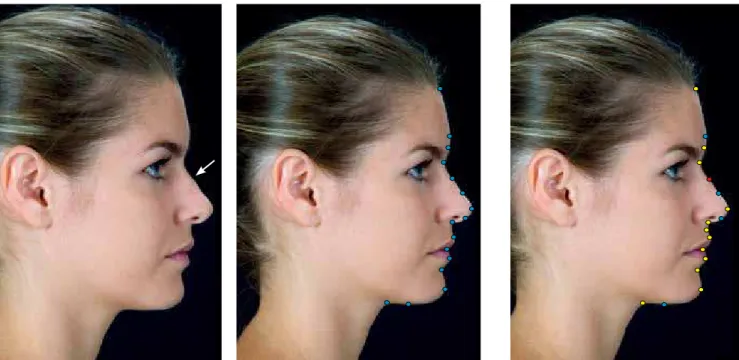
Figure 3 -Sagittal view with Interest Points (in blue), Reference Points (in yellow) and Discrepancy Points (in red). By manipulating the image on the computer a protuberance was added to the nasal dorsum (arrow) of the model, which created a new point of interest, that changed the esthetic percep-tion that we call point of discrepancy.
the analyzed part, breaking or damaging its harmo-ny, this flaw is considered as a Point of Discrepancy. Exaggerated or unexpected inclination of lines and structures can also be considered as Discrepancy Points. This evaluation and determination of the Discrepancy Points facilitate the perception of the problem. It is much easier to notice and quantify the error of a specific flaw when we identify these points. The attention given to Discrepancy Points leads the observer to a more careful analysis of the studied structure and eases the comprehension of specific needs. It is important to remember that Discrepancy Points have an intrinsic relation to Reference Points and it is necessary to have a clear idea of these last ones, so that the professional is alert for characteristics of normality. Only then the observer will have conditions to identify what is dis-crepant or has an unwanted alteration. The obser-vation of Discrepancy Points allows us to compre-hend the reason why some evaluations privilege the visualization of determined structures depending on the analyzed view. So, depending on the observa-tion plan (sagittal or frontal) the esthetic evaluaobserva-tion of determined structure can be changed, and this
change can be caused by the perception of Discrep-ancy Points that are found or not in a determined observation plan.
CONCLUSION
The Interest, Reference and Discrepancy Points are points that facilitate the visualization of analysis with esthetic perspective, allowing the professionals involved with esthetic orthodontic treatments to ob-serve more carefully the evaluated structures.
1. Ferreira, A. B. H. Novo Aurélio: o dicionário da língua portuguesa. Rio de Janeiro. Nova Fronteira. 1999.
2. Suassuna. A. Iniciação à estética. 10º ed. Rio de Janeiro. José Olympio. 2009. 3. Yarbus, A. L. Eye movement and vision. New York. Plenum. 1967.
4. Farkas, L. G. Anthropometry of the head and face in medicine. New York. Elsevier. 1987.