Research and Politics April-June 2015: 1 –10 © The Author(s) 2015 DOI: 10.1177/2053168015582287 rap.sagepub.com
Creative Commons CC-BY: This article is distributed under the terms of the Creative Commons Attribution 3.0 License (http://www.creativecommons.org/licenses/by/3.0/) which permits any use, reproduction and distribution of
the work without further permission provided the original work is attributed as specified on the SAGE and Open Access pages (https://us.sagepub.com/en-us/nam/open-access-at-sage).
Introduction
Understanding the interplay between collective decisions and collective intelligence is as important for small expert committees as it is for large democratic societies. The design of discussion rules and quorums critically shape the way groups find agreement and converge towards correct deci-sions. Advisory boards and expert committees are increas-ingly part of political decision making. Such committees make decisions on issues ranging from expected economic growth and tax estimates to estimates on the sea level in 2050 and 2100 (task of the “Intergovernmental Panel on Climate Change” (IPCC)). By definition of their task, com-mittee members share the same preference of correctly assessing the state of the world. Disagreement is limited to different beliefs about this state. Because of the presupposi-tion that a correct answer exists, the government and the public often expect experts to deliver consensual answers on which policy decisions and investments can be based.
Various aggregation methods of individual beliefs are used in such committees. For example, the preparation of the IPCC reports has recently been described as a “bazaar” of studies where actors “bargain” about the expected rise of the sea level (Bojanowski, 2011), and pooling of expert assessments has been used for truth-finding (Bamber and Aspinall, 2013). Such often chaotic political deliberation processes needs to be better informed by investigations about the interplay of collective decisions and collective
Majoritarian democracy undermines
truth-finding in deliberative committees
Jan Lorenz
1, Heiko Rauhut
2and Bernhard Kittel
3Abstract
The aggregated judgments of many usually outperform individual estimates of vaguely known facts. Communication among individuals may, however, undermine this wisdom-of-crowd effect because it makes judgments mutually dependent. Deliberative democratic theory, on the other hand, suggests that communication promotes correct decisions. We investigate this puzzle about the positive and negative consequences of consensus formation on the wisdom of crowds using experimental methods. Subjects in small deliberative committees had to communicate and thereafter judge vaguely known facts. We varied the agreement rules in groups and compared the groups’ change of performance from initial to final estimates. Interestingly, groups’ performance worsened on average when they had to reach a majority decision. Groups came on average closer to the truth if they had to decide unanimously or if they did not have any restrictions to reach agreement. The low performance under majority rule is robust against different knowledge questions, group sizes and communication types. The majority rule may be worst because it makes people too focused to reach a majority so that valuable minority opinions are disregarded or not even voiced. This implies that majoritarian democracy may be less suitable for truth-finding than less or more restrictive quorum rules.
Keywords
collective judgment, experimental political science, voting, deliberation, wisdom of crowds
1 Jacobs University, Focus Area Diversity and Bremen International
School for Social Sciences (BIGSSS), Bremen, Germany
2 Universität Zürich, Soziologisches Institut, Zürich, Switzerland 3 Universität Wien, Department of Economic Sociology, Wien, Austria
Corresponding author:
Jacobs University Bremen, Bremen International Graduate School of Social Sciences (BIGSSS), Campus Ring 1, 28759 Bremen, Germany. Email: [email protected]
intelligence, in particular the impact of quorum rules on truth-finding capacity. What works better: a majoritarian quorum, where strong approval is guaranteed but “esoteric” minority opinions can be disregarded? Or unanimity rule, where all minority opinions have to be taken seriously? Or should the deliberation process be unrestricted and allow for individual decisions from which political decision mak-ers extract their guiding policy, for example by averaging? This paper sheds light on these research questions with findings from a controlled experiment.
Truth-finding versus settlement in
deliberative committees
As early as 1907, Galton (1907b) demonstrated that aggre-gating the independent judgments of many individuals in an estimation competition approximates the true value with surprising accuracy. He argued that the median should be taken as method of aggregation (Galton, 1907a). The empirical finding has become a stylized fact and found its way into the popular science literature as the “wisdom-of-crowd phenomenon”, establishing the idea of collective intelligence (Surowiecki, 2004; Page, 2007). The median voter theorem (Downs, 1957) links the idea of median aggregation to majority rule which delivers the median voter’s opinion as its only stable outcome. From that per-spective majoritarian democracy should produce the wis-dom of the crowd.
In reality, expert committees do not simply aggregate or vote on their diverse beliefs. They typically decide after ample time of discussion, where they exchange arguments and knowledge to improve their capacity to make close to correct decisions. This exchange resembles the ideal of deliberative democracy (Thompson, 2008), according to which people debate, exchange and revise their beliefs in order to produce a rational consensus about the state of the world and appropriate collective action (Lehrer and Wagner, 1981; Mansbridge, 1983; Habermas, 1998).
In contrast to this ideal, a long tradition of social psycho-logical research has highlighted a variety of pitfalls of group discussions and decisions, such as group polarization and groupthink (Kerr and Tindale, 2004). Political science also highlights the possibility of the rational polarization (Spector, 2000). These and other mechanisms of polariza-tion (Dixit and Weibull, 2007; Pardos-Prado and Dinas, 2010; Wojcieszak, 2011) can shift behavior from proximity voting, which underlies the median voter theorem, to direc-tional voting (Adams et al., 2005), where voters intention-ally cast votes that are more extreme than their real positions. Even when communication and incentives are fully focused on truth-finding, communication undermines independence of judgments and thus the statistical founda-tion of the wisdom-of-crowd effect. Mild social influence about others’ estimates narrows the range of estimates to such an extent that the true value is often excluded (Lorenz
et al., 2011). This can create an exaggerated perception of accuracy in groups. The unresolved question is to what extent these social influence effects spoil truth-finding in committees and how this is moderated by quorum rules.
A conceptual step towards understanding truth-finding in groups is to distinguish it from finding a consensual set-tlement. These two dynamics can be separated into the con-cepts of “informational influence” and “normative influence”. Kaplan and Miller (1987) showed experimen-tally that for an intellective issue (assessing the size of a damage) people exerted more informational influence by sharing facts and persuading each other. For a judgmental issue (assessing the size of an appropriate punishment), they exerted more normative influence through reference to conformity and decision norms. The difference was stronger under unanimity rule than under majority rule. As truth-finding is an intellective issue, this implies that groups may be more focused on truth-finding under unanimity rule than under majority rule.
Similarly De Dreu et al. (2008) distinguish between epistemic and social motivation in group decision making. Epistemic motivation is the willingness to expend effort and search information to develop accurate and well-informed opinions. Social motivation is the preference for fair outcomes in the group, where people can be egoistic (proself) or fair (prosocial). Velden et al. (2007) showed experimentally that proself motives trigger minority opin-ion holders to block decisopin-ions under unanimity rule. Under majority rule, however, minority members are often over-ruled by proself majority opinion holders. This may imply that unanimity quorums may preserve valuable minority opinions better compared with majority quorums if the minorities sufficiently insist on their opinion.
The question of optimal quorums has a long tradition in political science. Buchanan and Tullock’s (1967) seminal proposition that the costs of decision making rise and the costs externalized on outsiders fall with an increasing quo-rum speaks for intermediate quoquo-rums, but it has received mixed support from experimental tests (Vanberg and Miller, 2013; Dougherty et al., 2014). Our research question is dif-ferent from this question because we focus on truth-finding, where subjects have common epistemic preferences instead of diverse egoistic preferences. Another related discussion addresses the relative merits of majority and unanimity in the dichotomous truth-finding problem of juries, guilt or innocent (Feddersen and Pesendorfer, 1998; Coughlan, 2000; Goeree and Yariv, 2011). In contrast to these lines of research, we frame the decision space as a continuum instead of a dichotomy (convict or acquit), and hence depart from these debates at a fundamental level.
minorities insist on their opinion. Instead, a majority quo-rum makes it easier to reach agreement in the group. However, there is little empirical evidence yet which shows under which quorum rules groups reach more accurate decisions. We thus designed an experiment to compare the ability of groups to find the truth under different agreement rules.
Experimental design
We translated the problem of deliberative collective judg-ment into a controlled computer-based laboratory experi-ment, using z-tree (Fischbacher, 2007) and ORSEE (Greiner, 2004). A total of 141 subjects were recruited from the student subject pool of the Experimental Laboratory at the University of Oldenburg. There were five sessions with 24 participants each. Another session consisted of 21 par-ticipants due to attrition.
The task in the experiment was to estimate quantitative facts about the real world. All questions were about per-centages which were typically not, or only vaguely, known by subjects. The full list of questions is shown in Table 1. Factual questions enable us to pose and incentivize group problems with unambiguous measures of performance based on an objective truth. Subjects were paid by the accu-racy of their answers (for details see below).
From pretests and earlier experiments we knew that the substance of the question has a large impact on results. This regards formal properties as the theoretical range or the location of the truth in the range, as well as population
properties as the felt difficulty, the diversity or a systematic bias. In real-world estimation problems of expert commit-tees where the truth is unknown to everybody, difficulty, diversity, and bias cannot be fully controlled a priori. Nevertheless, there might be mechanisms at play which have a substantial effect on average over many questions. To detect such mechanisms, it is thus important to test many different questions. On the other hand, it is also important to fix questions to control for other treatment effects. We chose a mixed strategy in our experiment with some questions we use very often and some questions we use in different versions (labeled a, b, and c in Table 1).
In each experimental session, subjects completed nine periods, each with a new estimation task. Each subject gave consecutive answers to each of the nine questions in two different stages. The first stage was a “private opinion stage” and the second one a “deliberation stage”.
Private opinion stage: Subjects gave a “private”
esti-mate. After this initial estimate, they were asked how certain they were about their estimate on a scale ranging from 1 (very uncertain) to 6 (very certain). Subjects knew that both values would never be communicated to other subjects.
Deliberation stage: Subjects were randomly assigned
to groups. Subjects could deliberate about their esti-mates via different electronic communication protocols. After finishing communication, subjects had to make a final decision. After each group member made a final
Table 1. List of questions (English translation, German original in the Online Appendix) and true values. In each session questions appeared in that order. Only one of the questions labeled a, b, c appeared in each experimental session.
ID Question Truth
1a What percent of the world’s population lives in Asia? 60.0
1b … North and South America? 13.5
1c … Africa? 15.0
2 What percent of the Earth’s surface is water? 70.8
3a What percent of the mass of the Earth’s crust is iron? 4.7
3b … aluminum? 8.1
3c … silicon? 27.7
4 What percent of the working population works in agriculture? 40.0
5a What percent of the eligible voted at the European election 1984 in the United Kingdom? 32.6
5b … France? 56.8
5c … Denmark? 52.4
6 What is the percent of votes of the USA at the World Bank (International Bank of Reconstruction and
Development)?
16.4
7a What is the percentage of water in a tomato? 93.0
7b … onion? 89.0
7c … cucumber? 95.0
8 Saudi Arabia consumes what percentage of the oil it produces? 19.0
9a What percent of the eligible voted at the federal election in Germany 2009? 70.9
9b … 1998? 82.2
decision, subjects were informed about the decisions of others in the group and whether they reached the neces-sary level of agreement. They were only informed about the true values and their payments after the end of the final period in order to minimize learning effects about group performance.
We varied the deliberation stage on three dimensions. Subjects had to deliberate about their estimates in differ-ently large groups, in different communication modes and they had to reach a final decision under different agreement rules.
(i) Group size (small versus large): Subjects
deliber-ated in groups of three or nine subjects.
(ii) Communication (qualitative versus quantitative): Deliberation was either implemented by a qualita-tive or by a quantitative communication protocol. Direct speaking was never allowed.
Qualitative communication happened in an ordinary chat window in which subjects could write to all other group members.
Quantitative communication was restricted to the infor-mation about 10 consecutive numerical estimates of others. Each subject had to state 10 estimates electronically which were shown to all group members immediately after they were entered by means of a table with a column for each group member. A new estimate was only possible when all others in the group had entered the same number of estimates.
(iii) Agreement rule (individual, majority, unanimity): Subjects had to make their final decision under one of three different agreement rules. They knew the rule already when starting to communicate. The final decision had to be entered simultaneously and privately after the deliberation stage was finished. We also required subjects to enter privately a final assessment of their certainty, using the same scale as in the private opinion stage.
In the individual treatment, there were no restrictions for collective agreement in final decisions. The majority treat-ment required an agreetreat-ment of a majority of group mem-bers. The unanimity treatment required an agreement of all group members. Hence, for a valid group decision, more than half of the group members had to enter exactly the same value under the majority rule and all members under the unanimity rule. Payments were based on the final group decision. Groups who failed to reach a valid group decision did not receive any payments. Disagreeing group members were paid based on the group decision. Under the individ-ual rule, subjects were individually paid out based on their final decision, regardless of the opinions of other group
members. The deliberation phase was here merely to exchange information.
Payments were a function of the distance between the final decision and the correct value: 4 Euros were paid for a distance not larger than 1.5 percentage points, 2 Euros for a distance not larger than 3, 1 Euro for a distance not larger than 6 and 50 Eurocents for a distance not larger than 12 percentage points. Distances larger than 12 units yielded no earnings. Thus, the payment differences from moving one unit closer to the correct value are always greater compared with the payment differences for moving one unit further away from the correct value. This generates an incentive to become better even if one believes to be already moder-ately close to the correct value. The payment function com-municates to subjects: “Your group (or yourself) performs well if you come really close to the truth. We are not satis-fied with moderately close answers. If you are way off, we don’t care about the magnitude and don’t pay you anyway”. The payment function also defines our main measure of performance.
Subjects were allocated to treatments based on a bal-anced treatment plan shown in the Online Appendix. In total we obtained a data table consisting of 1269 observa-tions, with each case collecting all entered data of a subject in one period. The dataset divides into 207 groups and each subject participated in nine of them. For questions Q2, Q4, Q6, Q8, and all question families (e.g. Q1a, Q1b, Q1c) we have groups with both communication modes, and group sizes and all three agreement rules. The experiment and the data is fully documented in the Online Appendix. Data and code producing figures and tables is available in a data-verse (Lorenz et al., 2015).
Results
Range reduction through communication
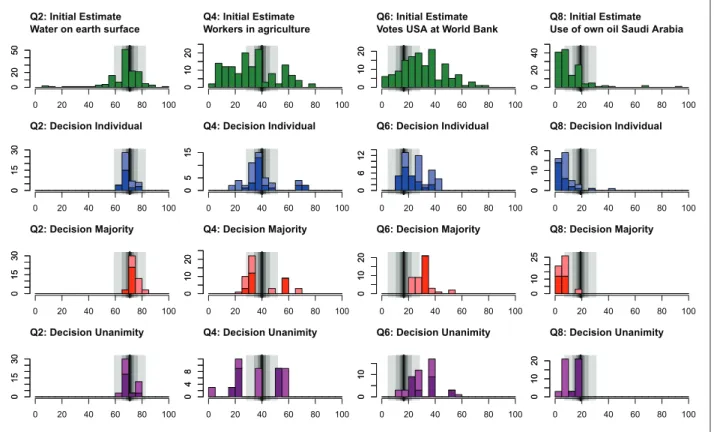
For a first impression of our data, we show the range of individual opinions before and after deliberation. Figure 1 shows histograms of opinions for the main questions Q2, Q4, Q6 and Q8. These questions were used under all agree-ment rules. (The histograms for the other questions are shown in the Online Appendix and yield similar results.) The first row shows the range of initial opinions. The rows below show opinions after deliberation under the individ-ual, majority and unanimity rule. It is apparent that the range of estimates becomes smaller under all quorum rules even when they do not have to agree. Likewise, groups agree on different opinions, which is demonstrated by the variance of group decisions under the unanimity rule.
Empirical inferiority of the majority quorum
group dataset. This aggregated data set is used to compute the following results for group performance. For the final decisions, majority and unanimity groups aggregated their group decision themselves through the agreement rule. For groups where subjects were paid individually, we took the median of the final decisions as the group decision as Galton (1907a) proposed. Analogously, initial and interme-diate estimates were aggregated by the median of all group members. The group decision was set missing if the group failed to agree. The individual certainty assessments for the initial estimate and the final decision were averaged to measure group certainty.
Group performance was measured in Euros by using the payment function from the experiment. In particular, we measure initial group performance and final group perfor-mance. Initial group performance is the potential payment of the group based on the initial estimates which were inde-pendent of the estimates of others. Deliberative group per-formance is the payment for the group decision. The effect of deliberation and agreement rule on group performance is measured by the change in group performance as the differ-ence between initial and final group performance. This change measure levels out the differences in initial perfor-mance under different agreement rules. Using the (potential)
payments instead of the raw distance to the truth is the natu-ral measure of performance regarding the incentives in the experimental setup. The Online Appendix shows robustness tests with alternative measures for the dependent variable: final performance after decision neglecting initial perfor-mance, the change of the distance to the truth, and the level of the distance to the truth after decision. Results are quali-tatively the same.
Figure 2A shows that the payoff of groups declined by about 0.3 Euros on average under the majority rule. In con-trast, performance increased by about 0.4 Euros on average under the unanimity and the individual rule. The difference between majority and both other rules is statistically sig-nificant (p≤ 0.01, see the Online Appendix). The average certainty of groups increased through deliberation. Interestingly, increase of certainty is strongest under the majority rule (Figure 2B). Looking at the absolute perfor-mance of collective decisions shows that groups under majority rule earned on average 0.7 Euros, while they earned 1.24 Euros under unanimity rules and 1.19 Euro under the individual rule. This corresponds to an average final group distance to the truth of 15.5 percentage points under majority rule compared to 9.8 and 10.4 under una-nimity and individual rule.
0 20 40 60 80 100
02
05
0
Q2: Initial Estimate Water on earth surface
02
05
0
0 20 40 60 80 100
01
02
0
Q4: Initial Estimate Workers in agriculture
01
02
0
0 20 40 60 80 100
01
02
0
Q6: Initial Estimate Votes USA at World Bank
01
02
0
0 20 40 60 80 100
02
04
0
Q8: Initial Estimate Use of own oil Saudi Arabia
02
04
0
0 20 40 60 80 100
01
53
0
Q2: Decision Individual
01
53
0
0 20 40 60 80 100
05
15
Q4: Decision Individual
05
15
0 20 40 60 80 100
06
12
Q6: Decision Individual
06
12
0 20 40 60 80 100
01
02
0
Q8: Decision Individual
01
02
0
0 20 40 60 80 100
01
53
0
Q2: Decision Majority
01
53
0
0 20 40 60 80 100
01
02
0
Q4: Decision Majority
01
02
0
0 20 40 60 80 100
01
02
0
Q6: Decision Majority
01
02
0
0 20 40 60 80 100
01
02
5
Q8: Decision Majority
01
02
5
0 20 40 60 80 100
01
53
0
Q2: Decision Unanimity
01
53
0
0 20 40 60 80 100
04
8
Q4: Decision Unanimity
04
8
0 20 40 60 80 100
01
0
Q6: Decision Unanimity
01
0
0 20 40 60 80 100
01
02
0
Q8: Decision Unanimity
01
02
0
Robustness over group size and mode of
communication
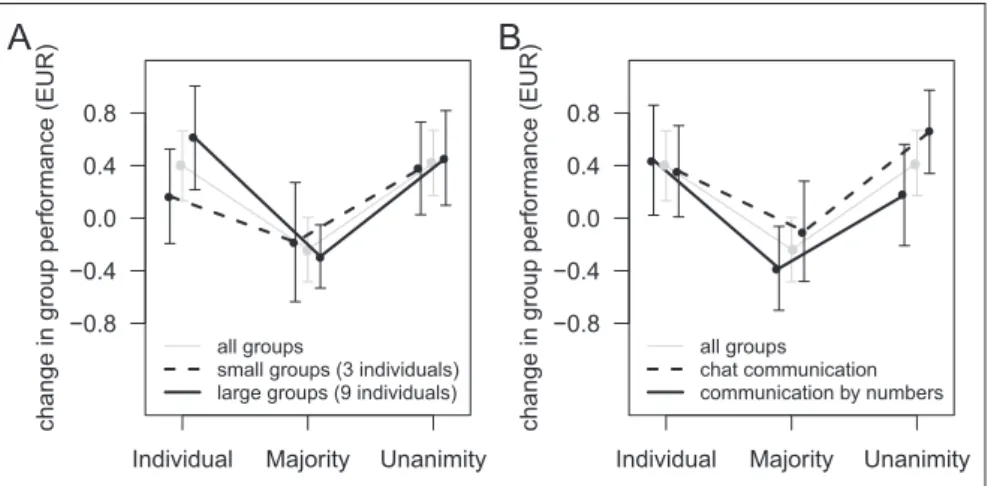
A crucial question is whether the inferiority of the major-ity quorum is robust across other aspects of the situation. Figure 3 demonstrates the robustness of our findings against group size and mode of communication. Both do not substantially change the effect of the agreement rule. This is also substantiated with a full factorial model of agreement rule, group size and communication and all two-way interactions (see the Online Appendix). There are mild effects suggesting that subjects under the indi-vidual rule might benefit from larger groups while it does not seem to help under unanimity and majority rule. Subjects under majority or unanimity rule seem to benefit more from communication by chat than subjects under the individual rule.
Robustness over different questions
Another important robustness check is whether the inferior-ity of the majorinferior-ity quorum is similar across different ques-tions. In order to test for question effects, we estimated a mixed maximum likelihood regression model treating the agreement rule as fixed effects and questions as random effects. Coefficients are shown in Table 2, documenting a significant and substantial difference in the change of group performance under majority rule compared to the other agreement rules. We compared the model with an analog fixed effects model for agreement rules and questions (see the Online Appendix). The Hausman test did not reject the null hypothesis that the two sets of coefficients are identical (p = 0.59). Given that question families 1, 3, 5, 7 and 9 have been phrased in slightly different ways in order to minimize session effects, we have also calculated coefficients for a
−0.3 0.0 0.3 0.6
c
hange
in
gr
oup
per
fo
rm
anc
e
(E
U
R
)
Individual Majority Unanimity
0.0 0.1 0.2 0.3 0.4 0.5 0.6
c
hange
in
gr
oup
c
e
rt
ai
nt
y
(
1−
6)
Individual Majority Unanimity
A
B
• •
•
•
•
•
Figure 2. Group performance deteriorates under the majority rule and improves under individual and unanimity rules (A). Certainty increases most under the majority rule and less under individual and unanimity rule (B). Data comprises of 69 runs in each agreement rule. Error bars are adjusted 95% confidence intervals (see the Online Appendix).
−0.8 −0.4 0.0 0.4 0.8
change in group per
fo
rm
ance (EUR)
Individual Majority Unanimity
all groups
small groups (3 individuals) large groups (9 individuals)
−0.8 −0.4 0.0 0.4 0.8
change in group per
fo
rm
ance (EUR)
Individual Majority Unanimity
all groups chat communication communication by numbers
A
B
•
••
•••
••• •••
• •
••
•
•
model restricted to the data relating to questions 2, 4, 6, and 8, which did not vary across treatments. The coefficients are robust to this change (see the Online Appendix). There is considerable variation over different questions regarding magnitude and direction of the effect as further shown in the Online Appendix, but majority rule is almost always inferior compared with the other rules.
Truth-finding or deliberating a settlement?
What mechanism may drive our finding that the majority quorum is inferior? We believe that different quorum rules trigger different kinds of social motivations in group members.
In order to assess social motivation for agreement, we calculated the extent of consensus in the three different agreement rules by averaging the number of finally agree-ing subjects in groups. Under majority rule these were 2.88 out of 3 in small groups and 8.17 out of 9 subject in large groups. This is much more than necessary for a successful majority decision. A total of 72.4% of all majority rule groups ended up in full unanimity. There was only one group which failed to reach a majority decision. This sug-gests that the majority rule triggers a strong motivation to reach an agreement and group members tend to follow the crowd more than necessary.
Under the unanimity rule, 5 out of 69 groups (7.2%) failed to reach a unanimous decision. In the individual treatment, there is much less consensus. Full agreement happened only in 7.2% of the groups and only in groups of three. These findings give an indication that majority rule triggers a bandwagon effect, where subjects converge too quickly on what seems to be a feasible group decision. Subjects under unanimity and individual rules seem to stay more focused in a truth-finding mode. Under the unanimity rule, group members with strong opinions can play out their veto power, because their expected payoff of decision fail-ure and subjection to the majority rule both equal zero.
Under the individual rule, where we aggregated the group decision by the median, the wisdom of crowd does a better job after deliberation. Both advantages are limited under the majority rule.
An additional argument for different motivations under different agreement rules is strategic reasoning. From a game-theoretic perspective, the motivation behind public opinion utterances can be twofold. First, one can inform others truthfully about one’s belief. Second, one can try to coordinate a collective decision as close as possible to one’s belief by strategic utterances of estimates, such as advanc-ing more extreme estimates.
The mix of different motives behind public utterances may be inferred by the empirical trajectories. Figure 4 gives an illustration. It shows the average time trend of group performance under number communication from initial pri-vate over ten intermediate estimates to the final group deci-sion. Average trends (top) are complemented by exemplary sessions for each agreement rule (bottom). The first row shows the average performance under individual, majority and unanimity rule. The two rows below exemplify the superiority of individual and unanimity rule over majority rule by single group trajectories.
The middle trajectory in Figure 4 serves as an illustra-tion for possible strategic reasoning. The four marked utter-ances can be assigned to the possible motivations: (a) truthful information of others about one’s belief; (b) strate-gic utterance higher than one’s belief to pull others towards one’s belief; (c) strategic decision to approach one agent in order to form a winning coalition; (d) confirm that the majority’s opinion is accepted.
Seeing our groups within the motivation model of De Dreu et al. (2008) we can first assume that all subjects have an epistemic motivation due to our payment scheme. Social motivations are particularly important under majority and unanimity rule, where others have to be persuaded to reach payments. Under majority rule, however, subjects may find themselves in a minority position in which they cannot
Table 2. Mixed effects regression with agreement rule as treatment variables and questions as random effects.
Dependent variable: change in performance
Coefficient Standard error p -value
Individual 0.74*** 0.27 0.006
Unanimity 0.68** 0.26 0.011
Intercept −0.14 0.23 0.546
Variance intercept 0.40 0.18
Variance residual 1.58 0.16
Number of observations 207
Number of groups 19
Wald χ2 9.34 0.0094
Log likelihood −353.2
enforce others to consider their epistemic judgments and may thus quickly loose their epistemic motivation in favor of social motivation. This may silently lead the group to “satisfice” under a low level of epistemic motivation, because finding a settlement represses truth-finding.
Conclusion
In summary, the majority quorum is surprisingly inappro-priate in aggregating the wisdom of the crowd. On average, majority rule leads deliberative groups to reach worse results in which they gain more confidence compared to groups deliberating under unanimity rule or without a requirement for agreement. The effect is robust over group size, mode of communication and different questions. There is variation within our results, and not every single
group on every single issue performs worse in truth-finding when using majority rule. Still, we think that the substantial difference warrants a careful consideration of the interplay of majority decisions and collective intelligence. When expert committees are established, they should either decide unanimously or aggregate independent judgments instead of imposing a majority decision.
It is noteworthy that our experiment does not create any conflict of interests. It is often argued that experts have con-flicting interests and therefore do not work towards finding the truth. We negated this problem with payments for find-ing the truth; even then, the majority rule proved to be an unfavorable institution for truth-finding. Hence, if we are concerned with truth-finding, then our results turn Buchanan and Tullock’s (1967, Ch. 6) argument about intermediate quorums for conflicts of interest between
Individual Majority Unanimity
deliberation period 1 2 3 4 5 6 7 8 9 10
p rivate decisio n Averag eg roup pe rfo rmanc e( € ) 0.5 1 1.3 0.84 1.28 deliberation period 1 2 3 4 5 6 7 8 9 10
p rivate decisio n Average group pe rfo rmanc e( € ) 0.5 1 1.3 1.04 0.66 deliberation period 1 2 3 4 5 6 7 8 9 10
p rivate decisio n Average group pe rfo rmanc e( € ) 0.5 1 1.3 0.85 1.03
Examples Examples Examples
deliberation time (min)
0 1 2 3
pr ivate decision Estimate (%) 0 25 50 75 100
Turnout EU parliament DK 1984 (52.4%)
0
0.5
deliberation time (min)
0 1 2 3
pr ivate decision Estimate (%) 0 25 50 75 100
Turnout EU parliament DK 1984 (32.6%)
c b d a 4 0 Possible motivation
astate private opinion b try to pull group up
cdecide for blue’s opinion d agree for majority’s sake
deliberation time (min) 0 1 p rivate decision Estimate (%) 0 25 50 75 100
Votes USA at World Bank (16.4%)
0.5
4
deliberation time (min)
0 1 2
pr ivate decision Estimate (%) 0 25 50 75 100
Mass of aluminium in earth crust (8.1%)
0.5
4
deliberation time (min)
0 1 2
pr ivate decision Estimate (%) 0 25 50 75 100
Water on earth surface (70.8%)
4 0.5 deliberation time (min) 0 1 p rivate decision Estimate (%) 0 25 50 75 100
Turnout Bundestag DE 2009 (70.9%)
0 4 € € € € € € € € € € € € € € € € € €
heterogeneous preferences on its head. The intermediate quorums is not best, but worst.
Of course, also the type of question and related system-atic biases, diversity of background knowledge and the level of difficulty have a large impact on performance. In contrast to the rules of deliberation and the agreement rule, these variables are typically not under the control of the principal who is looking for an assessment of an expert committee. Our results show that there is a significant, robust and substantial effect that majority rule is inferior for truth-finding in deliberative committees.
Acknowledgements
We thank Robert Goldstone and Stefan Herzog for sharing batter-ies of questions with us. The paper benefited from discussions in the Study Group “Dynamics of Collective Decisions” (2011– 2014) at the Hanse-Wissenschaftskolleg Institute for Advanced Study, Delmenhorst, Germany.The experimental design and work was done while Jan Lorenz and Bernhard Kittel were with the Carl von Ossietzky Universität Oldenburg, Germany.
Declaration of conflicting interest
The authors have no conflicts of interest to declare.
Funding
This work was supported by the Ministry of Science Culture in Lower Saxony. Jan Lorenz used a part of grant DFG LO2024/2-1 for the preparation of the manuscript.
Supplementary material
The online appendix is available at: http://rap.sagepub.com/con-tent/by/supplemental-data
References
Adams JF, Merrill S III and Grofman B (2005) A Unified Theory of Party Competition. Cambridge: Cambridge University Press.
Bamber JL and Aspinall WP (2013) An expert judgement assess-ment of future sea level rise from the ice sheets. Nature
Climate Change, advance online.
DOI:10.1038/ncli-mate1778.
Bojanowski A (2011) Klimarat feilscht um Daten zum Meeresspiegel-Anstieg. Spiegel Online (in German), 14 July 2011. Available at: http://www.spiegel.de/wissenschaft/ natur/0,1518,774312,00.html.
Buchanan J and Tullock G (1967) The calculus of consent: Logical foundations of constitutional democracy. Ann Arbor, MI: University of Michigan Press.
Coughlan PJ (2000) In defense of unanimous jury verdicts: Mistrials, communication, and strategic voting. The American Political Science Review 94(2): 375–393.
De Dreu CKW, Nijstad BA and van Knippenberg D (2008) Motivated information processing in group judgment and decision making. Personality and Social Psychology Review
12(1): 22–49. DOI:10.1177/1088868307304092.
Dixit AK and Weibull JW (2007) Political polarization.
Proceedings of the National Academy of Sciences of the United States of America 104(18): 7351–7356. DOI:10.1073/ pnas.0702071104.
Dougherty K, Pitts B, Moeller J and Ragan R (2014) An experi-mental study of the efficiency of unanimity rule and major-ity rule. Public Choice 158(3–4): 359–382. DOI:10.1007/ s11127-011-9901-0.
Downs A (1957) An Economic Theory of Democracy. New York: Harper & Row Publishers.
Feddersen T and Pesendorfer W (1998) Convicting the inno-cent: The inferiority of unanimous jury verdicts under strategic voting. The American Political Science Review
92(1): 23–35.
Fischbacher U (2007) z-Tree: Zurich toolbox for ready-made eco-nomic experiments. Experimental Economics 10(2): 171– 178. DOI:10.1007/s10683-006-9159-4.
Galton F (1907a) One vote, one value. Nature 75(1948): 414. DOI:10.1038/075414a0.
Galton F (1907b) Vox populi. Nature 75(1949): 450–451. DOI:10.1038/075450a0.
Goeree JK and Yariv L (2011) An experimental study of collective deliberation. Econometrica 79(3): 893–921. DOI:10.3982/ ECTA8852.
Greiner B (2004) An online recruitment system for economic experiments. In: Kurt Kremer VM (ed.) Forschung und wis-senschaftliches Rechnen 2003. GWDG Bericht 63. Ges. für Wiss. Datenverarbeitung, pp. 79–93.
Habermas J (1998) Between Facts and Norms: Contributions to a Discourse Theory of Law and Democracy (Studies in
Contemporary German Social Thought). Cambridge, MA:
MIT Press.
Kaplan MF and Miller CE (1987) Group decision making and normative versus informational influence: Effects of type of issue and assigned decision rule. Journal of Personality and Social Psychology 53(2): 306–313. DOI:10.1037/0022-3514.53.2.306.
Kerr NL and Tindale RS (2004) Group performance and deci-sion making. Annual Review of Psychology 55(1): 623–655. DOI:10.1146/annurev.psych.55.090902.142009.
Lehrer K and Wagner C (1981) Rational Consensus in Science and Society. Dordrecht, Holland: D. Reidel Publishing Company.
Lorenz J, Rauhut H and Kittel B (2015) Experimental data: Majoritarian democracy undermines truth-finding in delib-erative committees. DOI:10.7910/DVN/26907.
Lorenz J, Rauhut H, Schweitzer F and Helbing D (2011) How social influence can undermine the wisdom of crowd effect.
Proceedings of the National Academy of Sciences of the United States of America 108(22): 9020–9025. DOI:10.1073/ pnas.1008636108.
Mansbridge J (1983) Beyond Adversary Democracy. Chicago, IL: University of Chicago Press.
Page SE (2007) The Difference: How the Power of Diversity Creates Better Groups, Firms, Schools, and Societies. Princeton, NJ: Princeton University Press.
Pardos-Prado S and Dinas E (2010) Systemic polarisa-tion and spatial voting. European Journal of Political
Research 49(6): 759–786. DOI:10.1111/j.1475-6765.
Spector D (2000) Rational debate and one-dimensional conflict.
The Quarterly Journal of Economics 115(1): 181–200.
DOI:10.1162/003355300554700.
Surowiecki J (2004) The wisdom of crowds: Why the many are smarter than the few and how collective wisdom shapes business, economies, societies, and nations. Doubleday Books.
Thompson DF (2008) Deliberative democratic theory and empirical political science. Annual Review of Political Science 11(1): 497–520. DOI:10.1146/annurev. polisci.11.081306.070555.
Vanberg C and Miller L (2013) Decision costs in legislative bargaining: An experimental analysis. Public Choice 155: 373–394.
Velden FST, Beersma B and De Dreu CKW (2007) Majority and minority influence in group negotiation: The moderat-ing effects of social motivation and decision rules. Journal of Applied Psychology 92(1): 259–268. DOI:10.1037/0021-9010.92.1.259.
Wojcieszak M (2011) Deliberation and attitude polarization.