Arq Neuropsiquiatr 2008;66(2-A):268-271
268
PSEUDOANEURYSM OF THE INTERNAL
CAROTID ARTERY PRESENTING WITH
MASSIVE (RECURRENT) EPISTAXES
A life-threatening complication of craniofacial trauma
Marco Antonio Zanini
1, Adriana Tahara
1, Gabriel Siqueira dos Santos
1,
Carlos Clayton Macedo de Freitas
1,2, Mauricio Jory
2,3,
José Guilherme Mendes Pereira Caldas
2,3, Vitor Mendes Pereira
4PSEUDOANEURISMA DA ARTéRIA CARóTIDA INTERNA COM PROFUSAS E RECORRENTES EPISTAXES: COMPLICAçãO POTENCIALMENTE FATAL DO TRAUMA CRâNIO-FACIAL
1Disciplina de Neurocirurgia da Faculdade de Medicina de Botucatu, Universidade Estadual Paulista, Botucatu SP, Brasil (UNESP); 2Serviço de
Neurorra-diologia Diagnóstica e Intervencionista, Hospital das Clínicas da UNESP, Botucatu SP, Brasil (FMB/UNESP); 3Setor de Neurorradiologia Intervencionista
do Instituto de Radiologia, Hospital das Clínicas da USP, São Paulo SP, Brasil (FMUSP); 4Service de Neuroradiologie Diagnostique et Thérapeutique,
Hôpital de Bicetre, Paris, France.
Received 13 September 2007, received in inal form 2 January 2008. Accepted 18 February 2008.
Dr. Marco A. Zanini – Departamento de Neurologia e Psiquiatria / Faculdade de Medicina de Botucatu / UNESP - Rubião Jr S/N Cx. Postal: 540 - 18618-970 Botucatu SP, Brasil. E-mail: [email protected]
Vascular lesions can be serious complications result-ing of blunt or penetratresult-ing trauma1,2. Internal carotid
ar-tery lesion is one of most serious and relatively frequent in all mechanisms of craniofacial trauma. Several clinical manifestations can occur as central neurologic and cra-nial nerves deicits as well as several degrees of bleed-ing (from mild symptomatic to fatal). Recurrent and mas-sive epistaxis can occur after trauma due to pseudaoneu-rysms of the external and internal carotid artery (ICA)3,4.
Considering its life-threatening course, the assisting phy-sician has a relatively narrow time to detect and treat these lesions.
We present two cases of recurrent and massive epi-staxis secondary to ICA pseudoaneurysm following blunt and perforating trauma. Evolution was fatal in the irst case with delayed treatment and uneventfully in the sec-ond which was treated by occlusion of the pseudoaneu-rysm and ICA via endovascular intervention.
CASES
Case 1
A 22-year-old girl suffered a motor vehicle accident with fa-cial and cranial blunt trauma six months earlier. On admission at another institution, she presented nasal and oral bleeding and normal neurological examination (Glasgow score 15). Ad-mission computed tomography (CT) showed basal orbitofron-tal and maxillary fracture and no abnormality in the paranasal sinus (Fig 1). In subsequent days, she developed progressive right eye amaurosis, facial hypoesthesia, and epistaxis. Orbital
Arq Neuropsiquiatr 2008;66(2-A)
269 Internal carotid pseudoaneurysm: epistaxes Zanini et al.
(Fig 2). Digital subtraction angiography conirmed a giant trau-matic pseudoaneurysm of the cavernous segment of the right internal carotid artery with extension into the sphenoidal sinus (Fig 3). After several episodes of severe epistaxis over 17 days which were treated by nasal packing and blood transfusion, the patient was transferred to the authors’ facility. On admission, the patient was anemic and an abrupt and massive epistaxis oc-curred before proper treatment. The patient died despite con-tinuous blood transfusion and resuscitation maneuvers.
Case 2
A 23-year-old girl suffered two perforating knife wounds to the face, entering at the left nasal bone and left maxillary region. The blade crossed obliquely and cranially to the right, travers-ing the maxillary sinus and the pterygoid plate. On admission at another institution, she was hemodynamically stable with no evidence of other injuries. Conservative treatment was advo-cated as she was neurologically intact. Three months later she suffered headaches with recurrent massive epistaxis which was mistaken for upper gastrointestinal bleeding. Fifteen days later
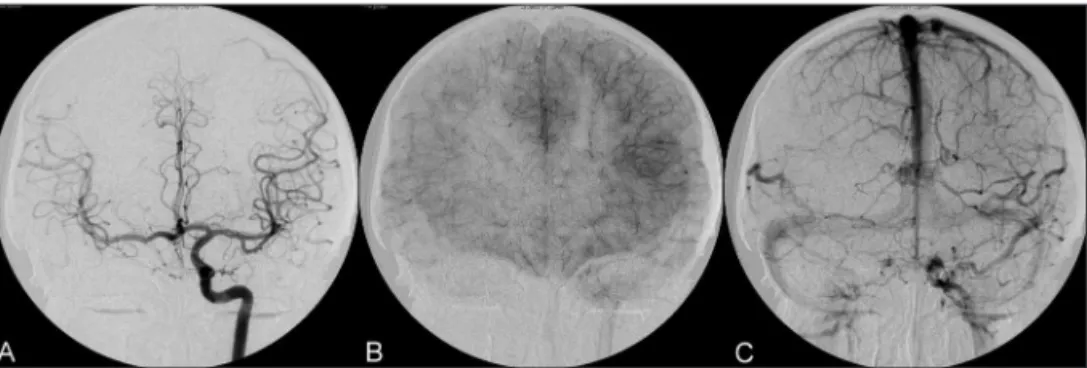
she was transferred to our hospital after several blood transfu-sions. On admission at our institution, she presented epistaxis, headache and anemic. Digital subtraction angiogram showed a pseudoaneurysm of the petrous-cavernous transition segment of the right internal carotid artery (Fig 4A and 4B). She was sub-mitted to balloon occlusion test followed by deinitive occlu-sion of the internal carotid artery at the level of the leocclu-sion with two occlusive balloons (Fig 4C and 4D). Epistaxis and headache ceased immediately after the procedure. The immediate and 6 Fig 2. Case 1. Pseudoaneurysm images ive months after trauma. (A–D) Contrasted CT scan showing
cranial base eroding mass with enhanced contrast media. (E–G) MRI showing heterogeneous mass in the sphenoidal area with internal low void.
Fig 3. Case 1. Digital subtraction angiography. (A) Anteroposterior view (B) lateral angiography of the right ICA demonstrating the cav-ernous segment giant pseudoaneurysm.
Arq Neuropsiquiatr 2008;66(2-A)
270
Internal carotid pseudoaneurysm: epistaxes Zanini et al.
months control angiogram showed no opaciication of the an-eurysm with proper collateral circulation (Fig 5). The patient is currently asymptomatic after seven months and performing her normal activities.
DISCUSSION
The pathological substrate of direct arterial neurovas-cular trauma consists of transection, dissection, throm-bosis, stenosis, arterio-venous istulae and formation of a pseudoaneurysm1,2,5. The traumatic lesion of the internal
carotid artery presents depending on the wall injury ex-tension. Intimal lesions (incomplete wall tear and throm-bus) presenting as thrombosis, stenosis or thromboem-bolic phenomena. Adventitial lesions also can occlude extrinsically the blood low. Dissection occurs when an intimal tear permits penetration of blood into the vessel wall with or without formation of a pseudoaneurysm6.
Transection occurs when complete wall compromising (adventitia, media and intimal) in a partial or complete cir-cumference of the vessel and present as an acute bleed-ing. In these cases, formation of arteriovenous istulae (ca-rotidocavernous if occurs inside the cavernous sinus)2,7 or
a pseudoaneurysm8,9 can be developed.
Traumatic pseudoaneurysm of the internal carotid ar-tery (TPICA) pathogenesis involves partial vessel transec-tion and formatransec-tion of a hematoma. The bleeding stops with counterpressure. The unclotted portion of the he-matoma located around the injured wall is illed by cir-culating blood in continuity with the arterial lumen. The hematoma liqueies in around one week and may rebleed. The blood causes an inlammatory reaction in surrounding tissue with the formation of a ibrous capsular wall and development of an epithelial lining. Continuous pulsatile forces can result in enlargement, weakening, and break-down of the ibrous wall8-10.
Usual clinical course is delayed, recurrent and well tolerated epistaxis to a severe bleed with hemodynamic instability, ranging from few days to several months,
al-though embolic phenomena and mass effect may also oc-cur11. Skull base TPICA can exhibit the classic triad of
uni-lateral blindness, orbital fractures, and massive epistaxis12.
Bleeding occurs in the posterior septum similar to other vascular injuries: ethmoidal arteries, branches of the oph-thalmic artery, sphenopalatine artery and internal maxil-lary artery. As a rule, traumatic arterial bleeding is more severe and more dificult to locate and control than in other epistaxis etiologies. Eventual rupture into the sphe-noid sinus results in massive and even fatal epistaxis with an associated 30-50% mortality rate8.
CT scan and MR provide initial information to suggest TPICA diagnosis11,13,14 and minimally invasive imaging such
as MR or CT angiography may conirm it2,14. However the
gold standard is considered to be carotid angiography1,2
and may provide the chance of prompt treatment by en-dovascular intervention. The angiographic features of pseudoaneurysm are: irregular contours of the aneurismal sac, lack of a deined neck, artery involvement, delayed emptying, and reduced opacity. Although TPICA is rare, it must be investigated in high risk patients: all knife pen-etrating trauma mainly if occurring in the orbitofrontal region or crossing the midline; blunt trauma patients with late neurological deterioration; cranial nerve palsy and amaurosis; and massive or mild recurrent post-traumatic epistaxis at any time in the past. Feiz-Erfan et al recently studying the incidence of direct neurovascular injuries as-sociated with blunt trauma to the skull base recommend-ed screening for neurovascular injuries in all patients with fractures of the clivus and sella turcica-sphenoid sinus1.
TPICA can be treated by surgery or endovascular in-tervention. These are either deconstructive, in which the affected blood vessel is removed from the circulation, or reconstructive, in which the injured area is excluded from the vessel but circulation is maintained13. Surgical
approaches are designed to either provide direct access to or bypass the lesion. A direct approach to the cavern-ous and petrcavern-ous ICA is challenging because anatomic
Arq Neuropsiquiatr 2008;66(2-A)
271 Internal carotid pseudoaneurysm: epistaxes Zanini et al.
straints limit direct operative exposure and distal control, and because of the fragile nature of the lesion preventing direct clipping9.
Endovascular treatment of the pseudoaneurysm may be with coils, stent, covered stent, or ICA balloon
occlu-sion6,7,9,15,16. Embolization with detachable platinum coil,
sometimes associated with stent, provides intracranial pseudoaneurysm obliteration while maintaining ICA low14. However there are reports of rebleeding after
coil-ing14,17,18. The use of a covered stent allows immediate
clo-sure of the incompetent wall segment of the artery while preserving blood low. However it may occlude arterial branches, many arterial stenoses have been currently re-ported and no data concerning the long-term patency are available8. Other disadvantages are dificulties of
place-ment and navigation in tortuous segplace-ments and expense. Currently, parent vessel occlusion has been the optimal measure and can be done even with coils or detachable balloons9. Detachable balloon occlusion of the ICA at the
level of the pseudoaneurysm is a quickly, easy, and less expensive procedure. It is important for occlusion to be performed at the level of the lesion, as well proximally, to avoid retrograde illing of the aneurysm by anastomoses from the Willis polygon or external carotid artery. A 30 minute balloon test occlusion (BTO) must be performed irst. During the test, clinical and angiography features are analyzed. Clinically, the patient must have no neurologi-cal disturbance during the test. Angiographineurologi-cally, venous phase appearance must be symmetrical or with a delay of no more than 2 seconds on the occlusion side com-pared with the contralateral side. Even with the patient passing the occlusion test, there is risk of ischemic com-plications. If the patient cannot tolerate the occlusion test, extra-to-intracranial (EC-IC) bypass surgery should be realized8,19. Bypasses can be accomplished from the
super-icial temporal artery to middle cerebral artery (MCA), or from external carotid artery to MCA using either saphe-nous vein or radial artery grafts19-22. Reported long-term
graft patency rates for saphenous vein grafts are 82% after 10 years22. The incidence of ischemic complications with
carotid artery ligation has been reported as high as 41% without bypass22. A lower complication rate is expected
if the BTO is performed19. In our case 2, carotid artery
oc-clusion by balloon was used because the patient passed the BTO and prompt epistaxis healing occurred. Unfortu-nately, case 1 could not be treated due to delay on refer-ring system, with a fatal outcome.
In conclusion, delay in diagnosis and treatment of pseudoaneurysm of the internal carotid artery can be very dangerous in patients and must be thoroughly in-vestigated in patients with recurrent or massive epistaxis and trauma history. Because the onset of TPICA
bleed-ing from the time of injury is variable, prompt diagnosis is clinically challenging. Optimal management demands rapid recognition and treatment to ensure the best out-come. Nowadays, endovascular occlusion of the pseu-doaneurysm and parent vessel provides the most quick and effective treatment for long-term resolution of these dangerous lesions.
REFERENCES
1. Feiz-Erfan I, Horn EM, Theodore N, et al. Incidence and pattern of direct blunt neurovascular injury associated with trauma to the skull base. J Neurosurg 2007;107:364-369.
2. Ray CE, Spalding SC, Cothren CC, Wang WS, Moore EE, Johnson SP. State of art: noninvasive imaging and management of neurovascular trauma. World J Emerg Surg 2007;2:1
3. Holger J. Epistaxis: a clinical study of 1724 patients. J Laryngol Otol 1974;88:317-327.
4. Chambers EF, Rosenblum AE, Norman D, et al. Traumatic aneurysms of cavernous internal carotid artery with secondary epistaxis. Am J Neu-roradiol 1981;2:405-409.
5. Lo YL, Yang TC, Liao CC, Yang ST. Diagnosis of internal carotid artery injury: the role of craniofacial fracture. J Craniof Surg 2007;18:361-368. 6. Scavée V, De Wispelaere JF, Mormont E, Coulier B, Trigaux JP, Schoe-vaerdts JC. Pseudoaneurysm of the internal carotid artery: treatment with a covered stent. Cardiovasc Intervent Radiol 2001;24:283-285. 7. Borba R, Sonda I, Dini LI, Calcagnotto FN, Marchett N, Cobalchini PC.
Fístula carótido-cavernosa com epistaxe letal: relato de caso. Arq Neu-ropsiquiatr 2001;59:276-279.
8. Celil G, Engin D, Orhan G, barbaros C, Hakan K, Adil E. Intractable ep-sitaxis related to cavernous carotid artery pseudoaneurysm: treatment of a case with covered stent. Auris Nasus Larynx 2004;31:275-278. 9. Bavinzski G, Killer M, Knosp E, Ferraz-Leite H, Gruber A, Richling B.
False aneurysm of the intracavernous carotid artery. Report of 7 cases. Acta Neurochir 1997;139:37-43.
10. Germiller JA, Myers LL, Harris MO, Bradford CR. Pseudoaneurysm of the proximal facial artery presenting as oropharyngeal hemorrhage. Head Neck 2001;23:259-263.
11. Lo YL, Yang TC, Liao CC, Yang ST. Diagnosis of traumatic internal carotid artery injury: the role of craniofacial fracture. J Craniof Surg 2007;18:361-368.
12. Barth G. Tödliche spätblutung aus der carotis interna nach schädeltrau-ma. Dtsch Med Wochenschr 1924;50:875-876.
13. Ray CE Jr, Spalding SC, Cothren CC, Wang WS, Moore EE, Johnson SP. State of the art: Noninvasive imaging and management of neurovas-cular trauma. World J Emerg Surg 2007;2:1.
14. Buerke B, Tombach B, Stoll W, Heindel W, Niederstadt T. Magnetic resonance angiography follow-up examinations to detect iatrogenic pseudoaneurysm following otorrhynolaryngological surgery. J Laryn-gol Otol 2007;121:698-701.
15. Higashida RT, Halbach VV, Dowd CF, et al. Intracranial aneurysms: in-terventional neurovascular treatment with detachable balloons: results in 215 cases. Radiology 1991;178:663-670.
16. Crow WN, Scott BA, Guinto FC Jr, et al. Massive epistaxis due to pseu-doaneurysm: treated with detachable balloons. Arch Otolaryngol Head Neck Surg 1992;118:321-324.
17. Teitelbaum GP, Halbach VV, Larsen DW, et al. Treatment of massive posterior epistaxis by detachable coil embolization of a cavernous in-ternal carotid artery aneurysm. Neuroradiology 1995;37:334-336. 18. Guglielmi G, Vinuela F, Sepetka I, et al. Electrothrombosis of saccular
aneurysms via endovascular approach. Part 2: electrochemical basis, technique, and experimental results. J Neurosurg 1991;75:1-7. 19. Jafar JJ, Russel Sm, Woo HH. Treatment of giant intracranial aneurysms
with saphenous vein extracranial-to-intracranial bypass grafting: indi-cations, operative technique, and results in 29 patients. Neurosurgery 2002;51:138-146.
20. Sekhar LN, Schramm VL, Jones NF, et al. Operative exposure and man-agement of the petrous and upper cervical internal carotid artery. Neu-rosurgery 1986;19:967-982.
21. Sen C, Sekhar LN. Direct vein graft reconstruction of the cavernous, pe-trous, and upper cervical internal carotid artery: Lessons learned from 30 cases. Neurosurgery 1992;30:732-743.