Arq Neuropsiquiatr 2008;66(2-B):328-330
328
RESTLESS LEGS SYNDROME IN
INSTITUTIONALIZED ELDERLY
Fábio Galvão Dantas
1, Jovany Luis Alves Medeiros
2, Kelly Soares Farias
3, Clarissa Dantas Ribeiro
3Abstract – Restless legs syndrome (RLS) is characterized by disturbing leg sensations associated to sleep complaints and excessive daytime somnolence. In the elderly, it affects 10 to 35%. Our objective was to determine the prevalence of RLS in institutionalized elderly, analyzing its relationship with clinical, laboratorial and neurophysiological features. We conducted a cross-sectional study of all the subjects under treatment on a chronic-care geriatric service by using face-to-face interviews, which include sleep complaints, the Epworth Sleepiness Scale and standardized questions addressing the four minimal criteria for RLS. The patients with RLS diagnosis received neurological examination, laboratorial tests and three of them, neurophysiological evaluation. The prevalence of RLS was 15.6%. Women were more affected and sleep complaints were frequent. There was no significance on other clinical, laboratorial or neurophysiological findings. We conclude that RLS is a prevalent condition in elderly, may lead to sleep complaints and is often underdiagnosed.
KEY WORDS: restless legs syndrome, prevalence, elderly.
Síndrome de pernas inquietas em idosos institucionalizados
Resumo – Síndrome de pernas inquietas (SPI) é um distúrbio caracterizado por sensações parestésicas nos membros, aliviadas à sua movimentação ativa. A patologia se associa freqüentemente a distúrbios do sono, sendo especialmente prevalente em idosos (10 a 35%), e pode estar associada a outras condições clínicas. Nosso objetivo foi determinar a prevalência da SPI em idosos institucionalizados, analisando queixas do sono e outras condições clínicas, bioquímicas e neurofisiológicas. Nós entrevistamos os idosos em regime de internato no Instituto São Vicente de Paula (Campina Grande, PB), utilizando questionários específicos para o sono, escala de sonolência de Epworth e um questionário para critérios mínimos para o diagnóstico de SPI. Os pacientes com o diagnóstico de SPI submeteram-se a exame neurológico, laboratoriais, e três deles, a exame neurofisiológico. A prevalência de SPI foi 15,62%, afetando especialmente o sexo feminino. Queixas de sono e patologias associadas foram freqüentes, embora os testes laboratoriais e neurofisiológicos não tenham acrescentado dados significativos. Nós concluímos que SPI é prevalente em idosos, relaciona-se a alterações do sono e é freqüentemente subdiagnosticada.
PALAVRAS-CHAVE: síndrome de pernas inquietas, prevalência, idosos.
Disciplina de Neurologia do Departamento de Fisioterapia da Universidade Estadual da Paraíba – Campus I – Campina Grande (UEPB): 1Médico
Neu-rologista Especialista em Neuroisiologia Clínica (áreas de EEG e Polissonograia), habilitado em Medicina do Sono, Professor Mestre do Departamento de Fisioterapia da Universidade Estadual da Paraíba, Doutorando do Programa de Pós-Graduação em Neuropsiquiatria e Ciências do Comportamento da Universidade Federal de Pernambuco; 2Médico Neurologista Especialista em Neuroisiologia Clínica (área de EEG), Professor Adjunto Doutor do
Departamento de Fisioterapia da Universidade Estadual da Paraíba; 3Acadêmica do Curso de Fisioterapia da Universidade Estadual da Paraíba. Pesquisa
apoiada pelo Programa Institucional de Iniciação Cientíica/UEPB.
Received 20 December 2007, received in inal form 15 April 2008. Accepted 27 April 2008.
Dr. Fábio Galvão Dantas – Departamento de Fisioterapia da Universidade Estadual da Paraíba - Avenida das Baraúnas 351 - 58109-753 Campina Grande PB - Brasil. E-mail: [email protected]
Restless legs syndrome (RLS) is a underdiagnosed neu-rological condition characterized by disturbing leg sensa-tions that may lead to severe anxiety, depression, sleep-disrupting and excessive daytime somnolence (EDS). Symptoms are usually more severe late in the day and at bedtime1. RLS affects about 1.06 to 15% of the general population2,3. Its prevalence increases with age4 and wom-en are more frequwom-ently affected5.
neuropa-Arq Neuropsiquiatr 2008;66(2-B)
329
Restless legs: elderly Dantas et al.
thology is not completely understood, RLS seems to be related to abnormal dopamine control, as the symptoms improve with dopaminergic drugs6.
In the present study, we aimed to investigate RLS prev-alence in institutionalized elderly, analyzing its relation-ship with insomnia, neurophysiological evaluation, clini-cal and laboratorial features.
METHOD Patients
From October/2006 through April/2007, we conducted a cross-sectional study of 64 subjects under treatment on a chron-ic-care geriatric service called Instituto São Vicente de Paula (Campina Grande, PB, Brazil). This institution is maintained by private and public donations and receives poor and frequent-ly abandoned elderfrequent-ly people. We excluded the patients young-er than 65 years, restricted to bed, suffyoung-ering with dementia and the subjects that did not cooperate with the interviewers. Af-ter that, were enrolled to study 32 patients.
Procedures
Two RLS-trained physiotherapy students (KSF and CDR) used standardized questions in face-to-face interviews. The positive or suspect cases were interviewed by one of us (FGD) to con-irm the diagnosis. All the participants were interviewed using a questionnaire on sleep complaints and the Epworth Sleepiness Scale (ESS) to evaluate EDS. They also were asked on standard-ized questions addressing the four minimal criteria for RLS10,11
(Table 1). The symptoms might occur at least ive times/ month. All the patients with RLS diagnosis were submitted to neurolog-ical examination and received laboratory evaluations for blood cells, urea, creatinin, free serum iron, ferritin. Three patients were evaluated with electromyography performed by one of us (JLAM). The patients with RLS were then paired by gender and age to a control group (elderly of the same institution with nega-tive diagnosis for RLS) for comparison of the laboratorial results.
Statistical analysis
Data were transcribed to the data bank of Windows Excel® software ile and were grouped into variables. One-way repeat-ed-measures analysis of variance (ANOVA) was used to compare
the results of laboratorial tests.A value of p<0.05 was consid-ered signiicant.
Ethics
This research protocol was approved by the Research Ethics Committee of the Paraíba State University (UEPB). All participat-ing patients gave written informed consent.
RESULTS
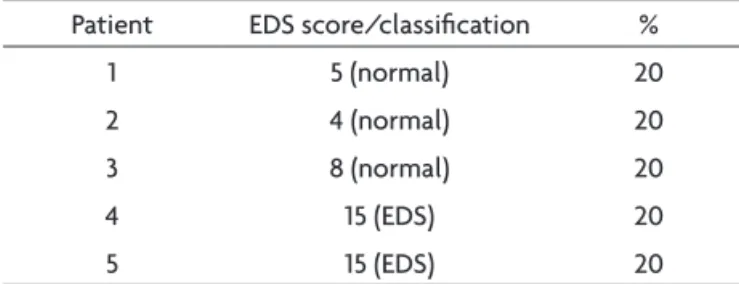
Thirty-two patients met the inclusion criteria, 11 men (34.3%) and 21 women (65.7%). Five of them (15.6%) had RLS, four women and one man. Table 2 depicts the main clinical features and electromyography results. The most prevalent sleep complaints were light sleep and insomnia. Table 3 depicts ESS results. One patient used sleep induc-tor and two complaint of snoring. The most frequent clin-ical pathologies were arterial hypertension (100%), diabe-tes (80%) and depression (20%). Neurological, neurophys-iologic and laboratorial examinations were normal.
DISCUSSION
In our sample, the prevalence of RLS was 15.6%. This value is within the range of values reported by other au-thors: 9.8%3 and 19%12. Other research2 found a prevalence of 1.06% in Japanese elderly, which suggests that maybe racial aspects may play a role on prevalence differences. Controversially, others found a prevalence of 44% in el-derly13. These results emphasizes that RLS is more preva-lent in elderly people and that more researches are need-ed to understand those differences.
Frequently, RLS is underdiagnosed because the symp-toms may be attributed to other causes, like anxiety, Table 1. Minimal criteria for restless legs syndrome diagnosis.
1. Unpleasant paraesthesias and disestesias of the legs or arms 2. Associated motor restlessness
3. Temporary improvement of symptoms with limbs movement or walking
4. Symptoms are more pronounced late in the day and at bedtime
Table 2. Clinical features and electromyography (EMG) examination in patients with restless legs syndrome.
Patient Age/gender Pain Numbness Cramps Itching MD Frequency SPB IS EMG 1 88/M Yes Yes Yes No No Daily Yes Move Normal 2 71/F Yes Yes Yes Yes No 3x/week Yes SH/SC – 3 85/F No Yes Yes No Yes 2x/week Yes Move Normal 4 79/F Yes No No Yes No Daily Yes Move/MAS – 5 73/F Yes No No No No Daily Yes Move/MAS Normal
Arq Neuropsiquiatr 2008;66(2-B)
330
Restless legs: elderly Dantas et al.
cramp or skin problems14. Our patients, for example, still did not have a correct diagnosis. RLS diagnosis is estab-lished on clinical criteria. Sometimes, the symptoms are not well described and it may lead to misinterpretation and a wrong diagnosis. One of the irst researches15 found a very high prevalence of RLS in a population (29%), but a questionnaire was used instead of a direct interview.
In our study, RLS was more prevalent in women. Other researches found similar results12,16,17. Yet this difference is not completely understood, hormones may play a role as RLS occurs in a higher prevalence in post-menopause and during the last trimester of pregnancy12. Conversely,
it may relect a greater life expectation for women18. In our series women were almost twice the number when compared to men.
Insomnia may affect 12 to 40% of elderly people19 and RLS is frequently associated to sleep complaints. Most of the RLS carriers look for medical assistance because of in-somnia10,17. In our research, most of the patients complaint
of insomnia, excessive daytime somnolence, enhanced sleeps latency and a not-refreshing sleep because of par-aesthesias and motor restlessness. These sleep complaints were also reported by other authors10,17,20 and they empha-size the impact of RLS on the patients daily activities.
Serum and cerebrospinal luid iron, ferritin and trans-ferring deiciency have been reported in association with RLS21. It was suggested that the low brain iron concentra-tion may result from a dysfuncconcentra-tion of iron transportaconcentra-tion from serum to CNS in idiopathic RLS patients22.
RLS has also been reported in association with main-tenance dialysis21 and chronic renal pathologies23-27. In our
study, all the RLS patients had normal renal studies, sug-gesting that these associations may be lacking, as reported by others26. We conclude that RLS is a prevalent condition in elderly and it may lead to sleep complaints. RLS is often underdiagnosed.
REFERENCES
1. Clark MM. Restless legs syndrome. J Am Board Fam Pract 2001;14:368-374. 2. Mizuno S, Miyaoka T, Inagaki T, Horiquchi J. Prevalence of restless legs
syndrome in non-institutionalized Japanese elderly. Psychiatry Clin Neurosci 2005;59:461-465.
3. Zucconi M, Ferini-Strambi L. Epidemiology and clinical indings of rest -less legs syndrome. Sleep Med 2004;5:293-299.
4. Berger K, von Eckardstein A, Trenkwalder C, Rothdach A, Junker R, Wei-land SKJ. Iron metabolism and the risk of restless legs syndrome in an el-derly general population - the MEMO Study. Neurol 2002;249:1195-1199. 5. Hening W, Allen RP, Tenzer P, Winkelman JW. Restless legs syndrome: demographics, presentation, and differential diagnosis. Geriatrics 2007;62:26-29.
6. Milligan SA, Chesson AL. Restless legs syndrome in the older adult: diagnosis and management. Drugs Aging 2002;19:741-751.
7. Bjorvatn B, Leissner L, Ulfberg J, et al. Prevalence, severity and risk fac-tors of restless legs syndrome in the general adult population in two Scandinavian countries. Sleep Med 2005;6:307-312.
8. Hornyak M, Trenkwalder C. Restless legs syndrome and periodic limb movement disorder in the elderly. J Psychosom Res 2004;56:543-548. 9. Winkelman JW, Shahar E, Sharief I, Gottlieb DJ.Association of restless
legs syndrome and cardiovascular disease in the Sleep Heart Health Study. Neurology 2008;70:35-42.
10. Walters AS. International Restless Legs Syndrome Study Group. To-ward a better definition of the restless legs syndrome. Mov Disord 1995;10:634-642.
11. Allen R, Picchietti D, Hening W, et al. Restless legs syndrome diagnostic cri-teria, special considerations and epidemiology. Sleep Med 2003;4:101-119. 12. Rothdach A; Trenkwalder C; Haberstock J; Keil U; Berger K. Preva-lence and risk factors of RLS in an elderly population. Neurology 2000;54:1064-1068.
13. Campos HH, Bitthecourt LRA, Haidar MA, Tuik S, Baract EC. Pre
-valência de distúrbios do sono na pós-menopausa. Rev Bras Ginecol Obstet 2005;27;731-736.
14. Sawle G. Movement disorders during Sleep. In Sawle G (Ed). Movement disorders in clinical practice. Oxford: Isis Medical Media 1999;159-165. 15. Strang R. The symptoms of restless legs. Med J Aust 1967;1:1211-1213. 16. Earley CJ. Clinical practice restless legs syndrome. N Engl J Med
2003;348:2103-2109.
17. Montplaisir J, Boucher S, Poirier G, Lavigne G, Lapierre O, Lesperance P. Clinical, polysomnographic, and genetic characteristics of restless legs syndrome: a study of 133 patients diagnosed with new standard criteria. Mov Disord 1997;12:61-65.
18. WHO. World Helth Statistics 2007. In: www.who.int/whosis/whostat2007. pdf. Access in 04-07-2008.
19. Morin CM, Hauri PJ, Espie CA, Spielman AJ, Beusse DJ, Bootzin RR. Non-pharmacological treatment of chronic insomnia. Sleep 1999;22:1134-1156. 20. Phillips B, Young T, Finn L, Asher K, Hening WA, Purvis C. Epidemiology
of restless legs symptoms in adults. Arch Intern Med 2000;160:2137-2141. 21. O’Keeffe ST. Secondary causes of restless legs syndrome in older
peo-ple. Age Ageing 2005;34:349-352.
22. Mizuno S, Mihara T, Miyaoka T, Inagaki T, Horiguchi J. CSF iron, ferritin and transferrin levels in restless legs syndrome. J Sleep Res 2005; 14:43-47. 23. Mucsi I, Molnar MZ, Ambrus C, et al. Restless legs syndrome, insom-nia and quality of life in patients on maintenance dialysis. Nephrol Dial Transplant 2005;20:571-577.
24. Goffredo-Filho GS, Gorine CC, Purysko AS, Silva HC, Elias IEF. Sín-drome das pernas inquietas em pacientes em programa de hemodiálise em Petrópolis, RJ: freqüência, aspectos laboratoriais e comorbidades. Arq Neuropsiquiatr 2003;61:723-727.
25. Collado-Seidel V, Kohner R, Samtleben W, Hillebrand GF, Oertel WH,
Trenkwalder C. Clinical and biochemical indings in uremic patients with
and without restless legs syndrome. Am J Kidney Dis 1998;31:324-328. 26. Winkelman JW, Chertow GM, Lazarus JM. Restless legs syndrome in
end-stage renal disease. Am J Kidney Dis 1996;28:372-378.
27. Miranda M, Araya F, Castillo JL, Duran C, Gonzalez F, Arís L. Síndrome de piernas inquietas: estudio clínico en población general adulta y en pacientes urémicos. Rev Med Chil 2001;129:179-186.
Table 3. EDS according to the ESS parameters in RLS patients.
Patient EDS score/classiication % 1 5 (normal) 20 2 4 (normal) 20 3 8 (normal) 20 4 15 (EDS) 20 5 15 (EDS) 20