ALPHA ABSOLUTE POWER
Motor learning of practical pistol shooting
Clayton Amaral Domingues
1,2, Sergio Machado
1,5, Emerson Garcia Cavaleiro
2,4,
Vernon Furtado
4, Mauricio Cagy
6, Pedro Ribeiro
1,3,4,5, Roberto Piedade
1Abstract – The present study aimed at investigating changes in behavior (shooting precision) and electrophysiological variables (absolute alpha power) during the motor learning of practical pistol shooting. The sample was composed of 23 healthy subjects, right-handed, male, between 18 and 20 years of age. The task consisted of four learning blocks. A One-way ANOVA with repeated measures and a post hoc analysis were employed to observe modifications on behavioral and electrophysiological measures (p<0.05). The results showed significative differences between blocks according to motor learning, and a significant improvement in shooting’s accuracy from both blocks. It was observed a decrease in alpha power in all electrodes examined during task execution when compared with baseline and learning control blocks. The findings suggest that alpha power decreases as the function of the motor learning task when subjects are engaged in the motor execution. Key words: qeeG, pistol shooting, motor learning.
Potência absoluta de alfa: aprendizagem motora do tiro prático de pistola
Resumo – o presente estudo teve por objetivo investigar alterações nas variáveis comportamentais (precisão do tiro) e eletrofisiológicas (potência absoluta de alfa) durante o aprendizado motor do tiro prático de pistola. A amostra constituiu-se de 20 sujeitos saudáveis, destros, sexo masculino, faixa etária entre 18 e 20 anos. A tarefa consistiu de quatro blocos de aprendizagem. A análise estatística das variáveis comportamentais e eletrofisiológicas foram realizadas por meio de uma ANOVA one-way e uma análise post hoc (p<0,05). os resultados demonstraram diferenças significativas entre os blocos em função do aprendizado motor, bem como uma sensível melhora na precisão do tiro de ambos os blocos. Foi observada uma diminuição na potência de alfa em todos os eletrodos analisados durante a execução da tarefa, quando comparados aos blocos de linha de base e controle da aprendizagem. os achados sugerem que a potência em alfa diminui devido o aprendizado motor quando sujeitos estão engajados na execução de uma tarefa motora complexa.
PAlAvrAs-chAve: eeGq, tiro de pistola, aprendizagem motora.
1laboratório de Mapeamento cerebral e Integração sensório-Motora, Instituto de Psiquiatria (IPUB), Universidade Federal do rio de Janeiro (UFrJ), rio de Janeiro rJ, Brasil; 2escola de Aperfeiçoamento de oiciais (esAo); 3departamento de Biociências, escola de educação Física e desportos (eeFd), Universidade Federal do rio de Janeiro (UFrJ), rio de Janeiro rJ, Brasil; 4Universidade castelo Branco (ProcIhM), rio de Janeiro rJ, Brasil; 5Instituto Brasileiro de Biociências Neurais (IBBN), rio de Janeiro rJ, Brasil; 6divisão de epidemiologia e Bioestatística, Instituto de saúde da comunidade, Uni-versidade Federal Fluminense (UFF), rio de Janeiro rJ, Brasil.
received 4 october 2007, received in inal form 3 March 2008. Accepted 25 March 2008.
Dr. Clayton Amaral Domingues – Rua General Savaget 3 / 101 - 21610-390 Rio de Janeiro RJ - Brasil. E-mail: [email protected]
The knowledge of motor learning effects on the cor-tex has become a challenge in neuroscience due the pro-cess of brain plasticity. The acquisition of new procedural knowledges supposedly is related to change in motor be-havior (i.e., learning), while retention of these knowledges is associated with memory aspects1. learning and memory are strongly related, once both processes share a similar neural mechanism. Both are also involved with attention´s control, sensory integration and perception2. learning gradually produces a reduction in error embedded in the task, increase coordination, agility and speed in
move-ment execution3. learning processes produces an internal representation which is seen through an increment in syn-aptic eficacy (“strength”) of neuron populations in cor-tical and subcorcor-tical structures4. The execution and con-solidation of motor act would lead to a new neural circuit organization, due the interaction of processes responsi-ble for short (i.e., sensory), working and long-term memo-ry3,5. The adjustment of this novel network would produce a reference´s system, which is inluenced by experience6.
memo-ry, strategy and goal oriented. The incorporation of motor gesture produces neuronal changes that can be detected with quantitative eletroencephalography (qeeG)7. sever-al studies have linked changes in corticsever-al maps according to the practice of closed skills, such as: shooting8-12, bow-ing and arrowbow-ing13,14 and goling15. In this manner,tasks as target shooting provide an original opportunity to study the processes of skill acquisition on the neural level. The shoot represent a complex motor-perception task which require a high level of procedural instructions, focal at-tention on aim apparatus, ine motor control in trigger ac-tivating, and postural stability9-11. These demands include temporo-spatial integration of visual, vestibular and pro-pioceptive information16-19. The essential behavioral mea-sures to assess learning and performance, such as preci-sion, values and impact disperpreci-sion, can be obtained and quantiied, which facilitate the assessment between pro-cessing and cortical performance10,11,19. The alpha power has been inversely correlated neural activation20,21. More-over, recent indings have reinforced the hypothesis of in-verse relationship between the alpha power and attention effort, planning and motor responses execution regarding the target shooting7-9,12.
Thus, the present study aimed at investigating chang-es in neural patterns in alpha band in frontal areas relat-ed to cognitive aspects during motor learning of practi-cal pistol shooting.
METHOd
Sample
The sample was composed for 20 healthy individuals of both sexes with ages varying between 18 and 20 years, right handed as edinburgh inventory22 and with director right eye, absence of
mental and physical illness (previous anamnesis). The subjects didn´t make use of any psychoactive or psychotropic substance at the time of the study. Moreover, they have not a sleep peri-od less than 6 to 8 hours at night before the experiment, and do not have previous experience in target shooting. All subjects signed a consent form and were aware of all experimental pro-tocol. The experiment was approved by the ethics committee of Federal University of rio de Janeiro.
Experimental procedures
The task was performed in a sound-attenuated room on in-door shoot Stand, adapted for practical pistol shooting,built inside Psychiatry Institute of Federal University of rio de Janei-ro.All subjects seated comfortably in a chair to reduce the arti-facts muscle, and a shoot table was used to support the hands and the gun. each subject was separately assessed in 3 moments: Base line (Bl1), Motor learning (Ml) and learning control (lc). In
irst moment (Bl1) the subject was sitting comfortably in a chair,
putted immediatly behind shoot line, with the hands over the lap. Besides, a qeeG was performed for 12 minutes (6 with close
and open eyes). In second moment (Ml) the subject was sitting with open eyes, holding a pistol (Taurus PT-380) and performing the complete task. The experiment consisted of 4 shoot blocks (B1, B2, B3 and B4) with 10 trials each, divided into 2 parts of 5
shoots with an interval of 2 minutes between them.The inter-vals favored the recovery of the active limb, avoiding muscular fatigue, and allowing any possible instruction. during the shoot execution, the participants should ire on the target mantaining the pistol aim apparatus, and the target center aligned.The qeeG was continually recording over the shoot blocks.during the task the lights were attenuated, the shooting’s room was isolated, thus, the subject does not suffered the interference of other vi-sual stimuli than the perception of vivi-sual stimulus (weapon and target). The subjects utilized special glasses for shooting to mi-nimise the double vision during the aim, which allowed the two eyes open during the shooting, preventing the facial fatigue in order to prevent artifacts. The third moment was performed 2 minutes after the last learning block, in same conditions as Bl1,
trying to verify signiicant differences between electrophysio-logical variables in relation to Bl1 and Ml.
Data acquisition
All data related to shoots were recording by Sam Trainer sys-tem (Knestel elektronik, Germany), which consiste of an elec-tronic device to register the data, based on an infrared signal in-terface emited for an optic device, adapted below the pistol’s frame and relected for 4 infrared sensorsarranged symmetrical-ly on a target located 5 meters in front of shooter. This system provides the impacts’ value, horizontal and vertical deviation prior the shooting (i.e., 6 seconds). Based on the report, it was possible to determine the shoot precision and the impacts dis-persion, allowing the mensuring of subjects’ performances. The results obtained between 0,1 and 10, correspondents to elec-tronic target area (10 cm in diameter) were selected, in order that this measure correspond to the center of the classic target on the practical pistol shooting. Impacts value equal or lower 6 were considered to low precision, between 6,1 and 9 moderated and above 9,1 very good. At the shooting moment, an eletronic sensoradapted to weapon emited an eletric pulse that marks in real-time the note channels of Braintech 3000 (emsa – Med-ical Instruments, Brazil). In this manner, it was possible to con-trol the eeGq recording during the 3 seconds prior to shoot and to delimitate the interests’ epochs.The International 10/20 sys-tem for electrodes23 was used with the 20-channel eeG system
pro-duced by the task. The data acquired had total amplitude of less than 100 µv. The eeG signal was ampliied with a gain of 22,000, analogically iltered between 0.01 hz (high-pass) and 35 hz (low-pass), and sampled at 240 hz. The software data Acquisition (delphi 5.0), developed at the Brain Mapping and sensory Motor Integration lab, was employed with the following digital ilters: notch (60 hz), high-pass of 0.3 hz and low-pass of 25 hz.
Data analysis and dependent measures
during the experiment, the behavior and electrophysiolog-ical variables were analysed. The behavior variables were ob-tained on the subjects’ performance in practical pistol shooting (i.e., shooting precision and impacts dispersion). The electro-physiological variables were recording from qeeG.The compu-tation’s variable was performedafter the recording and archiving of the qeeG data. The electroencephalographic signals were an-alyzed by MATlAB 5.3 (Matworks, ltd., UsA), which performed the Fourier Transform (FT). In this manner, based in eeG free ep-ochs (i.e., no artifacts),a threshold given by mean added up three standard deviation was established, and epochs with total power higher than this threshold were not integrate the analysis.
Statistical analysis
An ANOVA one way with repeated measures was used to
verifythe main effect for learning blocks (B1, B2, B3 e B4) on the dependent measure (performance in practical pistol shoot-ing), followed by a scheffé test (p<0.05). Another four ANOVA one way with repeated measures were performed to verify the main effect for blocks (six blocks - Bl1, B1, B2, B3, B4, e lc) on the alpha power varibility in frontal cortex, followed by a schef-fé test (p<0.05). The eeG absolute power values were log-trans-formed by SPSS software (version 15.0) to approximate a nor-mal distribution.
RESULTS
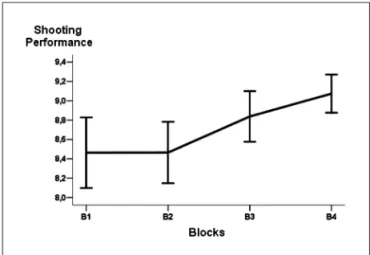
The irst analysis showed a signiicant difference be-tween the subjects performance over the learning blocks
(F(3,400)=4.214; p=0.006). The scheffé test demonstrated
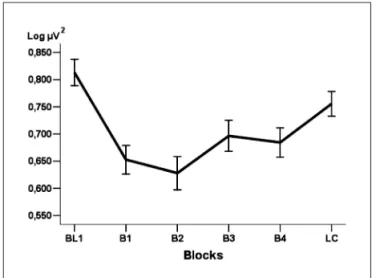
differences between B4 and B1 (p=0.034) and B4 and B2 (p=0.035) (Fig 1). In second analysis, it was veriied a signif-icant difference in alpha absolute power variability in F3 during the blocks (F(5.600)=9.741; p=0.000). Post hoc analysis stablished a signiicant decreasing over the motor learn-ing blocks (B1, B2, B3 and B4), when compared with control blocks (Bl1 and lc), however, B4 was not signiicantly
dif-ferent in relation to Bl1 (p=0.374) and lc (p=0.599) (Fig 2). The third analysis revealed that the alpha absolute pow-er variability in F4 could be expliained by blocks effect
(F(5.600)=19.544; p=0.000). The scheffé test demonstrated a
signiicant decreasing over the blocks (B1, B2, B3, and B4), when compared with control blocks (Bl1 and lc) (p=0.025)
(Fig 3). The fourth analysis indicated main effect for blocks
(F(5.600)=6.531; p=0.000) in alpha absolute power for F7. Post
Fig 1. Subjects’ performance during motor learning blocks (shooting blocks): impacts precision and dispersion.
Fig 2. Variability in F3 alpha power during the blocks.
Fig 3. Variability in F4 alpha power during the blocks. The increasing in alpha power in LC when compared with BL1 (p=0.025) suggest the
possibility of a learning consolidation.
demonstrat-ed a main effect for blocks (F(5.600)=8.540; p=0.000) in alpha
absolute power in F8. The results (scheffé test) demon-strated a signiicant decreasing during the blocks (B1, B2, B3 and B4), when compared with control blocks (Bl1)(Fig 5).
diScUSSiOn
our results will be discussed according to blocks main effect in relation to behavior (i.e., precision and shoot dis-persion) and electrophysiological (alpha power in F3, F4, F7 and F8 electrodes) measures.
Behavior measures – The results demonstrated an
im-provement in sujects performance over motor learning blocks, more evidently between B4 and B1, and between B4 and B2. In early phase of learning the sensorial stimulus dependence is essential for task execution4,5. The subjects were involved in basic skills coordination of task, such as, shoot position, weapon holdingand breath. Probably, it occurred a decreasing in attention processes related to main habilities, in other words, in target and trigger ac-tivating. It would explain the high variability in shooting
precision and an increasing in the lower precision shoots in early blocks (B1 and B2). In contrast, in the inal blocks (B3 and B4), it was demonstrated an increasing of basic skills’ domain and attention. In advanced stages of learning, the subjects better understanding the rules and the strate-gies of the task, and they can execute more automaticaly the fundamental habilities and reducing task complex-ity24. consequently, the shooter can maintain attention speciically in main shoot requirements, such as, integrate the better moment for trigger activation with the con-tinue low of visual and propioceptive feedback during the aim, even though minimizing intentionally the regula-tion of each component of the process separataly8,13,15. The inal result was reined of a motor-perception process, which leads to quality of movement improvement25-29.
Electrophysiological measures – The alpha band (8-12 hz)
was used to evaluate cognitive changes produced by sen-sory-motor task (practical pistol shooting)20,21,30. specii-cally, it was used absolute power measures to observe possible cortical changes.Absolute power is deined as total energy intensity of an electrode on a certain re-gion at different frequency bands15,17,28. There were seen signiicant differences between the interest blocks (Bl1, B1, B2, B3, B4 and lc), which are related to variability in alpha power with the cognitive processes during learn-ing task. First, it was veriied a signiicant decreaslearn-ing in all electrods (F3, F4, F7 and F8), when compared the control blocks (Bl1) and learning blocks (B1, B2, B3 and B4).
histori-cally, alpha power was inversely correlated to population of pyramidal neurons involved in perceptive, cognitive or motor tasks8,9,11,12. The evidences suggest that the increas-ing of alpha power plays a signiicant and adaptive role in the organization of visuo-spatial and motor processes during the target shooting. This gradual increase in alpha power can be considered an indication of learning, as it is linked to attention focused in the development of strat-egies and cognitive visuo-motoras11,12. The alpha band is associated with an increased neural synchrony and short effort, therefore, it is coupled with the best motor per-formance27.In this sense, the lower alpha absolute power over the motor learning blocks in relation to Bl1 and lc would explained by total inexperience on the task, fact which required beginners a high mental effort to inte-grate relevant stimulus of the task to produce a motor outcome according to experimental procedures.second, the movement is learned into segments, and the learning results in automation of these segments, more and more complexes. The prefrontal cortex is responsible to select the segments, requesting one just after other8,9,12,21. More-over, cognitive demand is inversely related to the use of segment structures (e.g., arm and hand)28. Therefore, our results demonstrated an increasing in alpha absolute
pow-Fig 4. Variability in F7 alpha power during the blocks.
er over the learning blocks, which suggests a decreasing of the cognitive demands during the task, suggesting an indicative of motor learning7,9,29. Third, the motor learning produces changes in cortical activation, in other words, along the practice occurred an increasing in alpha power (slow and rhythmic) in premotor areas. our hypothesis is that during planning to action occurr a comparison be-tween elements pre stored, (i.e., implicit memory) and new parameters of the upcoming motor action, leading to a major acuracy and less cognitive effort29.The differ-ence of processing between relevant and irrelevant tasks is probably facilitated by accumulation and storage of in-formation in long-term memory30, already the automation resulting of a decreasing in relationship between stimulus and answers and a reduction in information demand pro-vides from the memory10,12.An increase in alpha absolute power after motor learning can be interpreted as a reduc-tion of neuron activity in speciied regions, indicating a neural specialization. In this sense, our results suggest that the increasing in alpha power on the learning control block in F4 electrode when compared with others demonstrate a learning consolidation, as observed in Figure 3.In this manner, the experimental model used showed an effec-tive motor learning. Therefore, new investigations should replicate these indings maybe using new paradigms in-vestigating other bands, as beta and theta due yours rela-tionship respectively to motor and attention processes.
REfEREncES
1. Maxwell J, Masters R, Eves F. The role of working memory in motor learning and performance. Conscious Cogn 2003;12:376-402. 2. Jueptner M, Stephan K, Frith C, et al. Anatomy of motor learning: I.
Frontal cortex and attention to action. J Neurophysiol 1997;77:1313-1324. 3. Karni A, Gundela M, Jezzard P, et al. Functional MRI evidence for adult mo-tor cortex plasticity during momo-tor skill learning. Nature 1995;377:155-158. 4. Gandolfo F, Li C, Benda B, et al. Cortical correlates of learning in mon-keys adapting to a new dynamical environment. Proc Natl Acad Sci U S A 2000;29:2259-2263.
5. Cohen L, Brasil N, Pascual-Leone L, et al. Plasticity of cortical motor output organization following deafferentation, cerebral lesions, and skill acquisition. Adv Neurol 1993;63:187-200.
6. Wolpert D, Ghahramani Z, Flanagan R. Perspectives and problems in motor learning. Trends Cogn Sci 2001;5:487-494.
7. Smith M, McEvoy LK, Gevins A. Neurophysiological indices of strate-gy development and skill acquisition. Brain Res Cogn Brain Res 1999;7: 389-404.
8. Hatield BD, Landers DM, Ray WJ. Cognitive processes during self-paced motor performance: an electroencephalographic proile of skilled
marksmen. J Sport Psychol 1984;6:42-59.
9. Hauler A J, Spalding TA, Santa Maria DL, et al. Neuro-cognitive activ
-ity during a self-paced visuospatial task: comparative EEG proiles in
marksmen and novice shooters. Biol Psychol 2000;53:131-160.
10. Kerick SE, Douglass LW, Hatield BD. Cerebral cortical adaptations asso -ciated with visuomotor practice. Med Sci Sports Exerc 2004;36:118-129. 11. Hillman CH, Apparies RJ, Janelle CM, et al. An electrocortical compar-ison of executed and rejected shots in skilled marksmen. Biol Psychol 2000;52:71-83.
12. Kerick SE, Mcdowell K, Hung TM, et al. The role of the left temporal re-gion under the cognitive motor demands of shooting in skilled marks-men. Biol Psychol 2001;58:263-277.
13. Landers DM, Han M, Salazar W, et al. Effects of learning on electroen-cephalographic and electrocardiographic patterns in novice archers. Int J Sport Psychol 1994;25:313-330.
14. Salazar W, Landers DM, Petruzzello SJ, et al. Hemispheric asymmetry, cardiac response, and performance in elite archers. Res Q Exerc Sport 1990;61:351-359.
15. Crews DJ, Landers DM. Electroencephalographic measures of attention-al patterns prior to the golf putt. Med Sci Sports Exerc 1993;25:116-126. 16. Etzel EF. Validation of a conceptual model characterizing attention
among international rile shooters. J Sport Psychol 1979;1:281-290.
17. Konttinen N, Lyytinen H, Era P. Brain slow potentials and postural sway behavior during sharpshooting performance. J Motor Behav 1999; 31:11-20.
18. Hillman CH, Weiss EP, Hagberg JM, et al. The relationship of age and
cardiovascular itness to cognitive and motor processes. Psychophysi
-ology 2002;39:303-312.
19. Contreras-Vidal JL, Kerick SE. Independent component analysis of dynamic brain responses during visuomotor adaptation. Neuroimage 2004;21:936-945.
20. Grabner RH, Fink A, Stipacek A, et al. Intelligence and working
memo-ry systems: evidence of neural eficiency in alpha band ERD. Brain Res
Cogn Brain Res 2004;20:212-225.
21. Angelakisa E, Lubarb JF, Stathopouloua S, et al. Peak alpha frequency: an electroencephalographic measure of cognitive preparedness. Clin Neurophysiol 2004;115:887-897.
22. Oldield R. The assessment and analysis of handedness: the Edinburgh
inventory. Neuropsycology 1971;9:97-113.
23. Jasper H. The ten-twenty electrode system of the international federa-tion. EEG Clin Neurophysiol 1958;10:371-375.
24. Melcher T, Weidema M, Eenshuistra RM, et al. The neural substrate of the ideomotor principle: an event-related fMRI analysis. Neuroimage 2008;1;39:1274-1288.
25. Lawton GW, Hung TM, Saarela P, et al. Electroencephalographic and mental states associated with elite performance. J Sport Exerc Psychol 1998;20:35-53.
26. Hatield BD, Hillman CH. The psychophysiology of sport: a mechanis
-tic understanding of the psychology of superior performance. In: Sing-er RN, Hausenblaus HA, Janelle CM (Eds). The handbook of research on sport psychology, 2nd edition, New York: John Wiley, 2001:362-386.
27. Hantfield BD, Haufler AJ, Hung TM, et al. Electroencephalograph-ic studies of skilled psychomotor performance. J Clin Neurophysiol 2004;21:144-156.
28. Sakai K, Hikosaka O, Nakamura K. Emergence of rhythm during mo-tor learning. Trends Cogn Sci 2004;8:547-553.
29. Houk J. Outline of a theory of motor learning. In Requin J, Stelmach GE (Eds). Tutorials in motor neuroscience. NATO Advanced Science Insti-tute Series (ASI). Dordrecht, The Netherlands: Kluwer Academic Pub-lishers, 1991:253-269.