Percutaneous Occlusion of Patent Ductus Arteriosus
with the Amplatzer
®
Vascular Plug II Device:
Early Experience in Three Reference Centres
Luis Otávio Campanhã Sant’Anna
1, Rodrigo Nieckel da Costa
2, Marcelo Silva Ribeiro
3,
Wanda Teixeira do Nascimento
4, Fabrício Leite Pereira
5, Juliana Neves
6, Santiago Raul Arrieta
7,
Valmir Fernandes Fontes
8, Carlos Augusto Cardoso Pedra
9ABSTRACT
Background: The conventional devices available for the
percutaneous occlusion of a patent ductus arteriosus (PDA) may have limitations, especially in small children and adults with a large ductus arteriosus. The Amplatzer® Vascular Plug II (AVP II) device has been used in these scenarios with promising results. This study aims to report an early experience with the AVP II device at three reference centres.
Methods: This was a prospective study with retrospectively
collected data from patients who had undergone PDA occlu-sion with the AVP II since 2011. The devices were implanted using the anterograde approach under general anaesthesia, except for in one patient. Technical aspects, immediate occlusion, and complication rates were assessed. Results:
Forty patients (67.5% females) with a median age of 56.7 months (6 months to 654.7 months) and a median weight of 17.3 kg (5 kg to 93 kg) were included. Of these, 36 had a type A PDA, three had a type E PDA, and one had a type C PDA. The mean diameters of the ductus and of the device were 3.7 ± 1.5 mm and 9.4 ± 3.6 mm, respectively. In 3 patients, the initial device had to be replaced by another device of a different size. In one patient, an unsuccessful attempt led to the use of two implant devices. This patient was later referred for surgical repair. In five patients, a mild protrusion of the disc towards the aorta was observed, but the protrusion did not cause a significant pressure gradient. Residual flow was observed in two patients. There were no significant complications. Conclusions: The AVP II
1 Resident physician at Instituto Dante Pazzanese de Cardiologia and
Hospital do Coração da Associação do Sanatório Sírio. São Paulo, SP, Brazil.
2 Doctoral student in Science. Interventional cardiologist at Instituto
Dante Pazzanese de Cardiologia and Hospital do Coração da Associação do Sanatório Sírio. São Paulo, SP, Brazil.
3 Resident physician at Instituto Dante Pazzanese de Cardiologia and
Hospital do Coração da Associação do Sanatório Sírio. São Paulo, SP, Brazil.
4 Resident physician at Instituto Dante Pazzanese de Cardiologia. São
Paulo, SP, Brazil.
5 Resident physician at Instituto Dante Pazzanese de Cardiologia. São
Paulo, SP, Brazil.
6 Interventional cardiologist at Instituto de Medicina Integral Professor
Fernando Figueira. Recife, PE, Brazil.
Original Article
RESUMO
Oclusão Percutânea do Canal Arterial com a Prótese Amplatzer® Vascular Plug II: Experiência Inicial em Três Centros de Referência
Introdução: As próteses convencionais disponíveis para o
fe-chamento percutâneo da persistência do canal arterial (PCA) podem apresentar algumas limitações a seu uso, principalmente em crianças pequenas e em adultos com canais de maior diâ-metro. A prótese Amplatzer® Vascular Plug II (AVP II) tem sido
utilizada nesses casos com resultados animadores. Objetivamos apresentar a experiência inicial com AVP II em três centros de referência. Métodos: Estudo prospectivo, com coleta de dados retrospectiva, dos pacientes submetidos a fechamento de PCA com AVP II desde 2011. Os dispositivos foram implantados sob anestesia geral por via anterógrada, exceto em um paciente. Foram avaliados aspectos técnicos, taxa de oclusão imediata e complicações. Resultados: Foram selecionados 40 pacientes (67,5% do sexo feminino) com mediana de idade de 56,7 meses (6 meses a 654,7 meses) e mediana de peso de 17,3 kg (5 kg a 93 kg). Desses pacientes, 36 tinham PCA do tipo A, 3 do tipo E e 1 do tipo C. Os diâmetros médios do canal e da prótese foram de 3,7 ± 1,5 mm e de 9,4 ± 3,6 mm, respec-tivamente. Em 3 pacientes foi necessária a troca do dispositivo inicial por outro de diferente tamanho. Em uma paciente foi realizada tentativa de implante com 2 dispositivos, sem sucesso, a qual foi posteriormente encaminhada para correção cirúrgica. Em 5 pacientes foi observada discreta protrusão do disco para
© 2012 Elsevier Editora Ltda. and Sociedade Brasileira de Hemodinâmica e Cardiologia Intervencionista. All rights reserved.
7 Doctoral student in Science. Interventional cardiologist at Instituto
de Medicina Integral Professor Fernando Figueira. Recife, PE, Brazil.
8 Scientiic consultant on Interventional Cardiopediatrics at Instituto
Dante Pazzanese de Cardiologia. Physician in charge of Interventional Cardiopediatrics at Hospital do Coração da Associação do Sanatório Sírio. São Paulo, SP, Brazil.
9 PhD in Science. Head of the Congenital Cardiopathy Interventional
Section of Instituto Dante Pazzanese de Cardiologia and Interventional cardiologist at Hospital do Coração da Associação do Sanatório Sírio. São Paulo, SP, Brazil.
Correspondence to: Luis Otávio Campanhã Sant’Anna. Av. Dr. Dante Pazzanese, 500 – Ibirapuera – São Paulo, SP, Brasil – CEP 04012180 E-mail: [email protected]
device is a safe and effective alternative for PDA treatment, especially in patients with limitations to the conventional occlusion procedure.
DESCRIPTORS: Ductus arteriosus. Prostheses and implants.
Heart defects, congenital. Heart catheterisation.
P
atent ductus arteriosus (PDA) is one of the most common congenital cardiac lesions and accounts for up to 7% of all congenital heart diseases.1,2 Treatment is indicated in the irst year of life when there is heart failure or later, when there are negative hemodynamic consequences, including increased left ventricular dimensions on echocardiography.2 The timely closure of a PDA prevents the onset of complications such as heart failure, pulmonary arterial hypertension, arrhythmias, and possibly infectious endarteritis.1,2The percutaneous treatment of PDAs with last-generation intra-cardiac prostheses has been safely and effectively performed in several age groups, with the exception of neonates and young infants weighing < 4 to 5 kg.3
Several devices are used for closing a PDA; coils and plugs are the most common devices. The latter are prostheses designed exclusively for closing a PDA and consist of a body and a retention disc, which is positioned in the aortic side of the defect.3,4 However, in some anatomic variations5 (large-calibre tubular ductus, type A ductus with shallow aortic ampulla and small diameter, and angulated ductus), especially in low-weight patients, the distal disc can protrude to the aortic side and generate a pressure gradient in the aorta. The protrusion into the left pulmonary artery can also be occasionally observed in patients weighing < 8 to 10 kg. Moreover, the plug-type prosthesis, usually indicated for a ductus with a minimum diameter > 2.5 to 3 mm, is not provided by the Brazilian Uniied Health System (Sistema Único de Saúde – SUS) in Brazil, which limits the percutaneous treatment of PDAs in signiicant parts of the population of patients with this condition, including adults who typically have a larger diameter ductus and a wide and deep aortic ampulla. To overcome some of these limitations, the Amplatzer® Vascular Plug II device (AVP II, St. Jude Medical – St Paul, USA), originally designed for vessel occlusion, has been used for the percutaneous treatment of PDA with promising initial results.6-8 However, there have been few reports in the literature on studies of patients in whom this type of prosthesis was used for PDA closure.
The aim of this study was to present the experien ce of three hemodynamic services specialising in the treat-ment of congenital heart disease with the use of the AVP
a aorta sem ocasionar gradiente pressórico signiicativo. Houve luxo residual em 2 pacientes. Não ocorreram complicações signiicativas. Conclusões: O dispositivo AVP II é uma alterna-tiva segura e eicaz para o tratamento de PCA, principalmente naqueles que apresentam limitações ao fechamento convencional.
DESCRITORES: Canal arterial. Próteses e implantes. Cardiopatias congênitas. Cateterismo cardíaco.
II prosthesis for PDA closure. The technical aspects, im-mediate occlusion, and complication rates were evaluated.
METHODS
Study planning
This was an observational, prospective study with retrospective data collected from patients who under-went PDA closure with the AVP II prosthesis at three reference centres for the percutaneous treatment of congenital heart disease.
Selection criteria
Patients with a patent ductus arteriosus with hemo-dynamic effects, determined by left ventricular enlar-gement on echocardiogram, were included. Patients weighing < 5 kg, patients with ixed pulmonary artery hypertension and patients with active infection at the time of the procedure were excluded.
Procedure
All patients and/or guardians signed an informed consent, and the patients were taken to the catheteri-sation laboratory.
All patients underwent general anaesthesia and received prophylaxis for infectious endocarditis during the procedure; the antibiotic of choice was cefuroxime at a dose of 30 mg/kg to 50 mg/kg, followed by two additional doses. A femoral puncture was performed with the femoral sheaths positioned in the arterial and venous pathways. After the arterial puncture, heparin was administered at a dose of 50 U/kg to 100 U/kg, according to the institution’s routine protocol.
The implantation route was defined after choosing the prosthesis. In general, the route of choice was the antegrade venous route. The retrograde route was occa sionally used for a ductus < 3 mm. A therapeutic multipurpose or Judkins right coronary catheter with an internal diameter compatible with the passage of the device (defined by the table provided by the manufacturer) was used to deliver the prosthesis. New angiographies were performed before and after the prosthesis was released to evaluate the final position.
AVP II
The AVP II prosthesis, initially conceived for the occlusion of vessels (istulas, collaterals),9 consists of a nitinol mesh with varying numbers of wires (144 to 360) with different designs (one to three layers of wires)
(Figure 1 A and B). It has three discs of equal diameter without the presence of tissue inside. A small lexible joint between the discs allows their articulation. The prosthetic diameter starts at 3 mm and continues up to 22 mm, in 2 mm increments, beginning at 4 mm. The AVP II can be used with a guide catheter or extended introducers of varying sizes according to the manufac-turer’s recommendations. The speciications for diameters, lengths, and compatibilities are shown in Table 1.
The prosthesis was selected after considering the minimum diameter of the channel, the diameter of the aortic ampulla, the total length of the channel, and the total length of the aortic ampulla. In general, the di-ameter of the discs was at least two times greater than the minimum diameter of the channel, and was at most 1 mm larger than the largest diameter of the aortic ampulla. The length of the device (which increases ac-cording to the increase in disc diameter) did not exceed 1 to 2 mm of the total length of the ductus arteriosus. Because this is a device with three retention discs, two discs were positioned on the aortic side, and the third disc was positioned on the pulmonary side of the ductus arteriosus (Figures 2 and 3).
Follow-up
Echocardiographic assessments, chest radiographs, and electrocardiographic evaluations were performed in all patients before hospital discharge, which occurred the day after the procedure. A new echocardiogram was performed six months after implantation.
TABLE 1
Amplatzer® Vascular Plug II Models and Minimal Requirements
Amplatzer® Vascular Plug II Guide-catheter requirements
Diameter (mm)
Length (mm)
Minimum size
(F)
Minimum internal diameter
(inches)
Maximum internal diameter
(inches)
Maximum length
(cm)
3 6 5 0.056 0.067 100
4 6 5 0.056 0.098 100
6 6 5 0.056 0.098 100
8 7 5 0.056 0.106 100
10 7 6 0.070 0.106 100
12 9 6 0.070 0.106 100
14 10 8 0.086 0.106 100
16 12 8 0.086 0.106 100
18 14 9 0.098 0.106 100
20 16 9 0.098 0.106 100
22 18 9 0.098 0.106 100
Figure 1 – In A, Amplatzer® Vascular Plug II. In B, illustrative drawing
showing the three discs and the device’s nitinol mesh.
RESULTS
From March of 2011 to March of 2012, 40 patent ductus arteriosus closure procedures were performed in 40 patients using the AVP II device.
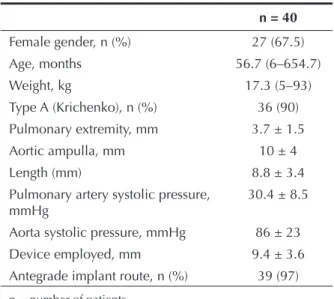
Of these patients, 27 were females (67.5%), and 13 were males (32.5%). The median age and weight were 56.7 months (6 months to 654.7 months) and 17.3 kg (5 kg to 93 kg), respectively. Ten patients
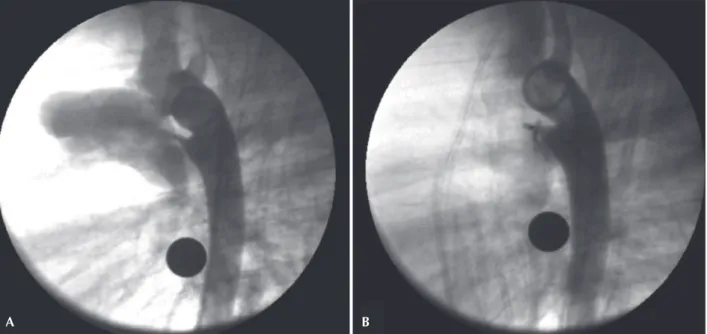
weighed < 10 kg. The ductus arteriosus was classi-fied, according to the Krichenko classification, as type A in 36 patients (90%), type E in three pa-tients, and type C in one patient. Measurements of the ductus arteriosus at the time of catheterisation were 3.7 ± 1.5 mm at the pulmonary extremity, 10 ± 4 mm in the aortic ampulla, and 8.8 ± 3.4 mm in length. The mean diameter of the device used was 9.4 ± 3.6 mm. The systolic pulmonary artery pressure Figure 2 – Ductus arteriosus type A with a 2 mm diameter at the pulmonary extremity. A 4 mm Amplatzer® Vascular Plug II device was successfully
employed. In A, initial aortography in the left view. In B, control aortography showing the device well positioned within the channel.
Figure 3 – Ductus arteriosus type A with a 2.8 mm diameter at the pulmonary extremity. An 8 mm Amplatzer® Vascular Plug II device was
success-fully employed. In A, initial aortography in left view. In B, control aortography showing the device well positioned within the ductus, with two discs inside the aortic ampulla and with no residual low.
A B
was 30.4 ± 8.5 mmHg, and the aortic systolic pres-sure was 86 ± 23 mmHg. The clinical, angiographic, and procedural data are shown in Table 2.
The antegrade implantation route was the preferred approach, with the exception of one procedure where the prosthesis was implanted using a retrograde route, which is the choice for patients with a small ductus because this route provides procedural dexterity. In this
patient, who weighed 59 kg, the retrograde approach was used to treat a 1.5-mm ductus arteriosus with a 3-mm prosthesis and a 5 F catheter (Figure 4).
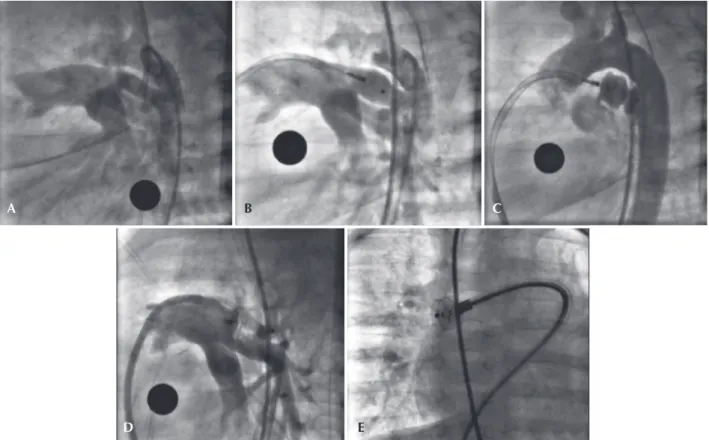
The procedure was successfully completed in all but one of the patients. This patient weighed 7.4 kg, and the ductus was type C, measuring 5.5 mm at both ends (Figure 5). The pulmonary artery systolic pressure was 38 mmHg, and attempts were made with 8-mm and 10-mm AVP II prostheses. The first prosthesis was not released and was replaced. The second prosthesis led to embolisation of the right pulmonary artery after its release and was successfully recovered with the aid of a bioptome. The patient was subsequently referred for surgery, and complications were not recorded.
The prosthesis showed a slight disk protrusion to the aortic side in ive patients, but none of them showed a signiicant pressure gradient as measured both in the catheterisation lab and on echocardiography.
In addition to the patient in whom embolisation occurred, device substitutions were required in three other patients. The irst patient, who had a 3-mm ductus arteriosus at the pulmonary extremity, needed to exchange an 8-mm prosthesis for a 6-mm one; the inal positioning was optimal (Figure 6). The second patient had a 5.7-mm PDA and a 16.8-mm aortic am-pulla. A 12-mm prosthesis implant was placed and then replaced by an 18-mm implant. The irst measurement of this ductus was 4 mm, most likely due to spasm during the injection of contrast, which resulted in an inaccurate assessment and undersizing of the prosthesis.
Figure 4 – Small (1.5 mm) ductus arteriosus in which a 3-mm Amplatzer® Vascular Plug II device was successfully implanted via a retrograde route.
In A, initial aortography in left view. In B, control aortography showing the device well positioned within the ductus and with no residual low.
TABLE 2
Clinical, Angiographic, and Procedural Data
n = 40
Female gender, n (%) 27 (67.5)
Age, months 56.7 (6–654.7)
Weight, kg 17.3 (5–93)
Type A (Krichenko), n (%) 36 (90)
Pulmonary extremity, mm 3.7 ± 1.5
Aortic ampulla, mm 10 ± 4
Length (mm) 8.8 ± 3.4
Pulmonary artery systolic pressure,
mmHg 30.4 ± 8.5
Aorta systolic pressure, mmHg 86 ± 23
Device employed, mm 9.4 ± 3.6
Antegrade implant route, n (%) 39 (97)
n = number of patients.
Figure 5 – Tubular ductus arteriosus type C, of high low, with 5.5 mm diameter at both ends. Unsuccessful attempts were made to implant 8-mm and 10-mm Amplatzer® Vascular Plug II devices, with a resulting embolisation of the 10-mm prosthesis to the right pulmonary artery; the device
was recovered with a bioptome. The control angiography after prosthesis recovery showed no signs of injury to the vascular wall. In A, initial aortography in left proile. In B, control aortography showing the 8-mm device poorly positioned within the ductus. In C, control aortography showing the 10-mm device well positioned within the ductus before its release. In D, the pulmonary trunk angiography showing the 10-mm device with protrusion toward the pulmonary artery after its release. In E, the embolised device in the pulmonary artery during recovery of the device, which was achieved using a bioptome.
D E
A B C
A B C
Figure 6 – PDA type E measuring 3 mm at the pulmonary extremity, in which an 8-mm Amplatzer® Vascular Plug II implant was placed and
subse-quently successfully replaced by a 6-mm one. In A, initial aortography in left view. In B, the angiography performed in the pulmonary trunk showing the 8-mm prosthesis with disc protrusion into the left pulmonary artery. In C, control aortography showing the 6-mm device well positioned within the ductus, with slight residual low.
The third patient who required a device to be replaced had a 3.5-mm ductus arteriosus that was implanted in a 6.5 x 5 mm Flipper coil, which embolised and
All but one patient underwent post-procedure recovery in the catheterisation laboratory. The only patient whose recovery took place in the intensive care unit was a 9-month-old child who weighed 5 kg; after a period of six hours, the child was transferred to the paediatric ward.
The echocardiographic study performed 24 hours after the procedure showed complete closure of low through the ductus arteriosus in all cases, except in two patients, who had minimal residual low. There was no increase in low velocity in the aorta or pulmonary artery. Those patients with minimal residual low still had less than six months of follow-up when this article was written.
DISCUSSION
The present experience with the AVP II device showed good results, with high rates of PDA closure. Echocardiography performed 24 hours after the procedure revealed only intra-prosthesis residual low with a low velocity. Due to the manufacturing characteristics of the device (with no tissue inside), immediate residual low is usually observed and disappears in a short period of time (appro ximately 24 hours). The authors believe that total occlusion will be observed in all patients during the follow-up.
In one patient, the prosthesis was positioned via the arterial route without technical dificulties or vascular complications. This technique can be employed in simple cases to provide greater lexibility for the procedure. Since the AVP II is more lexible, it can pass through lower proile systems and can be used in lower-weight patients, such as the ten patients in this study.
Even when implanting devices that are smaller than the aortic ampulla (the mean aortic ampulla was 10 mm and the prosthesis was 9.4 mm), there was slight distal disc protrusion to the aorta in ive patients, especially in small children. Because there was no local gradient, the prostheses were released. It is believed that the angiographic appearance should improve as the patients grow. Device replacement was necessary in three patients at the beginning of the study. At that point in time, the authors were still looking for an ap-propriate correlation between the size and anatomy of the PDA and the device being used. It is believed that, in addition to measurements of the aortic ampulla, the total length of both the ductus and the device should be taken into consideration so that there is no signiicant prolapse on the aortic side. Prolapse on the pulmonary side is unlikely because only one low proile disc is positioned on this side of the ductus.
There was only one unsuccessful case; the patient was small and had a large tubular ductus arteriosus. An attempt was made to implant a device approximately 30% larger than the diameter, treating the ductus as a vascular
structure. Because the 8-mm prosthesis was not stable inside the ductus, a 10-mm implant was chosen. At irst, this prosthesis showed satisfactory stability. However, after several minutes of observation, there was embolisation to the pulmonary artery. This episode exempliies the dificulty of closing a tubular ductus that has great dis-tensibility. The rescue with bioptome, introduced through a long 8 F sheath, presented no technical dificulties. Despite this unsuccessful case, Schwartz et al.9 reported occlusion of a tubular ductus arteriosus with the AVP II in a series of 14 patients, including ductus types C, D, and E according to the Krichenko classiication. Ng et al.8 also reported the successful closure of a tubular ductus arteriosus in two patients, one of whom was a young infant who was 3 months old. Despite these previous unfavourable experiences, the authors believe that a ductus with these anatomic features and size in low-weight patients can be closed successfully with the use of a more compact prosthesis. In such scenarios, the Amplatzer® Duct Occluder II (ADO II AS, St. Jude Medical – St. Paul, USA) may be useful because it has a nitinol mesh, which makes it more dense, and it is distributed in a single layer. Unfortunately, this prosthesis is not yet available for clinical use in Brazil.
Further studies with larger numbers of patients, dif-ferent anatomic variations, and long-term results must be performed to assess the precise role of the AVP II in the percutaneous closure of a PDA.
CONCLUSIONS
The AVP II prosthesis was safe and effective for closure of a PDA in patients in this small series. The prosthesis can be applied to a large or small arterial ductus, and it can be used in small children and adults with a wide aortic ampulla. The AVP II should be con-sidered as another tool for the percutaneous treatment of patent ductus arteriosus in selected cases.
CONFLICTS OF INTEREST
Carlos Augusto Cardoso Pedra is a consultant and lecturer at St. Jude Medical Company in Brazil. The other authors declare no conlicts of interest.
REFERENCES
1. Hoffmann JIE. Patent ductus arteriosus. In: Hoffmann JIE, editor. The natural and unnatural history of congenital heart disease. Philadelphia: Wiley Blackwell; 2009. p. 79-92.
2. Moore P, Brook MM, Heymann MA. Patent ductus arteriosus and aortopulmonary window. In: Allen HD, Driscoll DJ, Shaddy RE, Feltes TF, editors. Heart disease in infants, children, and adolescents. New York: Lippincott Williams & Wilkins; 2008. p. 683-701.
4. Bilkis AA, Alwi M, Hasri S, Haifa AL, Geetha K, Rehman MA, et al. The Amplatzer duct occluder: experience in 209 patients. J Am Coll Cardiol. 2001;37(1):258-61.
5. Krichenko A, Benson LN, Burrows P, Möes CA, McLaughlin P, Freedom RM. Angiographic classiication of the isolated, per-sistently patent ductus arteriosus and implications for percuta-neous catheter occlusion. Am J Cardiol. 1989;63(12):877-80. 6. Parra-Bravo R, Beirana-Palencia L, Corona-Rodriguez A,
Alarcon-Elguera L, Tejeda-Hernández N, Aguilar-Segura P, et al. Percutaneous closure of patent ductus arteriosus using the Amplatzer vascular Plug II. Arch Cardiol Mex. 2011;81(2):108-13.
7. Cho YK, Chang NK, Ma JS. Successful transcatheter closure of a large patent ductus venosus with the Amplatzer vascular plug II. Pediatr Cardiol. 2009;30(4):540-2.
8. Ng B, Schneider DJ, Hokanson JS. Closure of tubular patent ductus arteriosus in infants and small children with the Amplatzer Vascular Plug II. Congenit Heart Dis. 2011; 6(1):64-9.