898 Brazilian Journal of Physics, vol. 35, no. 3B, September, 2005
Yield Ratios in Particle-
γ
Coincidence as a Spectroscopic Tool
K. T. Wiedemann, N. H. Medina, J. R. B. Oliveira, J. A. Alc´antara-N´u˜nez, W. A. Seale, R. V. Ribas, E. W. Cybulska, and M.A.G. Silveira
Instituto de F´ısica da Universidade de S˜ao Paulo, S˜ao Paulo, SP, Brazil
Received on 1st December, 2004
Two nuclear reactions,11B+100Mo, (Eb=43 MeV) and16O+51V, (Eb=70 MeV) were studied with aγ
spectro-meter with a charged particle array in order to measure the correlation betweenγ-rays emitted by residual nuclei produced by heavy-ion reactions in coincidence with a charged particles detected at different angles. Ratios ofγ-transition intensities in coincidence with charged particles were measured for the main products of these reactions, providing a differentiation between the exit channels, even when complete fusion is the only reaction mechanism.
I. INTRODUCTION
Fusion-evaporation reactions have been used in the produc-tion of nuclei at high angular momentum and excitaproduc-tion ener-gies. The production cross-section for the residual nuclei pro-duced by this reaction mechanism are usually well described by the Monte Carlo code PACE (Projection Angular Momen-tum Coupled Evaporation)[1]. However, these predictions are not in good agreement with the experimental results when the nuclei are populated by other reaction mechanisms, such as incomplete fusion. In the fusion process of the projectile and target nuclei, it is possible that one of them breaks up into two or more nucleonic clusters prior to the formation of a com-pletely fused system. When the projectile breaks up into two clusters (break-up process) and the fusion of one of them and the target occurs, this mechanism is referred to as incomplete fusion. In this case, there is an anisotropy in the angular dis-tribution of the emitted particles.
Dracoulis et al.[2] suggested that the presence of incom-plete fusion, enhancing the anisotropy in the angular distri-bution of emitted particles, produces different intensities of
γ-transitions when in coincidence with particles detected at backward and forward angles (yield ratios) for the isotopes formed in a heavy-ion reaction. In this work, this hypothesis is investigated with the determination of these yield ratios as a function of theγ-ray energy. The yield ratios were analyzed for eight isotopes produced in the 11B+100Mo and16O+51V reactions.
II. EXPERIMENTAL PROCEDURES
Two reactions were measured at the Pelletron Accelera-tor of the Universidade de S˜ao Paulo: 11B+100Mo (Eb= 43 MeV), with a target of a 16mg/cm2 foil of100Mo, and 16O+51V(E
b=70 MeV), with a target of a 4.4mg/cm2foil of 51V on an evaporated 7mg/cm2 gold backing. The Saci-Perere array[3] was used to measure a correlation of γ-rays in coincidence with charged particles. The Saci (Sistema An-cilar de Cintiladores) is a 4πcharged particle telescope sys-tem consisting of 11 plastic phoswich scintillators disposed in the geometry of a dodecahedron. This system enables the selection of the charged particle fold in coincidence with the
observedγ−rays. The charged particle detectors were scre-ened against the scattered heavy ions with aluminum foils. Perere (Pequeno Espectrˆometro de Radiac¸˜ao Eletromagn´etica com Rejeic¸˜ao de Espalhamento) is the γ−ray spectrometer consisting of 4 HPGe detectors with BGO Compton-shields. The two fusion reactions were performed mainly for nuclear structure studies, with special interest in the nuclei:105Rh[4], 108Pd[5] and60,61Ni[6]. γγandγ-particle matrices in coinci-dence with protons andα−particles detected at forward(0◦), middle(63◦)and backward(117◦)angles were analyzed in order to extract yield ratios between theγ-transition intensi-ties.
III. DATA ANALYSIS AND EXPERIMENTAL RESULTS
a) The11B+100Mo reaction
The experimental cross-section for the production of the 105Rh nucleus in the reaction11B+100Mo is about four times larger than estimated by the code PACE, indicating a signifi-cant contribution of another mechanism in the production of this nucleus.
In Figure 1 the yield ratios in rhodium and palladium pro-ducts are shown. In Figure 1a it is not possible to differenti-ate the yield ratios for different palladium isotopes (107Pd and 108Pd, p3n and p2n channel, respectively), which indicates an isotropic distribution of emitted particles. Nevertheless, it is possible to see in Figure 1b different yield ratios for selected transitions in rhodium products: 104Rh and 105Rh (α3n and
α2n channel, respectively), suggesting that the difference is due to the presence of incomplete fusion.
Theγ-transition of 216 keV is an intense peak in theγ-ray spectrum, related with both105Rh and104Rh. The yield ratio indicates that its intensity may be predominantly attributed to 104Rh.
In Figure 2 theα-particle spectra in coincidence with104Rh and 105Rh γ-rays are shown, indicating higher energy α -particles associated with105Rh. The presence of these higher energyα-particles supports the hypothesis of a break-up pro-cess, typically related with incomplete fusion mechanism.
K. T. Wiedemann et al. 899
FIG. 1: The yield ratios for selected γ-transitions (in coincidence with particles detected at 63◦and 117◦), in palladium (a) and in
rho-dium products (b), as a function ofγ-ray energy.
FIG. 2: Theα-particle spectra detected in coincidence withγ-rays emitted by104Rh and105Rh. The contribution of higher energyα -particles emitted in the case of105Rh, supporting the hypothesis of the presence of incomplete fusion in its production.
is directly related to theγ-transition intensities[7]. The lated and experimental values are shown in Table I. The
simu-lated values for the palladium isotopes are in good agreement with the experimental results, suggesting complete fusion as the main reaction mechanism. The simulated values for the rhodium isotopes indicate the presence of another mechanism.
R0sim◦/63◦ R0exp◦/63◦ R63
◦/117◦
sim R
63◦/117◦
exp
104Rh 0.32(5) 0.74(8) 0.91(18) 1.58(16)
105Rh 0.32(5) 0.74 (8) 0.91(18) 2.52 (19)
107Pd 0.33(5) 0.32 (4) 1.69(34) 1.14 (10)
108Pd 0.33(5) 0.32 (4) 1.69(34) 1.14 (10)
TABLE I: Simulated and experimental yield ratios for the residual nuclei produced in the11B+100Mo reaction.
b) The16O+51V reaction
In the16O+51V reaction, the experimental cross-sections for most of the products of this reaction (60,61Ni and61,62Cu) are in good agreement with those predicted by the code PACE. The proton andα−particle spectra suggest there is no con-tribution of incomplete fusion in the production of most of the residual nuclei at 70MeV. The contribution of incom-plete fusion was observed in this reaction at a higher energy (90MeV)[8].
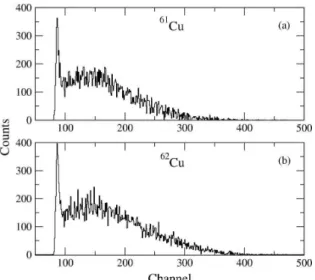
In the case of the nickel products (60Ni is aαp2n channel and61Ni is aαpn channel), the analysis of the energy spectra of theα−particles suggest the presence of higher energy par-ticles in the production of61Ni (see Figure 3). No difference was found forα-particle energies associated with the copper products (αxn channel) (see Figure 4).
FIG. 3:α-particle spectra detected at 0◦in coincidence withγ-rays
emitted by60Ni and61Ni. There is a contribution of higher energies α-particles in the61Ni spectrum.
In Figure 5 the yield ratios in nickel and copper products forγ−transitions in coincidence withα−particles detected at 0◦and 63◦are shown. Even with the hypothesis of complete fusion mechanism as the main, if not the only, mechanism responsible for population of these nuclei by this specific re-action, different yield ratios for selected transitions were ob-tained. This indicates that the presence of incomplete fusion is not a necessary condition to have different yield ratios, at least for systems with A¡70.
900 Brazilian Journal of Physics, vol. 35, no. 3B, September, 2005
FIG. 4: α-particle spectra detected at 0◦ in coincidence with61Cu
γ-rays (a) and62Cu (b). The spectra indicate that there is no
contri-bution of more energeticα-particles.
However, theα-gated simulated values suggest the presence of incomplete fusion in both60,61Ni. For the copper isotopes, the experimental yield ratios indicate the presence of another reaction mechanism for61Cu and62Cu nuclei.
R0sim◦/63◦ R0exp◦/63◦ R63
◦/117◦
sim R
63◦/117◦
exp
60Ni (αgated) 0.47(7) 1.09 (2) 1.91(29) 5.18 (13)
60Ni (p gated) 0.35(2) 0.48 (4) 1.86(28) 1.84 (13)
61Ni (αgated) 0.47(7) 0.93 (2) 1.91(29) 3.67 (8) 61Ni (p gated) 0.35(2) 0.48 (4) 1.86(28) 1.61 (13)
61Cu 0.47(7) 1.39 (5) 1.91(29) n.o.
62Cu 0.47(7) 0.89 (4) 1.91(29) n.o.
TABLE II: Simulated and experimental yield ratios for the residual nuclei produced in the16O+51V at Ebeam=70MeV (n.o. = not
ob-served).
IV. DISCUSSION
In the two reactions analyzed (11B+100Mo and16O+51V), yield ratios forγ-transitions in coincidence with different an-gles were extracted. Earlier work[2] suggested, as a first step, that the contribution of different reaction mechanisms (com-plete and incom(com-plete fusion), in the production of residual nu-clei, favors the presence of different yield ratios. This dif-ference was seen for the rhodium products measured in the first reaction, and presumed due to incomplete fusion, while there is no difference in the yield ratios for palladium pro-ducts. However, the results of the analysis of the 16O+51V reaction showed it was possible to obtain different yield ra-tios for different isotopes, even when these nuclei are popu-lated by the same reaction mechanism. This fact can be re-lated to the relatively low recoil velocity of the heavy com-pound system (111Ag) of the first reaction (11B+100Mo).
Un-FIG. 5: The yield ratios for selected transitions in (a) copper and (b) nickel products as a function ofγ−ray energy. The yield ratios in nickel products (αpxn channels) were extracted in coincidence with
α-particles.
K. T. Wiedemann et al. 901
V. CONCLUSION
Theγ-ray yield ratios were extracted in two heavy-ion reac-tions for eight isotopes. Different yield ratios were obtained for different isotopes studied even when the reaction mecha-nism is the same for both (or more) isotopes. The differen-tiation of the candidateγ-transitions can be a useful tool for assigning individual transitions to specific isotopes produced in fusion reactions. New experiments are being planned to increase the range of masses studied.
The authors would like to acknowledge financial support by Fundao de Amparo `a Pesquisa do Estado de S˜ao Paulo (FA-PESP) and Conselho Nacional de Desenvolvimento Cient´ıfico e Tecnol´ogico (CNPq), Brazil.
References
[1] A. Gavron, Phys. Rev. C 21, 230 (1980).
[2] G.D. Dracoulis et al., J. Phys. G: Nucl. Part. Phys. 23, 1191 (1997).
[3] J.A. Alc´antara-N´u˜nez et al., Nucl. Instr. Meth. A 497, 429 (2003).
[4] J.A. Alc´antara-N´u˜nez et al., Phys. Rev. C 69, 024317 (2004).
[5] J.A. Alc´antara-N´u˜nez et al., Braz. J. Phys 34, 1005 (2004). [6] M.A.G. Silveira et al., Proceedings of the V Latinamerican Symposium on Nuclear Physics, Santos, Brazil, 67 (2003). [7] K.T. Wiedemann, Master Degree Thesis, IFUSP (2005), unpublished.