small ORFs: A new class of essential genes for development
João Paulo Albuquerque
1, Vitória Tobias-Santos
1, Aline Cáceres Rodrigues
1,
Flávia Borges Mury
1,2and Rodrigo Nunes da Fonseca
1,21
Laboratório Integrado de Bioquímica Hatisaburo Masuda, Núcleo em Ecologia e Desenvolvimento
Sócio-Ambiental, Universidade Federal de Rio de Janeiro, Macaé, RJ, Brazil.
2Entomologia Molecular, Instituto Nacional de Ciência e Tecnologia,
Universidade Federal de Rio de Janeiro, Rio de Janeiro, RJ, Brazil.
Abstract
Genes that contain small open reading frames (smORFs) constitute a new group of eukaryotic genes and are ex-pected to represent 5% of theDrosophila melanogaster transcribed genes. In this review we provide a historical per-spective of their recent discovery, describe their general mechanism and discuss the importance of smORFs for future genomic and transcriptomic studies. Finally, we discuss the biological role of the most studied smORF so far, the Mlpt/Pri/Tal gene in arthropods. The pleiotropic action of Mlpt/Pri/Tal inD. melanogaster suggests a complex evolutionary scenario that can be used to understand the origins, evolution and integration of smORFs into complex gene regulatory networks.
Keywords:Tribolium,mlpt,pri,tarsal-less,Drosophila.
Received: January 14, 2015; Accepted: March 30, 2015.
Historical Perspective on the Discovery of small
Open Reading Frames (smORFs)
Our knowledge of genome sequence, size and gene content has increased with the availability of new DNA se-quencing technologies. This huge amount of data has opened new avenues for the development of bioinfor-matics. Bioinformatic prediction methods have been used to estimate the gene numbers of several eukaryotes, which vary considerably across groups. Estimations of gene con-tents do not support the theory that an increase in complex-ity can be associated with an increase in gene number. For example, a sponge genome contains more putative genes than a human genome does (Srivastavaet al., 2010). How-ever, transcriptome data have shown that half of the tran-scripts in mammalian genes are classified as non-coding RNAs (ncRNAs) because they do not contain large Open Reading Frames (ORFs) (e.g., Otaet al., 2004).
In general, gene prediction methods attempt to iden-tify intrinsic features in DNA sequences that are character-istics of exons, such as ORFs and Kozak consensus sequences (Figure 1). Traditionally, in silico approaches have considered a lower limit of 300 nucleotides or 100
amino acids for an ORF to be annotated as a putative exon. Thisin silico approach excludes small ORFs (smORFs) with fewer than 100 amino acids that might be biologically active. One of the first hints that smORFs might display a biological function was obtained by Kessleret al.(2003). These authors identified new genes inS. cerevisiaeby sim-ply BLAST-searching potential budding yeast ORF prod-ucts against sequences from other fungal and non-fungal species. Based on the hypothesis that conserved genes are functional, they found strong evidence for close to 100 new smORF genes in theS. cerevisiaegenome (Kessleret al., 2003). Later, using functional genomics techniques, such as EST sequencing and mutant analysis, Kastenmayeret al. (2006) provided evidence for the existence of 299 smORFs; this figure represents approximately 5% of the
annotated ORFs in S. cerevisiae. Furthermore,
Kasten-mayeret al.(2006) showed by specific gene deletion that 21 smORFs (~8%) are essential forS. cerevisaeviability. These smORFs are implicated in key cellular processes such as transport, intermediate metabolism and genome stability. Most importantly, at least some of the smORFs can be expressed and translated as peptides (Kastenmayer et al., 2006). Because several smORFs were shown to be conserved among fungi and higher eukaryotes (Kasten-mayeret al., 2006), it remains to be investigated whether smORFs play a role during metazoan development.
Send correspondence to Rodrigo Nunes da Fonseca. Laboratório Integrado de Bioquímica Hatisaburo Masuda, Núcleo em Ecologia e Desenvolvimento Sócio-Ambiental, Universidade Federal de Rio de Janeiro, Avenida São José do Barreto 764, 27965-045 Macaé, RJ, Brazil. E-mail: [email protected].
smORFs During Metazoan Development
Hormones and neuropeptides are considered the best examples of bioactive molecules of low molecular weight. They are transcribed as large mRNAs that are then pro-cessed into small peptides via post-translational mecha-nisms and proteolysis because they contain signal se-quences at their N-termini. After processing in the ER and Golgi apparatus, hormones or neuropeptides can signal far from their production site (Figure 2A). Recent functional genomic studies have shown a new way of generating such small bioactive peptides, including the direct translation of smORFs. More than one smORF may be present in a single transcript. Hence, eukaryotic mRNA can be polycistronic, with multiple exons containing an initiation codon within a single mRNA (Savardet al., 2006, Kondoet al., 2007, Fig-ure 2B). After secretion, smORFs act like hormones and neuropeptides and can be defined as a novel class of small peptide genes expressed during plant and animal morpho-genesis (reviewed by Hashimotoet al., 2008).
As previously mentioned, several smORFs have been identified based on their conserved structure and gene ex-pression in fungi (Kessleret al., 2003; Kastenmayeret al., 2006). In plants, several smORFs were identified by using genetic screening methods such as POLARIS, ROTUN-DIFOLIA4, and Enod40. These plant smORFs encode pep-tides that are involved in morphogenetic processes, includ-ing root formation, leaf shape control, and cortical cell division during nodule formation (reviewed by Hashimoto
et al., 2008). Because these smORFs have been found by unbiased genetic screenings and occupy small regions of plant genomes, it is likely that smORFs play a role in other biological processes and systems.
mille-pattes, tarsal-less and polished rice: The
Same Gene Can Act in Different Developmental
Contexts
smORFs may also play a major role in animal devel-opment. The first hint that a smORF was required for
ani-mal development was provided by Savard et al. (2006),
who investigated the embryogenesis of the red flour beetle, Tribolium castaneum. In an EST screening, Savardet al. (2006) identifiedmille-pattes (mlpt), a polycistronic pep-tide encoding four smORFs, three of which containing an LDPTGLY domain. InTribolium,mlptacts like abona fide
gap gene because it regulates Hox genes (Savardet al.,
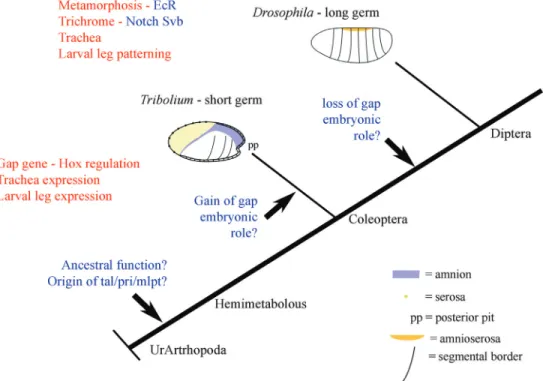
2006). The down regulation ofmlptresults in beetle larvae that have up to ten pairs of legs instead of the three pairs of legs observed in wild-type beetles. Moreover,mlptis ex-pressed in the thorax and at the posterior growth-zone, which is the region responsible for posterior segmentation
in short-germ insects, including the beetleT. castaneum
(Figure 3).
Galindoet al.(2007) and Kondoet al.(2007)
investi-gated the role of the mlpt ortholog in the fruit fly
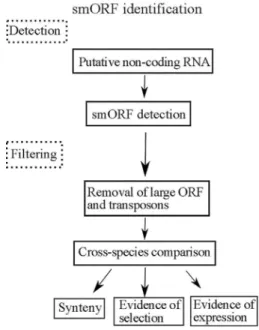
Drosophila melanogasterand provided interesting results regarding the function of these smORFs. Previously, this smORF ortholog was classified as a non-coding RNA in Drosophilabecause the small size of its ORFs suggested they were not translated (Tupyet al., 2005.) The embryonic gap gene role ofmlptturned out not to be conserved in fruit flies, and synonyms of the same gene, such astarsal-less (tal)(Galindoet al., 2007) or polished rice (pri) (Kondoet Figure 1- Scheme of the general method for the identification of smORFs
in different related species. Based on primary data and schemes from Kessleret al.(2003) and Ladoukakiset al.(2011). smORF prediction is based on detection and filtering. The filtering process is important to re-duce the false positive rate and increase the efficacy of functional smORFs estimation.
Figure 2- Schematic drawings of the generation of biologically active short peptides. A similar scheme was published by Hashimotoet al.
al., 2007) were found expressed in a pair-rule fashion dur-ing embryogenesis, but do not regulate Hox genes in flies. Kondoet al.(2007) also showed thatpriis required non-cell autonomously and is essential for the formation of the specific F-actin bundles that will form the denticles, which are the typical epidermal structures ofDrosophilalarvae. In
addition, pri is reported to function during tracheal
morphogenesis (Kondoet al., 2007). Interestingly, the first four small peptides, which are similar to LDPTGLY, could be translated in anin vitroassay using S2 cells, but the last and largest peptide was not translated in this system (Kon-doet al., 2007).In vivorescue experiments have shown that these LDPTGLY peptides are functionally redundant and that the overexpression of one of these smORFs is able to rescue the denticle and the tracheal loss-of-function pheno-type (Kondoet al., 2007). In addition to the roles reported
during embryogenesis by Kondoet al.(2007), Galindoet
al.(2007) provided evidence thattalis involved in leg pat-terning by demonstrating that talis expressed at the leg
imaginal discs and thattalhypomorphic mutants lack the
whole tarsal region (Galindoet al., 2007).
These three initial studies opened new avenues into smORF research because they showed that a single smORF can be involved in several developmental contexts with ap-parently different biological roles during morphogenesis.
tal/pri/mlpt As a Case Study for the Biological
Mechanism of a smORF
Though different biological roles for mlpt/tal/pri
have been described in several developmental contexts, the mechanism by which these smORFs act during develop-ment remained unknown until quite recently. One of the first hints of the mechanism of action formlpt/tal/priwas obtained by Kondoet al.(2010), who investigated the spec-ification and differentiation of larval epidermal denticle
structures in Drosophila. It was previously shown that
denticle differentiation in fruit flies is controlled by the ac-tivity of the transcription factor Shavenbaby (Svb) and its downstream target genes (Mevel-Ninioet al., 1995), Kon-doet al.(2007) had shown that the loss ofmlpt/tal/pridoes not affect the expression ofSvb, suggesting that these genes belong to different pathways that activate denticle
forma-tion. Subsequently, Kondoet al. (2010) showed that the
short 11 amino acid peptide found inmlpt/tal/priis able to trigger the terminal truncation of Svb. This truncation con-verts Svb from a repressor that has accumulated in nuclear
foci into a nucleoplasmic activator, both in vivo during
the nucleus, alter the function of essential transcription fac-tors, such as Svb. This finding showed an important and new role formlpt/tal/priand, by association, for smORFs.
The biological functions of the mlpt/tal/pri genes
have also been investigated in fruit fly leg specification, where they display two independent functions. The first function is in the determination of the presumptive tarsal region in early third instar larvae (Galindo et al., 2007; Pueyo and Couso, 2008). For tarsal determination, mlpt/tal/prinon-autonomously generates a new territory of presumptive tarsal cells by defining the presence of the transcription factors Rotund (Rn) and Spineless (Ss) and the absence of Dachshund (Dac) and B (Pueyo and Couso, 2008). Importantly, this role oftal-related peptides is inde-pendent of Svb, suggesting thatmlpt/tal/pripeptides inter-act with partners other than Svb.
The second biological function ofmlpt/tal/prigenes in the leg occurs later in development. During early pupal Drosophiladevelopment, Notch (N) signaling activatestal mRNA expression in stripes of cells in the distal part of each tarsal segment. Interestingly, the Tal peptides feed back on N signaling by repressing the transcription of Delta (Dl) in the tarsal joints. This feedback acts through the post-transcriptional activation of Svb in a similar manner to that described for trichomes during late embryogenesis (Mevel-Ninioet al., 1995; Delonet al., 2003; Sucenaet al., 2003). Thus, a common biological mechanism involving
Notch signaling and Svb may controlmlpt/pri/tal
expres-sion in several developmental contexts.
Finally, recent pioneering work has implicated the Mlpt/Pri/Tal peptides as mediators of ecdysone control of development (Chanut-Delalandeet al., 2014). A previously
uncharacterized enzyme of ecdysone biosynthesis in D.
melanogaster, Glutathione S transferase E14 (GstE14) was shown to be required formlpt/pri/talexpression. Moreover, the nuclear ecdysone receptor (EcR) was found to directly bind to themlpt/pri/tal cis-regulatory region, which sug-gests a direct link between ecdysone action andmlpt/pri/tal
activation (Chanut-Delalande et al., 2014). Therefore,
Mlpt/Pri/Tal peptides provide a molecular framework to explain how systemic hormonal signaling is able to execute different genetic programs both throughout embryonic
de-velopment and post-embryonically (Chanut-Delalande et
al., 2014).
Based on these essential roles ofmlpt/pri/talin sev-eral contexts, it is important to estimate how many other smORFs may play a role in other developmental processes. This has only recently been addressed using the new bio-informatic and molecular biology techniques described be-low (Ladoukakiset al., 2011; Aspdenet al., 2014).
How Many smORFs Exist in Animal Genomes?
Lessons From Fruit Flies
Quantifying how many smORFs exist within animal genomes is not trivial because the prediction methods used to identify coding sequence are biased against detecting very short open reading frames (< 100 bp) (e.g., Saeys et al., 2007). In general, gene prediction methods use either a de novoapproach with mathematical models that determine the probabilities for all possible intron-exon annotations in a given sequence, or a comparison to a known genome or
cDNA sequences from related organisms (Ladoukakis et
al., 2011). smORFs that contain fewer than 100 amino ac-ids and correspond to functional genes may not be pre-dicted and can thus be grouped with non-functional smORFs that can occur by chance (Windsor and
Mitchell-Olds, 2006). Ladoukakiset al.(2011) used a comparative
approach to investigate the smORFs of the fruit fly species D. melanogasterandD. pseudoobscura, two related spe-cies that are separated from their common ancestor by 25 to 55 million years. This investigation led to a range of
be-tween 401 and 4.561 functional smORFs inDrosophila. In
fact, 401 smORFs would represent 3% of the 13,907 pro-tein-coding genes that have been annotated as of 2011 (FlyBase release 5; as accessed in October 2011). Thus, a substantial number of biologically relevant smORFs await characterization.
A detailed functional analysis of one of these candi-dates, the transcript encoded by the gene putative non-coding RNA003in2L (pncr003:2L), indicated that this gene contains two potentially functional smORFs of 28 and 29 amino acids in a single sequence, which led to exciting re-sults (Magnyet al., 2013). pcnr003:2L regulates calcium transport and thus influences regular muscle contraction in theDrosophilaheart (Magnyet al., 2013). In contrast to the mlpt/pri/talpeptides, which are small and do not display a clear secondary structure, such as a alpha-helix or beta-sheet, pncr003:2L peptides have a predicted helical struc-ture. Searches for a structural homolog have identified two
paralogs in the human genome, sarcolamban (Scl) and
phospholambam (Pcl), which both contain two smORFs of 30 amino acids that are similar to pncr003:2L. Functional analysis of these human homologs indicates that they play a conserved role in calcium trafficking, particularly in regu-lating the activity of the sarco-endoplasmic reticulum Ca2+ adenosine triphosphatase (SERCA) enzyme. Thus, these smORF peptides are required for regular muscle contrac-tion in humans andDrosophila(Magnyet al., 2013).
Future Directions and Open Questions in
smORF Research
developmen-tal processes. Sequence analysis has shown that hundreds
of smORFs are conserved amongDrosophilaspecies,
sug-gesting that a large number of smORFs are functional
(Ladoukakis et al., 2011). As 401 of these conserved
smORFs are also expressed during Drosophila
embryo-genesis, it is likely that these smORFs are functional, be-cause high expression levels are suggestive of a functional role. It is expected that several other smORFs will have their function analyzed, in addition to mlpt/pri/tal (Galindo et al., 2007; Kondoet al., 2007; Savardet al., 2006) and pncr003:2L (Magnyet al., 2013).
A new promising technique, Poly-Ribo-Seq, was re-cently applied in the experimental validation and discovery of new smORFs (Aspdenet al., 2014). Briefly, Poly-Ribo-Seq requires polysome isolation for the determination of the sequence bound by each of the ribosomes. Polysomes are clusters of multiple ribosomes that are bound to mRNA during translation. The Poly-Ribo-Seq approach thus re-duces the number of false positives and doubled the number
of annotated smORFs inDrosophilaS2 cells (Aspden et
al., 2014), thereby increasing the evidence of translation from 107 to 228 smORFs. By using this approach, 700
functional smORFs were estimated within theDrosophila
genome by Aspdenet al.(2014).
Recently, Lu et al., 2014 synthesized ten bioactive peptides from the smORFs found in the genome of the
ascidian Ciona intestinalis and tested them as potential
antimicrobial peptides (AMPs). Five of these peptides were active against bacterial strains, suggesting that they may act as antimicrobial peptides (AMPs) in ascidians. Thus, it is possible that clusters of smORFs are activated upon infec-tion in a fast response and release.
What other open questions exist in smORF research? One of the most important regards the evolution of the most described smORF, mlpt/pri/tal in arthropods (Savardet al., 2006; Galindoet al., 2007; Kondoet al., 2007). Because mlpt/pri/tal is involved in several biological processes, such as early patterning, trichome, tracheal patterning and leg patterning, and was recently shown to be involved in metamorphosis (Chanut-Delalandeet al., 2014), it will be important to investigate the evolutionary origin and ances-tral role of this smORF (Figure 3). Is mlpt/pri/tal involved in all of these biological processes also in hemimetabolous insects and other arthropods? Evolutionary studies on mlpt/pri/talhave the potential to contribute to the discus-sion about the interaction between genetic developmental control and the environment, the so-called Eco-Evo-Devo field of knowledge (Abouheifet al., 2014). If 5% of the genes in a given genome are smORFs, as recently sug-gested forDrosophila melanogaster(Aspdenet al., 2014), it will be interesting to investigate whether at least some other developmental pathways such as Hh, Wnt, FGFs and BMPs are also regulated by and regulate other smORFs.
Importantly, it will be interesting to know whether smORFs are found in basal metazoans such as sponges,
cni-darians and ctenophores, as the examples described so far are primarily restricted to yeast, plants, arthropods and chordates. Additionally, we expect that, as experimental and bioinformatic methods become more powerful, smORFs will be essential components of genome annota-tions and studies of gene regulatory networks. Finally, ex-amples of horizontal smORF transfer between eubacteria and eukaryotes and parasites might be discovered.
Acknowledgments
The RNdF lab is supported by Fundação de Amparo de Pesquisa do Estado do Rio de Janeiro (FAPERJ), Con-selho Nacional de Pesquisa (CNPq) and Fundação Edu-cacional de Macaé (FUNEMAC). JPA is a master student of Programa de Pós-Graduação em Produtos Bioativos e Biociências (PPG-PRODBIO), VTS is supported by a PIBIC/CNPq scholarship and ACR by a FAPERJ scholar-ship.
References
Abouheif E, Fave MJ, Ibarraran-Viniegra AS, Lesoway MP, Rafi-qi AM and Rajakumar R (2014) Eco-evo-devo: The time has come. Adv Exp Med Biology 781:107-125.
Aspden JL, Eyre-Walker YC, Phillips RJ, Amin U, Mumtaz MA, Brocard M and Couso JP (2014) Extensive translation of small Open Reading Frames revealed by Poly-Ribo-Seq. eLife 3:e03528.
Chanut-Delalande H, Hashimoto Y, Pelissier-Monier A, Spokony R, Dib A, Kondo T, Bohere J, Niimi K, Latapie Y, Inagaki S et al.(2014) Pri peptides are mediators of ecdysone for the temporal control of development. Nat Cell Biol 16:1035-1044.
Delon I, Chanut-Delalande H and Payre F (2003) The Ovo/Sha-venbaby transcription factor specifies actin remodelling dur-ing epidermal differentiation in Drosophila. Mech Dev 120:747-758.
Galindo MI, Pueyo JI, Fouix S, Bishop SA and Couso JP (2007) Peptides encoded by short ORFs control development and define a new eukaryotic gene family. PLoS Biol 5:e106. Hashimoto Y, Kondo T and Kageyama Y (2008) Lilliputians get
into the limelight: Novel class of small peptide genes in morphogenesis. Dev Growth Differ 50(Suppl 1):S269-276. Kastenmayer JP, Ni L, Chu A, Kitchen LE, Au WC, Yang H,
Carter CD, Wheeler D, Davis,RW, Boeke JDet al.(2006) Functional genomics of genes with small open reading frames (sORFs) inS. cerevisiae. Genome Res 16:365-373. Kessler MM, Zeng Q, Hogan S, Cook R, Morales AJ and Cottarel
G (2003) Systematic discovery of new genes in the Saccharomyces cerevisiae genome. Genome Res 13:264-271.
Kondo T, Hashimoto Y, Kato K, Inagaki S, Hayashi S and Kageyama Y (2007) Small peptide regulators of actin-based cell morphogenesis encoded by a polycistronic mRNA. Nat Cell Biol 9:660-665.
Ladoukakis E, Pereira V, Magny EG, Eyre-Walker A and Couso JP (2011) Hundreds of putatively functional small open reading frames inDrosophila. Genome Biol 12:R118.
Lu Y, Zhuang Y and Liu J (2014) Mining antimicrobial peptides from small open reading frames inCiona intestinalis. J Pep-tide Sci 20:25-29.
Magny G, Pueyo JI, Pearl FM, Cespedes MA, Niven JE, Bishop SA and Couso JP (2013) Conserved regulation of cardiac calcium uptake by peptides encoded in small open reading frames. Science 341:1116-1120.
Mevel-Ninio M, Terracol R, Salles C, Vincent A and Payre F (1995)ovo, aDrosophilagene required for ovarian develop-ment, is specifically expressed in the germline and shares most of its coding sequences withshavenbaby, a gene in-volved in embryo patterning. Mech Dev 49:83-95.
Ota T, Suzuki Y, Nishikawa T, Otsuki T, Sugiyama T, Irie R, Wakamatsu A, Hayashi K, Sato H, Nagai Ket al.(2004) Complete sequencing and characterization of 21,243 full-length human cDNAs. Nat Genet 36:40-45.
Pueyo JI and Couso JP (2008) The 11-aminoacid long Tarsal-less peptides trigger a cell signal inDrosophilaleg development. Dev Biol 324:192-201.
Pueyo JI and Couso JP (2011) Tarsal-less peptides control Notch signalling through the Shavenbaby transcription factor. Dev Biol 355:183-193.
Saeys Y, Rouze P and Van de Peer Y (2007) In search of the small ones: Improved prediction of short exons in vertebrates, plants, fungi and protists. Bioinformatics 23:414-420. Savard J, Marques-Souza H, Aranda M and Tautz D (2006) A
seg-mentation gene in Tribolium produces a polycistronic mRNA that codes for multiple conserved peptides. Cell 126:559-569.
Srivastava M, Simakov O, Chapman J, Fahey B, Gauthier ME, Mitros T, Richards GS, Conaco C, Dacre M, Hellsten Uet al.(2010) TheAmphimedon queenslandicagenome and the evolution of animal complexity. Nature 466:720-726. Sucena E, Delon I, Jones I, Payre F and Stern DL (2003)
Regula-tory evolution of shavenbaby/ovo underlies multiple cases of morphological parallelism. Nature 424:935-938. Tupy JL, Bailey AM, Dailey G, Evans-Holm M, Siebel CW,
Misra S, Celniker SE and Rubin GM (2005) Identification of putative noncoding polyadenylated transcripts in Drosophila melanogaster. Proc Natl Acad Sci USA 102:5495-5500.
Windsor AJ and Mitchell-Olds T (2006) Comparative genomics as a tool for gene discovery. Curr Opin Biotechnol 17:161-167.
Associate Editor: Igor Schneider