The plant cell cycle: Pre-Replication complex formation and controls
Juliana Nogueira Brasil
1,3, Carinne N. Monteiro Costa
1,4, Luiz Mors Cabral
2, Paulo C. G. Ferreira
1and
Adriana S. Hemerly
11
Instituto de Bioquímica Médica Leopoldo de Meis, Universidade Federal do Rio de Janeiro, Rio de Janeiro,
RJ, Brazil.
2
Departamento de Biologia Celular e Molecular, Universidade Federal Fluminense, Niteroi, RJ, Brazil.
3
Centro Universitário Christus, Fortaleza, CE, Brazil.
4
Centro de Genômica e Biologia de Sistemas, Universidade Federal do Pará, Belém, PA, Brazil.
Abstract
The multiplication of cells in all living organisms requires a tight regulation of DNA replication. Several mechanisms take place to ensure that the DNA is replicated faithfully and just once per cell cycle in order to originate through mitoses two new daughter cells that contain exactly the same information from the previous one. A key control mech-anism that occurs before cells enter S phase is the formation of a pre-replication complex (pre-RC) that is assembled at replication origins by the sequential association of the origin recognition complex, followed by Cdt1, Cdc6 and fi-nally MCMs, licensing DNA to start replication. The identification of pre-RC members in all animal and plant species shows that this complex is conserved in eukaryotes and, more importantly, the differences between kingdoms might reflect their divergence in strategies on cell cycle regulation, as it must be integrated and adapted to the niche, eco-system, and the organism peculiarities. Here, we provide an overview of the knowledge generated so far on the for-mation and the developmental controls of the pre-RC mechanism in plants, analyzing some particular aspects in comparison to other eukaryotes.
Keywords: Pre-replication complex,A. thaliana, cell cycle.
Received: May 01, 2016; Accepted: August 16, 2016.
Introduction
The eukaryotic cell cycle is a highly coordinated pro-cess, when a cell replicates its genome and divides it equally into two daughter cells. In order to assure that the genome will not only be correctly duplicated, but also cor-rectly divided between daughter cells, a great number of control mechanisms take place during the cell cycle events. DNA replication is tightly monitored to ensure that the ge-nome is replicated just once per cell cycle (Kearsey and Cotterill, 2003). This control relies on a mechanism that takes place before cells enter S phase and licenses cells for replication by selecting and activating origins of replica-tion. The system is formed by the sequential recruitment of proteins to DNA replication origins, establishing the pre-replication complex (pre-RC). It represents the key process in controlling chromosome replication.
The “permission to replicate” is directly connected to a number of internal and external features, like the
avail-ability of nutrients, cell size, and others, in a way that cells can decide between entering S phase (thus initiating the process of cell division) or exit cell division cycle and start differentiating. The external controls regulating this step of the cell cycle are diverse among the multicellular euka-ryotes, following their different developmental strategies, and interfering in the mechanisms regulating pre-RC activ-ity. Therefore, this review uncovers the knowledge gener-ated so far on the formation and the developmental controls of the pre-RC machinery in plants, analyzing some particu-lar aspects in comparison to other eukaryotes.
Plants as a model for studies on DNA
replication controls.
Plants are good models to study DNA replication controls, since they have various developmental and ge-nome particularities. Plant development, compared to ani-mals, is highly influenced by the environment in which they grow, suggesting that plants have evolved specific mecha-nisms that convey environmental signals to control cell di-vision and ultimately plant growth. Plants, via post-em-bryonic organogenesis (Inzé and De Veylder, 2006), form new organs during their complete life span, and this
contin-Send correspondence to Adriana Hemerly. Instituto de Bioquímica Médica Leopoldo de Meis, Av. Carlos Chagas Filho, s/n, Centro de Ciências da Saúde, Bloco L ss29, Universidade Federal do Rio de
Janeiro, 21941-590, Rio de Janeiro, RJ, Brazil. E-mail:
Genetics and Molecular Biology, 40, 1(suppl), 276-291 (2017) Copyright © 2017, Sociedade Brasileira de Genética. Printed in Brazil DOI: http://dx.doi.org/10.1590/1678-4685-GMB-2016-0118
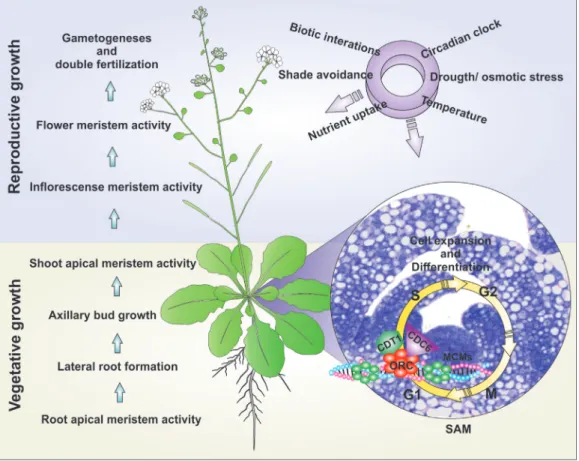
uous formation is tightly connected with the surrounding environment (Figure 1). Early in the development of the embryo, polarized forces establish the root and shoot meris-tems (Scheres, 2007). These meristematic cells and their descendants give rise to the various tissues and organs of a mature plant through the combined processes of cell divi-sion, cell expansion and cell differentiation. This ability de-pends on both the maintenance of proliferating cells in the meristems and the re-initiation of cell division in non-dividing cells (Veylderet al., 2003). Considering that plant cells don’t have the ability to move through the plant body, it becomes extremely important to coordinately control cell division and differentiation, so that a given cell can be pres-ent at its final place with its definitive fate (Brukhin and Morozova, 2011). In addition, higher plants adopt particu-lar strategies of development ending up with a great vari-ability of body architectures. This suggests that signaling controls regulating individual steps of the basic DNA repli-cation machinery might also differ among plant species.
The plant kingdom is divided in two large groups: the monocots and the dicots. The best-studied members of each group are the dicotArabidopsis thalianaand the monocot Oryza sativa. Although they share many characteristics,
some important differences in their developmental plans and genome structure are present.
Different from other kingdoms, higher plants present extreme differences in its genome size (followed by pheno-typical differences), with variations of more than 2,500 fold (Grime and Mowfforth, 1982). Allopolyploids, which are organisms that inherit their chromosomes from different species, are also common. Although chromosome number within species is usually constant, it can vary among plant species in a range that goes from n = 2 (inHaplopappus gracilis) to n = 100 (inSenecio biserratus). And, more in-terestingly, this number can also vary widely from genera-tion to generagenera-tion. Remarkably, it is also well known that controls coupling DNA replication with mitosis are quite flexible in plants. During development, plant cells often modify their classical cell cycle and undergo endoredu-plication events that allow them to increase their ploidy level (Sugimoto-Shirasu and Roberts, 2003). However, the consequences of this modified cell cycle for plant develop-ment are not completely understood.
Taken together, all these characteristics indicate that plants developed a number of novel regulatory networks to integrate cell cycle progression, cell growth and
ation with endogenous and exogenous signaling, becoming unique organisms for the study of DNA replication and de-velopmental abilities (Boniotti and Griffith, 2002). Thus, there has been an increasing interest in investigating the re-lationship between DNA replication controls and develop-ment in higher plants, and in the comparison with mechanisms employed by other eukaryotes. In this context, the first step that licenses DNA is one important crossroad when internal and environmental signals are integrated with cell division in order to trigger the developmental pro-gram in a flexible way.
Licensing DNA replication: the assembly of the
Plant pre-Replication Complex
Plant DNA Origins
Cells must license DNA for replication by selecting and activating specific origins of replication. In eukaryotes, there is a large number of possible origins of replication, but only a group of these available origins is chosen to be used by different types of cells and in different moments during development. Origin activation is possibly the result of a multisource signaling pathways where positive and negative proliferating signals result in a response of the pre-RC machinery, in a way that once the origin activation starts cells are compromised with DNA replication.
The origins of replication consist of DNA sequences or chromatin marks (or both) that are recognized by pro-teins that bind to DNA, the Origin Recognition Complex (ORCs), and where other proteins will also bind to form the pre-RC (Cunningham and Berger, 2005).
In budding yeast, the recognition of origins by ORC seems to be unique because a consensus sequence has al-ready been determined (the A-rich sequences named ACS) (Bell and Dutta, 2002; Nieduszynskiet al., 2006). In con-trast, it has been difficult to find clear consensus sequence in multicellular eukaryote organisms, due to their large ge-nome size and fluctuation during differentiation and devel-opment (Aladjem, 2007; Hiratani et al., 2009). From Drosophilastudies came the intriguing observation that the number of useful replication sites in a genome depends on other factors besides nucleotide sequence. In rapidly divid-ing nuclei of theDrosophilazygote there are many more initiation sites than in cultured cells, in a way that replica-tion origins used during the early stages of embryogenesis are not used by mature cells (Blumenthalet al., 1974). An-other possibility is that pre-RC interaction with the DNA might be related with DNA structure rather than sequence, as indicated in recent structural studies on archaeal orthologs of ORC interacting with the origin recognition box (Gaudieret al., 2007).
Experimental difficulties are the main constraint in the identification of a plant replication origin and in the characterization of its mechanism of recognition during DNA replication (Lee et al., 2009; Shultz et al., 2009;
Costaset al., 2011). Although little is known about DNA replication origins in plants, some features can be pointed as specific for plant origins in comparison to other euka-ryotes (Bryant and Aves 2011; reviewed in Raynaudet al., 2014). It seems that origin consensus sequences are more GC-rich in metazoans and plants (Costaset al., 2011; Bass et al., 2014), in contrast with the AT-rich sequences in yeast (Mechaliet al., 2013). Localization of these origins is pref-erentially near promoters of genes in metazoans (Cayrouet al., 2011). InA. thaliana, a study has sequenced and identi-fied ~1,500 putative genome-wide origins (Costaset al., 2011). That work revealed that 77.7% of origins were co-localized with gene units, preferentially towards their 5’ end. Also, highly expressed genes tended to have more ori-gins in regions immediately upstream or downstream (Costaset al., 2011). Replication origins from metazoans and yeast were found to be enriched with epigenetic marks (Dorn and Cook, 2011). In the same way,A. thaliana repli-cation origins were found to be enriched with H3K4me3, H4K5ac and the variant histone H2A.Z (Costas et al., 2011). Also, it is possible that chromatin modification pro-teins are needed to specify and/or activate origins in A. thaliana, as (1) it has been shown that two HATs (histone acetyltransferases) are redundantly required for gameto-phyte development (Latrasseet al., 2008); and (2) origins of chromosome 4 are associated with H3Lys36ac (Lamesch et al., 2012). The same logic was found in animals: HATs are required to stabilize chromatin for ORC loading in Drosophila(Vorobyevaet al., 2013), and some chromatin modifier proteins are needed for the correct assembly or ac-tivation of pre-RC in mammals (Tardatet al., 2010) and yeast (Rizzardiet al., 2012).
How is the pre-RC assembled in plants?
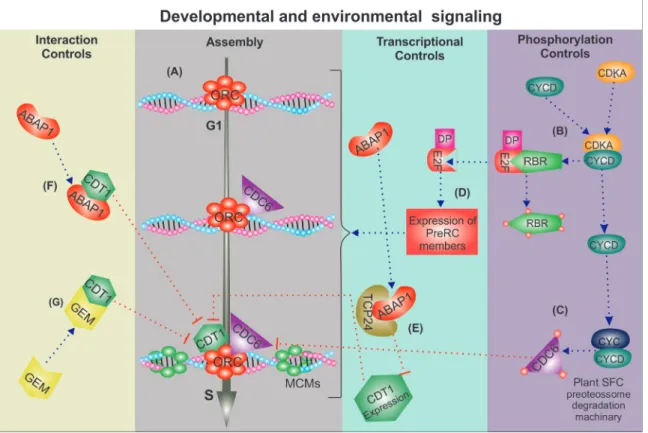
A generalized eukaryotic licensing model based on yeast and animal systems support that origin selection be-gins at the transition from M to G1 phases of the cycle. At this moment, mitogenic signaling from the environment triggers the expression of Cyclin D, a protein that interacts with CDKA (cyclin-dependent kinase A), forming the CDKA/CyclinD complex (Dresselhauset al., 2006). This complex promotes phosphorylation of different targets, in-cluding the retinoblastoma protein (RB), releasing the tran-scription factor E2F to promote expression of many pre-RC genes that bind to DNA replication origins at G1 phase (Figure 2). The first event in the formation of the pre-RC is the assembly of the ORC – a complex of six conserved sub-units (ORC1–ORC6) to replication origins (Bell, 2002). After ORC assembly, other members of the pre-RC use ORC as a landing platform, to which they bind. The recruit-ment of CDC6 by ORC is the next step in pre-RC assembly, followed by the recruitment of CDT1 (Bell and Dutta, 2002). In addition, CDC6 and CDT1 proteins act synergis-tically to load a complex formed by six proteins – the MCM complex (MCM2–7; Mini Chromosome Maintenance).
MCM loading is the last event in the licensing mechanism. After that, origins are licensed to replicate and any site con-taining the MCM complex has the potential to form an ac-tive DNA replication fork (Masaiet al., 2005) (Figure 2). The resulting complex loaded onto DNA, consisting of ORC1-6/CDC6/MCM2-7, is termed the pre-RC (for evolu-tionary aspects of pre-RC proteins through Archaea to eukaryotes see Bryant and Aves, 2011).
Pre-RC members can be identified by sequence homology in all genomes of higher plants available in pub-lic databases. A great number of members, were reported in eudicot A. thaliana (Gavin et al., 1995; Collinge et al., 2004; Masudaet al., 2004), and monocots like O. sativa (Kimuraet al., 2000; Li et al., 2005; Mori et al., 2005; Shultz et al., 2007), andZea mays (Sabelli et al., 1996, 1999; Bastida and Puigdomenech, 2002; Witmer, 2003; Dresselhauset al., 2006) (Table 1). These features suggest that pre-RC function has been conserved in the course of eukaryote evolution, and support the belief of a high con-servation of the replicative machinery among plants.
Nonetheless, some differences can be found in pre-RC members among plant species. Different from other eukaryotes studied so far,A. thalianahouses in its genome
two homologs ofORC1,CDT1andCDC6(Ramoset al., 2001; Collinge et al., 2004; Masuda et al., 2004; Diaz-Trivinoet al., 2005; Raynaudet al., 2005). TwoOsCDT1 homologs are also present in the monocot rice (Shultzet al., 2007), but these gene duplications are not necessarily found in all plant species, suggesting that it is not a general feature in the plant kingdom (Table 1).
AtORC1homologs, called ORC1a andORC1b,are highly similar proteins, with around 90% of amino acid similarity. The N-terminal portion of AtORC1a and AtORC1b contains a BAH (Bromo-Adjacent Homology) domain and a PHD (plant Homeodomain). BAH, associ-ated with a PHD, has been implicassoci-ated in linking DNA methylation, replication, and transcriptional regulation in mammals (Aasland et al., 1995; Callebaut et al., 1999). ORC1 has already been described as a transcriptional regu-lator in plants (Paket al., 1997; Saitohet al., 2002). The presence of the PHD exclusively in plant ORC1 genes among all other eukaryotes creates a very interesting obser-vation, once this domain is responsible for specific binding to H3K4me3, bothin vitroandinvivo (Sanchez and Gutier-rez, 2009). Thus, it is possible that plantORC1genes are
280
Plant
cell
cycle
Table 1- Pre-replication complex (pre-RC) genes published in literature in main plants models. The numbers in the table correspond to the numbers of homologs found in the organisms. Note that here we ac-counted only for genes cloned and characterized, although others could be found by sequence similarities by BLAST search in genomic data bases available online. At:A. thaliana;Os:Oryza sativa;Zm:Zea mays.
Protein ID A. thaliana ID O. Sativa ID Z. mays
ORC1 At4g14700/ BAH domain, PHD zinc finger domain, AAA_ATPase type
LOC_Os04g10650 BAH domain,
AAA_ATPase Type
GRMZM2G035665/GRMZM2G032209/GRMZM2G004924 BAH domain,
AAA_ATPase Type, P-loop_NTPase domain
At4g12620
ORC2 At2g37560 - LOC_Os10g34820 - GRMZM2G117238
-ORC3 At5g16690 - LOC_Os10g26280 - GRMZM2G381822
-ORC4 At2g01120 AAA_ATPase type LOC_Os01g49010 AAA_ATPase type GRMZM5G876520
-ORC5 At4g29910 - LOC_Os03g55200 - GRMZM2G089556
ORC6 At1g26840 - LOC_Os07g43540 - GRMZM5G825512
CDC6 At2g29680/ - LOC_Os01g63710 P-loop NTPase domain,
AAA_ATPase type
GRMZM2G007659/GRMZM2G363408
-At1g07270
CDT1 At2g31270/ - LOC_Os04g10650/LOC_Os10g34820 - GRMZM2G035665/GRMZM2G032209/GRMZM2G004924
-At3g54710
MCM2 At1g44900 MCM N-Term superfa-mily, P-loop_NTPase do-main, OB-fold domain
LOC_Os11g29380 MCM N-Term
superfa-mily, P-loop_NTPase do-main, AAA_ATPase type
GRMZM2G139894 MCM N-Term
superfa-mily, P-loop_NTPase do-main, AAA_ATPase type
MCM3 At5g46280 MCM N-Term superfa-mily, P-loop_NTPase main, OB-fold do-main, AAA_ATPase type
LOC_Os05g08100 MCM N-Term
superfamily
GRMZM2G162445/GRMZM2G100639 MCM N-Term
superfa-mily, P-loop_NTPase do-main, AAA_ATPase type
MCM4 At2g16440 MCM N-Term superfa-mily, P-loop_NTPase do-main, OB-fold dodo-main, AAA_ATPase type
LOC_Os01g36390 MCM N-Term
superfa-mily, P-loop_NTPase do-main, AAA_ATPase type
GRMZM2G066101 MCM N-Term
superfa-mily, P-loop_NTPase do-main, AAA_ATPase type
MCM5 At2g07690 MCM N-Term superfa-mily, P-loop_NTPase domain, OB-fold domain
LOC_Os02g55410 MCM N-Term
super-family
GRMZM2G075978 MCM N-Term
superfa-mily, P-loop_NTPase domain
MCM6 At5g44635 MCM N-Term superfa-mily, P-loop_NTPase domain, OB-fold domain
LOC_Os05g14590 MCM N-Term
superfa-mily, P-loop_NTPase domain
GRMZM2G021069 MCM N-Term
superfa-mily, P-loop_NTPase domain
MCM7 At4g02060 MCM N-Term superfa-mily, P-loop_NTPase do-main, OB-fold dodo-main, AAA_ATPase type
LOC_Os12g37400 MCM N-Term
superfa-mily, P-loop_NTPase do-main, AAA_ATPase type
GRMZM2G065205 MCM N-Term
playing an important role on epigenetic regulation of cell cycle and plant development.
One copy of eachMCMgene has been identified inA. thaliana(Springeret al., 1995; Stevens et al., 2002; Ma-sudaet al., 2004; Schreiberet al., 2006). Also,OsMCM2 encodes a functional homologue of the CDC19 fission yeast protein, able to rescue the wild-type phenotype in a mutant yeast for this gene, demonstrating how structurally close these proteins are (Choet al., 2008). Finally, it has been shown that all six MCM cDNAs from pea (Pisum sativum) contain Zinc Finger motifs, ATPase consensus se-quences like Walker A motif, Walker B motif or MCM sig-nature, and an Arginine Finger motif (Tranet al., 2010). PsMCM2 contains a putative nuclear localization se-quence, which is required for entering into the nucleus dur-ing G1/S-phase. PsMCM4has an endoplasmic reticulum target and phosphorylation sites for CDKs.PsMCM5 con-tains the leucine zipper pattern consensus sequence, present in regulatory proteins including transcription factors (Tu-tejaet al., 2011) (Table 1).
It is interesting to observe that the core DNA replica-tion machinery components in plants are, by sequence homology, more similar to human than to budding yeast (Shultzet al., 2007). Moreover, someA. thalianapre-RC members did not show any significant alignment with bud-ding yeasts. This also confirms the observation that some cell cycle proteins that are present in humans, but not in yeast, are also present inA. thalianaand rice (Shultzet al., 2007).
Regulation of pre-RC licensing by protein
interactions, stability and distribution.
Although mechanisms of cell division are conserved in eukaryotes, plants contain a larger number of cell cycle regulatory genes, such as 71 cyclin genes identified inA. thaliana, while only 15 were described in yeast and 23 in human (Van Leeneet al., 2010). The understanding of how this complex machinery works involves revealing protein expression, interaction partners, targets and biological functions.
Protein interactions between pre-RC members and beyond
In order to investigate the arrangement of the pre-RC components within the complex, studies on the character-ization of physical interactions among theA. thaliana, rice and maize ORC subunits were performed by yeast two-hybrid and pull-down assays. Similarly, in these three plant species, ORC3 plays a central role in maintaining the com-plex associations; however, there are some intrinsic differ-ences in ORC interaction patterns. InA. thaliana,protein interaction assays suggest a pre-RC architecture, in which AtORC3 and AtORC2 are central elements in maintaining the complex associations (Masudaet al., 2004;
Diaz-Tri-vinoet al., 2005).A. thalianahas two ORC1 subunits, and AtORC3 interacts only with AtORC1b and not with AtORC1a (Masudaet al., 2004; Diaz-Trivinoet al., 2005). In rice, OsORC2 and OsORC3 are also central pre-RC sub-units, forming a core that binds OsORC5 and recruits OsORC4 (Tanet al., 2013). In maize, ZmORC3 can bind to ZmORC2, -4, -5, but ZmORC5 cannot bind to ZmORC2. Also, ZmORC1 has a weak interaction with the others (Witmer, 2003). In general, the interactions among plant pre-RC members are very similar to those found in humans (Dharet al., 2001). Intrinsic differences in ORC interaction patterns among closely related species may suggest that: (1) they have little impact on assembly and function, or (2) they might hide evolutionary strategies in DNA replication initiation among species (Tanet al., 2013). Differences in expression profile among the pre-RC genes in the same plant species suggest that they might form different sub-complexes in the various plant tissues (discussed below). One interesting question that remains to be elucidated is whether the architecture of plant pre-RCs varies in different plant tissues and in response to developmental and environ-mental signals, acquiring specific roles depending on the developmental context.
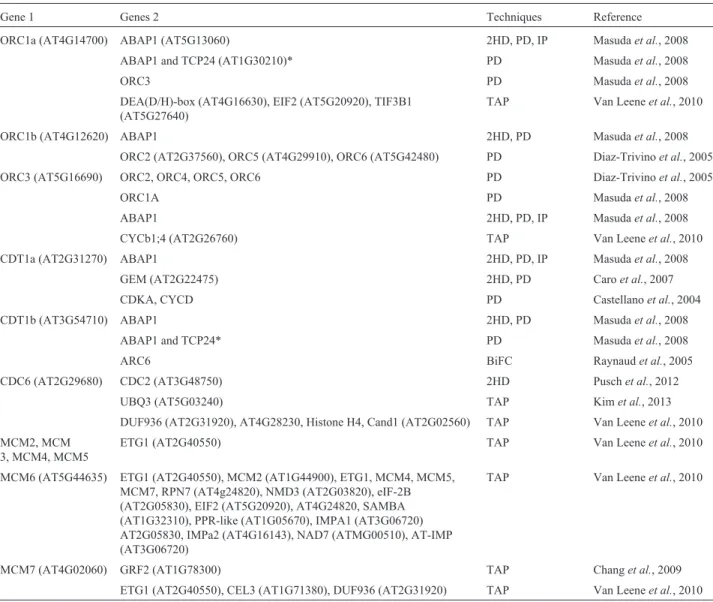
Interactions of plant pre-RC members with proteins outside the complex have been identified by co-immuno-precipitation, pull-down and two-hybrid assays (Table 2). Nevertheless, few regulators of the plant DNA licensing machinery in response to cell differentiation and environ-mental signaling have been studied so far. Other than the cell cycle regulation by CDK-Cyclins, novel regulatory proteins have been described to control pre-RC assembly and/or function in plant development.
The Armadillo BTBArabidopsisProtein 1 (ABAP1) is a plant-specific protein that binds directly to ORCa/b and CDT1a/b inA. thaliana. ABAP1 negatively regulates the assembly of the pre-RC, which reduces DNA replication li-censing and cell division rates (Masuda et al., 2008). ABAP1 could possibly prevent the assembly of a func-tional pre-RC complex by directly binding to members of pre-RC and/or by formation of a complex with TCP24, a transcription factor belonging to TCP class II that represses transcription ofCDT1aandCDT1b(Masudaet al., 2008). ABAP1 seems to participate in a negative feedback loop balancing mitotic DNA replication during leaf develop-ment (Figure 2).
Protein stability and subcellular distribution
The entrance into the cell cycle must be finely coordi-nated as it responds to diverse types of stimuli, including different growth factors, such as hormones and nutrients (Inzé and De Veylder, 2006; Takatsuka and Umeda, 2014). The majority of these regulators are connected to the cell cycle through the activity of cyclin-dependent kinases (CDKs), the main actors regulating progression through the cell cycle (Van Leeneet al., 2010). CDKs work as a com-plex with cyclins for further phosphorylation of specific targets, in a general mechanism that involves: (1) cyclin synthesis and destruction, (2) CDK-cyclin assembly, (3) in-hibitory and activating phosphorylation, and (4) the bind-ing of inhibitory proteins (Inzé and De Veylder, 2006) (Figure 2).
Once the pre-RC is assembled in replication origins, a series of phosphorylation on specific targets regulates
pre-RC activation followed by prevention of re-replication. Several members of the pre-RC are reported to be CDK regulation targets, such as CDC6, ORC1, ORC3 and MCMs; and the resulting phosphorylation of these proteins drives them to different fates (Erricoet al., 2010). In bud-ding yeast, after assembly of pre-RC and licensing of DNA, ScORC (possibly ScORC2 and ScORC6) and CDC6 are phosphorylated by CDC7-DBF4 and the cyclin dependent kinase CDC28 (cdc2)-CLN1 (Jacksonet al., 1993). This is followed by the displacement of CDC6 and MCM10 bind-ing for activation of MCM 2–7 and initiation of DNA repli-cation. CDC7/DBF4 kinases are as well important in regulating animal pre-RC, but they are not described in plants so far (Scofieldet al., 2014).
To prevent re-replication, both in budding yeast and in animals, phosphorylated CDC6 becomes a target of the SCF proteasome machinery, and any remaining CDC6 is
282 Plant cell cycle
Table 2- Pre-replication complex (pre-RC) protein interactions observed in experimental analysis inA. thaliana. Techniques: 2HD: yeast two-hybrid PD: pull-down; IP: immuno-precipitation; TAP: tandem affinity purification.
Gene 1 Genes 2 Techniques Reference
ORC1a (AT4G14700) ABAP1 (AT5G13060) 2HD, PD, IP Masudaet al., 2008
ABAP1 and TCP24 (AT1G30210)* PD Masudaet al., 2008
ORC3 PD Masudaet al., 2008
DEA(D/H)-box (AT4G16630), EIF2 (AT5G20920), TIF3B1 (AT5G27640)
TAP Van Leeneet al., 2010
ORC1b (AT4G12620) ABAP1 2HD, PD Masudaet al., 2008
ORC2 (AT2G37560), ORC5 (AT4G29910), ORC6 (AT5G42480) PD Diaz-Trivinoet al., 2005
ORC3 (AT5G16690) ORC2, ORC4, ORC5, ORC6 PD Diaz-Trivinoet al., 2005
ORC1A PD Masudaet al., 2008
ABAP1 2HD, PD, IP Masudaet al., 2008
CYCb1;4 (AT2G26760) TAP Van Leeneet al., 2010
CDT1a (AT2G31270) ABAP1 2HD, PD, IP Masudaet al., 2008
GEM (AT2G22475) 2HD, PD Caroet al., 2007
CDKA, CYCD PD Castellanoet al., 2004
CDT1b (AT3G54710) ABAP1 2HD, PD Masudaet al., 2008
ABAP1 and TCP24* PD Masudaet al., 2008
ARC6 BiFC Raynaudet al., 2005
CDC6 (AT2G29680) CDC2 (AT3G48750) 2HD Puschet al., 2012
UBQ3 (AT5G03240) TAP Kimet al., 2013
DUF936 (AT2G31920), AT4G28230, Histone H4, Cand1 (AT2G02560) TAP Van Leeneet al., 2010
MCM2, MCM 3, MCM4, MCM5
ETG1 (AT2G40550) TAP Van Leeneet al., 2010
MCM6 (AT5G44635) ETG1 (AT2G40550), MCM2 (AT1G44900), ETG1, MCM4, MCM5,
MCM7, RPN7 (AT4g24820), NMD3 (AT2G03820), eIF-2B (AT2G05830), EIF2 (AT5G20920), AT4G24820, SAMBA (AT1G32310), PPR-like (AT1G05670), IMPA1 (AT3G06720) AT2G05830, IMPa2 (AT4G16143), NAD7 (ATMG00510), AT-IMP (AT3G06720)
TAP Van Leeneet al., 2010
MCM7 (AT4G02060) GRF2 (AT1G78300) TAP Changet al., 2009
ETG1 (AT2G40550), CEL3 (AT1G71380), DUF936 (AT2G31920) TAP Van Leeneet al., 2010
phosphorylated and inactivated by interaction with cyclins (Mimuraet al., 2004). InA. thaliana,phosphorylation sites in CDC6 (Ramoset al., 2001) and MCMs (Dresselhauset al., 2006) were demonstrated, supporting a conserved regu-lation of the activation and prevention of re-replication steps in plants. To avoid re-replication, plants have as a key regulatory element the CDC6 dissociation from the pre-RC followed by its degradation, as well as the increase in CDC6 expression during S-phase and repression in G2 (Dambrauskas, 2003). During plant endoreplication, CDC6 is not degraded, and its overexpression induces rounds of endocycles (Bryant, 2011).
On the other hand, expression of most plant MCMs is greatly spread during the entire cycle (Springeret al., 2000; Holding and Springer, 2002; Huanget al., 2003; Choet al., 2008). It seems that plant strategies to prevent extra rounds of DNA replication based on MCM regulation seem to be much more similar to animals than to budding yeast. MCM5 and MCM7 are the MCMs that topologically load onto DNA in plants (Shultzet al., 2009). MCM7 changes its dynamic of localization during the cell cycle, where it is highly associated with chromatin in phases G1, S and G2, and is dispersed in the cell only in the M phase (Shultzet al., 2009). This indicates that plants do not regulate origin licensing by actively exporting the MCM complex from the nucleus during S phase, like in yeast. InA. thaliana and Nicotiana benthamiana,MCM5 and MCM7 are in the nu-cleus throughout most of the cell cycle and are displaced for only a brief period during mitosis (Shultz et al., 2009). Plant ORC1 is weakly associated to chromatin (Shultzet al., 2009), compared to mammals, where ORC1 is not part of the core origin recognition complex (Ohtaet al., 2003). At the transition between M and G1 in many euka-ryotes, MCMs are transported back to the nucleus to take part in another round of DNA replication licensing (Blow and Prokhorova, 1999). In animals, however, they remain inside the nucleus, and it is the inactivation of CDT1 that prevents MCM to load onto DNA again, as CDT1 is a key factor during MCM recruitment (Blow and Dutta 2005; Kernset al., 2007; reviewed by Rizzardi and Cook 2012). CDT1 is regulated mainly by ubiquitin-targeted proteolysis in animals (a process triggered by CDK/cyclin activity) and by interaction with Geminin, which sequesters CDT1, avoiding the complete pre-RC re-assembly (Suchytaet al., 2015). Geminins have also been implicated in the regula-tion of cell proliferaregula-tion and cell differentiaregula-tion by interact-ing in a competitive way with components of the pre-RC (CDT1) or with transcription factors (Six and Hox) (del Beneet al., 2004; Luoet al., 2004). Unlike animals, plants do not seem to have a Geminin homolog, and it is not yet determined if and how CDT1 regulates MCM loading. The CDT1 partner GEM shares similarity with animal Gemi-nins, as the competition of GEM for binding to CDT1 or to the transcription factor TTG1 might modulate the expres-sion of the homeobox factor GLABRA (GL2) and control
cell division (Caro et al., 2007). GEM is an ABA-res-ponsive protein that has a role in seed dormancy (Mauriet al., 2016); nevertheless the function of GEM in regulating the availability of CDT1 and DNA replication licensing in plants remains to be demonstrated.
Regulation of pre-RC licensing by mRNA
expression profiles.
The spatial and temporal expression patterns of the pre-RC genes have been studied in different plant species using various experimental approaches, such as inO. sativa (Kimuraet al., 2000; Moriet al., 2005; Choet al., 2008);Z. mays (Sabelli et al., 1996, 1999; Bastida and Puigdo-menech, 2002; Witmer, 2003; Liet al., 2005; Dresselhaus et al., 2006); A. thaliana (Witmer, 2003; Collingeet al., 2004; Masudaet al., 2004; Raynaudet al., 2005; Shultzet al., 2007) andN. tabacum(Dambrauskas, 2003). The re-sponses of pre-RC gene expression to various signals indi-cate that transcriptional control might exert an important level of regulation of the complex function. In addition, the data showed different expression profiles among pre-RC components suggesting the existence of various forms of the complex, possibly playing different roles during devel-opment (Raynaudet al., 2005; Danget al., 2011). Finally, the expression of pre-RC genes in tissues with low levels of cell proliferation suggests that they are likely to perform functions outside of the complex, not related to cell division (Dresselhauset al., 2006; Danget al., 2011). Various stud-ies have also identified pre-RC interactions with proteins not related to the plant cell cycle (Table 2).
Analyses of mRNA levels of pre-RC members from A. thaliana during a cell cycle round revealed a cell cy-cle-regulated profile, as transcript levels of pre-RC mem-bers are reduced significantly during S phase, especially ORC3 and CDC6 (Castellanoet al., 2001; Ramos et al., 2001; Masudaet al., 2004). Later, in the transition from G2/M, mRNA levels of most members rise again, display-ing a similar pattern (Castellanoet al., 2001; Masudaet al., 2004). However, the cell cycle expression profile of pre-RC members varies among plant species. InN. tabacum cell cultures,NtMCM3expression is not confined to a cell cycle-specific phase, differently fromNtCDC6, which is cell cycle regulated (Dambrauskas, 2003). In rice, MCM5 and -7 are found in high levels in the nucleus during both G1/S and G2/M phases (Shultzet al., 2009). MCM6 ex-pression is high, but it declines during S phase to undetect-able levels in late S and G2 phases in maize (Dresselhauset al., 2006).
2014). The phosphorylation of RBR by the CDK-cyclinD complex is a trigger point that releases the expression of cell cycle genes that are under the control of E2F-DP, such as pre-RC members (reviewed in Scofieldet al., 2014), and irreversibly commits the cell to DNA replication (Dimova and Dyson, 2005) (Figure 2). Promoters of allA. thaliana pre-RC genes, excluding AtORC5, have a putative E2F consensus binding motif (Castellano et al., 2001, 2004; Diaz-Trivinoet al., 2005). It was shown that theCDT1a andORC2genes are regulated before S phase by E2F inA. thaliana(Castellanoet al., 2004; Magyaret al., 2012).
The spatial and temporal mRNA localization of dif-ferent members of the pre-RC machinery can be very di-verse, depending on the tissue observed, and their regulation might also involve epigenetic control besides transcription factors (reviewed in Raynaudet al., 2014). For example, the function ofA. thalianaDNA replication factor C was recently described in the maintenance of gene silencing through histone methylation (Liuet al., 2010). Furthermore, at the G1/S transition, histone acetylation is required for the specification and activation of replication origins (Costaset al., 2011). A new Agenet/Tudor domain protein named AIP1 (ABAP1 interacting protein 1) was de-scribed as interacting with histones, ABAP1, and the plant histone modification reader (LHP1) to regulate the expres-sion of ABAP1 and LHP1 target genes in flower buds, such asAtCdt1bandFlower Locus T (FT),respectively (Brasilet al., 2015). In addition, intrinsic or extrinsic signals may af-fect plant growth, interfering with cell cycle regulation, endoreduplication, stress responses and cell death (Diaz-Trivinoet al., 2005; reviewed in John and Qi, 2008; Mag-yaret al., 2012; Sabelliet al., 2013). All these processes may be part of the same machinery, directly coordinating the expression of pre-RC members.
Consistent with a role in DNA replication, mRNAs of ORCsfrom A. thaliana, rice and maize, as well as tran-scripts ofAtCDC6,AtMCMsandZmMCMsare abundant in proliferating tissues, such as root tips, lateral root develop-ment, seedlings, young leaves and flower buds (Sabelliet al., 1996; Springer et al., 2000; Castellano et al., 2001; Bastida and Puigdomenech, 2002; Masuda et al., 2004; Diaz-Trivinoet al., 2005; Schreiberet al., 2006; Danget al., 2011; Chenet al., 2013). In rice,OsORC1andOsORC2 are strongly expressed in roots and inflorescence meris-tems, respectively, but there is a reduction of expression of OsORCsin tissues with low proliferative rates, leading to complete absence in mature leaves (Kimuraet al., 2000; Li et al., 2005). Similarly, mRNA levels of maizeZmORCs, except forZmORC3, are very low in mature leaves with few dividing cells, differing from the high expression levels ob-served in highly proliferative tissues (Witmer, 2003; Schreiberet al., 2006; Sabelliet al., 2013).
InA. thaliana,pre-RC members can also be found in organs with low cell division rates (Masudaet al., 2004; Diaz-Trivinoet al., 2005). This expression profile outside
proliferating cells could be correlated with DNA replica-tion in endoreduplicating cells (reviewed in John and Qi, 2008). AtORC1a,and notAtORC1b,is highly expressed in tissues that undergo extra endocycles of DNA replication (Diaz-Trivinoet al., 2005). The two AtCDC6genes also present different expression profiles (Masudaet al., 2004), andAtCDC6aexpression in non-dividing tissues has been associated with endoreduplication events (Castellanoet al., 2001). Also, higher AtCDT1 levels are directly correlated with an increase in the number of endocycles (Castellanoet al., 2004).
Alternatively, pre-RC members could also be in-volved in regulating processes other than licensing DNA for replication. In other eukaryotes, pre-RC proteins have been implicated in different roles, such as transcriptional regulation and heterochromatin assembly in yeast and metazoans, sister chromatin cohesion, chromosome segre-gation and cytokinesis, neuronal development, and cen-triole and centrosome copy number (Hemerlyet al., 2009; reviewed in Sasaki and Gilbert, 2007). Functional data have already demonstrated that the role of pre-RC members in plants is not limited to licensing DNA for replication, but is also related to the regulation of gene expression, chromatin condensation and cell differentiation, directly influencing the growth and development of plants from embryogenesis until the senescence (discussed below – see Table 3).
Plants seem to sense many environmental conditions and adjust cell cycle progression, at least in part, by regulat-ing the expression of pre-RC components. In this context, plant hormones have great importance by integrating sig-naling between organs and tissues within the plant and among other organisms, and in response to the environment (Takatsuka and Umeda, 2014). In higher plants, the TOR kinase protein integrates the auxin pathway with nutrient signals, resulting in both growth and cell division responses to the environment (Bögreet al., 2013; Henriqueset al., 2014). In cell cultures, auxin has been implicated in partici-pating in the stabilization ofE2Fb, compromising cells to the G1 to S phase transition (Magyar et al., 2005; Berckmanset al., 2011). Cell cycle progression is also reg-ulated by sucrose, which stimulates progression into S phase and cell division by controlling cyclins and pre-RC gene expression (Masuda et al., 2004; Planchais et al., 2004, Mengeset al., 2006). Recently it was suggested that methyl jasmonate contributes to inhibit the initiation of DNA replication by repression of CDC6 and CDT1 levels (Noiret al., 2013).
Epigenetic mechanisms in pre-RC function.
Although not yet well understood, animal DNA repli-cation timing and its regulation through epigenetic mecha-nisms, ranging from DNA methylation to histone modifica-tions and higher order chromatin structure, have been studied more deeply in the last years (reviewed by
al.
285
Genes Vegetative Phase Reproductive Phase Endoreduplication Others Reference
ORC1 Single mutants are lethal inA. thaliana Activation of expression of pre-RC
genes through epigenetic regulation in A. thaliana
De La Paz Sanchez and Gutierrez, 2009
ORC2 Cell cycle arrest by abnormal cell divi-sions inA. thaliana
Chromatin instability leading to em-bryo abortion inA. thaliana
Collingeet al., 2004
ORC3 Defects in lateral root development in O. sativa
Collingeet al., 2004
ORC6 Abortion in G1/S phase of the
genera-tive cell during male gametogenesis in A. thaliana
Qinet al., 2014
MCM2 Promotion of lateral root initiation close to the root tip inA. thaliana
Reduced growth and inhibition of endoreduplication in early embryo stage inA. thaliana
Niet al., 2009
MCM6 Demonstration of full helicase activity by itself inP. sativum
Promotion of salt tolerance, possibly by activating the expression of stress-related genes, inP. sativumand N. tabacum
Danget al., 2011; Quang et al., 2010
MCM7 Defects in ovule formation inA.
thaliana
Herridgeet al., 2014
MCM2-7 (single subunits)
Seed abortion in early and late stages inA. thaliana
Herridgeet al., 2014
CDT1a Abortions by defects in egg cell
devel-opment inA. thaliana
Increase in nuclear ploidy during leaf development inA. thaliana
Domenichiniet al., 2012; Castellanoet al., 2004
CDT1a/CDT1b double mutant
Delayed growth and yellow leaves and maintenance of the repressor histone H3K9 methylation status of root pat-terning genes inA. thaliana
Seed abortions due to a role in female gametophyte inA. thaliana
DNA stress leading to genome insta-bility probably due to incomplete ge-nome replication during S-phase inA. thaliana
Domenichiniet al., 2012; Caroet al., 2007
Delucchi and Cardoso, 2011). In plants, 130 epigenetic reg-ulators have been described so far, revealing enormous di-versity and contributing to the understanding of plant plas-ticity (Pikaard and Mittelsten Scheid, 2014). However, very little is known about epigenetic mechanisms regulat-ing the cell cycle.
As discussed above, some epigenetic marks are en-riched in DNA replication origins ofA. thaliana(Costaset al., 2011), suggesting that chromatin modification proteins could be involved in specifying replication origins and/or regulating DNA replication timing in plants.
ORC1 has an interesting role in the activation of pre-RC through epigenetic regulation of gene expression. The role of BAH domains of ORC1 in transcriptional si-lencing has been well studied in yeast (Ruscheet al., 2003), and their involvement in DNA damage was reported in metazoans (Kuoet al., 2012). InA. thaliana, the PHD do-main, present in the C-terminus of bothORC1genes, is re-sponsible for the recognition and binding to histone H3K4me3 residues in promoters of target genes such as MCM3,CDT1a, andORC3(Sanchez and Gutierrez, 2009). Moreover, the binding of ORC1 to its targets is related to the increase in H4 acetylation and trimethylation of H4K20 (Sanchez and Gutierrez, 2009). Recently, the crystal struc-ture of the AtORC1b BAH-PHD cassette and its preference for the unmodified state of key amino acids when in com-plex with a H3 peptide was reported, revealing a unique “sandwiching” mode of ORC1 recognition of its targets (Li et al., 2016).
The Agenet/Tudor-domain protein, AIP1, which in-teracts with the pre-RC regulator ABAP1 and with unmodi-fied histones, regulates the expression of ABAP1 target genes such asAtCdt1band seems to connect DNA replica-tion and transcripreplica-tion to chromatin remodeling controls during flower development (Brasilet al., 2015).
Therefore, pre-RC members, pre-RC regulators and epigenetic players were described as partners in regulating both transcription and replication origin specification and/or activation in plants. Transcription and replication are two cellular processes that require chromatin accessibil-ity, however it has not yet been elucidated if and how they are integrated in plant cells. As discussed above, a high per-centage of origins inA. thaliana co-localizes with the 5’ end of gene units and are more concentrated in highly ex-pressed genes (Costaset al., 2011). Hence, one question that remains to be answered is whether pre-RC proteins and their regulators, together with epigenetic mechanisms, could be, to certain extent, shared between replication li-censing and transcription machineries to co-regulate these vital cellular processes.
What do mutants tell us about pre-RC function?
Functional analyses of pre-RC components were in-vestigated in plants with modified levels of gene expres-sion. The observed phenotypes for each mutation are
sum-marized in Table 3. These studies showed that mutants in plant pre-RC genes could interfere in developmental pro-cesses either by directly affecting replication or by indirect effects on endoreduplication and heterochromatin forma-tion (Table 3).
Complete knockout plants forORCgenes cannot sur-vive, indicating that these genes are vital for the plant to complete its life cycle (Collingeet al., 2004; Sanchez and Gutierrez, 2009; Chenet al., 2013). Constitutive expres-sion of a specific mutation in the PHD domain of ORC1b in A. thalianaleads to the loss of theORC1boverexpression phenotype characterized by increased cell proliferation (Sanchez and Gutierrez, 2009), revealing that PHD is es-sential for ORC function in DNA replication. ORC1 is not only required to form the pre-RC and to license DNA repli-cation, but it also has a role in pre-RC activation through epigenetic regulation of gene expression (Takayamaet al., 2000; Saitohet al., 2002; Ruscheet al., 2003).
In A. thaliana,the ORC2 mutants show a zygotic-lethal phenotype, with abortion of embryos in the early globular state and enlarged endosperm nuclei (Collingeet al., 2004). It has been proposed that lowORC2levels in the mutants prevent pre-RC assembly and the lack of the check point before S-phase in embryo cells; this (a) leads to many endoreduplication cycles and the enlargement of the endo-sperm nuclei; as well as (b) triggers cell cycle arrest, lead-ing to abnormal divisions and chromatin instability that results in abortion of the embryo (Collingeet al., 2004).
In a developmental context, OsORC3 knockdown rice plants lack lateral roots and have a dwarf phenotype (Chenet al., 2013). A very fast differentiation of lateral root cells requires rapid cycles of cell division for tissue mainte-nance and development. However, in cells with lower OsORC3 availability, the G1/S phase is compromised, leading to lower proliferation levels and tissue defects (Chenet al., 2013).
AtORC6is required for the mitosis that gives origin to the two sperm cells of theA. thalianamale gametophyte, and its absence causes abortion of the generative cell, with aberrant DNA content (Qinet al., 2014). proBRP4:ORC6 RNAi mutants with reduced expression of ORC6 display pollen developmental defects, and aborted generative cells have a lower DNA content, suggesting impairment at the G1/S phase (Qinet al., 2014). ORC6 acts downstream of BRP4, a TFIIB-related protein involved in regulation of the mitotic cell cycle progression during male gametogenesis (Qinet al., 2014).
AtCDT1a seems to have a specific function in female gametogenesis during embryo sac development in A. thaliana, while a majority of pollen grains harboring the cdt1amutation develop normally, possibly due to a partial redundancy with AtCDT1b in the male gametophyte (Domenichiniet al., 2012). Nowacket al.(2006) first sug-gested that the storage ofCDKmRNAs in female tissues would avoid proteolysis and maintain sufficient supplies
for cell cycle activities, proposing that pre-RC proteins may accumulate in maternal tissues. Although not yet described for other members of the pre-RC, it is possible thatCDT1a accumulates in higher levels thanCDT1bat gametophyte development (Domenichiniet al., 2012) due to a CDT1b plastid-targeting sequence (Raynaudet al., 2005). CDT1 and CDC6 are expressed in stomatal precursor cells, and overexpression of these genes increases the number of stomata inA. thalianaleaves (Castellanoet al., 2004). In addition, simultaneous silencing of bothCdt1genes shows a delay in cell cycle progression and an increase in endo-reduplication (Raynaud et al., 2005). Plants with double mutation inCDT1aandCDT1bshow a variety of pheno-types, including: drastically reduced stature and deformed leaves; evidences of the DNA stress, probably due to in-complete genome replication during S-phase; aberrant DNA content and induction to cell death; better tolerance to DNA-damaging agents; and increased expression of genes involved in DNA repair (Domenichiniet al., 2012). More-over, CDT1 interacts with the GEM protein and may partic-ipate in the maintenance of the repressor mark histone H3K9 methylation status on root patterning genes (Caroet al., 2007).
Disruption ofA. thaliana MCM2 is lethal, causing plants to show problems at early embryo stage, while its overexpression inA. thalianaincreases cell division in root meristems and decreases endoreduplication (Ni et al., 2009).mcm7 mutants show leaky lethality in the mega-gametophyte (Springeret al., 1995), and its effects in em-bryo and endosperm development may be due the gene’s primary function in the ovule (Springer et al., 2000; Holding and Springer, 2002).
AtMCM7 was the first MCM protein identified in plants, reported with the name ofPROLIFERA(PRL) and with functions in reproduction and embryo development (Springeret al., 1995). Later, Herridgeet al.(2014) studied allMCMsmutants separately duringA. thalianaseed de-velopment. It was observed that, in general, reduced MCM in the endosperm promotes the expression of genes in-volved in DNA damage response in the ATM-dependent pathway. As expected for pre-RC genes, homozygous mu-tants for allMCMsare lethal, but different proportions of seed abortion in early and late stages are observed when heterozygous mutants are analyzed:mcm2andmcm5have the highest rates of late abortion andmcm3andmcm4the lowest. The endosperm defects in mutants are generally characterized by fewer and larger nuclei compared to wild-type seeds, the absence of cellularization in endo-sperm, and abnormal embryo cytokinesis. Among all mu-tants,mcm7is the more distinct one, and its defect at an early embryo stage confirms previous data that MCM7 is required during ovule development (Herridgeet al., 2014). The first evidence of a single subunit ofPsMCM6with a full helicase activityin vitrowas demonstrated by Tranet al.(2010). Helicase activity, as well as an ATPase activity,
have been described for AtMCM3 with greater unwinding efficiency with 5-forked DNA, and the indispensable pres-ence of ATP and magnesium ion (Rizviet al., 2016). All to-gether, these data points out the difference between plant and animal MCM mechanisms of action, once multi-heterodimers of MCM were reported in animals only.
Interestingly, a role of pRC on environmental re-sponses was shown by the overexpression ofPsMCM6in P. sativum, which increased salinity tolerance and cold stress in an ABA-independent pathway (Danget al., 2011). While the exact mechanism of stress tolerance is not known, the PsMCM6 characterization as Zn-HD family member supports its role in stress tolerance (Tranet al., 2010).
Remarkably, deregulation of expression (silencing or overexpression) of the different pre-RC members show dif-ferent effects on plant developmental processes, suggesting that they might have distinct roles in the pre-RC and/or might reflect their particular roles outside the complex. All together, the functional analysis data confirm that pre-RC genes are not only main actors in licensing DNA for repli-cation, but that they additionally have a role in chromatin stability and as regulators of gene expression, either by in-teraction with transcription factors or by epigenetic path-ways. These combined roles might act by integrating cell cycle progression in plants with developmental and envi-ronmental signaling.
Conclusions and Perspectives
Plants are continuously sensing the environment and modulating their development by adjusting the growth, ar-chitecture and timing of development of new organs. This means that every plant meristem might be sensing exoge-nous signals and integrating these with genetic controls, which leads to changes in gene expression that will finally balance cell proliferation and differentiation rates, to gener-ate the correct plant form. An important control of the G1 to S transition of the cell cycle is the pre-RC that is assembled at replication origins (Figure 1).
Therefore, the facilities available to study plants as whole organisms make them a suitable model for developmental studies.
There are still very important aspects of the pre-RC regulation and activity that need to be elucidated in plants. The understanding of the mechanism of origin recognition and selection, and how it is integrated with transcription controls, could enlighten ideas on specific strategies of cell cycle regulation as well as how cell cycle controls respond to environmental changes, and finally, how plant plasticity is integrated with these processes. Although pre-RC regula-tors were identified and mutant studies gave insights on pre-RC functions, it is now necessary to assemble all the pieces of the puzzle to understand how cell cycle regulation is integrated with developmental and environmental sig-nals, in order to generate adaptive responses, culminating with plant bodies adjusted to their surroundings.
Acknowledgments
We would like to thank Helkin Forero Ballesteros for preparing the illustrations. The research was supported by Fundação de Amparo à Pesquisa do Estado do Rio de Jane-iro (FAPERJ), Coordenação de Aperfeiçoamento de Pesso-al de Nível Superior (CAPES/COFECUB), and Conselho Nacional de Desenvolvimento Científico e Tecnológico (CNPq). JNB was supported by CNPq and by the interna-tional exchange program Science without Borders (CNPq) for PhD fellowships. CNMC was supported by CNPq and by the international exchange program CAPES/COFECUB for PhD fellowships. ASH and PCGF received support as CNPq and FAPERJ researchers.
References
Aasland R, Gibson TJ and Stewart AF (1995) The PHD finger: Implications for chromatin-mediated transcriptional regula-tion. Trends Biochem Sci 20:56-59.
Aladjem MI (2007) Replication in context: Dynamic regulation of DNA replication patterns in metazoans. Nat Rev Genet 8:588-600.
Bass HW, Wear EE, Lee TJ, Hoffman GG, Gumber HK, Allen GC, Thompson WF and Hanley-Bowdoin L (2014) A maize root tip system to study DNA replication programmes in so-matic and endocycling nuclei during plant development. J Exp Bot 65:2747-2756.
Bastida M and Puigdomenech P (2002) Specific expression of ZmPRL, the maize homolog of MCM7, during early embryogenesis. Plant Sci 162:97-106.
Bell SP (2002) The origin recognition complex: From simple ori-gins to complex functions. Genes Dev 16:659-672. Bell SP and Dutta A (2002) DNA replication in eukaryotic cells.
Annu Rev Biochem 71:333-374.
Berckmans B, Vassileva V, Schmid SP, Maes S, Parizot B, Nara-moto S, Magyar Z, Alvim Kamei CL, Koncz C, Bögre L,et al.(2011) Auxin-dependent cell cycle reactivation through transcriptional regulation of Arabidopsis E2Fa by lateral or-gan boundary proteins. Plant Cell 23:3671-3683.
Bisová K and Zachleder V (2014) Cell-cycle regulation in green algae dividing by multiple fission. J Exp Bot 65:2585-2602. Blow JJ and Dutta A (2005) Preventing re-replication of
chromo-somal DNA. Nat Rev Mol Cell Biol 6:476-486.
Blow JJ and Prokhorova TA (1999) Saying a firm “no” to DNA re-replication. Nat Cell Biol 1:E175-E177.
Blumenthal AB, Kriegstein HJ and Hogness DS (1974) The units of DNA replication inDrosophila melanogaster chromo-somes. Cold Spring Harb Symp Quant Biol 38:205-223. Bögre L, Henriques R and Magyar Z (2013) TOR tour to auxin.
EMBO J 32:1069-1071.
Boniotti MB and Griffith ME (2002) “Cross-talk” between cell di-vision cycle and development in plants. Plant Cell 14:11-16. Brasil JN, Cabral LM, Eloy NB, Primo LMF, Barroso-Neto IT,
Grangeiro LPP, Gonzalez N, Inzé D, Ferreira PCG and Hemerly AS (2015) AIP1 is a novel Agenet/Tudor domain protein from Arabidopsis that interacts with regulators of DNA replication, transcription and chromatin remodeling. BMC Plant Biol 15:270.
Brukhin V and Morozova N (2011) Plant growth and develop-ment - Basic knowledge and current views. Mathemat Model Nat Phen 6:1-53.
Bryant JA (2011) Replication of nuclear DNA. Ann Bot 107:106. Bryant JA and Aves SJ (2011) Initiation of DNA replication:
Functional and evolutionary aspects. Ann Bot 107:1119-1126.
Callebaut IY, Courvalin J and Mornon J (1999) The BAH (bro-mo-adjacent homology) domain: A link between DNA methylation, replication and transcriptional regulation. FEBS Lett 446:189-193.
Caro E, Castellano MM and Gutierrez C (2007) A chromatin link that couples cell division to root epidermis patterning in Arabidopsis. Nature 447:213-217.
Casas-Delucchi CS and Cardoso MC (2011) Epigenetic control of DNA replication dynamics in mammals. Nucleus 2:370-382.
Castellano MM, Carlos J, Ramirez-Parra E, Brown S and Gutier-rez C (2001) Expression and stability of Arabidopsis CDC6 are associated with endoreplication. Plant Cell 13:2671-2686.
Castellano M, Boniotti M, Caro E, Schnittger A and Gutierrez C (2004) DNA replication licensing affects cell proliferation or rndoreplication in a cell type-specific manner. Plant Cell 16:2380-2393.
Cayrou C, Coulombe P, Vigneron A, Stanojcic S, Ganier O, Peiffer I, Rivals E, Puy A, Laurent-Chabalier S, Desprat R,
et al.(2011) Genome-scale analysis of metazoan replication origins reveals their organization in specific but flexible sites defined by conserved features. Genome Res 21:1438-1449.
Chang IF, Curran A, Woolsey R, Quilici D, Cushman JC, Mittler R, Harmon A and Harper JF (2009) Proteomic profiling of tandem affinity purified 14-3-3 protein complexes in
Arabidopsis thaliana. Proteomics 9:2967-2985.
Chen X, Shi J, Hao X, Liu H, Shi J, Wu Y, Wu Z, Chen M, Wu P and Mao C (2013) OsORC3 is required for lateral root de-velopment in rice. Plant J 74:339-350.
Cho JH, Kim HB, Kim H-S and Choi S-B (2008) Identification and characterization of a rice MCM2 homologue required for DNA replication. BMB Rep 41:581-586.
Collinge MA, Spillane C, Köhler C, Gheyselinck J and Gros-sniklaus U (2004) Genetic interaction of an Origin Recogni-tion Complex Subunit and the Polycomb group gene MEDEA during seed development. Plant Cell 16:1035-1046.
Costas C, Sanchez M de P, Stroud H, Yu Y, Oliveros C, Feng S, Benguria A, López-Vidriero I, Zhang X, Solano R, et al.
(2011) Genome-wide mapping of Arabidopsis origins of DNA replication and their associated epigenetic marks. Nat Struct Mol Biol 18:395-400.
Cunningham EL and Berger JM (2005) Unraveling the early steps of prokaryotic replication. Curr Opin Struct Biol 15:68-76. Dambrauskas G (2003) Genes encoding two essential DNA
repli-cation activation proteins, Cdc6 and Mcm3, exhibit very dif-ferent patterns of expression in the tobacco BY-2 cell cycle. J Exp Bot 54:699-706.
Dang HQ, Tran NQ, Tuteja R and Tuteja N (2011) Promoter of a salinity and cold stress-induced MCM6 DNA helicase from pea. Plant Signal Behav 6:1006-1008.
del Bene F, Tessmar-Raible K and Wittbrodt J (2004) Direct inter-action of geminin and Six3 in eye development. Nature 427:745-749.
Desvoyes B, De Mendoza A, Ruiz-Trillo I and Gutierrez C (2014) Novel roles of plant RETINOBLASTOMA-RELATED (RBR) protein in cell proliferation and asymmetric cell divi-sion. J Exp Bot 65:2657-2666.
Dhar SK, Delmolino L and Dutta A (2001) Architecture of the hu-man origin recognition complex. J Biol Chem 276:29067-29071.
Diaz-Trivino S, del Mar Castellano M, Sanchez M de P, Rami-rez-Parra E, Desvoyes B and Gutierrez C (2005) The genes encoding Arabidopsis ORC subunits are E2F targets and the two ORC1 genes are differently expressed in proliferating and endoreplicating cells. Nucleic Acids Res 33:5404-5414. Dimova DK and Dyson NJ (2005) The E2F transcriptional
net-work: Old acquaintances with new faces. Oncogene 24:2810-2826.
Domenichini S, Benhamed M, De Jaeger G, Van De Slijke E, Blanchet S, Bourge M, De Veylder L, Bergounioux C and Raynaud C (2012) Evidence for a role of Arabidopsis CDT1 proteins in gametophyte development and maintenance of genome integrity. Plant Cell 24:2779-2791.
Dorn ES and Cook JG (2011) Nucleosomes in the neighborhood: New roles for chromatin modifications in replication origin control. Epigenetics 6:552-559.
Dresselhaus T, Srilunchang K-O, Leljak-Levanic D, Schreiber DN and Garg P (2006) The fertilization-induced DNA repli-cation factor MCM6 of maize shuttles between cytoplasm and nucleus, and is essential for plant growth and develop-ment Plant Physiol 140:512-527.
Errico A, Deshmukh K, Tanaka Y, Pozniakovsky A and Hunt T (2010) Identification of substrates for cyclin dependent kin-ases. Adv Enzyme Regul 50:375-399.
Gaudier M, Schuwirth BS, Westcott SL and Wigley DB (2007) Structural basis of DNA replication origin recognition by an ORC protein. Science 317:1213-1216.
Gavin KA, Hidaka M and Stillman B (1995) Conserved initiator proteins in eukaryotes. Science 270:1667-1671.
Grime JP and Mowfforth MA (1982) Variation in genome size -An ecological interpretation. Nature 299:151-153.
Henriques R, Bögre L, Horváth B and Magyar Z (2014) Balancing act: Matching growth with environment by the TOR signal-ling pathway. J Exp Bot 65:2691-2701.
Hemerly AS, Prasanth SG, Siddiqui K and Stillman B (2009) Orc1 controls centriole and centrosome copy number in hu-man cells. Science 323:789-793.
Herridge RP, Day RC and Macknight RC (2014) The role of the MCM2-7 helicase complex during Arabidopsis seed devel-opment. Plant Mol Biol 86:69-84.
Hiratani I, Takebayashi SI, Lu J and Gilbert DM (2009) Replica-tion timing and transcripReplica-tional control: Beyond cause and effect-part II. Curr Opin Genet Dev 19:142-149.
Holding DR and Springer PS (2002) The Arabidopsis gene PROLIFERA is required for proper cytokinesis during seed development. Planta 214:373-382.
Huang X, Springer PS and Kaloshian I (2003) Expression of the Arabidopsis MCM gene PROLIFERA during root-knot and cyst Nematode infection. Phytopathology 93:35-41. Huysman MJJ, Vyverman W and De Veylder L (2014) Molecular
regulation of the diatome cell cycle. J Exp Bot 65:2573-2584.
Inzé D and De Veylder L (2006) Cell cycle regulation in plant de-velopment. Annu Rev Genet 40:77-105.
Jackson AL, Pahl PM, Harrison K, Rosamond J and Sclafani RA (1993) Cell cycle regulation of the yeast Cdc7 protein kinase by association with the Dbf4 protein. Mol Cell Biol 13:2899-2908.
John PC and Qi R (2008) Cell division and endoreduplication: Doubtful engines of vegetative growth.Trends Plant Sc.13:121-127.
Kearsey SE and Cotterill S (2003) Enigmatic variations: Diver-gent modes of regulating eukaryotic DNA replication. Mol Cell 12:1067-1075.
Kerns SL, Torke SJ, Benjamin JM and McGarry TJ (2007) Ge-minin prevents rereplication during Xenopus development. J Biol Chem 282:5514-5521.
Kim DY, Scalf M, Smith LM and Vierstra RD (2013) Advanced proteomic analyses yield a deep catalog of ubiquitylation targets in Arabidopsis. Plant Cell 25:1523-1540.
Kimura S, Ishibashi T, Hatanaka M, Sakakibara Y, Hashimoto J and Sakaguchi K (2000) Molecular cloning and character-ization of a plant homologue of the origin recognition com-plex 1 (ORC1). Plant Sci 158:33-39.
Kuo AJ, Song J, Cheung P, Ishibe-Murakami S, Yamazoe S, Chen JK, Patel DJ and Gozani O (2012) The BAH domain of ORC1 links H4K20me2 to DNA replication licensing and Meier-Gorlin syndrome. Nature 484:115-119.
Lamesch P, Berardini TZ, Li D, Swarbreck D, Wilks C, Sasidha-ran R, Muller R, Dreher K, Alexander DL, Garcia-Her-nandez M,et al.(2012) The Arabidopsis Information Re-source (TAIR): Improved gene annotation and new tools. Nucleic Acids Res 40:1202-1210.
Latrasse D, Benhamed M, Henry Y, Herridge S, Kim W, Zhou D-X and Delarue M (2008) The MYST histone acetyl-transferases are essential for gametophyte development in Arabidopsis. BMC Plant Biol 8:121.
Lee HO, Davidson JM and Duronio RJ (2009) Endoreplication: Polyploidy with purpose. Genes Dev 23:2461-2477. Li KG, Yang JS, Attia K, Su W, He GM and Qian XY (2005)
Li S, Yang Z, Du X, Liu R, Wilkinson AW, Gozani O, Jacobsen SE, Patel DJ and Du J (2016) Structural basis for the unique multivalent readout of unmodified H3 tail by Arabidopsis ORC1b BAH-PHD cassette. Structure 24:486-494. Liu Q, Wang J, Miki D, Xia R, Yu W, He J, Zheng Z, Zhu JK and
Gong Z (2010) DNA replication factor C1 mediates geno-mic stability and transcriptional gene silencing in Arabidopsis. Plant Cell 22:2336-2352.
Luo L, Yang X, Takihara Y, Knoetgen H and Kessel M (2004) The cell-cycle regulator geminin inhibits Hox function through direct and polycomb-mediated interactions. Nature 427:749-753.
Magyar Z, De Veylder L, Atanassova A, Bakó L, Inzé D and Bögre L (2005) The role of the Arabidopsis E2FB transcrip-tion factor in regulating auxin-dependent cell division. Plant Cell 17:2527-2541.
Magyar Z, Horváth B, Khan S, Mohammed B, Henriques R, De Veylder L, Bakó L, Scheres B and Bögre L (2012) Arabidopsis E2FA stimulates proliferation and endocycle separately through RBR-bound and RBR-free complexes. EMBO J 31:1480-1493.
Masai H, You Z and Arai K (2005) Control of DNA replication: Regulation and activation of eukaryotic replicative helicase, MCM. IUBMB Life 57:323-335.
Masuda HP, Ramos GBA, de Almeida-Engler J, Cabral LM, Coqueiro VM, Macrini CMT, Ferreira PCG and Hemerly AS (2004) Genome based identification and analysis of the pre-replicative complex ofArabidopsis thaliana. FEBS Lett 574:192-202.
Masuda HP, Cabral LM, De Veylder L, Tanurdzic M, de Almeida Engler J, Geelen D, Inzé D, Martienssen RA, Ferreira PCG and Hemerly AS (2008) ABAP1 is a novel plant Armadillo BTB protein involved in DNA replication and transcription. EMBO J 27:2746-2756.
Mauri N, Fernández-Marcos M, Costas C, Desvoyes B, Pichel A, Caro E and Gutierrez C (2016) GEM, a member of the GRAM domain family of proteins, is part of the ABA signal-ing pathway. Sci Rep 6:22660.
MechaliM, Yoshida K, Coulombe P and Pasero P (2013) Genetic and epigenetic determinants of DNA replication origins, po-sition and activation. Curr Opin Genet Dev 23:124-131. Menges M, Samland AK, Planchais S and Murray JA (2006) The
D-type cyclin CYCD3:1 is limiting for the G1-to-S-phase transition in Arabidopsis. Plant Cell 18:893-906.
Mimura S, Seki T, Tanaka S and Diffley JF (2004) Phosphoryl-ation-dependent binding of mitotic cyclins to Cdc6 contrib-utes to DNA replication control. Nature 431:1118-1123. Mori Y, Yamamoto T, Sakaguchi N, Ishibashi T, Furukawa T,
Kadota Y, Kuchitsu K, Hashimoto J, Kimura S and Saka-guchi K (2005) Characterization of the origin recognition complex (ORC) from a higher plant, rice (Oryza sativaL.). Gene 353:23-30.
Ni DA, Sozzani R, Blanchet S, Domenichini S, Reuzeau C, Cella R, Bergounioux C and Raynaud C (2009) The Arabidopsis MCM2 gene is essential to embryo development and its over-expression alters root meristem function. New Phytol 184:311-322.
Nieduszynski CA, Knox Y and Donaldson AD (2006) Genome-wide identification of replication origins in yeast by compar-ative genomics. Genes Dev 20:1874-1879.
Noir S, Bömer M, Takahashi N, Ishida T, Tsui T-L, Balbi V, Shanahan H, Sugimoto K and Devoto A (2013) Jasmonate controls leaf growth by repressing cell proliferation and the onset of endoreduplication while maintaining a potential stand-by mode. Plant Physiol 161:1930-1951.
Nowack MK, Grini PE, Jakoby MJ, Lafos M, Koncz C and Schnittger A (2006) A positive signal from the fertilization of the egg cell sets off endosperm proliferation in angio-sperm embryo- genesis. Nat Genet 38:63-67.
Ohta S, Tatsumi Y, Fujita M, Tsurimoto T and Obuse C (2003) The ORC1 cycle in human cells: II dynamic changes in the human ORC complex during the cell cycle. J Biol Chem 278:41535-41540.
Pak DTS, Pflumm M, Chesnokov I, Huang DW, Kellum R, Marr J, Romanowski P and Botchan MR (1997) Association of the origin recognition complex with heterochromatin and HP1 in higher eukaryotes. Cell 91:311-323.
Pikaard CS and Mittelsten Scheid O (2014) Epigenetic regulation in plants. Cold Spring Harb Perspect Biol 6:a019315. Planchais S, Samland AK and Murray JA (2004) Differential
sta-bility of Arabidopsis D-type cyclins: CYCD3:1 is a highly unstable protein degraded by a proteasome-dependent mechanism. Plant J 38:616-625.
Pusch S, Harashima H and Schnittger A (2012) Identification of kinase substrates by bimolecular complementation assays. Plant J 70:348-356.
Qin Z, Zhang X, Zhang X, Xin W, Li J and Hu Y (2014) The Arabidopsis transcription factor IIB-related protein BRP4 is involved in the regulation of mitotic cell-cycle progression during male gametogenesis. J Exp Bot 65:2521-2531. Ramos GBA, Engler JDA, Ferreira PCG and Hemerly AS (2001)
DNA replication in plants: Characterization of a cdc6 homo-logue from Arabidopsis thaliana. J Exp Bot 52:2239-2240. Raynaud C, Perennes C, Reuzeau C, Catrice O, Brown S and
Bergounioux C (2005) Cell and plastid division are coordi-nated through the prereplication factor AtCDT1. Proc Natl Acad Sci U S A 102:8216-8221.
Raynaud C, Mallory AC, Latrasse D, Jégu T, Bruggeman Q, Delarue M, Bergounioux C and Benhamed M (2014) Chromatin meets the cell cycle. J Exp Bot 65:2677-2689. Rizvi I, Choudhury NR and Tuteja N (2016) Arabidopsis thaliana
MCM3 single subunit of MCM2-7 complex functions as 3’ to 5’ DNA helicase. Protoplasma 253:467-475.
Rizzardi LF, Dorn ES, Strahl BD and Cook JG (2012) DNA repli-cation origin function is promoted by H3K4 di-methylation inSaccharomyces cerevisiae. Genetics 192:371-384. Rizzardi LF and Cook JG (2012) Flipping the switch from G1 to S
phase with e3 ubiquitin ligases. Genes Cancer 3:634-648. Rusche LN, Kirchmaier AL and Rine J (2003) The establishment,
inheritance, and function of silenced chromatin in
Saccharomyces cerevisiae. Annu Rev Biochem 72:481-516. Sabelli PA, Burgess SR, Kush AK, Young MR and Shewry PR (1996) cDNA cloning and characterisation of a maize homologue of the MCM proteins required for the initiation of DNA replication. Mol Gen Genet 252:125-136.
Sabelli PA, Parker JS and Barlow PW (1999) cDNA and promoter sequences for MCM3 homologues from maize, and protein localization in cycling cells. J Exp Bot 50:1315-1322. Sabelli PA, Liu Y, Dante RA, Lizarraga LE, Nguyen HN, Brown
SW, Klingler JP, Yu J, LaBrant E, Layton TM,et al.(2013) Control of cell proliferation, endoreduplication, cell size,