Application of statistical experimental design for optimisation of bioinsecticides
production by sporeless
Bacillus thuringiensis
strain on cheap medium
Saoussen Ben Khedher
1, Samir Jaoua
1,2, Nabil Zouari
1,21Team of Biopesticides, Centre of Biotechnology of Sfax, University of Sfax, Sfax, Tunisia. 2Biological and Environmental Sciences Department, College of Arts and Sciences, Qatar University,
Doha, Qatar.
Submitted: October 04, 2011; Approved: November 13, 2012.
Abstract
In order to overproduce bioinsecticides production by a sporelessBacillus thuringiensisstrain, an
op-timal composition of a cheap medium was defined using a response surface methodology. In a first step, a Plackett-Burman design used to evaluate the effects of eight medium components on delta-endotoxin production showed that starch, soya bean and sodium chloride exhibited significant effects on bioinsecticides production. In a second step, these parameters were selected for further op-timisation by central composite design. The obtained results revealed that the optimum culture me-dium for delta-endotoxin production consists of 30 g L-1starch, 30 g L-1soya bean and 9 g L-1sodium chloride. When compared to the basal production medium, an improvement in delta-endotoxin pro-duction up to 50% was noted. Moreover, relative toxin yield of sporelessBacillus thuringiensisS22
was improved markedly by using optimised cheap medium (148.5 mg delta-endotoxins per g starch) when compared to the yield obtained in the basal medium (94.46 mg delta-endotoxins per g starch). Therefore, the use of optimised culture cheap medium appeared to be a good alternative for a low cost production of sporelessBacillus thuringiensisbioinsecticides at industrial scale which is of great
im-portance in practical point of view.
Key words: sporeless Bacillus thuringiensis, delta-endotoxins, cheap medium, optimisation,
re-sponse surface methodology.
Introduction
During the last decades, the efficiency of Bacillus thuringiensis(B. thuringiensis) in pest management has ex-tended its use in agriculture, forestry and urban sectors (Navon, 2000). The larvicidal activity of these bioinsec-ticides is based on parasporal crystals produced by the bac-terial cells during the sporulation phase (Aronson, 1993). In order to enhance the efficiency ofB. thuringiensis, over-producing sporeless mutants have been isolated by random mutagenesis (Ben Khedheret al., 2011b). These sporeless strains are more environmentally friendly and have many advantages such as a high delta-endotoxin production, a protection of encapsulated crystal from the harmful effect of UV-radiations and no viable spores would be present in their formulated products. For achieving an industrial
pro-duction on a large scale of such bioinscticides, it is neces-sary to improve the production process, especially by de-signing a suitable culture medium. The use of low cost carbon and nitrogen sources is an attractive alternative be-cause of the ability ofB. thuringiensisto use complex
sub-strates (Kanekar et al., 2002). Several locally available cheap materials such as gruel, fish meal (Zouari et al.,
1998), corn steep liquor, coconut waste, rice bran and mo-lasses were reported forB. thuringiensisproduction (Saal-maet al., 1983; Desai and Shethna, 1991; Lee and Seleena,
1991; Kumar et al., 2000). In order to improve delta-endotoxin production by sporelessB. thuringiensis,
com-mercial grades of starch and soya bean were used as carbon and nitrogen sources respectively, for medium optimisa-tion. Since, in a previous reported work (Ben Khedheret al., 2011b) overproducing sporeless (asporogenic and
Send correspondence to N. Zouari. Team of Biopesticides, Centre of Biotechnology of Sfax, University of Sfax, P.O. Box 1177, 3018 Sfax, Tunisia. E-mail: [email protected].
oligosporogenic) mutants were shown to overproduce delta-endotoxins compared to sporulating wild strain, an asporogenic B. thuringiensis strain S22 was used in this work. In the present study, a Plackett-Burman design was carried out to screen the cultural parameters that may affect delta-endotoxin production, followed by a central compos-ite design (CCD) involved in the optimisation of significant ones, needed towards the optimal production of delta-endo-toxin by sporelessB. thuringiensis, in a low cost medium.
Materials and Methods
Strain
The sporelessB. thuringiensis subspkurstaki strain S22 is used as a representative strain for the study (Ben Khedheret al., 2011b).
Inocula preparation
The inocula were prepared as reported by Ghribiet al.
(2004). The culture broth was used to inoculate the studied media to start with an initial cell density of 1.95 x 10⁷cfu mL-1.
Culture medium
Commercial grade starch was kindly provided from a local agro-industry (G.I.A. Slama, Bouargoug, Tunisia). Commercial soya bean, containing 46% proteins, was ob-tained from a local mill of animal meals (ALCO Affes Group, Sfax, Tunisia). The modified complex medium (NaCl was added) previously described by Ghribi et al.
(2007) was used with the following composition (g L-1): starch, 30; soya bean, 25; KH2PO4,1; K2HPO4, 1; MgSO4, 0.3; MnSO4, 0.01 and FeSO4, 0.01. Medium pH was ad-justed to 7.0 before sterilization at 121 °C for 20 min. In 250 mL flask, 0.4 g of CaCO3was added for maintaining of pH stability. The 250 mL flask containing 20 mL of cul-ture medium was incubated for 96 h at 30 °C in a rotary shaker set at 200 rev min-1.
Screening of important medium components
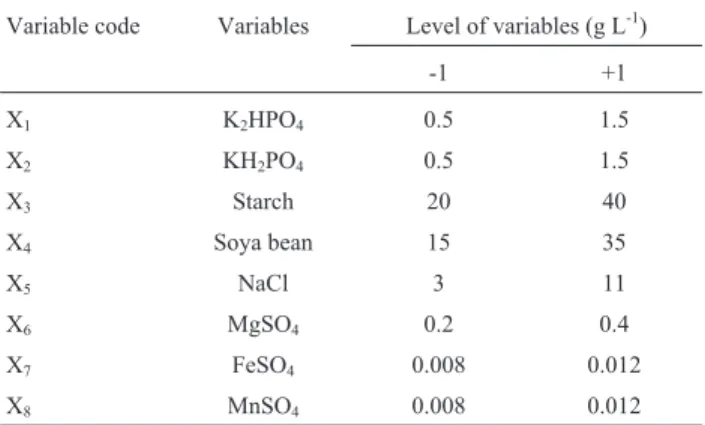
A Plackett-Burman design with 12 experiments was carried out for screening the effect of eight potential param-eters. Each row of the matrix represented a trial and each column represented an independent factor whose levels were varied. Each variable was evaluated at two levels, a high (1) and a low (-1) level (Table 1). The levels attributed to each variable were determined based on results of pre-liminary study (data not shown). For the present study, the selected variables included starch, soya bean, NaCl, KH2PO4, K2HPO4, MgSO4, MnSO4and FeSO4.
Optimisation of significant variables by a CCD
A CCD for the three selected variables (starch, soya bean and NaCl) was carried out in order to optimise delta-endotoxin production and to determine the optimum levels
of the investigated parameters. Each variable was analysed at five levels coded as -a,-1, 0, +1 and +a(Table 2). The second order model associated to the three variables CCD is:
h b b b b b b
b b b
= + + + + + +
+ +
0 1 2 3 11 22
33 12
X X X X X
X X X
1 2 3 1
2 2 2
3 2
1 2 13X X1 3+ b23X X2 3
(1)
In the above equation,h is the theoretical response model,b0,b1, ...,b12represent the model coefficients and Xj (j = 1 to 3) are the coded parameters selected for the CCD. The NemrodW software (Mathieuet al., 2000) was used for
experimental design and data analysis.
Delta-endotoxin determination
Delta-endotoxin concentration was determined in the solubilised crystal preparation from each culture medium as described by Zouariet al.(1998). The values presented
are the average of two separate experiments for each cul-tural condition.
Results and Discussion
Screening of medium parameters affecting delta-endotoxin production
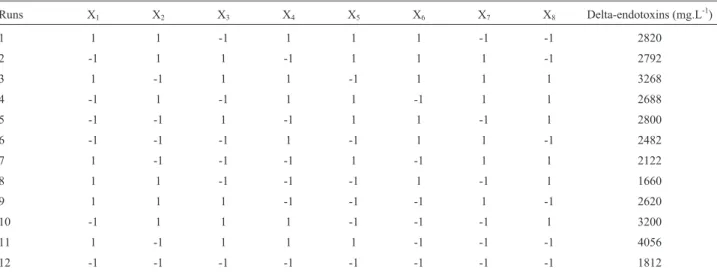
The objective of Plackett-Burman design (Table 3) was to screen, among eight independent variables, the fac-tors with main effects on toxin production of a sporelessB. thuringiensis strain S22 (Myers and Montgomery, 1995; Khuri and Cornell, 1996). The importance of eight medium components, namely, starch, soya bean, K2HPO4, KH2PO4,
Table 1- Coded and real values of variables in screening experiments.
Variable code Variables Level of variables (g L-1)
-1 +1
X1 K2HPO4 0.5 1.5
X2 KH2PO4 0.5 1.5
X3 Starch 20 40
X4 Soya bean 15 35
X5 NaCl 3 11
X6 MgSO4 0.2 0.4
X7 FeSO4 0.008 0.012
X8 MnSO4 0.008 0.012
Table 2- Experimental range of the three variables studied using CCD in terms of actual and coded factors.
Variables Level of variables (g L-1)
-a -1 0 1 +a
X1: Starch 13.18 20 30 40 46.81
X2: Soya bean 8.18 15 25 35 41.81
NaCl, MgSO4, FeSO4and MnSO4for delta-endotoxin pro-duction is shown in Table 4. Results of Table 4 illustrated the statistical significance of the model coefficients, deter-mined by Student’st-test. Starch, soya bean and NaCl ap-peared to be the major variables that positively affected delta-endotoxin production. Our results agree with reports that both carbon and nitrogen sources are the main compo-nents that affect the synthesis rate of delta-endotoxins (Far-reraet al., 1998). Moreover, our findings confirmed that adaptation ofB. thuringiensiscells to NaCl was beneficial in cheap complex production media (Ghribiet al., 2005). The other components were considered as least important factors. However, Tokcaer et al. (2006) reported that K2HPO4and MnSO4levels were critical for effective syn-thesis of crystal toxin specifically favoured biosynsyn-thesis. Nevertheless, according to the coefficient estimate analysis (Table 4), KH2PO4, K2HPO4, MgSO4, MnSO4and FeSO4 have no significant effect on delta-endotoxin synthesis, al-though the yield of toxin production is known to be greatly influenced by trace metals and other minerals.
Therefore, the three most significant components (starch, soya bean and NaCl) were selected for further opti-misation by response surface analysis.
Response surface analysis
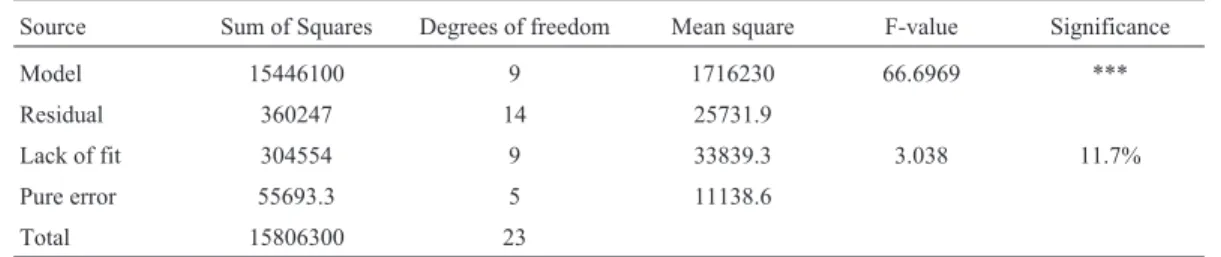
On the basis of our findings, starch, soya bean and NaCl, the most influenced factors in low cost medium (Ta-ble 2), were optimised using a CCD design. In this regard, a set of 24 experiments including, six center points and four check-points, (runs numbers 21 to 24) in order to check the validity of the fitted model, were carried out. The experi-mental and predicted responses for delta-endotoxin produc-tion are reported in Table 5. All experiments were carried out in duplicate. A multiple regression analysis of the data was carried out with the statistical analysis (Table 6). Ac-cording to Table 6, the regression effect was statistically highly significant [(P > F) < 0.01] at 97.7% of confidence level. The model also showed insignificant lack of fit [(P > F) = 11.7]. The fit of the model was also expressed by the coefficient of regression R2, which was found to be 0.977, indicating that 97.7% of the variability in the re-sponse (delta-endooxin production) could be explained by the model. Other parameters of ANOVA for response sur-face quadratic model were also studied. The RPred2of 0.928 is in reasonable agreement with the RA2of 0.963. These re-sults reinforced that the response equation provided a suit-able model for the CCD experiment.
Therefore, the model was probably adequate for pre-diction within the range of variables employed. The model can be shown as follows:
$ .
.
y (mg L ) = 4206.374 + 183.616X X X
-1
1 2
3
+ +
-724 487 272137 192132 60103 190 884 46 974 25 861
. . .
. .
X X X
X X X
1 2
2 2
3 2
1 2 1
- - +
+ X3+73 511. X X2 3
(2)
wherey is the response that is delta-endotoxin production,$ X1, X2and X3are the coded values of starch, soya bean and
Table 3- The 12 experiments Plackett-Burman design matrix and the corresponding delta-endotoxins production values.
Runs X1 X2 X3 X4 X5 X6 X7 X8 Delta-endotoxins (mg.L-1)
1 1 1 -1 1 1 1 -1 -1 2820
2 -1 1 1 -1 1 1 1 -1 2792
3 1 -1 1 1 -1 1 1 1 3268
4 -1 1 -1 1 1 -1 1 1 2688
5 -1 -1 1 -1 1 1 -1 1 2800
6 -1 -1 -1 1 -1 1 1 -1 2482
7 1 -1 -1 -1 1 -1 1 1 2122
8 1 1 -1 -1 -1 1 -1 1 1660
9 1 1 1 -1 -1 -1 1 -1 2620
10 -1 1 1 1 -1 -1 -1 1 3200
11 1 -1 1 1 1 -1 -1 -1 4056
12 -1 -1 -1 -1 -1 -1 -1 -1 1812
Table 4- Coefficient estimates corresponding to the Plackett-Burman de-sign.
Name Coefficient Error t. exp. Significance %
b0 2693.3 23.149 116.35 < 0.01 ***
b1 64.3 23.149 2.78 6.9
b2 -63.3 23.149 -2.74 7.2
b3 429.3 23.149 18.55 0.0342***
b4 392.3 23.149 16.95 0.0447***
b5 186.3 23.149 8.05 0.4**
b6 -56.3 23.149 -2.43 9.3
b7 -31.3 23.149 -1.35 26.9
b8 -70.3 23.149 -3.04 5.6
R2= 0.996; R
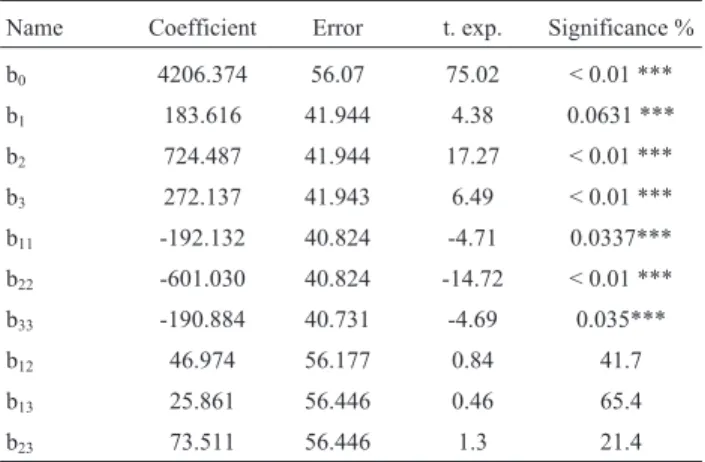
NaCl concentrations, respectively. The significance of the regression coefficients was tested by the Student’st-test. The regression coefficients and corresponding p-values for the model are presented in Table 7. The p-values were used as a tool to check the significance of each coefficient, which was necessary to understand the pattern of the mutual inter-actions between the three variables. Values of P less than 0.05 indicate model terms are significant. The results showed that the independent factors, starch (X1), soya bean (X2), NaCl (X3) and their quadratic terms (X12, X22and X32) have significant effects on delta-endotoxin production.
However, their interaction effects are found to be insignifi-cant (Table 7).
The coded model was used to generate three-dimen-sional response surface curves presentations to understand the interaction of medium components and to determine the optimal concentration of each one conducting to the maxi-mal delta-endotoxin production (Figure 1a-c).
Figure 1a illustrated the effect of starch (14-45 g L-1) and soya bean (9-41 g L-1) concentrations on delta-endo-toxin production at 7 g L-1NaCl. Starch concentration (X1) has no significant effect on the considered response in the presence of 15-25 g L-1 soya bean. A positive effect of
Table 5- Three variables CCD design with experimental and predicted values of delta-endotoxin production byB. thuringiensisS22.
Runs X1: Starch X2: Soya bean X3: NaCl Experimental response (mg L-1) Predicted response (mg L-1)
1 -1 -1 -1 2158 2188.435
2 1 -1 -1 2418 2409.996
3 -1 1 -1 3338 3396.438
4 1 1 -1 3700 3805.896
5 -1 -1 1 2610 2533.965
6 1 -1 1 2866 2858.969
7 -1 1 1 3903 4036.012
8 1 1 1 4580 4548.913
9 -1.68 0 0 3499 3354.132
10 1.68 0 0 3851 3971.741
11 0 -1.68 0 1180 1287.949
12 0 1.68 0 3900 3724.833
13 0 0 -1.68 3279 3208.789
14 0 0 1.68 4105 4124.148
15 0 0 0 4000 4206.374
16 0 0 0 4280 4206.374
17 0 0 0 4110 4206.374
18 0 0 0 4200 4206.374
19 0 0 0 4270 4206.374
20 0 0 0 4156 4206.374
21 -0.70 -0.40 -0.28 3400 3517.617
22 0.70 -0.40 -0.28 4132 3739.610
23 0 0.81 -0.28 4240 4285.424
24 0 0 0.86 4355 4298.890
Table 6- Results of the analysis of variance.
Source Sum of Squares Degrees of freedom Mean square F-value Significance
Model 15446100 9 1716230 66.6969 ***
Residual 360247 14 25731.9
Lack of fit 304554 9 33839.3 3.038 11.7%
Pure error 55693.3 5 11138.6
Total 15806300 23
R2= 0.977; R
starch is noticed in the presence of a concentration of soya bean higher than 25 g L-1. Indeed, the surface curves showed that a high delta-endotoxin production (4470 mg L-1) can be reached when using high concentra-tions of both starch and soya bean (over 30 g L-1). However, delta-endotoxin production declined sharply thereafter, by increasing both starch and soya bean concentrations over 35 g L-1. In fact, increasing starch concentration beyond 35 g L-1 led to a decline of delta-endotoxin production yield. This might be explained by the fact that toxin produc-tion is subject to catabolite repression which could be ex-hibited at high starch concentration (over 35 g L-1). This metabolic limitation was previously described (Zouari et al., 1998, 2002a) when using glucose or gruel as carbon sources (Zouariet al., 2002b) in delta-endotoxin produc-tion. But, this effect seems to be less exhibited with starch. Consequently, the results of this study revealed that starch, known to have a repressive and/or inhibitory effect on toxin synthesis (Özkan et al., 2003), supported a good delta-endotoxin production, sinceB. thuringiensisS22 strain has been shown to produce protease in substantially high yields (data not shown). So, this carbon source, used as low-cost and available substrate at an industrial scale, is readily used. This finding is promising since Içgenet al.(2002) re-ported that the use of maltose, starch and dextrin did not im-proveB. thuringiensiscrystal titers. On the other hand, they also demonstrated that soya bean was among the best ni-trogenous substrates which supported an optimal toxin pro-duction (Içgenet al., 2002), which agree with our findings.
When using more than 35 g L-1soya bean, a decrease in delta-endotoxin production was noticed, which could be attributed to a high biomass production as that could be ex-pected (Zouari and Jaoua, 1999; Prabakaran and Bala-raman, 2006) and therefore affected crystal production. On the other hand, this decrease of toxin production could be due to the repression or inhibition of secondary metabolism by nitrogen sources. In fact, the nitrogen catabolite
regula-Figure 1- Response surface plot of delta-endotoxin production showing the mutual interaction between (a) starch (X1) and soya bean (X2) concen-trations at constant value of NaCl (7 g L-1), (b) Starch (X
1) and NaCl (X3) concentrations with soya bean fixed at 25 g L-1, (c) Soya bean (X
2) and NaCl (X3) concentrations at constant starch value (30 g L-1).
Table 7- Coefficient estimates corresponding to the central composite de-sign.
Name Coefficient Error t. exp. Significance %
b0 4206.374 56.07 75.02 < 0.01 ***
b1 183.616 41.944 4.38 0.0631 ***
b2 724.487 41.944 17.27 < 0.01 ***
b3 272.137 41.943 6.49 < 0.01 ***
b11 -192.132 40.824 -4.71 0.0337***
b22 -601.030 40.824 -14.72 < 0.01 ***
b33 -190.884 40.731 -4.69 0.035***
b12 46.974 56.177 0.84 41.7
b13 25.861 56.446 0.46 65.4
b23 73.511 56.446 1.3 21.4
tion has been frequently reported and well illustrated (De-main, 1995).
Therefore, delta-endotoxin production heavily de-pends on the availability of both carbon and nitrogen sources in the medium. Both exhibited regulatory effects on toxin synthesis. So, when using starch and soya bean at ade-quate concentrations, an overproduction of endoto-xins could be achieved. As shown in Figure 1b, delta-endotoxin production was enhanced especially by increas-ing starch concentration and usincreas-ing moderate NaCl concen-tration (9 g L-1), at soya bean concentration of 25 g L-1. This result suggested that NaCl supply led to an improvement of delta-endotoxin production (Ghribiet al., 2005; Ben Khe-dheret al., 2011a), particularly when used at 9 g L-1and de-clined thereafter. In fact, NaCl addition plays the role of in-ducer of cell growth and consequently of delta-endotoxin production by sporeless B. thuringiensis mutants (Ben Khedheret al., 2011a). It also could involve the synthesis of osmoprotectants, solutes, and/or amino acids which are known to protect cellular constituents in bacteria (Ruzalet al., 1994). However, NaCl concentration over than 10 g L-1 can reduce the operational stability of the cells and affect its capacity to grow and produce crystal proteins (Amezegaet al., 1995). Figure 1c showed the effect of varying soya bean concentration from 8 to 42 g L-1and NaCl concentration from 0.3 to 11 g L-1 on delta-endotoxin production at a starch concentration of 30 g L-1. A positive effect of NaCl concentration is clear in the presence of high concentra-tions of soya bean (beyond 25 g L-1).
In this attempt, a careful balance of substrates which are convenient and attractive because they are inexpensive must be provided to achieve an optimal delta-endotoxin pro-duction. Indeed, the surface curves showed that high delta-endotoxin production (4432 mg.L-1) was achieved by using 30 g L-1soya bean and 9 g.L-1NaCl. Consequently, under the following conditions, 30 g.L-1starch, 30 g L-1soya bean and 9 g L-1NaCl, a maximal delta-endotoxin production was pre-dicted by the model, at of 4432±56.2 mg L-1.
Confirmation
In order to validate the predicted results, S22 strain was cultivated using optimised medium, in duplicate. The results clearly showed that the experimental response val-ues (4455 mg L-1) agree with those calculated (4432±56.2 mg L-1). Once again, this verification revealed a high de-gree of accuracy of the model under the investigated condi-tions. When compared to basal medium production (2834 mg L-1), we noted an improvement of delta-endo-toxin production reaching 57%, after optimisation of cheap medium composition. This toxin production improvement was also associated to yields improvement, calculated as the ratio of delta-endotoxin (mg L-1) over assimilated starch (g L-1), which reached 148.5 mg g-1of starch in optimised medium, compared to 94.46 mg g-1of starch in basal me-dium. Zouariet al.(2002b) reported that BNS3 toxin
pro-duction was 3194 mg L-1 when used 42 g L-1 gruel and 20 g L-1fish meal. Interestingly, delta-endotoxin produc-tion of S22 in our optimised medium exhibited 39.48% toxin production improvement, comparatively to BNS3 toxin production. So, considering the high production and stability of bioinsecticides based on sporeless B. thuringiensis,S22 strain is a promising strain for biotech-nological applications, especially when used our optimised cheap medium.
Acknowledgments
This work was supported by grants from the Tunisian Ministry of Higher Education and Scientific Research.
References
Amezega MR, Davidson I, McLaggan D, Verheyul A, Abee T, Booth I (1995) The role of peptide metabolism in the growth ofListeria monocytogenesATCC 23074 at high osmolarity. Microbiology 141:41-49.
Aronson AI (1993) The two faces ofBacillus thuringiensis: insec-ticidal proteins and post exponential survival. Mol Micro-biol 7:489-96.
Ben Khedher S, Jaoua S, Zouari N (2011a) Improvement of Bioinsecticides Production by Sporeless Bacillus thuringiensis Strains in Response to Various Stresses in Low Cost Medium. Curr Microbiol 62:1467-1477. Ben Khedher S, Zouari N, Messaddeq N, Schultz P, Jaoua S
(2011b) Overproduction of delta-endotoxins by sporeless
Bacillus thuringiensismutants obtained by nitrous acid mu-tagenesis. Curr Microbiol 62:38-43.
Demain AL (1995) Microbial secondary metabolism: The new frontier. In: W. Kuhn, H.P. Fiedler (eds) Sekundär Metabo-lismus bei Microorganismen. Altempo Verlag, Tübingen, pp 11-35.
Desai SY, Shethna YI (1991) Production and formulation of Ba-cillus thuringiensisvar.israelensisandB. sphaericus1593. Indian J Med Res 93:318-323.
Farrera RR, Pérez-Guevara F, de la Torre M (1998) Carbon: nitro-gen ratio interacts with initial concentration of total solids on insecticidal crystal protein and spore production in Bacillus thuringiensis HD-73. Appl Microbiol Biotechnol 49:758-765.
Ghribi D, Zouari N, Jaoua S (2004) Improvement of bioinsec-ticides production through mutagenesis of Bacillus thuringiensisby U.V. and nitrous acid affecting metabolic pathways and/or delta-endotoxin synthesis. J Appl Micro-biol 97:338-346.
Ghribi D, Zouari N, Jaoua S (2005) Improvement of bioinsec-ticides production through adaptation of Bacillus thuringiensiscells to heat treatment and NaCl addition. J Appl Microbiol 98:823-831.
Ghribi D, Zouari N, Trigui W, Jaoua S (2007) Use of sea water as salts source in starch and soya bean based media, for the pro-duction of Bacillus thuringiensis bioinsecticides. Process Biochem 42:374-378.
Kanekar PP, Nilegaonkar SS, Sarnaik SS, Kelkar AS (2002) Opti-mization of protease activity of alkaliphilic bacteria isolated from an alkaline lake in India. Bioresour Technol 85:87-93. Khuri AI, Cornell JA (1996) Response Surfaces, Designs and
Analyses. Marcel Dekker, New York.
Kumar A, Sra K, Sangodkar UMX, Sharma VP (2000) Advances in the bio-control of mosquito vectors utilizing Bacillus sphaericusandBacillus thuringiensisvar.israelensis. Proc. Natl Acad Sci India LXX 1-20.
Lee HL, Seleena P (1991) Fermentation of a MalaysianBacillus thuringiensisserotype H-14 isolate, a mosquito microbial
control agent utilizing local wastes. Southeast Asian J Trop Med Public Health 22:108-112.
Mathieu D, Nony J, Phan-Tan-Luu R (2000) NEMROD-W soft-ware. LPRAI, Marseille.
Myers RH, Montgomery DC (1995) Response Surface Methodol-ogy: Process and Product Optimization Using Designed Ex-periments. Wiley, New York.
Navon A (2000)Bacillus thuringiensisinsecticides in crop pro-tection - reality and prospects. Crop Prot 19:669-676. Özkan M, Dilek FB, Yetis Ü, Özcengiz G (2003) Nutritional and
cultural parameters influencing antidipteran delta-endotoxin production. Res Microbiol 154:49-53.
Prabakaran G, Balaraman K (2006) Development of a cost-effective medium for the large-scale production ofBacillus thuringiensisvar. israelensis Biol Control 36:288-292.
Ruzal SM, Alice AF, Sanchez-Rivas C (1994) Osmoresistance of spores fromBacillus subtilisand the effects of ssp muta-tions. Microbiology 140:2173-2177.
Saalma HS, Foda MS, Dulmage HT, Sharaby EL (1983) Novel fermentation medium for production of delta endotoxin fromBacillus thuringiensis. J Invertebr Pathol 41:8-19.
Tokcaer Z, Bayraktar E, Mehmetoglu U, Özcengiz G, Alaed-dinoglu NG (2006) Response surface optimization of anti-dipteran delta-endotoxin production by Bacillus thuringiensissubsp.israelensisHD 500. Process Biochem 41:350-355.
Zouari N, Achour O, Jaoua S (2002a) Production of delta-endo-toxin by Bacillus thuringiensis subsp. kurstaki and over-come of catabolite repression, by using highly concentrated gruel and fish meal media in 2 and 20 l fermenters. J Chem Technol Biotechnol 77:877-82.
Zouari N, Ben Sik Ali S, Jaoua S (2002b) Production of delta-endotoxin by severalBacillus thuringiensisstrains exhibit-ing various entomocidal activities towards Lepidoptera and Diptera in gruel and fish-meal media. Enzyme Microb Technol 31:411-418.
Zouari, N.; Dhouib, A.; Ellouz, R.; Jaoua, S. (1998). Nutritional requirements of a strain of Bacillus thuringiensis subsp
kurstakiand use of gruel hydrolysate, for the formulation of a new medium for delta-endotoxin production. Appl Bio-chem Biotechnol 69:41-52.
Zouari, N.; Jaoua, S. (1999). Production and characterization of metalloproteases synthesized concomitantly with d -endo-toxin byBacillus thuringiensissubsp.kurstakistrain grown on gruel-based medium. Enzyme Microb Technol 25:364-371.