Structural characterization of a new dioxamic acid derivative by experimental
(FT-IR, NMR, and X-ray) analyses and theoretical (HF and DFT) investigations
G.P. Souza
a,c, C. Konzen
b, T.R.G. Simões
c, B.L. Rodrigues
c, A.F.C. Alcântara
c,⇑, H.O. Stumpf
caDepartamento de Química, Universidade Federal de Ouro Preto, Ouro Preto, MG, Brazil
bLaboratório de Física Aplicada, Centro de Desenvolvimento da Tecnologia Nuclear, CP 941, 30123-970 Belo Horizonte, MG, Brazil cDepartamento de Química, ICEx, Universidade Federal de Minas Gerais, 31270-901 Belo Horizonte, MG, Brazil
a r t i c l e
i n f o
Article history:
Received 27 September 2011
Received in revised form 26 January 2012 Accepted 26 January 2012
Available online 24 February 2012
Keywords:
Molecule-based magnet Dioxamic acids
Supramolecular chemistry X-ray crystal structure NMR analysis HF and DFT calculations
a b s t r a c t
Very few investigations concerning the crystal structure and chemical properties of dioxamic acids have been related in the literature. This work describes the chemical properties ofortho-phenylenebis(oxamic acid) (2) and its new derivative, hydrogenoortho-phenylenebis(oxamato) benzimidazolium (3) using experimental (FT-IR, NMR, and X-ray single crystal diffraction) and theoretical (HF/3-21Gand B3LYP/ 6-31Gcalculations) methodologies. Compound2displays intramolecular hydrogen bonding between the hydrogen of an amide group and the oxygen atom of another amide group present in the structure. Compound3was prepared by a newly developed synthetic route involving decomposition of the dioxa-mic acid in solution without the presence of metallic ions. Thermodynadioxa-mic calculations indicate a pro-cess via two sucpro-cessive hydrolyzes of the amide groups of2, followed by condensation with formic acid and finally dehydration. The structure of3was solved by X-ray single-crystal diffraction and it con-sists ofmeso-helical chains stabilized by intra and intermolecular hydrogen bonds andp–pstacking interactions.
Ó2012 Elsevier B.V. All rights reserved.
1. Introduction
Oxamic acids and their ester derivatives are biologically impor-tant, showing antiallergic, antirheumatic, and antiinflammatory activities [1,2]. For example, meta-phenylenebis(oxamic acid) exhibited significant anti-asthmatic properties, being up to 2500 times more active in rats than disodium cromoglycate, a known agent used in the treatment of bronchial asthma caused by allergy [3]. Bis-oxamato ligands have been used as structural components in molecule-based magnets assemblies, providing efficient cou-pling among magnetic moments of transition metal ions and lan-thanides ions[4,5]. The strategy to prepare such molecule-based magnets with different dimensionalities and physical properties starts with the synthesis of a chelate-effect stabilized monometal-lic precursor[6–12]. This complex is then used as a building block for magnetic materials since it presents external carbonyl groups capable of bridging metal spin carriers.
Monometallic building blocks have been obtained from the ba-sic hydrolysis of theortho-phenylenebis(oxamic acid ethyl ester) (1,Fig. 1), followed by addition of transition metal ions [13,14].
The use of1as ligand was not successful in providing new precur-sors for molecule-based magnets containing FeII, FeIII, SnII, or SnIV.
In these cases, the high basicity of the reaction mixture either yields the corresponding metal hydroxide or promotes the forma-tion of theoxo-bridged complexes, e.g., (Et4N)4[Fe2O(opba)2]3H2O,
with opba standing forortho-phenylenebis(oxamato)[15]. Our re-search group recently employed an efficient methodology to pre-pare a molecule-based magnet precursor, [Fe(H2opba)(dmso)2]Cl,
using ortho-phenylenebis(oxamic acid) (2, Fig. 1) as pro-ligand. This precursor presents the ligand (2) in the iminoalcohol tauto-meric form, which is not the tautotauto-meric form observed in precur-sors containing other metallic ions (CuII, MnII, NiII, and ZnII)[16].
The literature has described the synthesis of some dioxamic acids, but very few investigations about their crystal structures, chemical properties, and topological control of their dimensional-ity have been reported[17]. Recently, a successful example of the topological control of the hydrogen bond-directed self-assembly was reported. The aromatic dioxalamide series ofN,N0-1,n -phenyl-enebis(oxamic acid ethyl ester) molecules withn= 2 (H2Et2opba), n= 3 (H2Et2mpba), andn= 4 (H2Et2ppba) present a supramolecular
aggregation of molecules into a duplex (0D), ameso-helix (1D) and a brick-wall sheet (2D), respectively. These experimental and the-oretical studies show the importance of the two oxalamide moie-ties as a hydrogen-bonded supramolecular synthons[17].
The application of the oxalamide derivatives as gelling systems has recently attracted considerable attention. The entanglement of
0022-2860/$ - see front matterÓ2012 Elsevier B.V. All rights reserved. doi:10.1016/j.molstruc.2012.01.044
⇑ Corresponding author. Address: Departamento de Química, Universidade Federal de Minas Gerais, Avenida Presidente Antônio Carlos, 6627, Campus Pampulha, Belo Horizonte, Minas Gerais 31270-901, Brazil. Tel.: +55 31 3427 5542 (W), +55 31 3409 5728; fax: +55 31 3409 5700.
E-mail address:[email protected](A.F.C. Alcântara).
Contents lists available atSciVerse ScienceDirect
Journal of Molecular Structure
the gel fibers, formed by unidirectional self-assembly of these low-molecular organic compounds, can result into three-dimensional networks which traps the solvent. For example, chiral bis(amino acid)oxalamides are able to gel water, as well as a number of low-polarity organic solvents[18,19].
In the present work, the chemical properties of 2and its new derivative, hydrogenoortho-phenylenebis(oxamato) benzimidazo-lium (3,Fig. 1) were investigated using experimental and theoret-ical methodologies. Their chemtheoret-ical structures were analyzed from the 1D NMR (1H and13C) and 2D NMR (1H–13C HMBC and1H–1H
NOESY) at different temperature and in different solvents, includ-ing solid-state MAS 13C NMR data. Moreover, a new synthetic
method is herein described for the preparation of3, whose crystals were suitable for X-ray structure determination. The theoretical studies were based on thermodynamic and carbon chemical shift calculations. Geometry optimizations were carried out usingab ini-tio Hartree–Fock (HF)[20] and Density Functional Theory (DFT) [21]methods as recently reported for our studies of other com-pounds[22,23].
2. Experimental section
2.1. Materials and measurements
Melting points (m.p.) were measured using digital equipment MQAPF-302 Microquimica. Elemental analyses (C, H, N) were performed on a 2400 CHN-Perkin Elmer instrument. Infrared spectra were recorded on a Perkin–Elmer Spectrum GX FTIR spec-trophotometer using KBr disks, in the 4000–400 cm1 range.1H
and13C NMR spectra in solution were recorded on a Bruker AVANCE
DRX 400 spectrometer using tetramethylsilane (TMS) as internal standard. The samples (15 mg) were dissolved in DMSO-d6
(0.5 mL). Chemical shifts are given in ppm (dunits). Solid-state NMR spectra were recorded on a Bruker AMX 400 wide-bore NMR spectrometer using a commercial triple resonance MAS 4 mm probe. Proton-decoupled 13C MAS NMR spectra were
ac-quired using cross polarization[24]. Typical acquisition parameters were the following: spin lock time 2.0 ms, recycle delay 3 s,1H B1
field 91 kHz, 3072 data points, 25,000 acquisitions, and spectral width of 50 kHz. The spectra were acquired at 298 K with a spin-ning speed of 10 kHz. Adamantane was used as reference (high field signal at 29.5 ppm).
One single crystal of 3 was chosen and mounted on an Enraf–Nonius Kappa-CCD diffractometer equipped with graphite monochromator. Mo K
a
(k= 0.71073 Å) radiation was used in the experiment. The final unit cell parameters were based on allreflections. Data collection used the COLLECT program [25]. Integration and scaling of the reflections were performed with the HKL Denzo–Scalepack system of programs[26]. 3424 Indepen-dent reflections resulted from this integration. The absorption correction was tried, but did not improve the model: the crystal is small, as well as its absorption coefficient. 2911 Reflections with positive intensities were merged and used in the structure resolu-tion and refinements. The structure was solved by direct methods with SHELXS-97[27]. The model was refined by full-matrix least squares based onF2, through SHELXL-97. All atoms were aniso-tropically refined. Hydrogen atoms bonded to carbon were stereo-chemically positioned and refined using the ridging model. Hydrogen atoms of the aromatic rings were set isotropic with a thermal parameter 20% greater than the equivalent isotropic dis-placement parameter of the atom in which each one is bonded. Hydrogen atoms H711 and H712, which are respectively bonded to N11 and N12, were found on the Fourier difference maps and fixed. Hydrogen atoms bonded to oxygen were also found in the Fourier difference synthesis. The hydrogen atoms HO1 and HO5 were located in special position (inversion center and two-fold axis, respectively), with occupancy factor fixed in 0.5. Their positions and isotropic displacement parameters were fixed. Experimental features are summarized inTable 1.
Fig. 1.Chemical structure of the diethylortho-phenylenebis(oxamato) (1),ortho-phenylenebis(oxamic) acid (2), and hydrogenoortho-phenylene(oxamato) benzimidazolium (3;H3opba= hydrogenoortho-phenylenebis(oxamato) andBZ= benzimidazolium cation).
Table 1
Crystal data and refinement results for3.
C11.33H9.33N2.67O4 F000= 1536
Mr= 246.88 Dx= 1.542 Mg m3
Hall symbol: -C 2yc Mo Karadiation,k= 0.71073 Å
a= 31.299 (4) Å a= 90° b= 5.5320 (6) Å b= 125.454 (6)° c= 22.623 (4) Å c= 90°
V= 3190.8 (7) Å3 0.0680.2130.048 mm
Z= 8 l= 0.12 mm1
Kappa CCD diffractometer Rint= 0.096
Radiation source: fine-focus sealed tube
hmax= 24.7°
Monochromator: graphite hmin= 2.2° T= 150 (2) K h=35?36
3624 Measured reflections k=5?6
2403 Independent reflections l=26?26
1056 Observed reflections (I> 2r(I))
Refinement onF2 Least-squares matrix: full
R[F2> 2r(F2)] = 0.061 w= 1/[r2(F
o2) + (0.0243P)2]
whereP¼ ðF2oþ2F2cÞ=3
wR(F2) = 0.127 (D/r)max< 0.001
S= 0.89 Dqmax= 0.28 and Å3
2403 Reflections Dqmin=0.30 and Å3
245 Parameters Extinction correction: none
All chemicals were of reagent grade quality, purchased from commercial sources, and used as received. The compoundortho -phenylenebis(oxamic acid ethyl ester) (1) was prepared as re-ported in the literature[13,14].
2.2. Synthesis of the compounds
Synthesis ofortho-phenylenebis(oxamic acid) (2) (adaptation of a method described elsewhere)[14]. An aqueous solution of NaOH 0.1 mol/L (14.3 mL; 1.43 mmol) was added dropwise to a suspen-sion of 1 (200.5 mg; 0.65 mmol). After vigorous stirring for 30 min at 60°C, the reaction mixture was cooled to room
temper-ature and then distilled water (25 mL) and a solution of HCl 1.2 mol/L (about 1.8 mL; 2.16 mmol) were added until pH1 was achieved. The white solid obtained was filtered, washed with cold water, and finally dried under reduced pressure to give 127.0 mg (yield 72%) of2as a white crystalline solid. M.p. 250°C
(decomp.); IR (KBr,
mmax
in cm1)m
3451 (mO
AH), 3299 (
mN
AHasym.), 3246 (mN
AHsym.), 3050–3000 (mCH
), 1775 (mC
@O), 1672 (amide I), 1557 (amide II), 1380 (dOAH), 1295 (dCAOAHin plane), 1188 (mC
AO), and 748 (dCAH out-of-plane);1H NMR (400 MHz, DMSO-d 6) dH
10.35 (ls; 2H; NH), 7.60 (dd,J= 3.6 and 5.6 Hz; 2H; H-3/6), and 7.29 (dd, J= 3.6 and 5.6 Hz; 2H; H-4/5); 13C NMR (100 MHz,
DMSO-d6)dC 161.6 (C-30/300), 156.8 (C-20/200), 129.6 (C-1/2), 126.1
(C-4/5), and 125.4 (C-3/6). Anal. Calcd. for C10H8N2O6 (MM =
252.18 g/mol): C, 47.6%; H, 3.2%; N, 11.1%. Found: C, 46.1%; H, 3.2%; N, 10.9%.
Synthesis of hydrogeno ortho-phenylenebis(oxamato) ben-zylmidazolium (3). Compound 2 (10.0 mg; 0.04 mmol) was dis-solved in 2 mL of DMSO. Colorless single crystals of 3 were obtained after 2 months of standing at room temperature and in complete absence of light. The product was collected by filtration, washed with ethanol, and dried under vacuum to give 2.3 mg (yield 32%). M.p. 270°C (decomp.); IV (KBr,
mmax
in cm1)m
3467(
mO
AH), 3162 (mNH
asym.), 3105 (mN
AHsym.), 3046 (mC
AH arom.), 2967, 2881, 2776 (mN+
AH), 1711 (mC
@O), 1682 (band I of amide), 1616 (band II of amide), 1474 (mcarboxyl
asym.), 1419 (mcarboxyl
sym.), 1393 (dOAH), 1250 (
mC
AO), 855 (dNAH, out-of-plane), 753, and 703 (dCAHout-of-plane). The crystal data and refinement for3are shown inTables 1–4.
3. Computational details
Theoretical studies were carried out using the Gaussian03W software package[28]. HF and DFT geometry optimizations were performed using the geometries previously obtained by the PM3 semi-empirical method [29]. BLYP and B3LYP functionals with the standard Pople’s split valence 6-31G basis set were used in Table 2
Fractional atomic coordinates and equivalent isotropic displacement parameters of non-hydrogen atoms (Å2).
x y z U
iso=Ueq
O1 0.03435 (12) 0.8685 (6) 0.04798 (18) 0.0313 (10) O2 0.02584 (13) 0.6611 (6) 0.0442 (2) 0.0372 (10) O3 0.11147 (12) 0.5627 (6) 0.14348 (19) 0.0321 (10) O5 0.03343 (12) 0.0180 (6) 0.18399 (18) 0.0306 (9) O4 0.06108 (13) 0.3193 (6) 0.20844 (19) 0.0360 (10) O6 0.13121 (14) 0.3839 (7) 0.05900 (19) 0.0407 (11) N1 0.10005 (14) 0.3557 (7) 0.0471 (2) 0.0266 (11) N2 0.10300 (15) 0.0265 (8) 0.0440 (2) 0.0274 (11) N11 0.09554 (16) 0.7218 (8) 0.2353 (3) 0.0353 (12) N12 0.09981 (16) 1.0215 (7) 0.2942 (2) 0.0318 (12) C1 0.04529 (19) 0.6980 (10) 0.0206 (3) 0.0312 (14) C2 0.08952 (19) 0.5329 (10) 0.0781 (3) 0.0286 (14) C3 0.13905 (17) 0.1754 (9) 0.0796 (3) 0.0199 (12) C4 0.17494 (17) 0.1535 (9) 0.1537 (3) 0.0235 (13) C5 0.21179 (17) 0.0303 (9) 0.1817 (3) 0.0259 (13) C6 0.21238 (18) 0.1960 (9) 0.1367 (3) 0.0274 (13) C7 0.17645 (18) 0.1739 (9) 0.0626 (3) 0.0254 (13) C8 0.14053 (19) 0.0119 (9) 0.0340 (3) 0.0245 (13) C9 0.10258 (18) 0.2067 (10) 0.0842 (3) 0.0258 (13) C10 0.06200 (19) 0.1735 (10) 0.1672 (3) 0.0289 (13) C11 0.0725 (2) 0.8295 (11) 0.3000 (3) 0.0373 (15) C12 0.1404 (2) 0.8539 (10) 0.1851 (3) 0.0282 (14) C13 0.17660 (19) 0.8269 (9) 0.1119 (3) 0.0290 (13) C14 0.21645 (19) 0.9960 (10) 0.0768 (3) 0.0356 (15) C15 0.2187 (2) 1.1834 (10) 0.1152 (3) 0.0328 (14) C16 0.18213 (19) 1.2184 (9) 0.1891 (3) 0.0315 (14) C17 0.14303 (19) 1.0439 (9) 0.2227 (3) 0.0236 (13)
Table 3
Selected geometric parameters for H4opba (Å,°).
O1AC1 1.280 (6) C4AC3 1.379 (6)
O1AHO1 0.8400 C17AC12 1.384 (7)
O3AC2 1.227 (6) C17AN12 1.387 (6)
O5AC10 1.293 (6) C17AC16 1.389 (6)
O5AHO5 1.230 (4) C1AC2 1.535 (7)
O4AC10 1.221 (6) C4AC5 1.385 (6)
O6AC9 1.223 (5) C7AC8 1.376 (6)
N1AC2 1.354 (6) C7AC6 1.379 (6)
N1AC3 1.409 (5) N12AC11 1.320 (6)
N1AH71 0.8800 N12AH712 0.880 (4)
N2AC9 1.344 (6) C5AC6 1.378 (6)
N2AC8 1.447 (6) C9AC10 1.551 (7)
N2AH72 0.8800 C15AC14 1.381 (7)
O2AC1 1.234 (6) C15AC16 1.385 (7)
N11AC11 1.340 (6) C3AC8 1.394 (6)
N11AC12 1.394 (6) C12AC13 1.368 (7)
N11AH711 0.915 (4) C13AC14 1.383 (6)
C1AO1AHO1 109.5 O4AC10AO5 127.7 (5)
C10AO5AHO5 107 (3) O4AC10AC9 119.1 (5)
C2AN1AC3 129.7 (4) O5AC10AC9 113.2 (5)
C9AN2AC8 123.3 (4) C14AC15AC16 123.7 (5)
C9AN2AH72 118.4 C4AC3AC8 119.3 (5)
C8AN2AH72 118.4 C4AC3AN1 123.1 (5)
C11AN11AC12 107.8 (4) C8AC3AN1 117.6 (4)
C11AN11AH711 135.9 (5) C13AC12AC17 121.5 (5)
C12AN11AH711 115.9 (5) C13AC12AN11 131.7 (5)
C12AC17AN12 106.4 (4) C17AC12AN11 106.8 (4)
C12AC17AC16 122.7 (5) C7AC8AC3 120.3 (5)
N12AC17AC16 130.9 (5) C7AC8AN2 118.7 (5)
O2AC1AO1 127.6 (5) C3AC8AN2 121.0 (5)
O2AC1AC2 119.3 (5) O3AC2AN1 126.0 (5)
O1AC1AC2 113.0 (5) O3AC2AC1 122.8 (5)
C3AC4AC5 119.7 (5) N1AC2AC1 111.2 (5)
C8AC7AC6 120.4 (5) C5AC6AC7 119.2 (5)
C11AN12AC17 109.0 (5) N12AC11AN11 110.0 (5)
C11AN12AH712 129.5 (5) N12AC11AH11 125.0
C17AN12AH712 121.5 (5) N11AC11AH11 125.0
C6AC5AC4 121.0 (5) C12AC13AC14 117.4 (5)
O6AC9AN2 124.2 (5) C15AC14AC13 120.3 (5)
O6AC9AC10 121.5 (5) C15AC16AC17 114.4 (5)
N2AC9AC10 114.3 (5)
Table 4
Hydrogen bond parameters (Å,°).
DAHAA d(DAH) d(H A) d(D A) <DHA
O1AHO1AO11 0.84 1.618 2.457 (7) 176.6
O1AHO1AO21 0.84 2.670 3.184 (5) 120.9
N1AH7AO2 0.88 2.186 2.636 (5) 111.3
N1AH71AO6 0.88 2.623 3.074 (5) 112.9
N2AH72AO22 0.88 2.436 3.148 (5) 138.3
O5AHO5AO53 1.230 (4) 1.230 (4) 2.459 (6) 176 (6)
O5AHO5AO43 1.230 (4) 2.410 (5) 3.131 (5) 115 (3)
N11AH711AO4 0.915 (4) 1.805 (3) 2.693 (5) 162.7(3)
N12AH712AO34 0.880 (4) 2.033 (3) 2.830 (5) 150.1(3)
N12AH712AO14 0.880 (4) 2.301 (3) 2.972 (5) 133.0(3)
Symmetry codes: (1)x,y+ 2,z; (2)x,y1,z; (3)x,y,z1/2; (4)x,y+ 2,
z1/2.
the DFT calculations[30–34]. The optimized geometries were char-acterized as true minima on the potential energy surface (PES) with all harmonic frequencies being real. The electronic-nuclear energies (E) were calculated by means of the HF and DFT methods. Solvent effect (DMSO,
e
= 46.7) in the geometry optimizations were taken into consideration using the Polarizable Continuum Model (PCM)[35,36]as implemented in the HF/6-31Gand DFT/B3LYP/ 6-31GGaussian03 software package.DFT/BLYP/6-31Goptimized geometries of2were used for the carbon chemical shift calculations. Values of calculated carbon chemical shifts (
rC
) of2were obtained in relation to the corre-sponding DFT/BLYP/6-31Gcalculated values for tetramethylsilane (rC
190.90). For structure3, the HF/6-31Gmethod was used. In this case, therC
value for tetramethylsilane wasrC
201.19. Corre-lations betweenrC
values and experimental carbon chemical shifts (dC) were obtained using software package Origin™ Standard 7.5.The
rC
anddCvalues were plotted onxandyaxes, respectively.Correlation curves were given as linear fits with correlation coeffi-cients (R2) and standard deviations (SDs) furnished by the program itself.
The formation of3from2was investigated through thermody-namic calculations according to Eq.(1). It is worth considering the whole amount of reaction energy (DGtotal) as the sum of three parts: electronic plus nuclear repulsion energy (DEele), DMSO sol-vation energy (DEsolv), and thermal correction to the Gibbs free en-ergy (DGtherm). The thermal contribution was estimated using the ideal gas model and calculated harmonic vibrational frequencies to estimate the zero-point energy correction (ZPE) and the correc-tion due to the thermal populacorrec-tion of the vibracorrec-tional levels.
D
Gtotal¼D
EeleþD
EsolvþD
Gtherm ð1Þ4. Results and discussion
The IR spectrum of2shows absorptions at 3299 (
mN
AHasym.),3246 (
mN
AHsym.), 1672 (amide I band), and 1557 cm1(amide II
band) which are characteristic of secondary amides. The absorp-tions at 3451 (
mO
AH), 1775 (mC
@O), 1380 (dOAH), 1295 (dCAOAHinplane), and 1188 cm1(
mC
AO) are characteristic of carboxylic acid groups. Absorptions at 3050–3000 (
mC
AH) and 748 cm1 (dCAH out-of-plane) are indicative of the presence of aromatic rings.The1H NMR spectrum of2in DMSO-d
6at 300 K shows
multi-plicity of signals at the aromatic hydrogen region which is charac-teristic of AA0–BB0spin systems. The singlet signal of hydrogen at
dH10.35 (NAH) shows HMBC correlations with the carbon signals atdC156.8 (C-20/200, via2J), 129.6 (C-1/2, via2J), and 125.4 (C-3/6,
via3J) and also shows NOESY correlations with the multiple signals
of hydrogen atdH7.60 (H-3/6). These multiple signals of hydrogen,
in its turn, show HMBC correlations with the carbon signals atdC
129.6 (C-1/2, via2
J) and 126.1 (C-4/5, via2
J). Finally, the hydrogen signal atdH7.29 (H-4/5) shows HMBC correlations with the carbon
signals atdC129.6 (C-1/2, via3J) and 126.1 (C-4/5, via2J). These 1D
and 2D NMR data are consistent to the chemical structure of2.
1H NMR spectrum of
2in solution of DMSO-d6:MeOD (4:1) at
300 K shows a low field signal atdH10.37 ppm and a weak
hydro-gen resonance appears atdH10.32 ppm, both these signals may be
attributed to hydrogen in carboxylic acid groups of two distinct conformations. Moreover, the13C NMR spectrum of2also shows
lower signals atdC156.6, 129.5, and 125.3 which are respectively
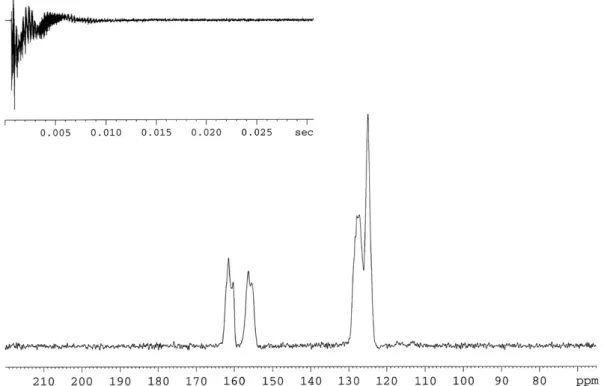
attributed to the carbon atoms C-20/200, C-1/2, and C-3/6 of other conformation of2. The solid-state MAS13C NMR spectrum of 2
(Fig. 2) shows weak signals neardC162.0 and 156.0 which may
be respectively attributed to C-30/300and C-20/200of the secondary conformer. However, these low-intensity signals are not observed in the13C NMR spectrum of2in DMSO-d
6 at 343 K. As a result,
the conformations interconvert too quickly to be resolved on the NMR time scale when the temperature is near 40°C higher than
the room temperature.
B3LYP/6-31Ggeometry optimizations were employed to a con-formational search of2. Two optimized geometries were obtained (2aand2b,Fig. 3). Geometry2a(E=946.55156779 a.u.) shows intramolecular hydrogen bond between the hydrogen of the amide group of a substituent and the oxygen of the amide group of the other one. Geometry2b(E=946.54910890 a.u.) shows aC2
sym-metry axis collinear with the aromatic ring plane and the hydrogen atoms of both the amide groups spatially close to each other.
Fig. 2.Solid-state MAS13C NMR of2(100 MHz; adamantane).
B3LYP/6-31G carbon chemical shift calculations were per-formed to2aand2b. The calculated
rC
values of both the geome-tries were correlated with the experimental chemical shift values obtained from the high-intensity signals in the13C NMR spectrumof2. The geometry2b(R2= 0.9963 and SD = 1.443) shows higher correlations than the geometry 2a(R2= 0.9943 and SD = 1.695). The thermodynamic calculations indicate2aas the predominant conformer while the chemical shift calculations indicate the contrary, i.e.,2bas the predominant conformer. In previous work,
results obtained from carbon chemical shift calculations were ver-ified by their accordance to experimental data[23]. Thus, based on the results from the carbon chemical shift calculations, geometry
2bmay be considered to be the predominant conformer.
The IR spectrum of3shows absorptions at 3162 (
mN
AHasym.)and 3105 cm1 (
mN
AH sym.) characteristic of NAH in hydrogen bonding and absorptions at 2967, 2881, and 2776 cm1
character-istic of N+
AH stretch. The absorption at 1682 cm1may be attrib-uted to R2C@NR stretch of imine groups. These IR absorptions are
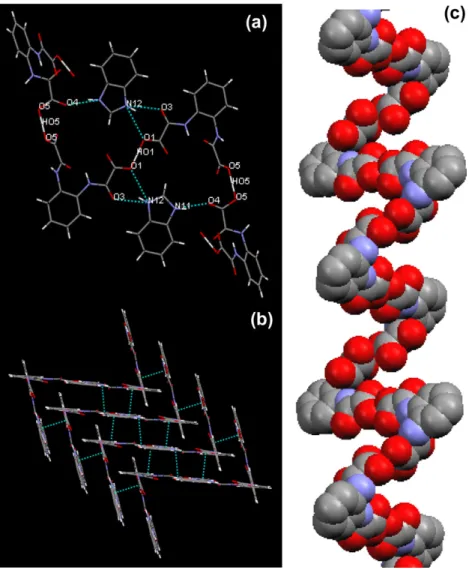
Fig. 4.Representations: (a) plane formed by hydrogen bonding, showing the involved atoms in these interactions, (b)p–pinteractions among adjacent chains – benzene– benzene ring distance of 3.874 Å, and (c) crystal packing with chain along the axisc, showing hydrogen bond (NAH O and OAHAO). In the left representation the BZ
molecules were omitted.
in agreement with the chemical structure of an imidazoline cation. Absorptions at 1474 and 1419 cm1may be attributed to
stretch-ing frequencies of the carboxylate group.
The absorptions attributed to C@O stretch in the IR spectrum of
3 (
mC
@O= 1711 cm1) display lower frequency in relation to the
corresponding absorption for2(
mC
@O= 1775 cm1). On the other
hand, the absorption attributed to CAO stretch in the IR spectrum of 3 (
mC
AO= 1250 cm1) displays higher frequency as comparedwith the corresponding absorption in the IR spectrum of 2
(
mC
AO= 1188 cm1). Both the absorption frequency variations
pro-vide epro-vidence for the presence of carboxylate groups in the struc-ture of 3, produced by the proton-transfer reaction from the oxamic acid to the benzylimidazole nitrogen. In fact, some imidaz-ole-type rings show proton conductivity and the structural reorga-nization occurs by hydrogen bonds-breaking and -making processes [37,38]. These properties are important for preparing proton-conducting membranes which may be usually used as fuel cell[39].
The asymmetric unit of3shows the ions benzimidazolium (BZ) and hydrogenoortho-phenylenebis(oxamato) (H3opba), as shown
inFig. 1. The hydrogen atoms HO1 and HO5 are located in special positions: HO1 in the inversion center and HO5 on a two-fold axis.
Crystal data and refinement results are shown inTables 1 and 2. Geometric parameters and hydrogen bonding parameters are shown inTables 3 and 4, respectively. TheH3opbaanionic unities
are connected through strong hydrogen bonds O1AHO1AO1 and O5AHO5AO5 (Table 4), forming an infinite chain parallel to the
c-direction (Fig. 4a). The alternance between the two-fold axis through HO5 and the inversion center through HO1 of this infinite chain results in ameso-helical structure. The interactions involving theBZcations are also important for the crystal packing: this cat-ion is involved in one normal (N11AH711AO4) and two bifurcated (N12AH712AO3 and N12AH712AO1) hydrogen bonds. An weak intramolecular interaction N7AH71AO2 is also observed, The
p
–p
stacking interactions between adjacent chains are also impor-tant for the crystal packing (Fig. 4b). The hydrogen bonds among asymmetric units of3lead to formation of its crystal structure hav-ing an infinity helical chain along the axisc(Fig. 4c), in which themeso-helical form occurs by supramolecular packaging process. The double helices of the DNA and the
a
-helices of protein and biopolymers, asa
-amilose and cicloamilose, furnish interesting biological examples of helical systems[40,41]. HF/3-21G geome-try optimizations were performed to a meso-helical polymeric chain containing 20 units of3, with starting geometry generated Fig. 5.Sequences of reaction steps proposed to formation ofBZfrom2: sequence A(2?I?II?III?IV?BZ), sequence B (2?I?II?V?BZ), and sequence C(2?I?VI?VII?VIII?V?BZ).
from the X-ray single crystal data. The optimized geometry shows destructuration of themeso-helical form of the starting geometry. These results indicate that van der Waals, electrostatic interac-tions, hydrogen bonding, and
p
–p
inter-chain interactions almost certainly play a key role in the aggregation of the polymeric units that provides themeso-helical crystal structure of3.The crystal structure of theN,N0-1,3-phenylenebis(oxamic acid ethyl ester), H2Et2mpba, shows a meso-helical chain formed by
hydrogen bond among the hydrogen of the amide groups and the oxygen of the carboxylic groups[42]. The single crystal X-ray dif-fraction analysis and theoretical calculations indicated that the helical nature and hydrogen bonding interactions are important for aggregation during the crystal growth of H2Et2mpba. In the case
of3, hydrogen bonds betweenBZandH3opbaunits lead to forma-tion of rings which give addiforma-tional stability to its crystal structure. The significant
p
–p
stacking interactions between the neighbor chains are suggested by the benzene–benzene ring distance of3.874 Å[43]. This information is important to crystal engineering science since new strategies may be proposed in the design of different crystal structures[44].
The literature describes the decomposition of oxamic acids in the presence of Fe3+ or Gd3+[45,46]. In both of these cases, the
mechanisms and reaction steps are not known. However, the for-mation of oxalate andortho-phenylenediamine has been proposed from the hydrolysis of1in the presence of Gd3+or oxamides in the
presence of Fe3+. Recently, it was observed that a novel transition
metal induced derivatization. The Cu2+ion is not coordinated by
the ligands diethyl N,N0-anthra-9,10-chinone-1,2-bis(oxamate) and diethyl N,N0-4,5-dinitro-o-phenylene-bis(oxamate) in the mode
g
4(j
2N,j
2O) as usually observed in [bis(oxamato)]4ligands [47]. In contrast, in this work, the decomposition of2was verified in DMSO without the presence of transition metal ions.Three reaction sequences may be proposed to the formation of
BZ from 2: sequence A (2?I?II?III?IV?BZ), sequence B
(2?I?II?V?BZ), and sequence C (2?I?VI?VII?
-VIII?V?BZ), as seen inFig. 5. In the first reaction step, all
se-quences provideIfrom the hydrolysis of an amide group of2. In fact, amides may be hydrolyzed in acid[48,49]or basic[50]media. In both media, the reaction is essentially irreversible. In neutral media hydrolyzes of amides have been also observed, but these reactions occur very slowly [51]. In the sequences A and B, the intermediateIcan undergo nucleophilic attack by nitrogen of the amine group to the carbonylic carbon of the amide group, a cyclization that gives intermediateII.
In sequence A, the formation of the intermediateIIIoccurs from the dehydration ofII, as that exhibited to the formation of imines from carbonylic compounds[52–54]. Next, intermediateIII under-goes decarboxylation, givingIV, and finally prototropic tautomer-ism of intermediate IV provides the product BZ. In fact, many carboxylic acids can be successfully decarboxylated, giving either a free acid or the corresponding acid salt form[55]. The decarbox-ylation of these compounds is favored when the structure has functional groups, mainly double or triple bond, placed at the
a
-or b-position. The mechanisms SE1 or SE2 have been suggestedfor the decarboxylation [56,57]. Moreover, some acids can be decarboxylated through a cyclic six-center mechanism[58,59]. In the case of aromatic acids, the decarboxylation can take place by the arenium ion mechanism, in which H+is the electrophile and
CO2is the leaving group[60–63]. In the case of the SE1 mechanism,
the reaction is assisted by the presence of electron-withdrawing groups, which stabilize the carbanion formed [64,65]. The evi-dences for this SE1-type mechanism are that the reaction is first
or-der and electron-withdrawing groups, which would stabilize the carbanion, facilitate the reaction [66]. The decarboxylation of
-21.24 - 4.33 -1.56 0.00 5.21 7.78 9.79 22.68
2 I
II
III
IV
BZ (A and B)
V VI
VII
VIII
Reaction coordinate (A)
(C)
(B)
0.64
-20.55
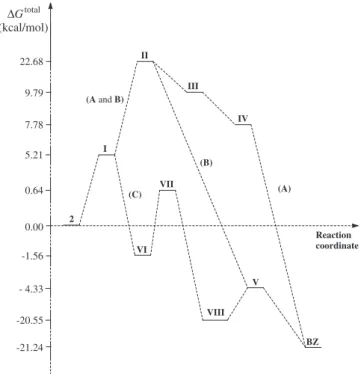
Fig. 6.Energy variation (in kcal/mol) of the sequences of reaction steps (sequences A–C) to the formation ofBZfrom2, as shown inFig. 5, obtained from DFT/BLYP/ 6-31Gcalculated values considering solvent effect (DMSO) using PCM model
(Table 5).
Table 5
Electronic plus nuclear repulsion energy (Eelectr), solvation energy (Esolv), total energy (Gtotal), and entropy (S) calculated for the structures involving in formation ofBZfrom2
using the DFT/BLYP/6-31Glevel of theory.
Structure Eelectr(Hartree) Esolv(Hartree) S(cal/mol K) Gtotal(Hartree)
2 946.55156779 0.026517041 130.070 946.417894
BZ 379.719417943 0.018116071 79.010 379.635127
I 644.667860025 0.026060483 107.724 644.552270
II 644.641971314 0.028594533 101.980 644.524431
III 568.251885370 0.042667284 95.492 568.158442
IV 379.673336741 0.021498955 79.127 379.588892
V 456.102570774 0.021846929 88.091 455.994710
VI 342.805624072 0.015012614 81.704 342.705746
VII 532.503663605 0.022481914 100.187 532.373364
VIII 456.12615419 0.020824614 93.909 456.021177
H2O 76.3885439037 0.011449664 46.590 76.386526 HO2CACO2H 378.26118494 0.017820002 74.340 378.243842 HCO2H 189.720585411 0.014364458 59.478 189.671199 CO2 188.563059929 0.003073239 51.342 188.572757
carboxylate ions is favored in the presence of metallic ions[67], but the reaction has been also performed in its absence[68]. The decarboxylation of carboxylic acids has been also verified in wet DMSO[69–73].
In the third step of the sequence B, the formation of the inter-mediate V occurs from the decarboxylation of the intermediate
II, followed by the dehydration of the intermediate and the obtain-ment ofBZ. On the other hand, sequence C shows the hydrolysis of the intermediateIto formation of the intermediateVI. After, the condensation between intermediate VI and formic acid (which can be generated from the decomposition of the oxamic acid) provides intermediate VII. This latter intermediate undergoes dehydration to give the intermediateVIII, which undergoes intra-molecular condensation to provide the intermediateV. The forma-tion of BZ from the intermediate V would be similar to that proposed in sequence B.
DFT/BLYP/6-31G geometry optimizations were performed for all structures shown inFig. 5, considering calculations in the gas-eous phase.Fig. 6shows the energy variation to the sequences A, B, and C, which was obtained from the thermodynamic data shown inTable 5. The thermodynamic data shows that the formation of
BZfrom2is more favored through sequence C.
5. Conclusion
The experimental conditions for the synthesis ofortho -pheny-lenobis(oxamic acid) (2) and its derivative hydrogenoortho -phen-ylenebis(oxamato) benzimidazolium (3) have been disclosed. Compound2was synthesized from a dilute solution of1, in order to prevent formation of polymeric impurities. In spite of the NMR data indicating the existence of two conformations for2in solu-tion, the B3LYP/6-31Gcalculations suggest that the lowest energy conformation is 2a due to the hydrogen bonding between the hydrogen of the amide group of a substituent and the oxygen of the amide group of the other one. Despite crystal packing affects, especially the interaction between H3opba and BZ, the weak
N7AH71AO2 is also observed in the crystal structure of 3. On the other hand, the B3LYP/6-31G carbon chemical shift calcula-tions indicate that the predominant conformer is2b.
The crystal structure of3was solved by X-ray diffraction. The structure is mainly stabilized by hydrogen bonds and
p
–p
interac-tions. It seems that helical unidimensional supramolecular system plays a fundamental role in the crystal formation and stability. HF/ 3-21G geometry optimizations for ameso-helical polymer chain containing 20 units of3indicated that van der Waals, electrostatic interactions, hydrogen bonding, andp
–p
interchain interactions must certainly play a key role in the aggregation of the polymeric units to provides themeso-helical crystal structure.During the formation of3a proton is transferred fromortho -phenylenebis(oxamic acid) to benzymidazole group. This product is similar to the blend of adipic acid and benzymidazole which shows proton conductivity through a diffusion process within pro-tonated and unpropro-tonated benzymidazole groups. Compound 3
has a structure that makes it a potential candidate for water-free organic electrolyte systems.
Acknowledgments
The authors thank the Conselho Nacional de Desenvolvimento Científico e Tecnológico (CNPq), the Fundação Coordenação de Aperfeiçoamento de Pessoal de Nível Superior (CAPES), and the Fundação de Amparo à Pesquisa do Estado de Minas Gerais (FAP-EMIG) for financial support. Authors would also like to thank Dr. Jason G. Taylor (Universidade Federal de Ouro Preto) for insightful discussion and for reviewing the manuscript for its English usage.
Appendix A. Supplementary data
Tables with the geometric parameters, figures with liner fit curves, and other results of all the optimized structures considered in this work are available from the authors upon request. Crystal-lographic data are deposited on Cambridge CrystalCrystal-lographic Data Center (CCDC 843697)
References
[1] B.V. Cheney, R.E. Christoffersentl, J. Med. Chem. 26 (1983) 726.
[2] B.V. Cheney, D.J. Duchamp, R.E. Christoffersentl, J. Med. Chem. 26 (1983) 719. [3] J.B. Wright, C.M. Hall, H.G. Johnson, J. Med. Chem. 21 (1978) 930.
[4] O. Kahn, Angew. Chem. Int. Ed. Engl. 24 (1985) 834.
[5] O. Guillou, O. Kahn, R.L. Oushoorn, K. Boubekeurand, P. Batail, Inorg. Chim. Acta 198–200 (1992) 119.
[6] H.O. Stumpf, L. Ouahab, Y. Pei, P. Bergerat, O. Kahn, Science 261 (1993) 447. [7] Y. Pei, M. Verdaguer, O. Kahn, J.P. Renard, J. Am. Chem. Soc. 108 (1986) 7428. [8] O. Kahn, Y. Pei, J. Sletten, J. Am. Chem. Soc. 108 (1986) 3143.
[9] C.L.M. Pereira, E.F. Pedroso, M.A. Novak, A.L. Brandl, M. Knobel, H.O. Stumpf, Polyhedron 22 (2003) 2387.
[10] M.G.F. Vaz, M. Knobel, N.L. Speziali, A.M. Moreira, A.F.C. Alcântara, H.O. Stumpf, J. Brazil Chem. Soc. 13 (2002) 183.
[11] M.G.F. Vaz, J.D. Ardisson, N.L. Speziali, G.P. Souza, H.O. Stumpf, M. Knobel, W.A.A. Macedo, Polyhedron 20 (2001) 1431.
[12] O. Kahn, H. Stumpf, Y. Pei, J. Sletten, Mol. Cryst. Liq. Cryst. 233 (1993) 231. [13] R. Ruiz, J. Faus, F. Lloret, M. Julve, Y. Journaurx, Coord. Chem. Rev. 193–195
(1999) 1069.
[14] H.O. Stumpf, Y. Pei, O. Kahn, J. Sletten, J.-P. Renard, J. Am. Chem. Soc. 115 (1993) 6738.
[15] E. Pardo, F. Lloret, R. Carrasco, M.C. Muñoz, T. Temporal-Sánchez, R. Ruiz-García, Inorg. Chim. Acta 357 (2004) 2713.
[16] G.P. Souza, C. Konzen, J.D. Ardisson, H.A. De Abreu, H.A. Duarte, A.F.C. Alcantara, W.C. Nunes, W.A.A. Macedo, M. Knobel, H.O. Stumpf, J. Brazil Chem. Soc. 17 (2006) 1534.
[17] M.C. Munõz, G. Blay, I. Fernández, Cryst. Eng. Comm. 12 (2010) 2473. [18] L. Frkanec, M. Zinic, Chem. Commun. 46 (2010) 522.
[19] J. Makarevic, M. Jokic, Z. Raza, Z. Stefanic, B. Kojic-Prodic, M. Zinic, Chem. Eur. J. 9 (2003) 5567.
[20] J.S. Binkley, J.A. Pople, W.J. Hehre, J. Am. Chem. Soc. 102 (1980) 939. [21] R.G. Parr, W. Yang, Density Functional Theory of Atoms and Molecules, New
York, Oxford, 1989.
[22] A.M. Barreto, A.F.C. Alcântara, H. Beraldo, Tetrahedron 61 (2005) 7045. [23] A.F.C. Alcântara, D. Piló-Veloso, W.B. De Almeida, C.R.A. Maltha, L.C.A. Barbosa,
J. Mol. Struct. 791 (2006) 180.
[24] S. Pausak, A. Pines, J.S. Waugh, J. Chem. Phys. 59 (1973) 591. [25] Nonis, Collect, Data collecting software, Nonius BV, 1999.
[26] Z. Otowinowski, W. Minor, Methods in Enzymologyin: C.W. Cart Jr., R.M. Sweet (Eds.), Macromolecular Crystallography, Part A, vol. 276, Academic Press, New York, pp. 307–326.
[27] G.M. Sheldrick, SHELX97, Program for the Refinement of Crystal Structures, University of Göttingen, Germany, 1997.
[28] M.J. Frisch, G.W. Trucks, H.B. Schlegel, G.E. Scuseria, M.A. Robb, J.R. Cheeseman, J.A. Montgomery, T. Vreven, K.N. Kudin, J.C. Burant, J.M. Millam, S.S. Iyengar, J. Tomasi, V. Barone, B. Mennucci, M. Cossi, G. Scalmani, N. Rega, G.A. Petersson, H. Nakatsuji, M. Hada, M. Ehara, K. Toyota, R. Fukuda, J. Hasegawa, M. Ishida, T. Nakajima, Y. Honda, O. Kitao, H. Nakai, M. Klene, X. Li, J.E. Knox, H.P. Hratchian, J.B. Cross, C. Adamo, J. Jaramillo, R. Gomperts, R.E. Stratmann, O. Yazyev, A.J. Austin, R. Cammi, C. Pomelli, J.W. Ochterski, P.Y. Ayala, K. Morokuma, G.A. Voth, P. Salvador, J.J. Dannenberg, V.G. Zakrzewski, S. Dapprich, A.D. Daniels, M.C. Strain, O. Farkas, D.K. Malick, A.D. Rabuck, K. Raghavachari, J.B. Foresman, J.V. Ortiz, Q. Cui, A.G. Baboul, S. Clifford, J. Cioslowski, B.B. Stefanov, G. Liu, A. Liashenko, P. Piskorz, I. Komaromi, R.L. Martin, D.J. Fox, T. Keith, M.A. Al-Laham, C.Y. Peng, A. Nanayakkara, M. Challacombe, P.M.W. Gill, B. Johnson, W. Chen, M.W. Wong, C. Gonzalez, J.A. Pople, GAUSSIAN 2003, Revision B.04, Gaussian, Inc., Pittsburgh PA, 2003.
[29] M.J.S. Dewar, E.G. Zoebish, E.F. Healy, J.J.P. Stewart, J. Am. Chem. Soc. 107 (1985) 3902.
[30] R. Ditchfield, W.J. Hehre, J.A. Pople, J. Chem. Phys. 54 (1971) 724. [31] W.J. Hehre, R. Ditchfield, J.A. Pople, J. Chem. Phys. 56 (1972) 2257. [32] P.C. Hariharan, J.A. Pople, Mol. Phys. 27 (1974) 209.
[33] M.S. Gordon, Chem. Phys. Lett. 76 (1980) 163.
[34] C. Hariharan, J.A. Pople, Theor. Chim. Acta 28 (1973) 213.
[35] M. Cossi, V. Barone, R. Camimi, J. Tomasi, Chem. Phys. Lett. 255 (1996) 327. [36] V. Barone, M. Cossi, J. Tomasi, J. Chem. Phys. 107 (1997) 3210.
[37] S. Ueda, T. Fukunagaa, H. Ishidab, Acta Cryst. E61 (2005) 1845. [38] B. Karadedeli, A. Bozkurt, A. Baykal, Physica B 364 (2005) 279. [39] Z. Chen, C. Zhang, L. Feng, Spectrochim. Acta Part A 62 (2005) 592. [40] B. Moulton, M.J. Zaworotko, Chem. Rev. 101 (2001) 1629. [41] L.M. Greig, D. Philp, Chem. Soc. Rev. 30 (2001) 287.
[42] G. Blay, I. Fernández, J.R. Pedro, R. Ruiz-Garcia, M.C. Munoz, J. Cano, R. Carrasco, Eur. J. Org. Chem. 2003 (2003) 1627.
[43] G. Yang, X.-L. Yu, Cryst. Res. Technol. 35 (2000) 993.
[44] G.R. Desiraju, Angew. Chem. Int. Engl. 34 (1995) 2311.
[45] M.C. Muñoz, R. Ruiz-Garcıa, M. Traianidis, A. Aukauloo, J. Cano, Y. Yournaux, I. Fernandez, J.R. Pedro, Angew. Chem. Int. Engl. 37 (1998) 1833.
[46] O. Guillou, P. Bergerat, O. Kahn, E. Bakalbassis, K. Boubekeur, P. Batail, M. Guillot, Inorg. Chem. 31 (1992) 110.
[47] T. Rüffer, B. Bräuer, F.E. Meva, B. Walfort, Dalton Trans. 37 (2008) 5089. [48] R.A. McClelland, J. Am. Chem. Soc. 97 (1975) 5281.
[49] A.J. Bennet, H. Slebocka-Tilk, R.S. Brown, J.P. Guthrie, A. Jodhan, J. Am. Chem. Soc. 112 (1990) 8497.
[50] R.H. De Wolfe, R.C. Newcomb, J. Org. Chem. 36 (1971) 3870. [51] D. Kahne, W.C. Still, J. Am. Chem. Soc. 110 (1988) 7529.
[52] A.F.C. Alcântara, D. Piló-Veloso, D.L. Nelson, J. Brazil Chem. Soc. 7 (1996) 225. [53] J.R. Pliego Jr., A.F.C. Alcântara, D. Piló-Veloso, W.B. De Almeida, J. Brazil Chem.
Soc. 10 (1999) 381.
[54] A.F.C. Alcântara, H.F. Santos, W.B. De Almeida, M.G.F. Vaz, L.M.M. Pinheiro, H.O. Stumpf, Struct. Chem. 10 (1999) 367.
[55] J. March, J. Chem. Educ. 40 (1963) 212. [56] S.P. Singh, J. Kagan, J. Org. Chem. 35 (1970) 2203.
[57] V.J. Shiner, B. Martin, J. Am. Chem. Soc. 84 (1962) 4824. [58] D.B. Bigley, M.F. Clarke, J. Chem. Soc. Perkin Trans. 2 (1982) 1. [59] G.G. Smith, F.W. Kelly, Prog. Phys. Org. Chem. 8 (1971) 75. [60] D.B. Bigley, J. Chem. Soc. (1964) 3897.
[61] G.L. Buchanan, N.B. Kean, R. Taylor, Tetrahedron 31 (1975) 1583. [62] H.H. Huang, F.A. Long, J. Am. Chem. Soc. 91 (1969) 2872. [63] A.V. Willi, M.H. Cho, C.M. Won, Helv. Chim. Acta 53 (1970) 663. [64] S. Oae, W. Tagaki, K. Uneyama, I. Minamida, Tetrahedron 24 (1968) 5283. [65] E. Buncel, T.K. Venkatachalam, B.C. Menon, J. Org. Chem. 49 (1984) 413. [66] P. Segura, J.F. Bunnett, L. Villanova, J. Org. Chem. 50 (1985) 1041. [67] D.H. Hunter, V. Patel, R.A. Perry, Can. J. Chem. 58 (1980) 2271. [68] S.T. Graul, R.R. Squires, J. Am. Chem. Soc. 110 (1988) 607. [69] A.P. Krapcho, Synthesis 805–822 (1982) 893.
[70] R. Aneja, W.M. Hollis, A.P. Davies, G. Eaton, Tetrahedron Lett. 24 (1983) 4641. [71] R.T. Brown, M.F. Jones, J. Chem. Res. (S) (1984) 332.
[72] E.V. Dehmlow, E. Kunesch, Synthesis (1984) 320.
[73] D.F. Taber, J.C. Amedio, F. Gulino, J. Org. Chem. 54 (1989) 3474.