Accuracy of measurement of pulmonary emphysema
with computed tomography: relevant points*
Acurácia da mensuração do enfisema pulmonar na tomografia computadorizada: pontos importantes
Bruno Hochhegger1, Edson Marchiori2, Klaus L. Irion3, Hugo Oliveira4
Some technical aspects should be taken into consideration in order to guarantee the reliability of the assessment of pulmonary emphysema with lung computed tomography densitometry. Changes in lung density associated with variations in lungs inspiratory and expiratory levels, computed tomography slice thickness, reconstruction algorithm and type of computed tomography apparatus make tomographic comparisons more difficult in follow-up studies of pulmonary emphysema. Nevertheless, quantitative computed tomography has replaced the visual assessment competing with pulmonary function tests as a sensitive method to measure pulmonary emphysema. The present review discusses technical variables of lung computed tomography and their influence on measurements of pulmonary emphysema.
Keywords: Accuracy; Measurement; Pulmonary emphysema; Computed tomography.
Para garantir a confiabilidade dos dados de quantificação computadorizada do enfisema pulmonar (densito-volumetria pulmonar) na tomografia computadorizada, alguns aspectos técnicos devem ser considerados. A alteração das densidades na tomografia computadorizada com as mudanças no nível de inspiração e expira-ção do pulmão, com a espessura de corte da tomografia computadorizada, com o algoritmo de reconstruexpira-ção e com o tipo de tomógrafo dificulta as comparações tomográficas nos estudos de acompanhamento do en-fisema pulmonar. No entanto, a densitovolumetria pulmonar substituiu a avaliação visual e compete com as provas de função pulmonar como método para medir o enfisema pulmonar. Esta revisão discute as variáveis técnicas que alteram a aferição do enfisema na tomografia computadorizada e sua influência nas medições de enfisema.
Unitermos: Acurácia; Mensuração; Enfisema pulmonar; Tomografia computadorizada. Abstract
Resumo
* *Study developed at Hospital Moinhos de Vento and Hospi-tal Dom Vicente Scherer – Santa Casa de Porto Alegre, Porto Alegre, RS, Brazil.
1. MD, Chest Radiologist of Hospital Moinhos de Vento, Ra-diologist of Hospital Dom Vicente Scherer – Santa Casa de Porto Alegre, Porto Alegre, RS, Brazil.
2. Titular Professor of Radiology at Universidade Federal Flu-minense (UFF), Niterói, RJ, Associate Coordinator of the Course of Post-Graduation in Radiology, Universidade Federal do Rio de Janeiro (UFRJ), Rio de Janeiro, RJ, Brazil.
3. MD, PhD, Consultant Chest Radiologist of Liverpool Heart and Chest Hospital, Liverpool, United Kingdom.
4. Professor of Medicine at Universidade Federal do Rio Grande do Sul (UFRGS), Porto Alegre, RS, Brazil.
Mailing address: Dr. Bruno Hochhegger. Rua João Alfredo, 558, ap. 301. Cidade Baixa. Porto Alegre, RS, Brazil, 90050-230. E-mail: [email protected]
Received March 29, 2010. Accepted after revision April 23, 2010.
available in the market. Thanks to MDCT, it is possible to create 3D reconstructions with accurate volumes measurement, a technological resource that has played an increasing role in the investigation of chest alterations(5,6).
The basis for the measurement of pul-monary emphysema at MDCT is the Hounsfield scale. Such scale is divided into 2,048 radiodensity levels, with 0 (zero) being the distilled water radiodensity and –1000 being the air radiodensity. The em-physematous areas are in a density range lower than that of a healthy pulmonary parenchyma, and can therefore be quanti-fied by measuring the volume of a radio-density range on the Hounsfield scale. Thus, the quantification of the volume of pulmonary emphysema is given by an em-physema index (EI), which is represented by pulmonary volumes with density simi-lar to that of emphysema divided by the pulmonary volumes with the density of a
Hochhegger B, Marchiori E, Irion KL, Oliveira H. Accuracy of measurement of pulmonary emphysema with computed to-mography: relevant points. Radiol Bras. 2010;43(4):260–265.
health sector and occupies the 12th position among the causes of loss of quality-of-life, with a forecast of moving to the 5th posi-tion by the year of 2020(2). Computed
to-mography (CT) is currently the method of choice for the non-invasive evaluation of pathological alterations involved in emphy-sema, and has demonstrated a good corre-lation with the pathology(3).
The introduction of multidetector-row helical CT (MDCT) has opened up new ho-rizons. In this type of equipment it is pos-sible to carry out a continuous scan along the whole extent of the chest within a single five-second breath hold. The result of such scan is a data volume and not only a data matrix, as it is the case with high resolution CT (HRCT). Studies report the use of only three tomographic sections for the evalua-tion of pulmonary emphysema(4). However,
the subtypes of heterogeneous emphysema shall be comprehensively evaluated. Nowadays MDCT apparatuses are widely
INTRODUCTION
Pulmonary emphysema is defined as “abnormal and permanent enlargement of the air spaces distal to the terminal bron-chioles, accompanied by the destruction of alveolar walls, without evident fibrosis”(1).
healthy lung. The threshold between a healthy lung and the emphysematous pa-renchyma has been the subject of studies by many authors(5,6). Studies developed
previously to the availability of MDCT reported slices thicknesses around 10 mm, which do not allow comparison with the data from MDCT. It was the studies in HRCT developed with healthy patients by Gevenois et al.(5) on the threshold at –950
Hounsfield units (HU), that allowed for greater assurance with respect to the cor-relation between thin slices and tomo-graphic measurement of emphysema. Most recently, Madani et al.(6) investigated such
thresholds in MDCT and proposed the val-ues of –950 HU and –970 HU. Attention should be given to the fact that in spite of the study by Madani et al.(6) having been
developed with MDCT, axial sections were utilized for histopathological comparison. Therefore, their data are obviously ex-pressed in area and not in volume.
With a view on these factors, CT was re-cently recommended in a workshop on CT sponsored by the European Respiratory Society (3), as the method of choice for the
management of longitudinal studies on pulmonary emphysema. In the present study, the authors conclude that the use of CT is the safest and most appropriate way to determine the rate of emphysema pro-gression in the follow-up of interventions as compared with the decrease in forced
expiratory volume in one second (FEV1) (3).
For a safer and greater utilization of CT in the measurement and follow-up of pulmo-nary emphysema, the variability derived from different techniques utilized in such measurement must be taken into consider-ation. This is extremely important, consid-ering that the knowledge about such varia-tions is essential for the definition of pul-monary emphysema progression.
The accuracy in quantifications by CT is particularly dependent on the protocols and acquisition techniques employed. The selection and variation of technical param-eters (for example slice thickness, tube current, exposure time and reconstruction algorithm) are important, and are many times clinically forgotten. Although many factors such as patient’s pulmonary dimen-sion and volume may affect the final image, the selection of the techniques is the most easily adjustable parameter, and the only one that have demonstrated influence on the comparability of extracted data(7).
The main parameters reported in the lit-erature and that have demonstrated influ-ence on emphysema measurements are described in the present review article.
THE RADIATION DOSE
There is currently a trend towards the re-duction of radiation doses utilized at CT. The variability described for the radiation
dose at chest CT can achieve 1000%(8,9).
The justification for the use of very low doses lies on the fact that the radiation dose poses an intrinsic risk of inducing the de-velopment of neoplasias(10). The image
quality seems to be acceptable for the evaluation of normal anatomic structures, even with a 50% decrease in the radiation dose(11). The problem with the utilization of
low doses, particularly in cases of pulmo-nary emphysema, is the poor contrast be-tween the healthy and the emphysematous parenchyma. In this situation, there is an increase in the image noise level, which causes an increase in the emphysema index (Figure 1)(12). Such an effect can be reduced
but not excluded, by means of a noise re-duction filter(9). Previous studies describe
the influence of the radiation dose on em-physema measurements, with statistically significant influence(8,9,13) (Figure 1).
THE FILTER
High resolution algorithms (denomi-nated Bone, B60, FC50) have been devel-oped to make the identification of structure margins or borders easier, changing the original HUs of the interface zones, and at-tributing new values that are similar to those of the adjacent structure. Such image processing is very useful for the visual analysis of the emphysema, since it simpli-fies the data for the human eye. The human
eye is capable of differentiating 40,000 shades in the gray scale. However, in order to identify something as a single structure mingled among several shades of gray, it is necessary that the gray-scale thresholds be well defined. It is such data manipulation that high-resolution filters provide: they group the similar densities to make the gray-scale thresholds better defined. How-ever, computers do not require such artifi-cial treatment of raw data, since, based on such raw data, they can measure the attenu-ation value of each individual pixel. Once a high-resolution filter is applied, the com-puter will measure the new, artificially cre-ated value for each interface zone. As the data are reconstructed at CT with different algorithms, the mean HU value of a region should remain the same, but the distribu-tion of the attenuadistribu-tion values and therefore the measurement resulting from such dis-tribution will change(14). This explains why
the total pulmonary volume is stable while the emphysema indices are altered(15). As
already demonstrated, the selection of a filter or reconstruction algorithm influ-ences the images spatial resolution. Previ-ous studies indicate a strong relationship of such filters, particularly the high-resolution ones, with the measurement of emphysema (Figure 2)(15). Boedeker et al.(14) have
de-scribed variations of 28% to 45%. On the other hand, Kemerink et al.(15,16) have
re-ported that in homogeneous zones with large areas of measured emphysema, the filters would not have caused significant changes in the measurements. In another study, the same group(17) reports the
experi-ment with heterogeneous zones, demon-strating a strong influence. In a recent study, Ley-Zarporozhan et al.(18), utilizing
multidetector-rows CT apparatuses, dem-onstrated a strong influence of such filters on the measurement of emphysema.
CT SLICE THICKNESS
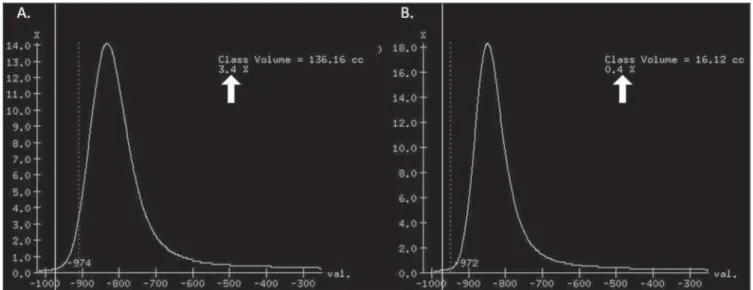
The theory on which the alterations of emphysema indices in relation to the slice thickness is based upon consists in the fact that thinner slices result in increased noise on the images and therefore, increased mean densities of the regions and decreased em-physema indices. Such effect of slices thick-ness on the measurement of emphysema is smaller than the influence of the filter(8).
However, variations are reported to achieve 2% of the emphysema indices with slice thickness variations between 1.25 mm and 10 mm (Figure 3)(8). Such variation alone is
of little importance, but must be considered, as together with the other variables, may
present significant alterations. The Euro-pean Society of Pneumology recommends a slice thickness of 1 mm for MDCT(3).
THE INSPIRATORY LEVEL
The tomographic density measurement is represented in HUs (Hounsfield units). The Hounsfield scale is (approximately) defined as –1000 HU for the air, 0 HU for distilled water and 1000 HU for the bone. Essentially, the lungs comprise two types of density: air (measuring approximately –1000 HU) and “tissue” (including blood, cells, water, etc., which have approximate densities of 0 HU). This tomographic den-sity measurement may be directly con-verted into the quantity of air and tissues present in a given region of interest (ROI) on images of the pulmonary parenchyma. For example, a region with a density of –600 HU contains on average 60% of air and 40% of “tissue”(17). By this principle, the
lung in expiration is denser than the lung in inspiration. In this same context, the variation in the inspiratory level will have an influence on the lungs density and, con-sequently, on the measurement of the em-physema indices (Figure 4). Based on these findings, inspiratory coaching methods have been developed for the measurement
Figure 3.A: Histogram of densities for the calculation of pulmonary emphysema with CT utilizing a dose of 120 kV, 200 mAs and 5 mm slice thickness. The pulmonary emphysema index was 0.6% (arrow), with a threshold at –950 HU. B: CT image of the same patient utilizing a dose of 120 kV, 200 mAs and 0.6 mm slice thickness. The pulmonary emphysema index was 2.2% (arrow), with a threshold at –950 HU. Observe the increased pulmonary emphysema index with the reduction of the slice thickness.
of emphysema by means of spyrometric gating. Such inspiratory coaching methods regulate the inspiration using always the same volumes and theoretically, should provide better reproducibility. Nowadays, studies demonstrate that such methods do not significantly affect the measurement of emphysema(19). The small variations (up to
200 ml) in the maximum inspiratory level of the patient have no significant influence on the measurements of emphysema, how-ever, in cases of variations above 200 ml, the utilization of computer softwares is recommended in order to compensate the smaller pulmonary volume by means of a mathematical analysis between the volume variations(20).
THE DIFFERENT TYPES OF CT SCANNERS
The types of CT scanners do not affect the total pulmonary volume measurements, which are obtained by utilizing a simple segmentation of low-attenuation regions (lungs) and high-attenuation regions (chest walls and soft tissues)(21,22). However,
dif-ferent apparatuses do significantly affect the measurements of pulmonary density and emphysema volume(21,22). Such
alter-ations are due, at least in part, to the level of noise at imaging studies(21,22). Such
in-creased noise level is intrinsic to the type of material used in the manufacture of the
equipment (X-ray sensors and tube) and the image processing software. The noise causes amplification of frequency distribu-tion of lung attenuadistribu-tion values. On the cen-tral regions of the Hounsfield scale (for example, water, 0 HU), the amplification of the distribution of frequency of lung at-tenuation values is symmetrical and there is no change in the mean attenuation value. However, at very low attenuations or at the extreme values of the Hounsfield scale (for example emphysema or hyperinflated pul-monary tissue) the effect of increased noise levels and amplification of the frequency of distribution of lung attenuation values is not symmetrical(21,22). This greater
asym-metry in the density distribution affects the emphysema volumes, as the emphysema measurements are based on a fixed thresh-old and any change in the density distribu-tion due to noise, will result in changes of volumes comprised below such thresh-old(21,22). Currently, there is a consensus on
the utilization of MDCT in the evaluation of pulmonary emphysema(3).
SOFTWARES FOR MEASUREMENT OF INDEX OF EMPHYSEMA
There are many computer softwares for the evaluation of pulmonary emphysema index (23–26). All of them are based on the
quantification of the areas with densities similar to those of emphysema. The main
difference among such softwares is the manner by which the pulmonary paren-chyma is excluded: some utilize an auto-matic density recognition method, while others rely on the operator to select the lung. A wide variability is observed in this aspect(24,25), which causes a variability in
the total pulmonary volume and, conse-quently, in the index of emphysema. Such factor is aggravated because a maximum pulmonary density value is not obtained (some utilize –250 HU, while others utilize –400 HU). Heussel et al.(25) have tested four
different computer programs in the same patients and have found statistically signifi-cant differences between measurements. The easiest method to manage such factors is to perform the measurement always with the aid of a same software and according to the same parameters(23).
THE USE OF INTRAVENOUS CONTRAST
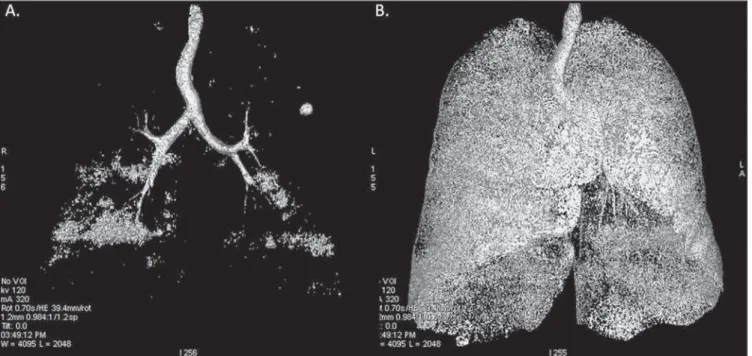
The changes detected after contrast in-jection show an increase in the pulmonary parenchyma density (Figure 5)(27).
There-fore, the amount of quantified emphysema decreases after the use of contrast. Due to this fact, intravenous iodinated contrast injection cannot be used in longitudinal studies.
It must be highlighted that the measure-ment of pulmonary emphysema by CT is
subject to a wide range of variables. How-ever, they are easily controllable and can be excluded. In order to guarantee the repro-ducibility of the measurements of the em-physema, a single CT equipment, radiation dose, processing algorithm, post-process-ing software and CT slice thickness should be used. Additionally, the differences be-tween total pulmonary volumes should not be > 200 ml (and in case they are, they should be adjusted by means of specific software). In the authors´ experience, the greatest problem with reproducibility of these studies is maintaining the pulmonary volumes. However, the authors have been able to achieve the reproducibility of pul-monary volumes in approximately 85% of the patients as a result of clear and easily understandable guidance of the patients. Finally, more safe and reliable measure-ments of pulmonary emphysema can be performed, provided the described vari-ables remain constant.
REFERENCES
1. [No authors listed]. The definition of emphysema. Report of a National Heart, Lung, and Blood In-stitute, Division of Lung Diseases workshop. Am Rev Respir Dis. 1985;132:182–5.
2. Murray CJ, Lopez AD. Evidence-based health policy – lessons from the Global Burden of Dis-ease Study. Science. 1996;274:740–3. 3. Newell JD Jr, Hogg JC, Snider GL. Report of a
workshop: quantitative computed tomography scanning in longitudinal studies of emphysema. Eur Respir J. 2004;23:769–75.
4. Marsh S, Aldington S, Williams MV, et al. Util-ity of lung densUtil-ity measurements in the diagno-sis of emphysema. Respir Med. 2007;101:1512– 20.
5. Gevenois PA, De Vuyst P, de Maertelaer V, et al.
Comparison of computed density and micro-scopic morphometry in pulmonary emphysema. Am J Respir Crit Care Med. 1996;154:187–92.
6. Madani A, Zanen J, de Maertelaer V, et al. Pul-monary emphysema: objective quantification at multi-detector row CT – comparison with mac-roscopic and micmac-roscopic morphometry. Radiol-ogy. 2006;238:1036–43.
7. Stoel BC, Bode F, Rames A, et al.Quality control in longitudinal studies with computed tomo-graphic densitometry of the lungs. Proc Am Thorac Soc. 2008;5:929–33.
8. Madani A, de Maertelaer V, Zanen J, et al. Pul-monary emphysema: radiation dose and section thickness at multidetector CT quantification – comparison with macroscopic and microscopic morphometry. Radiology. 2007;243:250–7.
9. Stolk J, Dirksen A, van der Lugt AA, et al. Re-peatability of lung density measurements with low-dose computed tomography in subjects with alpha-1-antitrypsin deficiency-associated emphy-sema. Invest Radiol. 2001;36:648–51.
10. Irion KL, Marchiori E, Hochhegger B, et al. CT quantification of emphysema in young subjects with no recognizable chest disease. AJR Am J Roentgenol. 2009;192:W90–6.
11. Prasad SR, Wittram C, Shepard JA, et al. Stan-dard-dose and 50%-reduced-dose chest CT: com-paring the effect on image quality. AJR Am J Roentgenol. 2002;179:461–5.
12. Schilham AM, van Ginneken B, Gietema H, et al. Local noise weighted filtering for emphysema scoring of low-dose CT images. IEEE Trans Med Imaging. 2006;25:451–63.
13. Zaporozhan J, Ley S, Weinheimer O, et al. Multi-detector CT of the chest: influence of dose onto quantitative evaluation of severe emphysema: a simulation study. J Comput Assist Tomogr. 2006; 30:460–8.
14. Boedeker KL, McNitt-Gray MF, Rogers SR, et al. Emphysema: effect of reconstruction algorithm on CT imaging measures. Radiology. 2004;232: 295–301.
15. Kemerink GJ, Kruize HH, Lamers RJ, et al. CT lung densitometry: dependence of CT number histograms on sample volume and consequences for scan protocol comparability. J Comput Assist Tomogr. 1997;21:948–54.
16. Kemerink GJ, Lamers RJ, Thelissen GR, et al. Scanner conformity in CT densitometry of the lungs. Radiology. 1995;197:749–52.
17. Kemerink GJ, Lamers RJ, Thelissen GR, et al. CT densitometry of the lungs: scanner performance. J Comput Assist Tomogr. 1996;20:24–33. 18. Ley-Zaporozhan J, Ley S, Weinheimer O, et al.
Quantitative analysis of emphysema in 3D using MDCT: influence of different reconstruction al-gorithms. Eur J Radiol. 2008;65:228–34.
19. Gierada DS, Yusen RD, Pilgram TK, et al. Repeat-ability of quantitative CT indexes of emphysema in patients evaluated for lung volume reduction surgery. Radiology. 2001;220:448–54. 20. Dirksen A. Monitoring the progress of
emphy-sema by repeat computed tomography scans with focus on noise reduction. Proc Am Thorac Soc. 2008;5:925–8.
21. Yuan R, Mayo JR, Hogg JC, et al. The effects of radiation dose and CT manufacturer on measure-ments of lung densitometry. Chest. 2007;132: 617–23.
22. Stoel BC, Bakker ME, Stolk J, et al. Comparison of the sensitivities of 5 different computed tomog-raphy scanners for the assessment of the progres-sion of pulmonary emphysema: a phantom study. Invest Radiol. 2004;39:1–7.
23. Irion KL, Marchiori E, Hochhegger B. Tomo-graphic diagnosis of pulmonary emphysema. J Bras Pneumol. 2009;35:821–3.
24. Irion KL, Hochhegger B, Marchiori E, et al. Chest X-ray and computed tomography in the evalua-tion of pulmonary emphysema. J Bras Pneumol. 2007;33:720–32.
25. Heussel CP, Achenbach T, Buschsieweke C, et al. Quantification of pulmonary emphysema in multislice-CT using different software tools. Rofo. 2006;178:987–98.
26. Irion KL, Hochhegger B, Marchiori E, et al. Pro-teus syndrome: high-resolution CT and CT pul-monary densitovolumetry findings. J Thorac Im-aging. 2009;24:45–8.