rev bras hematol hemoter.2 0 1 4;3 6(3):226–229
Revista Brasileira de Hematologia e Hemoterapia
Brazilian Journal of Hematology and Hemotherapy
w w w . r b h h . o r g
Case Report
Systemic mastocytosis – a diagnostic challenge
Ana Cristina Amorim Oliveira Gaia Lladó
a,b,∗, Claudia Elena Mihon
a,b,
Madalena Silva
a,b, Antonio Galzerano
baHospital Santo António dos Capuchos, Lisbon, Portugal bCentro Hospitalar de Lisboa Central, Lisbon, Portugal
a r t i c l e
i n f o
Article history:
Received 23 September 2013 Accepted 2 January 2014
Keywords:
Biopsy
Allergy and immunology Bone marrow cells
a b s t r a c t
Mastocytosis refers to a group of disorders characterized by the infiltration of clonally derived mast cells to the skin or extracutaneous tissues resulting in a heterogeneous clinical picture. It is a rare hematologic disorder in all its forms. The exact incidence is unknown; it affects patients of any age and males and females equally. Its molecular pathogenesis is incompletely understood. The clinical features of mastocytosis result from both chronic and episodic mast cell mediator release, signs and symptoms arising from diffuse or focal tissue infiltration, and, occasionally, the presence of an associated non-mast cell clonal hematologic disease. The histopathologic analysis is essential for definitive diagnosis but there is no curative treatment. The authors report a clinical case of a 72-year-old woman with no history of allergies, with bicytopenia, weight loss, and diffuse axial osteolytic lesions. This is a rare clinical case of aggressive systemic mastocytosis for which palliative treatment can improve survival and quality of life. A brief review of the literature about this pathology is also included.
© 2014 Associac¸ão Brasileira de Hematologia, Hemoterapia e Terapia Celular. Published by Elsevier Editora Ltda. All rights reserved.
Introduction
Mastocytosis refers to a group of myeloproliferative disorders characterized by an excessive proliferation of mast cells and their accumulation in one or multiple tissues. According to the World Health Organization (WHO), the disease can be classi-fied as cutaneous mastocytosis (CM), which describes forms of mastocytosis that are limited to the skin, and systemic mastocytosis (SM) in which mast cells infiltrate extracu-taneous organs, with or without skin involvement.1,2 The
∗ Corresponding author at: Alameda Santo António dos Capuchos Freguesia São José, Hospital Santo António dos Capuchos, 1169-050
Lisboa, AC, Portugal.
E-mail address:[email protected](A.C.A.O.G. Lladó).
pathogenesis is not well defined and treatment is only on a palliative basis.
The authors report a clinical case of SM and briefly review the literature about this disease.
Clinical case
A 72-year-old Caucasian woman with a history of diverticu-losis, surgically-corrected lumbar hernia and plurisegmental degenerative osteoarticular disease is reported. There was
http://dx.doi.org/10.1016/j.bjhh.2014.03.003
1516-8484/© 2014 Associac¸ão Brasileira de Hematologia, Hemoterapia e Terapia Celular. Published by Elsevier Editora Ltda. All rights reserved.
rev bras hematol hemoter.2 0 1 4;3 6(3):226–229
227
Figure 1 – Computed tomography scan of the lumbar spine and sacrum – scattered osteosclerotic lesions on vertebrae, sacrum and iliac bones (coronal view).
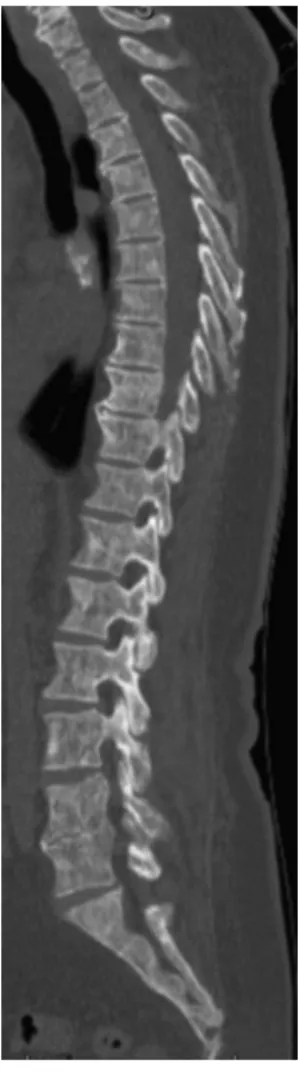
no background of allergies, smoking or alcoholism and she was taking only analgesic medications. In May 2012, she was admitted for acute diverticulitis. During her hospital stay the lower back pain worsened and so a computed tomography (CT) scan of the lumbar spine was performed which documented diffuse osteopenia and multiple scattered osteosclerotic lesions on vertebrae, the sacrum and the iliac bones (Figure 1). After discharge and with a presumptive diag-nosis of occult neoplastic disorder, she was referred to her doctor for further studies.
Several medical tests were performed including blood analysis, endoscopic and imaging exams but none showed relevant changes. In September she started with persistent diaphoresis with no fever or any symptoms suggestive of an infectious focus, anorexia and a quantified weight loss. The blood tests revealed slightly elevated levels of alkaline phos-phatase (162 U/L) and lactate dehydrogenase (LDH – 454 U/L). She was admitted again and a CT body scan was performed (Figure 2) which showed osteolytic lesions, in addition to the diffuse osteosclerotic lesions previously documented, with-out expansive features, spread throughwith-out the axial skeleton, that were assumed to be bone marrow sclerosis phenomena. Diaphoresis was associated to a pharmacological iatrogenic effect and the weight loss to a reactive depression. She was discharged and referred to our Internal Medicine Department. The sequential control blood tests showed increasing levels of bicytopenia (hemoglobin 11.2 g/dL and platelet count 122×109/L), leukocytosis (19.40 x 10⁹/L), with no formula
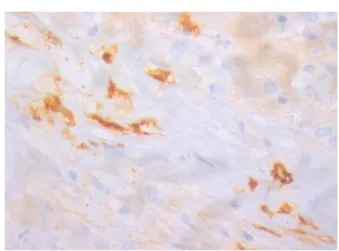
inversion, and LDH (572 U/L). With strong suspicion of a hematological disorder, a blood smear, myelogram and bone marrow biopsy were performed but all were unrevealing. The immunological study was negative and Paget’s disease and multiple myeloma were excluded. Finally, a percutaneous L1 biopsy was performed. This was essential for the definitive diagnosis because it documented a multifocal infiltration of atypical mast cells, characterized by spindle-shaped and hypogranular forms, representing 5% of cellularity and forming cellular aggregates of more than 15 cells. An immunohistochemistry study identified positive staining for CD117 and tryptase of these mast cells confirming the diagnosis of SM (Figures 3–5). These features associated with peripheral blood test abnormalities (bicytopenia), weight loss
Figure 2 – Computed tomography scan of the lumbar spine and sacrum – osteosclerotic and osteolytic lesions, without expansive features, spread throughout the axial skeleton (sagittal view).
and presence of osteolytic lesions are sufficient C findings that allowed the classification of an aggressive form of SM.
The patient was referred to the Hematology Department and began chemotherapy with cladribine which gave a
Figure 3 – Hematoxylin-eosin stain (magnification: 400×) – peripheral fibrosis and atypical mast cells with fusiform shape (circle).
228
rev bras hematol hemoter.2 0 1 4;3 6(3):226–229Figure 4 – Positive staining for CD117 (magnification: 400×) identifying atypical mast cells with fusiform shape.
partial response. Five cycles have been performed so far with clinical improvement. The patient remains under clinical and laboratory surveillance.
Discussion
Mastocytosis is a disorder characterized by an excessive pro-liferation of atypical mast cells and their accumulation in tissues. This infiltration can be limited to the skin (CM) or involve extracutaneous organs (SM).1,2
This is a rare disease in all its forms. The exact incidence is unknown and it can appear at any age, but mostly in children in which the disease is generally limited to the skin; it affects males and females equally.3
The molecular pathogenesis is incompletely understood but it is believed that activating mutations in the c-KIT recep-tor or CD117, essential for normal development and expansion of mast cells from hematopoietic progenitors, leads to a clonal hyperproliferation of atypical mast cells. The Asp816Val muta-tion is the most common.4,5
The clinical features result from both chronic and episodic mast cell mediator release associated with allergic and anaphylactic reactions, focal or diffuse tissue infiltration by mast cells and occasionally the presence of an associated non-mast cell clonal hematologic disease. Urticaria pigmen-tosa or cutaneous mastocytomas can appear in the CM form, while SM may present signs and symptoms resulting from the infiltration of mast cells in specific organs. The most commonly affected organ systems are the bone marrow, gastrointestinal tract, lymph nodes, liver, spleen, skeletal system and genitourinary tract, leading to the following clinical manifestations: anemia and thrombocytopenia, hep-atosplenomegaly, portal hypertension and hypersplenism, malabsorption, lytic bone lesions and pathologic fractures.6,7
The diagnosis is histopathological and should include a bone marrow evaluation because, in most cases, infiltration occurs. The histological exam is characterized by tissue infil-tration by atypical mast cells with a spindle or fusiform shape and a high nucleus:cytoplasm ratio; immunohistochemical staining with antibodies positive for tryptase, CD117, CD2 and CD25, and possible detection of mutations of the c-KIT recep-tor by cytogenetic analysis which is available in the United
Figure 5 – Positive staining for tryptase of mast cells (magnification: 400×). CD117 is not specific so this analysis is essential to definitive diagnosis.
States and some academic centers. This study may be supple-mented with serum tryptase levels and the measurement of metabolites of mast cell activation, including a 24-hour urine test for N-methyl histamine and 11-beta-prostaglandine F2.7–9 According to the WHO, diagnostic criteria for CM include skin lesions with compatible biopsy results, while for SM the presence of one major (multifocal clusters greater than 15 mast cells) and one minor criterion or three minor criteria (atypical morphology or spindle shapes in greater than 25% of the mast cells,c-KITgene mutation, mast cells expressing the CD2 or CD25 surface markers or both, and increased serum tryptase levels greater than 20 ng/mL) are required.9
After establishing the diagnosis it is necessary to define the disease category and the presence of B findings, corresponding to organ enlargement without organ dysfunction, or C findings that denote organ function impairment due to excessive mast cell infiltration; this latter is associated to a poorer prognosis. Our patient found herself inserted in a category of aggressive SM presenting three C findings (hematopoietic dysfunction with bicytopenia, diffuse bone lesions and weight loss due to malabsorption).7–9
The differential diagnosis is important to exclude other pathologies such as angioedema, carcinoid syndrome, pheochromocytoma, metastatic bone disease, myeloprolife-rative variant of hypereosinophilic syndrome and reactive mastocytosis which can be seen in patients with solid tumors and lymphomas.8
Currently, there are no curative therapies for SM and treat-ment is intended to reduce symptoms and improve quality of life. Patients with aggressive SM are candidates for mast cell cytoreductive therapies if C findings are present. The most frequently administered therapies are cladribine (1st line treatment), IFN-␣2b, glucocorticoids, hydroxyurea and tyro-sine kinase inhibitors. The choice of cladribine was made based on the current recommendations for slowly progressive cases.7,10
The response to treatment is commonly transient and most patients eventually relapse. Bone marrow suppression is the main side effect, as happened to our patient.10
rev bras hematol hemoter.2 0 1 4;3 6(3):226–229
229
two years, while others follow a slower course with several years of survival.
Conclusion
This is a rare disease that required perseverance in the diag-nostic search. The clinical and laboratory findings can be suggestive, but bone marrow biopsy and myelogram are essen-tial for definitive diagnosis. Although there is no specific treatment, chemotherapy may increase survival and improve quality of life.
Conflicts of interest
The authors declare no conflicts of interest.
Acknowledgements
The authors would like to acknowledge the help and guidance of Dr. Cristina Poole da Costa and Dr. Ana Ribeiro.
r e f e r e n c e s
1. Valent P. Diagnostic evaluation and classification of mastocytosis. Immunol Allergy Clin North Am. 2006;26:515–34.
2. Hoffman R, Benz Jr EJ, Shattil SJ, Furie B, Cohen HJ, Silberstein LE, et al. Hematology: basic principles and practice. 4th ed. Philadelphia: Elsevier; 2005. p. 911–25.
3. Akoglu G, Erkin G, Cakir B, Boztepe G, Sahin S, Karaduman A, et al. Cutaneous mastocytosis: dermographic aspects and clinical features of 55 patients. J Eur Acad Dermatol Venereol. 2006;20:969–73.
4. Akin C. Clonality and molecular pathogenesis of mastocytosis. Acta Haematol. 2005;114:61–9. 5. Bodemer C, Hermine O, Palmérini F, Yang Y,
Grandpeix-Guyodo C, Leventhal PS, et al. Pediatric
mastocytosis is a clonal disease associated with D816V and other activating c-KIT mutations. J Invest Dermatol. 2010;130:804–15.
6. Brockow K. Urticária pigmentosa. Immunol Allergy Clin North Am. 2004;24:287–316.
7. Pardanani A. Systemic mastocytosis in adults: 2012 Update on diagnosis, risk stratification, and management. Am J Hematol. 2012;87:401–11.
8. Valent P, Sperr WR, Schwartz LB, Horny HP. Diagnosis and classification of mast cell proliferative disorders: delineation from immunologic diseases and non-mast cell hematopoietic neoplasms. J Allergy Clin Immunol. 2004;114:
3–11.
9. Horny HP, Metcalfe DD, Bennett JM. Mastocytosis. In: Swerdlow SH, Campo E, Harris NL, et al., editors. World Health Organization Classification of tumors of
haematopoietic and lymphoid tissues. Lyon: IARC Press; 2008. 10. Bains SN, Hsieh FH. Current approaches to the diagnosis and
treatment of systemic mastocytosis. Ann Allergy Asthma Immunol. 2010;104:1–10.