Rev Bras
Cineantropom
Hum
DOI: http://dx.doi.org/10.5007/1980-0037.2017v19n2p214
original article
Repeatability and intra-rater reproducibility
of a digitalized test of body image perception
Repetibilidade e reprodutibilidade intra-avaliador
de um teste digitalizado de avaliação da percepção
da imagem corporal
Emanuelle Francine Detogni Schmit1
Ana Paula Rodrigues1
Catiane Souza1
Cláudia Tarragô Candotti1
Jefferson Fagundes Loss1
Abstract – A body schema is a cortical representation of the spatial relations of body parts. It can be evaluated using the Image Marking Procedure (IMP). However, that instrument lacks information regarding its reliability and a standardized set of procedures. he aim of this study was to test the repeatability and intra-rater reproducibility of an adapted IMP. Methods: It consisted of two steps: (1) adaptation of the instrument; (2) veriication of its reliability. Sixty-ive young adult women were evaluated on two diferent days by a single rater, with a one-week interval between evaluations. hree consecutive measurements were performed on each day. Regarding repeatability, for all the variables (coordinates, distances and area), the ICC scores were classiied as excellent, with low SEM (<4.5cm) and MDC (<8.5cm) values. Regarding intra-rater reproducibility, only the variables area and distance between the trochanters presented ICC> 0.6. he adapted IMP needs to be conducted only once. Regarding reproducibility, the variables apt for use are the area within the points and the distance between the trochanters. In contrast to the original IMP test, in this adapted version we do not recommend the use of the distances between the shoulders, the hip/waist or the top of the head in relation to the ground.
Key words: Evaluation of research programs and tools; Perception; Reproducibility of results.
Resumo – O esquema corporal é uma representação cortical das relações espaciais das partes do corpo que pode ser avaliado pelo Image Marking Procedure (IMP), o qual carece de informações acerca da coniabilidade, bem como dos procedimentos de padronização do teste. Objetivou-se testar a repetibilidade e reprodutibilidade intra-avaliador do teste IMP adaptado. Estudo desenvolvido em duas etapas: (1) adaptação do instrumento; (2) veriicação da coniabilidade. Participaram do estudo 65 mulheres adultas jovens, avaliadas em dois dias, por um único avaliador, com intervalo de sete dias. Em cada dia foram realizadas três medições consecutivas. Resultados: Em relação à repetibilidade, para todas as variáveis analisadas (coordenadas, dis-tâncias e área), os escores ICC foram classiicados como excelentes, com valores baixos de SEM (<4,5cm) e MDC (<8,5cm). Na reprodutibilidade intra-avaliador apenas as variáveis área e distância entre trocânteres apresentaram ICC>0,6. O IMP adaptado é um instrumento que necessita uma única execução do teste. Com relação a reprodutibilidade, as variáveis possíveis de serem utilizadas são a área e distância entre trocânteres. Contrariamente ao que é utilizado no teste IMP original, nesta versão adaptada não recomendamos o uso das distâncias entre os ombros, cinturas e o topo da cabeça em relação ao chão.
1 Federal University of Rio Grande do Sul, Porto Alegre, RS, Brazil
he perceived dimensions of the body or body schema is a cortical repre-sentation of the spatial relations between parts of the body, which depends on multi-modal sensorial aferences and their connections with the motor system1,2. hose perceived dimensions are based on two components: (1)
the sensorial, which refers to visual responses and the integration of tactile and kinesthetic information, and (2) the non-sensorial, formed from cer-ebral information, which is cognitive and afective in nature, relecting the beliefs and knowledge held by the individual regarding their own body3,4.
he Image Marking Procedure (IMP) is a test frequently used to evaluate the perceived dimension of the body, that is, the body schema5.
It consists of a test in which blindfolded participants project the perceived location of body segments in relation to each other in response to tactile prompts (top of head, shoulders, waist, hip) on a sheet of paper ixed on the wall in front of them. It was developed in the 1970s to detect perceived distortions of body segments occasioned by eating disorders6. Currently,
it is still used in clinical trials investigating eating disorders. However, its use has expanded to include the evaluation of healthy individuals and those with chronic pain, regardless of age7,8 or sedentary and active lifestyle8, as
well as the collection of evidence regarding the efectiveness of exercises and therapies, mainly, associated to the body and mind, such as dance, yoga and pilates9.
Although the IMP test has several evaluative functions1,8-9, our search
of the literature found no references regarding its reliability. hus, it is important to assess the repeatability and reproducibility of the test. Re-peatability describes the degree of equality between the results obtained following consecutive measurements conducted by the same rater, using the same instrument and method10. Conirmation of this feature allows, for
example, the test to be conducted only once, with no need for repetition, thus saving the participants and professionals time. Intra-rater reproduc-ibility describes the degree of equality between the results obtained in tests conducted by the same rater, using the same instrument and method, on diferent occasions, with a time diference10 at least 24 hours11
.Conirma-tion of this feature allows, for example, one to state that any diferences in the results of tests conducted at distinct moments are derived from a speciic intervention.
In addition, as far as we know, the literature contains no clearly deined standardized procedure for performing the IMP test. For example, there is no mention of standardization of the distance at which that the individual should stand in relation to the location where they will mark the points. his may interfere in the results when many individuals are evaluated or when the same participant is reevaluated on diferent occasions. From the operational standpoint, the original IMP used materials like craft paper and a measuring tape6. Taking that into account, recording the evaluation
Body schema evaluation test Schmit et al.
storage of information, as well as allow more accurate modes of measure-ment. Slight changes in the originally proposed methodological procedures may make the test more practical and accurate, as well as more ecological. From this perspective, seeking to ill this gap in the literature, the objectives of this study were: (1) to propose an adapted version of the IMP test; (2) to assess the repeatability and the intra-rater reproducibility of the adapted test. We believe that by modernizing and standardizing the procedures and applying rigorous methodological assessments, the adapted version of the IMP test will be faster to use and more reliable.
METHODOLOGICAL PROCEDURES
he methodology used to produce the adapted version of IMP, a test de-signed to assess body schema, consisted of two steps: (1) adaptation of the instrument based on the original IMP methodology; and (2) analysis of repeatability and intra-rater reproducibility of the adapted version. In order to corroborate and justify the adaptations, a brief description of the original IMP methodology, along with its analytical possibilities, is presented below.
The original IMP test
he IMP is considered a tactile-stimulation based projective test, which uses the following standard methodology: the blindfolded subjectis positioned in front of a sheet of craft paper (140cm high by 60cm wide) ixed to a wall at 40cm from the ground and is asked to imagine he/she is standing in front of a mirror. he evaluator then touches predetermined reference points on the subject’s body (top of head, right and left shoulders, waist curves and hips) and the subject should immediately mark the corresponding point on the paper with a marker pen. his procedure is repeated three times. For the purpose of analysis, the subject is placed against the paper and the same anatomical points are marked directly on the same sheet of paper in order to allow comparison between the real image and the perceived image based on the geometric igures obtained by joining the points, from the horizontal widths and the distance from the top of head to the ground6.
The adapted IMP test
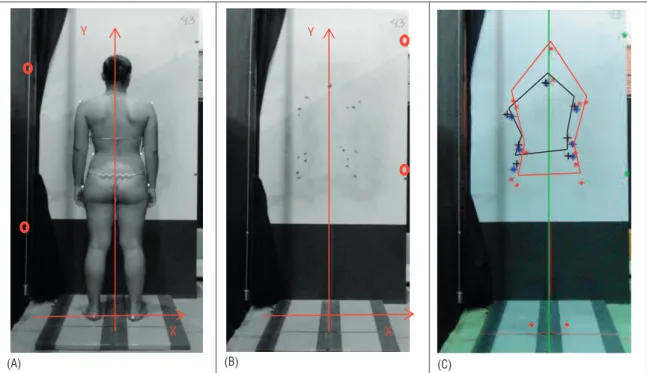
from the right acromion to the styloid process of the right ulna. he fol-lowing anatomical reference points were selected to be touched during the test: top of head (from the original IMP method), right and left acromion (substituting “shoulder” in the original IMP), a point immediately below the lowest right and left ribs (substituting “waist curves” in the original IMP) and right and left greater trochanter (substituting the “hips” in the original IMP). Following the identiication of points with a dermographic pen, relexive markers were ixed to the same locations and digital photo-graphs of the body in the position adopted for the test were obtained,that is, with the subject’s back to the camera (DSC-W510 - 12.1 megapixels, Sony), which was positioned on a tripod 90cm from the ground and 350cm from the whiteboard.
Following this, the subject was blindfolded and physically prompted. Using the indicator and middle ingers, the researcher touched each refer-ence mark for three seconds. At the same time, the subject was asked to immediately mark the corresponding location on the whiteboard using two marker pens, one in each hand, marking the point with the hand on the same side of the body that was touched, the corresponding mark of a touch in the right acromion was made with the marker in the right hand. Finally, a photographic image of the white board was obtained. Each sequence of points was repeated three consecutive times, without interval between sequences. he irst reference point in each sequence was always the apex of the head as recommended in the original IMP test, when the subject was asked to take a deep breath, hold the breath, receive the prompt, mark the point on the white board, and only then exhale. he other prompts, executed in random order, were conducted without any link to breathing.
Interpretation of the adapted IMP test
Body schema evaluation test Schmit et al.
were on the right side of the central reference, and negative abscissas when the points were on the left side.
he same derived measurements used in the original IMP were calculated: the area within the linked points, the distance between the corresponding right and left points and the distance from the top of head to the ground. In addition, the distance between top of head to the point midway between the trochanters and the speciic individual coordinate values of each point were evaluated. All calculations were obtained using routines elaborated in Matlab software (version 7.9).
Analysis of repeatability and intra-rater reproducibility
he second stage consisted in the analysis of repeatability and intra-rater reproducibility of the adapted version of the instrument. he sample size was calculated according to Walter, Eliasziw and Donner14, assuming: the
null hypothesis value of the Intraclass Correlation Coeicient - ICC to be 0.40 (on the basis that any value lower than .40 might be considered clinically “unacceptable”); 80% of power; three replicated measurements per subject; and a signiicance level of 95% to detect an ICC value of 0.6, a minimum number of 52 participants was determined (rounding up from 51.5). Considering any possible losses due to the fact that evaluations would be conducted on two diferent days, 65 participants were selected (age 28.6±4.0years; weight 60.2±8.0kg; height 165.9±11.0cm; BMI 21.9±1.9Kg/ m2). Given the possibility of gender diferences regarding the expression of
the body schema, for convenience, only young women, aged between 21 and 35 years, who were part of the university community where this research was
Figure 1. Evaluating the body schema, (A) real image, (B) perceived image (points marked on the board), and (C) figure formed by
ous weekly physical activity), not to be pregnant, nor present psychological and/or neurological disorders that could interfere with the test. Participants would also be excluded in the case of dizziness or diiculty in maintaining the orthostatic position during the test period. he participants received information regarding the evaluation procedures and agreed to participate voluntarily by signing a free informed consent term in accordance with the requirements of National Health Council. he research was approved by the Research Ethics Committee of the university where the study was conducted. he evaluations were carried out in a controlled environment, with ambient temperature maintained at 23ºC, stable lighting conditions, and external interferences, including noise, restricted to a minimum. he cir-cadian rhythm of the subjects was obeyed, with the test and re-test being performed preferably at the same time of the day, during day time. First, the subject’s medical history was taken to collect information regarding depressed states and personal data (name and age). After, the IPAQ ques-tionnaire was applied to verify the level of physical activity, and the body mass and height were measured. hen, the subject was instructed to don swimwear (bikini) to perform the test.
Statistic procedures
he data were analyzed using SPSS software, version 20.0. he mean and standard deviation were used in the descriptive analysis. To determine the repeatability and the intra-rater reproducibility, the intra-class coeicient (ICC), the standard error of measurement (SEM) and the minimum de-tectable change (MDC) were calculated. Where, ICCs>0.80 indicate high reliability, between 0.60-0.79 moderately high reliability, from 0.40-0.59 moderate reliability and <0.40 low reliability17. hus, only those ICC values
greater than 0.6 were considered relevant. To evaluate the degree to which measurements that may have varied due to errors in the measurement pro-cess, the standard error of measurement (SEM) was calculated using the following formula: SEM=SD, where SD is the standard deviation of the measurements18. To evaluate the degree of change necessary to determine
whether there was a real change or merely a measurement error, minimum detectable change (MDC) was used based with a 95% conidence interval, where MDC=1.96 * SEM19. In all the analyses α<0.05 was adopted.
To analyze repeatability, the three replicates of the irst test were considered (tests performed in sequence on the same day). To analyze intra-rater reproducibility, the irst replicate, performed on day one, was compared with the irst replicate performed after a minimum interval of seven days following the irst15,16.
RESULTS
Body schema evaluation test Schmit et al.
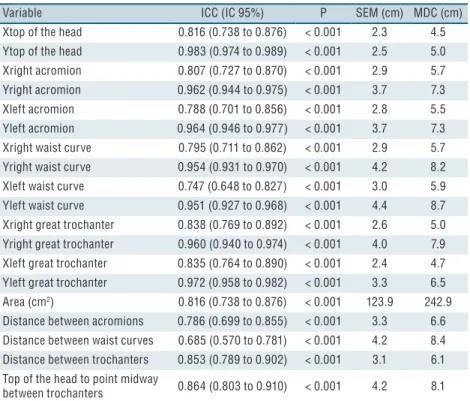
distances and area) the ICC scores were classiied as excellent, with SEM values less than 4.5cm and MDC values less than 8.5cm (Table 1). By contrast, in the analyzes of reproducibility only two variables, the distance between trochanters and the area within the points, were shown to be relevant (ICC>0.6). None of the coordinates, nor the other distances, had ICC scores greater than 0.6, with SEM values almost doubled and MDC values above 30 cm (Table 2).
Table 1. Repeatability scores for the adapted instrument
Variable ICC (IC 95%) P SEM (cm) MDC (cm)
Xtop of the head 0.816 (0.738 to 0.876) < 0.001 2.3 4.5 Ytop of the head 0.983 (0.974 to 0.989) < 0.001 2.5 5.0 Xright acromion 0.807 (0.727 to 0.870) < 0.001 2.9 5.7 Yright acromion 0.962 (0.944 to 0.975) < 0.001 3.7 7.3 Xleft acromion 0.788 (0.701 to 0.856) < 0.001 2.8 5.5 Yleft acromion 0.964 (0.946 to 0.977) < 0.001 3.7 7.3 Xright waist curve 0.795 (0.711 to 0.862) < 0.001 2.9 5.7 Yright waist curve 0.954 (0.931 to 0.970) < 0.001 4.2 8.2 Xleft waist curve 0.747 (0.648 to 0.827) < 0.001 3.0 5.9 Yleft waist curve 0.951 (0.927 to 0.968) < 0.001 4.4 8.7 Xright great trochanter 0.838 (0.769 to 0.892) < 0.001 2.6 5.0 Yright great trochanter 0.960 (0.940 to 0.974) < 0.001 4.0 7.9 Xleft great trochanter 0.835 (0.764 to 0.890) < 0.001 2.4 4.7 Yleft great trochanter 0.972 (0.958 to 0.982) < 0.001 3.3 6.5 Area (cm2) 0.816 (0.738 to 0.876) < 0.001 123.9 242.9
Distance between acromions 0.786 (0.699 to 0.855) < 0.001 3.3 6.6 Distance between waist curves 0.685 (0.570 to 0.781) < 0.001 4.2 8.4 Distance between trochanters 0.853 (0.789 to 0.902) < 0.001 3.1 6.1 Top of the head to point midway
between trochanters 0.864 (0.803 to 0.910) < 0.001 4.2 8.1
X and Y: coordinates; ICC: intra-class correlation coefficient; IC: confidence interval; SEM: standard error of measurement; MDC: minimum detectable change. Note: The SEM and MDC values for all the variables are in centimeters with the exception of the area, which are expressed in cm2.
Table 2. Reproducibility scores for the adapted instrument.
Variable ICC (IC 95%) P SEM (cm) MDC (cm)
Xtop of the head 0.516 (0.251 to 0.709) < 0.001 3.8 7.5
Ytop of the head 0.393 (0.100 to 0.623) 0.005 16.3 31.9 Xright acromion 0.382 (0.100 to 0.622) 0.005 4.7 9.3 Yright acromion 0.394 (0.067 to 0.602) 0.009 15.6 30.7 Xleft acromion 0.362 (0.065 to 0.600) 0.009 4.4 8.7 Yleft acromion 0.468 (0.191 to 0.676) 0.001 14.9 29.3 Xright waist curve 0.369 (0.073 to 0.606) 0.008 4.3 8.3 Yright waist curve 0.468 (0.191 to 0.676) 0.001 15.7 30.7 Xleft waist curve 0.551 (0.296 to 0.732) < 0.001 4.3 8.5 Yleft waist curve 0.456 (0.176 to 0.668) < 0.001 15.5 30.5 Xright great trochanter 0.493 (0.222 to 0.693) < 0.001 3.9 7.7 Yright great trochanter 0.375 (0.080 to 0.610) 0.007 17.3 33.8 Xleft great trochanter 0.474 (0.199 to 0.680) 0.001 4.4 8.7 Yleft great trochanter 0.391 (0.098 to 0.621) 0.005 16.5 32.3
Distance between acromions 0.405 (0.114 to 0.631) 0.004 9.7 19.0 Distance between waist curves 0.556 (0.303 to 0.736) < 0.001 9.0 17.7 Distance between trochanters 0.796 (0.649 to 0.886) < 0.001 6.1 12.0 Top of the head to point midway
between the trochanters 0.542 (0.338 to 0.753) < 0.001 7.5 14.6
X and Y: coordinates; ICC: intra-class correlation coefficient; IC: confidence interval; SEM: standard error of measurement; MDC: minimum detectable change. Note: The SEM and MDC values for all the variables are in centimeters with the exception of the area, which are expressed in cm2.
DISCUSSION
he repeatability of the adapted instrument was supported by the high ICC values obtained for all the variables (Table 1), which suggests it is unnecessary to conduct three consecutive repetitions. hus, the method can be adapted to include just one point-marking session. he reduction in the number of repetitions makes the procedure simpler and quicker, with no loss of information quality.
In relation to intra-rater reproducibility (Table 2), given that the ICC classiication should be at least high moderate, only the distance between the trochanters and the area within the points should be used in a comparative analysis at two distinct moments (24-hour minimum interval), since only these variables reliably reproduce the perceived body dimensions. he hori-zontal distances between the acromions and the waist curves, as well as the height from the top of head, measures used in the original version of IMP, were found not to present reproducibility. herefore, they should not be used.
According to Tavares et al.5, the factors inluencing body perception
may be either environmental, which are independent of the subject, or subjective, which are intrinsic to the evaluated individual. he environ-mental factors are created by the test conditions, and include the instruc-tion protocol, the lighting in the evaluainstruc-tion room, the color of clothes, the repetition of the test and the presence of marks on the face. Considering these factors, in the present study, great care was taken in its execution, when instructing the subject and in the choice of location (physical envi-ronment and lighting). As the subject remained blindfolded during the evaluation, visual aspects were deemed to have no inluence. Regarding to repetitions of the test, this factor had no apparent inluence since the measures were repeatable.
On the other hand, the subjective factors are related to individual characteristics5, such as the period of the menstrual cycle, which was not
Body schema evaluation test Schmit et al.
as possible, may have directly inluenced the measures and psychometric indexes obtained.
According to Button, Francellaand Slade21 there is no homogeneous
perception regarding the body among healthy women, since aspects such as weight changes, concerns about slimness and anxiety appear to medi-ate body perception diferently in each person. his fact corrobormedi-ates the indings of the present study regarding the area of the body schema, since the area encompasses a larger body dimension, and is more susceptible to perceptive distortions.
he advantages of the adapted IMP include its ease-of-use, the low cost of the materials, the relatively small physical space required, and the short data collection period, since the test needs to be performed only once. Together these features make the instrument feasible for use in evaluating the body schema. It should be noted that although this study was conducted to evaluate only the reliability of the adapted IMP test, future users of this adapted test will also be able to calculate the body per-ception index, created by Slade and Russel22, which categorizes the body
schema22. By determining the ratio between the perceived size and actual
size multiplied by 100, the index expresses scores such as underestimation (<100%), normal estimation (=100%) and overestimation (>100%). hus, it is emphasized that the adapted IMP can be adopted for use in educational and clinical routines, as well as in research, while always respecting ethical and methodological issues13.
he present study has some limitations, including the fact the sample is exclusively composed of young females, which inhibits the extrapola-tion of the results. Moreover, there are signiicant limitaextrapola-tions regarding inter-rater reproducibility and inter-location reproducibility. herefore, to overcome these limitations, further studies should be conducted among subjects from both genres, from diferent age groups, and involving dif-ferent evaluators and locations.
CONCLUSION
he adapted IMP it is an instrument with excellent repeatability. herefore, it is suggested that in future evaluations only one test run be performed. With regard to reproducibility, this is restricted to the area within the points and the distance between the trochanters, since these variables represent the perceptual dimension of the body in the same way at diferent times. In contrast to the original IMP test, when applying this adapted version, we do not recommend the use of the distances between the shoulders, waist curvesor the top of the head in relation to the ground.
REFERENCES
1. Pereira ES, Segueto KJ, hurm BE, Gama EF. Body schema analysis between yoga
and body combat practitioners. FIEP Bulletin 2010:80(1):494-98.
2. Segheto W, Segheto KJ, Silva CB, Gama EF. Esquema corporal e nível de atividade
CORRESPONDING AUTHOR Emanuelle Francine Detogni Schmit Rua Felizardo, 750
Escola Superior de Educação Física, Fisioterapia e Dança – ESEFID/ UFRGS
Laboratório de Pesquisa do Exercício – Sala 218 - Rio Grande do Sul, Porto Alegre – RS – Brasil.
E-mail: [email protected]
tion: Role of biopsychosocial variables. Body Image 2006;3(2):163-71.
5. Tavares MCGCF, Campana ANNB, Tavares Filho RF, Campana MB. Avaliação
perceptiva da imagem corporal: história, reconceituação e perspectivas para o Brasil. Psicol estud 2010;15(3):509-18.
6. Askevold F. Measuring body image. Preliminary report on a new method.
Psy-chother Psychosom 1975;26(2):71-77.
7. Ferreira CC, Favero FM, Fontes SV, Quadros AAJ, Pereira SSR, Oliveira ASB,
et al. Análise da imagem e esquema corporal em indivíduos com diagnóstico de síndrome pós-poliomielite. Revi Neuroc 2012;20(1):50-7.
8. hurm EB, Matoso A, Diaz CA, Paschoalini C, Neves E, Tuunelis R, Kiyomoto
HD, Gama EF.Chronic pain efect on body schema and neuropsychological per-formance in athletes: a pilot study. Percept Motor Skill 2013;116(2):544-53.
9. Fonseca CC, hurm BE, Vecchi RL, Gama EF. Ballroom dance and body size
perception. Percept Motor Skill 2014;119(2):495-503.
10. VIM. International vocabulary of metrology – Basic and general concepts and
associated terms (3rd ed.). Joint Committee for Guides in Metrology: 2012.
11. Associação Brasileira de Normas Técnicas – ABNT. Norma Brasileira Registrada –
NBR 10536 – Statistics: Vocabulary and Symbols. 1988; Available from: < https:// onedrive.live.com/?cid=4E0D589D53BBEB5D&id=4E0D589D53BBEB5D!119 &parId=4E0D589D53BBEB5D!118&o=OneUp> [2016 aug 10].
12. Ferrer-García M, Gutiérrez-Maldonado J. Body Image Assessment Software:
psychometric data. Behav Res Methods 2008;40(2):394-407.
13. Neves AN, Morgado FFR, Tavares MCGCF. Body image assessment: essential
notes for a good research practice. Psic: Teor Pesq 2015;31(3):375-80.
14. Walter SD, Eliasziw M, Donner A. Sample size and optimal designs for reliability
studies. Stat Med 1998;17(1):101-10.
15. Staes F, Stappaerts K, Vertommen H, Everaert D, Coppieters M. Reproducibility
of a survey questionnaire for the investigation of low back problems in adolescents. Acta Paediatr 1999;88(11):1269-73.
16. Pedhazur EJ, Schmelkin LP. Measurement, design and analysis: an integrated
approach. Hillsdale, NJ: Lawrence Erlbaum Associates, 2013.
17. Katz JN, Larson MG, Phillips CB, Fossel AH, Liang MH. Comparative
meas-urement sensitivity of short and longer health status instruments. Med Care 1992;30(10):917-25.
18. Denegar CR, Donald WB. Assessing reliability and precision of measurement:
an introduction to intraclass and standard error of measurement. J Sport Rehabil 1993;2(1):35-42.
19. Hicks GE, George SZ, Nevitt MA, Cauley JA, Vogt MT. Measurement of lumbar
lordosis: inter-rater reliability, minimum detectable change and longitudinal vari-ation. J Spinal Disord Tech 2006;19(7):501-506.
20. Gaya A, Garlipp DC, Silva MF, Moreira RB. Ciências do movimento humano:
introdução à metodologia da pesquisa. Porto Alegre: Artmed, 2008.
21. Button EJ, Francella F, Slade PD. A reappraisal of body perception disturbance
in anorexia nervosa. Psychol Med 1977;7(2):235-243.
22. Slade PD, Russell GFM. Awareness of body dimensions in anorexia nervosa: