Original article (short paper)
Improving aerobic capacity through active
videogames: A randomized controlled trial
Jorge Luiz de Brito-Gomes Raphael José Perrier-Melo
Universidade Estadual de Pernambuco UPE, Recife, Brazil
Erik Anders Wikstrom
University of North Carolina Charlotte, Charlotte, United States
Manoel da Cunha Costa
Universidade Estadual de Pernambuco UPE, Recife, Brazil
Abstract–– The rate of peak workload improvement between different types of Active Video Games (AVG) in young sedentary adults was investigated. Aerobic capacity improvement after a 6-week intervention between AVG types was also compared. Twenty participants, after baseline assessments, were randomized into one of three parallel groups: structured AVG (n = 6), unstructured AVG (n = 7) and a control group (n = 7). Participants played their respective AVG 3 times a week for 6-weeks (30 minutes-session). The control group maintained normal activities. Both structured and unstructured AVG improved peak workload after four weeks but only the structured group maintained this improvement
through week ive and six. Aerobic capacity improved in the unstructured (Pre: 36.0 ± 5.2ml.kg.min-¹,Post: 39.7 ± 4.9ml.kg.min-¹, p = .038) and structured AVG (Pre: 39.0 ± 5.9ml.kg.min-¹,Post: 47.8 ± 4.3ml.kg.min-¹, p = .006) groups.
Structured AVG provide greater health beneits to aerobic capacity and peak workload in young sedentary but otherwise
healthy males relative to unstructured AVG.
Keywords: exercise, videogames, physical itness
Resumo––“Melhora da capacidade aeróbica através de videogames ativos: Um estudo controlado randomizado.” A velocidade de aparecimento de melhoria de potência de diferentes tipos de Video Games Ativos (VGA) em adultos jovens foi investigada. A melhora da capacidade aeróbia após uma intervenção de 6 semanas de diferentes VGAs também foi comparada. Vinte participantes após avaliações iniciais foram divididos aleatoriamente em três grupos paralelos: VGA estruturado (n = 6), o VGA não estruturados (n = 7) e um grupo controle (n = 7). Os participantes realizaram suas respectivas 3 vezes por semana de VGA durante 6 semanas (30 minutos por sessão). O grupo controle manteve suas atividades normais. Ambos estruturado e não estruturado melhoram a potência depois de quatro semanas, mas somente o grupo estruturado manteve esta melhoria nas semanas cinco e seis. A capacidade aeróbica foi melhorada tanto no
VGA não-estruturado (Pre: 36,0 ± 5,2ml.kg.min-¹, Post: 39,7 ± 4,9 ml.kg.min-¹, p = 0,038) e estruturado (Pre: 39,0 ±
5,9ml.kg.min-¹,Post: 47,8 ± 4,3ml.kg.min-¹, p = 0,006). O VGA estruturado proporcionou maiores benefícios na saúde da capacidade aeróbica e a potência em homens jovens sedentários, em relação ao VGA não-estruturado.
Palavras-chave:exercício, video games, treinamento físico
Resumen––“Mejora en la capacidad aeróbica a través de juegos de vídeo activos: un estudio controlado seleccionado al azar.” La tasa de mejoría mayor volumen de trabajo entre los diferentes tipos de Juegos de Video Activos (VJA) en jóvenes adultos sedentarios fue investigado. Mejoras de la capacidad aeróbica después de una intervención de 6 semanas entre los tipos de AVG también se comparó. Veinte participantes, después de evaluaciones de referencia, fueron aleatorizados en uno de tres grupos paralelos: VJA estructurado (n = 6), VJA no estructurada (n = 7) y un grupo control (n = 7). Los participantes jugaron sus respectivos VJA 3 veces por semana durante 6 semanas (30
minutos-sesión). El grupo control mantuvo sus actividades normales. Trabajo máximo fue mejorado pelo dos VJA
después de cuatro semanas, pero sólo el structurado mantuvieron esta mejora en la semana cinco y seis. La capacidad aeróbica fue mejorado por tanto la no estructurada (Pre: 36,0 ± 5,2ml.kg.min-¹, Post: 39,7 ± 4,9 ml.kg.min-¹, p = 0,038) y estructurada (Pre: 39,0 ± 5,9ml.kg.min-¹, Post: 47,8 ± 4,3ml.kg.min-¹, p = 0,006). VJA. Estructurado VJA ofrecer mayores beneficios para la salud en la capacidad aeróbica y la carga de trabajo máximo en jóvenes varones sedentarios pero por lo demás saludables relativas a VJA no estructurada.
Introduction
A growing percentage of the worldwide population has adopted a
sedentary life style (WHO, 2000). Unfortunately, this has resulted
in decreased physical activity (PA) levels, which has been shown to increase the risk of a number of hypokinetic diseases such as
hypertension, obesity and diabetes (WHO, 2000). This increase
in sedentary behavior is occurring in parallel to the development of numerous technologies that result in individuals spending more of their day on “screen time” (Altenburg, Hofsteenge, Weijs,
Delemarre-van de Waal, & Chinapaw, 2012). Screen time is de
-ined as time spent on the triad of watching TV, using computers,
and playing videogames which discourages regular PA (Christie
& Trout, 2007). For example, traditional videogames require less
body movement and lower physiological costs when compared to watching TV while standing in children and young adults (Lanningham-foster et al., 2010).
According to American College of Sports Medicine (ACSM), young adults should perform 30 to 60 minutes of
moderate PA (50 to 69% of maximum heart rate) at least 5 days
a week to maintain cardiovascular health (Garber et al., 2011) when appropriately evaluated and advised by a health
profes-sional. This document supersedes the 1998 American College
of Sports Medicine (ACSM. Recent efforts to reduce screen time and promote PA has resulted in active videogames (AVGs) which have been shown to elevate levels of daily PA (Bailey
& McInnis, 2011; Finco, 2010). There are two primary types
of AVGs. Unstructured video games promote physical activity through gameplay but do not require formal movement patterns and do not have systematic progressions to more demanding levels of physical activity as game play progresses. These games are generally designed for recreation, motivation, and/
or rehabilitation (Falcade, Baroncini, & Hanna, 2013; Perrier-melo, Brito-gomes, Fernandes, Oliveira, & Costa, 2013; Taylor
et al., 2012).
Structured video games are designed to improve physical
itness within a virtual reality environment by adhering to the
principles of sport training. As a result, these games require
formal completion of traditional exercises (e.g. squats, cycling) and systematically progress players by increasing the dificulty of the movements as game play progresses (Christie & Trout, 2007; Kraft, Russell, Bowman, SelsorIII, & Foster, 2011; Warburton et al., 2007). Previous research has shown that a structured cycling
AVG signiicantly improves the peak aerobic capacity workload in overweight and obese adolescents after 10 weeks of play (Adamo, Rutherford, & Goldield, 2010). Similarly, young adults (18-25 years) saw a signiicant improvement in aerobic capacity after only
6 weeks of a structured AVG intervention (Warburton et al., 2007). While evidence supports the use of structured AVG to promote aerobic capacity, it is unclear if unstructured AVGs can improve aerobic capacity as effectively as structured AVG. Therefore the primary purpose of this investigation was to determine how quickly AVG, structured and unstructured, improve peak workload (w) in young sedentary adults. The secondary purpose of this investigation was to determine which type of AVG, structured or unstructured, result in greater aerobic capacity (ml.kg.min-1) improvements after a 6-week intervention.
We hypothesized that both structured and unstructured AVG will improve aerobic capacity (peak workload - w) in less than 6-weeks but that the structured AVG would result in greater aerobic capacity (ml.kg.min-1) improvements. This hypothesis
was based on the inclusion of itness principles within the
structured AVG.
Method
Design and participants
This Brazilian non-blinded parallel group randomized
controlled trial (registration number: U1111-1159 7242) was
conducted in the Laboratory Evaluation in Human Performance
CENESP/ESEF/UPE, Recife-PE, in 2014. The participants were
recruited through university advertisements and word of mouth.
The sample included 24 volunteer normotensive university students between 18 and 25 years of age (age: 19.8 ± 2.0 years, height: 1.78 ± 0.07 m, weight: 73.0 ± 9.5 kg). A power analysis
(GPower Software, version 3.1.9) indicated that a sample of 18 participants (6 each group) was needed to identify signiicant pre to post differences with >80% power and a 5% level of signiicance. All participants were healthy eutrophic males who
were physically inactive (3 months with no structured
physi-cal activities) and had no previous experience playing AVG.
All participants read and signed the informed consent form approved by the University of Pernambuco (UPE) Research
Ethics Committee (Number approval: 858 209; Approval date: 03/11/2014) prior to participation. Additionally, all par -ticipants were screened using the Physical Activity Readiness Questionnaire (PAR-Q) prior to initiating the investigation.
Procedures
Once eligible, participants underwent baseline testing to determine body weight, height, resting heart rate, blood pressure, aerobic capacity, and peak workload. Body weight
and height (Stewart, Marfell-Jones, Olds, & Ridder, 2012) were used to calculate the Body Mass Index (BMI) by kilo -gram per square meter. All hemodynamic measurements were
captured after resting for ive minutes in a seated position. Heart rate (HR) was assessed by using a Polar FT1 (Polar, Finland) heart rate monitor. Next the systolic blood pressure
(SBP) and diastolic (DBP) were measured using an automated
blood pressure machine (OMRON HEM- 7113) according to Guidelines of Brazilian Hypertension (Nobre, 2010). Peak workload was obtained during a maximal
Astrand-Ryhmingcycle test performed on a Cateye EC-1600 Ergociser (Ergociser, Japan) following the protocol used by the ACSM
(Astrand & Ryhming, 1954). In brief, this test is completed by an initial 2 minute warm up at 25 watts. Participants then completed a 2-minute stage at 100 watts before adding 50 watts every 2 minutes until fatigue. During the baseline and post intervention maximal cycle test, all participants wore a
to a metabolic gas analyzer (CPX/D, Cortex, Germany) to determine aerobic capacity. For the baseline and all sub -sequent assessments, participants were instructed to wear
minimal clothing, to avoid moderate or vigorous exercise for 24 hours prior to testing, to eat at least three hours before
the assessment, and to refrain from alcohol and smoking the day prior. No changes to the trial design were made after the initiation of the trial.
Randomization and experimental trial intervention
After completing the baseline assessment, participants were randomized to one of three groups: a) Unstructured
AVG (Kinect Sports: boxing), b) Structured (Nike Kinect
training) and c) Control (normal daily activities). Kinect
Sports: Boxing was chosen as the unstructured AVG because boxing related games have consistently demonstrated the ability to signiicantly increase heart rate as well as energy
expenditure and to do so more than many other unstructured AVG (Falcade, Baroncini, & Hanna, 2013; Perrier-Melo, Brito-Gomes, Fernandes, Oliveira, & Costa, 2013; Taylor et al., 2012). However, it is important to note that the Kinect
Sports: Boxing AVG differs from formal boxing training. Speciically, it does not require speciic movements to be made (i.e., proper boxing technique) and does not increase
activity intensity (e.g., number of punches, rate of punches thrown, etc.) as game play progresses. As a result, the game promotes physical activity through a fun and free game play environment that is unstructured. Nike Kinect Training was
chosen because the gameplay mimics exercising with a it
-ness professional. Speciically, the games requires an initial itness assessment and progresses players to more demanding exercises systematically in correlation with progression in the game. Thus, the game met the operational deinition of a Structured AVG. Table 1 provides the characteristics that were used as part of the current operational deinition of structured
and unstructured AVGs.
Division Characteristics Games
Structured
Uses basic exercises such as squats,
push-ups, cycling.
Incorporates planned movement patterns. Movement pattern feedback may or may not be provided based on the operating system.
Systematic order of exercise progression and/
or intensity (e.g. sets, reps, rate, duration).
Gym Games Your Shape
Fitness
Game bike
Nike Kinect Training
Unstructured
Activities that do not mimic formal exercises
but rather sporting movements and general body movements. Players are free to move as they wish during game play and there is no formal progression to higher levels of
physi-cal activity dificulty as game play progresses.
Boxing Volleybal
Table tennis Dance
Dance revolution
Table 1. Active videogames characteristics.
Baseline aerobic capacity scores were rank ordered from highest to lowest and then allocated in the following order:
1) Unstructured; 2) Structured; 3) Control; 4) Control; 5) Structured; 6) Unstructured. This cycle was restarted as needed
until all participants were assigned. Each treatment group then performed an AVG familiarization session. The unstructured
group (boxing), performed 20 minutes of gaming and was
allowed to see the tutorial videos of the game. The structured
group (Nike training) performed a brief itness assessment (~20 minutes) that the AVG provides to prescribe the exercises that
were to be performed during gameplay and they were allowed to see the tutorial videos of the game.
All training sessions were completed with an Xbox 360º
Kinect console. All AVG were displayed, via a multimedia
projector (Ppower Lite S10+, EPSON) mounted to the labo
-ratory ceiling, on a wall with an image size of approximately 1.3m high by 1.6m wide. Sound was broadcast via a single ampliied speaker (COM 126 Professional, ONEAL, Brazil) connected to the Xbox 360º console. The laboratory was keep
at 24 ± 2° C, with 40-60% relative humidity. Two days after
baseline testing and game orientation, participants initiated the 6-week intervention. Each participant completed 3 sessions per
week of the intervention for a total of 18 sessions (30 minutes
each). The unstructured AVG is composed of 3-minute rounds of simulated punches against the computer and the participant can move from side to side and complete mini-squats as part of game play. The structured AVG is composed of different
functional exercises of the limbs and core that emphasize body weight resistance. Exercises included in the structured AVG
also require side to side movement as well as jumping and sta-tionary running. Participants in the AVG groups were required
to complete at least 90% of the training sessions or they would
be dropped from the investigation. Each week and following
the inal training session participants completed another assess -ment of peak workload using the methodology described for the baseline assessment. Aerobic capacity was also assessed
following the inal 6-week training session but not on a weekly
Statistical analyses
All data initially underwent tests of normality (Shapiro-Wilk). After determining normal distribution of the data, baseline values (HR, BP, peak workload, aerobic capacity) were compared among the control, structured AVG, and unstructured AVG groups using separate one-way ANOVAs. Change in peak workload during the intervention was assessed using a repeated measure ANOVA. Tukey’s post hoc test was used to identify the location of signii
-cant differences if appropriate. Finally, paired t-tests determined
pre to posttest differences in aerobic capacity for each group. An a priori alpha level of .05 was used for all statistical tests.
Results
In total, four participants were excluded. Three for failing to complete at least 90% of the training sessions and one
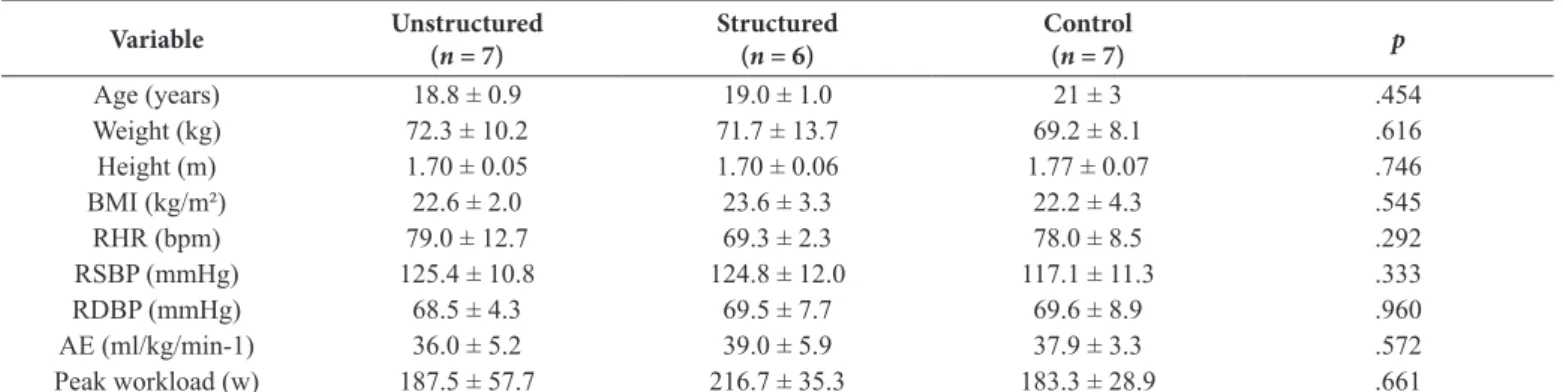
acquired an osteo-mio-articular injury, independent of the study protocol.The demographic and baseline assessments of
the remaining 20 participants can be seen in Table 2. These participants were classiied as having a normal aerobic capac -ity by both the ACSM and the American Heart Association (Garber et al., 2011).
The change in peak workload of the structured and un-structured AVG groups and control group throughout the
intervention period are presented at the Figure 1. Over time,
the control group did not differ from the baseline assessment (p = .700). The unstructured AVG intervention resulted in
a signiicant improvement in peak workload at week four,
relative to baseline (p = .002), but this improvement was no
longer signiicantly different from the baseline assessment
(p > .05) at weeks ive and six. The structured AVG also re
-sulted in a signiicant improvement in peak workload at week 4
(p = .002) but this improvement was maintained at the ifth
and sixth week (p = .005).
Table 2. Sample characterization recruited for the study (n = 20).
Variable Unstructured (n = 7)
Structured (n = 6)
Control
(n = 7) p
Age (years) 18.8 ± 0.9 19.0 ± 1.0 21 ± 3 .454 Weight (kg) 72.3 ± 10.2 71.7 ± 13.7 69.2 ± 8.1 .616 Height (m) 1.70 ± 0.05 1.70 ± 0.06 1.77 ± 0.07 .746 BMI (kg/m²) 22.6 ± 2.0 23.6 ± 3.3 22.2 ± 4.3 .545 RHR (bpm) 79.0 ± 12.7 69.3 ± 2.3 78.0 ± 8.5 .292 RSBP (mmHg) 125.4 ± 10.8 124.8 ± 12.0 117.1 ± 11.3 .333 RDBP (mmHg) 68.5 ± 4.3 69.5 ± 7.7 69.6 ± 8.9 .960
AE (ml/kg/min-1) 36.0 ± 5.2 39.0 ± 5.9 37.9 ± 3.3 .572
Peak workload (w) 187.5 ± 57.7 216.7 ± 35.3 183.3 ± 28.9 .661
BMI – Body Mass Index; BPM – Beats per minute; RHR - Resting Heart Rate; RBP - Resting Systolic Blood Pressure; RDBP – Diastolic Blood Pressure; AE -
Aerobic capacity.
Figure 1. Peak workload of AVG and control group during the measu
-ments. *Signiicant difference relative to baseline measurement (p < .05).
Aerobic capacity was also signiicantly improved, relative to baseline, at the end of the six-week intervention for the AVG groups. More speciically, unstructured AVG improved aerobic capacity from 36.0 ± 5.2ml.kg.min-¹ to 39.7 ± 4.9ml. kg.min-¹ (p = .021), while structured AVG improved aerobic
capacity from 39.0 ± 5.9ml.kg.min-¹ to 47.8 ± 4.3ml.kg.min-¹
(p = .007). There was no change in the aerobic capacity of the
control group (Baseline: 36.9 ± 4.5 ml.kg.min-¹, Post: 38.9 ± 3.7 ml.kg.min-¹; p = .214).
Discussion
The purpose of this investigation was to determine how quickly structured and unstructured AVG could improve peak workload in young adults and which type of AVG would result in greater aerobic capacity improvements. The results of this investigation support our a priori hypothesis that both struc-tured and unstrucstruc-tured AVG would improve peak workload
in less than six weeks as both groups resulted in signiicant
improvements after 4-weeks. However, the decline of peak
workload in the unstructured AVG group during the ifth and sixth week of the intervention suggests that only structured
AVG can improve and maintain an increased peak workload in young healthy but sedentary adults. Our results also support our hypothesis that structured AVG would result in greater aerobic capacity improvements relative to unstructured AVG
structured AVG improved their aerobic classiication from regular (34 – 42 ml/kg/min-1) to good (43 – 52 ml/kg/min-1).
Previous research has shown that peak workload can be
improved in overweight and obese individuals after 10 weeks
of a structured cycling AVG (Adamo et al., 2010). Similarly, the
peak workload of healthy young adults (18-25 years) improved
after only 6 weeks of a structured AVG intervention (Warburton et al., 2007). These results are consistent with those observed in the current investigation and cumulatively suggest that structured AVG played 3 times a week as recommended by the ASCM can
provide health beneits in as early as four weeks across differ -ent populations (Garber et al., 2011). However, it is dificult to determine the effectiveness of unstructured AVG as no other
investigation has quantiied their effect on peak workload after
a scheduled intervention program. Several investigations have demonstrated that unstructured videogames result in an elevated
heart rate (Falcade et al., 2013; Naugle, Naugle, & Wikstrom,
2014; Perrier-melo et al., 2013; Taylor et al., 2012) but no other evidence is available to compare the effects of an unstructured AVG as a formal intervention. Based on the current results alone, it would appear that an unstructured AVG may be an effective early intervention but participants may need to transition into
a more structured exercise regimen to maintain itness gains.
However, this is speculative and further research using a breadth of unstructured AVGs should be conducted to test this hypothesis.
Greater improvements in aerobic capacity were also
ob-served in the structured AVG group (22.67%; Effect size = 1.42, 95%CI: 0.15 to 2.68) relative to the unstructured AVG group (10%; Effect size = 0.53, 95%CI: -0.53 to 1.60) and the control group (Effect size = 0.45, 95%CI: -0.61 to 1.51). The large effect size and conidence interval that do not cross zero clearly indicate that six-weeks of a structured AVG interven
-tion is an effective modality to improve cardiovascular itness in young sedentary but otherwise healthy adults. Further, the
observed improvements are consistent with those in the
liter-ature using more traditional exercise programs. For example, VO2max improvements of 16.7%, 22.5%, and 10% were
observed with sprint interval training, high-intensity interval aerobic training, and continuous aerobic training respectively
in healthy but sedentary adults (26.5 years) after 40 training
sessions over an eight week supervised intervention (Matsuo et al., 2014). Matsuo et al. also noted that young healthy but
sedentary adults (29.2 years) had a 22.4% and 14.7% improve
-ment in VO2max after 24 training sessions over eight weeks (3
days a week) of supervised high-intensity interval training and moderate-intensity continuous aerobic training respectively (Matsuo et al., 2014). Similarly, Sloan et al. illustrated an
~10% improvement in aerobic capacity in young healthy but
sedentary adults (30.4 years) after completing 36-48 training
sessions during a 12 week progressive aerobic exercise inter -vention (Sloan et al., 2009).
However, it should be noted that the current results were observed with a supervised training intervention and may not be as profound if the training intervention was unsupervised.
Evidence has shown that engaging in exercise behavior is inluenced by a number of affective variables including posi
-tive affec-tive responses (Williams, 2014; Schneider, Dunn, &
Cooper, 2009). Previous research has shown that unstructured AVG are more enjoyable than traditional exercise modalities (e.g., treadmill walking) during a single exercise bout (Naugle, Naugle, & Wikstrom, 2014) but no research has quantiied the affective response to structured AVG during a single exercise
bout or over a prolonged training intervention (Graves et al.,
2010). It is unlikely that “screen time” will dramatically reduce
in the near future but the use of AVG may provide opportunities
to reduce sedentary habits and promote cardiovascular itness
as outlined by the ACSM (Haskell et al., 2007). While struc
-tured AVG increased aerobic capacity by 22.67%, relative to the 10% increase in unstructured AVG, these effects will only
be achieved if individuals chose to participate in this activity.
Future research is needed to quantify the affective response to
both structured and unstructured AVG during a training inter-vention which may be different than the response initially felt
during a single bout of exercise. Similarly, research on which
type of AVG or a combination of structured and unstructured AVG results in the greatest adherence rate is also needed.
This investigation is not without limitations. First, we used
a sample of only young adult males. Research has shown that
men and women have different exercise motivations, attitudes towards video gaming (Graf, Pratt, Hester, & Short, 2009) and also cognitive functions (Teixeira-Arroyo et al., 2014). These
differences may result in different exercise intensities during
game play and subsequently different changes in peak workload and aerobic capacity. In addition, the current investigation only used a single structured and unstructured AVG. Previous research has shown that not all games produce the same cardiovascular
response (Miyachi, Yamamoto, Ohkawara, & Tanaka, 2010) or
have the same affective response (Naugle et al., 2014). Future research is needed to test the effectiveness of a broad range of structured and unstructured AVG as well different combinations
of games to optimize the health beneits observed from AVG.
Conclusion
This data suggest the structured AVG can provide health
beneits as measured by aerobic capacity and peak workload in as little as four weeks. Further, the data indicate that structured AVG result in signiicantly greater improvements in aerobic capacity after six weeks when compared to unstructured AVG
in young sedentary but otherwise healthy adults. Consequently, results indicate that incorporation of structured active videog-ames into routine training may be a viable option for enhancing physical activity. This would suggest that structured AVG within a virtual environment may be a practical solution to improving
physical itness for sedentary young adults because of their
integration in screen time devices but further research is needed
to conirm this hypothesis.
References
Adamo, K.B., Rutherford, J.A, & Goldield, G.S. (2010). Effects of
health. Applied Physiology, Nutrition, and Metabolism, 35,
805-815. doi:10.1139/H10-078
Altenburg, T.M., Hofsteenge, G.H., Weijs, P.J.M., Delemarre-van de
Waal, H.A, & Chinapaw, M.J.M. (2012). Self-reported screen time
and cardiometabolic risk in obese Dutch adolescents. PloS One, 7,
e53333. doi:10.1371/journal.pone.0053333
Astrand, P.O., & Ryhming, I. (1954). A Nomogram for Calculation of Aerobic Capacity (Physical Fitness) From Pulse Rate During
Submaximal Work. Journal of Applied Physiology, 7, 218-221.
Bailey, B.W., & McInnis, K. (2011). Energy cost of exergaming: a comparison of the energy cost of 6 forms of exergaming. Archives of Pediatrics & Adolescent Medicine, 165, 597-602. doi:10.1001/
archpediatrics.2011.15
Christie, B., & Trout, J. (2007). Rather than contribute to a sedentary
lifestyle, these games demand activity from the players. Interactive Video Games in Physical Education, 78, 29-45.
Falcade, A., Baroncini, L., & Hanna, E. (2013). Análise do consumo de oxigênio, da frequência cardíaca e equivalentes metabólicos
através de um videogame ativo. Inspirar, 5, 20-24. Retrieved from
http://www.inspirar.com.br/revista/wp-content/uploads/2014/01/
artigo370.pdf
Finco, M.D. (2010). Wii it: um estilo de vida saudável.
Garber, C.E., Blissmer, B., Deschenes, M.R., Franklin, B.A, Lamonte, M.J., Lee, I.-M., Swain, D.P. (2011). American College of Sports Medicine position stand. Quantity and quality of exercise for
developing and maintaining cardiorespiratory, musculoskeletal,
and neuromotor itness in apparently healthy adults: guidance for prescribing exercise. Medicine and Science in Sports and Exercise,
43, 1334-1359. doi:10.1249/MSS.0b013e318213fefb
Graf, D.L., Pratt, L.V, Hester, C.N., & Short, K.R. (2009). Playing active video games increases energy expenditure in children.
Pediatrics, 124, 534-540. doi:10.1542/peds.2008-2851
Graves, L.E.F., Ridgers, N.D., Williams, K., Stratton, G., Atkinson, G., & Cable, N.T. (2010). The physiological cost and enjoyment of Wii Fit in adolescents, young adults, and older adults. Journal of Physical Activity & Health, 7, 393-401. Retrieved from http://
www.ncbi.nlm.nih.gov/pubmed/20551497
Haskell, W.L., Lee, I.-M., Pate, R.R., Powell, K.E., Blair, S.N., Franklin, B.A, Bauman, A. (2007). Physical activity and public health: up -dated recommendation for adults from the American College of Sports Medicine and the American Heart Association. Circulation,
116, 1081-1093. doi:10.1161/CIRCULATIONAHA.107.185649
Kraft, J.A.K., Russell, W.D.R., Bowman, T.A.B., SelsorIII, C.W., &
Foster, G.D. (2011). Heart Rate and perceived Exertion during self selected intensities for exergaming compared to tradicional exercise
in college age participants. Journal of Strength and Conditioning Research, 1736-1742.
Lanningham-foster, L., Foster, R.C., Mccrady, S.K., Jensen, T.B., Mitre, N., & Levine, J.A. (2010). Activity promoting games and increased energy expenditure. Journal of Pediatrics, 154, 819-823.
doi:10.1016/j.jpeds.2009.01.009.Activity
Matsuo, T., Saotome, K., Seino, S., Eto, M., Shimojo, N., Matsushita,
A., Mukai, C. (2014). Low-volume, high-intensity, aerobic interval
exercise for sedentary adults: VO2max, cardiac mass, and heart
rate recovery. European Journal of Applied Physiology, 114,
1963-1972. doi:10.1007/s00421-014-2917-7
Matsuo, T., Saotome, K., Seino, S., Shimojo, N., Matsushita, A.,
Iemitsu, M., Mukai, C. (2014). Effects of a low-volume aero
-bic-type interval exercise on VO2max and cardiac mass. Medicine
and Science in Sports and Exercise, 46, 42-50. doi:10.1249/
MSS.0b013e3182a38da8
Miyachi, M., Yamamoto, K., Ohkawara, K., & Tanaka, S. (2010).
METs in adults while playing active video games: a metabolic chamber study. Medicine and Science in Sports and Exercise, 42,
1149-1153. doi:10.1249/MSS.0b013e3181c51c78
Naugle, K.E.E., Naugle, K.E.M., & Wikstrom, E.A. (2014).
Cardiovascular and affective outcomes of active gaming: Using the nintendo Wii as a cardiovascular training tool. Journal of Strength and Conditioning Research, 28, 443-451.
Nobre, F. (2010). VI Diretrizes Brasileiras de Hipertensão. Arquivos Brasileiros de Cardiologia, 95, 1-51.
Perrier-melo, R.J., Brito-gomes, J.L., Fernandes, S., Oliveira, M., & Costa, C. (2013). analisar as respostas da frequência cardíaca e da
pressão arterial durante e após uma sessão de vídeo games ativos (VGA’s). Revista Terapia Ocupacional Da Universidade de São Paulo, 24, 259-266. doi:10.11606/issn.2238-6149.v24i3p259-66
Schneider, M., Dunn, A.L., & Cooper, D. (2009). Affective, exercise
and physical activity among healthy adolescents. Journal of Sports Exercises and Psycology, 31, 706-723.
Sloan, R.P., Shapiro, P.A, DeMeersman, R.E., Bagiella, E., Brondolo,
E.N., McKinley, P.S., & Myers, M.M. (2009). The effect of aer -obic training and cardiac autonomic regulation in young adults.
American Journal of Public Health, 99, 921-928. doi:10.2105/
AJPH.2007.133165
Stewart, A., Marfell-Jones, M., Olds, T., & Ridder, de H. (2012).
International Society for the Advancement of Kinantropometry. International Standards for Anthropometric Assessment. Australia.
Taylor, L.M., Maddison, R., Pfaefli, L.A, Rawstorn, J.C., Gant, N., & Kerse, N.M. (2012). Activity and energy expenditure in older peo -ple playing active video games. Archives of Physical Medicine and Rehabilitation, 93, 2281–2286. doi:10.1016/j.apmr.2012.03.034
Teixeira-arroyo, C., Rinaldi, N.M., Batistela, R.A., Barbieri, F.A., Vitório, R., & Gobbi, L.T.B. (2014). Exercise and cognitive
functions in Parkinson’s disease : Gender differences and disease severity. Motriz, 20, 461–469.
Warburton, D.E.R., Bredin, S.S.D., Horita, L.T.L., Zbogar, D., Scott,
J.M., Esch, B.T.A, & Rhodes, R.E. (2007). The health beneits of interactive video game exercise. Applied Physiology, Nutrition, and Metabolism = Physiologie Appliquée, Nutrition et Métabolisme,
32, 655-663. doi:10.1139/H07-038
WHO, World Health Organization (2000). Obesity: Preventing and
managing the global epidemic.
Authors’ note
Jorge Luiz de Brito-Gomes is a PhD student of the graduate program in physical education at the Pernambuco State University (UPE), Re-cife (PE), Brazil.
Raphael José Perrier-Melo is afiliated with Laboratory of Evaluation
in Human Performance, Pernambuco State University (UPE), Recife (PE), Brazil.
Erik Anders Wikstrom, Ph.D., is afiliated with the University of
North Carolina Charlotte, Charlotte, North Carolina.
Manoel da Cunha Costa, Ph.D., is afiliated with the graduate pro
-gram in physical education, Pernambuco State University (UPE), Recife (PE), Brazil.
Corresponding author
Jorge Luiz de Brito Gomes
Rua Arnóbio de Marques, 310, Bairro Santo Amaro; Recife, Pernam
-buco 50100-130, Brazil. Phone: 55-31833378
E-mail: [email protected]
Additional information
This study is part of a master’s thesis.
Manuscript received on January 21, 2015 Manuscript accepted on August 13, 2015
Motriz. The Journal of Physical Education. UNESP. Rio Claro, SP, Brazil