Combined Effect of
TLR2
Gene
Polymorphism and Early Life Stress on the
Age at Onset of Bipolar Disorders
José Oliveira1,6, Bruno Etain2,4,5,6, Mohamed Lajnef2,4,6, Nora Hamdani2,4,5,6,
Meriem Bennabi1,6, Djaouida Bengoufa1,3, Aparna Sundaresh1,6, Arij Ben Chaabane1,6,
Frank Bellivier2,4,5,6, Chantal Henry2,4,5,6, Jean-Pierre Kahn7,6, Dominique Charron1,3,6,8, Rajagopal Krishnamoorthy1,6, Marion Leboyer2,4,5,6‡, Ryad Tamouza1,3,6,8‡
*
1INSERM, U1160, Hôpital Saint Louis, Paris, France,2INSERM, U955, Psychiatrie Génétique, Créteil, France,3Laboratoire Jean Dausset and LabEx Transplantex, Hôpital Saint Louis, Paris, France,4 Université Paris-Est, Faculté de Médecine, Créteil, France,5AP-HP, Pôle de Psychiatrie, DHU PePSY, Hôpitaux Universitaires Henri Mondor, Créteil, France,6Fondation FondaMental, Créteil, France,7Service de Psychiatrie et Psychologie Clinique, CHU de Nancy, Hôpitaux de Brabois, Vandoeuvre Les Nancy, France,8Université Paris Diderot, Sorbonne Paris-Cité, Paris, France
‡RT and ML are co-senior authors on this work. *[email protected]
Abstract
Gene-environment interactions may play an important role in modulating the impact of early-life stressful events on the clinical course of bipolar disorder (BD), particularly associated to early age at onset. Immune dysfunction is thought to be an important mechanism linking childhood trauma with early-onset BD, thus the genetic diversity of immune-related loci may account for an important part of the interindividual susceptibility to this severe subform. Here we investigated the potential interaction between genetic variants of Toll-like receptors 2 (TLR2) and 4 (TLR4), major innate immune response molecules to pathogens, and the child-hood trauma questionnaire (CTQ) in age at onset of BD. We recruited 531 BD patients (type I and II or not otherwise specified), genotyped for theTLR2 rs4696480 andrs3804099 and
TLR4 rs1927914 andrs11536891 single-nucleotide polymorphisms and recorded for history of childhood trauma using the CTQ.TLR2andTLR4risk genotype carrier state and history of childhood emotional, physical and sexual abuses were evaluated in relation to age at onset as defined by the age at first manic or depressive episode. We observed a combined effect of
TLR2 rs3804099 TT genotype and reported sexual abuse on determining an earlier age at onset of BD by means of a Kaplan-Meier survival curve (p =0.002; correctedp= 0.02). Re-gression analysis, however, was non-significant for theTLR2-CTQ sexual abuse interaction term. The negative effects of childhood sexual abuse on age at onset of BD may be amplified inTLR2 rs3804099 risk genotype carriers through immune-mediated pathways. Clinical char-acteristics of illness severity, immune phenotypes and history of early life infectious insults should be included in future studies involving large patient cohorts.
OPEN ACCESS
Citation:Oliveira J, Etain B, Lajnef M, Hamdani N, Bennabi M, Bengoufa D, et al. (2015) Combined Effect ofTLR2Gene Polymorphism and Early Life Stress on the Age at Onset of Bipolar Disorders. PLoS ONE 10(3): e0119702. doi:10.1371/journal. pone.0119702
Academic Editor:Eliseo A Eugenin, Rutgers University, UNITED STATES
Received:September 20, 2014
Accepted:January 15, 2015
Published:March 19, 2015
Copyright:© 2015 Oliveira et al. This is an open access article distributed under the terms of the
Creative Commons Attribution License, which permits unrestricted use, distribution, and reproduction in any medium, provided the original author and source are credited.
Data Availability Statement:All relevant data are within the paper.
Funding:The authors have no support or funding to report.
Introduction
Classically viewed as a cyclical disease, bipolar disorder (BD) is now seen as a multi-systemic, progressive chronic illness whose clinical manifestations can be underpinned by biological and environmental factors interacting in a complex manner [1,2]. This severe disorder is associated with a significant burden of psychiatric and other medical comorbidities as well as premature mortality and is the fourth cause of disease incapacity worldwide [3,4]. In addition, BD is a highly heterogeneous disorder for which identification of underlying mechanisms as well as definition of personalized therapeutic interventions is still elusive. Efforts to define homoge-nous subgroups have in particular enabled the identification of early-onset BD as being more familial as well as clinically and biologically more homogenous than late-onset subforms [5,6]. Admixture analyses performed in different population groups have consistently identified early-onset BD as a distinct subset associated with worse clinical outcome; severe symptoms, resistance to treatment, higher rate of suicide attempts and of comorbidities, thus suggesting that early age at onset (AAO) is a proxy for severity of BD [5,7]. In terms of mechanisms, it is noteworthy that early-life psychosocial stressors, notably emotional and sexual abuses are asso-ciated to early AAO [8,9]. Such stressful events are also known to induce acute and chronic immune/inflammatory alterations [10–13] possibly leading to an increased vulnerability to di-abetes, obesity, cardiovascular disorders, autoimmunity, cancer and neurodegeneration com-monly observed in adults with history of childhood maltreatment [14–18]. Of interest is that elevated C-reactive-protein (CRP), as well as high prevalence of cardiovascular disorders, type 2 diabetes mellitus, hypertension and obesity, are observed in early onset BD [19,20] and that some of these conditions even precede the diagnosis of BD in pediatric patients [20]. These epi-demiological observations may reflect the immune/inflammatory dysfunctions possibly partic-ularly important in early-onset BD. This could be exemplified by the pro-inflammatory gene expression signature observed in monocytes of 85% of adolescent offspring of BD patients who later developed a mood disorder as compared to the only 19% observed among adolescent healthy controls [21]. One of the proposed mechanisms is that acute stressor-mediated events may induce chronic alterations in immune/inflammatory processes in genetically predisposed individuals [12,13]. Exploring the control of innate immune responses in BD, we recently de-scribed associations between genetic variants of Toll-like receptor 2 (TLR2) andTLR4loci and early-onset BD [22,23].
install a fragile neuro-immunological homeostasis that is potentially overwhelmed by subsequent traumatic life experiences [33–35].
Based on these observations, we hypothesized that the genetic potential of innate immune/ inflammatory responses may variably modulate the impact of psychosocial stressors on the clinical expression of BD, assessed here by AAO used as a proxy of severity. In this cross-sec-tional study, we investigated potential interactions on AAO of BD between funccross-sec-tionally-rele- functionally-rele-vantTLR2/TLR4genetic variations and reported childhood trauma, both previously showed to be independently associated with early-onset BD.
Materials and Methods
Subjects
BD patients (n= 531) meeting DSM-IV criteria [36] for BD (type I or II and NOS), admitted to three French university-affiliated psychiatric departments (Paris-Créteil, Bordeaux and Nancy), were interviewed by trained psychiatrists with the French version of the Diagnostic In-terview for Genetic Studies (DIGS version 3.0) [37]. All patients were of French descent with at least three grandparents from the mainland of France and were consecutively recruited be-tween February 2006 and January 2010. All patients were euthymic at inclusion defined by hav-ing a Montgomery-Åsberg Depression Rathav-ing Scale score [38] and a Mania Rathav-ing Scale score [39] no more than five. The AAO was defined by the age at which the first mood episode (de-pressive, manic or hypomanic) occurred and determined by reviewing the medical case notes and retrospective information obtained with the DIGS. The cohort was further divided in two subgroups namely early-onset and late-onset, using the AAO of 22 years as the threshold, de-termined on the basis of previous admixture analyses of independent sample sets [5]. Written informed consent was obtained from all participating subjects and the institutional ethical committee approved the research protocol. These patients were sampled from one large ongo-ing study that explored genetic and environmental risk factors of BD. Data regardongo-ing the asso-ciation betweenTLR2/TLR4genetic variations and BD have been previously published [22,23] and this was the same for the data regarding the association between AAO and childhood trau-ma [8]. To be included in this analysis, all cases had to have both a retrospective assessment of the AAO of BD, defined by the age of the first manic or depressive episode, as well as available genotypes forTLR2orTLR4genetic variations.
Childhood trauma assessment
History of childhood trauma was obtained using the French version of the Childhood Trauma Questionnaire (CTQ) [40] and was available for 62% of the included patients. The CTQ is a retrospective self-report instrument that examines the traumatic childhood experiences of adults and adolescents. It consists of 28-items, each one rated from 1 (never) to 5 (very often), that measure five types of childhood trauma: emotional abuse, emotional neglect, physical abuse, physical neglect and sexual abuse. A total score from 5 to 25 for each type of abuse is de-termined allowing the classification in four levels of maltreatment (absence, low, moderate and severe) based on cut-off scores determined for each type of trauma [41]. The CTQ has shown excellent test-retest reliability and convergent validity and the different cut-offs have been shown to have good specificity and sensitivity [41,42].
TLR2
and
TLR4
genetic polymorphism studies
Four functionally-relevantTLR2andTLR4single-nucleotide polymorphisms (SNPs) (rs4696480,
association studies of BD [22,23]. Genomic DNA was extracted from EDTA-treated peripheral blood samples or B-lymphoblastoid cell lines using the Nucleon BACC3 kit (GE HealthCare, Chal-font St Giles, UK). The four SNPs (TLR2intron 1rs4696480 A/T,TLR2exon 3rs3804099 C/T and
TLR4promoterrs1927914 A/G and 3’UTRrs11536891 C/T) were analyzed using pre-developed TaqMan 5’-nuclease assay kits (Applied Biosystems, Foster City, CA, USA) with allele-specific fluorogenic oligonucleotide probes (C__27994607_10, C__22274563_10, C__2704048_10 and C__31784036_10, respectively), as previously reported.
Statistical analysis
Gaussian distribution of AAO was tested using the Shapiro-Wilk’s (W = 0.896,p<0.001).
Non-parametric analyses were carried out, using classical Mann-WhitneyUtest to explore as-sociations betweenTLR2andTLR4genetic variants and AAO as a continuous variable, for the purposes of the present study.
Association between AAO and CTQ (physical abuse, emotional abuse and sexual abuse sub-scores) was tested with the Kruskal-Wallis’one-way analysis of variance using each CTQ sub-score as a discrete variable categorized into absent, low, moderate and severe abuse. A lo-gistic regression analysis was performed to statistically test for the gene-environment interac-tion i.e. between risk genotype ofTLR2 rs3804099 and the sexual abuse sub-score of the CTQ on the pattern of AAO of BD (dichotomized into early- and late-onset as described above). Fi-nally, a Kaplan-Meier survival curve was used to analyze the combined effect of two risk vari-ables namelyTLR2 rs3804099 and CTQ sexual abuse sub-score, on AAO. The statistical power was estimated using the Freedman method for two-sample comparison of survival functions Log-rank test. The estimated power was of 80.7%, 80.5% and 82.3% respectively for the com-parison of individuals having the two risk factors (TLR2 rs3804099 TT genotype and reported childhood sexual abuse) with the other groups i.e. (i) risk genotype with absence of childhood sexual abuse, (ii) non-risk genotype with reported childhood sexual abuse and (iii) absence of both risk factors. Results were corrected for multiple comparisons by means of the Bonferroni correction using ap-value of 0.005 as a marker of significance. All analyses were performed using Stata 12 and SPSS statistics 20.
Results
Both demographic and clinical characteristics of the study subjects are described inTable 1. 47.5% of BD patients (n= 252) had an early AAO (before the age of 22) while 52.5% (n= 279)
a late AAO. A significant proportion of the patients that completed the CTQ report have suf-fered from one or other form of childhood abuse (physical, emotional or sexual) of at least low severity (61.7%). Among them, 17.9% reported physical abuse, 48.9% emotional abuse and 30.6% sexual abuse.
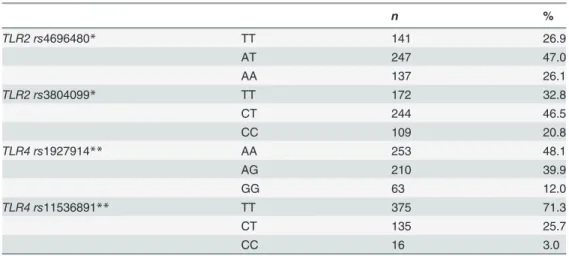
Genotype and allele frequencies of the studiedTLR2andTLR4genetic variants (Table 2) were in Hardy-Weinberg equilibrium and comparable to those reported in public database for Caucasians (http://www.ncbi.nlm.nih.gov).
Effects of
TLR2
and
TLR4
genetic polymorphism and CTQ abuse scores
on age at onset of bipolar disorder
We found that theTLR2 rs3804099 TT genotype was marginally associated with an earlier AAO [p= 0.01; correctedp(pc) = 0.1] with mean AAO of 23.5±9.56 years for patients bearing the TT genotype and 25.5±9.93 years for those carrying the others (CT and CC). No associa-tion was noted for the other analyzed polymorphisms (TLR2 rs4696480,TLR4 rs1927914 and
Furthermore, we found an association between severity of sexual abuse (patients classified into absent, low, moderate and severe trauma scale categories) and AAO of BD (p= 0.002;pc= 0.02). The mean AAO for patients reporting absent, low, moderate and severe sexual abuse was respectively 25.5±10.45, 25.3±8.78, 19.8±6.52 and 21.5±6.73. No such association with AAO was noted for both physical and emotional abuse.
Effect of genotype-environment interaction: effect of
TLR2 rs3804099 /
CTQ sexual abuse score on age at onset of BD
Schematic representation ofTLR2 rs3804099 TT genotype distribution pattern and sexual abuse sub-score as a function of AAO is shown inFig. 1. No relationship betweenTLR2 rs3804099 polymorphism and childhood sexual abuse on AAO of BD was observed in the lo-gistic regression analysis. Introducing gender as a covariate in the model did not modify the ob-served results (data not shown) (see below indiscussionsection). However, using AAO of BD as a“time to event”variable in a Kaplan-Meier survival curve, we found that the presence of
Table 1. Clinical and demographic characteristics of the 531 bipolar disorder patients.
Mean (range) SD
Age at inclusion 42.4 (14–80) 13.1
Age at onset 24.8 (6–67) 9.8
n %
Sex 531
Male 220 41.4
Female 311 58.6
Diagnosis 531
BD I 391 73.6
BD II 113 21.3
BD NOS 27 5.1
Age at onset 531
Early-onset (<22 years) 252 47.5
Late-onset (22 years) 279 52.5
Physical abuse* 329
Absent (5–7) 270 82.1
Low (8–9) 28 8.5
Moderate (10–12) 14 4.3
Severe (13–25) 17 5.2
Emotional abuse* 329
Absent (5–8) 168 51.1
Low (9–12) 74 22.5
Moderate (13–15) 37 11.2
Severe (16–25) 50 15.2
Sexual abuse* 327**
Absent (5) 227 69.4
Low (6–7) 40 12.2
Moderate (8–12) 33 10.1
Severe (13–25) 27 8.3
*Data not available for the entire cohort (data available for 62% of patients).
**Childhood trauma questionnaire sexual abuse sub-score is missing for two patients.
bothTLR2 rs3804099 TT risk genotype and low to severe sexual trauma had a cumulative effect on AAO of BD (p= 0.002;pc= 0.02) (Fig. 2). For example, at the age of 20 years, 59% of those with both risk factors were already clinically affected as compared to the 37% of those without any risk factor. Co-occurrence of theTLR2 rs3804099 TT genotype (previously associated with early AAO) and reported low to severe sexual abuse had a statistically significant effect on de-termining early disorder-onset age when compared with any of the three other combinations.
Discussion
It is well established that childhood traumatic experiences are associated with increased severi-ty of BD, namely with an earlier age at onset (AAO), but possible interaction between environ-mental factors such as stress and genetic background is unknown [8]. Knowing that stress is a major inducer of inflammatory responses [11], we explored here the interaction between im-munogenetic variations and presence of early and severe stress in a sample of BD patients. We observed a combined effect of both a genetic variant ofTLR2, a major trigger of peripheral and central inflammatory responses, and reported childhood sexual abuse on the AAO, a proxy of increased severity of psychiatric and somatic manifestations in BD [7]. Thus, we propose that
TLR2 rs3804099 TT genotype carriers may be more susceptible to inflammation-mediated damage induced by early stress with consequent earlier AAO of BD.
Early-life trauma is associated with permanent alterations of the immune system, namely development of chronic mild inflammation (CRP) [13] and stronger inflammatory responses (IL-6) subsequently to stress exposures [10]. Inflammation has also been suggested to be in-volved in the mechanisms underlying the comorbidity between metabolic syndrome and psy-chiatric disorders and causing premature mortality in individuals with a history of childhood adversity [11,43,44]. Childhood inflammation (IL-6) has been recently demonstrated to even precede the diagnosis of depression and psychosis in a prospectively followed general popula-tion cohort [45]. The genetic diversity of immune-related genes could thus be implicated in the inter-individual vulnerability to such stressors.
Table 2. Genotype frequencies of the studiedTLR2andTLR4polymorphisms for the 531 bipolar disorder patients.
n %
TLR2 rs4696480* TT 141 26.9
AT 247 47.0
AA 137 26.1
TLR2 rs3804099* TT 172 32.8
CT 244 46.5
CC 109 20.8
TLR4 rs1927914** AA 253 48.1
AG 210 39.9
GG 63 12.0
TLR4 rs11536891** TT 375 71.3
CT 135 25.7
CC 16 3.0
TLR: Toll-like receptor
*Genotyping missing for six individuals. **Genotyping missing forfive individuals.
So far, genes linked to biological stress response systemsviz. the hypothalamic-pituitary-ad-renal axis (FKBP5), the monoaminergic system (SLC6A4,COMT) and the neurotrophic sup-port of the CNS (BDNF), provided logical candidate genes to test for gene-environment interactions in several studies and confirmed the suspected genetic vulnerability and epigenetic changes to stressful/traumatic life events in psychiatric settings [46–53]. However, these mole-cules are not in direct relationship with the potential environmental risk factors as it is the case with TLR2, a sensor of BD-associated neurotropic pathogens [54–56]. This is of importance as prenatal immune priming through the TLR-mediated pathway and peripubertal stress expo-sure synergistically induced behavioral changes, unbalanced neurotransmitter levels and en-hanced the expression of markers of inflammation and of microglia activation in stress sensitive brain areas of mice [35]. TLR2 molecules are pivotal both in homeostasis and in im-mune surveillance of the CNS [57]. Indeed, neuroinflammation can be elicited through the TLR2-mediated pathway either by endogenous molecules such asα-synuclein and amyloidβ
-Fig 1. Representation of age at onset of bipolar disorder according toTLR2genotype and reported childhood sexual abuse.Mean±standard deviation of bipolar disorder age at onset is represented according to Toll-like receptor 2 (TLR2)rs3804099 risk genotype carrier state and reported sexual abuse as defined by the Childhood Trauma Questionnaire (CTQSSA).
peptide in Parkinson and Alzheimer disorders respectively [58,59] or by infectious insult as pre-viously demonstrated for herpes simplex virus type 1 [60]. Moreover, associations between the
TLR2genetic diversity and Alzheimer’s disease [61] or cognitive function in schizophrenia [62] are highly suggestive of genetically-driven inter-individual ability to modulate neuroinflamma-tory processes. Of importance is that theTLR2 rs3804099 polymorphism was showed on the one hand to be associated with several inflammatory and infectious diseases including pulmonary tu-berculosis, neonatal infection, filariasis, ocular Behcet’s disease and cancer [63–67] and to exert a functional impact on the inflammatory response on the other [65,68,69].
It is plausible to hypothesize thatTLR2 rs3804099 TT genotype carriers may be more sus-ceptible to certain infectious insults and/or more prone to inflammation-mediated damage in presence of stress. TLR2, but not TLR4, has also been implicated in the perpetuation of inflam-matory responses in the CNS after pro-inflaminflam-matory stimulation of astrocytes [70] and in-volved in hippocampal neurogenesis as mice lackingTLR2displayed impaired hippocampal and neuronal differentiation, which was not observed forTLR4[71]. These observations could be related to theTLR2specificity of our findings especially as hippocampal alterations have
Fig 2. Kaplan-Meier survival curve of age at onset of bipolar disorder.Patients were stratified in four groups according toTLR2(Toll-like receptor 2)
rs3804099 TT risk genotype carrier state and reported childhood sexual abuse as defined by the Childhood Trauma Questionnaire (CTQSSA) and age at onset defined as a time-to-event variable in a Kaplan-Meier survival curve (p= 0.002; correctedp= 0.02).
been repeatedly reported in adults with a history of childhood traumatic experiences and are suggested to be involved in the pathophysiology of BD [72–74].
Our regression analysis yielded a non-significantTLR2-CTQ interaction term, likely indi-cating that our results, while suggestive, are not robustly indicative of gene-environment inter-action. Many genes with small effects are involved in the etiology of BD interacting with numerous environmental stressors. This may be one of the reasons for not detecting signifi-cance in regression analysis, leaving aside the limited sample size. However, a combined effect is observed in determining an earlier AAO in our patients when performing a Kaplan-Meyer survival curve. Since gender is a critical issue in BD as well as in the susceptibility to trauma, fu-tures studies involving much more larger patient cohorts are warranted to address the issue. In-deed, we failed to observe any difference after sex-based stratification, possibly due to the sample size.
TLR2genetic susceptibility probably contributes to the neuro-immunological responses to pre- and perinatal infections establishing a lower threshold for subsequent stress-triggered pathological responses leading to a more severe clinical presentation. Such severity should be investigated in future studies including outcomes such as global functioning, cognition, suicid-ality, number and duration of mood episodes and development of comorbid conditions such as metabolic syndrome or autoimmune thyroiditis. Given the present findings, it would also be of interest to investigate the susceptibility conferred by thisTLR2polymorphism to BD-associat-ed pathogens likeToxoplasma gondiiand the relationship between perinatal infections and childhood traumatic events on immune and clinical phenotypes of BD. Associations with in-fectious stigma, as well as markers of inflammation and stress components (e.g. cortisol) could not be explored as they were not available in our cohort. We deliberately chose to study euthy-mic patients to minimize the potential recall bias of traumatic childhood experiences associated with mood state. Moreover, the patients included in this study are from the mainland of France and of French descent with equal access to medical care (French social security system). Thus we cannot extrapolate these observations to BD in other populations socio-culturally and genetically distinct.
We propose that both risk factors, genetic polymorphism ofTLR2and sexual abuse, inde-pendently found in earlier studies to be associated with earlier AAO, act cumulatively in im-mune-related pathways contributing to increase the“allostatic load”in BD. Further studies are warranted to sustain this model which may open the way to novel therapeutic targets and to personalized medicine based on one’s genetic background and history of exposure to environ-mental risk factors.
Acknowledgments
We thank patients with bipolar disorder and controls who agreed to participate in this study. We thank the Cochin Hospital cell repository, the Clinical Centre of Investigations, the Biologi-cal Resources Centre) of Mondor Hospital, and the blood bank Centre of EFS Créteil (for tech-nical assistance. We thank the FondaMental Foundation.
J. Oliveira acknowledges the financial support of the Foundation for Science and Technolo-gy (Portugal) doctoral degree grant (SFRH/BD/76170/2011).
Author Contributions
References
1. Leboyer M, Kupfer DJ. Bipolar disorder: new perspectives in health care and prevention. J Clin Psychi-atry. 2010; 71: 1689–1695. doi:10.4088/JCP.10m06347yelPMID:21190640
2. Lichtenstein P, Yip BH, Björk C, Pawitan Y, Cannon TD, Sullivan PF, et al. Common genetic determi-nants of schizophrenia and bipolar disorder in Swedish families: a population-based study. Lancet. 2009; 373: 234–239. doi:10.1016/S0140-6736(09)60072-6PMID:19150704
3. Collins PY, Patel V, Joestl SS, March D, Insel TR, Daar AS, et al. Grand challenges in global mental health. Nature. 2011; 475: 27–30. doi:10.1038/475027aPMID:21734685
4. Gore FM, Bloem PJ, Patton GC, Ferguson J, Joseph V, Coffey C, et al. Global burden of disease in young people aged 10–24 years: a systematic analysis. Lancet. 2011; 377: 2093–2102. doi:10.1016/ S0140-6736(11)60512-6PMID:21652063
5. Geoffroy PA, Etain B, Scott J, Henry C, Jamain S, Leboyer M, et al. Reconsideration of bipolar disorder as a developmental disorder: Importance of the time of onset. J Physiol Paris. 2013; 107: 278–285. doi:
10.1016/j.jphysparis.2013.03.006PMID:23542544
6. Leboyer M, Henry C, PailleMartinot ML, Bellivier F. Age at onset in bipolar affective disorders: a re-view. Bipolar Disord. 2005; 7: 111–118. PMID:15762851
7. Etain B, Lajnef M, Bellivier F, Mathieu F, Raust A, Cochet B, et al. Clinical expression of bipolar disorder type I as a function of age and polarity at onset: convergent findings in samples from France and the United States. J Clin Psychiatry. 2012; 73: e561–566. doi:10.4088/JCP.10m06504PMID:22579163
8. Etain B, Aas M, Andreassen OA, Lorentzen S, Dieset I, Gard S, et al. Childhood trauma is associated with severe clinical characteristics of bipolar disorders. J Clin Psychiatry. 2013; 74: 991–998. doi:10. 4088/JCP.13m08353PMID:24229750
9. Etain B, Henry C, Bellivier F, Mathieu F, Leboyer M. Beyond genetics: childhood affective trauma in bi-polar disorder. Bibi-polar Disord. 2008; 10: 867–876. doi:10.1111/j.1399-5618.2008.00635.xPMID:
19594502
10. Carpenter LL, Gawuga CE, Tyrka AR, Lee JK, Anderson GM, Price LH. Association between plasma IL-6 response to acute stress and early-life adversity in healthy adults. Neuropsychopharmacol. 2010; 35: 2617–2623.
11. Coelho R, Viola TW, Walss-Bass C, Brietzke E, Grassi-Oliveira R. Childhood maltreatment and inflam-matory markers: a systematic review. Acta Psychiatr Scand. 2014; 129: 180–192. doi:10.1111/acps. 12217PMID:24205846
12. Copeland WE, Wolke D, Lereya ST, Shanahan L, Worthman C, Costello EJ. Childhood bullying in-volvement predicts low-grade systemic inflammation into adulthood. Proc Natl Acad Sci U S A. 2014; 111: 7570–7575. doi:10.1073/pnas.1323641111PMID:24821813
13. Danese A, Pariante CM, Caspi A, Taylor A, Poulton R. Childhood maltreatment predicts adult inflamma-tion in a life-course study. Proc Natl Acad Sci U S A. 2007; 104: 1319–1324. PMID:17229839
14. Kelly-Irving M, Lepage B, Dedieu D, Lacey R, Cable N, Bartley M, et al. Childhood adversity as a risk for cancer: findings from the 1958 British birth cohort study. BMC Public Health. 2013; 13: 767. doi:10. 1186/1471-2458-13-767PMID:23957659
15. Miller GE, Chen E, Parker KJ. Psychological stress in childhood and susceptibility to the chronic dis-eases of aging: moving toward a model of behavioral and biological mechanisms. Psychol Bull. 2011; 137: 959–997. doi:10.1037/a0024768PMID:21787044
16. Rich-Edwards JW, Spiegelman D, Lividoti Hibert EN, Jun HJ, Todd TJ, Kawachi I, et al. Abuse in child-hood and adolescence as a predictor of type 2 diabetes in adult women. Am J Prev Med. 2010; 39: 529–536. doi:10.1016/j.amepre.2010.09.007PMID:21084073
17. Shonkoff JP, Garner AS, Committee on Psychosocial Aspects of Child and Family Health, Committee on Early Childhood, Adoption, and Dependent Care, Section on Developmental and Behavioral Pediat-rics. The lifelong effects of early childhood adversity and toxic stress. PediatPediat-rics. 2012; 129: e232–246. doi:10.1542/peds.2011-2663PMID:22201156
18. Slopen N, Koenen KC, Kubzansky LD. Childhood adversity and immune and inflammatory biomarkers associated with cardiovascular risk in youth: a systematic review. Brain Behav Immun. 2012; 26: 239– 250. doi:10.1016/j.bbi.2011.11.003PMID:22138616
19. Goldstein BI, Collinger KA, Lotrich F, Marsland AL, Gill MK, Axelson DA, et al. Preliminary findings re-garding proinflammatory markers and brain-derived neurotrophic factor among adolescents with bipo-lar spectrum disorders. J Child Adolesc Psychopharmacol. 2011; 21: 479–484. doi:10.1089/cap.2011. 0009PMID:22040193
21. Padmos RC, Hillegers MH, Knijff EM, Vonk R, Bouvy A, Staal FJT, et al. A discriminating messenger RNA signature for bipolar disorder formed by an aberrant expression of inflammatory genes in mono-cytes. Arch Gen Psychiatry. 2008; 65: 395–407. doi:10.1001/archpsyc.65.4.395PMID:18391128
22. Oliveira J, Busson M, Etain B, Jamain S, Hamdani N, Boukouaci W, et al. Polymorphism of Toll-like re-ceptor 4 gene in bipolar disorder. J Affect Disord. 2014; 152–154: 395–402. doi:10.1016/j.jad.2014.12. 025PMID:25618002
23. Oliveira J, Hamdani N, Busson M, Etain B, Bennabi M, Amokrane K, et al. Association between toll-like receptor 2 gene diversity and early-onset bipolar disorder. J Affect Disord. 2014; 165: 135–141. doi:10. 1016/j.jad.2014.04.059PMID:24882191
24. Akira S, Uematsu S, Takeuchi O. Pathogen recognition and innate immunity. Cell. 2006; 124: 783–801. PMID:16497588
25. Hanke ML, Kielian T. Toll-like receptors in health and disease in the brain: mechanisms and therapeutic potential. Clin Sci (Lond). 1979. 2011; 121: 367–387. doi:10.1042/CS20110164PMID:21745188
26. Koga K, Izumi G, Mor G, Fujii T, Osuga Y. Toll-like receptors at the maternal-fetal interface in normal pregnancy and pregnancy complications. Am J Reprod Immuno. 1989. 2014; 72: 192–205.
27. Olson JK, Miller SD. Microglia initiate central nervous system innate and adaptive immune responses through multiple TLRs. J Immunol. 2004; 173: 3916–3924. PMID:15356140
28. Dickerson FB, Boronow JJ, Stallings C, Origoni AE, Cole S, Krivogorsky B, et al. Infection with herpes simplex virus type 1 is associated with cognitive deficits in bipolar disorder. Biol Psychiatry. 2004; 55: 588–593. PMID:15013827
29. Fu ZF, Amsterdam JD, Kao M, Shankar V, Koprowski H, Dietzschold B. Detection of Borna disease virus-reactive antibodies from patients with affective disorders by western immunoblot technique. J Af-fect Disord. 1993; 27: 61–68. PMID:8432962
30. Hamdani N, Daban-Huard C, Lajnef M, Richard JR, Delavest M, Godin O, et al. Relationship between Toxoplasma gondii infection and bipolar disorder in a French sample. J Affect Disord. 2013; 148: 444– 448. doi:10.1016/j.jad.2012.11.034PMID:23273549
31. Parboosing R, Bao Y, Shen L, Schaefer CA, Brown AS. Gestational influenza and bipolar disorder in adult offspring. JAMA Psychiatry. 2013; 70: 677–685. doi:10.1001/jamapsychiatry.2013.896PMID:
23699867
32. Meyer U. Prenatal poly(i:C) exposure and other developmental immune activation models in rodent systems. Biol Psychiatry. 2014; 75: 307–315. doi:10.1016/j.biopsych.2013.07.011PMID:23938317
33. Bergink V, Gibney SM, Drexhage HA. Autoimmunity, inflammation, and psychosis: a search for periph-eral markers. Biol Psychiatry. 2014; 75: 324–331. doi:10.1016/j.biopsych.2013.09.037PMID:
24286760
34. Bayer TA, Falkai P, Maier W. Genetic and non-genetic vulnerability factors in schizophrenia: the basis of the“two hit hypothesis.”J Psychiatr Res. 1999; 33: 543–548. PMID:10628531
35. Giovanoli S, Engler H, Engler A, Richetto J, Voget M, Willi R, et al. Stress in puberty unmasks latent neuropathological consequences of prenatal immune activation in mice. Science. 2013; 339: 1095– 1099. doi:10.1126/science.1228261PMID:23449593
36. American Psychiatric Association. Diagnostic and Statistical Manual of Mental Disorders. 4th ed. Paris: Masson; 1994.
37. Nurnberger JI Jr, Blehar MC, Kaufmann CA, York-Cooler C, Simpson SG, Harkavy-Friedman J, et al. Diagnostic interview for genetic studies. Rationale, unique features, and training. NIMH Genetics Initia-tive. Arch Gen Psychiatry. 1994; 51: 849–859; discussion 863–864. PMID:7944874
38. Montgomery SA, Asberg M. A new depression scale designed to be sensitive to change. Br J Psychia-try J Ment Sci. 1979; 134: 382–389.
39. Bech P, Rafaelsen OJ, Kramp P, Bolwig TG. The mania rating scale: scale construction and inter-ob-server agreement. Neuropharmacology. 1978; 17: 430–431. PMID:673161
40. Paquette D, Laporte L, Bigras M, Zoccolillo M. [Validation of the French version of the CTQ and preva-lence of the history of maltreatment]. Sante Ment Que. 2004; 29: 201–220. PMID:15928793
41. Bernstein DP, Fink L. Childhood Trauma Questionnaire: A Retrospective Self-report: Manual. Harcourt Brace & Company; 1998.
42. Bernstein DP, Fink L, Handelsman L, Foote J, Lovejoy M, Wenzel K, et al. Initial reliability and validity of a new retrospective measure of child abuse and neglect. Am J Psychiatry. 1994; 151: 1132–1136. PMID:8037246
44. Steptoe A, Hamer M, Chida Y. The effects of acute psychological stress on circulating inflammatory fac-tors in humans: a review and meta-analysis. Brain Behav Immun. 2007; 21: 901–912. PMID:17475444
45. Khandaker GM, Pearson RM, Zammit S, Lewis G, Jones PB. Association of Serum Interleukin 6 and C-Reactive Protein in Childhood With Depression and Psychosis in Young Adult Life: A Population-Based Longitudinal Study. JAMA Psychiatry. 2014; 71: 1121–1128. doi:10.1001/jamapsychiatry.2014. 1332PMID:25133871
46. Binder EB, Bradley RG, Liu W, Epstein MP, Deveau TC, Mercer KB, et al. Association of FKBP5 poly-morphisms and childhood abuse with risk of posttraumatic stress disorder symptoms in adults. JAMA. 2008; 299: 1291–1305. doi:10.1001/jama.299.11.1291PMID:18349090
47. Caspi A, Sugden K, Moffitt TE, Taylor A, Craig IW, Harrington H, et al. Influence of life stress on depres-sion: moderation by a polymorphism in the 5-HTT gene. Science. 2003; 301: 386–389. PMID:
12869766
48. Klengel T, Mehta D, Anacker C, Rex-Haffner M, Pruessner JC, Pariante CM, et al. Allele-specific FKBP5 DNA demethylation mediates gene-childhood trauma interactions. Nat Neurosci. 2013; 16: 33– 41. doi:10.1038/nn.3275PMID:23201972
49. Miller S, Hallmayer J, Wang PW, Hill SJ, Johnson SL, Ketter TA. Brain-derived neurotrophic factor val66met genotype and early life stress effects upon bipolar course. J Psychiatr Res. 2013; 47: 252– 258. doi:10.1016/j.jpsychires.2012.10.015PMID:23182421
50. Perroud N, Jaussent I, Guillaume S, Bellivier F, Baud P, Jollant F, et al. COMT but not serotonin-related genes modulates the influence of childhood abuse on anger traits. Genes Brain Behav. 2010; 9: 193– 202. doi:10.1111/j.1601-183X.2009.00547.xPMID:20002200
51. Perroud N, Courtet P, Vincze I, Jaussent I, Jollant F, Bellivier F, et al. Interaction between BDNF Val66-Met and childhood trauma on adult’s violent suicide attempt. Genes Brain Behav. 2008; 7: 314–322. PMID:17883407
52. Romens SE, McDonald J, Svaren J, Pollak SD. Associations Between Early Life Stress and Gene Methylation in Children. Child Dev. 2014; doi:10.1111/cdev.12270[Epub ahead of print]. 53. Roth TL, Lubin FD, Funk AJ, Sweatt JD. Lasting epigenetic influence of early-life adversity on the
BDNF gene. Biol Psychiatry. 2009; 65: 760–769. doi:10.1016/j.biopsych.2008.11.028PMID:
19150054
54. Cai M, Li M, Wang K, Wang S, Lu Q, Yan J, et al. The herpes simplex virus 1-encoded envelope glyco-protein B activates NF-κB through the Toll-like receptor 2 and MyD88/TRAF6-dependent signaling pathway. PloS One. 2013; 8: e54586. doi:10.1371/journal.pone.0054586PMID:23382920
55. Debierre-Grockiego F, Campos MA, Azzouz N, Schmidt J, Bieker U, Resende MG, et al. Activation of TLR2 and TLR4 by glycosylphosphatidylinositols derived from Toxoplasma gondii. J Immunol. 2007; 179: 1129–1137. PMID:17617606
56. Mun HS, Aosai F, Norose K, Chen M, Piao LX, Takeuchi O, et al. TLR2 as an essential molecule for protective immunity against Toxoplasma gondii infection. Int Immunol. 2003; 15: 1081–1087. PMID:
12917260
57. Rivest S. Regulation of innate immune responses in the brain. Nat Rev Immunol. 2009; 9: 429–439. doi:10.1038/nri2565PMID:19461673
58. Kim C, Ho DH, Suk JE, You S, Michael S, Kang J, et al. Neuron-released oligomericα-synuclein is an endogenous agonist of TLR2 for paracrine activation of microglia. Nat Commun. 2013; 4: 1562. doi:10. 1038/ncomms2534PMID:23463005
59. Liu S, Liu Y, Hao W, Wolf L, Kiliaan AJ, Penke B, et al. TLR2 is a primary receptor for Alzheimer’s amy-loidβpeptide to trigger neuroinflammatory activation. J Immunol. 2012; 188: 1098–1107. doi:10.4049/ jimmunol.1101121PMID:22198949
60. Aravalli RN, Hu S, Rowen TN, Palmquist JM, Lokensgard JR. Cutting edge: TLR2-mediated proinflam-matory cytokine and chemokine production by microglial cells in response to herpes simplex virus. J Immunol. 2005; 175: 4189–4193. PMID:16177057
61. Yu JT, Mou SM, Wang LZ, Mao CX, Tan L. Toll-like receptor 2–196 to-174 del polymorphism influences the susceptibility of Han Chinese people to Alzheimer’s disease. J Neuroinflammation. 2011; 8: 136. doi:10.1186/1742-2094-8-136PMID:21989233
62. Kang WS, Park JK, Lee SM, Kim SK, Park HJ, Kim JW. Association between genetic polymorphisms of Toll-like receptor 2 (TLR2) and schizophrenia in the Korean population. Gene. 2013; 526: 182–186. doi:10.1016/j.gene.2013.04.058PMID:23644137
64. Arji N, Busson M, Iraqi G, Bourkadi JE, Benjouad A, Bouayad A, et al. Genetic diversity of TLR2, TLR4, and VDR loci and pulmonary tuberculosis in Moroccan patients. J Infect Dev Ctries. 2014; 8: 430–440. doi:10.3855/jidc.3820PMID:24727508
65. Fang J, Hu R, Hou S, Ye Z, Xiang Q, Qi J, et al. Association of TLR2 gene polymorphisms with ocular Behcet’s disease in a Chinese Han population. Invest Ophthalmol Vis Sci. 2013; 54: 8384–8392. doi:
10.1167/iovs.13-12878PMID:24255044
66. Junpee A, Tencomnao T, Sanprasert V, Nuchprayoon S. Association between Toll-like receptor 2 (TLR2) polymorphisms and asymptomatic bancroftian filariasis. Parasitol Res. 2010; 107: 807–816. doi:10.1007/s00436-010-1932-9PMID:20549240
67. Wang X, Li J, Xie W, Zhang W, Chang Y. Toll-like receptor 2 gene polymorphisms and cancer suscepti-bility: a meta-analysis. Neoplasma. 2013; 60: 459–467. doi:10.4149/neo_2013_060PMID:23581420
68. Chen KH, Gu W, Zeng L, Jiang DP, Zhang LY, Zhou J, et al. Identification of haplotype tag SNPs within the entire TLR2 gene and their clinical relevance in patients with major trauma. Shock. 2011; 35: 35– 41. doi:10.1097/SHK.0b013e3181eb45b3PMID:20577149
69. Zhang F, Gao XD, Wu WW, Gao Y, Zhang YW, Wang SP. Polymorphisms in toll-like receptors 2, 4 and 5 are associated with Legionella pneumophila infection. Infection. 2013; 41: 941–948. doi:10.1007/ s15010-013-0444-9PMID:23526294
70. Henn A, Kirner S, Leist M. TLR2 hypersensitivity of astrocytes as functional consequence of previous inflammatory episodes. J Immunol. 2011; 186: 3237–3247. doi:10.4049/jimmunol.1002787PMID:
21282508
71. Rolls A, Shechter R, London A, Ziv Y, Ronen A, Levy R, et al. Toll-like receptors modulate adult hippo-campal neurogenesis. Nat Cell Biol. 2007; 9: 1081–1088. PMID:17704767
72. Femenía T, Gómez-Galán M, Lindskog M, Magara S. Dysfunctional hippocampal activity affects emo-tion and cogniemo-tion in mood disorders. Brain Res. 2012; 1476: 58–70. doi:10.1016/j.brainres.2012.03. 053PMID:22541166
73. Frey BN, Andreazza AC, Nery FG, Martins MR, Quevedo J, Soares JC, et al. The role of hippocampus in the pathophysiology of bipolar disorder. Behav Pharmacol. 2007; 18: 419–430. PMID:17762510