4 8 4 8 4 8 4 8 4 8
Prontocor/Hospital do Coração and Atleticor/Medicina do Exercício. Mailing address: Odwaldo Barbosa e Silva – Prontocor - Hospital do Coração – Rua da Creoulas, 133 - 52011-270 - Recife, PE – E-mail: [email protected]
Arq Bras Cardiol, volume 81 (nº 1), 48-53, 2003 Odwaldo Barbosa e Silva, Dário C. Sobral Filho
Recife, PE - Brazil
A New Proposal to Guide Velocity and Inclination in the Ramp
Protocol for the Treadmill Ergometer
Treadmill testing (TT), exercise tolerance or ergometry, is one of the most popular noninvasive methods of diagno-sis used in cardiological evaluations. According to Ameri-can statistics, 8.2% of patients are advised to undergo the procedure 1. It is indicated to help diagnoses, establish
treatment, determine prognosis, and evaluate functionally the cardiovascular system. Initially, it was used in the inves-tigation of thoracic pain in patients who might have corona-ry artecorona-ry disease; later, its use spread to other clinical situa-tions and medical specialties.
Master, in 1929, was the first author to describe a me-thodology for preforming TT, using the effort to climb 2 stair steps. Cardiac capacity was assessed by the respon-ses of pulse and blood pressure, but the ECG value was not recognized 2,3. The use of a bicycle ergometer increased
after the studies of Astrand et al 4 in 1954, who established
physiological bases for exercise tolerance, correlating oxy-gen consumption with heart rate to the submaximal level of exercise.
Bruce 5 introduced the treadmill for performing the test
and described the protocol for using this new type of ergo-meter, marking the beginning of modern methodology for TT. Until the present time, this protocol is the most com-monly used and has been standardized by the World Health Organization 6. In 1959, Balke and Were developed a
new exercise protocol and established a formula for the cal-culation of oxygen consumption based on the velocity and inclination of the treadmill 6. Ellestad et al 7 published a TT
protocol for treadmill testing with a fixed inclination of 10% and a velocity of 1.7 miles per hour (mph) for 3 minutes, 3 mph for 2 minutes, 4 mph for 2 minutes, and finally 5 mph for 3 minutes, with a follow-up electrocardiogram (ST and rhythm), and tests for heart rate, blood pressure, and the presence of thoracic pain.
In Brazil, one of the first studies published in the area of ergometry was that of Eugênio do Carmo, of the Instituto Estadual de Cardiologia Aloysio de Castro, in Rio de Janeiro, in 1962. However, the method became known as a routine exa-mination in cardiology thanks to Feher and Magalhães, of the Instituto Dante Pazzanese de Cardiologia de São Paulo 6.
Objective – To suggest criteria to guide protocol prescription in ramp treadmill testing, according to sex and age, based on velocity, inclination, and max VO2 reached by the population studied.
Methods – Prospective study describing heart rate (HR), time, velocity, inclination, and VO2 estimated at maximum effort of 1840 individuals from 4 to 79 years old, who performed a treadmill test (TT) according to the ramp protocol. A paired Student t test was used to assess the difference between predicted and reached max VO2, calculated according to the formulas of the “American College of Sports Medicine”.
Results – Submaximal HR was surpassed in 90.1%of the examinations, with a mean time of 10.0+2.0 minute. Initial and peak inclination velocity of the exercise and max VO2 were inversely proportional to age and were greater in male patients. Predicted Max VO2 was signifi-cantly lower than that reached in all patients, except for female children and adolescents (age < 20 years old).
Conclusion – Use of velocity, inclination, and maxi-mum VO2 actually reached, as a criterion in prescribing the ramp protocol may help in the performance of exercise in treadmill testing. The ramp protocol was well accepted in all age groups and sexes with exercise time within the programmed 8 to 12 minutes.
4 9 4 9 4 9 4 9 4 9
In 1981, from the description of the cardiovascular response to ramp testing with an ergometer, this protocol was used in the performance of TT 8,9. Vivacqua and Hespanha 10
described special protocols for treadmill testing adapted to the Brazilian population, with the workload applied semi-individually, enabling patients to perform the exercise com-fortably and to adjust it to their current physical condition. Myers et al 11, published the first study comparing other
protocols to the ramp protocol, which was the base for further studies using ramp protocols (RP) for the treadmill.
Protocol choice depends on the available ergometer and the patient being assessed. Staggered protocols, such as Bruce, Ellestad, Sheffield and Naughton, commonly used in treadmill tests, recommend workload increases (inclination and velocity) at regular intervals of 2 or 3 minu-tes 10,12,13. The intensity of the work remains constant during
some minutes and then it is suddenly increased. Patients with different characteristics, such as age, sex, and physical conditioning are submitted to pre-determined workloads of the same intensity, which will cause great variances in exa-mination time according to the characteristics of each indi-vidual assessed.
RP is characterized by duration between 8 and 12 minu-tes, with small and constant increases in the velocity and inclination, individualized for the sex and age of the patient, having as a basis the predicted maximum VO2 9,11,14,15 that
may be estimated by the formula of the ACSM14, 16 [male:
VO2=1.11x (60–0.55x age), female: VO2=1.11x (48–0.37x age)] or by the questionnaire “VSAQ” (Veterans Self-Administe-red Questionnaire) 17,18. Shorter tests demonstrate smaller
values of max VO2, possibly due to muscular limitation because of greater effort intensity. Likewise, in longer tests, lower VO2 max values were also found, by the increase in body temperature, greater dehydration, muscular discom-fort, or by different energetic substratum involved in more prolonged exercises 19.
Nowadays, the majority of practicing physicians in Brazilian clinics who perform exercise testing use treadmills, and the Bruce protocol is still the protocol of choice. The tendency, however, is to perform RP, which individualizes the increase in workload according to the patient, and ena-bles the performance of TT, regardless of age, sex, or pre-vious physical condition 1.
Because max VO2, estimated by formulas, overestima-tes VO2 when compared with that directly assessed by the cardiopulmonary exercise test 20, the suggested inclination
and velocity by the computerized system, for the perfor-mance of ramp exercises, underestimate the duration of the examination. Observing that frequent examinations have times greater than 12 minutes, we started using greater values of inclination and velocity to reach maximum effort, within 8 to 12 minutes.
The present study aims at describing the mean dura-tion of exercise, the velocity, and the inclinadura-tion reached by patients at peak exercise, distributed by sex and age. VO2 maximum is reached, assessed indirectly with the ACSM 14,16
formula, and compared with that predicted for the patient.
Thus, we expect to contribute new criteria to guide the pres-cription of exercise in the performance of RP. We do not intend to perform comparisons of the variables between ages and sexes, because the difference in exercise tolerance after puberty has already been well established 21.
Methods
From February 1998 to December 2001, 15,589 tests were performed using the ramp protocol in 3 ergometry laboratories in patients with similar characteristics, having the same health insurance, and sent by the same group of doctors. Of 1,966 examinations performed by one observer, from January 2000 to December 2001, 1,840 were selected with patients’ ages between 4 to 79 years, 965 (52.4%) female and 875 (47.6%) male.
We included the individuals that concluded the proto-cols, interrupted due to fatigue, regardless of the diagnosis or the use of medication. We excluded those patients with in-complete data, or with an interrupted protocol due to other causes before exceeding the maximum heart rate (HR max) predicted for the age, calculated by the Karvonen formula 22.
Chest pain, electrocardiographic alterations (ST segment, intraventricular or atrioventricular rhythm and conduction disturbances), abnormal patterns of blood pressure or other abnormalities were some of the other causes interrupting the protocol.
Individuals < 19 years of age were considered chil-dren or adolescents, and those > 60 years of age were consi-dered elderly.
Variables assessed, represented by mean + standard deviation, categorized by sex and age were velocity and inclination prescribed in the beginning of exercise and rea-ched at maximum effort, duration of exercise, maximum heart rate reached, predicted and reached VO2 maximum at peak effort. Predicted and reached VO2 were assessed by the formula of the American College of SportsMedicine (ACSM) 14,16 and the statistical analysis used the paired
Stu-dent t test, with a significance value of P<0.05.
TT were performed using treadmill ergometer Micro-med/Inbramed models EM 200 and 10,400, controlled by a computerized system Micromed ErgoPC-13/ErgoPC Elite, which commands the velocity and inclination of the treadmill, estimates VO2, and suggests individualized values for exercise performance. We used a system of electrocar-diographic recording of 13 derivations (MC5 and the 12 classic ECG derivations), with placement of electrodes following guidelines of modified Mason and Likar 22.
5 0 5 0 5 0 5 0 5 0
parameters were assessed to reach maximum VO2 20 to 30% above the predicted value and for older patients about 10%. The use of values observed (inclination, velocity, and VO2 maximum reached), started being used as criteria in the protocol prescription.
Results
Of the 1,840 patients included in the study, with ages between 4 and 79 years (45.8+16.9), 965 were women, with a mean age of 48.2+15.6 and 875 men, with a mean age of 43.1+17.9 years. More than 75% of patients were between 30 and 69 years of age, and 192 (10.4%) were children and ado-lescents. In females, 52% were between 40 and 59 years old and in males, 58.7% were between 30 and 59 years old.
In 90.1%, maximum HR reached was > the predicted submaximal HR for age (efficient test) – female sex 88.8% and male sex 91.4%. Between children and adolescents, 95.3%
of females and 90.6% of males performed efficient tests. Elderly patients completed a smaller number of efficient tests (78.7%). Average exercise time was 10.0+2.0 minutes, with 9.5+1.8 minutes for women and 10.6+1.9 minutes for men.
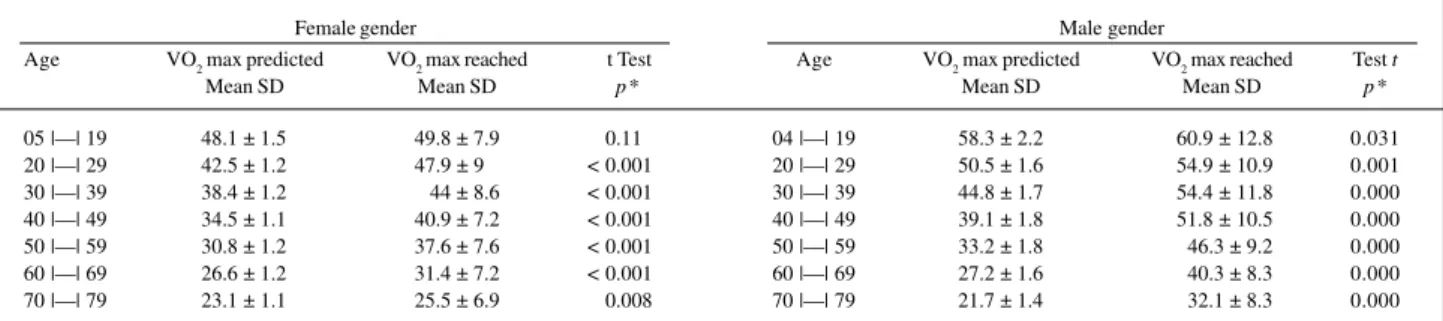
When distributed by sex and age, the mean initial velocity corresponds approximately to half of the maximum velocity reached, and the inclination varies about 10% bet-ween the initial and maximum values, as observed in tables I and II. Mean maximum VO2 reached was greater than that predicted in both sexes and in all age groups. Only female children and adolescents did not have significant differen-ces (tab. III).
Discussion
The first description of the ramp protocol was publi-shed by Myers et al 11 in 1991, with 44 patients analyzed.
One year later, the same authors 17 studied 200 apparently
Table I - Distribution of female patients who performed TT according to the ramp protocol regarding frequency, velocity, and inclination in the beginning of exercise and at maximum effort (mean standard deviation) – Recife/PE
Age group Frequency Initial Velocity Maximum Velocity Initial Inclination Inclination Maximum
n Mean SD Mean SD Mean SD Mean SD
05 |—| 19 64 3.4 ± 0.3 7.5 ± 0.8 4.9 ± 1.2 14.9 ± 1.8
20 |—| 29 57 3.4 ± 0.3 7.1 ± 0.8 5.7 ± 0.9 15 ± 2.2
30 |—| 39 111 3.2 ± 0.3 6.6 ± 0.9 5.4 ± 0.6 14.8 ± 1.9
40 |—| 49 236 3 ± 0.2 6.1 ± 0.7 5.2 ± 0.6 14.5 ± 1.8
50 |—| 59 266 2.8 ± 0.3 5.8 ± 0.7 4.3 ± 1.0 13.8 ± 2.2
60 |—| 69 174 2.5 ± 0.3 5.2 ± 0.7 2.5 ± 1.3 11.8 ± 2.4
70 |—| 79 57 2.1 ± 0.3 4.7 ± 0.8 0.4 ± 0.9 9.6 ± 2.7
Table II - Distribution of male patients who performed TT according to the ramp protocol regarding frequency, velocity, and inclination in the beginning of exercise and at maximum effort (mean standard deviation) – Recife/PE
Age group Frequency Initial Velocity Maximum Velocity Initial Inclination Inclination Maximum
n Mean SD Mean SD Mean SD Mean SD
04 |—| 19 128 3.8 ± 0.6 8.7 ± 1.4 5.3 ± 1.6 16.2 ± 2.9
20 |—| 29 70 3.7 ± 0.3 7.9 ± 1.2 6 ± 1.6 15.9 ± 2.0
30 |—| 39 140 3.5 ± 0.4 7.8 ± 1.1 6 ± 1.2 16 ± 2.6
40 |—| 49 200 3.4 ± 0.6 7.4 ± 1.0 5.5 ± 0.7 16 ± 1.8
50 |—| 59 174 3.1 ± 0.4 6.6 ± 0.9 5 ± 0.7 15.7 ± 2.1
60 |—| 69 98 2.7 ± 0.3 6 ± 0.7 3.3 ± 1.4 14.4 ± 2.5
70 |—| 79 65 2.4 ± 0.3 5.4 ± 0.9 1 ± 1.3 11.5 ± 3.0
Table III - Distribution of patients that performed TT according the ramp protocol regarding, sex, age group, predicted and reachedVO
2 max and p value –
Recife/PE
Female gender Male gender
Age VO2 max predicted VO2 max reached t Test Age VO2 max predicted VO2 max reached Test t
Mean SD Mean SD p* Mean SD Mean SD p*
05 |—| 19 48.1 ± 1.5 49.8 ± 7.9 0.111 04 |—| 19 58.3 ± 2.2 60.9 ± 12.8 0.031 20 |—| 29 42.5 ± 1.2 47.9 ± 9.0 < 0.001 20 |—| 29 50.5 ± 1.6 54.9 ± 10.9 0.001 30 |—| 39 38.4 ± 1.2 44 ± 8.6 < 0.001 30 |—| 39 44.8 ± 1.7 54.4 ± 11.8 0.000 40 |—| 49 34.5 ± 1.1 40.9 ± 7.2 < 0.001 40 |—| 49 39.1 ± 1.8 51.8 ± 10.5 0.000 50 |—| 59 30.8 ± 1.2 37.6 ± 7.6 < 0.001 50 |—| 59 33.2 ± 1.8 46.3 ± 9.2 0.000 60 |—| 69 26.6 ± 1.2 31.4 ± 7.2 < 0.001 60 |—| 69 27.2 ± 1.6 40.3 ± 8.3 0.000 70 |—| 79 23.1 ± 1.1 25.5 ± 6.9 0.008 70 |—| 79 21.7 ± 1.4 32.1 ± 8.3 0.000
5 1 5 1 5 1 5 1 5 1
healthy patients. Aksut et al 23 assessed hemodynamic
res-ponses in 30 young healthy patients (11 men and 19 wo-men), comparing the Bruce protocol with a customized ram-ped protocol. In the same year, Yokoyama et al 24, also
com-pared the response between these 2 protocols in 17 men and 5 women. A more significant number, of 698 patients from both sexes, was analyzed by Kaminsky and Whaley 25, with
the ramped Bruce protocol. Bader et al 26 observed the
pat-tern of 24 individuals with age > 60 years participating in the ramp protocol and McInnis et al 27, in 25 obese women. In the
same year, Will and Walter 28 compared the Bruce protocol
with the ramped Bruce protocol in 23 patients.
Therefore, we observed that the numbers of patients assessed in the present study was greater than that of the several prospective studies published on the ramped proto-col. We did not consider the use of medications or the asso-ciation between diseases in this population, because the main variables assessed were duration of exercise, the velocity and the inclination reached, and the max VO2 assessed in relation to the predicted value (by the formula of ACSM 16). In
90.1% of the patients, the max HR reached was > 85% of the maximum HR predicted by the Karvonen formula 22. Only the
patients with age > to 60 years old, in frequent use of medica-tions that could interfere the chronotropism, had a relative frequency of ineffective examinations < 80%. This popula-tion of elderly patients reached on average 91.4+11.9% of the predicted maximum HR, compared with 83+10% of the pa-tients studied by Bader et al 26 in 1999. In the age group 20 to
39 years, almost 100% of the individuals reached the predic-ted submaximal HR.
Mean exercise duration was 10+2 minutes, regardless of age and sex, and was within the time of 8 to 12 minutes, according to that suggested by the latest guidelines of the ACC/AHA 29 in 1997 and of ACSM 30 in 2000 and also
according to the publications that describe the methodolo-gy and the interpretation of TT and that states that the optimal duration of exercise must be between 8 and 12 minu-tes 8,9,11,15,17,18,31. The computer programs developed to
cus-tomize the test aimed at reaching predicted maximum VO2 within this ideal time 11,32. The exercise period in the Bruce
protocol is significantly lower than those of Balke and ramp, and the protocols with shorter periods cause greater discre-pancies between VO2 and workload 11. Tests longer than 15
minutes may become monotonous for healthy individuals or those with heart diseases, in addition to involving a sui-table evaluation of oxygen uptake. The time of exercise and the suitability to hemodynamic conditions make the test more pleasant, safer, and more accurate 18. Review of the
lite-rature by Myers and Bellin 8 reinforces previous statements
that in ramped TT the exercise must be customized, to reach predicted maximum VO2 in 9 to 10 minutes.
In the present study, only the female patients with ages below 20 years old did not have significant differences when compared with the predicted value and reached values of maximum VO2, calculated according to the ACSM formu-la, according to sex and age group. In the other patients, regardless of sex and age, the oxygen uptake reached was
significantly greater than that predicted, in accordance with Araújo 20 where VO
2 estimated by formulas overestimates
VO2 when compared with that measured through the analy-sis of expired gases. Mean values of velocity and inclina-tion, reached at maximum effort, were greater than those esti-mated at the prescription of customized ramp, using predic-ted maximum VO2 as the pattern.
Myers et al 11, in 1991, published the first study that
compared other protocols to those of ramp. Forty-one pa-tients were submitted to 6 different protocols, 3 with a tread-mill ergometer (Bruce, Balke, and ramp) and 3 with a cycle ergometer (25 watts, 50 watts per stage, and ramp). They observed hemodynamic responses and gas exchanges and developed computer programs to customize the ramp proto-col, based on the capacity of exercise on a treadmill and bicy-cle, to obtain an optimal exercise duration of 9 to 10 minutes. Max VO2 for the treadmill was 16% greater with the cycle ergometer. There was no significant difference in heart rate, blood pressure, or maximum VO2 between the treadmill and cycle ergometer protocols (using the same ergometer). In all protocols with or without ramp, predicted maximum VO2 was greater than that measured. The error in predicting VO2 by the workload was lower with the ramp protocol, which presents a more linear correlation between these parame-ters. Using protocols with short and small workload increa-ses between the stages or using the ramp protocol, maxi-mum VO2 reached through the analysis of gases exhaled had closer levels of predicted maximum VO2.
Myers et al 17 stated that the protocol choice may
might influence the assessment of variables. The causes of interruption (ST segment, HR, and VO2) may vary accor-ding to the protocol. Customization of the test, with reduced workload increase and adequate duration (8 to 12 minutes) are recommendations to enhance the test. Yamamoto et al 33
developed a computer program to control the increase in velocity and inclination of the treadmill ergometer to enable a linear increase in VO2 with the individual walking until the end of the exercise, according to the duration of the exa-mination.
For Myers and Froelisher 31, the exercise protocol
must be customized, with small and constant progressive increases in inclination and velocity, to perform the test in 8 to 12 minutes. Comparison of results between different exa-minations may be done through the workload rather than exercise duration, such as with the Bruce protocol.
Fletcher et al 32 observed the disadvantages of the
Bruce protocol: a sizable increase in workload between sta-ges; in the 4th stage the patient can walk or run, which leads to differences in VO2 determination; the test may be inter-rupted due to discomfort in inferior limbs or the inability to tolerate great increases in workload with changes in stage. They concluded that the ramp protocol, customized for the patient tested, with low workload increases and a shorter time interval and with 9-minute duration, demonstrates greater accuracy in the maximum O2 reached.
Mastrocolla et al 22, of the Consenso Nacional de
Car-5 2 5 2 5 2 5 2 5 2
diovascular da Sociedade Brasileira de Cardiologia, com-ment that, recently, greater clinical interest has been shown in exercise testing protocols that meet the characteristics of linearity in the responses of oxygen uptake. These proto-cols, generally known as ramp protoproto-cols, use a constant increase ratio for exercise intensity rather than the stages of definite duration, enabling a greater customization and adaptation of the protocol to the patients’ condition, and being able to be performed both on cycle and treadmill ergometers.
Aksut et al 23 compared the Bruce protocol with a
cus-tomized ramp protocol in healthy men and women. They did not observe significant differences between the protocols regarding heart rate, blood pressure, ventricular function, or measured VO2.
Another methodology of exercise testing with conti-nuous protocols of increasing load was used by Mahse-redjian et al 34, in a comparative study of methods (treadmill
test with direct VO2 measure and field test with indirect VO2 determination) to predict maximum oxygen uptake and anae-robic thresholds in athletes: initial velocity of 9 km/h with increase an of 1 km/h per minute up to 15 km/h and, after that, an increase in inclination of 5% per minute until exhaustion. VO2 max determined by the direct method was not correlated to that determined by the lane test.
For Vivacqua 35, the ramp protocol, with a progressive
workload has enabled determining more precisely the ische-mic threshold in stratification of patients with chest pain in tests performed in most cases, between 12 and 24 hours after emergency admittance. According to this author, ramp protocols enable better adaptation to the ergometer, with greater performance during exercise, greater reliance in the determination of electrocardiographic, and hemodynamic variables, of the oxygen uptake at peak effort, and of the ventilatory threshold. The exercise duration and the suitabi-lity to biomechanical conditions of the individuals make the test more pleasant, safer, and more accurate.
McInnis et al 27 studied 25 obese women to compare
the values of predicted maximum oxygen uptake with that determined by direct measurement, using 2 exercise proto-cols with the treadmill ergometer: Bruce protocol and a
cus-tomized ramp protocol. The result of this study suggests that the ramp and staggered protocols have similar capacity in the assessment of functional capacity in obese women.
Will and Walter 28 studied hemodynamic responses,
test duration, and patient comfort with the conventional Bruce protocol and a ramp Bruce protocol. No significant differences occurred in values for heart rate, blood pressu-re, and subjective evaluation of noticed effort (Borg scale) at the end of exercise. Duration of exercise and maximum VO2 were significantly greater, and the patients reported greater facility and comfort with the ramp Bruce protocol.
The American College of Sports Medicine 30
recom-mends that “whatever the chosen protocol, it must be custo-mized, with velocity (if treadmill) based on the individual capa-city and workload increase so that the test lasts 8 to 12 minu-tes.” Historically, the protocol for exercise was based on tradition, convenience, or both. As of the 1990s, studies have suggested that protocols with different and greater workload increases do not maintain a linear correlation between VO2 and the work performed, with an overestimated predicted VO2 8. The ramp protocol is close to the guidelines of policies
that propose a customized protocol for each patient 29.
The current tendency is to use customized ramp pro-tocols, with an increase in effort intensity according to the patient, so that the test duration remains between 8 and 12 minutes, which facilitates the analysis of hemodynamic and ventilatory variable patterns 1.
In conclusion, despite the use of velocity, inclination, and maximum effort variations above that predicted by the computerized system, the ramp protocol was well tolerated by patients, regardless of age, sex, use of medication or pre-existing diseases, with a mean exercise duration of 10.0 + 2.0 minutes, within the suggested limit by several authors. The use of inclination and velocity, effectively reached by the patients, distributed according to sex and age may be used as one more criterion to guide parameters for the performan-ce of the ramp protocol with a treadmill ergometer. The use of calculated VO2 maximum, significantly greater than the predicted VO2 for almost all patients from both sexes can also be useful to prescribe velocity and inclination of the customized ramp protocol.
References
1. Araújo CGS. Teste de exercício: terminologia e algumas considerações sobre passado, presente e futuro baseado em evidências. Rev Bras Med Esporte 2000; 6: 77-84.
2. Alfieri RG, Marcondes GD. Histórico. In: Exercício e o Coração. 2a ed. Rio de
Janeiro: Cultura Médica, 1993: 3-9.
3. Ellestad MH. História do teste de esforço. In: Prova de Esforço. 2a ed. Rio de
Janeiro: Cultura Médica, 1984: 2-5.
4. Ästrand PO, Rodahl K. Avaliação da capacidade de trabalho físico na base dos testes. In: Tratado de Fisiologia do Exercício. 2a ed. Rio de Janeiro:
Interameri-cana, 1977: 304-36.
5. Bruce RA. Evaluation of functional capacity and exercise tolerance of cardiac patients. Mod Concepts Cardiovasc Dis 1956; 25: 321-6.
6. Vivacqua R, Hespanha R. Introdução – Histórico – Perspectiva. In: Ergometria e Reabilitação em Cardiologia. Rio de Janeiro: Medsi, 1992: 1-6.
7. Ellestad MH, Allen W, Wan MCK, Kemp G. Maximal treadmill stress testing for cardiovascular evaluation. Circulation 1969; 39: 517-22.
8. Myers J, Bellin D. Ramp exercise protocol for clinical and cardiopulmonary exercise testing. Sports Med 2000; 30: 23-9.
9. Serra S. Considerações sobre ergoespirometria. Arq Bra Cardiol 1997; 68: 301-4. 10. Vivacqua R, Hespanha R. Metodologia do teste ergométrico. In: Ergometria e
Reabilitação em Cardiologia. Rio de Janeiro: Medsi, 1992: 39-100. 11. Myers J, Buchanan N, Walsh D, et al. Comparison of the ramp versus standard
exercise protocols. J Am Coll Cardiol 1991; 17: 1334-42.
12. Ellestad MH. Protocolo do teste de esforço. In: Prova de Esforço. 2a ed. Rio de
Janeiro: Cultura Médica, 1984: 105-126.
13. Alfieri RG, Marcondes GD. Metodologia. In: Exercício e o Coração. 2a ed. Rio de
5 3 5 3 5 3 5 3 5 3 14. Protocolo em rampa: manual de referência rápida. Brasília, 1998. Disponível em:
URL: http://www.micromed.ind.br/ergopc13/download/rampa.pdf. Acesso em 28/2/01.
15. Dubach P, Litscher K, Ratti R, Reinhart WH. Current aspects in ergometry. Schweiz Med Wochenshr 1993; 123: 214-22.
16. American College of Sports Medicine. Cálculos metabólicos. In: Manual para o Teste de Esforço e Prescrição do Exercício. 5a ed. Rio de Janeiro: Revinter, 2000:
237-50.
17. Myers J, Buchanan N, Smith D, et al. Individualized ramp treadmill. Observations on a new protocol. Chest 1992; 101(Suppl 5): 236-41.
18. Vivacqua R. Considerações sobre o protocolo de rampa aplicado no teste ergomé-trico. Boletim do Departamento de Ergometria e Reabilitação Cardiovascular da SBC 1999; 18: 16-7.
19. Barros Neto TL, César MC, Tambeiro VL. Avaliação da aptidão cardiorrespiratória. In: Ghorayeb N, Barros Neto T. O Exercício: Preparação Fisiológica, Avaliação Médica, Aspectos Especiais e Preventivos. São Paulo: Atheneu, 1999: 15-24. 20. Araújo CGS. A Ergoespirometria como procedimento em medicina do exercício:
necessidade, opção ou luxo? Jornal de Medicina do Exercício 1998; 20: 4-5. 21. Ästrand PO, Rodahl K. Capacidade para o trabalho físico. In: Tratado de
Fisio-logia do Exercício. 2a ed. Rio de Janeiro: Interamericana, 1977: 265-303.
22. Mastrocolla LE, Brito AX, Brito FS, et al. Consenso Nacional de Ergometria. Arq Bras Cardiol 1995; 65: 189-211.
23. Aksut SV, Pancholy S, Johnson J, et al. Comparison of left ventricular performance in healthy young women and men during exercise. J Nucl Cardiol 1996; 3: 415-21. 24. Yokoyama Y, Tanabe K, Yamamoto A, et al. Relationship between ischemic ST depression and uptake kinetics during ramp exercise test in patients with effort angina. J Cardiol 1996; 27: 241-6.
25. Kaminsky LA, Whaley MH. Evaluation of a new standardized ramp protocol: the BSU/Bruce Ramp protocol. J Cardiopulm Rehabil 1998; 18: 438-44. 26. Bader DS, Maguire TE, Balady GJ. Comparison of ramp versus step protocol for
exercise testing in patients ≥ 60 years of age. Am J Cardiol 1999; 83: 11-4. 27. McInnis KJ, Bader DS, Pierce GL, Balady GJ. Comparison of cardiopulmonary
responses in obese women using ramp versus step treadmill protocols. Am J Cardiol 1999; 83: 289-91.
28. Will PM, Walter JD. Exercise testing: improving performance with a ramped Bruce protocol. Am Heart J 1999; 138: 1033-7.
29. ACC/AHA Guidelines for Exercise Testing: A Report of the American College of Cardiology/American Heart Association Task Force on Practice Guidelines (Committee on Exercise Testing). J Am Coll Cardiol Data???? 30: 260-315. 30. American College of Sports Medicine. Avaliação clínica em esforço. In: Manual
para o Teste de Esforço e Prescrição do Exercício. 5a ed. Rio de Janeiro: Revinter,
2000: 77-96.
31. Myers J, Froelisher VF. Exercise testing. Procedures and implementation. Cardiol Clin 1993; 11: 199-213.
32. Fletcher GF, Balady C, Froelicher VF, Hartley LH, Haskell WL, Pollock ML. Exercise standards. A statement for healthcare professionals from the American Heart Association. Circulation 1995; 91: 580-615.
33. Yamamoto M, Tanabe K, Ohmiya K, et al. Development of computer software in ramp slope controlles for treadmill ergometer. J Cardiol 1992; 22: 687-93. 34. Mahseredjian F, Barros Neto TL, Tebexreni AS. Estudo comparativo de métodos
para a predição do consumo máximo de oxigênio e limiar anaeróbio em atletas. Rev Bras Med Esporte 1999; 5: 167-72.