Ann. Geophysicae 15, 1—4 (1997) (EGS — Springer-Verlag 1997
The LION instrument on SOHO and its scientific objectives
S. M. P. McKenna-Lawlor1,2, I. Elendt1, P. Rusznyak2, H. Kunow3, R. Mu¨ller-Mellin3, M. Witte4 1Experimental Physics Department, St. Patrick’s College, Maynooth, Ireland
2Space Technology Ireland, St. Patrick’s College, Maynooth, Ireland 3Institut fu¨r Reine und Angewandte Kernphysik, Universita¨t Kiel, Germany 4Max Planck Institut fu¨r Aeronomie, Katlenburg-Lindau, Germany
Received: 11 October 1995/Revised: 1 July 1996/Accepted: 3 July 1996
Abstract. A technical description is presented of the low-energy ion and electron (LION) instrument on the SOHO spacecraft and its scientific goals are discussed. LION forms part of the comprehensive suprathermal and ener-getic particle analyzer (COSTEP), which is, in turn, a sub-set of the COSTEP/ERNE particle analyser collaboration (CEPAC).
1 Introduction
It is now possible to distinguish a rich variety of solar phenomena by observing the energetic particles they emit. Impulsive flares, coronal mass ejections (CMEs), disap-pearing-filament events and interplanetary shock waves are each recognised to have as distinctive a signature with respect to the timing, composition and spectra of the energetic particles they emit as they do in the radio, optical, X-ray and gamma-ray photons they produce. The philosophy of using suprathermal and energetic particle data as diagnostic tools for the remote probing of solar processes can thus be expected to lead to significant new insights into critical problems concerning both solar pro-cesses and solar cosmic ray modulation in interplanetary space.
On board SOHO there are two energetic particle ex-periments: namely COSTEP (comprehensive supra ther-mal and energetic particle analyser) and ERNE (energetic and relativistic nuclei and electron experiment). The COS-TEP and ERNE experiments are collaboratively linked under the name CEPAC (COSTEP-ERNE particle ana-lyser collaboration) to jointly address a wide range of scientific topics including (1) energy releases and particle acceleration in the solar atmosphere (long duration
Correspondence to: S. M. P. McKenna-Lawlor
events, impulsive events, non-flare associated particle events); (2) analysis of samples of solar atmospheric ma-terial (large solar particle events, elemental abundances, isotopic abundances, small3He rich flares, impulsive kilo-volt electron events); (3) steady state processes in the solar atmosphere and (4) particle propagation in the interplan-etary medium (travelling shock events, co-rotating inter-action regions, small scale plasma events).
The CEPAC collaboration allows systematic investiga-tions to be mounted into the areas of interest outlined through (a) measuring energetic particles over a wide range of energies and species and (b) combining this in-formation with simultaneous observations from other ex-periments on SOHO and with ground-based observa-tions.
CEPAC has three units. These are, within COSTEP, named LION (the low-energy ion and electron experi-ment) and EPHIN (the electron, proton, helium instru-ment). Within ERNE there are two sensors, HED (the high-energy detector) and LED (the low-energy detector) which are jointly named ESU (the ERNE sensor unit). COSTEP and ERNE share a common data processing unit (CDPU), which forms the interface to the spacecraft on-board data handling system. They also share a com-mon power supply (LVPC), which forms the interface to the spacecraft power bus.
The subject of the present work is the LION instru-ment and its scientific objectives and the reader is directed to Kunowet al. (1992) and Torstiet al. (1992) for accounts of EPHIN and ERNE.
2 The LION instrument
LION is essentially a semiconductor detector designed to measure energetic particles. The instrument features two sensor heads, each containing a double telescope, which together provide the capability to measure particle spectra in the range &40 keV to 6 MeV for protons and
&40 keV to 300 keV for electrons (Table 1). One channel
Table 1.LION energy channels
TI (D1 and D2) TII (D1 and D2) Energy range
P1#E1 P1 44.5—81.9 keV
P2#E2 P2 81.9—128.1 keV
P3#E3 P3 128.1—189.1 keV
P4#E4 P4 189.1—308.9 keV
P5 P5 308.9—755 keV
P6 P6 0.755—1.99 MeV
P7 P7 1.99—6.04 MeV
H1 H1 6.87—26.00 MeV
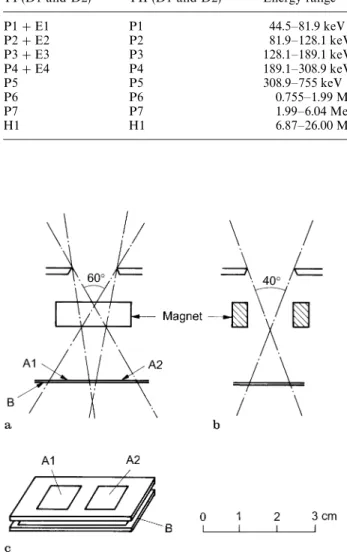
Fig. 1. a Schematic of one LION sensor, showing the ‘2 in 1’ telescope configuration and deflection magnet; b as above, seen rotated through 90°;cschematic of the LION detector stack
is provided. Count rates are accumulated with 15 s time resolution (counter saturation occurs at 106counts/15 s). Overall, COSTEP will measure the energy spectra of electrons in the approximate range 40 keV—10 MeV, as well as protons and helium nuclei up to 53 MeV/n. ERNE will measure electrons in the range 2—50 MeV and also the energy spectra of elements in the range Z"1—30, from a few MeV/n up to 540 MeV/n. Each LION sensor head consists of three ion-implanted silicon detectors, arranged in a unique ‘2 in 1’ telescope configuration (Figure 1).
Square (12]12 mm2) detectors A1 and A2 form the
dual front elements, mounted so as to make back-to-back contact with the rectangular rear element B(19]34 mm2).
Detector B is operated in anticoincidence to reduce back-ground from penetrating particles. A1 and A2 view the same rectangular entrance aperture, providing a total field of view of 60°]40° and a total geometric factor of
0.32 cm2ster. Each A detector, in combination with the
common B detector, forms a distinct particle telescope, providing extended angular coverage for a minimum weight penalty.
The first LION sensor head employs a ‘broom magnet’ utilising rare earth NdFeB material to sweep electrons of energies up to about 300 keV away from the ‘A’ detectors. In order to eliminate stray magnetic fields, the magnet has a closed soft iron yoke. Higher energy electrons will pen-etrate the ‘A’ detectors and trigger the B (anticoincidence) detector; protons[6.04 MeV will be stopped within A. By this means, energetic electrons are separated from ener-getic protons in channels P5, P6 and P7. The second LION sensor head, which is identical, except that no broom magnet is included, measures the sum of electrons and protons, thereby enabling the determination by sub-traction of electron rates in the energy range below about 300 keV. A correction for count rate contamination by scattered particles, and/or by particles penetrating the walls of the instrument, will be applied in any case where this is calculated to be warranted.
The LION analog processing electronics consist of two identical sensor interfaces and a section which performs common functions. The signals of particles that have stopped in one of the four front detectors are processed in separate analog chains consisting of two-stage-amplifiers and discriminators. The dynamic range extends from 44.5 keV to 26 MeV, and is divided into eight energy bins for counting. The part common to both sensors contains a flight test generator to produce test pulses for periodic checking of the analog signal processing chains. Also provided is a telecommand decoder/buffer to receive and store commands controlling instrument status; an analog housekeeping monitor to select and convert monitored parameters into digital data and a detector bias voltage supply.
As already mentioned, the data and command interface between LION, the other CEPAC instruments and the SOHO data system is provided by a ‘common’ central data processing unit (CDPU). This is connected to the various instruments using individual serial interfaces. Connection to the spacecraft bus is provided by a stan-dard interface. The design of this unit, including its inter-facing, is redundant, so that any single failure will not reduce experiment performance. A real time multi-tasking operating system permits CDPU software to be written in a higher programming language to facilitate structural programming and modularity.
The high-reliability low voltage power converter (LVPC) which provides the operating voltages for LION (as well as for the other CEPAC instruments and the CDPU), has a fully redundant design featuring two identi-cal power blocks and an appropriate control block. Both LION sensor heads and their associated electronics are packed into one housing having envelope dimensions 18.2]15.0]16.9 cm3. A sunshade protects the sensor
ap-ertures from direct illumination and from stray light. The entrance aperture points in the direction of the nominal interplanetary magnetic field at 1 AU, 45° ahead of the spacecraft-sun line. The instrument has a total power requirement of 1.1 W; a mass of 2.1 kg and a telemetry rate of 50 bits per second.
3 Origin//acceleration of solar particles
Over the past several years, there has been a profound revision in our understanding of the origin and acceler-ation of solar particles and three distinct types of event (gradual, impulsive and CIR related) can now be recog-nised (Reames, 1994 and references therein).
3.1 Gradual events
Large, gradual (i.e. slowly rising) solar energetic particle (SEP) events are related to the occurrence of coronal mass ejections (CMEs). These energetic particles, which are proton dominated, are accelerated from the ambient plasma of the corona and solar wind by the shock wave that expands ahead of a large CME, thereby filling the heliosphere with particles over a wide longitude range. In general, acceleration continues out to distances far be-yond the orbit of the Earth. However, for the highest energy ions, acceleration does not continue far from the Sun because such particles are less efficiently confined by the wave trapping region near the shock when the plasma expands as R~2(for protons in the range&100 MeV to
'20 GeV peak acceleration occurs when the shock at the leading edge of the CME is 6—10 solar radii out from the Sun).
The average element abundances of the accelerated ions reflect those of the solar corona. Also, their ionisation states (e.g. Fe`14) are similar to those of the solar wind and typical of a coronal plasma temperature of&2 MK
(compare with the mean ionisation state of Fe in impulsive events reported later). This suggests, in accord with other evidence, that the ions in gradual SEP events cannot originate in flares or in field reconnection regions. There is, however, an association between gradual SEPs and disappearing filaments (disparition brusques) which, like CMEs, are characterised by their ‘low’ plasma temper-atures relative to flares.
In gradual events, the energetic particles are acceler-ated at the point of intersection of the observer’s magnetic field line with the distant CME shock. This point sweeps eastwards across the entire shock as a function of time, as the observer progressively moves to new field lines be-cause of solar rotation. Regions of bi-directional stream-ing immediately behind (i.e. on the solar side of) the shock, are frequently associated with magnetic structures in the ejecta. Further behind the shock, particle intensities are nearly identical over a longitude interval as large as 180°
and they decline over many days, thereby providing in-sights into the overall topography of the fields drawn out by the CME.
3.2 Impulsive events
In impulsive flares, intense beams of electrons generate electromagnetic ion cyclotron (EMIC) waves. These waves are resonantly absorbed by3He, as well as by heavy elements such as Ne, Mg, Si and Fe. In these wave particle interactions, acceleration induced enhancements are
pro-duced in the abundances of the elements mentioned, which are superimposed on their ‘normal’ coronal abund-ances. The abundance enhancements vary smoothly with the charge to mass ratio (Q/A) of the ions concerned. Mean ionisation states of the energetic particles (e.g. Fe`20) indicate either heating in the source region up to about 10 MK or, more probably, stripping of the ions by the intense electron beams characteristic of impulsive flares.
The possibility in recent years to distinguish particles accelerated at CME-driven shocks from those accelerated in solar flares, has changed some aspects of our under-standing of interplanetary particle transport. In particu-lar, it is now apparent that the extended time profiles characterising gradual events represent signatures of con-tinuous shock-related acceleration, rather than indicate slow diffusion of flare-accelerated particles through the corona.
3.3 Events associated with CIRs
When a high-speed solar wind stream originating in a co-ronal hole overtakes slower moving solar plasma emitted previously in the same direction, a piling up of the solar wind occurs along an extended interface called the inter-action region. The pressure built up in this region gives rise to large amplitude hydromagnetic waves which propagate both inwards (sunward) and outwards, while being generally convected outwards by the solar wind. Beyond the orbit of the Earth, these waves steepen into a pair of collisionless shocks. The reverse shock from the CIR propagates into the high-speed stream and acceler-ates particles from that population, which can then be relatively easily measured.
Ion abundance measurements made in the high-speed streams characterizing CIRs show a dependence on the first ionisation potential (FIP), which appears reduced relative to that pertaining in gradual and impulsive events. This presumably reflects the element abundances present in the coronal holes where the high speed streams are formed. The abundances thus recorded also show some dependence on the maximum speed of the high-speed wind stream sampled. The abundances of elements in CIR streams may be contaminated by the presence of interstel-lar pickup ions. Spectral variations in the electron and ion enhancements, as well as in the value of the H/He ratio monitored at Ulysses over an approximately 2-year peri-od, were demonstrated by Simnett et al. (1995) to be of solar, rather than of instrumental, origin. These results indicate the need for ongoing high time resolution monitoring of CIR related particle phenomena, to take account of the important temporal changes they display. Again, measurements made at Ulysses when located at 4.6 AU, latitude 33°S, showed, in advance of the expected return of a CIR, the presence of a population of energetic ions and electrons (it is noted that the CIRs disappeared as Ulysses progressed to high latitudes and reappeared when Ulysses returned to lower latitudes). This popula-tion was interpreted by Tappin and Simnett (1995) to have been injected at the base of the solar wind (over an
extended period), along a trajectory magnetically connec-ted to the spacecraft by a newly emerged active solar region which, however, showed no associated evidence of flaring.
4 Conclusion
The CEPAC experiment will make a unique set of obser-vations of solar particles over a wide range of energies and species. This information will be combined with multiple state-of the-art simultaneous observations from SOHO and other spacecraft (radio, optical, X-ray, gamma-ray, white light). Ground-based measurements at high spatial and temporal resolution of the magnetic field topology, and of the velocity fields (flows and waves) in the photo-sphere and chromophoto-sphere, will simultaneously be made. These related data will be exploited, within the general framework of a co-operative international endeavour, to reach a better understanding of the physical processes that form and heat the solar corona and give rise to its acceler-ation into the inter-planetary medium.
The energetic particle data will, in particular, be used by the CEPAC Team to investigate in depth the three different types of SEP. In this connection, detailed studies of the relationship between energetic particles and CMEs will throw light on such questions as the accelerated particle source (ambient solar wind or seed particles); detailed aspects of shock structure; acceleration mecha-nisms; location of the axis of most effective acceleration relative to the flare; acceleration power as a function of radial distance from the sun/angular distance from the flare axis; the effect of CME size and topology on the particles, etc. It is expected that these particle observa-tions will contribute as much to improving our under-standing of CMEs as the observations of CMEs have themselves contributed over the past several years to the present general understanding of gradual SEPs.
The unique electron measurement capability of LION and ERNE, combined with high resolution determina-tions within CEPAC of isotopic abundances over a broad energy range, backed up by charge state and velocity distribution information and complementary space-craft/ground based data, will contribute to determining how the abundances in individual events depend on such
parameters as temperature, density and the magnetic and electric fields present at the acceleration site. These data will also elucidate the influence of waves, neutron decay protons, associated gamma-ray burst generation etc. on the characteristics of the particles originating in individual impulsive events.
Recent insights into the transport of particles from gradual and impulsive events through interplanetary space permit us to now investigate the nature of the scattering law pertaining under different solar-wind con-ditions, as well as the influence of the presence of features such as sector boundaries and shocks. Also, the way in which flux anisotropy changes to flux isotropy during particular particle events will be studied.
CIRs are typically observed during several years around solar minimum which, in the present cycle, falls close to the time of the SOHO launch. Studies made with, hitherto, unprecedented sensitivity and mass resolution of suprathermal and energetic CIR related particles, will provide insights into the origin of the seed particles accel-erated at the reverse shock. Monitoring, over extended time periods, of the dynamic internal changes now known to be a feature of fast-speed solar streams can also be carried out.
Acknowledgement. The Editor in Chief thanks K. Staines for his help in evaluating this paper.
References
Kunow, H., R. Mu¨ller-Mellin, H. Sierks, S. McKenna-Lawlor, and J. Sequeiros,COSTEP, comprehensive suprathermal and energetic particle analyser for SOHO—scientific goals and data descrip-tion,Proc.First SOHO¼orkshop,Annapolis,Maryland,ºSA, 25—28August1992, ESA SP-348, 43—46, 1992.
Reames, D.V.,Coronal abundances determined from energetic par-ticles,Adv.Space Res. (in press) 1994.
Simnett, G. M., K. A. Sayle, S. J. Tappin, and E. C. Roelof, Co-rotating particles enhancements in the ecliptic plane,Space Sci.
Rev.,72,327—330, 1995.
Tappin, S. J., and G. M. Simnett,Solar particles observed near 33°
latitude,Space Sci.Rev.,72,331—334, 1995
Torsti, J. E., T. Valtonen, E. Eronen, M. Hoisko, M. Louhala, M. Lumme, A. Niemenen, P. Peltonen, E. Rahonen, G. Schultz, and M. Teitennen,Energetic particle analyser ERNE,Proc.First SOHO ¼orkshop, Annapolis, Maryland, ºSA, 25—28 August
1992, ESA SP 348, 47—50, 1992.
.