215
Abstract
The adsorption of organic substances in metals and in different media has been attributed to different effects, such as the carbon chain size, type or number of hetero-atom in the molecule structure, reactivity, the steric effect, among others. The objec-tive of this work is to study the electrochemical indole behavior for AISI 430 stainless steel (SS), when changing the study media from H2SO4 1 mol L-1 to HCl 1 mol L-1. The experimental techniques used are as follows: the open-circuit potential, anodic and cathodic potentiodinamic polarization, electrochemical impedance spectroscopy, optical microscopy and scanning electron microscopy. These results suggest that the adsorption of indole in the presence of SO4-2 is lower than in the medium containing Cl-, which is justiied by the indole action as a weak acid, because it has only a single pair of electrons, which is displaced and takes part in the π-electron aromatic system; thus the irst step of the indole reaction in acid media is the protonation and generation of an indole cation.
Keywords: Corrosion inhibitor, adsorption, protonation.
Resumo
A adsorção das substâncias orgânicas nos metais, em diferentes meios, tem sido atribuída a diferentes efeitos, tais como: tamanho da cadeia carbônica, tipo ou nú-mero de heteroátomo presente na estrutura da molécula, reatividade, efeito estérico, entre outros. O objetivo desse trabalho é estudar o comportamento eletroquímico do Indol (C8H7N), para o aço inoxidável AISI 430, quando se muda o meio de estu-do de H2SO4 1 mol L-1 para HCl 1 mol L-1. Experimentalmente foram empregadas
as técnicas seguintes: medida de potencial de circuito aberto, curvas de polarização potenciodinâmica anódica e catódica, espectroscopia de impedância eletroquímica, microscopia óptica e eletrônica de varredura. Esses resultados sugerem que a adsor-ção do indol, em presença de SO4-2, é menor em relação ao meio que contem íons Cl-,
fato justiicado pela ação do indol como ácido fraco, pois o mesmo possui apenas um único par de elétrons, o qual é deslocado e participa do sistema π–elétron aromático. Dessa forma, a primeira etapa da reação do indol, em meio ácido, é a protonação e a geração de um indol cátion.
Palavras-chave: Inibidor de corrosão, adsorção, protonação.
Electrochemical behavior of
indole for AISI 430 stainless
steel in changing the media from
1 mol L
-1
H
2
SO
4
to 1 mol L
-1
HCl
Comportamento eletroquímico do indol para o
aço inoxidável AISI
430 com a mudança do meio
de H
2
SO
4
1 mol L
-1
para HCl 1 mol L
-1
Martha Tussolini Master in Applied Chemistry
UNICENTRO - State University in the Midwest, Guarapuava - Paraná, Brazil.
Aline Viomar Master in Bioenergy
UNICENTRO - State University in the Midwest, Guarapuava - Paraná, Brazil.
André Lazarin Gallina Master in Bioenergy
UNICENTRO - State University in the Midwest, Guarapuava - Paraná, Brazil.
Everson do Prado Banczek Doctor in Science
UNICENTRO - State University in the Midwest, Guarapuava - Paraná, Brazil.
Maico Taras da Cunha Master
UNICENTRO - State University in the Midwest, Guarapuava - Paraná, Brazil. maico_tc@yahoo. com.br
Paulo Rogério Pinto Rodrigues Doctor in Science.
UNICENTRO - State University in the Midwest, Guarapuava - Paraná, Brazil.
2 4
1. Introduction
The metallic corrosion is a tech-nological subject well studied since the economic loss of companies and govern-ments in the replacement of corroded metal parts are quite signiicant (Anun-ziato, 2010). To minimize the problem of corrosion, corrosion inhibitors are used; these are substances that when added to aggressive media minimize the oxidation reactions (Rodrigues, 1998). There are several studies about inhibitors, mainly on the adsorption effect of these com-pounds considering the inluence of the
heteroatom present in the carbon chain, the polar group effect, the electron den-sity in aromatic compost, the position of the heteroatom in the aromatic ring, the nature and charge of the metal surface, the type of electrolyte, among others (Rodrigues, 1997). It was observed that inhibition depends on the chemical and electronic structures of the compounds, the latter being more important when different azoles were studied, but with similar surface areas, differing only in the number and type of heteroatom, the
oxidation of carbon steel in media 1 mol L-1 HCl (Popova, 2006). The study of the indole effect on the corrosion behavior of 316 L solution of sodium chloride 0.3 mol L-1 at different pH values (4, 8 and 10) showed that change occurs in inhibitory eficiency (Düdükcü, 2004). For these changes, the objective is to study the electrochemical behavior of Indole (C8H7N) for AISI 430 SS, when changing the aggressive medium from 1 mol L-1 H
2SO4 to 1 mol L
-1 HCl (Tus-solini, 2010).
2. Materials and Methods
The electrochemical behavior was evaluated using the following techniques: open circuit potential (Eca) tests, anodic and cathodic potentiodynamic polariza-tion measurements electrochemical im-pedance spectroscopy (EIS); the surface of the sample was analyzed by scanning electron microscopy (SEM). All tests were performed at 22 ± 2°C. In electrochemical tests, a three-electrode cell was employed using: platinum as the counter-electrode with a 35 cm2 average area; saturated mercury sulfate (Hg/Hg2SO4) and silver-silver chloride (Ag/AgCl) as reference electrodes; and a working electrode of
(square plate 430 steel Stainless (SS) with a 2 cm2 average area).
Before tests were carried out, the working electrode was polished with SiC sandpaper with grit sizes 320, 400, 600 and 1200 mesh successively; after that it was rinsed with ultrapure water and dried in a cold air jet. A scanning electron microscope Philips brand, model XL 30 was used for SEM, and the analysis was followed by polishing with diamond paste 1μ. All solutions used were prepared with analytical reagents and ultrapure water. The concentra-tions of sulfuric acid and hydrochloric
acid were 1 mol L-1 in the presence and absence of indole at 1x10⁻³ 5x10⁻⁴ and 1x10⁻⁴ mol L-1 concentrations.
Tests of the open circuit potential (Eca) were obtained performing a stable potential of ± 5 mV in the interval time of 30 minutes before each test electrochemi-cal impedance spectroscopy was carried out. The curves of anodic and cathodic potentiodynamic polarization were obtained in the two media studied with 1 mV / s scan rate. The electrochemical impedance spectroscopy curves were ob-tained from the kinetic equilibrium with ± 10 mV potential perturbation.
3. Results
The open circuit potential curves of 430 SS in different media are shown in Figure 1.
The reason why two different ref-erence electrodes were used is different
media – so in the H2SO4 media, the MSE employed contains sulfate ions, and in the HCl media, SCE was employed that contains chloride ions; the common ion present in the reference electrode and in
the media allows to minimize de junction potential. The Ecorr values for the system in the absence and presence of indole in 1 mol L-1 H
2SO4 and 1 mol L
-1HCl media are presented in the Table 1.
Figure 1
Open circuit potential curves of 430 SS, in absence (°) and in the presence of
azoles in 1x10⁻³ mol L-1(_) concentration
in media: (1.A) 1 mol L-1H
2SO4; and (1.B)
1mol L-1HCl.
Table 1
Corrosion potential of indole at different
concentrations in the 1 mol L-1 H
2SO4 and
1 mol L-1HCl media for 430 SS.
Indole / mol L-1
Ecorr / mV vs SHE (vs. MSE) in 1 mol L-1 H
2SO4
Ecorr / mV vs SHE (vs. Ag/AgCl) in 1 mol L-1 HCl
0 -1514 ± 5 (-900) -683 ± 9 (-462)
1x10⁻⁴ -1498 ± 3 (-884) -681 ± 6 (-459)
5x10⁻⁴ -1501 ± 3 (- 887) -672 ± 8 (-450)
1x10⁻³ -1508 ± 8 (-894) -682 ± 9 (-460)
0 0 -0,96 -0,54 -0,93 -0,52 -0,9 -0,5 -0,87 -0,48 -0,46
25 50 25 50
t (min) t (min)
E ( V v s M S E ) E ( V v s A g /A g C l)
75 100 125 150 75 100 125
217 Figure 2
Potentiodynamic anodic polarization curves of 430 stainless steel in 1 mol
L-1 H
2SO4 media in the absence (
_) and
presence of indole concentrations (_)1x10
-3, (_) 5x10⁻⁴ and (_) 1x 10⁻⁴ mol L-1 in the
following regions: (2.A) active-passive-transpassive and (2.B) active.
Figure 3 Potentiodynamic anodic polarization
curves of 430 SS in HCl media in the
absence (_) and presence of indole in the
following concentrations (_) 1x10⁻³,
(_) 5x10⁻⁴ e (_) 1x10⁻⁴ mol.L-1.
Figure 4 Cathodic potentiodynamic polarization
curves of 430 SS in the (4.A) H2SO4
and (4.B) HCl media in the absence (_)
and presence of Indole in the following
concentrations: (_)1x10⁻³, (_) 5x10⁻⁴e
(_) 1x10⁻⁴ mol L-1.
In Figures 2 and 3 the anodic poten-tiodynamic polarization curves for 430 SS are presented in the absence and presence of indole in 1 mol L-1 H
2SO4 and 1 mol L -1
HCl media.
In Figure 4 the potentiodynamic cathodic polarization curves for 430 SS are shown in the absence and presence
of Indole at different concentrations in 1 mol L-1 H
2SO4 and 1 mol L
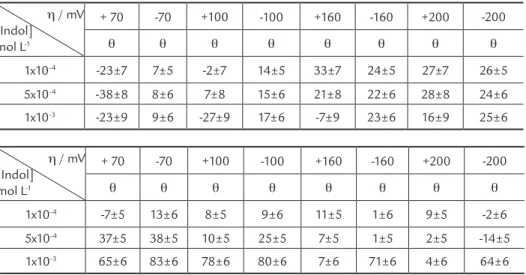
-1HCl media. Tables 2 and 3 show the coverage degrees (θ) in the media of 1 mol L-1 HCl
and 1 mol L-1 H
2SO4 in the presence of Indole. These values of θ were calculated
at different voltages from the Equation 1 (Tussolini, 2007):
θ
= ( j
s/i- j
c/i) / j
s/i (1)Where:
jc/i= current density in the presence of indole. js/i= current density in the absence of indole. The EIS measurements were carried
out in the corrosion potential in 1 mol L-1 H2SO4 and 1 mol.L-1 HCl media in the presence and absence of Indole 1x10⁻³ mol L-1, the curves are presented in Figure 5.
Figure 6 presents the scanning elec-tron microscopy for 430 SS in the presence and absence of indole in 1 mol L-1 HCl and 1 mol L-1 H
2SO4 media.
η / mV [Indol]
mol L-1
+ 70 -70 +100 -100 +160 -160 +200 -200
θ θ θ θ θ θ θ θ
1x10⁻⁴ -23±7 7±5 -2±7 14±5 33±7 24±5 27±7 26±5
5x10⁻⁴ -38±8 8±6 7±8 15±6 21±8 22±6 28±8 24±6
1x10⁻³ -23±9 9±6 -27±9 17±6 -7±9 23±6 16±9 25±6
η / mV [Indol]
mol L-1
+ 70 -70 +100 -100 +160 -160 +200 -200
θ θ θ θ θ θ θ θ
1x10⁻⁴ -7±5 13±6 8±5 9±6 11±5 1±6 9±5 -2±6
5x10⁻⁴ 37±5 38±5 10±5 25±5 7±5 1±5 2±5 -14±5
1x10⁻³ 65±6 83±6 78±6 80±6 7±6 71±6 4±6 64±6
Table 2 The inhibiting action of Indole in 1 mol
L-1H
2SO4 media in 430 SS oxidation at
different anodic and cathodic overvoltage.
Table 3 The inhibiting action of Indole in 1 mol
L-1 or HCl media in 430 SS oxidation at
different anodic and cathodic overvoltage.
-0,48 -0,28
E vs Ag/AgCl (V)
j
/
A
.c
m
²
-0,027 0,173 0,073 0,273
-0,08 -0,12 -0,32
A B
-0,5 -0,95
E vs Ag/AgCl (V) E vs MSE (V)
j
/
A
.c
m
²
j
/
A
.c
m
²
-0,15 -0,24
-0,1 -0,14
-0,19
-0,09 -0,05
-0,04
0
-0,6
-1,05 -1,15 -0,7
2 4
Figure 5
EIS Diagram for 430 SS in (5.A) 1 mol
L-1 H
2SO4 and (5.B) 1 mol L
-1HCl in the
absence (•) and presence (°) of indole at
a 1x10⁻³ mol L-1 concentration. EIS carried
out in Ecorr and Eperturbation = ± 10 mV vs.
MSE. In (5.C) the expansion of (5.B) is shown for better visualization of the curve
in the absence of Indoles in 1 mol L-1 HCl.
Figure 6
Scanning Electron Microscope (SEM) of 430 stainless steel ABNT in: (A) 1 mol
L-1H
2SO4 in the absence of indole, (B) 1
mol L-1H
2SO4 in the presence of indole, (C)
1 mol L-1 HCl in the absence of indole and
(D) 1 mol L-1 HCl in the presence of indole.
4. Discussion
Figures 1.A and 1.B show that in the presence of Indole in the irst few minutes, the potential decreases, after that time, more positive values are reached where it stabilizes. This behavior is probably due to rupture of the pre-existing oxide layer before immersion in the metal, which ac-celerates the process of hydrogen evolution and after these initial minutes the potential tends to rise due to the generation of new oxide layer in the presence of the corre-sponding indole.
Table 1 shows that the addition of Indole to the two media studied did not promote signiicant change in the Ecorr values, suggesting that the inhibitory ac-tion of azoles in relaac-tion to the oxidaac-tion
of 430 SS in both media studies is mixed. Figure 2 reveals that the addition of indole to the concentrations studied in-creases the current density (j) in the region of the anodic curve studied, suggesting the indole action as a catalyst of corrosion in the active region and transpassive for 430 SS in 1 mol L-1H
2SO4 media. Figure 3 shows that the Indole concentration is the highest when more negative poten-tials decreased (j). And for the lowest concentration at lower potentials there was no change, yet at potentials above -0.26 V increases occurred (j). There is a breakdown of passive ilm, probably by the presence of Cl-.
In Figure 4.A, it can be observed
that indole has a double behavior at lower potentials. In potentials lower than -1V, an increase occurs in the current density and when potentials are increased the current density decreases, sometimes acting either as a catalyst or as an inhibitor.
It is observed in Figure 4.B that the indole in the highest concentration reduces the current density in the region studied. While in lower concentrations of greater E ≥-0.62 V/SME, there is some increase in (j), suggesting a dual effect for these concentrations, catalyst and inhibitor, probably because at low concentrations there are more exposed active sites catalyz-ing the reaction rate of hydrogen detach-ment.
0
0
0 20 40 60 80 -20
0
-0,1
-0,5 1
1 2
100 120 140 160 0,5
0,5 1,5
ZReal ( .cm )Ω -2
ZReal ( .cm )Ω -2
ZReal ( .cm )Ω -2
Z
(
.c
m
)
lm
g
Ω
-2
Z
(
.c
m
)
lm
g
Ω
-2
Z
(
.c
m
)
lm
g
Ω
-2
0,4
0 0,5
20 0,9
1
40 1,4
1,5
60
501Hz
10kHz 0,01Hz
0,01Hz 10Hz
1,5
2,5
A B
C
A B
219
The indole in sulfuric acid media had an inhibitory effect for the cathodic overvoltage, while the anodic region to the inhibitory effect is only relevant at high voltages, as shown in Table 2, where η
≥ 200 mV. In Table 3 it is possible to see the indole in the cathodic and low anodic overvoltage, the highest concentration showed a highly eficient inhibitor.
In Figure 5.A it is possible to observe that the impedance in the presence of in-dole is slightly larger than for the system with only 1 molL-1 H
2SO4. The presence of an arc can be noticed: capacitive in high frequency and inductive in low frequency. In the irst arc, the capacitor can be attrib-uted to faradaic processes and the second inductive due to the indole presence.
Figure 5.B reveals that in 1 mol L-1 HCl the impedance in the presence of indole is signiicantly greater than in its absence. Featuring two arcs and the induc-tive arc is due to the adsorption of indole. “Holes” characteristic of generalized attacks can be seen in igure 6.A, probably due to dissolution around the inclusions, the remaining area suggested generalized corrosion of 430 stainless steel in 1 mol L-1 H2SO4 . In the presence of Indole in igure 6.B, corrosion is lower than that observed for the system in its absence.
Figure 6.C shows that the corrosion is localized for 430 stainless steel type in the 1 mol L-1 HCl media. In Figure 6.D a minimization of corrosion of 430 SS in the presence of indole in HCl media is
observed when compared to igure 6.C. Comparing Tables 2 and 3, the re-sults in hydrochloric acid 1 mol.L-1 media, the inhibitory eficiency in the presence of indole in the 1x10⁻³ molL-1 concentration is considerably higher when compared with the same concentration for the sul-furic acid media. This increase can be at-tributed to the fact that the nitrogen atom provides electrons to the aromatic ring, thus catalyzing the protonation process in hydrochloric acid media, which follows the mechanism suggested in Figure 7. It is suggested that the indole in protonated form can adsorb on electrode surface by simple electrostatic attraction of positively charged molecule, due to the chloride ions adsorbed in that metal surface.
Figure 7 Mechanism proposition of protonation
to Indole in media of HCl.
5.
Conclusions
The corrosion of 430 SS in sulfuric acid media is typically generalized, while in the hydrochloric acid media the attack is very aggressive. A considerable reduction of the localized corrosion was observed in the presence of indole.
EIS diagrams showed that for the H2SO4 and 1 molL-1 HCl media, the
high-est impedances were found in the presence of indole, being higher for the hydrochloric acid medium.
The potentiodynamic polarization showed that in the two media studied the presence of indole had no signiicant in-hibitory effect in the anodic region. How-ever, in the cathodic region, the highest
concentration studied for the 1 molL-1 HCl media presented high inhibitory effect. It can be suggested that this behavior is due to the fact that the indole in this medium is protonated, which would facilitate the adsorption on metallic substrate in the presence of Cl-.
6. Acknowledgments
CNPq, CAPES, FINEP and Araucaria Foundation.
7. References
ANUNZIATO, P., TUSSOLINI, M., CAPARICA, R., FURSTENBERGER, C. B., RODRIGUES, P. R. P. A inluência do Thiobacillus Thiooxidans na corrosão do aço inoxidável 430 em H2SO4 1 mol L-1. REM - Revista Escola de Minas, v. 63, n. 1, p. 97-102, 2010.
DÜDÜKCÜ, M., YAZICI, B., ERBIL, M. The effect of indole on the corrosion behaviour of stainless steel. Materials Chemistry and Physics, v. 87, p.138-141, 2004.
GENTIL, V. Corrosão. 4ª Edição. Rio de Janeiro: LTC, 1987.
KHAMIS, E. The effect of temperature on the acid dissolution of steel in the presence of inhibitors. Corrosion, v. 46, n. 6, 1990.
MAZURKIEWICZ, B. et al. Anodic passivity of iron in Sulphuric acid. Electrochim. Acta, v. 38, n. 4, p. 495-502, 1993.
MORAES, J. E., SPAGNOL, C., TUSSOLINI, M., RODRIGUES, P. R. P., FURSTENBERGER, C. B. Corrosão microbiológica do aço inoxidável austenítico 316 em Na2SO4 0,5 mol L-1 na ausência e presença de Escherichia coli. REM -
Revista Escola de Minas, v. 63, n. 1, p. 111-115, 2010.
RAMANATHAN, L. V. Corrosão e seu controle. São Paulo: Hemus Editora Ltda,
1990.
Indole
+ H
N N
H H
H
+ H+
2 4
RODRIGUES, P. R. P., ANDRADE, A. H. P., AGOSTINHO, S. M. L. Benzotriazole as corrosion inhibitor for type 304 stainless steel in water-ethanol media containig 2M H2SO4. British Corrosion Journal, Inglaterra, v.33, n.3, p. 211-213, 1998. POPOVA, A., CHRISTOV, M., ZWETANOVA, A. Effect of the molecular structure
on the inhibitor properties of azoles on mild steel corrosion in 1M hydrochloric acid. CorrosionScience, v. 49, n. 5, p. 2131-2143, 2006.
RODRIGUES, P. R. P. O Benzotriazol como inibidor de corrosão para ferro e ligas
ferrosas em meios de ácido sulfúrico. Instituto de Química da USP-SP. 1997. (Tese de Doutorado).
TUSSOLINI, M., SPAGNOL, C., ALVES, G. J. T, CUNHA, M. T,. RODRIGUES, P. R. P. Estudo do comportamento eletroquímico de azóis para o aço inoxidável AISI 430 em H2SO4 1 mol L-1. REM- Revista Escola de Minas, v. 63, n. 1, p. 103-109, 2010.