69 REM: R. Esc. Minas, Ouro Preto, 67(1), 069-075 jan. mar. | 2015
Metallurgy and materials
Metalurgia e materiais
Methodology to control
the influence of processing
factors during composite
stone fabrication
Metodologia para controlar a influência de fatores
de processo na fabricação de pedra composta
Fernando Soares Lameiras
Doutor em Engenharia
CDTN -Centro de Desenvolvimento da Tecnologia Nuclear/CNEN,
Comissão Nacional de Energia Nuclear [email protected]
Glaucia Danielle Leirose da Silva
CDTN -Centro de Desenvolvimento da Tecnologia Nuclear/CNEN,
Comissão Nacional de Energia Nuclear [email protected]
Abstract
Composite stone is made of crushed materials bound by a polymer resin. A design of experimental techniques was used to evaluate the inluence of factors (resin type, use of adhesion promoter, compaction pressure, vibration duration, use of a vacuum, and cure program) on the manufacturing of composite stone. The response variable was lexural strength. A 2IV6-2 fractional factorial design with
ive replications was initially used, which showed that resin type, use of adhesion promoter, and a cure program were factors of signiicant inluence, as well as the interaction between them and the interaction between the resin type and the use of adhesion promoter. The data was re-arranged into a full 23 factorial design with ten
replications to calculate the inluence of these factors. The lack of inluence of the other factors suggests that lower pressures should be used to improve the process by employing the surface response methodology.
Keywords: composite stone, manufacturing, design of experiments, inluence of factors
Resumo
A pedra composta é feita de uma mistura de materiais granulados ligados por uma resina polimérica. Técnicas de planejamento fatorial foram utilizadas para de-terminação da inluência de fatores na fabricação da pedra composta. Seis fatores fo-ram analisados: tipo de resina, uso de promotor de adesão, pressão de compactação, duração da vibração, utilização de vácuo e programa de cura. A variável de resposta foi a resistência à lexão. Foi, inicialmente, empregado um planejamento fatorial fra-cionário 2IV6-2 com cinco réplicas, cujo resultado indicou a inluência signiicativa dos
fatores tipo de resina, uso de promotor de adesão e programa de cura, assim como da interação entre eles e da interação entre tipo de resina e promotor de adesão. Os da-dos foram rearranjada-dos num planejamento fatorial 23 completo com dez réplicas para
o cálculo da inluência desses efeitos. A falta de inluência dos outros fatores sugere que pressões de compactação mais baixas devem ser utilizadas para a otimização do processo, com o uso da metodologia de superfície de resposta.
Palavras-chave: pedra composta, fabricação, planejamento fatorial, inluência de fatores.
http://dx.doi.org/10.1590/0370-44672015680208
1. Introduction
Composite stone, also known as engineered stone or polymer concrete,
is made with crushed natural materials, which are responsible for 90 to 96% of
dif-ferent granulometries (less than 10 mm). Fractions of these materials are blended with resin and additives to form a paste, which is molded and vibrocompacted under vacuum, followed by resin harden-ing (Tassone and Toncelli, 1995). Slabs of different dimensions can be obtained by this process.
This product is already largely com-mercialized in the USA and Europe. Its appearance is similar to natural stone, yet it is controlled and more uniform. Its hardness is comparative and it has no pores. The exploitation of natural reserves of raw materials is diminished because crushed materials are used in its manufacture. These characteristics are seen as advantageous by consumers and environmental agencies. Therefore, a prominent role is expected for composite stone in civil construction for use in wall coatings and paving. In Brazil, there is an interest in the production of composite stone using mining residues.
During the paste preparation, resin is used which should form a thin layer on the surface of each particle. The additives act as adhesion promoters or initiators and accelerators of polymerization. The resin acts as an organic bonding agent between the particles. An unsaturated polyesther resin is normally used. It is usually dissolved in a styrene monomer to reduce viscosity and facilitate the forma-tion of cross-links, which are responsible for the hardening (Souza, 2010).
The mineral silicic particles contain many silanol groups (SiOH) on their sur-faces. They are highly polar and hardly compatible with nonpolar resins. The weak interaction impairs the mechanical properties of the composite stone.
Ad-ditionally, silanol groups tend to form hydrogen bonds with each other, which results in a relatively strong interaction between these particles. Since the resin concentration is low, the particles tend to form agglomerates, resulting in hardly any dispersion of mineral silicic particles in the resin. Silane adhesion promoters are used as additives to decrease interaction between particles and enhance their inter-action with the resin, acting as a bridge between them. The organofunctional si-lanes have distinct endings on each part of their molecular chain. One of the endings is a Si-OR group (silanol). This ending in-teracts with the surface of silicic particles by means of hydroxyl groups. The other ending is a reactive organic functional group (e. g., epoxy or amine groups). This group is compatible with the resin, if it has adequate functionality and is able to participate in the polymerization reaction (Pizzitola, 2011). In summary, these adhe-sion promoters act as a bridge between the silicic particles and the resin, greatly enhancing the interaction between them.
Dimethylaniline (DMA) is used to stimulate initiation of the polymeriza-tion of unsaturated polyester resins. It is a reducing agent, decomposing the organic peroxides and generating free radicals which initiate the polymerization. Another additive used is the cobalt accel-erator. It is a 6% solution of cobalt salts in aliphatic solvent, which acts as a strong reductant. By means of a redox reaction, it provides great amount of energy for the catalysis of the polymerization reaction of unsaturated polyester resins. It is used in curing processes where the reactivity is controlled.
After mixing, the paste is molded
for vibrocompaction under vacuum. The goal of vibrocompaction is to achieve a high packing of the mineral particles, where the smaller particles ill the voids between larger ones. The combination of vibration and the correct use of particle size fractions are very important for ob-taining high-density matrices. The role of the compaction pressure is to improve the settlement of particles and increase the adhesion between them. Therefore, high compaction pressures are unnecessary (Biazzo, 2009). The vacuum is necessary because air bubbles may be trapped dur-ing vibrocompaction and later become pores after the cure of the resin. Moreover, the existing drag forces of the ambient air pressure have signiicant effects on the porosity and uniformity of the pressed mold (Xiang, 2009).
Finally, the curing of the resin is car-ried out to complete polymerization and promotes its adhesion to mineral particles, so as to achieve a monolithic piece of high mechanical strength and hardness. The piece may then be subjected to grind-ing and polishgrind-ing, as is usually done for marble and granite. Because of industrial protection, there are few published papers in literature about this product.
There are several factors in the manufacturing process of composite stone that may inluence its characteristics. The objective of this paper is to present a meth-odology for studying the inluence of six factors, as well as the interactions between them, so as to introduce changes aimed at optimizing the process, both technically and economically. The factors studied were resin type, use of adhesion promoter, compaction pressure, duration of vibra-tion, use of vacuum, and cure program.
2. Materials and methods
The following materials were used: granular minerals (quartz supplied by Ecoart in three grain sizes and residue from the iron ore concentration process supplied by Samarco Mineração), un-saturated orthophthalic polyester resins (a commercial resin from Fibercenter and another special one whose manufac-turer claims it avoids the use of adhesion promoter, taken as a blind experiment), organofunctional silane (Dynasylan, 3-aminopropyltriethoxysilane, Evonik), dimethylaniline (Fibercenter), and 6% cobalt accelerator (Fibercenter).
The fractions of quartz granules and residue were mixed based on Ecoart’s
recipe, as well as the quantities of resin and adhesion promoter used. The three grain sizes and amount used were 8.91μm (7.13 g), 283.62 μm (6.45 g) and 638.88 μm (11.4 g). They were mixed with 2.25 g of resin and 0.225 g of adhesion pro-moter. These ingredients were mixed by hand with a spatula in a glass container until a paste was obtained. Then, the DMA (0.045 g) and cobalt accelerator (1 drop) were added, with an additional mixing step.
The vibrocompaction under vacu-um was performed in a 70 mm x 25 mm x 8 mm mold, where the paste was placed. The vacuum was created using a pump
71 REM: R. Esc. Minas, Ouro Preto, 67(1), 069-075 jan. mar. | 2015
samples were removed from the mold. No unmolding agent was used.
Flexural strength was used as the re-sponse variable. The three-point test was used, performed in an American Instron 5882 universal test machine with a load cell of 5 kN and a cross-head speed of 70 mm/min. Flexural strength measurements
were taken from ive samples for each run. A 2IV6-2 fractional factorial design
was initially conducted, which required 16 experiments. In this experimental design, the main factors are confounded with interactions between three factors that probably have little inluence, and interactions between the two factors
are confounded with each other. Table 1 shows the six factors studied. Table 2 shows the design matrix and the aliases for the main factors of the 2IV6-2
frac-tional factorial design. Both, tests for obtaining the samples and the lexural tests, were performed in random order with ive replicates.
Factor
Level
low (-) high (+)
A. Resin commercial special
B. Adhesion promoter without with
C. Compaction pressure 16 MPa 33 MPa
D. Duration of
vibrocompac-tion 2 minutes 4 minutes
E. Vacuum without with
F. Cure program 80 oC/30 min + 120 min oC/120 90 oC/30 min + 110 min oC/120 Table 1
Composite stone manufacturing factors studied in this paper
Run A B C D E = ABC F = BCD
1 - - -
-2 + - - - +
-3 - + - - + +
4 + + - - - +
5 - - + - + +
6 + - + - - +
7 - + + - -
-8 + + + - +
-9 - - - + - +
10 + - - + + +
11 - + - + +
-12 + + - + -
-13 - - + + +
-14 + - + + -
-15 - + + + - +
16 + + + + + +
Aliases for the main factors
A = BCE + DEF + ABCDF B = ACE + CDF + ABDEF
C = ABE + BDF + ACDEF D = AEF + BCF + ABCDE
E = ABC + ADF + BCDEF F = ADE + BCD + ABCEF
Table 2 Design matrix for the 2IV6-2 fractional factorial design
Density was also measured by helium picnometry.
In this experiment a new lab scale assembly was used to obtain the samples of composite stone. Table 3 shows the results obtained for flexural strength. Minitab 16 software was used to calculate the effects, whose results are presented in
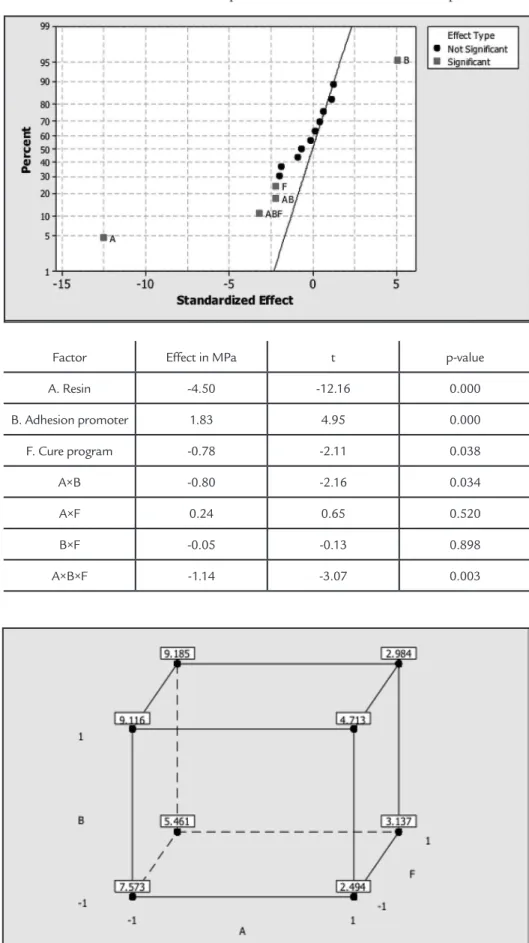
Table 4. Figure 1 shows the normal plot of the effects. The signiicant factors are A (resin), B (adhesion promoter), and F (cure program), and the A×B and A×B×F inter-actions. The factors C (compaction pres-sure), D (duration of vibrocompaction),
and E (vacuum) had no signiicant effect. The lexural strength values were much lower than the values usually obtained for composite stone. This sug-gests problems in the process of obtain-ing the samples.
Run Flexural strength in MPa
1 6.53 7.86 6.42 7.05 6.06
2 2.45 3.53 3.08 2.36 2.82
3 8.92 8.02 6.75 8.93 7.15
4 2.27 2.51 2.52 7.46 2.34
5 7.78 6.80 6.24 2.80 5.39
6 2.62 2.93 2.30 3.57 4.38
7 9.00 8.59 9.82 6.64 8.20
8 4.02 3.57 6.16 5.31 3.17
9 7.29 2.06 7.71 1.25 7.29
10 2.47 2.54 1.85 6.66 2.05
11 9.68 10.93 11.18 7.65 9.47
12 3.54 3.22 5.98 8.54 3.62
13 8.00 10.41 8.52 8.00 6.88
14 3.21 1.88 1.91 2.97 0.73
15 10.94 12.39 10.97 9.02 8.76
16 2.92 2.16 3.44 0.69 3.53
Table 3
Results of flexural strength
tests of the composite stone samples
Factor Effect in MPa t p-value
A. Resin -4.51 -12.50 0.000
B. Adhesion promoter 1.83 5.07 0.000
C. Compaction
pres-sure 0.16 0.45 0.652
D. Duration of
vibrocompaction 0.45 1.24 0.219
E. Vacuum 0.05 0.13 0.899
F. Cure program -0.79 -2.18 0.033
A×B -0.80 -2.21 0.030
A×C -0.68 -1.88 0.064
A×D -0.72 -2.00 0.050
A×E -0.23 -0.64 0.523
A×F 0.24 0.67 0.503
B×D 0.42 1.16 0.252
B×F -0.05 -0.13 0.899
A×B×D -0.31 -0.87 0.390
A×B×F -1.41 -3.17 0.002 Table 4
Results of the effect
73 REM: R. Esc. Minas, Ouro Preto, 67(1), 069-075 jan. mar. | 2015
This result allows us to rearrange the data in Table 2 in a 23 full factorial
design with 10 replicas (runs 1+13: A-, B-, F-; A+, runs 2+14: B-, F-; runs 7+11: A-, B+, F-; runs 8+12: A+, B+, F-; 5+9: A-, B-, F+; runs 6+10: A+, B-, F+; runs 3+15 : A-, B+, F+ and runs 4+16: A+, B+, F+). Table 5 shows the results of the effects according
to the 23 full factorial design, which are
practically the same as those in Table 4. Figure 2 shows the cube plot of the signiicant effects. The resin is the factor with the greatest inluence. The lexural strength decreases when using the special resin on average 4.51 MPa compared to the commercial resin. The adhesion
pro-moter has the second greatest inluence. Its use increases the lexural strength, on average 1.83 MPa. There was a small, but signiicant interaction between the resin and the adhesion promoter. The value of this interaction was negative (-0.80 MPa). This shows that the adhesion promoter has a smaller effect on the special resin.
Figure 1 Normal plot of the effects (response is
flexural strength, alpha = 0.05).
Factor Effect in MPa t p-value
A. Resin -4.50 -12.16 0.000
B. Adhesion promoter 1.83 4.95 0.000
F. Cure program -0.78 -2.11 0.038
A×B -0.80 -2.16 0.034
A×F 0.24 0.65 0.520
B×F -0.05 -0.13 0.898
A×B×F -1.14 -3.07 0.003
Table 5 Results of the effect calculations
(t0 = t72;0.05 = 1.99) for the 23 full factorial design Standard deviation = 0.36 MPa
In fact, Figure 2 shows that the adhesion promoter increases the lexural strength in average 2.63 MPa using the commercial resin, while such an increase is only on average 1.04 MPa with the special resin. Although smaller, the effect of the adhesion promoter with the special resin is still signiicant. The cure program has a small, but signiicant effect on lexural strength. Its effect is on average -0.78 MPa. The interactions of the cure program with the resin or the adhesion promoter are not signiicant. However, the interaction between these three fac-tors is signiicant, with a negative value of -1.14 MPa. That is, a temperature increase from 80 to 90 oC in the cure program decreases the lexural strength. Differential scanning calorimetry (DSC) was used to determine the degradation
temperature of the resin in composite stone. The degradation takes place for temperatures higher than 300°C. There-fore, the cure program does not affect the polymeric resin properties.
There was no significant effect from the compaction pressure. This fact may be due to the use of very high pres-sures, which also prevented the effect of the vibrocompaction duration, which was also not signiicant. It suggests that lower pressures should be investigated. The fact that the vacuum did not cause a signiicant effect also merits an analysis of the design of the vacuum mechanism through a hole in the wall of the mold. Another possibility is that the use of very high pressures may have entrapped air bubbles in the samples, preventing the action of the vacuum. Without the
vacuum effect, the presence of pores in the samples is expected, caused by the entrapment of air bubbles. In fact, the average density of the samples was 2.53 g/cm3, slightly below the expected range
of 2.54 to 2.56 g/cm3. This lower density
may have contributed to the low lexural strength values.
The analysis presented above con-siders that the data of Table 5 can be described by a normal distribution. A more rigorous approach should consider the Weibull distribution, shown in Table 6, where σ50 is the average flexural strength, Δσ50 is the standard deviation and R2 is the correlation coeficient. The
highest lexural strengths were achieved in runs (7+11) and (3+15), conirming the results obtained above (use of com-mercial resin and adhesion promoter).
Runs Flexural strength, σ50,
in MPa Standard desviation, ∆σ50, in MPa R2
1 + 13 5.787 0.440 0.769
2 + 14 2.981 0.125 0.549
7 + 11 8.972 0.132 0.955
8 + 12 4.036 0.225 0.788
5 + 9 7.115 0.257 0.897
6 + 10 2.605 0.138 0.917
3 + 15 9.546 0.155 0.942
4 + 16 3.519 0.243 0.788
4. Conclusions
Table 6
Flexural strength tests of the composite stone samples according to Weibull statistics.
A methodology for the simultane-ous study of the effects of process fac-tors for obtaining samples of composite stone was presented by using a frac-tional factorial design. This methodol-ogy helps to optimize the process, both technically and economically.
A new lab assembly was used to obtain samples of composite stone. The effects of the following parameters were studied: type of resin, use of adhesion promoter, compaction pressure, dura-tion of vibrocompacdura-tion, use of vacuum, and cure programs. Flexural strength was the response variable. Within the range of values of the factors analyzed,
it was determined that the resin type exerts the greatest effect on lexural strength. The use of a special resin caused a decrease in lexural strength. The use of the adhesion promoter had the second greatest inluence, causing an increase in lexural strength. Although the adhesion promoter is more eficient with the use of commercial resin, its inluence with the use of a special resin was still signiicant. The cure program had a small, but signiicant inluence on the lexural strength value.
The compaction pressure, dura-tion of vibrocompacdura-tion, and use of vacuum had no signiicant inluences
on lexural strength. This fact suggests that it is necessary to investigate new value ranges for these factors by means of the surface response methodology. The negligible inluence of the vacuum shows that the samples must have had residual porosity, which was later con-irmed by density measurements. This residual porosity may have contributed to the low lexural strength values of the composite stone samples.
75 REM: R. Esc. Minas, Ouro Preto, 67(1), 069-075 jan. mar. | 2015
Received: 23 May 2013 - Accepted: 20 July 2014.
6. References
BIAZZO, I. et alii. A theory of amorphous packing of binary mixtures of hard sphe-res. Physical Review Letters, v. 102, n. 19, p. 195701, 2009. Disponível em <arxiv. org.pdf/0903.5099.pdf>. Access on 18/07/2013.
GALETAKIS, M., RAKA, S. Utilization of limestone dust for artiicial stone produc-tion: an experimental approach. Minerals Engineering, v. 17, n. 2, p. 355-357, Feb 2004.
LAM DOS SANTOS, J. P., ROSA, L. G., AMARAL, P. M. Temperature effects on mechanical behaviour of engineered stones. Construction and Building Mate-rials, v. 25, n. 1, p. 171-174, Jan 2011.
LEE, M. Y. et al. Artiicial stone slab production using waste glass, stone fragments and vacuum vibratory compaction. Cement & Concrete Composites, v. 30, n. 7, p. 583-587, Aug 2008.
PIZZITOLA, I. C. P. Estudo da incorporação de ibras curtas de sílica amorfa em compósitos de polipropileno utilizados pela indústria automotiva nacional. São Paulo: Escola Politécnica, Universidade de São Paulo, 2011. 131 p. (Dissertação de Mestrado em Ciências Sociais).
SOUZA, E. W. D. Estudo para fabricação de reletores automobilísticos utilizando um material compósito termoixo e um material termoplástico. 2010. São Paulo: Instituto de Pesquisas Energéticas e Nucleares, Universidade de São Paulo, 2010. 112 p. (Dissertação de Mestrado em Tecnologia Nuclear).
TASSONE, P. and TONCELLI, M. Procedure for fast curing at high temperature of polyester resins used as binding in the production of polymer concrete slabs. In: PROCEEDINGS OF THE VIII INTERNATIONAL CONGRESS ON POLY-MERS IN CONCRETE, Jul. 03-05, Oostende, BELGIUM. 1995. P. 352-356. XIANG, J. The effect of air on the packing structure of ine particles. Powder
Tech-nology, v. 191, p. 280-293, 2009.
5. Acknowledgments
To the inancial support of Fape-mig, CNPq, and CAPES. To Samarco