Can tourism score with
Football
Nuno Falcão
Dissertation written under the supervision of Professor
Helena Maria Correia Neves Cordeiro Rodrigues
Dissertation submitted in partial fulfilment of requirements for the MSc in
Strategic Marketing, at the Universidade Católica Portuguesa, April 2020.
2
Abstract
Dissertation: Can Tourism Score with Football The Author: Nuno Falcão
Sports Tourism industry has been studied for a long time, resulting in many research articles and scope reviews. Past research focus mainly on sports mega-events, to advance previous investigation the present research focuses on tourism from single football games of European Competitions that largely contributes to the Tourism industry in the European continent: Champions League and Europa League. The main objective of this dissertation is to understand if some motivations and necessities influence the intention to visit the city where the event takes place. In order to study the hypotheses, using a quantitative approach, it was used a questionnaire, developed based on the Conceptual Framework and adapted from previous investigation. The questionnaire was collected via online aiming to collect the answer from people watch football games. After conducting a statistical analysis on IBM SPSS Statistics 25, using as the main test the Linear Regression to test the defined hypotheses, the findings support that:
i. Entertainment and Eustress are motivations that positively influence the sports tourists to visit the city in which they will attend the game;
ii. Facilities and Costs are necessities that positively influence the sports tourists to visit the city in which they will attend the game;
iii. Entertainment, Aesthetic and Group Affiliation are motivations that positively influence the search for recommendations of the city in which sports tourists will attend the game; iv. Facilities and Costs are necessities that positively influence the search for
recommendations of the city in which sports tourists will attend the game.
3
Resumo
Título da Dissertação: Can Tourism Score with Football Autor: Nuno Falcão
Turismo desportivo como indústria tem sido alvo de vários estudos, resultando numa vasta pesquisa. Os estudos baseiam-se em particular nos megaeventos desportivos. De forma a complementar a pesquisa existente, a presente dissertação tem por objetivo estudar um único evento desportivo que contribui para o desenvolvimento do turismo no continente europeu: os jogos de futebol das competições Europeias, tanto Champions League como Europa League. O principal objetivo desta dissertação é perceber se certas motivações e necessidade influenciam a intenção de visitar a cidade na qual irão assistir ao jogo. O método principal foi o estudo quantitativo, foi utilizado um questionário, desenvolvido com base no Modelo Teórico e adaptado de pesquisas anteriores. O questionário foi divulgado online em grupos onde o futebol é o tema principal, de modo a conseguir captar o máximo de respostas que tenham o enquadramento do tema. Após a análise estatística através do IBM SPSS Statistics 25, utilizando uma Regressão Linear para analisar as hipóteses, confirmando:
i. Entretenimento e Emoção são motivações que influenciam positivamente os turistas desportivos a visitar a cidade onde irão assistir ao jogo;
ii. Instalações e custos são necessidades que influenciam positivamente os turistas esportivos a visitar a cidade onde irão assistir ao jogo;
iii. Entretenimento, Estética e Ida em Grupo são motivações que influenciam positivamente a busca de recomendações da cidade na qual os turistas desportivos vão ao jogo; iv. Instalações e custos são necessidades que influenciam positivamente a busca de
recomendações da cidade em que os turistas desportivos comparecerão ao jogo.
4
Aknowledments
I would like to thank my family and friends for the incentive to continue my studies and pursue a Master’s Degree. Their support was crucial to me during this year and half to keep giving my best.
I also have to thank Católica Lisbon School of Business and Economics for giving me the necessary knowledge for the elaboration of this dissertation, but also to my professional and personal life.
At last, a really special acknowledgment to my supervisor, Professor Helena Rodrigues, for the given support, assistance and encouragement over this semester.
5
Table of Contents
Abstract ... 2 Resumo ... 3 Aknowledgements ... 4 Table of Contents ... 5 List of Figures ... 7 List of Tables ... 7 1. Introduction ... 8 2. Literature Review ... 10 2.1. Sports Tourism ... 10 2.1.1. Football Tourism ... 11 2.2. Travel Motivation ... 122.2.1. Sport Fan Motivation Scale ... 14
2.3. Football ... 16
2.3.1. FIFA ... 17
2.3.2. UEFA ... 18
2.3.3. UEFA Champions League ... 19
2.3.4. Europa League... 20
3. Methodology ... 21
3.1. Objectives ... 21
3.2. Research Approach ... 21
3.3. Hypothesis Formulation and Conceptual Framework ... 21
3.3.1. Hypothesis Formulation ... 21 3.3.2. Conceptual Framework ... 23 3.4. Target Population ... 24 3.5. Survey ... 25 3.5.1. Macrostructure ... 25 3.5.2. Microstructure ... 27 3.6. Sample Characterization ... 27 3.7. Statistical Methods ... 28 4. Results ... 29 4.1. Univariate Analysis ... 29 4.1.1. Motivations ... 29 4.1.2. Necessities ... 29 4.1.3. Sports Tourism ... 29
6
4.2. Data Analysis ... 30
4.2.1. Analysis of the Hypothesis ... 30
5. Discussion ... 34 6. Conclusion... 37 6.1. Limitations ... 38 6.2. Future Research ... 38 References ... 39 Appendix ... 44 Appendix 1 - Questionnaire ... 44 Appendix 2 - Tables ... 49
7
List of Figures
Figure 1 – Conceptual Framework ... 24
List of Tables
Table 1 – Linear Regression to test H1 ... 31Table 2 – Linear Regression to test H2 ... 32
Table 3 – Linear Regression to test H3 ... 32
Table 4 – Linear Regression to test H4 ... 33
Table 5 – Micro-Structure ... 49
Table 6 – Demographic Characterization ... 50
Table 7 – Univariate Analysis - Motivations ... 50
Table 8 – Univariate Analysis - Necessities... 51
8
Introduction
In sports, globalization is the process of involvement and interaction among people, companies, and governments of different countries. Practical effects, as the development of communication and technology, the entrance and competition in the foreign markets, and cross-cultural management have contributed to the development of the world.
Due to globalization effect, tourism is also growing worldwide, counting with 1.4 billion international tourists. Despite of that, it is in Europe where we can observe higher growth rates and a more significant number of tourists visiting the old continent, counting with more than 710 million tourists in 2018 (“Tourism-Our World in Data”). The development of infrastructures, such as hotels, restaurants, museums, public spaces, and transportation systems, made the European countries better prepared to accommodate a higher numbers of tourists. As the effects of tourism growth have been felt worldwide, several types of tourism were developed, such as health and medical tourism, religious tourism, business tourism, or sports tourism.
Sports tourism is responsible for 10% of the world tourism industry, which makes it a trending topic that has been analysed in the recent past (“Sport tourism - World Sport Tourism Show”). Nowadays, it is possible to observe a lot of sports tourists traveling around Europe. The development of transport and infrastructure facilities that facilitate the trip to the host country contribute to the greater openness of the different countries to welcome tourists from other countries. The increase of information and communication that enables an improvement of the knowledge of the event details and make it easier to travel to another location to attend the event (“How Sports Tourism is Boosting Local Economies | The World Financial Review”).
Looking through the different sports, we can identify football as one of the main attractions for this type of tourism in Europe. The European football market had a value of €28.4 billion in the season 2017/18 and is growing every year (“European football market size 2006-2018 | Statista”). Move millions of fans throughout Europe, people talk about it every day, is a growing source of revenue, promote TV programs, and is an essential source of advertising for the major world brands.
In the last decade of the 20th century, scholars started to pay attention to this trending topic,
conducting research on sports. Most of the scientific work focus on the so called mega-events, for example the FIFA football World Cup or the Olympic Games. This type of events assumes a common ground and have a predefined region where all the activities happen. Represent a large number of supporters and take place over a long period of time, it is not just a singular
9
event and makes it mandatory for the local host countries to think ahead how to prepare the infrastructures to accommodate these people. The main objective of previous studies focus on the consequences of the mega-events like the financial impact or the implications for the host countries. Despite the significant importance of the mega-events, this project will focus on a on single event the football games. Facing individual football games, it is possible to see that all the teams travel every week from their own town to a different place to play; and the fans follow their team wherever the team plays.
Observing a substantial growth of tourists in Europe, the study will analyse the two biggest football competitions in Europe: Champions League and Europa League. Both competitions are organized by UEFA, an umbrella association of FIFA, which is the primary football association of the world. The number of spectators of both competitions increased more tans 3 million in the last 20 years. (“Liga Europa - Espectadores | Transfermarkt”; “UEFA Champions League - Attendance figures (Detailed view) | Transfermarkt”).
Having this in mind, the focus of the project will be on understanding the needs and motivations of Portuguese to go abroad to watch a football game of European competitions. Thus, the needs and motivations to become this type of sport tourist.
Therefore, the main objective of this Dissertation is to answer the following research question:
Does football fans motivations and necessities have an influence on intention to visit the city in which the European Competion takes place?
To be able to investigate this topic more deeply, the dissertation has a Second Objective:
To investigate if football fans motivations and necessities have impact on searching for recommendations of the city where the game will occur.
This dissertation is divided into four main sections - the first section is the “Literature Review”, which based on previous research, aims to analyze the main topics of this study (Sports, Tourism and Motivations). The succeeding sections will explain the “Methodology” used to collect the necessary data, followed by the “Results” and “Discussion” of the assembled information. In the last section, the “Conclusions” will resume the main findings of this study, providing information to answer the main question of the study.
10
2. Literature Review
2.1 Sports TourismSports and Tourism are growing industries. Both are being studied, and articles are being written because there is a lot of unknown things about these industries (Higham, 2018). There isn´t a clear and universal definition of Sports Tourism.
The concept of sports tourism is considering more than the sum of its parts. It is not an addictive combination but a new concept (Weed & Bull, 2012). In fact, both industries are known to be connected for a long time ago, but in the last few years, researchers are becoming interested in the possible outcomes with the relation of both concepts. The number of studies increased, and the attempts to define the concept of sports tourism have been growing. Nevertheless, there isn’t a formal and universal definition of Sports Tourism.
Several researchers tried to define it from different angles. Early researchers exclude spectators in the definition of sport tourists, considering only individuals who actively participate in sports during holiday time (De Knop, 1987). Active sports vacations can be a sport trip like skiing, a non-organized sport activity that happens during vacation, or merely taking advantage of the sports facilities that tourists find in the holiday place (Gibson, Lamont, Kennelly, & Buning, 2018).
Later, factors as technological advancements, better transportation infrastructures, and growth of media coverage helped the development of spectatorship as a tourism experience, making scientists realize that they must consider spectators as part of the definition of sport tourism (Kurtzman & Zauhar, 2005). Therefore, travel away to participate in a sport or just to observe it are the behaviors that a sport tourist take part (Higham, 2018). Having these definitions in mind, sport tourists can be divided into three groups: event participants, event spectators, and sport lovers, those who travel to take part in self-organized sports (Higham, 2018). Another definition that summarize the above is sports tourism as “all forms of active and passive involvement in sporting activity participated in casually or in an organized way for non-commercial or business/non-commercial reasons, that necessitate travel away from home and work locality” (Standeven & De Knop, 1999). At some point, despite several different definitions of sports tourism, all of them agree that sports tourists visit or participate in a sport event they are attending. Consequently, they can be divided and analyzed into two different groups: active and passive sport tourists.
11
As stated above, travel away to participate in some type of sport is active sport tourism. Active sports tourism can be viewed as a potential travel market segmentation because tourists have different needs, and those can be explored by the organizations that have as main objective offering sports holidays to their guests (Vamplew, 2013). Skiing, golf, cycling or tennis are examples of activities that make tourists travel away from their places. Also, it was found that the likelihood of active participation in sport tourism is related to age since it decreases when age increase (Higham, 2018). Therefore, it is possible to state that some active sport tourists become passive.
Passive sports tourism is everything except active sport participation. Examples of passive sports tourists can be the spectators of events in the stadium, visiting sports museums or sports facilities (Ritchie & Adair, 2004). Some researchers define two different types of passive sports tourists: first, the ones the intention to travel is linked with to attending a specific event; second, those that decided to go with a different purpose but being there, experience passive sport tourism.
Another study was developed that states sports tourism a little bit differently, dividing the definition into three groups. Active sports tourists, as stated above, those who the first travel intention is to participate in sports. Event sports tourists, which is like passive sports tourism, therefore, tourists that travel to attend or spectate some sport event. Finally, nostalgia sports tourism, which is represented by living a more reliable experience like the atmosphere of the stadium (Gibson, 1998).
A different classification that aimed to highlight the type of motivations that drives the visitor intention to travel was developed and distinguish sports tourism from tourism sports. Sports tourism applies to those who travel primarily to experience competition in some way, and tourism sport to those who sport is a secondary or incidental reason to travel (Getz & Page, 2014).
2.1.1 Football Tourism
As stated above, tourism is divided into different categories, of which sports tourism is one of them. Sports tourism is also divided into different types of tourism, like golf tourism, skiing tourism, or football tourism. Football tourism is the most attractive sports tourism type and represents people that travel to play or join some activities related to football. Football clubs play an important role in football tourism demands (Gumusgul, Kalkavan, Ozdilek, Demirel, & Dogan Ustun, 2013). Football is the largest and the most popular sport worldwide, and the
12
number of people involved in growing and expanding the popularity of the game (“Fan Favorite: The Global Popularity of Football is Rising – Nielsen”).
Football tourists are the group of people that travel due to some type of football event, which is usually a football game. Within this group, it is possible to define the three significant groups of football tourists: the most usual are the football teams that have to travel to play a game. These press members visit the city where the game will occur to make news, and finally, spectators who are the largest group of football tourists (Erdogru & Yazici, 2013).
Seasonal tourism is a theme explored by many researchers due to the adverse effects it can have not only on the destinations but also on the people living within those destinations (Higham & Hinch, 2002). Seasonality is usually caused by two different groups of factors, natural and institutional (Grobelna & Skrzeszewska, 2019). Inherent seasonality is linked with climate and weather conditions throughout the year, like precipitation, wind, temperature, daylight. These types of factors can influence the satisfaction of tourists. Institutional factors focus on the social norms and practices of society and are represented by the cultural elements, ethnicity, industrial holidays, school (Higham, 2018). Sports tourism in Europe helps in the seasonality problem. The tourism associated with sports is dependent on the time of the year the sports events will be, and most of the European countries have sports seasons between September and June. This was facilitated by the development of Europe, which lead to a professionalization of several sports. The uniformization increased the mass participation due to reasons like fitness, social contact, health, performance, or simply because of the development of the interest by some type of sport (Sloan, 2012).
Football isn’t an exception; most of European countries have internal competitions from September to June. Also, the two biggest football competitions in the European context, Champions League and Europa League, are within this period. As being the primary sport in Europe, football helps the seasonality problem because of the number of people traveling within the off-season because of the sport increase (Getz & Page, 2014).
2.2 Travel Motivation
As stated above, sports tourism presupposes that someone travels away from his place to go abroad and watch or participate in some type of sports. In order to accomplish this research, it is essential to understand what could make someone go elsewhere to attend or participate in some kind of game. With this aim, in this chapter is going to be analyzed the past research about travel motivations.
13
First, it is essential to state that motivations are elements that help the segmentation process in the tourism process (Higham, 2018). Motivations can vary among different people, destinations, segments, situations, and help to recognize tourists’ preferences and values. Understanding that motivations can vary considering different perspectives, we can say that motivation is a dynamic concept (Kozak, 2002). Past research has shown that tourists are influenced not only by one motivation but by multiple different motives that, related to needs, are the factors that make someone travel abroad (Goodall, 2013).
Researchers have been studied the reasons that make people travel, aiming to understand why people are going. As already stated above, it is a combination of needs and motivations that make people fly. The most common approach to understand people's needs is the Maslow pyramid, which states a hierarchy of needs (Maslow, 1943). The pyramid represents different levels disposed of by their importance, where the most relevant ones support the others. At the bottom of the pyramid, there are physiological needs that can be represented, for example, by sleep, thirst, hunger, and shelter. Next, there are the safety needs, expressed, for instance, by financial, emotional, and personal security. The third level of the pyramid is the social needs such as friendships, love, family, and intimacy, followed by self-esteem needs, represented by respect from others, recognition, and status. At the top, there are the self-actualization needs, such as utilizing and developing abilities and talents and pursuing goals. Following Maslow's’ theory, to move up in the pyramid and achieve the self-realization level, the needs at the referent level should be fulfilled and satisfied (Maslow, 1943).
Maslow’s theory has been studied and analyzed over time, and a lot of researchers considered that the levels are not independent, but they are continuously overlapping each other. Having this in mind, some researchers studied Maslows’ pyramid and interpreted it in a tourism context. Looking through it, researchers contradict Maslow and state that, in a tourism context, it is possible to satisfy higher needs even if the lower ones are not satisfied. In other words, it is possible to satisfy self-esteem needs, yet if safety needs are not fully met (Mayo, E.J., & Jarvis, 1981). Researchers believe that, when people travel, tourists attribute more importance to intellectual needs than to the first two levels of the pyramid: physiological and safety needs. This happens first because people tend to forget the problems when traveling in vacation time. Therefore, tourists usually forget the lower needs in these situations. In the second place, they are available to meet higher needs as the self-esteem ones (Mayo, E.J., & Jarvis, 1981). Despite this, scholars agree with Maslow’s theory regarding the last level of the pyramid. Both the theory and researchers assume that just a few achieve the need for self-realization (Mayo, E.J., & Jarvis, 1981).
14
Different positions were stated about the travel motivation needs, which are based on the Maslow’s pyramid, and several researchers designed different theories about it. All the studies assume that motivations can be a useful information for marketers because they can help in segmenting and positioning tourists to provide the exact experience they expect.
One study assumes that travel decisions are made based on push and pull motivation factors, defining pull factors as natural and historical environments, cleanliness and safety, easy access, outdoor activities, and sunny atmosphere. Consider as push factors novel experiences, escape, knowledge-seeking, fun, rest, and togetherness with friends and family (Higham, 2018).
It is easy to state a long list of known motivations to travel, but it is difficult to organize them in a way that can help some type of research. That’s precisely what was done by some scholars, an attempt to categorize the different motivations. The final work sums up all the motivations into four different categories. The first one is real motives, which includes sports, health, recreation, and relation. Desire to know other cultures, art, religion, music, and dance are examples of the second category defined, cultural motives. The third category represents interpersonal motives, which are represented by the desire to visit friends or family, the desire to make new friends, or, on the other hand, to have some distance from the family. Finally, the status and prestige category that focus the recognition, respect or reputation (Sharpley, 2018) Looking into sports travel motivations, there were several attempts to measure the level of motivation of sports tourists. To achieve the objective, it was developed the Motivation Scale for Sport Consumption (MSSC). Measuring the psychological motivations of sports tourists is the primary objective of the method. The scale was based on ten different factors that can be divided into push and pull factors: achievement, acquisition of knowledge, physical attractiveness of participants, escape, aesthetics, eustress, social interaction, family, and quality of the physical skills of participants (Trail & James, 2001).
2.2.1 Sport Fan Motivation Scale
In the past several decades, scholars have dedicated a lot of time trying to understand which the main motivations of sports tourists are. Some different theories were developed, but one of the most used is Sport Fan Motivation Scale (SFMS). The scale is measured based on eight different factors: eustress, self-esteem, escape, entertainment, economic, aesthetic, group affiliation, and family affiliation (D. L. Wann, 1995). Understand which are the main motivations of people
15
that attend sporting events (spectators), and the ones that are enthusiastic with some type of sport (fans) are the key objectives of the scale.
The quality of the Sport Fan Motivation Scale was tested by applying it to different groups and compare several sports. The improvements made the authors confirm and improve the reliability of the eight-factor model (D. Wann, Schrader, & Wilson, 1999).
Going through the psychological factors in greater detail, escape motive focus on diversion that comes from the use of sports, either as a sport fandom or just as a spectator of some sport (D. L. Wann, Grieve, Zapalac, & Pease, 2008). The idea is to make an individual forget about his daily routine, such as work problems or home life, and break it temporarily to focus his attention on a hobby.
The economic motive is typical of a person who is more attracted to a sport due to the possibility of potential gains that comes from sports wagering (Higham, 2018). These people may not be the typical sports spectator because they are not worried about standings and do not identify themselves with sports or players; the primary issue is to make money with their bet. Another hypothesized motivation is eustress, which is euphoric stress. Eustress is a positive form of stress that causes excitement in an individual and gives him energy. Spectators that are motivated by eustress enjoy the thrill of a game because it creates the state of wellbeing and entertainment coming from the stress feeling (Yu, 2010).
Entertainment is the fourth motive defined in the SFMS model. Individuals consider sport as an enjoyable pastime comparable to watching television or going to the theatre (D. L. Wann et al., 2008). Watching the favourite team succeed, watching violent sports, or watching a failure of rivals are ways of sporting entertainment (Yu, 2010). Other individuals are motivated by the desire to increase their esteem. Sports can help individuals to create and maintain a self-concept. Based on an association with a team, the feelings of accomplishment and achievement are developed, mainly when their team is successful (Hambrick, 2010).
The sixth motive that can influence sports consumption is aesthetics, which is represented by the individuals who consider sports as a form of art. Gymnastics or synchronized swimming are sports where the artistic component is highly valued, but depending on each person, all sports can have a stylistic motivation. The last two motives focus on the social side of being a sports spectator. Group affiliation resumes the necessity of share the spectating experience as being part of a group. The opportunity of having some time with their friends is an essential factor that drives the sports decisions of some individuals. The family motive is identical with the group affiliation. Instead of spending some time with others in general, individuals look to sports consumption as a way of passing the time with their family (D. L. Wann et al., 2008).
16
Looking through the different models that identify individuals’ necessities and motivations, it is possible to analyse the market by segmenting and categorizing the specific groups. Since both tourism and sports are growing industries, these types of models can be beneficial for companies and associations. They can use it to promote and organize events and develop more accurate strategies to increase efficiency and returns.
2.3 Football
As stated above, football or soccer is the number one sport, not only in Europe but in the world. The market size of European Football of the season 2017/18 was €28.4 billion, a number that has been increasing every year (“Annual Review of Football Finance 2019 | Deloitte UK”). Players’ market value has been growing. In the last six seasons, there were more than ten-player transfers that cost more than 100 million euros (“Soccer players highest transfer fees all-time 2019 | Statista”). The football industry is not only growing due to the market value of the players but also by the attendances and broadcasting rights (“Annual Review of Football Finance 2019 | Deloitte UK”).
But it wasn't always like that. Football went through several stages before it reached today's dimension. The first scientific evidence of a sport similar to football date back to the second and third centuries BC. In China, during the Han Dynasty, it was created a military exercise where the soldiers had to control a small leather ball without touching it with their hands. The exercise, called Tsu’ Chu, was the first of many different forms of football over many years (“History of Football - The Origins - FIFA.com”).
Therefore, it was only in the nineteenth century that football, as we all know today, started to take shape. Started in the beginning of the century with a lot of England schools implementing football as an education system, they believed in football as a sport capable of developing some personal qualities as loyalty, cooperation, and team spirit. Despite all of that, different versions of football were being played, and the uniformization was becoming a common goal. Thus, a meeting between London schools and clubs in 1863 mark the birth of the first football association (“History of Football - The Global Growth - FIFA.com”).
In the following years, several challenges were shaping the football we know today. Competitions were created, international games among national teams started to be played, and it was legalized the professionalism of players. These solutions have made it possible for football to grow. Nowadays, European countries have football leagues, and national teams play games during the year. And the fact that players become professionals allows players to have
17
high market values and become significant assets for their clubs (“Soccer players highest transfer fees all-time 2019 | Statista”).
In the late 19th and early 20th centuries, the United Kingdom began to spread football throughout Europe. The growth was visible, and quickly football associations were created in various countries around the world. Therefore, at the beginning of the 20th century, it was
founded FIFA, an international association that represents all national associations throughout the world (“History of Football - The Global Growth - FIFA.com”).
2.3.1 FIFA
Football was being spread throughout the world, and countries were feeling the necessity to create an association that organizes and uniformize football. The association was created in Paris in the 21st May 1904, where France, Belgium, Denmark, the Netherlands, Spain, Sweden,
and Switzerland are considered the founders. They decided to Fédération Internationale de Football Association (FIFA) (“History of FIFA - Foundation - FIFA.com”).
The number of members was getting higher every year. National associations were one by one adhering to FIFA’s ideas for the international football. As the number of members was growing, FIFA’s congresses started to talk about a competition that could integrate all members. Thus, in 1930, counting with 41 members, it was played the first World Cup, a tournament created by FIFA that count with national teams (“History of Football - The Global Growth - FIFA.com”). From the beginning until now, FIFA has grown a lot. Nowadays, FIFA has 211 members distributed for six different confederations (“FIFA - FIFA.com”):
● AFC - Asian Football Confederation (47 members) ● CAF - Confederation of African Football (56 members)
● CONCACAF - Confederation of North, Central American and Caribbean Association Football (41 members)
● CONMEBOL – Confederación Sudamericana de Fútbol (10 members) ● OFC – Ocean Football Confederation (14 members)
● UEFA – Union of European Football Associations (55 members)
FIFA is responsible for three different sports: football, futsal and beach soccer. Each of the sports have different competitions where the responsibility to organize them is from FIFA. All three sports and the various competitions are analyzed by FIFA every year to understand the changes needed to improve it all over the world. Since the day one, FIFA organized conferences to help in the decisions required, counting now with a total of 69 meetings.
18
The main competition organized by FIFA is the football World Cup. As stated above, the first one was in 1930 in Uruguay and counted with 13 teams and 18 matches. After 21 World Cups, the 2018 competition was in Russia and counted with 32 teams for a total of 64 games.
In the 21st century, FIFA stated itself as a significant international organization. Looking to the
financial side of the Association, we observe a big difference since the beginning of the century. In 2003, FIFA’s revenues were about €575 million and increased to €4,6 billion in 2018 (“FIFA revenue 2003-2018 | Statista”). Analyzing the growth in greater detail, one of the main reasons was the increase of the revenue with television broadcasting rights, which in 2018 was about €2544 million (“FIFA TV broadcasting rights revenue 2003-2018 | Statista”). Also helping it, are the six confederations that are growing and promoting competitions not only for national teams but also for clubs.
2.3.2 UEFA
Despite FIFA’s work, the association felt that it was essential to create umbrellas in each region of the world to be closer to each member of the organization. As FIFA has always been headquartered in Europe (first in France, then in Switzerland), concerns about European football were still present in FIFA’s mind, what made the association feel the necessity of building an umbrella for European countries only in the mid-century. To promote football and strengthen the game among the European members, it was founded the Union Associations Européenes de Football, which is usually called UEFA (Mittag & Legrand, 2010).
It started with 31 members in 1954 in Basel, Switzerland, and created to be the face of football development by projecting a united and supportive community among national associations in Europe. Over the years, UEFA implemented a lot of changes aiming to achieving the growth in football: creation of instruction courses for coaches and referees, security and safety measures, production of many competitions for clubs and national teams (“The history of UEFA | Inside UEFA | UEFA.com”).
Some competitions created like the Champions League, Europa League, or the European Cup started to grow and to attract football fans, clubs, national associations, and media. The commercial football growth was on the base of the growth of football itself. To a better understanding of this growth, it is possible to notice that UEFA’s revenues since the beginning of the 21st century increased a lot. The total income of the season 2004/05 was approximately
€660 million, and this value in the season 2017/18 was about €2,79 billion (“UEFA revenue 2004-2018 | Statista”). The media impact was clear since, in the season 2017/18, the UEFA
19
broadcasting rights revenue was about €2,26 billion (“UEFA revenue breakdown 2004-2018 | Statista”).
UEFA organizes the EURO for national teams every four years. In those years, UEFA has three significant sources of revenue and attendance for games organized by the organization. Therefore, in years in which don’t exist EURO, the two most significant sources of revenue and attendances are Champions League and Europa League.
2.3.3. UEFA Champions League (UCL)
Champions League is now the biggest football club competition in the world, where the best clubs, players and fans can prove they are the best in Europe. In the season 2017/18, the revenues of the competition achieved a value of €2,11 billion and is spread for more than 200 countries that aim to watch UCL games (“UEFA Champions League revenue 2005-2018 | Statista”; “Worldwide reach of the Lisbon final | UEFA Champions League | UEFA.com”). Despite that, the Champions League was not always a success; not even always had the same name.
UCL was the transformation of the European Cup, a competition that remained almost unchanged for 40 years. In 1992, UEFA decided to create a competition that could attract clubs, fans, and media. Started the creation of a global brand, which was established with a partnership with TEAM, a company that worked in Television and Media Marketing.
The main objective of the partnership was to create a Brand Identity for Champions League, taking advantage of the growth of the television as a critical factor for football consumption. Thus, the first measure was the centralization of commercial, branding control, and marketing of the tournament, which was a bit strange for some clubs, but it was something that increased revenues for UEFA and clubs. With this measure, clubs are no more responsible for selling broadcasting rights of Champions games, UEFA assumed this responsibility and did a great job by increasing a lot the revenues from broadcasting rights. In the season of 20187/18, UEFA achieve the value of €1.71 billion by selling the broadcasting rights for more than 200 countries (“UEFA Champions League rights revenue 2003-2018 | Statista”).
The development of the competition was based on a mix between history and modernization. With this goal in mind, UEFA defined a vision (“to create the ultimate stage for Europe’s club championship”), a mission (“giving fans the best competition in the world”), and several brand values (“proud, special, in touch, passionate”). To meet the values that the partnership thought
20
necessary, the primary objective was to create a brand identity for the Champions League, making the competition a world brand. Therefore, they focused on four symbols: an anthem that play before each Champions League game; the Trophy gained by the team that become champion; a starball which is the champions league ball and in the logo of the competition; and the house of colors which is black, white and silver. All the four symbols are though to create a mix of history, prestige, and preciousness in the fans’ minds (Holt, 2007). The objective was accomplished since the brand value of UCL in 2017 was $185 million (“UEFA Champions League brand value 2012-2017 | Statista”) and the attendances to the games have been growing, reaching over 7 million supporters in 2018/19 Champions League games, 3 million more than when compared to 20 years earlier (“UEFA Champions League - Attendance figures (Detailed view) | Transfermarkt”).
2.3.4. Europa League
Europa League is the second biggest competition of football clubs in Europe where more than 200 European clubs have already been in the group phase of the tournament (“Recordes e estatísticas da fase de grupos da Europa League | UEFA Europa League | UEFA.com”). The structure is similar to the one defined for Champions League, but the competition counts with clubs that do not belong to the elite of football, which makes it less visible than UCL. In total, 205 games played since the group phase, and 56 teams can win the competition each year.
The total revenue of the competition in the season 2017/18 achieved a value of €372 million, in which €324 million were due to the broadcasting rights of the Europa League. (“UEFA: Europa League total revenue 2007-2018 | Statista”; “UEFA Europa League broadcasting rights revenue 2012-2018 | Statista”). The number of spectators in the competition’s games reached a value higher than 6 million, an increase in the attendance of more than 3,3 million spectators compared to twenty years earlier (“Liga Europa - Espectadores | Transfermarkt”).
21
3. Methodology
In this chapter, a presentation of the methods used in the project will be made, which is based on the conceptual model of research developed and previously tested. The proposed model and the hypotheses to be tested were obtained through the literature review, which is presented in the previous chapter. The statistical models to test the hypotheses and the data collection process will also be addressed in the present section.
3.1. Objectives
The main objective of the present study is to evaluate and analyze which are the football fans main motivations and necessities that have an influence on intention to visit the city in which the European Competion (Champions League and Europa League) takes place and to further understand if football fans motivations and necessities have impact on the recommendations process.
3.2. Research Approach
This project will be using primary data, with the main source of data being quantitative data. An internet questionnaire developed to gather the quantitative data needed to test the proposed hypothesis. The survey was designed according to the research question and research objectives to guaranty that the research aim would be achieved (Veal, 2006).
3.3. Hypothesis Formulation and Conceptual Framework 3.3.1. Hypothesis Formulation
According to the literature review, there are a considerable number of studies debating the relationship between sports tourism and the motivations that lead to an individual become a sports tourist (Trail & James, 2001; Wann, Grieve, Zapalac, & Pease, 2008). Some scholars tried to understand which are the main psychological drivers that lead a person to travel to be part of a sporting event.
Based on previous studies and the Sport Fan Motivation Scale, will be analyzed in order to understand which are the essential intrinsic characteristics that influence the likelihood of visiting the city in which they will attend the game. To do so, the following hypothesis were formulated:
22 H1.1 - Eustress is a motivation that influences the intention to visit the city in which they attend the game.
H1.2 - Escape is a motivation that influences the intention to visit the city in which they attend the game.
H1.3 - Entertainment is a motivation that influences the intention to visit the city in which they attend the game.
H1.4 - Aesthetics is a motivation that influences the intention to visit the city in which they attend the game.
H1.5 - Group Affiliation is a motivation that influences the intention to visit the city in which they attend the game.
It is impossible to go through this theme without mention the practical necessities. If an individual wants to go abroad to watch a football game, he will need to think about the prices, the travel or merely the accommodation. Many researchers had a higher focus on the psychological motivations of sports tourists, and the practical necessities were studied just for a few. Despite not directly connected with sports tourism, several scholars studied the actual needs in many different situations. To go through the study, these types of research had been considered and adapted to create higher value for the thesis (Ramires, Brandão, & Sousa, 2018).
Based on the previous studies and adapting several researches in which the central theme was not sports tourism, the following hypothesis was formulated to analysis the likelihood of visiting the city in which the game takes place:
H2.1 Facilities are necessities that influence the intention to visit the city in which they attend the game.
H2.2 Transports are necessities that influence the intention to visit the city in which they attend the game.
H2.3 Costs are necessities that influence the intention to visit the city in which they attend the game.
After hypothesizing which are the main drivers that influence the likelihood of visiting the city in which they will watch a football game of European competitions, it is interesting to understand which are the main drivers that lead them to search for information about it. Indeed, nowadays, it is easy to find information about everything on the internet. Having this in mind,
23
the following hypothesis were designed based on the psychological drivers that could lead a person to search for recommendation of a city that pretend to visit.
H3.1 - Eustress is a motivation that influences the quantity of investigation for recommendations of the city in which they attend the game.
H3.2 - Escape is a motivation that influences the quantity of investigation for recommendations of the city in which they attend the game.
H3.3 - Entertainment is a motivation that influences the quantity of investigation for recommendations of the city in which they attend the game.
H3.4 - Aesthetics is a motivation that influences the quantity of investigation for recommendations of the city in which they attend the game.
H3.5 - Group Affiliation is a motivation that influences the quantity of investigation for recommendations of the city in which they attend the game.
As mentioned above, it is imperative to understand which are the practical necessities that could lead people to search for recommendations of the city I which they will attend the football game. To teste that idea, we will use the three variables mentioned above (Transports, Facilities, and Costs) as a way of understanding how much importance they have when a Sports Tourist travel to another city. Based on past studies, three hypotheses were formulated:
H4.1 - Facilities are necessities that influence the quantity of investigation for recommendations of the city in which they attend the game.
H4.2 - Transports are necessities that influence the quantity of investigation for recommendations of the city in which they attend the game.
H4.3 - Costs are necessities that influence the quantity of investigation for recommendations of the city in which they attend the game.
3.3.2. Conceptual Framework
The Conceptual Framework represented below in Figure 1, and the respective hypotheses were developed based on the literature review. This dissertation pretends to adapt and test the Model inspired on the study of (Baloglu, 2000), to study and examine the organization of informational, motivational, and mental constructs on visiting intention.
24
Figure 1 – Conceptual Framework
Font: Adapted from (Baloglu, 2000)
3.4. Target Population
For this investigation, we consider as the primary target population the football fans and belong to football discussion groups in social media. To ensure that only people of the target population answer to the questionnaire, the survey was only shared in specific groups where the topic of discussion is football.
It was preceding the final questionnaire, a pre-test made with a survey distributed between 6 of November and 11 of November, collecting a total of 47 answers. The collected data enabled us to conduct the necessary to understand if the results were consistent with supporting and
Motivations • Eustress (Eu) • Escape (Es)
• Entertainment (En) • Aesthetic (Ae)
• Group Affiliation (Ga)
Necessities • Facilities (Fa) • Transports (Tr) • Costs (Co) Sports Tourism • Intension to Visit (Sp1)
• Search for recommendations (Sp2)
H1.1 H1.2 H1.3 H1.4 H1.5 H3.1 H3.2 H3.3 H3.4 H3.5 H4.1 H4.2 H4.3 H2.1 H2.2 H2.3
25
answering the defined hypothesis. Although some changes were made, these pre-tests confirm the reliability of the first questionnaire, which allowed it be used as the main instrument to answer the research problem and objectives The final questionnaire (see Appendix 1) was distributed online through different platforms.
3.5. Survey
Survey is an example of quantitative research and is a type o research essential to gather information regarding the attitudes, behaviors, and characteristics of a population by distributing a standardized questionnaire to a sample of individuals (McLafferty, 2010).
With the aim of reach the maximum number of answers to eliminate some bias, the questionnaires were distributed essentially through social media (Facebook, Instagram, Whatsapp, and Linkedin). With this objective in mind, the survey distributed through specific social media groups that are composed of individuals that are considered football fans, and all of them had already attended in the stadium at least one football game of their team.
The survey was designed to achieve the information needed about the motivations and practical necessities of the respondents to proceed with the project. The questionnaire is based on the literature review and developed and tested scales that supported the research works cited in the second chapter. The designed survey was based on closed questions.
Distributing the questionnaire via social media may raise some sampling questions since they do not correspond to the targeted group (McLafferty, 2010). Therefore, it is assumed a bias on the questionnaire that can be explained by the usage of the distribution channels stated above.
3.5.1. Macrostructure
The data collection instrument was created to analyze the needs and motivations of individuals that could lead an individual to travel in order to watch a football game from European Competitions.
According to a macrostructure, the questionnaire was divided into four different parts. The first part was based on what can motivate an individual to go abroad and watch a football game. Next, the questionnaire went through the practical necessities and the needs the individuals thought essential to lead them to go abroad and watch a football game. The third part is
26
focussing the main objective of the dissertation, the Sports Tourism intentions. Finally, were designed demographic questions to understand how the sample is composed.
The relevant variables of the questionnaire they intend to analyze were organized in the groups one, two and three, which are divided and structured as follows:
1. Motivations ● Eustress ● Escape ● Entertainment ● Aesthetic ● Group Affiliation 2. Necessities ● Facilities ● Transports ● Costs 3. Sports Tourism ● Intention to visit
● Search for recommendations
In the first three groups of questions the answers were based on a seven-point Likert scale, where (1) represents does not describe me, (2) Does not describes me, (3) Mostly does not describe me, (4) Somewhat describes me, (5) Mostly describes me, (6) Describes me, (7) Clearly describes me. Motivations and necessities are multidimensional concepts, sports tourists motivated and need not only by one dimension, that’s why the Likert-type scale was used in this research (Kozak, 2002). Also, in the survey, it was used verbal labels instead of numbers because, over the years, several studies have shown that respondents react better to verbal than to numerical scales, there exists a tendency to avoid the extremes (Haley & Case, 1979; Shulman, 1973).
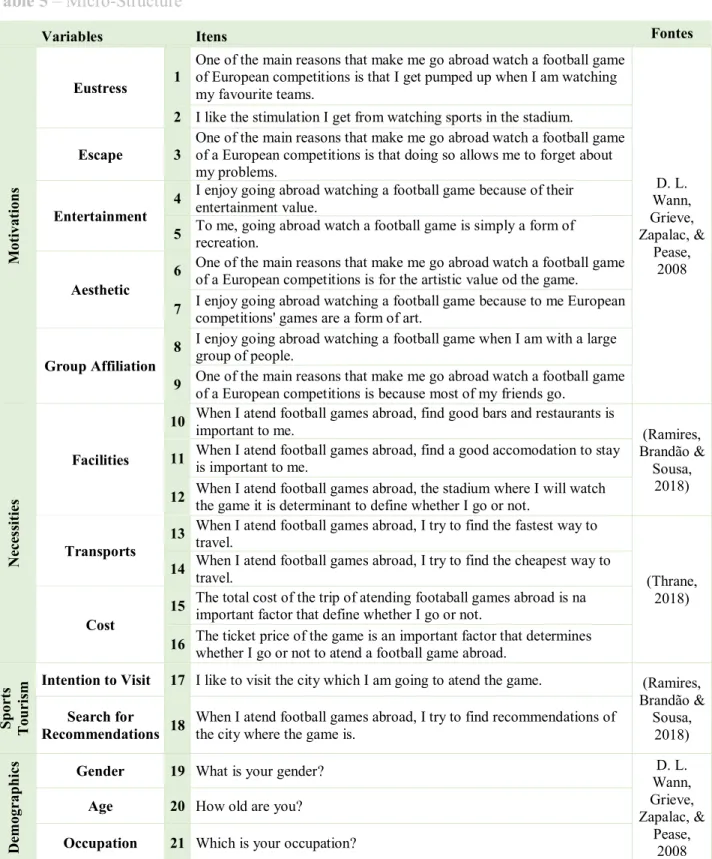
3.5.2. Microstructure
The survey is divided into four groups with a total of 21 questions. The first group of items seeks to understand the motivations that led or could lead respondents to travel abroad to watch a football game. The group is composed of five dimensions, namely: eustress, aesthetics, escape, entertainment, and group affiliation (Wann et al., 2008).
27
The second group of questions focused on the practical necessities of respondents, the needs an individual can have when goes abroad to watch a football game of European competition. This set of questions were divided into three dimensions, which are: facilities, and transports with three variables each, and the costs with two variables. The third group focus the objectives of the study, looking to Sports Tourism intention to visit and search for recommendations.
Finally, to understand the sample that answer to the questionnaire and to facilitate the tourism segmentation, the fourth group are demographic questions. It was asked to participants the gender, the age, and the occupation.
3.6. Sample Characterization and Sample Size
By understanding that the number of obtained answers influence the statistical estimates, the number of respondents by variable should be between 10 and 20 (Gorsuch, 2003). Having a total of 18 variables in this study, the number of answers obtained should be higher than 180, something that was accomplished in the study, summing more than 230 answers to the questionnaire.
As stated in the previous chapter, the sample was collected by a questionnaire posted in social media groups that relate to football. The questionnaire had 236, from which only 235 were considered as valid. The statistical characterization of the sample was performed according to gender, age, and occupation.
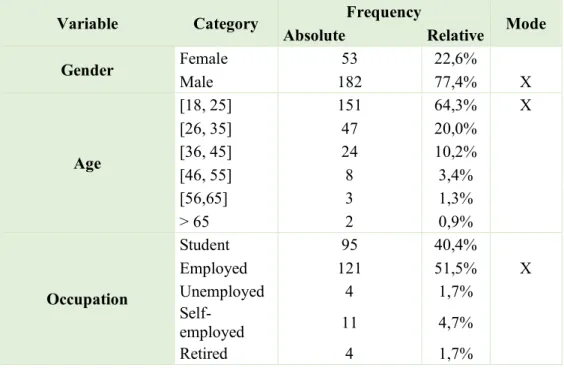
By observing Table 6, in the context of the statistical characterization of the sample about the demographic variables, it can be concluded that most of the respondents are male (77.4%) because the participants of the social media groups where the questionnaire was shared are mainly male. Although the significant difference among males and females (22.6%) participants, the number of man football supporters is much higher, so, in terms of gender, the sample can be considered a characterization of the universe. Most respondents are aged between 18 and 25 years (64,3%), followed by the participants aged between 26 and 35 years (20.0%). The sample is quite young because younger individuals compose the groups of social media where the questionnaire was shared.
The sample is almost all represented by employed (51.5%) and student individuals (40.4%). Once again, this can be explained by the way the data was collected.
28 3.7. Statistical Methods
The data were exported and codified for the statistical software SPSS version 25, to treat the data to answer the hypothesis stated above.
Thus, to present a statistical characterization of the sample, the use of absolute and relative frequency tables, as well as the mode identification for each variable.
Then, a univariate analysis was performed for each item that integrates the scales of motivations and necessities through central trend measures and dispersion, namely: mean, standard deviation, minimum, and maximum. They were 95% confidence intervals were calculated for the mean.
Finally, two different analysis were made. First, to answer the first two hypotheses were designed one Linear regression for each subgroup (Motivations and Necessities) to understand the impact of each variable in Sports Tourism. Second, with the objective of understanding if the variables’ impact is higher on the respondents that already travelled abroad to watch a football game, were designed two Linear Regressions for each subgroup, one for those who already went and one for those who didn’t.
29
4. Results
4.1. Univariate Analysis
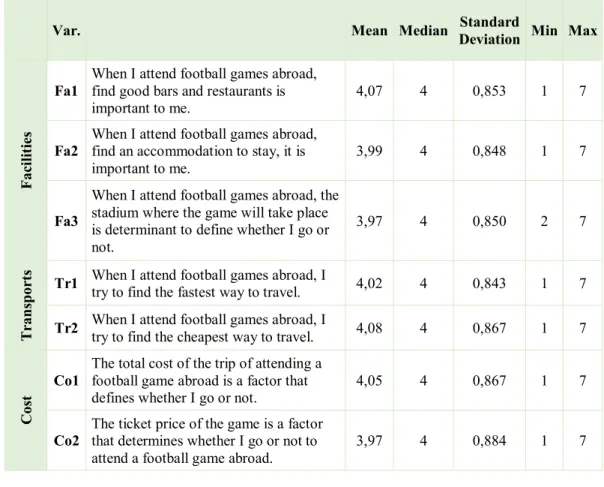
Below will be analyzed the factors that construct the support for this research, which are the motivations and necessities. Then, as we can see in Appendix 2 – Table 7, the variables that compose each one of them will be studied according to the participants’ perceptions, presenting the mean, the median, the standard deviation, the minimum, and the maximum. In the data analysis, it is generally found that the mean value obtained for the variables is close to 4 on a 7-point Likert scale that was used in the questionnaires.
4.1.1. Motivations
The motivations construct composed of 9 variables divided into five subdimensions, designated, Eustress, Escape, Entertainment, Aesthetics, and Group Affiliation.
As we can see in table 7, Entertainment and Group Affiliation are the subdimensions that counted higher values. Variables En1 and En2 had 4.26 and 4.23 respectively. Regarding Group Affiliation variables, Ga1 and Ga2, the values obtained were 4.56 and 4.61.
4.1.2. Necessities
The necessities construct composed of 7 variables divided into 3 subdimensions, designated, Facilities, Transports, and Cost, and can be analyzed through the information in Appendix 2 – Table 8.
Looking through the sub-dimension Facilities, with two different variables. Fa1 is the variable with higher mean value, counting with 4.07. Fa1 is followed by Fa2 and Fa3, with mean values of 4.99 and 4.97, respectively.
The variables that compose the Transports sub-dimension are two. Tr2, counting with a mean value of 4.08, is the one with higher mean value, and it is followed by Tr1 with 4.02. Finally, the last sub-dimension that composes Necessities is Cost. Cost is divided into two variables, from which Co1 is the one with a higher mean value (4.05), followed by Co2 (3.97).
4.1.3. Sports Tourism
Regarding the respondents’ perceptions about Sports Tourism, which is described by two variables as we can see in Table 9. The variable Sp2 was the one that obtained a higher mean value (4.17), followed by and Sp1, with mean value of 4.15.
30 4.2. Data Analysis
The subsection of the “Results” chapter, where the hypotheses will be studied through the analysis of the exported data from the questionnaire, according to the results provided by the tests conducted through SPSS.
To have an answer for each of the hypotheses, four Linear Regressions were used, since it is the most suitable test for this analysis: (1) the first one will test what is the effect that the independent variables (motivations) have on the construct “Sp1”, indicating if Motivations have a positive impact on liking to visit the city in which the game is. (2) the second Linear Regression uses as the independent variables. These constructs compose the necessity factors (Facilities, Transports, and Costs), aiming to understand if those necessities influence the will to become a sports tourist by visiting the city in which the game will occur. (3) the third Linear Regression will test what is the effect that the independent variables (motivations) have on the construct “Sp2”, indicating if Motivations have a positive impact on finding recommendations of the city in which the game will be. (4) the fourth and last Linear Regression analyzes the effect of the Necessities on the construct “Sp2”, aiming to understand they have an impact on the search for recommendations of the city in which they will attend the game.
4.2.1. Analysis of the Hypothesis
To study the hypotheses, it was used a Linear Regression test - there was no need to create dummy variables since all the variables are metric and use the same scale (7-point Likert Scale). Thus, the independent variables used for the test are Eustress, Self-esteem, Escape, Entertainment, Economic, Aesthetics, Group Affiliation and Family Affiliation, being the dependent variable Sports Tourism (Sp1). This test aims to understand the influence that Motivations have on linking to visit a city in which they will attend a football game from European Competitions.
31
Table 1 - Linear Regression to test H1 and Subsequent
Model
Summary ANOVA Coefficients
Ind. Variable Variable Dep. Rsquare Sig. Unstd. Beta Sig. VIF Eu1 Sp1 0,744 0,000 0.190 0.128 1.703 Eu2 -0.371 0.036 1.495 Es1 0.235 0.073 1.129 En1 0.313 0.001 1.542 En2 0.364 0,000 1.377 Ae1 0.009 0.909 1.371 Ae2 0.122 0.248 1.371 Ga1 0.162 0.064 1.604 Ga2 -0.09 0.296 1.539
The results presented in Table 1 will allow the necessary conclusions to analyze the respective hypothesis. The R Square in the Model Summary indicates the level of variance in the dependent variable. In this case, 0,744 of variation in the dependent variable is explained by the eight independent variables. The ANOVA test assumes the null hypothesis (H0), where all coefficients are zero, and thus, the independent variables do not affect the dependent variable. To reject the null hypothesis, the p-value (Sig.) must be lower than 5%. As we can observe in the table above, the p-value is lower than 5%, which means that we do not reject the null hypothesis, confirming that independent variables have an impact on the dependent variable. After confirming the impact of the variables, it is important to analyze the Coefficients test to verify which of the independent variables affect the dependent variable. Thus, if the p-value (Sig.) of the coefficient has a p-value below 5%, means that the coefficient is significant, and therefore, it has an impact on the dependent variable. As we can observe in Table 1, there are only three p-values below 5%. “Eu2”, “En1” and “En2”, indicate that those are the independent variables that have an impact on the dependent variable. Going through the column of the VIF, we can see that the forth variables are below 2.5, denying the possibility of Multicollinearity, which indicates a high correlation among the variables.
After studying the impact of the Motivation variables on “Sp1” construct, it is essential to make the same analysis for the necessity factors.
32
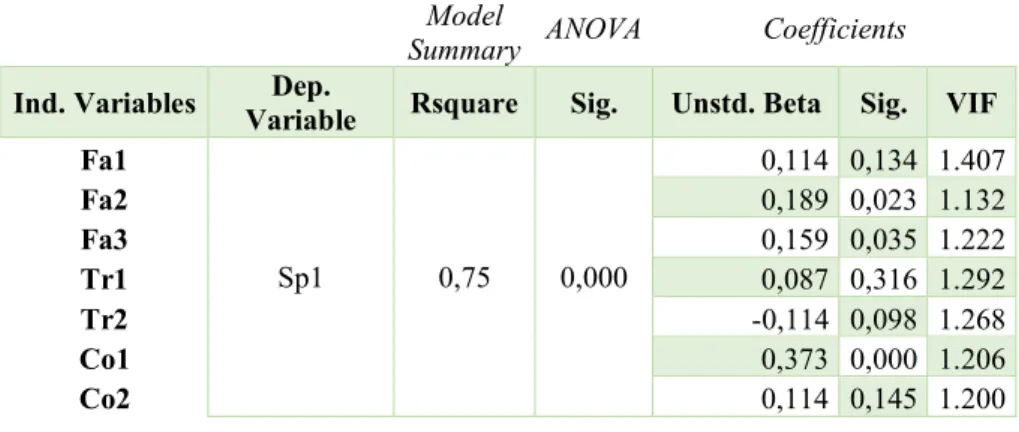
Table 2 - Linear Regression to test H2 and Subsequent
Model
Summary ANOVA Coefficients
Ind. Variables Variable Dep. Rsquare Sig. Unstd. Beta Sig. VIF Fa1 Sp1 0,75 0,000 0,114 0,134 1.407 Fa2 0,189 0,023 1.132 Fa3 0,159 0,035 1.222 Tr1 0,087 0,316 1.292 Tr2 -0,114 0,098 1.268 Co1 0,373 0,000 1.206 Co2 0,114 0,145 1.200
The R Square from the Model Summary test states that the independent variables explain 0.75 of the variance in the dependent variable applied to the Linear Regression. Regarding the ANOVA test, it is possible to reject the null hypothesis (H0), since the p-value is lower than 5%. This is the confirmation that the model is significant because the independent variables influence the dependent variable. By the coefficients test, there is three independent variables that presents a p-value lower than 5%, which means “Fa1”, “Fa2” and “Co1” have a positive and significant impact on the dependent variable. The VIF of the variable is lower than 2.5, rejecting a Multicollinearity problem.
Next will be analyzed the impact of the Motivation variables on the construct “Sp2”, aiming to understand if the eight factors influence the participants' search for recommendations of the city in which they will attend the football game.
Table 3 - Linear Regression to test H3 and Subsequent
Model
Summary ANOVA Coefficients
Ind. Variable Variable Dep. Rsquare Sig. Unstd. Beta Sig. VIF Eu1 Sp2 0,774 0,000 0.123 0.28 1.703 Eu2 0.091 0.559 1.527 Es1 -0.046 0.697 1.254 En1 0.29 0.001 1.129 En2 0.311 0,000 1.377 Ae1 0.216 0.002 1.371 Ae2 0.028 0.758 1.325 Ga1 0.262 0.01 1.371 Ga2 -0.119 0.237 1.604
33
The R Square from the Model Summary test states that the independent variables explain 0.774 of the variance in the dependent variable applied to the Linear Regression. Regarding the ANOVA test, it is possible to reject the null hypothesis (H0), since we can observe a p-value lower than 5%. This means that the independent variables influence the dependent variable, which confirms that the model is significant. By making the coefficients test, four independent variables present a p-value lower than 5%, which means “En1”, “En2”, "Ae1” and “Ga1” have a positive and significant impact on the dependent variable. The VIF of the variable is lower than 2.5, rejecting a Multicollinearity problem.
After studying the impact of the Motivation variables on “Sp3” construct, it is essential to make the same analysis for the necessity factors.
Table 4 - Linear Regression to test H4 and Subsequent
Model
Summary ANOVA Coefficients
Ind. Variables Variable Dep. Rsquare Sig. Unstd. Beta Sig. VIF Fa1 Sp2 0.768 0,000 0.309 0,000 1.407 Fa2 0.149 0.063 1.132 Fa3 0.027 0.711 1.222 Tr1 0.075 0.368 1.292 Tr2 0.005 0.936 1.268 Co1 0.323 0,000 1.206 Co2 0.051 0.502 1.200
The R Square from the Model Summary test states that the independent variables explain 0.768 of the variance in the dependent variable applied to the Linear Regression. Regarding the ANOVA test, it is possible to reject the null hypothesis (H0), since the p-value is lower than 5%. This confirms that the model is significant because the independent variables influence the dependent variable. By the coefficients test, it is possible to observe that “Fa1”, “Fa2” and “Co1” are the variables that present p-values lower than 5%. This means that these three variables are the ones that have a significant impact on the dependent variable, “Sp2”. The VIF of the variable is lower than 2.5, rejecting a Multicollinearity problem.
34
5. Discussion
The main findings of the first Linear Regression (Table 1) is that some motivations directly affect the will to visit the city in which the game will be. Although the model had demonstrated a significant effect on the independent value, Eustress (“Eu2”) and Entertainment (“En1” and “En2”) are the factors that demonstrate a higher significant value for “Sp1”. This confirms the research developed by Wann et al. (2008), proving that the emotion of the game, and the traveling with someone to watch the game influence the probability of visiting the city. Therefore, these results will lead to the confirmation of the hypothesis 1.1 and 1.3:
H1.1 - Eustress is a motivation that influences the intention to visit the city in which they attend the game.
H1.3 - Entertainment is a motivation that influences the intention to visit the city in which they attend the game.
However, despite of the research confirmation (Wann et al., 2008) that, all the eight motivations have a positive effect on their visiting intentions of the city in which they will attend the game, in this analysis we cannot confirm it for four variables: Self-esteem, Escape, Economic and Aesthetics. Thus, this will lead to the rejection of hypothesis 1.2, 1.4, and 1.5:
H1.2 - Escape is a motivation that influences the intention to visit the city in which they attend the game.
H1.4 - Aesthetics is a motivation that influences the intention to visit the city in which they attend the game.
H1.5 - Group Affiliation is a motivation that influences the intention to visit the city in which they attend the game.
Through the second Linear Regression test on Table 2, that aims to understand what is the effect that some practical necessities have on visiting the city in which they will attend the game. It is possible to infer that Facilities and Costs are important variables, leading respondents to confirm that finding the best places to stay and the cost of the trip it will influence the intention of travel to watch the game and visit the city. Therefore, we can confirm the hypothesis 2.1 and 2.3:
35 H2.1 - Facilities are necessities that influence the intention to visit the city in which they attend the game.
H2.3 - Costs are necessities that influence the intention to visit the city in which they attend the game.
However, as confirmed in Table 2, the variables Transports does not have a significant impact on the dependent variable (Sp1). This means that the way they travel to the city in which they will attend the game do not influence the intention to visit it. Consequently, this will result in the rejection of the hypothesis 2.2:
H2.2 - Transports are necessities that influence the intention to visit the city in which they attend the game.
Going through the third Linear Regression on table 3, the analysis measures the influence of the eight motivations on the intention to search for recommendations of the city in which they will attend the game. The model had demonstrated that two of the eight variables influence Sp2. Therefore, the model confirms the hypothesis 3.4, 3.6 and 3.7:
H3.3 - Entertainment is a motivation that influences the quantity of investigation for recommendations of the city in which they attend the game.
H3.4 - Aesthetics is a motivation that influences the quantity of investigation for recommendations of the city in which they attend the game.
H3.5 - Group Affiliation is a motivation that influences the quantity of investigation for recommendations of the city in which they attend the game.
Despite the positive model significance, by analyzing Table 3, it is possible to conclude that the variables Eustress, Self-esteem, Escape, Economic and Family Affiliation did not influence the intention to search for recommendations of the city in which they will attend the game. Thus, this result in the rejection of hypothesis 3.1, and 3.2:
H3.1 - Eustress is a motivation that influences the quantity of investigation for recommendations of the city in which they attend the game.
H3.2 - Escape is a motivation that influences the quantity of investigation for recommendations of the city in which they attend the game.