MATHEMATICAL CONTENTS THROUGH
TALES
Maria do Carmo Martins, PhD
Helena Sousa Melo, PhD
University of Azores, PortugalAna Isabel Santos, PhD
Sandra Vinagre, PhD
CIMA, University of Évora, PortugalAbstract
This work is about the contest “A tale that accounts” which is promoted by an organizing committee with the collaboration of Regional Delegation of South and Islands of the Portuguese Mathematical Society. This contest is open to all students of public and private schools of all country and consists of writing and illustrating a tale involving mathematical contents. The contest, which is now in its third edition, began in the school year of 2012/2013. The experience allows us to point out that it promotes the interdisciplinary between different contents and revealed to be a captivating initiative that has been well accepted by a growing number of students and teachers.
Keywords: Interdisciplinary, Mathematics, Imagination, Knowledge Introduction
The contest “A tale that accounts” (Concurso “Um conto que contas”, in Portuguese language) is open to all students of public and private schools of all country, from the first level of first cycle to the last level of secondary. In Portugal, the basic education is consisted of nine years of schooling, divided into three sequential cycles of four, two and three years, respectively, and the secondary education which is consisted of three years of schooling.
The competition consists of writing and illustrating a tale involving mathematical contents and it has as main objectives to promote habits of reading and writing in students and to promote coordination between various disciplines, stimulating the imagination.
The participants can compete in one of eight categories, according to their level of education, in individual modality or in team, with a maximum
The eight categories that participants can compete, four in individual modality or in team, are:
a) 1st category or category A1 – a competitor of the 1st, 2nd, 3rd or 4th
year;
b) 2nd category or category A2 – a competitor of the 5th or 6th year;
c) 3rd category or category A3 – a competitor of the 7th, 8th or 9th year;
d) 4th category or category A4 – a competitor of the 10th, 11th or 12th
year;
e) 5th category or category B1 – two to four competitors of the 1st, 2nd,
3rd or 4th year;
f) 6th category or category B2 – two to four competitors of the 5th or 6th
year;
g) 7th category or category B3 – two to four competitors of the 7th, 8th
or 9th year;
h) 8th category or category B4 – two to four competitors of the 10th, 11th
or 12th year.
Each tale must be accompanied by the title, the name of the author(s), the name of the responsible teacher by the participation of student(s), the name of the school and an illustrative design. The illustrative design should allow perceiving the central idea of the story.
The tales was assessed by a jury, which includes specialists from mathematics and Portuguese language. In this evaluation are valued mathematical contents (corresponding to the educational level of the participants and according to the official programs – see [5-8]), the domain of language, originality, creativity, logical narrative, among others.
The areas of the responsible teacher by the participation of students are mathematics, Portuguese language, English language, natural sciences, citizenship, art and visual technology, and also attended librarian teachers and teachers of first cycle.
Until now, there were three editions of the contest, the first of which in the school year 2012/13. The texts of the three tales highest rated in each of the eight categories were published annually in a book (see [1-3]).
The first edition – 2012/13:
In addition, the participants had to present the tales with the following specificities, namely the number of characters of each category, including blank spaces:
a) categories A1 and B1 – between 5000 and 7500 characters; b) categories A2 and B2 – between 7500 and 10000 characters; c) categories A3 and B3 – between 10000 and 12500 characters; d) categories A4 and B4 – between 12500 and 15000 characters.
In this edition were not proposed any themes to the students, so that they could write about anything, since mathematical contents were included.
In the first edition of the contest were submitted 118 tales, 48 in individual modality and 70 in team (more specifically, 14 tales to the category A1, 14 tales to the category B1, 13 tales to the category A2, 21 tales to the category B2, 13 tales to the category A3, 25 tales to the category B3, 8 tales to the category A4 and 10 tales to the category B4). This contest was attended by 278 students, but it involved about 2100 students.
Figure 1. Image of the first edition of the contest “A tale that accounts”
The second edition – 2013/14:
In this edition the number of characters of each category, including blank spaces, was changed for:
a) categories A1 and B1 – between 4000 and 6000 characters; b) categories A2 and B2 – between 6000 and 8000 characters; c) categories A3 and B3 – between 8000 and 10000 characters; d) categories A4 and B4 – between 10000 and 12000 characters. In this year was proposed Mathematics of Planet Earth as general theme, in particular for each category were proposed the following themes:
a) categories A1 and B1 – a planet to discover: oceans, meteorology and climate, mantle processes, natural resources, solar systems;
b) categories A2 and B2 – a planet at risk: climate change, sustainable development, epidemics, invasive species, natural disasters;
c) categories A3 and B3 – a planet organized by humans: political, economic, social systems and financial services, transport organization and communication networks, management of resources, energy;
d) categories A4 and B4 – a planet supported by life: Ecology, Biodiversity, evolution.
In the second edition of the contest were submitted 99 tales, 42 in individual modality and 57 in team (more specifically, 10 tales to the category A1, 11 tales to the category B1, 10 tales to the category A2, 18 tales to the category B2, 17 tales to the category A3, 26 tales to the category B3, 5 tales to the category A4 and 2 tales to the category B4). This contest was attended by 213 students, but it involved about 1063 students.
Figure 2. Image of the second edition of the contest “A tale that accounts”
The third edition - 2014/15:
In the last edition of the contest, the number of characters was the same of the second edition and were proposed the following themes:
a) categories A1 and B1 – Mathematics and Nature; b) categories A2 and B2 – Mathematics and Sport; c) categories A3 and B3 – Mathematics and Magic; d) categories A4 and B4 – Mathematics and Art.
In the third edition of the contest were submitted 151 tales, 74 in individual modality and 77 in team (more specifically, 9 tales to the category A1, 16 tales to the category B1, 26 tales to the category A2, 20 tales to the category B2, 27 tales to the category A3, 35 tales to the category B3, 12 tales to the category A4 and 6 tales to the category B4). This contest was attended by 301 students, but it involved about 2920 students.
Figure 3. Image of the third edition of the contest “A tale that accounts”
Conclusion
The contest, during these three first editions, comes involving teachers of Mathematics, Portuguese language, and even other educational areas, as well as all students in an exploratory trip using creativity and imagination, applying the mathematical concepts as a common basis in the creation of the tales, and the interdisciplinary of various topics considered over the period of the student's learning from a very early age until the degree in high school.
In Table 1 we present the data of the three editions of competition, namely the number of tales submitted and the number of students involved.
First edition 2012/13 Second edition 2013/14 Third edition 2014/15 Tales of category A1 14 10 9 Tales of category A2 13 10 26 Tales of category A3 13 17 27 Tales of category A4 8 5 12
Total of the individual tales 48 42 74
Tales of category B1 14 11 16 Tales of category B2 21 18 20 Tales of category B3 25 26 35 Tales of category B4 10 2 6
Total of the team tales 70 57 77
Total of the tales submitted 118 99 151
Attended students 278 213 301 Involving students 2100 1063 2920
The Figures 4 and 5 show the evolution of the number of stories presented in eight categories. We can observe that the second and third categories, either individually or in teams, have more participation, wherein the category B3 is the more participated and the category B4 is the less participated.
Figure 4. Graph with the number of tales in individual modality by category.
Figure 5. Graph with the number of tales in team modality by category.
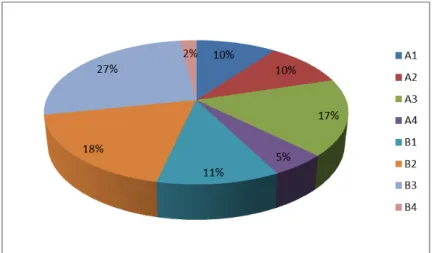
In Figures 6, 7 and 8 we present pie charts with the data of all categories in each edition of the competition.
Figure 7. Graph with the percentage of tales by category in second edition.
Figure 8. Graph with the percentage of tales by category in third edition.
This activity promotes an exchange of interdisciplinary experiences combining, as already mentioned, several areas of knowledge, in particular the Portuguese language and Mathematics. This promotes the enrichment of the relationship between students and teachers. For the student is a peculiar and interesting way to consolidate knowledge and for the teacher an effective and attractive way to promote the interdisciplinary between different contents.
Some teachers have referred that this creative process has been important in motivating all students, and not only students with better classification in Mathematics.
It should be noted that in this competition there is no prize money. In addition to the experience gained, the prize is a book with the compilation of the 24 winning tales, including the tales from first to third place in each of the eight categories.
Given the information from the first three editions, the good experiences are always contagious. We believe that the contest is a true stimulus among all students.
The sponsors of the contest have been the University of Évora, the Luís de Molina Foundation, the Research Centre in Mathematics and Applications of University of Évora, the Research Centre in Applied Mathematics and Technologies of Information of University of Azores, the Delta Cafés and the AMIL – Association of Interactive and Ludic Mathematics.
Acknowledgements:
This work has been partially supported by national founds by FCT – Fundação para a Ciência e a Tecnologia within the project UID/MAT/04674/2013.
References
Melo, Helena and Sandra Vinagre, eds. Concurso ”Um conto que contas” – 2012/13, 2013.
Melo, Helena and Sandra Vinagre, eds. Concurso ”Um conto que contas” – 2013/14, 2014.
Melo, Helena and Sandra Vinagre, eds. Concurso ”Um conto que contas” – 2014/15, 2015.
Melo, Helena and Sandra Vinagre. The contest “A tale that accounts”, Proceedings of Recreational Mathematics Colloquium, Ludus, 63–66, 2015. Ministério da Educação. Programa de Matemática do Ensino Secundário, 2001.
Ministério da Educação. Programa de Matemática do Ensino Básico, 2007. Ministério da Educação. Programa e Metas Curriculares Matemática para o Ensino Básico, 2013.
Ministério da Educação. Programa e Metas Curriculares Matemática para o Ensino Secundário, 2014.