UNIVERSIDADE DE LISBOA
FACULDADE DE LETRAS
Multiple literacies and Web 2.0
in the English as a Foreign Language classroom
Silene Cardoso
Dissertação orientada pela Prof.ª Doutora Lili Cavalheiro e
coorientada pelo Prof. Doutor Carlos A. M. Gouveia, especialmente
elaborada para a obtenção do grau de Mestre em Linguística Aplicada.
MESTRADOEMESTUDOSINGLESESEAMERICANOS
ÁREA DE ESPECIALIZAÇÃO DE LINGUÍSTICA APLICADA
2017
UNIVERSIDADE DE LISBOA
FACULDADE DE LETRAS
Multiple literacies and Web 2.0
in the English as a Foreign Language classroom
Silene Cardoso
MESTRADOEMESTUDOSINGLESESEAMERICANOS
ÁREA DE ESPECIALIZAÇÃO DE LINGUÍSTICA APLICADA
2017
Acknowledgements
I would never have been able to complete this dissertation without the support from many people, especially without the guidance of my supervisors, and support from my husband, family, and friends.
First of all, I would like to express my sincere and deepest gratitude to my supervisors Professor Lili Cavalheiro and Professor Carlos Gouveia for all the guidance, expertise, patience from the very beginning of this research. Both were always available to clarify my questions and to provide all the advice throughout my journey.
I am also indebted to all the teachers who kindly answered the questionnaire; without their contribution, this research would not have been possible. I would also like to thank
Associação Portuguesa de Professores de Inglês (APPI) for sharing the questionnaire with
their members, which was a great contribution.
Thanks are also due to my dearest friends and colleagues, from many different places, for all the support, encouraging words and understanding.
I would also like to thank my mother, for all the unconditional love, support, understanding and patience.
I could not forget to thank my cats for providing me with moments of break and fun. Finally, I would like to thank my husband for all meals, love, and supportive and encouraging words, as well as for the unconditional understanding and patience. Without your love and support, my work would have been much harder.
Resumo
As inovações tecnológicas têm transformado a sociedade contemporânea de diversas formas ao longo dos últimos 50 anos. A expansão da Internet, nesse sentido, é responsável por alterar, especialmente, a forma como as pessoas se comunicam, interagem e se relacionam umas com as outras. Como consequência, é possível ver mudanças principalmente em três esferas sociais: na vida profissional, na vida pública e na vida privada (Cope & Kalantiz, 2000).
Essas mudanças também afetaram (ou pelo menos deveriam ter afetado) a educação e o conceito de literacia, já que não é mais possível considerá-los da mesma forma que eram pensados há vinte ou mesmo há dez anos. Consequentemente, há cerca de vinte e cinco anos esse tema tem chamado a atenção de muitos pesquisadores (por exemplo, Bezemer & Kress, 2016; Cope & Kalantiz, 2000, 2008, 2009, 2014; Kress, 2003, 2005; Kress & Jewitt, 2003), que têm se preocupado com o papel da escola e da educação na sociedade contemporânea. A necessidade e a possibilidade de estabelecer novas definições para o que significa literacia nesta sociedade em constante mudança estão em foco já há algum tempo em diversas áreas do conhecimento.
Nesse sentido, aprender a ler e a escrever (o sentido mais tradicional de literacia) ganhou novas perspetivas, e hoje para poder tornar-se leitor e produtor de sentidos são necessárias competências adicionais que vão além de dominar o código linguístico. É essencial também aprender como os diferentes modos semióticos (imagens, cor, sons, gestos) são articulados para comunicar diferentes mensagens em diferentes plataformas, na página impressa ou no monitor. Diante desse facto, a Internet trouxe ainda mais desafios, e comunicar utilizando os diferentes meios que a web proporciona exige o desenvolvimento de competências ligadas ao ambiente digital.
A escola, como sendo o local onde a educação formal ocorre, não pode mais ignorar as novas tecnologias em sua realidade; mas, apesar de ser possível observar a introdução de aplicativos e outras tecnologias no contexto escolar, a abordagem a textos multimodais (aqueles compostos não apenas pela língua escrita ou oral, mas também por imagens, sons, e movimento) em ambientes digitais, assim como uma integração efetiva dessas ferramentas com os objetivos de aprendizagem, parece ainda precisar de investigações e pesquisas adicionais.
O ensino de línguas, de modo geral, e o de inglês como língua estrangeira, em particular, parecem muito beneficiar-se dos avanços tecnológicos, especialmente no que se
refere à interatividade e mobilidade que a expansão da Internet proporcionou. As novas tecnologias, nesse âmbito, parecem contribuir para o desenvolvimento das habilidades linguísticas e também das multiliteracias relacionados com esse mundo digital, incluindo sobretudo, as literacias multimodal, crítica e digital.
Considerando esse cenário, parece ser cada vez mais necessário investigar se as novas tecnologias são usadas nas aulas de inglês como língua estrangeira e de que maneira elas são utilizadas e até que ponto elas contribuem para o processo de ensino-aprendizagem. Consequentemente, as impressões e opiniões dos professores em relação ao uso das ferramentas digitais nas aulas é de grande importância.
Por questionário dirigido a professores do 3º Ciclo do Ensino Básico e do Ensino
Secundário, investigou-se como as novas tecnologias, em especial a Web 2.0, são utilizadas nas aulas de inglês destes ciclos de ensino em Portugal.
O questionário foi criado na plataforma online www.freeonlinesurveys.com e distribuído digitalmente, por email e compartilhamento em redes sociais, a professores de inglês dos referidos ciclos de estudos. Durante o período em que ficou disponível, entre 7 de fevereiro e 30 de março de 2017, foram recebidas 132 respostas válidas, as quais foram tratadas de forma anônima.
O questionário estava organizado em três partes e era composto por dezasseis perguntas fechadas, entre perguntas de escolha única, de múltipla escolha, de ordenação de elementos e escalas de Likert. A primeira parte, composta pelas perguntas de um a cinco, pretendia estabelecer os dados demográficos e, assim, traçar um perfil dos professores que participaram da pesquisa. As perguntas de seis a dez pretendiam verificar os materiais, recursos e seus usos na sala de aula. A terceira parte era composta pelas perguntas de onze a dezasseis e enfocava o uso propriamente dito da tecnologia nas aulas desses professores.
Foi possível determinar que a maioria dos professores que responderam ao questionário tem entre 41 e 60 anos de idade, leciona nas regiões de Lisboa e Setúbal ou na região Entre o Douro e o Minho. Além disso, para lecionar inglês, a maioria concluiu o Ramo de Formação Educacional e quase metade do número total dos respondentes atualmente leciona em ambos os ciclos de estudo. No que se refere aos recursos que têm disponível na escola e na sala de aula de aula, itens como projetores, computadores e Internet são os mais comuns.
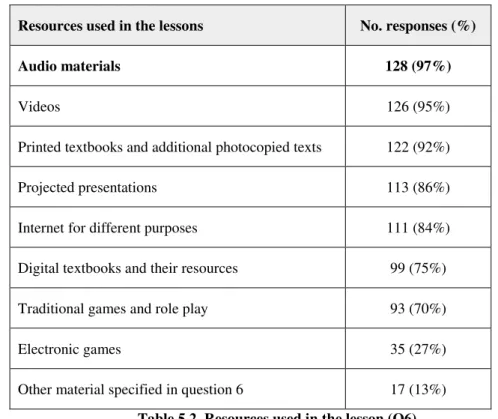
Foi também possível verificar que os materiais de áudio e vídeo, os manuais didáticos e a Internet para uso geral são os recursos mais utilizados pelos professores. Além disso, a maioria desses professores afirmou que em geral abordam outros modos semióticos nos textos
que trabalham com seus alunos e que procuram adotar ainda uma abordagem de multiliteracias, tendendo assim a concordar ainda sobre a importância de abordar os textos de forma crítica com seus alunos. Entretanto, pela própria natureza da metodologia adotada neste trabalho, não está claro de que forma esses professores adotam a abordagem multimodal e de multiliteracias na sala de aula.
Os professores que participaram da pesquisa tendem a utilizar as ferramentas da Web 2.0 em suas aulas e muitos deles acreditam que essas tecnologias são úteis no desenvolvimento das habilidades linguísticas. De acordo com as respostas obtidas, a tecnologia auxilia mais no desenvolvimento das habilidades de oralidade e escuta. Por outro lado, a escrita parece ser a habilidade menos trabalhada por meio da tecnologia. De qualquer forma, não está claro se os recursos digitais indicados, mesmo para o desenvolvimento das habilidades orais e auditivas, são de fato utilizados de forma mais inovadora ou apenas como uma forma mais moderna de aplicar métodos mais tradicionais. De forma semelhante, apesar de muitos desses professores terem indicado que as tecnologias auxiliam uma abordagem multimodal e de multiliteracias, assim como no trabalho interdisciplinar e de aspetos culturais, não foi possível determinar se de fato adotam essas posturas ao lidar com textos digitais. Sendo assim, pesquisas adicionais são necessárias para estabelecer os detalhes do modo como as tecnologias são de fato utilizadas na sala de aula.
Apesar de a maioria desses professores indicar que o uso de recursos digitais e da tecnologia na sala de aula demanda tempo e trabalho adicionais, eles tendem a reconhecer que as vantagens ainda são maiores do que esses obstáculos de tempo e de carga de trabalho. Nesse sentido, e com base nas respostas obtidas, pode-se dizer que o treinamento de professores para uma melhor utilização da tecnologia na sala de aula, assim como a criação de recursos digitais que atendam melhor às suas necessidades parecem ser elementos necessários para proporcionar uma melhor integração da Web 2.0 com os objetivos de aprendizagem.
Concluindo, apesar deste ser um estudo descritivo, e considerando o fato de que o limitado número de respostas obtidas não pretenda representar as opiniões do conjunto de professores de inglês do terceiro ciclo e do secundário, espera-se que os dados obtidos e os comentários apresentados possam indicar algumas tendências e, assim, contribuir de alguma forma para pesquisas futuras.
Palavras-chave: tecnologia e Web 2.0, multiliteracias, literacias digitais, literacia multimodal, ensino de língua inglesa
Abstract
Innovations in technology have deeply changed the way people communicate, interact, and relate with each other. In view of this, over the past twenty-five years, many scholars and researchers (e.g., Bezemer. & Kress, 2016; Cope, Kalantiz, 2000, 2008, 2009, 2014; Kress, 2003, 2005; Kress & Jewitt, 2003) have demonstrated concerns on the role of the school and education in this technological society. The Internet has posed additional challenges; and communicating through this global network also demands competences that go beyond written or verbal language. Although the use of technology in education seems to be a reality in many contexts, the approach to different multimodal texts (the ones composed not only of written language, but also of images, sounds, and movement) in online environments, and a consistent integration of technology and learning objectives require further investigation.
Bearing this in mind, this study aims to provide a general overview of the use of new technologies, more specifically, of the Web 2.0, in English as a Foreign Language (EFL) classrooms of the third cycle of basic education (Years 7 to 9) and secondary education (Years 10 to 12) in Portugal. In order to do so, this dissertation begins by providing a theoretical background, a definition of the Web 2.0 and its implications for language learning and EFL teaching, followed by a discussion of some documents and initiatives published by the European Union and Portuguese government concerning digital competences and the use of technology for education and language learning. Additionally, research was conducted by means of an online questionnaire on the use of the Web 2.0 in EFL classrooms.
The questionnaire was sent to EFL teachers of the abovementioned educational levels and was made available from February 7th to March 31st, 2017. During this period 132 valid
responses were received. Based on the answers provided, it can be assumed that among this group of teachers, new technologies tend to be part of their professional practice. However, it is unclear if digital tools have been used to actually promote more innovative ways of teaching or just as a different way to approach more traditional methods. Moreover, it seems that training and further development of suitable materials is required to facilitate and better integrate new technologies in the classroom.
Keywords: Technology and Web 2.0, Multiliteracies, Digital literacies, Multimodal literacy, English language teaching
Table of Contents
Acknowledgements ... i Resumo ... iii Abstract ... vii List of Figures ... xi List of Tables ... xiList of Abbreviations ... xiii
Introduction ... 1
Chapter 1. Communication, society, and learning ... 5
1.1. Changing societies ... 5
1.2. Multimodality, communication, and technology ... 8
1.3. Multiple literacies ... 14
1.4. Multilingualism and English Language Teaching (ELT) ... 17
Chapter summary ... 20
Chapter 2. Web 2.0, communication, and education ... 21
2.1. Defining Web 2.0 ... 21
2.2. Bower’s typologies of Web 2.0 tools for learning and Bloom’s digital taxonomy ... 23
2.3. Web 2.0 and digital literacies ... 29
2.4. The ACTFL Standards for Foreign Language Learning and technology ... 33
Chapter summary ... 39
Chapter 3. New technologies and learning in the EU and Portuguese contexts ... 41
3.1. The European context ... 42
3.2. The Portuguese context ... 50
Chapter summary ... 59
Chapter 4. Research objectives and methodology ... 61
4.1. Research questions and objectives ... 61
4.3. The questionnaire ... 63
Chapter summary ... 74
Chapter 5. Survey analysis and discussion ... 75
5.1. Demographic data ... 75
5.2. Materials, resources, and their use ... 78
5.3. Use of technology ... 84
5.4. Final comments and conclusions ... 92
Chapter summary ... 95
Conclusion ... 97
References ... 101
Books and articles ... 101
Websites and other electronic sources ... 107
Documents and reports ... 108
List of Figures
Page
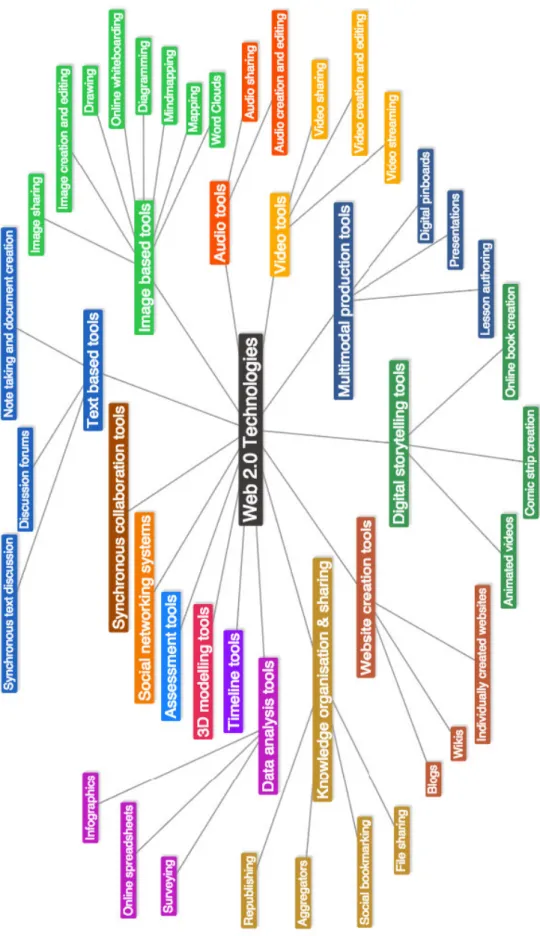
Figure 2.1 Typology of Web 2.0 learning technologies 25
Figure 2.2 The revised Bloom’s Taxonomy 28
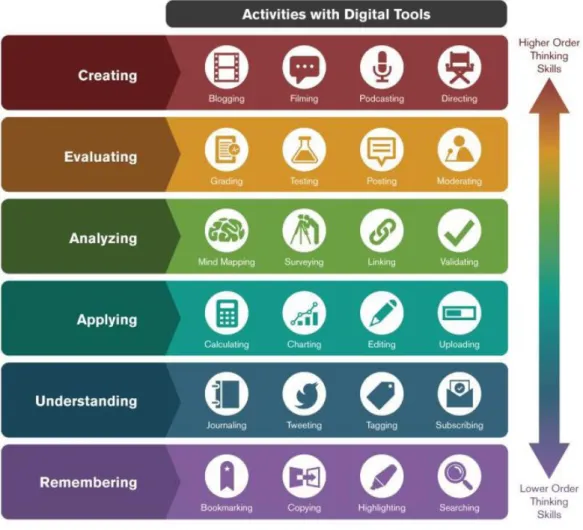
Figure 2.3 Bloom’s Digital Taxonomy 29
List of Tables
Page
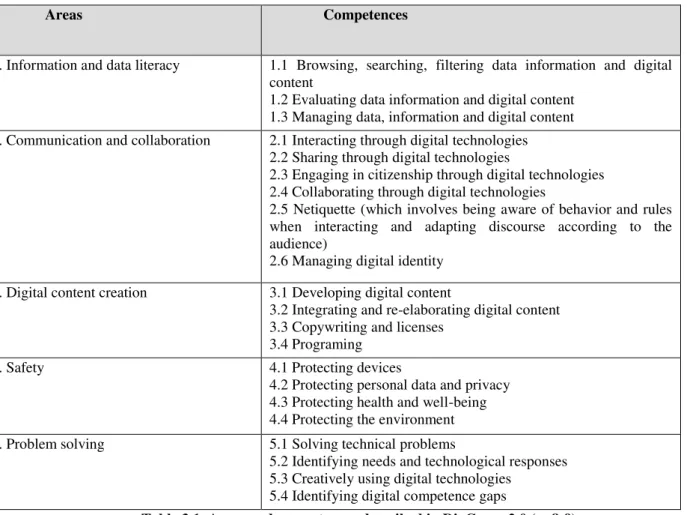
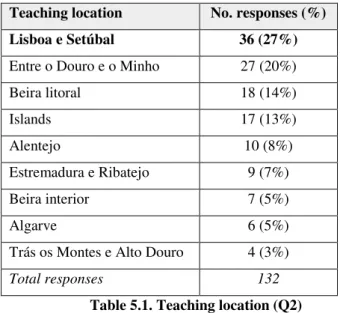
Table 3.1 Areas and competences described in DigComp 2.0 43 Table 5.1 Teaching location – Question 2 76 Table 5.2 Resources used in the lesson – Question 6 79 Table 5.3 Frequency of materials used – Question 7 80 Table 5.4 Importance of approaching texts critically – Question 9 82 Table 5.5 New technologies use and teachers’ perception – Question 13 88 Table 5.6 New technologies and teachers’ opinions – Question 15 91
List of Abbreviations
ACTFL American Council on the Teaching of Foreign Languages ANPRI National Association of Informatics Teachers
APPI Associação Portuguesa de Professores de Inglês
CMC Computer-Mediated Communication
CALL Computer-Assisted Language Learning CLIL Content and Language Integrated Learning
DGE Directorate-General for Education (Direção Geral da
Educação)
DGES Directorate-General for Higher Education (Direção Geral
de Ensino Superior)
DESI Digital Economy & Society Index
EC European Commission
EU European Union
EFT English as a foreign language
ELT English Language Teaching
Introduction
It is widely acknowledged that innovations in technology have changed societies in many and different ways over the past fifty years. The global spread of the Internet has especially transformed the way people communicate, interact, and relate to each other. As a consequence, it has deeply altered working lives, public lives, and private lives (Cope & Kalantiz, 2000).
Considering this scenario, it is no longer possible to think about education and literacy as it was thought twenty or even ten years ago. Thus, over the past twenty-five years, many scholars and researchers (e.g. Bezemer & Kress, 2016; Cope & Kalantiz, 2000, 2008, 2009, 2014; Kress, 2003, 2005; Kress & Jewitt, 2003) have demonstrated concerns about the role of school and education. These concerns are related especially to the concepts of ‘literacy’ and ‘to be literate’: what do literacy and to be literate mean in this technological fast-paced society in which knowledge has a central role?
Learning how to read and write has gained different perspectives and, consequently, students are required to develop different competences in order to become literate. Not only is it essential to learn the formal written language, but it is also crucial to learn how other modes of meaning (images, sounds, gestures, colors) are articulated in order to convey a message on different platforms, on the page or screen. The Internet, in this sense, has posed additional challenges, and to communicate through this global network, competences linked to the specificities of the online environment are also necessary.
A milestone in the research towards a pedagogy of multiliteracies is undoubtedly the works that have been developed by a group of researchers called the New London Group (which included Courtney Cazden, Bill Cope, Norman Fairclough, James Gee, Mary Kalantzis, Gunther Kress, Carmen Luke, Sarah Michaels, Martin Nakata) that first met in 1994 to discuss the role of literacy and learning in contemporary societies. After almost twenty-five years and the massive development of technology, it is possible to see significant advances in education; however, it seems that the traditional concept of literacy (simply the ability to read and write, and count) has not changed considerably in schools.
In this sense, although the use of technology in education seems to be a reality in many contexts, the approach to different multimodal texts (the ones composed not only of written or oral language, but also of images, sounds, and movement) in online environments, and a consistent integration between technology and learning objectives seem to require further research.
Language teaching, in general, and more particularly the teaching of English as a foreign language (EFL), appear to have greatly benefited from the advances in technology, especially regarding interactivity and mobility that the expansion of the Internet brought about. New technologies, in this respect, seem to have a positive impact on improving language skills as well as on the development of multiple literacies related to the use of those technologies, including, particularly, multimodal and critical literacies.
Bearing this in mind, it seems increasingly necessary to investigate if and how digital technologies have been used in the EFL classrooms and to what extent digital tools contribute to the teaching-learning process. Consequently, teachers’ impressions and attitudes towards their use of these new technologies in their lessons are of great importance.
In this sense, this study aims to investigate how new technologies, and especially the Web 2.0, are explored in English classrooms of the third cycle of basic education (Years 7 to 9) and secondary education (Years 10 to 12) in Portugal; therefore, the study will try to answer the following questions:
1. Have new technologies, and more specifically the Web 2.0, been used in English classrooms of the third cycle and secondary education in Portugal?
2. If so, how have these technologies been used?
a. Have they been used in a way that promotes a multimodal and multiliteracies approach?
b. Have teachers considered them helpful in improving language skills and meeting the learning objectives?
Furthermore, it is possible to establish the following objectives for this research: 1. To analyze how technology, and more specifically the Web 2.0, has been used in
English classrooms.
2. To analyze if and how technological tools have been used to develop a multimodal and multiliteracies approach.
3. To verify if technology is considered useful to develop language skills and how. In order to meet the objectives and answer the research questions, the methodology applied in this study involves the collection of data through an online questionnaire targeting English teachers of the educational levels mentioned. This questionnaire basically consists of checklists, multiple-choice responses, ranking questions, and Likert scales with the aim to investigate teachers’ impressions on the use of technology and how they tend to use digital
tools in their lessons. Therefore, this study is organized into five chapters which are briefly described below.
Chapter 1 provides an overview of the key-concepts and theories related to learning practices in contemporary societies on which the present study relies on, namely: multimodality, multiliteracies, critical literacy and digital literacies. The role of English language teaching in the fast-paced technological society is also discussed.
In Chapter 2, a definition of the Web 2.0 and a description of digital tools and their relation to education are presented. Additionally, the implications of the Web 2.0 for foreign language teaching are briefly discussed. Therefore, this chapter aims to further discuss the theoretical background more closely related to the use of the Web 2.0 in education, particularly in foreign language learning, and the digital literacies involved.
Aiming to provide an overview of the initiatives and proposals concerning digital competences in the European Union (EU) and in Portugal, Chapter 3 considers some documents issued by the European Commission (EC) (namely DigComp 1.0, 2.0 and 2.1; DigCompOrg; and the chapters on Computer-Assisted Language Learning [CALL] of a report entitled Improving the effectiveness of language learning: CLIL [Content and Language Integrated Learning] and computer assisted language learning). The INCoDe.2030 initiative, proposed by the Portuguese government and concerning digital literacies, is also discussed along with the English syllabi for the third cycle and secondary education.
After providing the theoretical background and discussing some of the frameworks and initiatives in the EU and in Portugal, Chapter 4 details the methodology applied in this research, including: the reasons for the study; the research questions and its objectives, as aforementioned; the research context and its rationale; and the presentation and discussion of the online survey sent to teachers.
Finally, Chapter 5 presents and discusses the results from the online questionnaire in light of the theories and the documents presented in Chapters 1 to 3. Although the data collected do not intend to represent the total teacher population of the third cycle and secondary education, it is expected that the results and the conclusions drawn may indicate some tendencies in the use of technology in EFL classrooms in Portugal and can contribute to developing further studies in the future.
Chapter 1
Communication, society, and learning
Contemporary societies have been going through different major transformations in many spheres over the last fifty years, at least. Changes in economy and technology have greatly impacted human lives in many ways. Considering that discourses are “socially constructed knowledges of (some aspect of) reality” (Kress & Van Leeuwen, 2001, p. 4) – which means that they develop in specific social contexts – language and communication have also been highly affected by all the changes occurring in society. Technological development, in particular, has brought not only new ways of thinking about the world and new ways of interacting in society, but also, and no less importantly, new ways of making meaning and of communicating.
In the face of such changes, there has been an increasing need to rethink the role of education in general, and to discuss the meaning of literacy in particular. It is no longer possible to think about literacy without considering the technological and economic changes, especially because of two major transformations in relation to language and communication: a change from the dominance of writing to an increasing importance of the image; and a change from the dominance of the book (or print) to the dominance of the screen (Kress, 2005).
Considering the aspects mentioned above, the aim of this chapter is to provide a theoretical background to multimodality and multiliteracies with the aim of presenting a rationale for approaching literacy and education as central issues of discussion in many areas. Consequently, a discussion of the role of EFL teaching and learning is also provided.
1.1. Changing societies
The central role of knowledge in contemporary societies has been widely acknowledged. Knowledge has become even more crucial, especially because technological development has led to a greater demand for multi-skilled workers who engage in lifelong learning (Krieken et al., 2013, p. 171). Consequently, as pointed out by Cope and Kalantzis, “[a]s knowledge is the result of learning, education is more important than ever” (2009, p. 168).
In 1994, a group of researchers, who became known as the New London Group, met to discuss the role of literacy and learning in contemporary societies. They proposed a pedagogy of multiliteracies which presented valuable insights for education in this changing world. In their manifesto, the authors pointed out the changes that were happening in the mid-1990s, and how language and communication had changed at that time in three spheres of
society: people’s working, public, and private lives (New London Group, 2000). Many of the changes they discuss, as well as some of their expectations, have since been observed. However, some positive perspectives relating to society’s development seem to have taken certain negative directions.
By comparing old capitalism with new capitalism, the authors explain that in the past working lives were mainly characterized by a rigid hierarchy, a discourse of discipline and divisions of labor, which did not promote a learning environment and, consequently, workers were unable to develop new skills. Similarly, schools were places characterized by discipline where authoritarian teachers were the central characters in the learning process, and the students were passive subjects in their own learning process in which the main focus was memorization. The emphasis was on numeracy and literacy, which was by and large related to learning how to read and write in the national language.
In contrast, what we have been observing over recent decades, and especially by the end of the twentieth century, is that the relationships in working spheres have dramatically changed, and knowledge and learning have become central in professional environments. Enterprises seem to require workers who are able to not only perform different tasks, but who are also able to engage in lifelong learning. Bearing this in mind, innovation, creativity and learning how to learn are essential skills in a constantly changing society. Additionally, it is widely known that technology has been changing working relationships and professional communication. E-learning environments, Intranet platforms, and e-mails have been replacing more formal written memorandums, paper-based communication, and face-to-face training. The increased use of digital tools by companies has supported collaborative and individual work in many different ways as well.
However, as pointed out by the New London Group in 1994, these workplace discourses could be considered in two distinct ways: as new possibilities for education and social systems; or as new systems of mind control and exploitation. More than twenty years have gone by since the establishment of the New London Group, and despite all the efforts made by some scholars in transforming education, unfortunately, it is possible to say that what has been observed lately is much closer to new forms of exploitation. This position is explained by Cope and Kalantzis (2009) in their review of contemporary society:
The discourses and practices of today’s workplace can equally be read as a highly sophisticated form of co-option — the co-option of teamwork, vision and mission and corporate culture, for instance, in which everyone is supposed to personify the enterprise, to think, will and act the enterprise. The more you feel you belong to this kind of enterprise, the more its inequalities — its iniquities indeed — recede into the inevitability of common sense. And a lot of people are left out of the new economy […] Patterns of exclusion remain endemic. Even in the heart of the new economy, those who do not manage to clone to the corporate culture and buy into its feigned egalitarianism — people who find their difference makes them an outsider, however subtle — find their aspirations to social mobility hitting “glass ceilings” (Cope and Kalantzis, 2009, p. 170).
In fact, as stated by the researchers of the New London Group (2000), “It is not our job [as teachers] to produce docile, compliant workers. Students also need to develop the capacity to speak up, to negotiate, and to be able to engage critically with the conditions of their working lives.” (p. 13). Therefore, a pedagogy of multiliteracies may “help create conditions of critical understanding of the discourses of work and power, a kind of knowing from which newer, more productive and genuinely more egalitarian working conditions might emerge” (Cope & Kalantzis, 2009, p. 171).
Similarly, public lives have changed dramatically over the years. As explained by Cope and Kalantzis (2009, p. 171), over the past decades there has been a decentralization of the state and an increasing privatization of public services and organizations in the name of neoliberalism, which sells the idea of a greater liberty for citizens. Consequently, in many countries, there has been a systematic decrease in social investment and welfare programs. In many parts of the world, education has become a very lucrative business, thereby making it more market-based than a service provided by the state to its citizens. In this sense, the main target in many state schools, in some countries, is basic literacy and numeracy; thus, a greater gap is created between lower and upper classes, with only the latter able to afford a better education.
Furthermore, as mobility becomes easier, mass migration increases and, as a result, greater diversity is observed within public spaces. In many cities, teachers face diverse classrooms with students from different economic, social, and linguistic backgrounds. This diversity, as explained by Cope and Kalantzis (n.d.), is mainly generated by the impact of new technologies and mass migration, two aspects that are central reasons for proposing a new way of learning.
Private lives have been greatly affected by all the transformations in society, especially as a result of the development of new technologies. Personal relationships have dramatically changed in the current century with a greater exposure of people’s private lives in social media. At the same time, mass migration, along with cuts in welfare programs and economic crises seem to be leading people towards a less tolerant society.
Sadly, and interestingly, mass media have played an increasingly significant role not only in the dissemination of information, but, in some ways, also in the reinforcement of intolerances and prejudices. This scenario was intensified in many Western countries by the 2008 financial crisis. This was not only the case in Europe, but in many places around the world; hence, creating serious situations concerning unemployment in many countries (Portugal included), which are struggling yet to offer better working conditions to their citizens. In Portugal, the economic situation has made many young adults leave the country in search of better jobs and opportunities. At the same time, the refugee crisis, due to poverty and wars, especially in Africa and the Middle East, has contributed to the emergence of a feeling of retrograde nationalism with demonstrations of cultural, ethnic, and racial prejudice invading not only social media, but also real lives.
As the authors state, “schooling in general and literacy pedagogy in particular, cannot afford to ignore the trajectories of change. They need to be able to justify the pedagogical paths they choose to take” (Cope & Kalantzis, 2009, p. 174). Undoubtedly, in order to create different learning environments and opportunities in the face of such changes, efforts have been made in many educational scenarios; however, it seems their long-term impact on societies, and on learning itself, is not yet clear.
1.2. Multimodality, communication, and technology
It is well recognized that discourse and social interactions have been greatly impacted by new technologies, especially the Internet. Since the outset of the Internet and the increasing growth of globalization, language and meaning-making have also undergone significant changes.
Kress (2005) explains that in the face of such transformations it is possible to identify two types of revolution: one is related to the modes of representation, in which it is possible to observe a change from the central role of writing to the increasing significance of the image; the second concerns the media of dissemination, “from the centrality of the medium of the book to the medium of the screen.” (ibid., p. 6)
Consequently, these two major changes, or revolutions, have had a great impact not only in social interactions, but also in the way knowledge is shaped. Therefore, one way of understanding the impact of new technologies on social interactions, and on discourse, is to analyze the relationship “between technologies of representation (the modes of ‘multimodality’) and technologies of dissemination (the media of multimediality)” (Jewitt, 2004, p. 184).
Multimodality is related to how meaning is made across communication processes and how we choose to make it through different modes. It is an approach through which communication and representation are understood to involve something more than the language in which those modes are always being shaped and reshaped by social practices.
The theoretical approach of multimodality which this work relies on is that of social semiotics multimodal analysis, as developed by Kress and Van Leeuwen (2001), which is founded on Halliday’s (1978, 1985) theory of language description, Systemic Functional Grammar. Social semiotics draws upon the fact that language is social, therefore, it is shaped by people’s social and cultural work, rather than being a ready-made resource.
Modes of meaning
Considering the notion of the sign as an element in which the signified (the meaning) and
signifier (the material form) are brought together in order to make meaning, Bezemer and
Kress (2016) argue that according to their view of social semiotics, the sign has three characteristics. The first one is that the relation between the meaning and the form is always motivated, rather than arbitrary1. This means that a person chooses a form (signifier) based on
its aptness to express a certain meaning. In this assumption, Kress (1993) relies on the theory of sign making, instead of sign use, that is, in social semiotics signs are not ready to use, rather they are made in context, motivated by situational and cultural aspects. In this regard, Kress further explains:
I wish to say that signs are always motivated in this manner by the producer’s ‘interest’, and by characteristics of the object. It is ‘interest’ which determines the characteristics that are to be selected and to be represented. The relation of signifier to signified, in all human semiotic system, is always motivated, and is never arbitrary. (Kress, 1993, p. 173)
Additionally, the second characteristic is that a sign is also “shaped by the environment in which it is made, and its place in that environment” (Bezemer & Kress, 2016, p. 9). Therefore, signs are constantly being made by people (sign-makers). In this respect, when comparing traditional semiotics and social semiotics, Jewitt (2006) shows that social semiotics focuses on the notion of semiotic resource, rather than code (understood as a set of
1The notion of arbitrariness was stressed by Saussure (1966). Focusing on language, he argued that the relation
between the signifier (sound – in the case of speech; or shape – in the case of writing) and the signified (the meaning of a word) is arbitrary. This means, for instance, that the word ‘ball’ (its sound or written form) does not give any information about what it is or the object itself. However, the perspective adopted by social semiotics is that this relation is always motivated. Therefore, “in sign making (rather than sign use) the sign maker selects a signifier for its aptness to the expression of a particular meaning.” (Arbitrariness, n.d., para 1).
rules that connects signs and meanings). This traditional perspective suggests that the semiotic system can only be used, not changed, and the author further explains:
Traditional semiotics sees language and other semiotic systems as a code: sets of rules for connecting signs and meanings. This means that once two or more people have understood the same code they can connect the same meanings to the same sounds or graphic patterns and understand each other. This suggests that the semiotic system is simply ‘there’. It can be used but it cannot be changed in any way. The sign is viewed as a pre-existing conjunction of a signifier and signified, an element in a code, to be understood and used. This view of semiotic systems places people in a passive role to the production of meaning and establishes language and other semiotic systems as entirely stable”. (Jewitt, 2006, p. 17)
On the other hand, social semiotics relies on the fact that signs are products of the social process and, in this approach, people are part of the meaning-making, and not only a producer. Jewitt also states that “signs are products of a social process of sign making in which a person (sign-maker) brings together a semiotic resource (a signifier) with a meaning (the signified) that they want to express” (ibid., p. 17-18). This means that in order to make signs, the sign-maker needs to choose from a variety of available modes of meaning, each mode having different meaning potentials and different social effects.
Mode, therefore, is a central concept in multimodality. As pointed out by Kress (2011), “[m]ode is a socially shaped and culturally given resource for making meaning.
Image, writing, layout, music, gesture, speech, moving image, soundtrack are examples of
mode used in representation and communication.” (p. 54). The specific potential and limitation of each mode is called affordance (Kress, 2010), which is the third characteristic of a sign. For example, in order to communicate a concept through writing, in addition to lexis there are other resources available, such as color, font style, and layout. Alternatively, the same concept would be represented differently through images, leading to different meanings. Therefore, “[a]s modes offer different potentials for making meaning, this entails that signs – and their effects – made in one mode differ from signs made in other modes” (Bezemer & Kress, 2016, p. 9).
In this sense, as demonstrated by Jewitt (2011, p.14-15), it is possible to identify four interconnected theoretical assumptions that underlie multimodality. The first is that language is a part of a ‘multimodal ensemble’; this means that although language is many times assumed as the main and most significant mode of communication, especially in learning and teaching contexts, communication and representation always involve several modes being articulated at the same time. The second assumption is that each mode realizes a different communicative work, that is, each mode has the potential to produce certain meanings. The third assumption is that meaning is made according to the choices people make of the modes
in order to communicate, therefore, the interaction between modes is crucial in meaning-making. The fourth and last assumption is that modes are (re)shaped by social practices in specific social contexts.
In other words, although there are certain conventions in the use of one mode or another to realize different concepts, when sign-makers choose to use these preexisting modes, they are constantly reshaping them in order to make the meanings more evident.
Additionally, as pointed out by Bezemer & Kress (2016), when some recognizable potentials of a resource (as a mode or sign) are constantly reshaped, this generates a tension between instability and stability. Instability is a marked characteristic of contemporary societies, and because of this instability it seems that the use of modes and signs is shaped less by conventions, which are not as stable as they used to be. Therefore, the use of semiotic modes should be analyzed and seen in relation to social, geographical, and historical conditions. As argued by Kress (2010), semiotic resources are never fixed and “[n]o degree of power can act against the socially transformative force of interaction.” (ibid., p. 8)
From this point of view, it is possible to state that communication is always multimodal (Kress, 2005). As language is not the only way people communicate, it is essential to look at and analyze beyond language to understand communication and interaction in contemporary societies. Jewitt (2013) explains that “Multimodality emphasizes the importance of the social context and the resources available to people to make meaning, with attention to people’s situated choice of resources (…)” (p. 2). Moreover, as signs and modes are culturally and socially motivated, it is also important to bear in mind that different cultures create different semiotic representations for making meaning. As pointed out by Kress (2010):
modes are the result of a social and historical shaping of materials chosen by a society for representation: there is no reason to assume that the mode of gesture in Culture 1 covers the same area or the same concerns or is used for the same purposes and meanings as the mode of gesture in Culture 2. (Kress, 2010, p. 11)
Color is a good example of a mode which can assume different meanings in different cultures; whereas black is the color related to funerals in many western cultures, in some eastern countries white is the color of mourning.
Although communication and representation have always been multimodal, the theoretical approach presented above, which explains in a more systematic way how and why it is imperative to look beyond language, is relatively new and has been developed since the early years of the twenty-first century. This can probably be explained by the huge and fast
transformations in contemporary societies, which may lead to the need to look at how communication has also changed. Considering that representation and communication are only possible through, and motivated by, social interaction, it is undeniable that the social changes seen at the end of the twentieth century, and especially in the twentieth-first century, have greatly affected language and how people communicate.
Mode, medium, and technology
As discussed above, mode refers to the resources used for communication or representation. On the other hand, medium refers to the way these representations are used to make meaning, that is, the way these texts are disseminated. Similarly, it is important to highlight that both modes and media have their own separate powers and effects, and therefore they offer different potentials and constraints for meaning-making.
As demonstrated by Kress (2003), the organization of the mode of writing (and also of speech) is different from the organization of the mode of image. While writing is governed by the logic of time and sequence, the mode of image is governed by the logic of space and, consequently, provides different ways of making meaning. These differences in the organization of those modes and the dominance that shifts from one to another have a great impact on the way a text is read and on the role of the author. In a book, for example, there is a sequence that it is necessary to follow in order to understand the message presented by the author. Therefore, the writer is much more in charge of the reading path their reader is going to take and is the one ‘in charge’ of the sequence in which the information is going to be presented. Although the reader could, of course, read a book by skipping chapters, for example, the sequence of words and sentences are quite static and the reader needs to follow them to understand the whole message.
On the other hand, although there are some ways to create reading paths in images, for instance, by using lighting, color, and the position of the elements, those paths are inevitably much more open, and the author does not have great control over what the reader is going to look at first. For instance, in a painting depicting a scene, an artist could use several techniques in an attempt to guide the reader through his or her narrative; however, the audience is much freer to look at the different elements and make other meanings based on those. The reader of an image, in this sense, has an increasingly effective role in making meaning along with the author.
It seems important, at this point, to clarify the meaning of the word text as it has been adopted in this work. A text, in the perspective adopted here, means any material object of representation resulting from social practices and interactions with the aim of making meaning, be it verbal, visual or both. As explained by Kress & Van Leeuwen (2006):
Texts are material objects which result from a variety of representational and production practices that make use of a variety of signifier resources organized as signifying systems (we have called these ‘modes’), and a variety of ‘media’, of ‘signifier materials’ – the surfaces of production (paper, rock, plastic, textile, wood, etc.), the substances of production (ink, gold, paint, light, etc.) and the tools of production (chisel, pen, brush, pencils, stylus, etc.). (Kress & Van Leeuwen, 2006, p. 216)
The shift in the dominance of the medium of the page to the medium of the screen has intensified those transformations in the reading path and in the role of the author. Additionally, as pointed out by Kress (2003), the new media not only make the use of different modes easier, especially images and sounds, but also promote interaction among their users (interactivity) and the relation of users with other texts (hypertextuality).
The interactivity across the new media is seen in at least two ways: first, it is possible to write back to the author of a text more quickly and more easily when compared to the medium of a book; and the new media make it possible to create collaborative texts more easily, at the same time, without the writer even knowing the other authors involved in the process, for example, in the case of wikis (e.g. Wikipedia). Therefore, the notion of authorship has changed in different ways, not only because of the interactivity, but also due to the hypertextuality provided by these new media. With the notion of hypertextuality, the notion of the author as the source (or at least the unique source) of a text is put into question, as clearly explained by Kress (2003):
The metaphor of text-as-texture was in that respect always accurate: our experience of language cannot be, is never, other than the experience of texts. Our use of language in the making of texts cannot be other than the quotation of fragments of texts, previously encountered, in the making of new texts. The ease with which texts can be brought into conjunction, and elements of texts reconstituted as new texts, changes the notion of authorship. If it was a myth to see the author as originator, it is now a myth that cannot any longer be sustained in this new environment. (Kress, 2003, p. 5)
In other words, medium has a profound impact on meaning making and, in this case, the change from the page to the screen has intensified the spread of multimodal texts. Once new technologies facilitate the use of different modes, and each mode has its own potentials and constraints in meaning making, it is crucial to learn how to use the available modes by understanding their potentials for meaning. From this perspective, understanding how those modes work on the screen poses a central issue of discussion to learning (Jewitt, 2006, p. 12).
Consequently, the importance of knowing how to read and understand those multimodal texts is central, because if all modes in a message are creating certain meanings, each one of them carries an essential part of the information, and therefore, more often than not, it is impossible to read them in isolation. As Jewitt (2006) states, “[a]t times, the meaning realized by two modes can be ‘equivalent’, at others they may be complementary” (p. 12). Additionally, it is extremely relevant to understand how the modes are organized and how they interact with each other. All these aspects posed by new technologies and the medium of screen seem to have a significant impact on reshaping knowledge, especially in learning environments (Jewitt, 2013).
Jewitt (2013) presents interesting examples that illustrate how reading and writing in a learning context may reshape knowledge. Reading a novel in a digital format, for example, provides students with a totally different experience from reading it on paper, mainly because of the degree of the multimodal representation of the information presented. In order to provide an example, the author refers to the digital version of Of Mice and Men, by John Steinbeck. By presenting different modes and resources of interaction between the reader and the text, this digital book requires the student to articulate different domains of knowledge. As the author summarizes, “[r]eading in a digital context requires understanding meanings across different modes and understanding the principles and values of the design” (Jewitt, 2013, p. 19). Similarly, new technologies have also been transforming writing in learning contexts where there is an increasing use of images and sounds in students’ productions.
Summing up, as Jewitt claims, “the use of technology can literally transform what can be seen and by whom it can be seen” (2011, p. 4). Therefore, being a proficient reader and writer in contemporary society means knowing how to articulate the modes of representation in the different media in which they may appear.
1.3. Multiple literacies
The development of new technologies, and especially the advances in Web 2.0 technologies, have created not only new discourses or forms of interaction and other forms of integration, or opportunities, but also further divisions (Cope & Kalantzis, 2008). Therefore, education and literacy have to be rethought in order to address new forms of discourses and the wide range of multimodal texts that are mainly supported by new technologies, as well as also be able to provide solutions for inequality, prejudices, and poverty.
Consequently, as has been noted throughout this chapter, many researchers (for example Coiro, Knobel, Lankshear & Leu, 2008; Cope & Kalantzis, 2000, 2009; Kress, 2003; Kress & Van Leeuwen, 2001, Unsworth, 2001) focus on stressing the need to rethink education and the concept of literacy. It is clear that literacy cannot be understood as, nor limited to, learning how to read and write as it has been considered in the past. Thus, concepts such as ‘visual literacy’, ‘new literacies’, ‘multimodal literacy’, ‘digital literacies’, and ‘multimodal literacies’, which have been used to describe and point the way towards new practices of discourse impacted by technology, need to be addressed in education.
Multimodal literacy, as has been demonstrated in this chapter, stresses the fact that writing is a multimodal action (spatiality and directionality are important in meaning making) (Kress & Jewitt, 2003). It refers to meaning-making through the different modes and how we understand, respond, produce, and interact with texts (written, oral, visual composition, and so on), especially digital texts.
It seems relevant to stress that two aspects of multimodal literacy are crucial to education and classroom practices. The first is the effect of technology on reading and writing ‘on screen’ (in comparison to reading and writing on paper), and the second is the change in social practices in literacy that have been promoted by the development of the Web 2.0. (Walsh, 2010).
In the face of the social changes discussed in this chapter, and especially those related to the development of the Web 2.0, it seems increasingly relevant to also discuss the concept of digital literacy. Digital literacy (Buckingham, 2008) refers to the ability to perform some competences in a digital environment. In the past, the concept was related more to technical competences (e.g. computer literacy); however, as it cannot be restricted to technical use only, and since nowadays it involves different competences, it is also possible (and maybe more relevant) to talk about digital literacies, in the plural.
Being literate in a digital environment involves several competences. Besides learning how to understand and use different modes in the medium of the screen, it is also necessary to develop other skills, such as, but not limited to: Internet searching and research; hypertext navigation; knowledge assembly (that is, knowing how to gather and compare information from diverse sources); content evaluation; online safety; and online etiquette. Mastering the technical aspects of the new technologies, therefore, is not enough for new generations. As explained by Rojo (2012), the school needs to create practical opportunities for students to become effective meaning-makers by critically analyzing and reinterpreting the different discourses and meanings they receive or produce:
O trabalho da escola sobre esses alfabetismos estaria voltado para as possibilidades práticas de que os alunos se transformem em criadores de sentido. Para que isso seja possível, é necessário que eles sejam analistas críticos, capazes de transformar […] os discursos e significações, seja na recepção ou na produção (Rojo, 2012, p. 29).
In this sense, being a critical analyst is essential in our contemporary knowledge society, so therefore, the concept of critical literacy2 seems more important than ever. Critical
literacy (Freire, 1987; Luke, 2000; Luke & Dooley, 2011) basically refers to the competences through which cultural and social relations and political power can be transformed, by analyzing and using text (Luke & Dooley, 2011). Although this is not a new concept, and it has been applied in many educational contexts, including second language learning environments, many scholars, educators, and researchers stress the importance of critically approaching digital texts.
For instance, in 2015, the Italian semiotician Umberto Eco caused some controversy when he stated that social media has given the idiots the right to speak. In his speech, he was actually referring to the need for younger generations to learn how to filter information on the Internet, as he pointed out when he said: “uno dei grandi problemi della scuola italiana è
aiutare i ragazzi a filtrare le informazioni su Internet” (Radiocentodieci Unito, 2015).
Clearly, this is a major problem not only in Italian schools, but also perhaps in education in general. Similarly, Andreas Schleicher, Director for the Directorate of Education and Skills at the Organization for Economic Co-operation and Development (OECD), in an interview with the BBC (Coughlan, 2017), pointed out the importance of teaching students to distinguish what is true from what is not true on the Internet.
In both cases, what has been stressed is the need to focus on different literacies, in order to fully and critically read the range of multimodal texts that have spread via new technologies, and thus, to become multiliterate in the new social contexts. In this sense, a multiple literacies and multimodal approach seems to offer perspectives on how to deal with texts, critically taking into consideration the new forms of discourse and meaning-making in contemporary societies.
2 Critical literacy and critical thinking are closely related terms, but are not exactly the same. Considering critical
thinking, it is more related to the attempt to read a text considering different views and without being biased and prejudiced. Critical literacy, on other hand, is based on the fact that all texts convey knowledge and power-related ideas, therefore, questions power-related to the author, the audience, the purpose and the ‘hidden’ messages should be approached when reading a text. (McInulty, 2013). In this study, however, these terms have been used interchangeably, since in the questionnaire sent to the English teachers (see the Appendix) the term ‘critical thinking’ has been used for simplicity reasons and because no further theoretical information was provided.
Furthermore, in the BBC interview, Schleicher highlights the importance of young people engaging with diversity, instead of seeing it as a problem, an issue that can be verified in many comments across social media. At this point, he highlights a technical feature of social media that would make the acceptance and debate across different cultures and realities difficult. By gathering people with similar ideas and behaviors, by means of online data collection, social media tend to provide less space for a debate on diversity in an attempt to find consensus and understanding. That is why, as explained by Luke (2000), it is crucial to provide new ways of thinking and interacting with others from different cultures and backgrounds. The author further explains:
Critical Multiliteracies for effective information sourcing from, and participation in, the new digital datasphere provides not only the rudimentary and ‘functional’ skills of, say, keyboarding, file management, CD-ROM searching, or Internet browsing. It also involves analysis of the power relations of new institutions and worlds […] (Luke, 2000, p. 71).
The pedagogy of multiliteracies, as proposed by the New London Group in 1994, also emphasizes the importance of a pedagogy involving four knowledge processes: contextualization and background knowledge; clear and open instructions to learners about how various texts are structured; critical analysis by interpretation of the cultural and social contexts; and, the ultimate objective, development of the necessary knowledge to transform meanings from one context to another.
Therefore, in this changing contemporary world, where sometimes people seem to be so intolerant of diversity, it is increasingly important to learn, and to teach, how to read all the meanings that have been created and articulated by the different semiotic modes in a text, and to critically think about all those meanings and representations.
1.4. Multilingualism and English Language Teaching (ELT)
The phenomenon of multilingualism is stressed in many documents regulating education. For instance, the goal of the EU, in terms of multilingualism, is that European citizens are able to speak at least two foreign languages. On their website3, the EU highlights the importance of
language learning because, among other things, “speaking other languages helps people from different cultures understand one another – essential in a multilingual, multicultural Europe”.
English, for instance, has become more than ever the common language of the media, commerce, politics, and undoubtedly, of the Internet, the film industry, science, and
academia. As estimated by Crystal (2016), there are currently in the world around five non-native speakers of English to one non-native speaker. The consequences of the supremacy of the English language over other languages, also called linguistic imperialism, can be observed in at least two ways. On the one hand, an increasing emergence of new Englishes has been seen (Cope & Kalantzis, 2000; Crystal, 2003; Jenkins, 2009), while on the other hand, several minority languages are disappearing at an even faster rate than before (Cope & Kalantzis, 2008). Therefore, as argued by Cope and Kalantzis (2000), these linguistic and cultural issues are central in contemporary societies, which require the use of multiple languages and multiple Englishes for interactions. In this sense, working with cultural issues and multiple Englishes in a multimodal approach when teaching English as a foreign language is increasingly relevant.
In EFL classes, the use of multimodal texts is not new. In addition to written texts, audiovisual materials, for example, are commonplace in foreign language classes in general. Similarly, it is interesting to note that textbooks have changed considerably following the two revolutions put forth by Kress (2005), and now a greater number of visual compositions are present in comparison to those from the past. The increasing dominance of the screen has also been noted in static, printed texts, which have begun to be shaped like screens (Kress, 2005), so as to represent websites, blogs, emails, and to make them even more attractive to the reader.
In education, and especially in ELT, the increasing use of visual materials certainly has a profound effect in how meaning is made and how literacies should be taken into consideration. However, reproducing the screen on the page to make printed materials more attractive to students and teachers is not enough; pedagogical activities prompting the students to get involved and become aware of the meanings that are being created in the whole composition is also crucial.
Additionally, sociolinguists, such as Lippi-Green (2012), Jenkins (2009), and many others, have pointed out that all these varieties of English, all these new Englishes that are emerging in different contexts, can lead to discrimination and racism. Therefore, this scenario poses additional challenges to teachers of EFL. Students should be able to master the language in its formal aspects, but this alone is not enough to be a successful reader and producer of meanings in contemporary societies. Similarly, in a society with increasing diversity and controversial discourses, learning how to critically read and write is more and more important.
In this sense, a multimodal and multiliteracies approach to teaching EFL, using technological resources, seems to be of great value to teachers and students. As pointed out by Lotherington (2007), many studies have been developed on multiliteracies, multiculturalism, and multimodality in ELT. Such studies have raised discussions which target issues such as:
linguistic imperialism (Nettle & Romaine, 2000; Phillipson & Skutnabb-Kangas, 1999;
Skutnabb-Kangas, 2000); digital literacies (Gee, 2003; Kellner, 2004; Kress, 2003; Lankshear & Knobel, 2003); language ownership and deterritorialized languages (Graddol, 1999);
cultural identities in complex postmodern digital landscapes (Castells, 2000; Hawisher &
Selfe, 2000); discourse and digital environments (Baron, 2003; Crystal, 2001; Lotherington, 2004); impact of globalization on language teaching (Cameron, 2002; Zhenhua, 1999); and,
communication needs in an information-based economy (Castells, 2000; Gee, 2000). All these
aspects have changed the environment of ELT inside the classroom and posed challenges to English teachers, especially in regular schools that observe an increasing need to prepare younger generations for a fast-paced, technological society.
Chapter summary
In a fast-paced society, in which information has been made available with great speed and through different technological media, knowledge and learning are central issues. In order to address the demands and the need to rethink literacy and education, several theories have been developed in recent decades.
In this sense, this chapter aimed to provide an overview of the key-concepts and theories related to learning practices in contemporary societies which the present study relies on, namely: multimodality; multiliteracies; digital literacies; and, the role of the English language.
Therefore, the first section provided an overview of emerging changes in societies and their impact on learning and education. Meanwhile, the second section focused on the theories of multimodality and the implications of technology for communication. The third section discussed the need to integrate a multiple literacies approach in education, one which also encompasses digital literacies. Lastly, the fourth section presented a general view of the role of the English language (and its emerging Englishes) in digital and globalized western societies, and its implications for ELT.
In Chapter 2, a discussion of the Web 2.0 and its implications for education and language teaching is provided, in an attempt to support the idea of an effective integration of technology, multimodality, and EFL.
Chapter 2
Web 2.0, communication, and education
It is widely acknowledged that the development of new technologies, especially that of the Web 2.0, has changed the way individuals communicate and make meaning in contemporary societies. Although the use of digital tools in education has been steadily growing, and such use is usually associated with several advantages, such as fostering students’ motivation and offering new ways of learning, it is also true that it poses many different challenges to students and teachers, especially to language teachers.
The aim of this chapter is to not only describe some features of the Web 2.0 and its tools, which have been shown to be useful for education, but also to discuss implications of its use in foreign language classrooms. In order to do so, in the first section, an explanation is provided of what is meant by Web 2.0 and its features. The second section presents a typology of the most common Web 2.0 tools used for learning, as proposed by Bower (2015). Additionally, the same section provides a discussion about the link of some of these tools with the revised Bloom’s taxonomy (Anderson et al., 2001), and presents Bloom’s Digital Taxonomy, as proposed by Churches (2009). The third section provides a discussion on the use of technology to promote multiple literacies in foreign language classrooms, with an emphasis on multimodal and digital literacies. Lastly, the final section establishes a link between Web 2.0 tools and the Standards of Foreign Language Learning: Preparing for the
21st Century (National Standards in Foreign Language Education project [NSFLE], 1996)
issued by the American Council on the Teaching of Foreign Languages (ACTFL), as suggested by recent studies.
2.1. Defining Web 2.0
The term ‘Web 2.0’ was first coined in 2004 by Dale Dougherty, the vice-president of O’Reilly Media Inc., to designate the second generation of Internet services that focus mainly on enhanced publication, sharing, and interactivity. As pointed out by O’Reilly (2005), since it is not possible to establish a hard boundary for Web 2.0, he proposes instead a set of principles and practices that are easily recognizable to a wide range of technologies and websites on the Internet.
More than technical tools and market-oriented principles, the second generation of the World Wide Web carries important social implications. Web technologies currently in use have the fundamental feature of facilitating interaction among people by making it easier to