Measuring Happyiness and Wellbeing in Smart Cities
Lisbon Case Study
Joana Branco Gomes, João Sousa Rego and Miguel de Castro Neto
NOVA Information Management School (NOVA IMS), Universidade Nova de Lisboa,Campus de Campolide, 1070-312 Lisboa, Portugal
Keywords: Quality of Life, Human Smart City, Urban Data, Data Visualization, Dashboards.
Abstract: This paper presents the results of a data analysis on Lisbon rates of happiness and wellbeing as a measure of smart cities. To analyse this issue we collected, respectively, objective and subjective data from an open portal data website and a survey of subjective data filed by the citizens, represented at parish level, using a ranking of 1 to 5. The 52 datasets of objective and subjective data supported the production of a dashboard at parish level. The parishes with high performances (Avenidas Novas, Misericórdia, Santo António and S. Vicente) are all in the centre of the city. One of the possible conclusions is that there is a cluster of higher values in the city centre, that could be explain for economic reasons and also because to the proximity to city facilities.
1 INTRODUCTION
In recent years, happiness and wellbeing are being used as a primary indicator of quality of human life and development. Since 2012, aligned with the UN and OCED a World Happiness Report (Helliwell, et al., 2017) has been published with echoes in government meetings and policies implemented.
Happiness and wellbeing are nowadays considered a measure of social progress and a goal of public policy. This information can be used by governments, communities and organizations, to enable policies that support better lives. By analysing several indicators like income, education, health, among others, it’s possible to have a better inside of communities welfare, that analysing these indicators individually.
In February 2017, the United Arab Emirates held a full-day World Happiness meeting, as part of the World Government Summit. Now International Day of Happiness, March 20th, provides a focal point for events spreading the influence of global happiness research. The launch of this report at the United Nations on International Day of Happiness is to be preceded by a World Happiness Summit in Miami, and followed by a three-day meeting on happiness research and policy at Erasmus University in Rotterdam.
1OECD Better Life Index - www.oecdbetterlifeindex.org
Nevertheless, happiness and well-being are a subjective and complex concept to calculate. There are several possible methods and data samples to measure it. Some data is objective, like unemployment rate, distance from services, scholar dropout rate, … Other subjective like the perceived education conditions (that can by higher or lower than the actual education conditions). There are several ways of measuring. OECD1, Eurostat2, and World
happiness report (Helliwell, et al., 2017) use different ways of measuring and divide happiness and well-being in different categories.
Besides the challenge of calculate subjective data, there is a technological challenge of keep the data actual, meanful, and useful in an automatic way.
1.1 City of Lisbon Case Study
Most research on happiness and wellbeing are country oriented. The World Happiness Report 7
analysis indicators such as: Log GDP per capita, Social support, Healthy life expectancy at birth, and adaptation, Freedom to make life choices, Generosity, Perceptions of corruption. The results are analysed by the governments and most measure / public policies taken into places are introduced as a Smart Government measure. Such as the creation of
2Eurobarameter – Quality of life in European cities -
ec.europa.eu/regional_policy/sources
270
Gomes, J., Rego, J. and Neto, M.
websites, portals with public information or digital services.
In recent years, a growing number of city governments have been getting into the game of
Happiness and Wellbeing measure. In 2016 In the
European Commission dropped its yearly Flash Eurobarometer of quality of life in European cities2, a
huge survey of how happy people in hundreds of cities across Europe are.
The Urban Europe — statistics on cities, towns and suburbs defines smart cities as a Urban Europe — statistics on cities, towns and suburbs. In this index, where Portugal stands in the middle of the boar, capitals have a clear lead.
Lisbon, as the main city in Portugal, should be analysed as a smart city that promotes happiness and
wellbeing index.
In this paper, we analysed the city of Lisbon with data collected from open data platforms and a survey made by the authors in May 2017.
The data was first analysed with a geographic information system (ARC GIS) and then visualized using a dashboarding software (Power BI software).
The objectives of this case study are:
Create a model to evaluate or Test a model, usign a mix model from OECD Beter Life Index 1 and the quality of life in European cities2 parameters
Identify the parish and categories with lower and higher performances
Compare the self-reported results (subjective data) and objective resuts. Identify the most important categories
for the citizens Create a hapiness map
Create an interective hapiness index The challenge of this paper is collect the data, that is not available, updated and open. This challenge is strongly related to open data policies in Portugal.
2 DATA SOURCES
Concerning the objective data of geographic nature it was imported from the municipality of Lisboa open data portal3. The no geographic (statistical data) was
retrieved from Instituto Nacional de Estatísitca4 and
Eleições – Secretaria Geral da administração interna5
and introduced by parish.
The subjective data was collected from a survey launch online, and answered by 67 individuals (43
3Open Data Arc Gis Dataset –
opendata.arcgis.com/datasets/CML
female and 24 male), during 2 weeks in May of 2017. The age of the persons inquired was mainly between 26-35 (44%) and 36-45 (29%).
This survey has divided in 4 phases. First the identification (sex, age and postal code); Second the definition of happiness (select the topics more important for the personal happiness); Third the city conditions (9 questions), where the inquires answer from bad to good in a scale of 1to 5; and Foutrh the personal life quality (10 questions) where the answer were also from a scale from 1 to 5.
Both objective and subjective data collected was introduced in a geographic information system (in this case ARC MAP), at the parish level.
The data was divided into 11 categories, according the OECD Better Life Index1 and quality of
life in European cities2.
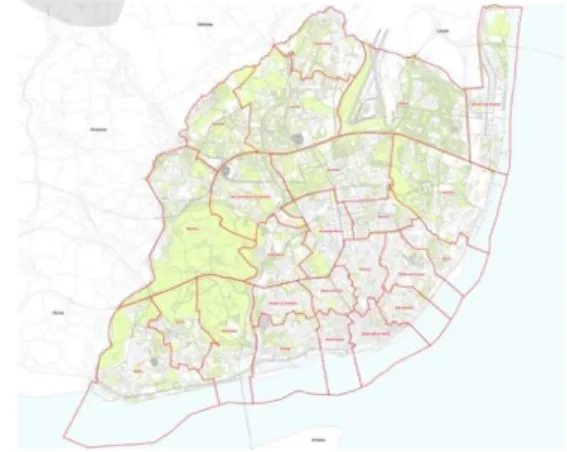
Figure 1: Old Parish of Lisbon – image from the official CML website.
Figure 2: Current Parish of Lisbon – image from the official CML website.
4INE – Instituto Nacional de Estatística – www.ine.pt 5www.eleicoes.mai.gov.pt
Table1: Categories and data.
CATEGORY
MEASURE
OBJECTIVE DATA SUBJECTIVE DATA
Housing Housing spending’s (€/parish) Overlapping houses (%/parish) Self-reported housing conditions
Jobs Unemployment rate
(%/parish)
Income Income / Job security
Education Distance to public schools Illiteracy (%/parish) Scholar dropout (%/parish) Self-reported education conditions Health
Distance from public hospitals and health centres Self-reported health Environment Self-reported environment quality Self-reported cleaning conditions
Safety Self-reported safety
outside home
Community Trust in people
Civic engagement Voters percentage (%/parish) Trust in government / city hall Trust in public services Work-life balance
Distance to subway and trains stops
Distance from
commercial areas Distance from sports facilities
Distance from
playgrounds
Distance from cultural facilities
Distance from a green area Building degradation (%/parish) Working hours Time devoted to leisure City infrastructure Self-reported public transport quality Self-reported sports facilities quality Self-reported cultural facilities quality Self-reported green areas and leisure parks quality
Self-reported streets, buildings, and public spaces conditions Use of green, cultural and leisure spaces
In 2015 the city of Lisbon create a new map of the city, redefining the parishes, and decentralization competences. The parishes pass from 53 to 24. Since the data collected for this paper refers to data prior and after 2015, it was used the old parishes limits,
with 53 parishes + 1 (Parque das Nações), the only new parish created in 2015.
This paper also should considerer social media data mining in order to find how people feel regarding some subjects and also regarding their lives.
3 DATA ANALYSIS
The data (52 datasets of both objective and subjective data) was introduced in a geographical information system (ARC GIS) in order to relate and compare the data using geoprocessing capabilities. The representation of the results was made using ARC GIS for mapping purposes and Power BI for dashboarding.
To compare datasets from the same category different representations were used on ARC GIS. The distance to facilities was created using a buffer according the values defined by Adrian Pitts in Planning and design strategies for sustainability and profit: pragmatic sustainable design on building and urban scales (Pitts, A., 2004) (on education - 300m for pre-scholar, 1,5km for 1º and 2º grades and 3km for 3º and high school; On health 1km for health centres and 2km for hospitals; For other facilities - 500m for transports, 600m for green areas and playgrounds, 2km for sports facilities and 2,5km for culture and commerce).
Regarding the subjective data the correlation was made by creating and normalizing values, by parish. It’s possible to identify:
There is a correlation between house spending’s and housing overlapping (the houses are cheaper in parish where we have more houses with excess of people). This could be explained by social-economic factors.
There is a clear need for pre-schools around the city
The city is almost covered for 1º, 2º and 3º grade schools.
The area of Monsanto Park isn’t covered in several facilities buffer, but since is a park without housing, services or other living spaces, it wasn’t considered to define the best and worst performances.
The city centre is well covered of health facilities, but the peripheral parish no. The city is well covered for commerce,
cultural and sport facilities.
The public transportation doesn’t cover all the city, but this paper doesn’t have the bus
network, in this sense, this category is incomplete.
The Self Reported Security on Job/Income is the category with most differences of results, where we can find parishes with the 5 different scores.
Civic Engagement has lower results, followed by Trust in Community and Environment.
Work-Life Balance has clearly better scores. This could be explained because on this category the best results are the average score, and people have tendency to not give the higher and lower score, staying on the middle. Health and Safety also have higher scores then the others categories.
3.1 Rates and Performances
The performances rates regarding the categories, the parishes, the relation between objective and subjective data among other, is information helpful for governants and the city hall. With this information is possible to have measure progress, identify city problems, support better lives, make better and more informed managing decisions.
On the geographical information system built it’s possible to identify and compare the parishes / categories with higher and lower performances. These values were defined by finding the difference between the parish value and the average value of all parishes. Because all the data has different measures and scales the value used to define where a parish performed worst or better in each category was different. For instant on the education and health, if the parish has 100% of the area covered by the buffer the parish performance is Best, if 30% or more of the parish area is not covered by the buffer is rated Worst.
Regarding subjective data, and since is rated 1 to 5 from the survey, the parish that have a difference of more than 0,5 or less then -0,5 were classified has Best or Worst.
3.1.1 Parishes with Higher and Lower
Performances
Looking at the results it’s possible to identify that the centre has best performs, except on building degradation. The lower performances are usually on peripheral parishes.
The parish with lower performances are Carnide, Beato followed by Ajuda, Alcântara. Marvila, Parque das Nações and Santa Clara. None of this parish are in the city centre. The parish with high performances
are Avenidas Novas, Misericórdia, Santo António and S. Vicente (by order). All of this parish are in the centre of the city. It’s possible to conclude that there is a cluster of higher values in the city centre, that could be explain for economic reasons and also because to the proximity to city facilities.
This information is represented in ARC MAP (for work and planning purposes) and Power BI (dashboard for explaining, correlate, visualize and to support citizens to understanding).
Figure 3: Dashboard - Parishes with best and worst performances.
3.1.2 Categories with Higher and Lower
Performances
The categories with lower results are Education and Health, followed by Civic engagement. The categories with higher results are Community, Housing and Jobs. It’s possible to conclude that there is a need to guaranty a more accessibility to health and education facilities, specially in the parish outside the city centre. There is also a need to act on the civic engagement and in the trust in public services and people.
Most of the categories have differences between parishes, except City Infrastructure, where the parishes are balanced between each other. It’s possible to find clusters of parishes in individual categories (for example people on the centre feel more safe them people from peripheral parish).
Figure 4: Categories with higher and lower performances.
3.1.3 Self Reported vs Objective Data
It’s important to correlate the self-reported / sentiment about a category and the objective data of the same category. This can only be done for Housing, Education, Health, Civic engagement and City Infrastructures, because of the lack of available data. It’s possible to conclude:
On Housing its possible to conclude that the housing spending’s and the housing overlapping are not the most important feature that contribute for the individual sentiment of happiness regarding housing. On Education, as opposite, there is a
correlation between objective data and subjective data. People living on Ajuda, Alcântara, Beato, Campolide and Carnide parishes felt more unhappy related to educations and also have lower performances in scholar dropout, illiteracy and area in the parish outside the school influence ratio. On the other hand people living in Misericordia and Avenidas Novas, have higher performance and also fell more happy about the education conditions. On Health the people from parishes of
Avenidas Novas, Misericordia, S. António and S.Vicente with best performances (closest to health facilities) feel healthy. But in other hand the parishes of Penha de França e S. Maria Maior, that also are close to health facilities, but where people don’t fell healthy. Since our survey group is young and mostly healthy is difficult to find a correlation between this data.
On Civic Engagement there isn’t a correlation between the voters percentage and the trust in public services and people. The same happens in city infrastructure. It’ possible to conclude that the survey should have more respondants in order to be more accurate, as also it should have more people with different ages.
3.1.4 Categories more Important to People
On the survey people were asked to identify the 3 most important categories for their one happiness:
Work-live balance was one of the categories most important, with 48% of the inquires choosing this category.
Health with 44%, Housing with 39% Income 38%.
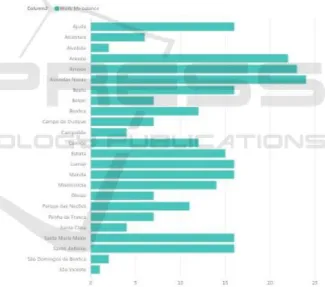
The Work-Life Balance is composed by the average of two questions in the survey: How many hours a day do you work, and how many hours a day you spend on leisure and sport. Only 23% of people answers that work between 4-8h and only 15% answered they spend 2-4h in leisure and sport. The percentage of people working more that 8h a day was 72% and spending less then 2h in leisure and sport was 85%. Its possible to conclude that the target group works more hours that usually and spend less hours that it supposed to in leisure. This could be explained by the age of the group, that are young people making an effort to grow in their jobs. The parish more balanced are Carnide, Marvila, Olivais and Parque das Nações, probably because people on this neighbourhood have more income, and can afford to work less hours, and because of the opposite, we have people precarious part-time jobs that gives them more time available for leisure. The parishes with lower performance are Ajuda, Alcântara, Santa Maria Maior, Santo António e S. Vicente, located on the center and the ocidental part of town.
Figure 5: Work-life balance performance.
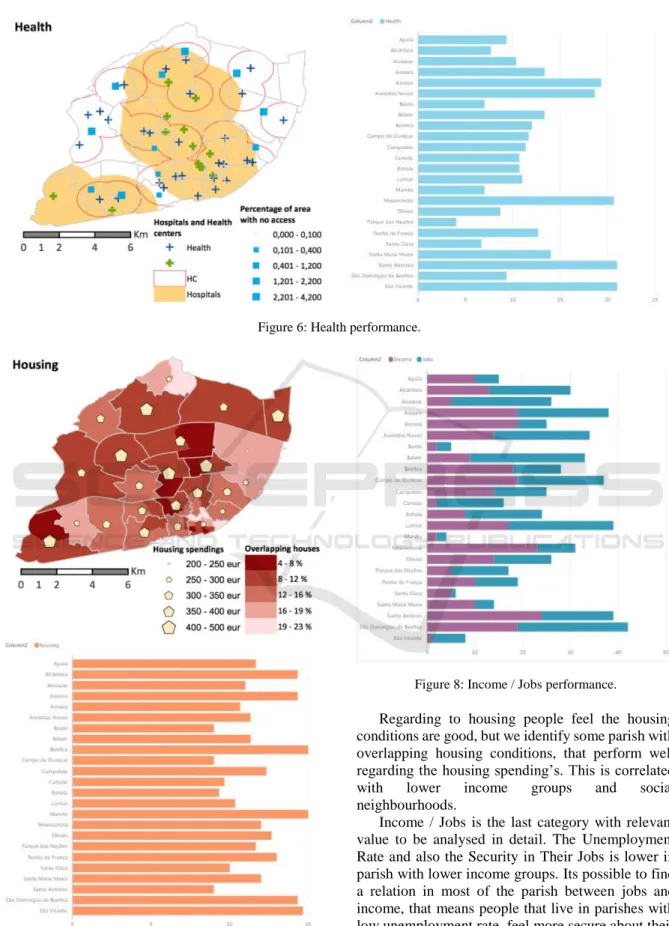
The people inquired rate Health as the second most important category, but in general they feel very healthy. This could mean that although they are healthy (probably because of their young age), they think there is a need to improve in health care systems. There are parishes with no access to both health centres and hospitals: Beato, Benfica, Marvila, Olivais, Parque das Nações and Santa Clara. This parishes are not located on the city centre, and there is a predominance of parishes in the occidental part of town.
Figure 6: Health performance.
Figure 7: Housing performance.
Figure 8: Income / Jobs performance.
Regarding to housing people feel the housing conditions are good, but we identify some parish with overlapping housing conditions, that perform well regarding the housing spending’s. This is correlated with lower income groups and social neighbourhoods.
Income / Jobs is the last category with relevant value to be analysed in detail. The Unemployment Rate and also the Security in Their Jobs is lower in parish with lower income groups. Its possible to find a relation in most of the parish between jobs and income, that means people that live in parishes with low unemployment rate, feel more secure about their income.
3.2 Happiness Map
The happiness map that results from this work can be seen as a tool for governments, city halls, and also the citizens by representing all the information collected (subjective and objective).
This map takes into consideration the categories that are more important to people. The data was related by a ranking system by dataset, in order to compare the several datasets, with different scales and information’s.
The results in warm colours represent higher rankings and with cold colours low ranks. It’s possible to identify that the centre performed better, and the north and east parts of city performed worst. These could be explained by social economical motives as well as the distance to city facilities.
Figure 9: Happiness map.
Clustering the results it’s possible to identify more clearly the areas in the city, were is necessary to invest and reduce the difference of happiness and wellbeing among the citizens:
The city centre with higher performances The parishes of Charneca, Ameixoeira,
Lumiar and Carnide at the north of the city The parishes of Marvila, Beato e São João,
to the east of the city.
Figure 10: Happiness map.
3.3 Happiness Index
To provide some added value to the project an happiness index was created. This index is a tool meant to be used by the citizen in order to allow them to create their one happiness dashboards / maps according to the categories that are more important to them. This tool could be made available on public municipal platforms, allowing the citizen to choose the parish that suits more his personal needs, in order to achieve higher personal happiness and well-being.
Figure 11: Interactive Index.
Furthermore, this tool allows for the user to specify which are the variables that he values the most (subjective and objective) and the results will adjust automatically.
4 CONCLUSIONS
This project can benefit the city hall, politicians and decision makers, making the city smarter, happier, and with less inequality. It also benefits the citizens since they can access a dashboard simple do understand and visualize, making their life decisions easier (example choosing a place to live).
The city centre has the parish with higher performances, and the parish of Beato, Carnide and Ajuda are the parish with lower performance.
This study suggest an investment on:
Children facilities: pre-schools and playgrounds around the city
Primary health care centres (centros de saúde). Investment on city infrastructures in the parishes of Carnide, Santa Clara, Beato, Marvila and Ajuda.
The open data provided by the municipality of Lisbon demonstrated the enormous potential in its use, both in the evaluation of public policies and in the development of solutions for valuing certain neighbourhoods or even the real estate sector.
However the study allowed to identify at least 50 datasets were required to achieve higher quality precluding its use in its fullness. Regarding the survey, some fragilities were identified in the sample of the answers collected, it would be benefit to have more answers and also to a more diverse group (about age, sex and income).
The development of this study would make sense through a partnership with the municipality, allowing full access to all information and providing solutions for the use of open municipal data. In this way a greater approximation between the released data and the users of the data is promoted.
This paper will also benefit with data mining sentiment analysis, besides the surveys.
Finally this study will also benefit if collecting the data, processing and storing was done in a dynamic and automatic way.
REFERENCES
Pitts, A., 2004. Planning and design strategies for sustainability and profit: pragmatic sustainable design on building and urban scales. Elsevier.
Helliwell, J., Layard, R., Sachs, J. 2017. World Happiness
Report 2017, New York: Sustainable Development
Solutions Network.
Ortiz-Ospina, E., Roser, M., 2013. Happiness and Life
Satisfaction, Rotterdam: Worls Database of Happiness.
Deaton, A., Eisenhower, D., 2014. Using happiness data in
policy making.
Tabor, D., Stockley, L., 2017. Personal Well-being in the
UK.
Veenhoven, R., Rotterdam: World Database of Happiness.
ArcGis – Open Data
J. Sterne, 2010, Social Media Metrics: How to Measure and
Optimize Your Marketing Investment.