Electrical and Optical Transport Characterizations of Electron Beam Evaporated V Doped
In
2O
3Thin Films
Md. Ariful Islama*, Ratan Chandra Royb, Jaker Hossainb, Md. Julkarnainb, Khairul Alam Khanb
Received: December 8, 2015; Revised: August 24, 2016; Accepted: September 7, 2016
Vanadium (5 at. %) doped Indium Oxide (V: In2O3) thin ilms with diferent thicknesses (50 nm,
100 nm and 150 nm) were prepared onto glass substrate by electron beam evaporation technique in
a vacuum of about 4×10⁻³ Pa. X-ray difraction (XRD) pattern revealed that the prepared ilms of
thickness 50 nm are amorphous in nature. Temperature dependence of electrical resistivity was studied in the 300 < T < 475 K temperature range. The ilms exhibit a metallic behavior in the 300 < T < 380 K range with a positive temperature coeicient of the resistivity (TCR), whereas at T > 380 K, the conduction behavior turns into a semiconductor with a negative TCR. Optical studies revealed that the ilms of thickness 50 nm possess high transmittance of about 86 % in the near-infrared spectral region. The direct optical band gap lies between 3.26 and 3.00 eV depending on the ilm thickness.
Keywords: Transparent conducting oxide, Activation energy, Indium oxide, V: In2O3 Thin ilms,
Optical band gap
* e-mail: [email protected]
1. Introduction
Transparent conducting oxide (TCO) has become the essential part of the optoelectronic applications due to its excellent transparent and conductive properties. TCO has unique characteristics such as low electrical resistivity (< 10-3
Ω-cm) and high optical transmittance in the visible region (> 80 %) with a wide energy band gap (3.70 eV)1-3. Due
to these combined unique properties, TCO has been used in a wide range of applications such as lat panel displays, photovoltaic cells, light emitting diodes, solar cells, barrier layers in tunnel junctions, and thin ilm transistor (TFT)4-8.
Literature reports on TCO ilms revealed that some TCO thin ilms have interesting physical phenomena such as metal–semiconductor transitions (MSTs). These transitions occur at a wide temperature range and are observed in doped TCO thin ilms9-15. Among the various TCO thin ilms like
ITO, CdO, ZnO, SnO2, Indium oxide (In2O3) has been widely
used in lat panel displays, opto-electronic modulators, liquid crystal displays, solar cells, architectural glasses and photovoltaic devices. A variety of electrical properties such as metallic, semiconducting, or insulating behavior can be
obtained depending on its stoichiometric form (In2O3)16. The
structural and opto-electrical properties of oxide materials like In2O3 thin ilms are highly inluenced by doping
impurities. The impurities like tin (Sn), zinc (Zn), gallium (Ga), copper (Cu), zirconium (Zr), erbium (Er), molybdenum (Mo) and titanium (Ti) have been doped to In2O3 to produce
technologically useful materials and studied extensively by
many researchers17-23. Compared to these dopants, vanadium
is one of the interesting and suitable external dopant in our study because indium has a valence of three, and vanadium has a valence of ive. In V: In2O3 samples, vanadium acts
as a cationic dopant in the indium oxide lattice, which results in n-doping of the lattice by providing one or two electrons to the conduction band. If vanadium substitutes with indium, it provides free electrons into the lattice and the electrical conduction will increase but it also acts as a neutral impurity scattering center and decreases the electrical conduction when combined with interstitial oxygen atoms. Its smaller ionic radius (78 pm) compared with (94 pm)
for In3+ causes local strains and enhance the formation of
grain boundaries. A variety of deposition techniques have
been used for the preparation of undoped and doped In2O3
ilms such as reactive thermal evaporation method, electro-deposition, radio frequency magnetron sputtering24–27. Li et
al. reported a transparent conducting V: In2O3 thin ilms
for hole injection in organic light-emitting devices (OLEDs) prepared by a modiication-speciic reactive thermal co-evaporation method, which shows a minimum electrical resistivity of 7.95×10⁻⁴ Ω-cm and good optical transmittance
in the visible spectra range24. Recently, Seki et al. fabricated
transparent V: In2O3 thin ilms for OLED by spray chemical vapor deposition28 and found the minimum resistivity of 1.08
× 10−3 Ω-cm and average transmittance in the visible range of 84 %. V: In2O3 nanoibers can be used as a gas sensor
at low temperature29. Although there have been a number
of investigations on the structural, electrical and optical
a Department of Physics, Rajshahi University of Engineering & Technology – RUET, Rajshahi, Bangladesh
properties of the above-mentioned doped In2O3 ilms, no
systematic study has been paid on the electrical and optical
properties using vanadium as a dopant.
In this article, vanadium (5 at. %) doped indium oxide
(V: In2O3) thin ilms were prepared onto glass substrate by
the electron beam evaporation technique. The inluence of thickness on the electrical and optical properties of the V:
In2O3 thin ilms were investigated.
2. Experimental details
Vanadium doped (5 at. %) indium oxide thin ilms were prepared onto glass substrate by electron beam evaporation technique in vacuum at ~ 3×10⁻⁴ pa from In
2O3 powder (99.999
% pure) and vanadium powder (99.999 % pure) obtained from Aldrich Chemical Company, USA. Each material was weighted by an electronic balance (Mettler TOLEDO, AB 204) having a resolution of ± 0.0001 g. The percentage of composition was determined as30:
3. Results and Discussion
3.1. Structural Properties
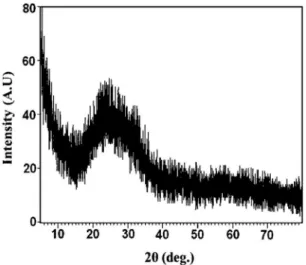
XRD pattern of the as-deposited V: In2O3 thin ilm with
thickness of 50 nm is shown in Figure 1. In the absence of sharp difraction peaks in the XRD pattern indicates that the ilm is amorphous in nature. Similar result was observed in e-beam evaporated indium tin oxide ilms10.
%
% ( )
Weight
V
w
w
w
100
1
V InO
V
#
=
+
Where Wv and WInO are the weight of V and In2O3,
respectively. When the chamber pressure was reduced to
3×10⁻⁴ pa, deposition was started with beam currents 60 mA
by turning on the low tension (LT) switch. The deposition rates of VIO thin ilms are about 12.5 nms-1.
The thicknesses of the ilms were determined using interference Fizeau fringes method31. The electrical contacts
required for resistivity measurements were made with silver paste (leading silver D-200) above the ilms. Structural property of the V: In2O3 ilm was carried out in a PHYLIPS
PW3040 X’Pert PRO XRD System. X-ray difractogram of the sample was recorded using monochromatic CuKα radiation
(λ=1.54187 Å), scanning speed 2 degree/min, starting from
80 and ending at 800. The surface morphology of the ilm was
studied using in a HITACHI S-3400N Scanning Electron Microscopy (SEM) system.
Temperature dependent electrical resistivity (ρ) measurements were performed by Van-der-Pauw technique
using a standard four-probe setup32. The electrical contacts
were made in the four corners using silver paste (leading silver D-200) above the ilms. Resistance was measured by applying a current through the sample, and measuring the voltage by digital multi-meters (KENWOOD DL-711), respectively. The optical transmittance spectra of ilms were recorded from 300 < T < 1100 nm wavelength using
a SHIMADZU UV- double beam spectrophotometer at room temperature. To determine the band gap of the V:
In2O3 thin ilms optically, the plot of (αhν) 2 vs. (hν) was
drawn for direct allowed transition. The value of the band gap was determined for the tangent of these curves which intersect the energy axis.
Figure 1: XRD pattern of the as-deposited V: In2O3 ilm with
thickness of 50 nm.
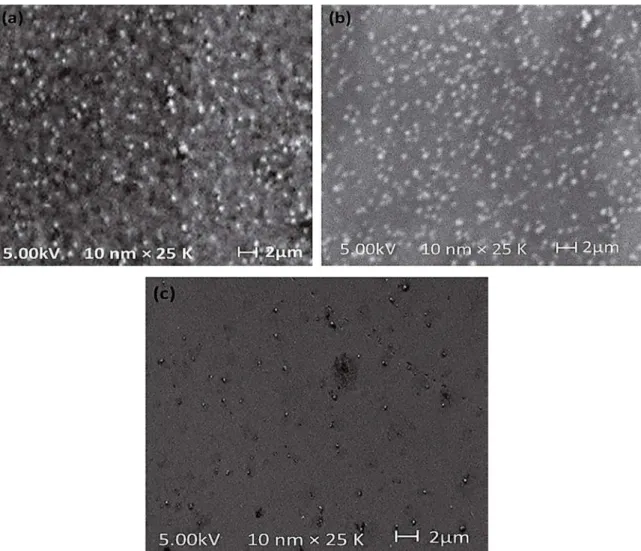
Scanning Electron Microscopy (SEM) was used to study the surface morphology of V: In2O3 thin ilms. Figure
2 shows the SEM micrograph of the as-deposited V: In2O3
thin ilm with diferent thicknesses. The ilms display uniform morphology and possess nearly distributed grains
over the surface.
3.2. Electrical properties
Figure 3 shows the resistivity versus temperature for a few typical V: In2O3 ilms with diferent thicknesses of 50 nm,
100 nm and 150 nm in the 300 <T < 475 K range. From Table 1 it is observed that the resistivity of V: In2O3 ilms strongly
depended on the ilms thickness. At room temperature, the resistivity of the ilms decreases from 1.80×10⁻¹ to 1.10×10⁻²
Ω-cm with increasing the ilms thickness. The decrease in resistivity with the ilms thickness may be attributed to the lesser relative contribution of the carrier scattering at the ilms surface33. Vanadium doping afects the resistivity of
the V: In2O3 thin ilms. The minimum resistivity of 1.10 ×10⁻² Ω-cm is observed in V: In
2O3 which is larger than that
for pure indium oxide (~2.00 × 10⁻⁴ Ω-cm)34 and indium tin
oxide (~1.9 × 10⁻⁴ Ω-cm) thin ilms35. The reason for the
Figure 2: SEM micrograph of the as-deposited V: In2O3 ilm with diferent thicknesses.
Figure 3: Temperature dependence of the resistivity (ρ) as a function
of temperature (T) of V: In2O3 thin ilms with diferent thicknesses.
and V2O5, which acts as a carrier traps rather than electron
donors. As observed from Figure 3, the resistivity for all ilms increases with increasing the temperature up to 380
K, showing metallic behavior. At approximately 380 K, the resistivity begins to decrease rapidly, and above 415 K, ρ decreases slowly with further increasing the temperature. The ilms display a semiconductor behavior at T > 380 K, and a minimum resistivity of 9.00 × 10⁻⁴ Ω-cm is found at
475 K. Metallic and semiconductor behavior are evidenced in the resistivity measurements as a function of temperature: a metal–semiconductor transition (MST).
defect removal during annealing36-38. Thus, rearrangement
and elimination of point defect clusters leads to an increase in carrier concentration, thereby reducing resistivity.
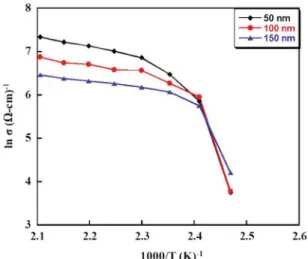
Figure 4 shows that the ilms exhibit a positive TCR in the 300 < T < 380 K temperature range, whereas the ilms display a semiconductor behavior with a negative TCR in the 380 < T < 475 K range. The activation energy calculated from temperature dependent electrical conductivity measurements
of V: In2O3 ilms. The plot of ln (σ) vs. 1000/T in the 380
< T< 475 K temperature range is shown in Figure 5. The plot is found to have two regions with two diferent slops with the point of inlection around 425 K. The presence of two regions with two diferent slopes in the plot may be due to the presence of two types of conduction in the
V: In2O3 ilms, such as 380 < T < 425 K and above 425 K
in the investigated temperature range. In the 380-425 K range, V may be provided electrons in the lattice which are activated to the localized state and this state moves toward the conduction band and thus increased conductivity. And above 425 K, impurity-impurity scattering may be increased which leads to decrease in the electrical conduction. Fitting the data using the linear equation:
Table 1: Dependence of resistivity on the ilms thickness at various
temperatures.
No. Thickness (nm) Resistivity (Ω-cm) At 300 K At 380 K At 475K
1 50 1.80 ×10⁻¹ 3.30 ×10⁻¹ 9.00 ×10⁻⁴
2 100 3.60 ×10⁻² 6.60 ×10⁻² 1.40 ×10⁻³
3 150 1.10 ×10⁻² 2.10 ×10⁻² 1.70 ×10⁻³
/
( )
exp
E K T
2
B2
0v
=
v
Q
-
D
V
where ΔE is the activation energy, σ0 is the pre-exponential
factor and KB is the Boltzmann constant and T is the absolute temperature. In the 380 < T < 425 K temperature range, almost average ΔE of 8.25 eV is found, and at T > 425 K, ΔE is found to decrease from 0.40 to 0.20 eV with increasing the ilms thickness.
3.3. Optical properties
UV-VIS spectra of the ilms were studied using the optical transmittance measurements which were taken in the spectral region from 300 < T < 1100 nm. The variation
of optical transmittance as a function of wavelength for V:
In2O3 thin ilms with various thicknesses, as shown in Figure
6. It is seen from the igure that transmittance is greatly afected by ilms thickness, the thinner ilms of thickness 50 nm show relatively higher transmittance of about 86 % in the near infrared region. The ilms of thickness 100 nm are transparent with transmission of about 80 % and the thicker
Figure 4: Variation of T.C.R. with temperature for the V: In2O3 thin
ilms with diferent thicknesses.
Figure 5: Plot of ln (σ) versus 1000/T of V: In2O3 thin ilms with
diferent thicknesses in the temperature range 385-475 K.
Figure 6: Spectral transmittance of V: In2O3 thin ilms as a function
ilms of thickness 150 nm are relatively less transparent with transmission of about 75 % in the near infrared region. The reduction of transmittance with thickness may be attributed to the optical scattering arising from longer optical paths and also to changes in the carrier concentration39,40. In the
visible region, transmittance of all ilms decreases sharply with decreasing the wavelength up to 620 nm, and after which, it remains almost constant with further increasing the wavelength up to 400 nm. This decrease of transmittance with the increase in photon energy is due to the absorption
of free carrier.
The absorption coeicient (α) was calculated from the
transmittance (t) using the relation41:
/
d
ln
/
T
( )
1
1
3
a
=
"
Q
V
%
where d is the ilm thickness and T is the transmittance.
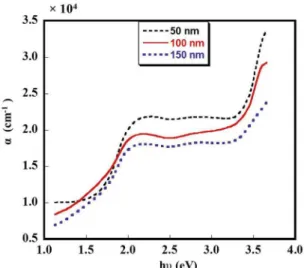
Figure 7 shows the variation of absorption coeicient with the photon energy (hν) of V: In2O3 thin ilms of diferent
thicknesses. The absorption coeicient for all ilms is found
to be the order of 104 cm-1. The optical band gap (Eg) was
determined from the absorption coeicient (α) and photon energy (hγ) using the following relation:
( )
hv
A hv
Eg
m4
a
=
R
-
W
where Eg is the optical band gap, hγ is the energy of the
incident photon, and A is a constant and m takes the value of ½ and 2 for direct and indirect allowed transition, respectively. The direct allowed bang gap is obtained by plotting (αhυ)2
against photon energy and extrapolating the linear part of the plots to zero absorption (α=0). Figures 8 (a)-(c) show the (αhυ)
2 versus (hυ) plots for various thicknesses. It is observed that E g
decreases from 3.26 eV to 3.00 eV with increasing thickness. This is possibly due to the increase in particle size and decrease in strain and dislocation density. The doping of vanadium into
the indium oxide reduces the band gap (band gap of pure indium oxide is 3.75 eV42). This band gap reduction may be attributed
to the decrease in carrier concentration because some V causes
disorder in the indium oxide lattice and V atoms acts as a carrier trap instead of electron donors. This decrease in carrier density shifted the absorption edge towards lower energies. The band
gaps of V: In2O3 ilms at various ilms thicknesses are inserted
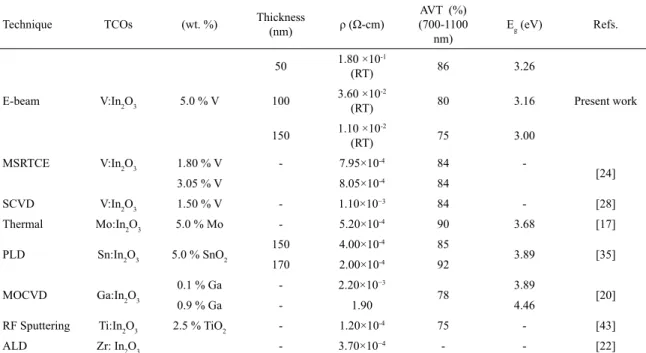
in Table 2. The resistivity, optical transmittance and direct band
gap of the V: In2O3 thin ilms of the pervious works are compared
in Table 3 with the present work.
4. Conclusions
Vanadium (5 at. %) doped indium oxide thin ilm was prepared onto glass substrate by electron-beam evaporation method. XRD analysis indicated that the V: In2O3 ilm is an
amorphous one. Temperature dependent electrical resistivity were carried out in the 300 < T < 475 K temperature range.
Figure 7: Absorption coeicient (α) as a function of photon energy
(hυ) of V: In2O3 ilms with diferent thicknesses.
Figure 8: (αhυ)2 versus photon energy ( hυ) plots for V: In 2O3 ilms
with diferent thicknesses of (a) 50 nm, (b) 100 nm and (c) 150 nm.
Table 2: Optical band gap of V: In2O3 thin ilms with diferent
thicknesses
No. Thickness (nm) AVT (%)
(700-1000 nm) Band gap (eV)
1 50 86 3.26
2 100 80 3.16
3 150 75 3.00
AVT average transmittance
The ilms exhibit a metallic behavior with a positive TCR in the 300 < T < 380 K range. Semiconductor conductivity with metal-semiconductor transition is observed at T > 380 K in V:
In2O3. For the ilm with 50 nm thickness, the resistivity value is
close to 9.00 × 10⁻⁴ Ω-cm at 415 K and the transmittance is ~86
Table 3: Comparison of electrical and optical properties of V: In2O3 thin ilms with previous reported works of diferent TCO ilms by
various techniques.
Technique TCOs (wt. %) Thickness
(nm) ρ (Ω-cm)
AVT (%)
(700-1100 nm)
Eg (eV) Refs.
E-beam V:In2O3 5.0 % V
50 1.80 ×10
-1
(RT) 86 3.26
Present work
100 3.60 ×10
-2
(RT) 80 3.16
150 1.10 ×10
-2
(RT) 75 3.00
MSRTCE V:In2O3 1.80 % V - 7.95×10
-4 84
-[24]
3.05 % V 8.05×10⁻⁴ 84
SCVD V:In2O3 1.50 % V - 1.10×10⁻³ 84 - [28]
Thermal Mo:In2O3 5.0 % Mo - 5.20×10
-4 90 3.68 [17]
PLD Sn:In2O3 5.0 % SnO2
150 4.00×10⁻⁴ 85
3.89 [35]
170 2.00×10⁻⁴ 92
MOCVD Ga:In2O3
0.1 % Ga - 2.20×10⁻³
78 3.89 [20]
0.9 % Ga - 1.90 4.46
RF Sputtering Ti:In2O3 2.5 % TiO2 - 1.20×10
-4 75 - [43]
ALD Zr: In2O3 - 3.70×10⁻⁴ - - [22]
MSRTCE modiication-speciic reactive thermal co-evaporation, SCVD spray chemical vapor deposition, PLD pulsed laser deposition, MOCVD Metal-Organic Chemical Vapour Deposition, ALD atomic layer deposition
structural, electrical and optical properties of V: In2O3 ilms are
encouraging for application as a transparent conducting oxide and are suitable for many opto-electronic applications.
5. Acknowledgments
A. Islam is grateful to the Institute of Mining, Mineralogy & Metallurgy, BCSIR, Joypurhat, Bangladesh, for measuring the X– ray data. The authors also wish to thank Dr. Nuruzzaman and A. T. K. Karim for valuable discussions.
6. References
1. Dakhel AA. Optical properties of highly conductive and transparent Au-incorporated Eu oxide thin ilms. Journal of Alloys Compounds.
2009;470(1-2):195-198.
2. Meng Y, Yang X, Chen H, Shen J, Jiang Y, Zhang Z, et al. A new transparent conductive thin ilm In2O3: Mo. Thin Solid Films.
2001;394(1-2):219-223.
3. Xirouchaki C, Kiriakidis G, Pedersen TF, Fritzsche H. Photoreduction and oxidation of as-deposited microcrystalline indium oxide. Journal of Applied Physics. 1996;79(12):9349.
4. Ginley DS, Bright C. Transparent conducting oxides. MRS Bulletin. 2000;25(8):15-18.
5. Wagner JF, Keszler DA, Presley RE. Transparent Electronics. New York: Springer; 2008.
6. Fortunato E, Ginley D, Hosono H, Paine DC. Transparent Conducting Oxides for Photovoltaics. MRS Bulletin. 2007;32(3):242-247.
7. Chua BS, Xu S, Ren YP, Cheng QJ, Ostrikov K. High-rate room temperature plasma-enhanced deposition of aluminum-doped zinc oxide nano ilms for solar cell applications. Journal of Alloys and Compounds. 2009;485(1-2):379-384.
8. de Biasi RS, Grillo MLN. Inluence of manganese concentration on the electron magnetic resonance spectrum of Mn2+ in CdO.
Journal of Alloys and Compounds. 2009;485(1-2):26-28. 9. Naidu Muniswami RV, Subrahmanyam A, Verger A, Jain MK,
Bhaskara Rao SV, Jha SN, et al. Electron-electron interactions based metal-insulator transition in Ga doped ZnO thin ilms. Electronic Materials Letters. 2012;8(4):457-462.
10. Liu XD, Jiang EY, Zhang DX. Electrical transport properties in indium tin oxide ilms prepared by electron-beam evaporation. Journal of Applied Physics. 2008;104(7):073711.
11. Nistor M, Perrière J. Metal–insulator transition in oxygen deicient Ti based oxide ilms. Solid State Communications. 2013;163:60-64.
12. Sun-Jian, Yang W, Huang Y, Lai WS, Lee AYS, Wang CF, et al. Properties of low indium content Al incorporated IZO (indium zinc
oxide) deposited at room temperature. Journal of Applied Physics.
2012;112(8):083709.
13. Guo EJ, Guo H, Lu H, Jin K, He M, Yang G. Structure and characteristics of ultrathin indium tin oxide ilms. Applied Physics Letters. 2011;98(1):011905.
14. Lin BT, Chen YF, Lin JJ Wu CY. Temperature dependence of resistance and thermopower of thin indium tin oxide ilms. Thin
Solid Films. 2010;518(23):6997-7001.
15. Li Y, Huang Q, Bi X. The change of electrical transport characterizations in Ga doped ZnO ilms with various thicknesses. Journal of Applied
16. Bender M, Katsarakis N, Gagaoudakis E, Hourdakis E, Douloufakis E, Cimalla V, et al. Dependence of the photoreduction and oxidation behavior of indium oxide ilms on substrate temperature and ilm thickness. Journal of Applied Physics. 2001;90(10):5382.
17. Kaleemulla S, Madhusudhana Rao N, Girish Joshi M, Sivasankar Reddy A, Uthanna S, Sreedhara Reddy P. Electrical and optical
properties of In2O3:Mo thin ilms prepared at various Mo-doping
levels. Journal of Alloys and Compounds. 2010;504(2):351-356.
18. Ito M, Kon M, Miyazaki C, Ikeda N, Ishizaki M, Matsubara R, et al. Amorphous oxide TFT and their applications in electrophoretic displays. Physica Status Solidi A. 2008;205(8):1885-1894. 19. Moholkar AV, Pawar SM, Rajpure KY, Ganesan V, Bhosale CH.
Efect of precursor concentration on the properties of ITO thin ilms. Journal of Alloys and Compounds. 2008;464(1-2):387-392. 20. Kong L, Ma J, Yang F, Luan C, Zhu Z. Preparation and characterization
of Ga2xIn2(1−x)O3 ilms deposited on ZrO2 (1 0 0) substrates by
MOCVD. Journal of Alloys and Compounds. 2010;499(1):75-79.
21. Sasaki M, Yasui K, Kohiki S, Deguchi H, Matsushima S, Oku M, et al. Cu doping efects on optical and magnetic properties of In2O3.
Journal of Alloys and Compounds. 2002;334(1-2):205-210.
22. Asikainen T, Ritala M, Leskelä M. Atomic layer deposition growth of zirconium doped In2O3 ilms. Thin Solid Films. 2003;440(1-2):152-154.
23. Ito N, Sato Y, Song PK, Kaijio A, Inoue K, Shigesato Y. Electrical and optical properties of amorphous indium zinc oxide ilms. Thin
Solid Films. 2006;496(1):99-103.
24. Li H, Wang N, Liu X. Optical and electrical properties of Vanadium doped Indium oxide thin ilms. Optics Express. 2008;16(1):194-199.
25. Sharma R, Mane RS, Min SK, Han SH. Optimization of growth of
In2O3 nano-spheres thin ilms by electro-deposition for dye-sensitized
solar cells. Journal of Alloys and Compounds.
2009;479(1-2):840-833.
26. Peng LP, Fang L, Yang XF, Li YJ, Huang QL, Wu F, et al. Efect of annealing temperature on the structure and optical properties of In-doped ZnO thin ilms. Journal of Alloys and Compounds.
2009;484(1-2):575-579.
27. Sun SY, Haung JL, Lii DF. Efects of H2 in indium–molybdenum
oxide ilms during high density plasma evaporation at room
temperature. Thin Solid Films. 2004;469-470:6-10.
28. Seki Y, Seki S, Hoshi Y, Uchida T, Sawada Y. Characteristics of vanadium-doped indium oxide thin ilms for organic light-emitting diodes fabricated by spray chemical vapor deposition. Japanese
Journal of Applied Physics. 2015;54(4):041101.
29. Liu J, Guo W, Qu F, Feng C, Li C, Zhu L, et al. V-doped In2O3
nanoibers for H2S detection at low temperature. Ceramics
International. 2014;40(5):6685-6689.
30. Chopra KL. Thin Film Phenomena. New York: McGraw-Hill;1969.
31. Tolansky S. Multiple Beam Interferometry of Surfaces and Films.
Oxford: Clarendon Press; 1948.
32. Van der Pauw LJ. A method of measuring speciic resistivity and hall efect of discs of arbitrary shape. Philips Research Reports.
1958;13:1-9.
33. Giraldi TR, Escote MT, Bernardi MIB, Bouquet V, Leite ER, Longo E, et al. Efect of Thickness on the Electrical and Optical Properties
of Sb Doped SnO2 (ATO) Thin Films. Journal of Electroceramics.
2004;13(1):159-165.
34. Adurodija FO, Izumi H, Ishihara T, Yoshioka H, Motoyama M, Murai K. Inluence of substrate temperature on the properties of indium oxide thin ilms. Journal of Vacuum Science and Technology
A. 2000;18(3):814.
35. Kim H, Gilmore CM, Piqué A, Horwitz JS, Mattoussi H, Murata H, et al. Electrical, optical and structural properties if indium-tin-oxide thin ilms for organic light-emitting devices. Journal of Applied
Physics. 1999;86(11):6451.
36. Primak W. Kinetics of Processes Distributed in Activation Energy. Physical Review. 1955;100:1677.
37. Meechan CJ, Brinkman JA. Electrical Resistivity Study of Lattice Defects Introduced in Copper by 1.25-Mev Electron Irradiation at 80°K . Physical Review. 1956;103:1193.
38. Damodara Das V. Modiied equations for the evaluation of energy distribution of defects in as-grown thin ilms by Vand’s theory. Journal of Applied Physics. 1984;55(4):1023.
39. Banerjee AN, Ghosh CK, Chattopadhyay KK, Minoura H, Sarkar AK, Akiba A, et al. Low-temperature deposition of ZnO thin ilms on PET and glass substrates by DC-sputtering technique. Thin Solid Films. 2006;496(1):112-116.
40. Agashe C, Kluth O, Schöpe G, Siekmann H, Hüpkes J, Rech B. Optimization of the electrical properties of magnetron sputtered aluminum-doped zinc oxide ilms for opto-electronic applications. Thin Solid Films. 2003;442(1-2):167-172.
41. Demichelis F, Kaniadakis G, Tagliferro A, Tresso E. New approach to optical analysis of absorbing thin solid ilms. Applied Optics.
1987;26(9):1737-1740.
42. Szczyrbowski J, Dietrich A, Hofmann H. Optical Properties of RF-Sputtered Indium Oxide Films. Physica Status Solidi A.
1982;69(1):217-226.
Erratum
In the article "
Electrical and Optical Transport Characterizations of Electron Beam
Evaporated V Doped In
2O
3Thin Films
", DOI number:
http://dx.doi.org/10.1590/1980-5373-mr-2015-0753, published in Mat. Res.
, 20(1): 102-108,
in the first page where it
read:
Md. Ariful Islam
a *Ratan Chandra Roy
bJakir Hossain
bMd. Julkarnain
bKhairul Alam Khan
ba
Department of Physics, Rajshahi University of Engineering & Technology - RUET,
Rajshahi, Bangladesh
b
Department of Applied Physics & Electronic Engineering, University of Rajshahi,
Rajshahi, Bangladesh
It should be written:
Md. Ariful Islam
a *Ratan Chandra Roy
bJaker Hossain
bMd. Julkarnain
bKhairul Alam Khan
ba
Department of Physics, Rajshahi University of Engineering & Technology - RUET,
Rajshahi, Bangladesh
b