*e-mail: [email protected]
Novel Morphology of Needle-Like Nanoparticles of Na
2Mo
2O
7Synthesized by Using Ultrasonic Spray Pyrolysis
Ivana Lj. Validžić*, Miodrag Mitrić
Vinča Institute of Nuclear Sciences, University in Belgrade, P.O. Box 522, 11001, Belgrade, Serbia
Received: May 11, 2012; Revised: July 13, 2012
Low-temperature method for the synthesis of novel morphology of needle-like nanoparticles of disodium dimolybdate (Na2Mo2O7) in the process of ultrasonic spray pyrolysis (USP) using aqueous solutions of thermodynamically stable molybdenum (VI) oxide clusters as precursor is described. Needle-like Na2Mo2O7 particles were obtained and collected in toluene, while centrifugation was employed to isolate solid material from solution. The scanning electron microscopy (SEM) confirmed that the morphology of the synthesized Na2Mo2O7 particles is needle-like collected into bundles. The X-ray Powder Diffraction (XRPD) analysis revealed appearance of orthorhombic Na2Mo2O7, synthesized at 300 °C. By comparing the XRPD pattern of the synthesized needle-like Na2Mo2O7 powder obtained in the process of USP with the XRPD pattern simulated for randomly-distributed crystallites by planes, the most prefered growth plane of needle-like nanoparticles were found.
Keywords: sodium dimolybdate, ultrasonic spray pyrolysis, scanning electron microscopy, Mo-complexes, X-ray technique
1. Introduction
Ternary molybdates generally (Na–Mo–O) have attracted considerable attention because of their interesting structural and thermodynamic properties1. Lammers and
Blasse2 reported the luminescence properties of Na 2Mo2O7.
Molybdate compounds have been extensively studied for solid-state lighting with light emitting diodes. In most cases, this structure is luminescent ion hosts in order to obtain a well defined emission property3,4. On the other
side, sodium dimolybdate (Na2Mo2O7) belongs to the class of sodium molybdates with the general composition Na2MonO3n+1[5,6]. The room temperature structure of
Na2Mo2O7 is orthorhombic, belonging to the base-centered orthorhombic type of structure with 64 space group Cmca. Na2Mo2O7 has been the subject of many investigations, including the measurements of the UV-Vis spectrum, FTIR and Raman spectra and differential thermal analysis (DTA)7-10.
Conventional method for preparation of disodium dimolybdate (Na2Mo2O7) is thermal treatment of mixture consisting of sodium molybdate and molybdenum trioxide in a platinum crucible for two weeks at 700 °C11. In the
meantime, Goel et al.12 reported preparation of Na 2Mo2O7
in the process of pyrolisis of sodium oxomolybdenum (VI) oxalate at lower temperature (280 °C). Recently, a new low-temperature method has been reported for the synthesis of Na2Mo2O7 in the process of USP using acidified aqueous solutions of thermodynamically stable molybdenum (VI) oxide clusters as a precursor7, and also detailed crystal
structure refinement was presented by Jovanović et al.13. The
obtained spherical Na2Mo2O7 nanoparticles powders were collected in isobutyl alcohol7. To the best of our knowledge,
no other papers concerning synthesis of Na2Mo2O7 can be found in literature. On the other side, the synthesis of the same Na2Mo2O7 particles with different morphology could be interesting goal, in terms of morphology can influence the optical properties and structure14. It has been observed
that elongated morphological forms may show enhanced optical properties15.
In this paper, we report the low-temperature synthesis in the process of USP using molybdenum (VI) oxide clusters as a precursor. Processed complexes obtained at 300 °C were collected in toluene. Obtained particles of Na2Mo2O7 are needle-like, and as far as we are aware this is the first synthesis of this shape. Drastic variation in the morphology as well as in the structure preferential orientation were found only by changing the solvent polarity.
2. Experimental Procedures
All chemicals (molybdenum (VI) oxide, perchloric acid, toluene and sodium perchlorate) purchased from Merck (Darmstadt, Germany) were pure grade and they were used without further purification. Aqueous solutions of thermodynamically stable molybdenum (VI) oxide clusters were prepared as described in literature16,17. Briefly,
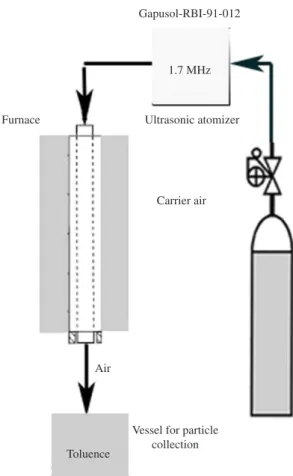
The Na2Mo2O7 powders were obtained in the process of ultrasonic spray pyrolysis (USP) using solutions consisting of molybdenum (VI) oxide clusters as a starting material. Laboratory setup for USP (see Figure 1) consists of ultrasonic atomizer (GAPUSOL-RBI-91-012, Sarl, France) operating at a frequency of 1.7 MHz for aerosol generation, and horizontal electric furnace with the quartz tube and a vessel for particle collection. The effective heating length of reactor tube was 1 m with the maximum temperature of 300 °C in the middle of the furnace. The flow rate of air was 30 dm3 per hour. The droplet velocity, calculated from
the ratio of the carrier gas flow to the reaction zone area (0.5 × 10⁻³ m2), was 0.017 m/s.The flow rate of aerosol
droplets was assumed to be equal to the flow rate of gas carrier, and the residence time of the aerosol droplets in the reaction zone, calculated from the ratio of the tube length to the droplet velocity, was found to be 1 minute.
The obtained Na2Mo2O7 powder was collected in toluene and particles were separated from solvent containing excess of Cl– ions immediately after synthesis by using
ultra centrifugation. Synthesized Na2Mo2O7 particles were washed several times and dried at air. We repeat the procedure under above mentioned condition several times, in order to verify the results obtained. The system chosen for this study (total molybdate concentration of 0.1 M and pH = 3.9) is well characterized in literature16, and under
above mentioned conditions Mo7O24 and Mo8O26 species
exist at concentration level of more than 90% of total molybdate concentration. The extension of this approach for the synthesis of the Na2Mo2O7 powders under different concentrations and pH is under way in our laboratory.
Absorption spectra of the precursor solution were measured using UV-Vis spectrophotometer (Perkin Elmer Lambda 5, Waltham, Massachusetts, USA). Reflection spectra of Na2Mo2O7 powder were recorded using Avantes S2000 (Eerbeek, Netherlands) instrument with Deuterium-Halogen light source.
The scanning electron microscopy (SEM) measurements were performed using JEOL JSM-6460LV instrument (Tokyo, Japan). The Na2Mo2O7 samples were coated with thin layer of gold deposited by sputtering process. The thickness of the gold film was up to 40-50 nm.
The X-ray Powder Diffraction (XRPD) patterns of investigated samples were obtained on a Philips PW-1050 automated diffractometer using CuKα radiation (operated at
40 kV and 30 mA). A fixed 1° divergence and 0.1° receiving slits were used. Diffraction were collected in the 2θ range
10-60°, counting for 12 s in 0.02° steps. XRPD pattern simulated for randomly-distributed crystallites by planes were obtained in “Find it” program.
3. Results and Discussion
Aqueous complexes of molybdenum (VI) are formed in a number of overlapping and simultaneously existing protonation – deprotonation and aggregation – disaggregation equilibria16,18,19. Depending on the total molybdate
concentration and the degree of acidification of the solution, different molybdenum (VI) complexes appeared. During the process of USP the sprayed droplets containing molybdenum oxide clusters were transformed into particles by different processes including solvent evaporation and the precipitation of dissolved substance. The schematic diagram of experimental setup previously explained in the experimental section is presented in Figure 1.
Typical SEM image of the Na2Mo2O7 particles collected after the USP in toluene and separated from the solvent by ultra-centrifugation is shown in the Figure (2a and b). All of the particles are needle-like with quite uniform size distribution, all over the sample. The average diameter was found to be around 100 nm and length up to 10 µm. It should be mentioned that as far as we are aware this is the first synthesis of needle-like nanoparticles of Na2Mo2O7. Conventional method developed by Seleborg11 leads to the
formation of rod-shaped Na2Mo2O7 crystals. Further, in the Figure 3 are shematically presented two dominant complex species Mo7O246– and Mo
8O264– present in the precursor
solution that was well characterized and proved16,17.
Complexes processed by the spray pyrolysis process are self-organized in non-polar toluene in a way that spherical nanoparticles probably through oriented-attachment of individual nanoparticles form needles. Variations in the morphologies of the as-synthesized Na2Mo2O7 particles (from spherical observed in 2-propanol7 to needle-like
observed in toluene) were found only by changing the polarity of the solvents. Similar effect of the solvent polarity on the structural and morphological properties of AgI particles prepared using ultrasonic spray pyrolysis has already been observed20.
In the Figure 4 is presented absorption spectrum of the precursor solution consisting of thermodynamically stable molybdenum (VI) oxide clusters. Absorption
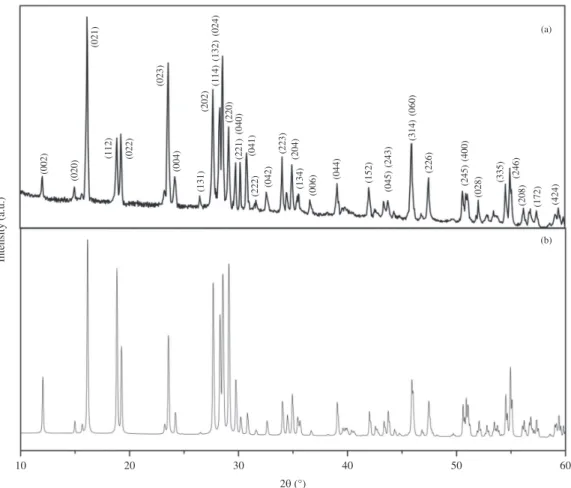
Figure 5. The XRPD pattern of the synthesized Na2Mo2O7 powder obtained in the process of USP, with the most intensive planes indexed in the spectrum (JCPDS Nº. 01-073-1797) (a) and XRPD pattern simulated for randomly-distributed crystallites by planes (b).
Figure 3. Spherical schematic presentation of two experimentally observed molybdenum oxide clusters Mo7O24
6– and Mo 8O26
4– used
as precursor (dashed lines represents the weak and solid lines the strong bonds in the complexes). Further the schematic presentation of nanoparticles obtained by ultrasonic spray pyrolysis in non-polar toluene, that self-assembly in the needle-like formation.
Figure 4. Absorption spectrum of the precursor solution of complexes at pH = 3.9 and total molybdate concentration of 0.1 M (left), and reflection spectrum of the synthesized needle-like Na2Mo2O7 powder (right).
that (112) crystall plane is positioned parallel to the focal plane of the XRD experiment. By carefully observing the SEM micrographs (Figure 2a, b), it can be concluded that the needles are mostly placed in one plane, that is the focal plane of the XRD experiment. That is to say it is quite clear that the needles of synthesized Na2Mo2O7 preferentially lay in relation to focal plane of the diffractional experiment. From the all above said it is natural to presume that the needles are grown from the crystallites preferentially oriented along the (112) direction along the needle axis. Therefore, it is reasonable to conclude that the most likely plane, along which the needles of Na2Mo2O7 were crystallized is (112).
4. Summary
In this work by using acidified aqueous solutions of thermodynamically stable molybdenum (VI) oxide clusters as precursors and non-polar toluen as a solvent, we obtained the novel morphology of disodium dimolybdate. Needle-like nanoparticles of Na2Mo2O7 powder were revealed by the scanning electron microscopy. The X-ray diffraction analysis undoubtedly confirmed formation of the orthorhombic Na2Mo2O7 for samples synthesized at temperature as low as 300 °C. It was showed that the most likely plane, along which the needles of Na2Mo2O7 were crystallized is (112).
Acknowledgements
Financial support for this study was granted by the Ministry of Science and Technological Development of the Republic of Serbia (Projects 172056, 45020 and 45015). minimum at about 3.3 eV was observed, while in the lower
energy area the curve is not flat even shows some features and weak maxima at around ~3 eV. As expected, absorption of needle-like Na2Mo2O7 powder is red shifted for about 0.3 eV compared to the precursor solution.
Using the XRPD measurements, solid materials obtained after the process of USP were analyzed. Typical XRPD spectrum of needle-like Na2Mo2O7 powder collected in toluene, washed and dried at 300 °C is shown in the Figure 5a. The XRPD clearly showed orthorhombic crystalline structure of needle-like Na2Mo2O7 (JCPDS Nº. 01-073-1797). On the XRPD spectrum (A), the most intensive planes are indexed. It should be pointed out that the small amount of impurities (<5%) are present in samples collected in toluene. Having in mind that variety of molybdenum (VI) complex species participates as a starting material in the course of needle-like Na2Mo2O7 synthesis, we believe that this is not surprising.
Further, in the Figure 5b is shown XRPD pattern for Na2Mo2O7, simulated for randomly-distributed crystallites by planes. This diffractogram corresponds to a crystal powder with no preferential crystall growth, along specified crystallographic direction and with crystallites, randomly orientated in relation to the geometry of an XRPD experiment. By comparing XRPD patterns for our needle-like Na2Mo2O7 sample and XRPD pattern for Na2Mo2O7 simulated for randomly-distributed crystallites by planes, it is easy to observed that diffraction maxima that corresponds the plane (112) is the most suppressed. It is also easy to observed that proportionally suppressed are the planes with similar orientation (the planes mutually occupied by small angles). This means that less crystallites (in relation to the random orientation) are oriented in a way
References
1. Mathews T, Krishnamurthy D and Gnanasekaran T. An electrochemical investigation of the thermodynamic properties of Na2Mo2O7 and Na2NiO3. Journal of Nuclear Materials. 1997; 247:280-284. http://dx.doi.org/10.1016/ S0022-3115(97)00075-5
2. Lammers MJJ and Blasse G. Luminescence of sodium molybdate (Na2Mo2O7) and sodium tungstate (Na2W2O7). Physica Status Solidi a. 1981; 63(1):157-161. http://dx.doi. org/10.1002/pssa.2210630121
3. Benoît G, Véronique J, Arnaud A and Alain G. Luminescence properties of tungstates and molybdates phosphors. Solid State Sciences. 2011; 13(2):460-467. http://dx.doi.org/10.1016/j. solidstatesciences.2010.12.013
4. Wang Z, Liang H, Zhou L, Wu H and Gong M. Luminescence of (Li0.333Na0.334K0.333)Eu(MoO4)2 and its application in near UV InGaN-based light-emitting diode. Chemical Physics Letters. 2005; 412(4-6):313-316. http://dx.doi.org/10.1016/j. cplett.2005.07.009
5. Gnanasekaran T, Mahendran KH, Kutty KVG and Mathews CK. Phase diagram studies on the Na-Mo-O system. Journal of Nuclear Materials. 1989; 165 (3):210-216. http://dx.doi. org/10.1016/0022-3115(89)90197-9
6. Gatehouse BM. The crystal and molecular structures of Ce6Mo10O39 and K2Mo2O7-H2O and the refinement of the
“Lindqvist” octamolybdate (NH4)4Mo8O26-4H2O. Journal of The Less-Common Metals, 1977; 54(1):283-288. http://dx.doi. org/10.1016/0022-5088(77)90149-7
7. Jovanović DJ, Validžić ILJ, Janković IA, Andrić ŽM, Mitrić M and Nedeljković JM. Novel low-temperature synthesis of disodium dimolybdate by ultrasonic spray pyrolysis. Journal of the American Ceramic Society. 2007; 90(12):4030-4032. 8. Machida N and Eckert H. FT-IR, FT-Raman and 95Mo
MAS-NMR studies on the structure of ionically conducting glasses in the system AgI-Ag2O-MoO3. Solid State Ionics. 1998; 107(3-4):255-268. http://dx.doi.org/10.1016/ S0167-2738(98)00009-5
9. Mudher KDS, Keskar M, Krishnan K and Venugopal V. Thermal and x-ray diffraction studies on Na2MoO4, Na2Mo2O7 and Na2Mo4O13. Jo u r n a l o f A l l o y s a n d Compounds. 2005; 396(1-2):275-279. http://dx.doi. org/10.1016/j.jallcom.2004.12.024
10. Saraiva GD, Paraguassu W, Maczka M, Freire PTC, Sousa FF and Mendes Filho J. Temperature-dependent raman scattering studies on Na2Mo2O7 disodium dimolybdate. Journal of Raman Spectroscopy. 2011; 42(5):1114-1119. http://dx.doi. org/10.1002/jrs.2836
16. Validžić ILJ, Van Hooijdonk G, Oosterhout S and Kegel WK. Thermodynamic stability of clusters of molybdenum oxide.
Langmuir. 2004; 20(8):3435-3440. PMid:15875879. http:// dx.doi.org/10.1021/la035986f
17. Tytko KH. Gmelin handbook of inorganic chemistry: Molybdenum. 8th ed. Berlin: Springer; 1987. v. B3a.
18. Tytko KH, Baethe G and Cruywagen JJ. Equilibrium studies of aqueous polymolybdate solutions in 1M sodium chloride medium at 25 degree C. Inorganic Chemistry. 1985; 24(20):3132-3136. http://dx.doi.org/10.1021/ic00214a010
19. Cruywagen JJ and Draaijer AG. Solvent extraction investigation of molybdenum (VI) equilibria. Polyhedron. 1992; 11(2):141-146. http://dx.doi.org/10.1016/S0277-5387(00)83275-1
20. Va l i d ž ić I L J , J o k a n o v ić V, U s k o k o v ić D P a n d Nedeljković JM. Influence of solvent on the structural and morphological properties of AgI particles prepared using ultrasonic spray pyrolysis. Materials Chemistry and Physics. 2008; 107(1):28-32. http://dx.doi.org/10.1016/j. matchemphys.2007.06.035
12. Goel SP and Mehrotra PN. Preparation of sodium dimolybdate by the pyrolysis of sodium oxomolybdenum (VI) oxalate.
Thermochim Acta. 1985; 95(1):295-299. http://dx.doi. org/10.1016/0040-6031(85)80060-5
13. Jovanović DJ, Validžić ILJ, Mitrić M and Nedeljković JM. Structure of disodium dimolybdate synthesized using thermodynamically stable molybdenum (VI) oxide clusters as precursors. Journal of the American Ceramic Society. 2009; 92(10):2467-2470. http://dx.doi.org/10.1111/ j.1551-2916.2009.03225.x
14. Chen S, Webster S, Czerw R, Xu J and Carroll DL. Morphology effects on the optical properties of silver nanoparticles. Journal of Nanoscience and Nanotechnology. 2004; 4(3):254-259. PMid:15233085. http://dx.doi.org/10.1166/jnn.2004.034
15. Lee W, Jeong MC and Myoung JM. Evolution of the morphology and optical properties of ZnO nanowires during catalyst-free growth by thermal evaporation.