*e-mail: [email protected]
1. Introduction
Scientiic and technological research works are being intensiied around the world to permit the reuse of industrial residues that otherwise would be discarded to the ambient. In general these residues solid, liquid or gaseous need to be treated or recycled inside the own producing industry. In many cases, however, such as that of ornamental stones (marble, granite, etc) the residue cannot be locally treated or recycled and must be discarded in containing ponds or landills. This represents serious risks associated with contamination by inappropriate transportation and handling1. Similar situation occurs for residues from steelmaking industries2.
In order to search solutions for this speciic case of ornamental stone industrial sector, its corresponding residue has been investigated as possible by-product to fabricate composite materials as artiicial stones3. This type of artiicial stone would be a technically sound alternative to reduce both cost and environmental impact. Indeed, natural stones such as marble and granite not only generate a large amount of fragmented residues during cutting and polishing operations but are also brittle and can easy break, which generates more fragments. By contrast, the already commercial Stellar™ artiicial marble composite is impervious, without stains and does not break easily. This is a consequence of the eficient
adherence of the residue particles provided by the polymeric matrix resin, which also retains the penetration of liquids and prevents the formation and propagation of laws and cracks4-6.
In the present work, the industrial residue investigated was not from the ornamental stone sector but from the steelmaking industrial sector. The current Brazilian year production of steel is of the order of 2.5 million tons. According to information presented by the Rio de Janeiro Industry Federation (FIRJAN)2, for each ton of produced steel, around 613 kg of residues are generated, from which 13% are ine powders. Therefore, an estimated 1.6 million ton of steelmaking residues, including 200 thousand tons of powders, are presently disposed in Brazil. Part of these powders corresponds to electrostatically precipitated ine residual particles that are the main material in this work. Indeed, it will be shown that the use of this residue as an epoxy composite to produce an artiicial stone is associated not only with the valorization of an undesirable industrial waste but also to jobs opportunity based on the development of a novel material for civil construction. The objective was then to evaluate, for the irst time, the possibility of fabricating artiicial stone as an epoxy composite incorporated with a dust residue collected from the electrostatic precipitator of the sintering stage of a steelmaking plant. Plates of this composite were produced by vacuum vibro-compression with the intention of developing a new environmentally correct material with
Development of Epoxy Matrix Artiicial Stone Incorporated
with Sintering Residue from Steelmaking Industry
Elaine Aparecida Santos Carvalhoa, Vinícius Ribeiro Marquesa, Rubén Jesus Sánchez Rodriguesa,
Carlos Eduardo Gomes Ribeirob, Sergio Neves Monteiroc, Carlos Maurício Fontes Vieiraa*
aAdvanced Materials Laboratory, Universidade Estadual do Norte Fluminense – UENF, Av. Alberto Lamego, 2000, CEP 28013-602, Campos dos Goytacazes, RJ, Brazil bMechanical Engineering Department, Instituto Federal do Espirito Santo – IFES, Rodovia Cachoeiro Alegre, Km 05, CEP 29300-000, Cachoeiro de Itapemirim, ES, Brazil
cDepartment of Materials Science, Instituto Militar de Engenharia – IME,
Praça General Tibúrcio, 80, Praia Vermelha, Urca, CEP 22290-270, Rio de Janeiro, RJ, Brazil
Received: December 14, 2014; Revised: November 11, 2015
The present work is part of an innovation research project aiming to develop artiicial stone from industrial wastes. In principle, the project goal is to fabricate artiicial stones with improved characteristics to be used as plates for housing and road construction. In this work, the speciic industrial residue was an electrostatically precipitated powder obtained from the initial sintering stage of an integrated steelmaking plant. Plates were produce by vacuum vibro-compression of epoxy resin mixed with 80 and 85 wt% of this speciic residue. After curing, the plates were characterized for physical parameters and mechanical properties. The microstructural aspect of the inishing surface was analyzed for both novel artiicial stones by scanning electron microscopy. The results indicated that the 80% residue incorporated artiicial stone is superior to the 85% residue incorporated and markedly stronger than a commercial artiicial stone, incorporated with granite residue, with comparable density and water absorption. These characteristics favor the technical substitution of the presently investigated artiicial for the commercial stone. In particular, based on wear tests, the residue incorporated artiicial stone would be restricted to application as pavement in medium trafic roads.
both competitive cost and acceptable quality for the market of ornamental stones. The vacuum vibro-compression technique was reported to promote an improvement in properties such as water absorption and mechanical strength7,8.
2. Material and Methods
The basic materials used in this work were a residue, with a maximum particle size of 0.1 mm, collected at the eletrostatic precipitator of the sintering stage of the Arcelor Mittal integrated steelmaking plant located in Vitoria, ES, Brazil, and a commercial epoxy resin. The electrostatic precipitator powder residue (EPR) was mixed in amounts of 80 and 85 wt% with the still luid diglycidyl ether of the bisphenol-A (DGEBA) epoxy resin mixed with phr 13, which is the stoichiometric fraction, of trietylene tetramine (TETA) hardener. The mixtures were poured under vacuum and 10 MPa of pressure in a mold, which was subjected to the vibro-compression technique at 90°C for 20 min of cure. The molding process produced square plates with 100 mm × 100 mm and 10 mm of thickness. These electrostatic powder residue incorporated artiicial stone plates (EPRAP), in the amounts of 80 and 85%, EPRAP 80 and EPRAP 85, respectively, were evaluated for their apparent density (ρa), Equation 1, apparent porosity (ηa), Equation 2, and water absorption (αa), Equation 3, according to the ABNT NBR 15845 norm9. This norm served as the basis for fabrication of samples with dimensions of 50 mm × 50 mm × 50 mm. These samples were dried in a stove at 70°C for 24 hours and then placed inside a desiccator until measurements. Then, distilled water was added in a lask until 1/3 of the samples’ height. After 4 hours, more water until 2/3 of the height was added and, after another 4 h, complete submersion of the samples during 40 hours. The samples were then weighed both submerged (sub), water saturated (sat) and dried (sec). Properties were obtained through the following equations:
(
sec)
a
sat sub
M
1000
M M
ρ = ×
− (1)
(
)
(
sat sec)
a
sat sub
M M
n 100
M M
−
= ×
− (2)
(
)
(
sat sec)
a
sat sub
M M
100
M M
α = − ×
− (3)
where Msec is the dry mass; Msat the water saturated mass, and Msub the submerged (hydrostatic scale weight) mass.
The mechanical strength was evaluated at room temperature (RT) by three points bending tests in a model 5582 Instron machine. For these tests, the recommendations for agglomerated stones of the Spanish EN 14617-2 norm10 as
well as the F annex of the Brazilian norm ABNT NBR 15845[9] were followed. Ten prismatic specimens with dimensions of 100 mm × 25 mm × 10 mm were used for each condition of these lexural tests. The average stress and corresponding standard deviation were calculated.
Amsler type of wear tests were conducted in two samples cut out of each EPRAP with reduced dimensions of 70 mm × 70 mm. These wear tests were RT performed in a rotatory hard circular track using normalized sand as abrasion material. In the wear test, a load of 66 N was applied on the specimen while maintaining a sand low of 72 ± 6 cm3/min onto the rotary track. After 250 turns, which corresponds to a total circuit of 500 m, the specimen was weighed. This was done again after 500 turns (total 1000 m). Amsler wearing was given in terms of thickness reduction after 500 m and 1000 m of trajectory according to the NBR 12.042:2012 norm11. The EPRAP physical parameters and mechanical results were compared to those obtained with similar test procedure in an artiicial StellarTM commercial ornamental stone, supplied by the Ecologicstone irm.
The surface microstructural aspect of gold sputtered samples of the distinct EPRAPs were analyzed by scanning electron microscopy (SEM) in a model JSM-6460 LV Jeol microscope, operating with secondary electrons at 20 kV.
3. Results and Discussion
Table 1 presents the results of density, water absorption, apparent porosity and density of the materials. The EPRAPs have similar or less water adsorption and apparent porosity than those of the StellarTM stone, with no signiicant inluence of the type of residues. By contrast, in Table 1 and Figure 1
Figure 1. Flexural strength versus delection strain curves for: EPRAP 85, EPRAP 80, neat epoxy and commercial ornamental stone.
Table 1. Density, water absorption, apparent porosity and lexural strength of sintering electrostatic precipitator artiicial stone plates (EPRAP), commercial artiicial stone, epoxy and electrostatic precipitator residue (EPR).
Specimen Density (g/cm3)
Water absorption
(%)
Apparent porosity
(%)
Flexural Strenght
(MPa)
EPRAP 85 2.73±0.03 0.24±0.12 0.65±0.23 41.70±4.08
EPRAP 80 2.68±0.03 0.17±0.04 0.45±0.12 57.57±3.21
Stellar TM 2.38±0.04 0.18±0.04 0.44±0.10 36.61±2.48
Epoxy 1.16±0.05 - - 93.59±4.7
-it can be seen that the lexural strength was improved by the addition of the electrostatic precipitator residue (EPR).
The EPRAPs’ densities were higher than that of StellarTM stone, which was due to the residue incorporation. Artiicial stones with addition of other types of residue and similar process methodologies show similar effects on density. Lee et al.12 report artiicial stones with density of 2.11 g/cm3 fabricated from glass and a granite residue, which have lower density than that of EPR in the present work. Santos et al.13 also reported a lower density value of 2.40 g/cm3. As for the water absorption and apparent porosity, Table 1, the EPRAP 80 displays lower values, similar to those of the Stellar™ stone. Both the water absorption and the porosity could be associated with the microstructure of the artiicial stone. This depends on the process variables and particles size distribution of incorporated residue and other less important contributions.
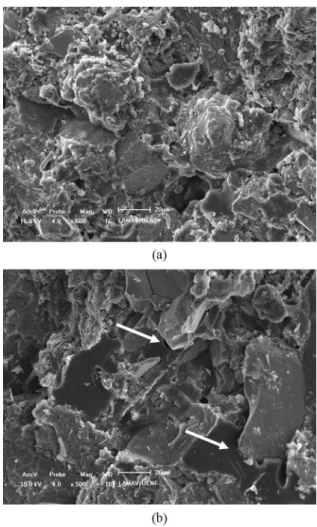
As shown in Figure 1, The EPRAP samples presented a higher lexural modulus than the Stellar™ and the epoxy resin. This could be a consequence of the more rigid EPR particles12 but should also be analyzed in terms of the microstructure effect on the mechanical properties. As for the EPRAPs formulations, one must consider a different behavior. The eficient epoxy matrix between residue particles improves the mechanical properties in EPRAP 80 stone with 20 wt% of epoxy content. In this stone, it could be observed a more uniform region in the fracture between electrostatic precipitator residue particles, as pointed by arrows in Figure 2b.
The morphology observed in both samples of EPRAPs at the fracture region, Figure 2, as well as StellarTM were in agreement with the density and apparent porosity presented in Table 1. The fracture regions of the 15% and 20 wt% epoxy samples display the existence of cavities and/or pores. The relevant differences, however, were the epoxy uniformity and particles contact aspects. Apparently, these differences were the main responsible for the lower lexural modulus of EPRAP 85 as compared to EPRAP 80 artiicial stones.
Moreover, the lexural strength, Table 1, of both EPRAP 85 (41.70 MPa) and EPRAP 80 (51.57 MPa) stones were signiicantly lower than that of the neat epoxy (93.59 MPa). In principle, this was expected as a consequence of the artiicial stone microstructure, in which the polymer phase is not continuous but full of porosity, which caused a reduction in the mechanical properties13, as compared to the neat epoxy.
The lexural rupture stress data reported in the litterature14-16 for artiicial stones with similar contents of the present EPRAPs, but employing calcareous marble particles, were found to vary between 16-46 MPa. The difference in values might be attributed to microstructure laws, such as voids and porosities.
The wear test is extensively used to evaluate the performance of a given material, including hard surface for both pedestrian and vehicles pavements. In this test, the volume loss of a stone for house or road construction causes changes in the mechanical properties as well as brightness and color of the surface17. Table 2 shows the abrasive wear for the EPRAPs and the commercial StellarTM stone. In this table it is seen that the commercial stone is around 30% more
wear resistant than the EPRAPs. In the case of EPRAP 85, the limited amount (15 wt%) of epoxy is responsible for the greater abrasive wear due to the loss of EPR particles that might not be well adhered to the relatively small amount of polymeric phase.
Here is important to mention that there is no wear speciication in Brazilian norms. In other words, there is no limit imposed by norm to the wearing reduction in abrasive tests. Frasão & Farjallat18 suggested a maximum limit of 1 mm for reduction in Amsler wearing. Chiodi & Rodrigues19 proposed different wearing reduction speciications to be applied as technological parameter in calcareous stones for horizontal pavement plates. According to these authors, light trafic pavements should have Amsler wearing less than
Figure 2. SEM fractographs of the materials EPRAP 85 (a) and EPRAP 80 (b).
Table 2. Amsler wearing associated with thickness reduction of EPRAPs and StellarTM .
Material Abrasive Wear (mm)
500 m 1000 m
EPRAP 85 1.34 2.52
EPRAP 80 1.04 2.16
6 mm while medium trafic less than 3 mm and heavy trafic less than 1.5 mm. Following this proposal, the commercial StellaTM stone could be used in any kind of trafic. However, the EPRAPs would be restricted for application as pavements in medium or light trafic roads.
It is also relevant to mention that Ribeiro20 found a greater reduction in thickness of an artiicial stone fabricated with limestone (calcareous) particles incorporated into a polymeric matrix. The author reported reductions of 5.23 and 8.83 mm after, respectively, 500 and 1000 m of wear test. The artiicial stone investigated by Ribeiro20, however, presented relatively high porosity and weak particle/matrix interfacial bonding caused by a non-reactive solvent. This justiied the large thickness reduction observed.
Figure 3 shows by SEM the polished surface aspect of both EPRAPs 85 and EPRAP 80. Sensible microstructural differences can be detected between the two materials. In addition to a greater amount of residue particles, as expected, the EPRAP 85 in Figure 3a also reveals more porosity in its epoxy matrix than the EPRAP 80 in Figure 3b. As aforementioned, this is a consequence of a comparatively more dificult molding operation due to an excess of residue in the EPRAP 85. The lack of adhesion between the residue
particles and the epoxy resin gives rise to pores that impairs the water absorption and the mechanical properties. On the contrary, EPRAP 80 in Figure 3b reveals a more consistent microstructure with less amount of pores, which justify its higher lexural modulus in Table 1. Figure 4 shows the polished surface of the StellarTM commercial stone. In this igure, it is observed a smooth surface, which is associated with good physical properties.
4. Summary and Conclusions
Artiicial stones, EPRAP 85 and EPRAP 80, with DGEBA/TETA epoxy matrices incorporated, respectively, with 85 and 80 wt% of residue, collected from the electrostatic precipitator in the sintering sector of an integrated steelmaking plant, were for the irst time developed and characterized.
• The water absorption and porosity of these novel artiicial stones, EPRAPs, were found to be similar to those of a StellarTM commercial artiicial stone made with granite residues.
• The EPRAPs lexural strengths were superior not only to that of the StellarTM but also to the lexural strengths obtained in other conventional artiicial stones incorporated with residues from marble and glass industries.
• In particular, the EPRAP 80 with 20 wt% of epoxy resin, displays a microstructure with less porosity and a wear resistance enough to be used in pavements supporting medium or light trafic.
Acknowledgements
The authors thank the Brazilian agencies: CNPq, CAPES, and FAPERJ for inancing this research and for providing scholarships to E.A.S.C, V.R.M and C.E.G.R co-authors. It is also acknowledged the permission to use the SEM facility of the PEMM/COPPE of the Federal University of Rio de Janeiro.
Figure 4. SEM micrograph of the polished surface of commercial
StellarTM artiicial stone.
References
1. Gonçalves JP, Moura WA and Dal Molin DC. Evaluation of granite residue from cutting operation, as addition, on the mechanical properties of concrete (in Protuguese). Ambiente Construído. 2002; 2(1):53-68.
2. Federation of State of Rio de Janeiro Industries – FIRJAN.
Rio, environment, technology and sustainability solutions in the Brazilian steelmaking sector. Rio de Janeiro: FIRJAN;
2009. In Portuguese.
3. Ribeiro CEG, Rodríguez RJS, Vieira CMF, Carvalho EA, Cândido VS and Monteiro SN. Fabrication of artificial stone from marble residue by resin transfer molding. Materials Science Forum. 2014; 775-776:336-340. http://dx.doi.org/10.4028/
www.scientific.net/MSF.775-776.336.
4. Ribeiro CEG, Rodríguez RJS, Vieira CMF, Carvalho EA, Cândido VS and Monteiro SN. Production of synthetic ornamental marble as a marble waste added polyester composite. Materials Science Forum. 2014; 775-776:341-345. http://dx.doi.org/10.4028/
www.scientific.net/MSF.775-776.341.
5. Ribeiro CEG, Rodriguez RJS and Vieira CMF. Production of ornamental compound marble with marble waste and unsaturated polyester. In. Proceedings of the Extraction & Processing Division (EPD) Congress 2014, 143rd Annual Meeting & Exhibition (TML 2014); 2014; San Diego, EUA. Hoboken: Wiley/TMS, 2014. p. 129-194.
6. Molinari EJ. Reuse of natural stone residues for the development of thermo set polymer matrix composite in the fabrication of industrial stones. [Dissertation]. Florianópolis: Federal
University of Santa Catarina; 2007. In Portuguese.
7. Ming-Yu L, Chun-Han K, Fang-Chih C, Shang-Lien L, Jyh-Dong L, Ming S, et al. Artiicial stone slab production using waste glass, stone fragments and vacuum vibratory compaction.
Cement and Concrete Composites. 2008; 30(7):583-587. http://
dx.doi.org/10.1016/j.cemconcomp.2008.03.004.
8. Lee DJ and Shin IJ. Effects of vacuum, mold temperature and cooling rate on mechanical properties of press consolidated glass fiber/PET composite. Composites. Part A, Applied Science and Manufacturing. 2002; 33(8):1107-1114. http://dx.doi. org/10.1016/S1359-835X(02)00051-9.
9. Brazilian Association of Technical Norms – ABNT. ABNT NBR 15845-10: stones for linning: test methods. Rio de Janeiro:
ABNT; 2010. In Portuguese.
10. Spanish Association of Standards and Certification. UNE-EN 14617-2-08: test methods part 2: determination of the lexural strength. Madrid: UNE-EN; 2008. In Spanish.
11. Brazilian Association of Technical Norms – ABNT. ABNT NBR 12.042-12: inorganic material – determination of abrasion wearing. Rio de Janeiro: ABNT; 2012.
12. Lee M-Y, Ku C-H, Chang F-C, Lo S-L, Lin J-D, Shan M-Y, et al. Artificial stones lab production using was glass, stone fragments
and vacum vibratory compaction. Cement and Concrete Composites. 2008; 30(7):583-587. http://dx.doi.org/10.1016/j. cemconcomp.2008.03.004.
13. Santos JPL, Rosa LG and Amaral PM. Temperature effects on mechanical behaviour of engineered stones. Construction & Building Materials. 2011; 25(1):171-174. http://dx.doi.
org/10.1016/j.conbuildmat.2010.06.042.
14. Dalpiaz G. Study of the effect of mineral illers in particulates polypropylene matrix composites. [Thesis]. Porto Alegre:
Universidade Federal do Rio Grande do Sul; 2006. In Portuguese. 15. Gunduz G. Processing of unsaturated polyester. In: Cheremisinoff
NP, editor. Advanced polymer processing operations. Westwood:
United States of America; 1998. p. 1-38.
16. Borsellino C, Calabrese L and Di Bella G. Effects of powder concentration and type of resin on the performance of marble composite structures. Construction & Building Materials. 2009; 23(5):1915-1921. http://dx.doi.org/10.1016/j. conbuildmat.2008.09.005.
17. Karaca Z, Hacımustafaoğlu R and Gökçe MV. Grain properties, grain boundary interactions and their effects on the characteristics of marbles used as building stones. Construction & Building Materials. 2015; 15:166-171. http://dx.doi.org/10.1016/j. conbuildmat.2015.05.023.
18. Frasão EB and Farjallat JES. Technological characteristics of the principal Brazilian silicate stones used as covering. In:
Proceedings of the 1st International Conference of Natural Stone; Lisboa, Portugal. Lisboa: Ministry of Trade and Tourism; 1995. p. 47-58.
19. Chiodi C Fo and Rodriguez HP. Guide application of stones in coverings. São Paulo: Abirochas; 2009. p. 118.
20. Ribeiro CEG. Production of artiicial Stone using a residue from the marble industry in polyester matrix. [Thesis]. Campos dos