301
Metallurgy and materials
Metalurgia e materiais
The influence of tundish
heating and purging on
inclusion formation
Jayme Alves de Souza Junior
Technical Assistance Engineer-ArcelorMittal Tubarão Serra - Espírito Santo - Brazil [email protected]
Estéfano Aparecido Vieira
Professor,
Programa de Pós-Graduação em Engenharia Metalúrgica e de Materiais - PROPEMM, Instituto Federal do Espírito Santo Vitória - Espírito Santo - Brazil [email protected]
Felipe Fardin Grillo
PhD student
Department of Metallurgical and Materials Engineering
Politechnic School University of São Paulo. São Paulo - São Paulo - Brazil
Jose Roberto de Oliveira
Professor,
Programa de Pós-Graduação em Engenharia Metalúrgica e de Materiais - PROPEMM, Instituto Federal do Espírito Santo Vitória - Espírito Santo - Brazil [email protected]
Abstract
Steel with high cleanliness requirements require an accurate control of the non-metallic inclusions, such as its quantity, morphology, chemical composition and size distribution. The continuous casting tundish has a fundamental role in steel cleanliness, avoiding its reoxidation by air and ladle slag that retain inclu-sions, as well as aiding the removal of those same inclusions along the continuous casting (Sahai, 2008). To perform the study, IF steel samples were collected in RH at the start, in the middle and at the end of the continuous casting of the tundish's irst heat in three different conditions of tundish processing, alternating between heating and purging. These samples had their inclusions characterized by MEV/ EDS using the ASCAT (Automated Steel Cleanliness Analysis Tool) technology. The results showed that more than 90% of the oxide inclusions generated in that
type of steel are Al2O3 and AlTi. It was also observed that there is an increase of
steel inclusions originating from RH in the tundish and that area fraction and average inclusionary density decreases along the continuous casting in two of the processing conditions.
Keywords: Inclusions, tundish, ASCAT and purging.
http://dx.doi.org/10.1590/0370-44672014680027
1. Introduction
The requirements for steel me-chanical properties and chemical com-position are in constant transformation with the growing demands for quality; at the same time, the cost, energy and environmental effect in production have also become items of great con-cern. Hence, steel properties such as mechanical resistance, malleability, durability and resistance to corrosion have improved over the years to meet such needs. This was achieved partly by producing the so-called "clean steel", or steels of high cleanliness in relation to the presence of non-metallic inclu-sions deteriorate most of the mentioned
properties Zang and Thomas, (2002) and Choudhary, (2011).
An experiment was developed on an industrial scale at ArcelorMittal Tubarão Steel Company, using the ac-tual productive process of Continuous Casting, where the focus was on the evolution and generation of inclusions in the Continuous Casting tundish. The experiment result supplies a quantitative and qualitative description of inclusions generated in the tundish's irst heating, and under deined and controlled condi-tions of heating and previous purging of that same tundish .
The present work aims to
evalu-ate the cleanliness of an ultra low car-bon IF (Interticial Free) steel produced in Continuous Casting, through the
analysis of Al2O3 and AlTi inclusions
2. Materials and methods
Three different types of Ultra Lower Carbon steel - IF processing were studied in the continuous casting tundish:
a) Tundish with Hot Start and with preliminary Purging (AP);
b) Tundish with Hot Start and No preliminary Purging (ASP) and
c) Tundish with Cold Start and with preliminary Purging (FP). Figure 1 corresponds to the schematic
draw-ing of the Ultra Lower Carbon steel processing runs in the tundish sequence, showing the sample collection points for the steel cleanliness study of the irst heat of the tundish.
Figure 1
Sample collection in the pot and tundish.
The following information summa-rizes the stages that were followed for the development of this work.
'Lollipop' type samples of Ultra Low Carbon steel were collected in the tundish sequence’s irst heat of the Continuous Casting in the three different processing conditions described below, equally in the RH ladle as in the Tundish;.
The samples were sent to the Ar-celorMittal research center in Chicago-USA for inclusion characterization via sweeping electronic microscope SEM / EDS using ASCAT technology (RJ Lee Group, 2005);
From the data, the steel cleanliness results were analyzed in the RH and
tundish (Al2O3 and AlTi inclusions) indi-vidually for each processing condition as well as by comparative analysis among the different processes.
Experiment samples were removed in three different heats for each type of processing in the tundish, as shown in Table 1, being that in each situation, a ladle sample after RH treatment and three samples of the same heating were removed during its casting in the tundish, making a sub-total of 12 samples for each experi-ment, and a total of 36 inal samples. The sampling stages are:
i) one sample in the ladle after treat-ment in RH and liberation for Casting. This sample aims to characterize the
inclusion that is getting into the continu-ous casting.
ii) Three samples in the irst heat of the tundish during its casting from the ladle mentioned in item i. The irst sample will be removed after having drained 50t from the ladle, practically after illing the tundish up, the second one after having drained 150t from the ladle, practically a half of the ladle and the third sample leaving 50t for the end of the ladle. It is important to note that the experiment is only focused on the tundish's irst heating, as it is the one with the biggest inluences from the pre-liminary procedures of tundish heating and pre-purging.
SAMPLE 4 (250t) SAMPLE 2 (50t)
SAMPLE 3 (150t)
Ladle in RH Ladle in RH
IF Tundish Sequence with n heats SAMPLE 1
Heating and Purging Heating and
Purging
1ª Heat Tundish 1ª Heat Tundish
2ª Heat Tundish 2ª Heat Tundish
nª Heat Tundish
Sampling condition Heat 1 Heat 2 Heat 3 Tundish with heating and purging (AP)
Collected in RH ladle AP1 AP2 AP3 Collected after 50t casted into tundish AP50.1 AP50.2 AP50.3 Collected after 150t casted into tundish AP150.1 AP150.2 AP150.3 Collected after 250t casted into tundish AP250.1 AP250.2 AP250.3
Tundish with heating and no purging(ASP)
Collected in RH ladle ASP1 ASP2 ASP3 Collected after 50t casted into tundish ASP50.1 ASP50.2 ASP50.3 Collected after 150t casted into tundish ASP150.1 ASP150.2 ASP150.3 Collected after 250t casted into tundish ASP250.1 ASP250.2 ASP250.3
Tundish with no heating and purging (FP)
Collected in RH ladle FP1 FP2 FP3 Collected after 50t casted into tundish FP50.1 FP50.2 FP50.3 Collected after 150t casted into tundish FP150.1 FP150.2 FP150.3 Collected after 250t casted into tundish FP250.1 FP250.2 FP250.3
Total of samples 36 Table 1
303
For a reproductive guarantee of the different trial process heats, some basic operational variables of the continuous casting process were maintained in constant range: casting temperature, casting speed, covering powder quantity, heat casting time and ladle opening without use of oxygen.
Of the inclusion indicators sup-plied by ASCAT, two igure among the
more used and representative for clean-liness measurement in this work. The
irst is inclusion Area Fraction (Area
occupied by an inclusion class in µm2
/ total analyzed Area in mm2) and the
second is Inclusion Density (numeric
amount of certain class of inclusions / total analyzed Area). The occupied Area Fraction notably stands out in cleanliness evaluation for considering
not only the quantity, but the inclu-sion sizes, representing the density of impurities in the steel. Although the number of large inclusions is much smaller than those of minor inclusions, its volumetric fraction can be larger, and a simple inclusion of great size found in the material can cause relevant defects. Also inclusion size distribution was evaluated.
3. Results and discussions
Firstly, it was checked and con-irmed that all the assisted runs met the process variables described in the previous chapter; there was no need to
discard any sample.
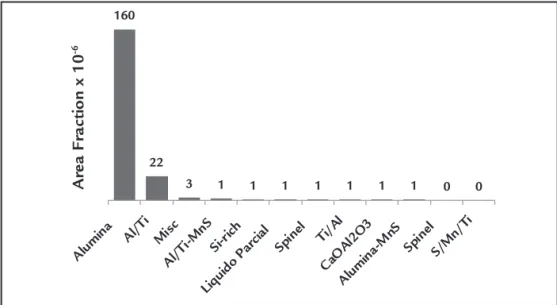
The Figure 2 shows the average Area Fraction of several oxide classes observed in the samples collected in
RH and in the three distinct conditions in the Continuous Casting processing.
Figure 2 Area fraction average of inclusions found by ASCAT in the different studied process.
The two majority inclusion groups presented in the samples and the focus of this work were Al2O3 and AlTi inclusions; Al2O3 inclusions occupied proportionally seven times more area than AlTi
inclu-sions. MATSUURA et al (2007) shows
that the generation of less AlTi is due to the fact that the titanium, used as ele-ment stabilizer, is only added to the steel at the end of RH treatment and in small amounts, while alumina is generated from the intentional aluminum oxidation for
steel deoxidation.
The average result of 4 sample groups collected in three different run for each type of tundish processing is shown as follows.
Comparative Evaluation of Al
2O
3and AlTi Inclusions in the Three Processing Types
The Figure 3 presents the average Area Fraction and average inclusionary
Density of Al2O3 and AlTi Inclusions
together in the three studied processes.
160
22
3 1 1 1 1 1 1 1 0 0
Alu min
a Al/T
i Mis
c
Al/T
i-MnSSi-rich
Liqu ido
Parc ial
Spin el
Ti/A l
CaO Al2O
3
Alu min
a-M nS
Spin el
S/M n/Ti
A
rea
F
rac
ti
on
x
1
0
-6
It is seen that the smallest occu-pied Area Fraction by AlTi inclusions in the three cases, which on average are 6 times smaller than the occupied
Area fraction for Al2O3 inclusions,
as already shown in the Figure 2. as well as the total Area Fraction, the inclusionary Density total plotted in the secondary axis of the same graph show similar evolution in the three processes, with the increase of RH inclusion totals (samples AP, ASP and FP) for the Tundish (AP50, ASP50 and
FP50 samples). According to Tanaka et
al. (1993) that behavior is explained due to the irst steel portion that enters in the tundish being totally unprotected, entering in contact with the air and
forming new Al2O3 exogen inclusions
and worsening the steel cleanliness. Inclusionary reduction of the two cleanliness indicators is also observed in the graph during the casting in the three evaluated processes, in other words, the tundish's initial samples (AP50, ASP50 and FP50 samples) until the last ones
(AP250, ASP250 and FP250 samples). This reduction along the casting is expected and according to Sahai and Emi (2008) due to the tundish's steel re-newal coming from the ladle and greater cleanliness, and as a secondary cause the tundish's own capacity to remove inclusions by lotation as the steel passes through it towards the mold.
The analysis of Figure 4 together with Table 2 shows the following ten-dencies in relation to the three studied processes:
Figure 4
Size distribution
average of Al2O3 e AlTi inclusions in the three different studied process.
Table 2
Area fraction and density average of Al2O3 e AlTi inclusions in the three different studied process.
Sample Area Fraction (Al2O3) Area Fraction (AlTi) Total Area Fraction Std Deviation total AF Delta each step % Delta into Tundih % Total Density
(no/mm2)
Std Deviation Total Density Delta each step % Delta into Tundih %
AP 32 12 44 16 14 4
AP50 250 23 273 107 523 26 7 81
AP150 208 24 231 40 -15 20 10 -24
AP250 191 18 208 60 -10 -24 15 7 -22 -41
ASP 43 10 53 16 11 2
ASP50 184 29 214 57 304 35 14 232
ASP150 202 39 241 62 13 51 26 46
ASP250 183 32 214 61 -11 0 34 14 -33 -2
FP 67 6 73 32 11 3
FP50 228 26 254 22 247 33 2 200
FP150 174 26 200 25 -21 28 2 -17
FP250 165 23 189 27 -6 -26 25 15 -11 -26
a) RH inclusionary evolution for the Tundish: The three processes present Al2O3 and AlTi inclusion pick-up in the tundish expressed by the occupied total Area Fraction, the largest percentage pick-up (523%) being in the heats with Heating and Purging (AP), followed by the heats with Heating and No Purging (ASP) with 304%. The best result was observed in the heats with Tundish for Cold and Purging (FP) that had an inclusionary pick-up in the Area Fraction of 247%. Considering the Total inclusionary Density, the pro-cess with Heating and No Purging (ASP) leaves its previous second position and becomes the greater inclusion evolution with a 232% increase in RH Density for the Tundish. This behavior would be the most expected, as this tundish type does not have the previous Purging, which
favors oxidation, as shown by Tanaka et
al (1993), Zang and Thomas (2003) and
Yanyan et al (2013).
The largest pick-up in the tundish with Heating and Purging (AP) was not expected, because according to the Jen-Hsin et al (2003) experiment, due to its high temperature, in the warm tundish, the oxygen present is 20.9% smaller than a cooling tundish. The tundish's greatest temperature, besides reducing the air volume inside the refractory container, according to the Miki et al (1999) experi-ment, promotes different behavior from the steel low inside the tundish, with a rising tendency to buoyancy and greater circulation, thus favoring steel cleanli-ness. An explanation for this might be the abnormal pick-up of one of the group heats, either for a non- registered purging
defect or some air low between ladle and tundish.
b) Inclusions behavior during Cast-ing: As expected, the process with Heating and No Purging (ASP) presented the worst reduction result for inclusion Area Frac-tion during the casting, given the lack of purging, greatly adding to the tundish's initial inclusions, as already shown. The other two processes, Heating with Purg-ing (AP) and CoolPurg-ing with PurgPurg-ing (FP) presented similar performances, with a 24% and 26% reduction respectively in the inclusionary total, showing that the initial purging of the last two processes might have made the difference, as dis-cussed previously. That improvement inclusionary tendency along the heats is explained by Sahai e Emi (2008) mainly by the renewal in the tundish of a cleaner 0 10 20 30 40 50 60 70 80 90 100
1-2.5 2.5-5 5-10 10-20 >>>
Size distribuition (µm)
305
steel coming from the pot, as well as the tundish’s own capacity to remove inclu-sions through its synthetic slag.
c) Size of the Inclusions: The average general distribution of the inclusion size in RH and in the Tundish follows the great majority of inclusions (47%~86%) con-centrating on the smallest range between 1µm to 2.5µm, followed by 12%~37% of the inclusions in the range between 2.5µm
to 5µm, 2%~16% in the range between 5µm to 10µm and 0~5% between 10µm to 20µm, with no inclusion above 20 µm. The distribution of inclusion size in the tundish is quite favorable to steel cleanli-ness. According to T. Emi (2005), there are very few occurrences of inclusions above 10µm and none above 20µm.
The high standard deviation values for both, total area fraction and total
density, shows how inclusion measure are sensitive to operational variables, sampling and analysis practice. Results in the ladle show more stability with a lower standard deviation, probably due a more stable homogenization condition of the ladle process. Meanwhile in the tundish, the results are more impacted by the unstable conditions of the tundish luxes, especially during its irst heat illing.
4. Conclusions
Al2O3 and AlTi inclusions are the two majority inclusion groups presented in an IF aluminum killed steel, both rep-resenting 90% of total inclusions;
Al2O3 inclusions occupies propor-tionally seven times more area than AlTi inclusions, and its volumetric size distri-bution is as follows: 85% <=10µm, 15% between 10µm~20µm and 0% > 20µm. This size distribution was not affected by
the different studied processes;
All three processes presented inclu-sion pick-up from RH to the Tundish and as expected, tundish purging showed to be the most more eficient than that with no preliminary Purging process, especially during a tundish sequence;
The heating process showed a simi-lar tendency evolution when compared to the cold tundish, for both, RH-Tundish
pick-up and inclusion reduction along the tundish sequence;
Finally it is concluded that previous purging of the tundish has an important role in minimizing RH inclusion pick-up for Continuous Casting, proving to be more important than heating the tundish. The tundish with no purging had the worst result and the cooling tundish with purging had the best general performance.
5. Acknowledgements
Thanks to ArcelorMittal Tubarão for the support, that recognized a great
technical training opportunity, and to friends Phd. Henrique Silva Furtado and
Msc Paulo Andre Lucas P. for the technical discussions on the studied theme.
6. References
JEN-HSIN, C., CHING-CHIH, C., CHUN-YEN, Y., CHING-CHAO, Y., Tundish metallurgical practices for "Slab production in Bokaro steel”., Metal, 2003. MATSUURA, H., WANG, C., WEN, G., SRIDHAR, S. The transient stages of
inclu-sions evolution during Al and/or Ti additions to Molten iron. ISIJ Internacional, v. 47, n. 9, p. 1265-1274, 2007.
SASAI, K., MIZUKAMI, Y. Reoxidation behavior of molten steel in tundish. ISIJ International, v. 40, n. 1, p. 40-47, 2000.
RJ Lee Group, Oak Ridge National Laboratory, RJ Fruehan Consulting, Aspex LLC Development of the Automated Steel Cleanliness Analysis Tool ASCAT, RJ Lee Group 350 Hochberg Rd Monroeville, PA 15146, September 24,1999 through September 23,2005.
CHOUDHARY, S. K. Inluence of modiied casting practice on steel cleanliness. ISIJ International, v. 51, p. 557–565, 2011.
EMI, T. Improving steelmaking and steel properties, fundamentals of metallurgy, Ed. In: SEETHARAMAN, S. (Ed.). UK: Woodhead Publishing, Cambridge, Inst. of Mater., Minerals & Mining, 503-554, 2005.
YANYAN, B., ANDREY, V. K., PÄR, G. J. Evolution of Different Inclusions during ladle treatment and continuous casting of Stainless steel. ISIJ International, v. 53, p. 2099-2109, 2013.
MIKI, Y., THOMAS, B. G. Modeling of inclusion removal In: Tundish, A. Metallur-gical Transactions B, v. 30, p. 639-654, 1999.
SAHAI, Y., EMI, T. Tundish technology for clean steel production. World Scientiic, Singapore, p. 1-15, 2008.
ZHANG, L., THOMAS, B. G. Evaluation and control of steel cleanliness – review. In: STEELMAKING CONFERENCE PROCEEDINGS, 85. ISS-AIME. Warren-dale, PA, p. 431-452, 2002.
ZHANG, L., THOMAS, B. G. Inclusions in continuous casting of steel. In: NATIONAL STEELMAKING SYMPOSIUM, 24. Morelia, Mich, México, p. 138-183, 2003.