CLINICAL SCIENCE
Parathyroidectomy after kidney transplantation:
short- and long-term impact on renal function
Gustavo Fernandes Ferreira,IFabio Luiz de Menezes Montenegro,II David Jose Machado,I Luiz Estevam Ianhez,IWilliam Carlos Nahas,IElias David-NetoI
IRenal Transplant Unit, Faculdade de Medicina da Universidade de Sa˜o Paulo, Sa˜o Paulo, Brazil.IIDepartment of Head and Neck Surgery, Faculdade de
Medicina da Universidade de Sa˜o Paulo, Sa˜o Paulo, Brazil.
INTRODUCTION:Kidney transplantation corrects endocrine imbalances. Nevertheless, these early favorable events are not always followed by rapid normalization of parathyroid hormone secretion. A possible deleterious effect of parathyroidectomy on kidney transplant function has been reported. This study aimed to compare acute and long-term renal changes after total parathyroidectomy with those occurring after general surgery.
MATERIALS AND METHODS: This was a retrospective case-controlled study. Nineteen patients with persistent hyperparathyroidism underwent parathyroidectomy due to hypercalcemia. The control group included 19 patients undergoing various general and urological operations.
RESULTS:In the parathyroidectomy group, a significant increase in serum creatinine from 1.58 to 2.29 mg/dl (P,
0.05) was noted within the first 5 days after parathyroidectomy. In the control group, a statistically insignificant increase in serum creatinine from 1.49 to 1.65 mg/dl occurred over the same time period. The long-term mean serum creatinine level was not statistically different from baseline either in the parathyroidectomy group (final follow-up creatinine = 1.91 mg/dL) or in the non-parathyroidectomy group (final follow-up creatinine = 1.72 mg/dL).
CONCLUSION: Although renal function deteriorates in the acute period following parathyroidectomy, long-term stabilization occurs, with renal function similar to both preoperative function and to a control group of kidney-transplanted patients who underwent other general surgical operations by the final follow up.
KEYWORDS: Kidney Transplant; Parathyroid Hormone; Parathyroidectomy; Renal Function; Surgery.
Ferreira GF, Montenegro FLM, Machado DJ, Ianhez LE, Nahas WC, David-Neto E. Parathyroidectomy after kidney transplantation: short- and long-term impact on renal function. Clinics. 2011;66(3):431-435.
Received for publication onSeptember 24, 2010;First review completed onNovember 1, 2010;Accepted for publication onNovember 30, 2010
E-mail: [email protected]
Tel.: 55 11 35393637
INTRODUCTION
Secondary hyperparathyroidism (HPT) is an almost universal complication in patients with chronic renal failure. Successful kidney transplantation corrects endocrine and metabolic imbalances and the main abnormalities respon-sible for secondary HPT in the first months following surgery.1Nevertheless, these early favorable events are not always followed by a rapid normalization of parathyroid hormone (PTH) secretion. Elevated PTH levels are observed in up to 25% of patients one year after transplantation, despite adequate renal function.2 A subgroup of these patients will ultimately require parathyroidectomy.
A possible deleterious effect of parathyroidectomy on kidney transplant function was reported.3 Evidence of an acute effect of parathyroidectomy without significant
compromise in the long run was reported.4In one study, the
only parameter observed to correlate with an acute decrease in renal function was an acute reduction in PTH.5
In one study of successfully kidney-transplanted indivi-duals, renal changes after total parathyroidectomy with immediate autograft, which were estimated by variation in creatinine level, differed in comparison to changes in kidney transplant patients undergoing other head and neck proce-dures.6 In that study, the control group included only a
small number of patients, and observation was restricted to the first days after the operation. These aspects limit the conclusions that can be drawn regarding the long-term safety of total parathyroidectomy in the management of persistent HPT after kidney transplantation. Although kidney dysfunction has also been described in patients undergoing subtotal parathyroidectomy,7 one study sug-gested the superiority of this technique over total parathyr-oidectomy with autotransplantation in the management of persistent HPT after kidney transplantation.8For some renal transplant patients, it was recommended that total para-thyroidectomy should be avoided to avoid compromising long-term renal function.8
Copyrightß2011CLINICS– This is an Open Access article distributed under
The present study aimed to compare acute and long-term renal changes in patients undergoing either total parathyr-oidectomy and immediate autotransplantation or compar-able general surgical operations in a larger subset of kidney transplant patients.
METHODS
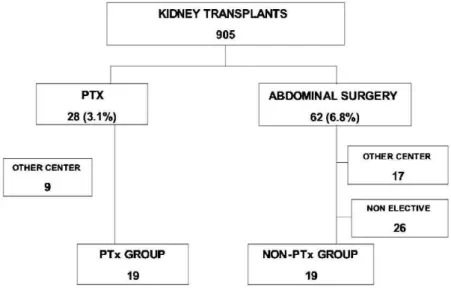
The study was a retrospective case-controlled study of renal allograft recipients at a single institution. This study was part of a project approved by the Institutional Ethical Committee on research. Records from all patients who received a kidney transplant at the University of Sa˜o Paulo, Hospital das Clinicas, between January 2000 and December 2006 were reviewed. A total of 905 patients were analyzed which may be compared to the 715 patients who received kidney transplants in the five year period 2002-2007 covered by the official registry of the Institution.9Kidney transplant patients who underwent a total parathyroidectomy with autotransplantation for persistent HPT or for HPT devel-oped after transplantation were designated the case group. The control (non-parathyroidectomy) group consisted of renal transplant cases submitted to elective abdominal operations. Figure 1 shows patient selection. The following subjects were excluded from the final analysis: patients with infected abdominal surgeries and patients who received their parathyroid or abdominal surgeries at other centers.
The demographic data, cause of renal failure, type of renal pre-transplant replacement therapy, type of donor, immunosuppressive therapy, dialysis duration before trans-plantation, time from transplantation to surgery, serum creatinine levels and estimated creatinine clearance were analyzed. Creatinine clearance was estimated using the Cockroft-Gault equation. Creatinine levels were compared at baseline (i.e., before the operation), in the early post-operative period (i.e., the highest value obtained during the first week after the operation) and in the long-term follow up. All patients were followed until the first occurrence of renal transplant failure (defined as the need for renal replacement therapy or preemptive renal retransplantation), death or 1 January of 2007 (end of study).
Statistical analyses for continuous variables are presented as mean ¡ standard deviation in cases in which the
distribution is parametric. Student’s t test was employed to verify possible differences between groups. Contingency tables were created for qualitative variables and were tested by Fisher’s Exact Test or the chi-square test, as appropriate.
RESULTS
Between January 2000 and December 2006, 28 of 905 renal transplant patients at our transplant outpatient clinic underwent parathyroidectomy because of persisting hyper-parathyroidism, resulting in a period prevalence of 3.1%. Nine patients were excluded from the evaluation because they underwent parathyroidectomy at other centers. During the same period, 62 patients underwent abdominal surgery. Of those, 26 had non-elective operations, and procedures took place in other centers; these were excluded from the present analysis.
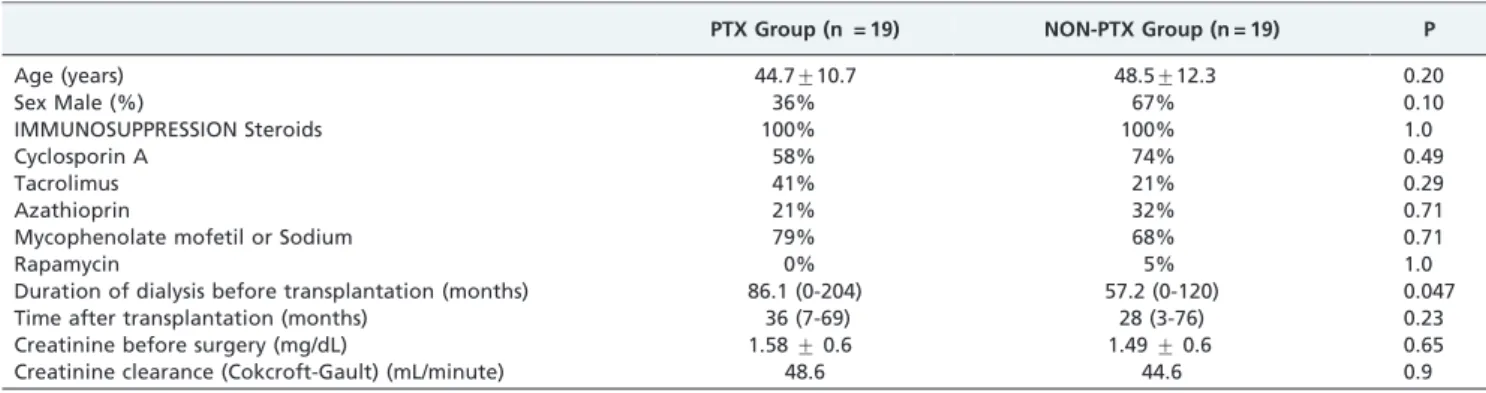
The 19 patients with persistent HPT underwent parathyr-oidectomy due to hypercalcemia. The 19 patients in the control group received general and urological operations as follows: herniorrhaphy in 9, radical prostatectomy in 4, transurethral prostatectomy in 2, 1 cholecystectomy, 1 laparoscopic nephrectomy, 1 open nephrectomy plus chole-cystectomy and 1 open herniorrhaphy plus cholechole-cystectomy. Renal replacement therapy before transplantation consisted of hemodialysis in 95% of the parathyroidectomy group and 89% of the control group. None of the cases in the study group underwent peritoneal dialysis before transplantation as compared with 5% of the control group. The remaining patients in both groups had pre-emptive renal transplanta-tion, with no significant differences in mean time on dialysis or mean time of surgery after renal transplantation. The mean time on dialysis before renal transplantation was 86.1 (range 0-204) months in the parathyroidectomy group and 57.2 (range 0-120) months in the control group (p = 0.047). The mean time for surgery after renal transplantation was 34 months (range 7–69 months) for the parathyroidectomy group and 26.9 months (range 3-76) for the control group (p = 0.23). The cause of chronic renal failure was glomerulonephritis or vasculitis in 47% of the patients undergoing parathyr-oidectomy and in 37% of the controls. Hypertensive disease induced renal failure in 26% of the study cases and in 21% of the controls. Cystic, hereditary or congenital diseases were
found in 11% of the cases and in 21% of the controls. Diabetes was not observed in any of the study cases but was present in 5% of the controls. The etiology of renal failure was unknown or missing in 11% of the patients who underwent parathyroidectomy. The donated kidney was from a deceased donor in 84% of the cases in both groups. Immunosuppression was similar in both groups. Table 1 shows the mean age, gender, type of immunosuppressant, duration of dialysis before transplantation, time of surgery after transplantation, mean preoperative creatinine and preoperative estimated glomerular filtration rate for patients in the two groups.
In the parathyroidectomy group, the mean PTH was 350 pg/mL (range 134-3950) and the mean total calcium was 10.7 mg/dL (range 10.2-12.7). There were no operative deaths. A significant increase in serum creatinine from 1.58 to 2.29 mg/dL (p,0.05) was noted in the parathyroidectomy group within the first 5 days after parathyroidectomy. An insignificant increase in serum creatinine occurred in the control group in the first 5 days after surgery (baseline: 1.49mg/dL; day 5: 1.65mg/dL). On the fifth day after surgery, creatinine was higher in the parathyroidectomy group (p,0.05) than in the control group.
In the parathyroidectomy group, renal function stabilized after 24¡10 months of follow up. At that time, the mean serum creatinine value (1.91 mg/dL) was not statistically different from baseline. Renal function stabilized after 31¡ 24 months in the non-parathyroidectomy group, with a final follow-up creatinine mean value of 1.72 mg/dL (Figure 2).
At the long-term follow up, one death related to sepsis had occurred in the parathyroidectomy group, and two deaths related to cardiovascular disease had occurred in the non-parathyroidectomy group. None of the deaths were related to the surgical procedures. Censoring for death revealed similar findings. In the group of patients who underwent parathyroidectomy after the kidney transplanta-tion, only two patients lost the graft, with one at 22 months post-surgery and the other at 63 months. The three patients were diagnosed with chronic allograft nephropathy. None of the controls lost their kidney grafts. The difference in graft loss was not statistically significant (p = 0.48).
DISCUSSION
The decision to recommend parathyroid surgery after kidney transplantation is a difficult one. Evidence-based
Table 1 -Demographic and clinical data.
PTX Group (n = 19) NON-PTX Group (n = 19) P
Age (years) 44.7¡10.7 48.5¡12.3 0.20
Sex Male (%) 36% 67% 0.10
IMMUNOSUPPRESSION Steroids 100% 100% 1.0
Cyclosporin A 58% 74% 0.49
Tacrolimus 41% 21% 0.29
Azathioprin 21% 32% 0.71
Mycophenolate mofetil or Sodium 79% 68% 0.71
Rapamycin 0% 5% 1.0
Duration of dialysis before transplantation (months) 86.1 (0-204) 57.2 (0-120) 0.047
Time after transplantation (months) 36 (7-69) 28 (3-76) 0.23
Creatinine before surgery (mg/dL) 1.58¡0.6 1.49¡0.6 0.65
Creatinine clearance (Cokcroft-Gault) (mL/minute) 48.6 44.6 0.9
Legend: PTX = parathyroidectomy; NON-PTX = other operations.
guidelines are currently lacking, and thus, laboratory data, clinical symptoms and imaging data should all be con-sidered. A previous report suggested a possible deleterious effect of total parathyroidectomy with immediate auto-transplantation on long-term kidney graft survival.8
Although the present study demonstrated an acute dete-rioration of renal function in the acute period after parathyroidectomy, renal function was similar to baseline and the control group at the final follow up. This suggests that the deterioration only persists short term. Group that contained patients undergoing some urological surgeries with a greater interference in renal function, the difference observed in the first week remained unchanged.
The present paper clearly shows that acute changes in renal function are not the same after parathyroidectomy and other comparable operations not involving the parathyroid glands, leading one to consider anesthetic or post-trauma effects on these variables.10Indeed, one study demonstrated that renal function after total parathyroidectomy without immediate autotransplantation did not differ even from that of patients undergoing subtotal parathyroidectomy.11 This study emphasizes that persistent HPT is an important surgical disease in kidney transplant patients, as parathyr-oidectomy accounted for approximately 31% (28 of 90) of all operative diseases of these patients. Cinacalcet may play an effective role in the clinical management of such patients12, but the drug is not yet available for patients in Brazil.
The results presented here demonstrate that parathyroi-dectomy, which is an important therapeutic modality for kidney transplant patients, appears to be safe for kidney function irrespective of the technique employed. Notwith-standing, determining the mechanism involved in the acute deterioration of renal function that occurs shortly after parathyroidectomy may permit better patient selection and determination of the most appropriate type of parathyr-oidectomy in kidney-transplanted patients.13
Acute renal changes after parathyroidectomy are also seen in some patients undergoing parathyroidectomy for primary HPT. In the past, these alterations were clinically evidenced by the presence of oliguria, but it is now possible to observe a significant elevation in creatinine shortly after the surgery.14 Clinically evident renal failure may occur
even in more recent cases.15,16
Much has been said in the literature about the hemody-namic effects of PTH on the kidney,17-19 but precise mechanisms for long-term alterations in renal function have not been proposed. Moreover, contradictory information has been presented.4 In 1983, Pang et al. suggested that
different segments of the PTH molecule might have specific activities.20It seems reasonable to speculate that the variable patterns of creatinine change after parathyroidectomy may result from the activity of another parathyroid substance or of a PTH fragment.
PTH-related protein (PTHrP) is an autocrine/paracrine peptide expressed in renal tubules and vasculature that may play an important role in regulating overall renal function. It was first identified as a tumor-derived protein responsible for humoral hypercalcemia of malignancy.21 PTHrP is
homologous to PTH in the N-terminal region, suggesting a possible basis for the similarity of this peptide’s actions to those of PTH when secreted into the systemic circulation by malignant tumors. Experimental analysis has shown that PTHrP can act as an endogenous vasorelaxant, modulating renal responses to vasoactive stimuli.16This effect suggests
the possibility that calcineurin inhibitors, which act as powerful glomerular vasoconstrictors, might worsen creati-nine levels.22In any case, both the acute and chronic effects of high levels of PTH on kidney function deserve further study, as apparently contradictory results have been described.23,24
REFERENCES
1. Messa P, Sindici C, Cannella G, Miotti V, Risaliti A, Gropuzzo M, et al. Persistent secondary hyperparathyroidism after renal transplantation. Kidney Int. 1998;54:1704-13, doi: 10.1046/j.1523-1755.1998.00142.x. 2. Evenepoel P, Claes K, Kuypers D, Maes B, Bammens B, Vanrenterghem
Y. Natural history of parathyroid function and calcium metabolism after kidney transplantation: a single-centre study. Nephrol. Dial. Transplant. 2004;19:1281-7, doi: 10.1093/ndt/gfh128.
3. Lee PP, Schiffmann L, Offermann G, Beige J. Effects of parathyroidect-omy on renal allograft survival. Kidney Blood Press. Res. 2004;27:191-6, doi: 10.1159/000079810.
4. Evenepoel P, Claes K, Kuypers DR, Debruyne F, Vanrenterghem Y. Parathyroidectomy after successful kidney transplantation: a single centre study. Nephrol. Dial. Transplant. 2007;22:1730-7, doi: 10.1093/ ndt/gfm044.
5. Schwarz A, Rustien G, Merkel S, Radermacher J, Haller H. Decreased renal transplant function after parathyroidectomy. Nephrol. Dial. Transplant. 2007;22:584-91, doi: 10.1093/ndt/gfl583.
6. Montenegro FLM, Ferreira GF, Lourenc¸o Jr DM, Martin RM, Arap SS, Correa PH, et al. Transitory decrease of renal function after parathyr-oidectomy: a clinical observation indicating the renal hemodynamic effect of parathyroid hormone? Rev.Bras.Cir.Cabec¸ a Pescoc¸ o. 2007;36:196-201.
7. Rostaing L, Moreau-Gaudry X, Baron E, Cisterne JM, Monrozie`s-Bernadet P, Durand D. Changes in blood pressure and renal function following subtotal parathyroidectomy in renal transplant patients presenting with persistent hypercalcemic hyperparathyroidism. Clin. Nephrol. 1997;47:248-255.
8. Schlosser K, Endres N, Celik I, Fendrich V, Rothmund M, Ferna´ndez ED. Surgical treatment of tertiary hyperparathyroidism: the choice of procedure matters! World J Surg. 2007;31:1947-53, doi: 10.1007/s00268-007-9187-z.
9. Azeka E, Auler Ju´nior JO, Fernandes PM, Nahas WC, Fiorelli AI, et al. Registry of Hospital das Clı´nicas of the University of Sa˜o Paulo Medical School: first official solid organ and tissue transplantation report - 2008. Clinics. 2009;64:127-34, doi: 10.1590/S1807-59322009000200010. 10. Ramakant P, Agarwal G. Surgical treatment of tertiary
hyperparathyr-oidism: the choice of procedure matters: surgical management of tertiary hyperparathyroidism: an enigma. World J Surg. 2008;32:1894. 11. Rayes N, Seehofer D, Schindler R, Reinke P, Kahl A, Ulrich F, et al.
Long-term results of subtotal vs total parathyroidectomy without autotrans-plantation in kidney transplant recipients. Arch Surg. 2008;143:756-761, doi: 10.1001/archsurg.143.8.756.
12. Serra AL, Savoca R, Huber AR, Hepp U, Delsignore A, Hersberger M, et al. Effective control of persistent hyperparathyroidism with cinacalcet in renal allograft recipients. Nephrol. Dial. Transplant. 2007;22:577-83, doi: 10.1093/ndt/gfl560.
13. Montenegro F, Ferreira G, Ianhez L. Surgical treatment of tertiary hyperparathyroidism: the choice of procedure matters! World J Surg. 2008;32:1892-1893; author reply 1895-1896, doi: 10.1007/s00268-007-9413-8. 14. Montenegro F, Martin R, Lourenc¸o D. The parathyroids and the kidney:
Fuller Albright revisited. World J Surg. 2009;33:246-7.
15. Montenegro FLDM, Martin RM, Correˆa PHS. Renal failure after surgery for primary hyperparathyroidism: is acute reduction of parathyroid function a risk factor? Clinics. 2009;64:369-72, doi: 10.1590/S1807-59322009000400017.
16. Laroche M, Garrette F, Rostaing L, Cantagrel A, Mazie`res B. [End-stage renal failure following parathyroidectomy for advanced primary hyperparathyroidism]. Rev Med Interne. 1998;19:787-791, doi: 10.1016/ S0248-8663(98)80382-2.
17. Barenbrock M, Hausberg M, Kosch M, Kisters K, Hoeks AP, Rahn KH. Effect of hyperparathyroidism on arterial distensibility in renal transplant recipients. Kidney Int. 1998;54:210-5, doi: 10.1046/j.1523-1755.1998.00963.x.
18. Fritsch S, Lindner V, Welsch S, Massfelder T, Grima M, Rothhut S, et al. Intravenous delivery of PTH/PTHrP type 1 receptor cDNA to rats decreases heart rate, blood pressure, renal tone, renin angiotensin system, and stress-induced cardiovascular responses. J. Am. Soc. Nephrol. 2004;15:2588-600, doi: 10.1097/01.ASN.0000141040.77536.AF. 19. Noonan WT, Qian J, Stuart WD, Clemens TL, Lorenz JN. Altered renal
hemodynamics in mice overexpressing the parathyroid hormone (PTH)/ PTH-related peptide type 1 receptor in smooth muscle. Endocrinology. 2003;144:4931-8, doi: 10.1210/en.2003-0351.
the hypercalcemic properties. Endocrinology. 1983;112:284-9, doi: 10. 1210/endo-112-1-284.
21. Suva LJ, Winslow GA, Wettenhall RE, Hammonds RG, Moseley JM, Diefenbach-Jagger H, et al. A parathyroid hormone-related protein implicated in malignant hypercalcemia: cloning and expression. Science. 1987;237:893-6, doi: 10.1126/science.3616618.
22. Lyson T, Ermel LD, Belshaw PJ, Alberg DG, Schreiber SL, Victor RG. Cyclosporine- and FK506-induced sympathetic activation correlates with
calcineurin-mediated inhibition of T-cell signaling. Circ. Res. 1993;73: 596-602.