Universidade Federal de Minas Gerais and Centro de Pesquisa René Rachou -FIOCRUZ
Mailing adress: Sandhi Maria Barreto - Laboratório de Epidemiologia, Centro de Pesquisa René Rachou - Av. Augusto de Lima, 1715 – 30190-002 – Belo Horizonte, MG, Brazil - [email protected]
English version by Stela Maris C. e Gandour
Objective - To investigate preoperative predictive factors of severe perioperative intercurrent events and in-hospital mortality in coronary artery bypass graft (CABG) surgery and to develop specific models of risk prediction for these events, mainly those that can undergo changes in the preoperative period.
Methods - We prospectively studied 453 patients who had undergone CABG. Factors independently associated with the events of interest were determined with multiple logistic regres-sion and Cox proportional hazards regresregres-sion model.
Results - The mortality rate was 11.3% (51/453), and
21.2% of the patients had 1 or more perioperative inter-current events. In the final model, the following variables remained associated with the risk of intercurrent events: age ≥ 70 years, female sex, hospitalization via SUS (Siste-ma Único de Saúde - the Brazilian public health system), cardiogenic shock, ischemia, and dependence on dialysis. Using multiple logistic regression for in-hospital morta-lity, the following variables participated in the model of risk prediction: age ≥ 70 years, female sex, hospitalization via SUS, diabetes, renal dysfunction, and cardiogenic shock. According to the Cox regression model for death within the 7 days following surgery, the following varia-bles remained associated with mortality: age ≥ 70 years, fe-male sex, cardiogenic shock, and hospitalization via SUS.
Conclusion - The aspects linked to the structure of the Bra-zilian health system, such as factors of great impact on the results obtained, indicate that the events investigated also depend on factors that do not relate to the patient’s intrinsic condition.
Key words: myocardial revascularization surgery, in-hos-pital mortality, perioperative complications
Arq Bras Cardiol, volume 80 (nº 1), 51-60, 2003
Fernanda Fuscaldi Almeida, Sandhi Maria Barreto, Bráulio Roberto G. M. Couto, Carlos E. F. Starling
Belo Horizonte, MG - Brazil
Predictive Factors of In-Hospital Mortality and of Severe
Perioperative Complications in Myocardial
Revascularization Surgery
At the beginning of the 20th century, cardiovascular di-seases accounted for less than 10% of the deaths in the world. At the end of that century, that group of diseases accounted for approximately half of the deaths in the deve-loped countries and 25% of the deaths in developing coun-tries. In 2020, cardiovascular diseases are estimated to ount for 25 million deaths per year, and ischemic heart diseases will surpass infectious diseases as the first cause of death in the world 1.
In Brazil, cardiovascular diseases lead the causes of death and hospitalization, accounting for 32.6% of the deaths with a determined cause. From 1996 to 1999, cardio-vascular diseases accounted for 9% of the hospitalizations via SUS (Sistema Único de Saúde - the Brazilian public health system), being the major cause of hospitalization in the population aged 40 to 59 years (17%) and in the popula-tion aged 60 or above (29%). Ischemic cardiac diseases acco-unted for 29.6% of the deaths due to cardiovascular diseases, the mean mortality rate of this group of diseases being 46.4 deaths per 100,000 inhabitants/year in the period 2.
Mortality due to ischemic heart diseases varies widely among countries and among regions in the same country. Recent data from the MONICA Project 3 relative to a 10-year period of study with 37 different populations indicate a reduction in ischemic cardiac events and related mortality rates in most countries. Multiple aspects have contributed to this favorable tendency, including the reduction in the prevalence of risk factors, the improvement in health care and the increase in access to it, and new methods of diag-nosis and treatment 4,5.
an-nually 6. The introduction of percutaneous coronary inter-vention slowed down the progression of myocardial revas-cularization surgery 7, which, however, remained as 1 of the most frequently performed surgeries. In-hospital mortality after isolated myocardial revascularization surgery declined over the period from 1967 to the 1980s. From the 1990s on-wards, the morbidity and mortality rates have been constant or shown a mild increase 8. In Brazil, the hospitalizations via SUS related to myocardial revascularization surgeries com-prised a total of 1,465 in 2001, representing a 27% increase as compared with data from 1996 (1,157). The mean in-hos-pital mortality rate during this period was 7.4% 9.
The tendency towards stabilization or mild increase in the mortality indices after myocardial revascularization sur-gery worldwide may reflect alterations in the type of patient undergoing myocardial revascularization surgery over time, particularly with the appearance of the percutaneous revas-cularization procedures. Compared with patients from the 1970s, the current population undergoing surgery is charac-terized by older people, a high percentage of females, pre-sence of poor cardiac condition (unstable angina, three-vessel disease, previous revascularization, left ventricular dysfunction) and association with other diseases (hyper-tension, diabetes, and peripheral vascular disease), compri-sing a more severely ill population 10,11.
Raw (overall) rates of mortality and of complications, however, do not allow a precise evaluation of the institutio-nal results related to the surgical procedures for cardiovas-cular diseases. Assessment of the severity of the illness of the population undergoing cardiac surgery and the use of this information to stratify the risk is fundamental to adjust the indicators of mortality and complications according to the degree of compromise of the patients, and, consequen-tly, to allow valid comparisons of the results in the same ins-titution over time and among insins-titutions 12-14.
In Brazil, punctual initiatives for quantifying the results related to myocardial revascularization surgery are limited to overall indicators, particularly mortality, ignoring the characterization of the severity of the surgical popula-tion. The lack of epidemiological studies to predict the risk of mortality in myocardial revascularization surgery in our country hinders valid comparisons with the mortality rates reported by different institutions.
We report the results of a prospective study with pa-tients who had undergone myocardial revascularization sur-gery to identify predictive factors of in-hospital mortality and of severe perioperative intercurrent events. A p < 0.05 was considered significant.
Methods
This study was carried out in a medium-sized (250 beds) tertiary care general hospital and referral center for cardiac surgery in the city of Belo Horizonte, in the state of Minas Gerais, from March 1996 to March 1999. At that
hos-pital, a mean of 30 cardiac surgeries is performed per month. The population studied comprised all patients who under-went myocardial revascularization surgery. The surgical procedures without extracorporeal circulation or aortic clamp were also included in this study.
Based on a literature review, 4 models of mortality risk prediction in cardiac surgery were selected 15-18 as a basis for structuring the assessment protocol of the patients. All risk factors included in the final models of risk prediction in those studies were included in our final protocol in addition to other factors considered pertinent by the authors that were available in the patient’s medical record. The final pro-tocol comprised 5 groups of variables as follows: demogra-phic variables and those related to lifestyle, concomitant cli-nical problems, assessment of the cardiovascular system, priority degree of the surgery, and data referring to the sur-gical procedure itself. The variable “team” was structured aiming at grouping the surgeons of the institution conside-ring the following working similarities: technical approach, type of patients, and work routine. Chart I shows the list of variables included in the protocol.
Data collection was performed by the major investi-gator, the major source of data being the medical records. The patients who met the inclusion criteria were followed up from their admission to the surgical block onwards, and their data referring to the pre-, peri-, and postoperative periods were recorded in a specific form. The periodicity of data collection varied, being daily in the intensive care unit and 3 times a week in the other hospitalization units. Peri-and postoperative complications were recorded in open field. Periodical assessment of the records of the surgical cardiac procedures performed enabled the identification of all patients who died during surgery, avoiding loosing in-formation of this specific group, and also enabled checking occasional losses of patients due to changes in data collec-tion flow. The database was structured with EPI-INFO soft-ware. Data input was performed on a monthly basis with para-llel consistency analysis and correction of occasional errors. The following dependent variables were considered: in-hospital death due to all causes during or after myocardial revascularization surgery, and severe intercurrent events during the procedure (acute myocardial infarction, low cardiac output, arrhythmias, increased bleeding, cardiopul-monary arrest, and hemodynamic instability).
We chose to include “death due to all causes” in the place of “death due to cardiac cause” because of the diffi-culty in establishing the cause of death in patients under-going myocardial revascularization surgery with a compli-cated clinical evolution.
The analysis of severe intercurrent events was limited to the perioperative period, because the immediate postope-rative (24 hours) complications are strongly influenced by the factors related to surgery, therefore not fulfilling the ob-jectives of this study.
sociode-Chart I – Independent variables included in the protocol and their relation with the models of risk prediction chosen
Variable Models of risk prediction
Parsonnet15Tuman17Iggins16 Tu18
1989 1992 1992 1995
Demographic and anthropometric aspects and lifestyle
Age x x x x
Sex x x x
Weight x
Smoking *
Assessment of the cardiovascular system
Stenosis of the left main coronary artery* Number of coronary arteries impaired*
Left ventricular ejection fraction x x x x
Left ventricular aneurysm x
Surgical aortic stenosis x
Transaortic pressure gradient x >120 mm Hg
Mitral valve insufficiency x
Pulmonary artery systolic pressure x
≥ 60 mm Hg
Pulmonary hypertension x
Preoperative intra-aortic balloon x
Preoperative AMI x
Unstable angina *
Systemic arterial hypertension x
Congestive heart failure x
Cardiogenic shock x
Acute mechanical complication x
Dependence on pacemaker x
Adult congenital heart disease x Endocarditis*
Previous cerebral stroke x x
Previous peripheral vascular surgery x
IV Nitrate /IV inotropic * Previous anti-platelet therapy* Coexisting clinical problems
Acute renal failure x
Serum creatinine x x
Dialysis x
Hematocrit x
Diabetes x x
Chronic obstructive x
bronchopulmonary disease
Morbid obesity x
Paraplegia x
Severe asthma x
Dyslipidemia* Preoperative ICU* Priority of surgery
Elective, urgent, emergency surgery x
Emergency surgery x x
Postangioplasty emergency x
Postcatheterization emergency x Data referring to surgery
Reoperation x x x x
Valve x
Mitral valve surgery x x
Aortic valve surgery x x
MRVS x
MRVS + valve x
Multivalve or MRVS + valve x x
* Other variables included in the protocol.
mographic variables and the preoperative conditions con-tained in the protocol were investigated as potential pre-dictors of death and of severe complications. The following preoperative risk factors were excluded from the study be-cause they had a frequency below 3%: emergency surgery
after angioplasty (0.9%), emergency surgery after catheteri-zation (0.2%), left ventricular aneurysm (2.9%), preoperative intra-aortic balloon (0.7%), and acute renal failure (0.2%).
Considering the equivalence of some variables indica-ting similar dysfunctions, they were grouped into the 5 fol-lowing categories for multivariate analysis: type of surgery (reoperation or nonelective surgery, or both), renal dysfun-ction (dependence on dialysis or creatinine ≥ 1.9 mg/dL, or both), cardiac failure (congestive heart failure or acute pul-monary edema or pulpul-monary hypertension, or any combina-tion of these), myocardial ischemia (unstable angina or acute myocardial infarction in the 3 weeks preceding surgery), and degree of impairment (stenosis > 50% in 3 coronary arteries or stenosis of the left main coronary artery, or both).
The factors associated with mortality and with severe complications in the perioperative period were determined with multiple logistic regression. Initially, each variable grouped according to affinities, demographic aspects and lifestyle, concomitant clinical problems, assessment of the cardiovascular system, priority of the surgery, and data re-ferring to the surgical procedure was investigated. Later, the colinearity between the variables in each group and bet-ween variables of different groups was investigated. The final model included all variables that showed a statistical association with the event at the level of 0.10 in addition to sex and age, considered, a priori, confounding variables in this study. When 2 or more variables had colinearity, only the one showing the strongest association with the event of interest or with the most plausible clinical significance was included in the final model.
Survival after myocardial revascularization surgery was analyzed to determine the factors associated with mor-tality within the first 8 days after surgery. The patients who were discharged or died prior to that period contributed to the study only with the time until the occurrence of 1 of these facts. Kaplan-Meier curves for the time elapsed until death were calculated for the cohort and subgroups accor-ding to age and sex. The heterogeneity of the curves was tested using the log-rank test. The multivariate analysis of deaths after surgery was performed with the Cox propor-tional hazards regression model to assess the predictive effect of each variable on the risk of death.
Results
In the period studied, 453 patients underwent myocar-dial revascularization surgery, of whom only 12 (2.6%) under-went another concomitant surgical cardiac procedure (9 aortic valve replacements and 3 mitral valve replacements). Tables I and II show the characteristics of the patients studied in regard to length of stay (overall, stratified for periods, and at the intensive care unit), the preoperative variables investi-gated, and data about the surgical procedure.
Table II – Distribution of the patients who underwent myocardial revascularization surgery according to the preoperative characteristics
and conditions.
Variable Distribution N (%)
Demographic aspects and lifestyle
Age < 50 years 65 (14.4)
Age 50-59 years 127 (28)
Age 60-69 years 159 (35.1)
Age ≥ 70 years 102 (22.5)
Female sex 147 (32.5)
Male sex 306 (67.5)
Smoking 130 (28.7)
Type of health care coverage on admission
Public (SUS) 323 (71.3)
Private (non-SUS) 130 (28.7)
Data concerning the cardiovascular system
Stenosis of left main coronary artery 42 (9.3)
One-vessel disease 94 (20.9)
Two-vessel disease 217 (48.3)
Three-vessel disease 138 (30.7)
Left ventricular aneurysm 13 (2.9)
Previous AMI < 7 days 14 (3.2)
Previous AMI 7-21 days 20 (4.6)
Previous AMI > 21 days 125 (28.7)
Previous cerebral stroke 22 (4.9)
Systemic arterial hypertension 301 (66)
Congestive heart failure 64 (14.1)
Unstable angina 191 (42.2)
Cardiogenic shock 10 (2.2)
Acute pulmonary edema 17 (3.8)
Pulmonary hypertension 20 (4.4)
Preoperative intra-aortic balloon 3 (0.7)
Use of an anti-platelet drug 7 days 19 (4.2)
Coexisting clinical problems
Creatinine ≥ 1.9 mg/dL 14 (3.6)
Dependence on dialysis 6 (1.3)
Diabetes mellitus 88 (19.4)
Chronic obstructive pulmonary disease 76 (16.8)
Dyslipidemia 80 (17.7)
Anemia (hematocrit < 34%) 39 (10.1)
Surgical team
Team A 98 (21.6)
Team B 250 (55.2)
Team C 105 (23.2)
Type of surgery
Elective surgery 325 (71.7)
Non-elective surgery 128 (28.3)
Reoperation 30 (6.6)
Postangioplasty emergency surgery 4 (0.9)
Postcatheterization emergency surgery 1 (0.2) Characterization of the procedure
Use of the saphenous vein 389 (86.1)
Use of the internal thoracic artery 327 (72.3)
Concomitant aortic replacement 9 (2)
Concomitant mitral replacement 3 (0.7)
Surgery without extracorporeal circulation 24 (5.4) Table I – Length of stay, duration of the surgery, and time of
extracorporeal circulation in myocardial revascularization surgery.
Variable Mean ± SD Median Variation
Length of stay (days)
Preoperative 6.6 ± 6.4 5 0 - 37
Postoperative 11.2 ± 12.6 8 0 - 138
Preoperative ICU 3.8 ± 3.6 3 0 - 23
Postoperative ICU 4.1 ± 5.8 2 0 - 63
Surgery
Duration of the procedure (hs)* 5.2 5 0.8 - 11.7 SD- standard deviation; * information available for 98.0% of the patients; ** information available for 82.3% of the patients; duration of aortic clamp available in only 33% (151) of the procedures.
Fig. 1 - Distribution of the population studied according to age group and the type of health care coverage at the time of hospital admission.
62.7
37.3 81.5
18.5 78
22
67.3
32.7
< 50 years 50-59 years 60-69 years ≥ 70 years
Age Group
SUS Non - SUS %
90 80 70 60 50 40 30 20 10 0
67.5% of the patients. The age distribution of the female population differed from that of the male population, with a greater concentration of females older than 59 years (X2 = 6.24; p = 0.04). In regard to medical insurance cove-rage, 71.3% of the patients were covered only by the SUS. An increase in the proportion of individuals with other types of coverage (private patients or patients co-vered by private health plans) was observed as age in-creased (fig. 1).
Elective surgeries corresponded to 71.7% of the pro-cedures performed. No difference was observed in the distribution of the surgeries grouped by categories in regard to the type of patient’s medical insurance coverage at the time of hospitalization.
Ventricular ejection fraction was determined only in 153 (33.8%) patients, in whom the median of the ventricular ejection fraction was 55%, and 10.5% of the patients showed severe left ventricular dysfunction (ventricular ejection fraction ≤ 35%).
Although 38.9% of the patients had acute myocardial infarction prior to surgery, only 3.1% experienced it within 7 days from surgery, 4.4% between 7 and 21 days, and 27.6% experienced it more than 21 days before surgery.
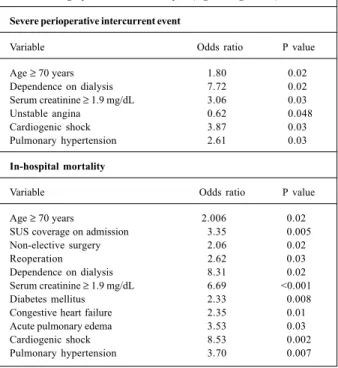
During the procedure, 21.2% of the patients (96/453) had 1 or more severe perioperative intercurrent events (tab. III). Six risk factors showed a statistically significant association
with the occurrence of an event: age ≥ 70 years, dependence
on dialysis, serum creatinine ≥ 1.9 mg/dL, cardiogenic
Table III - Factors associated with severe perioperative intercurrent event and in-hospital mortality in myocardial revascularization
surgery on univariate analysis (logistic regression).
Severe perioperative intercurrent event
Variable Odds ratio P value
Age ≥ 70 years 1.80 0.02
Dependence on dialysis 7.72 0.02
Serum creatinine ≥ 1.9 mg/dL 3.06 0.03
Unstable angina 0.62 0.048
Cardiogenic shock 3.87 0.03
Pulmonary hypertension 2.61 0.03
In-hospital mortality
Variable Odds ratio P value
Age ≥ 70 years 2.006 0.020
SUS coverage on admission 3.35 0.005
Non-elective surgery 2.06 0.020
Reoperation 2.62 0.030
Dependence on dialysis 8.31 0.021
Serum creatinine ≥ 1.9 mg/dL 6.69 <0.001
Diabetes mellitus 2.33 0.008
Congestive heart failure 2.35 0.013
Acute pulmonary edema 3.53 0.032
Cardiogenic shock 8.53 0.002
Pulmonary hypertension 3.70 0.007
Fig. 2 - Mortality rate and severe perioperative intercurrent event rate in myocardial revascularization surgery according to age group.
< 50 years 50-59 years 60-69 years ≥ 70 years
Age Group
Severe Intercurrent Event rate Mortality Rate % 35
30
25
20
15
10
5
0
7.7 9.4
10.1
17.6 24.6
15
18.9
30.4
Fig. 3 - Distribution of the deaths and severe perioperative intercurrent events in regard to the characteristics of the surgeries.
Elective/1st Surgery Elective/Reoperation Non-elective/1st Surgery Non-elective/Reoperation
.
. .
.
.
Mortality Rate Rate of Severe Perioperative Intercurrent events
. .
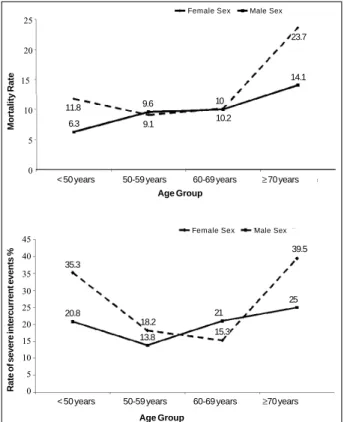
Severe perioperative intercurrent events predomina-ted in female patients in all age groups, except in the 60- to 69-year group (fig. 4).
In the final model, the following preoperative variables remained statistically associated with a high risk of inter-current events: age ≥ 70 years, hospitalization via SUS, car-diogenic shock, ischemia, and dependence on dialysis. The variable ischemia (OR = 0.45; 95% CI: 0.27 – 0.75) showed a protective effect in regard to the event assessed (tab. IV).
The overall mortality rate observed was 11.3% (51/ 453). In the period referring to the day of the surgery (perio-perative and immediate posto(perio-perative periods), the morta-lity rate was 3.3% (15/453). Eight (1.8%) patients died in the surgical block, and, in the postoperative period, the mor-tality rate was 9.7%.
The results of the univariate analysis of the preopera-tive risk factors for mortality are shown in table III, where the following 11 risk factors showed a significant association with mortality: age ≥ 70 years, hospitalization via SUS, reo-peration, nonelective surgery, dependence on dialysis, dia-betes, serum creatinine ≥ 1.9 mg/dL, congestive heart fai-lure, cardiogenic shock, acute pulmonary edema, and pulmo-nary hypertension.
The mortality rate was greater in the population aged 70 years or more (17.6%) as compared with that of the patients aged less than 70 years (9.4%; p=0.02) (fig. 2). Diffe-rences in the mortality rates between the sexes were only
observed when stratification by age group occurred. In the group aged ≥ 70 years, the risk of death in females was 2.7 times greater than that in males (p= 0.02) (fig. 4).
The mortality rate among individuals hospitalized via SUS was 13.9%, and the risk of death among them was 3.4 times greater than that among individuals covered by pri-vate health plans or pripri-vate patients (p=0.05). All deaths on the day of the surgery occurred in patients hospitalized via SUS (X2 = 6.2; p=0.01). After that period, no difference was observed in the distribution of deaths in regard to the type of health care coverage at the time of hospitalization (X2 = 0.64; p=0.42). Among individuals hospitalized via SUS, deaths occurred in all age groups, while in the category of private medical insurance or private patients, deaths were limited to the population aged 60 years or more.
Nonelective surgeries associated with reoperation had a mortality rate of 33.3%, 5 times greater than that in the reference group (elective/first surgery) (X2= 7.93; p= 0.005) (fig. 3).
The patients who developed cardiogenic shock in the preoperative period had an 8.6-time greater risk of death than those without that risk factor (p=0.002). In the popula-tion assessed, 10 patients with that condipopula-tion were identi-fied, and 50% evolved to death. Analyzing death on the day of surgery, this risk became 15 times greater (p=0.003) and it increased to 36 times when, in addition to shock, the patient had been hospitalized via SUS (p=0.0006).
Table IV – Final models of risk prediction of severe perioperative intercurrent event and in-hospital mortality in myocardial revascularization surgery.
Severe perioperative intercurrent event (logistic regression)
Coefficient OR 95% CI P
Age ≥ 70 years + 1.97 1.71 [1.00 - 2.90] 0.049
Female sex* + 1.36 1.41 [0.85 - 2.30] 0.170
SUS coverage + 2.22 1.90 [1.08 - 3.35] 0.030
Cardiogenic shock + 2.66 6.39 [1.62 - 25.09] 0.008
Dependence on dialysis + 2.69 11.37 [1.94 - 66.62] 0.007
Ischemia - 3.04 0.45 [0.27 - 0.75] 0.002
Mortality (logistic regression)
Coefficient OR 95% CI P
Age ≥ 70 years + 2.15 2.10 [1.07 - 4.15] 0.032
Female sex* + 0.61 1.23 [0.63 - 2.40] 0.540
SUS coverage + 2.89 3.89 [1.55 - 9.78] 0.004
Diabetes + 2.27 2.25 [1.12 - 4.53] 0.023
Renal dysfunction + 2.95 6.04 [1.83 - 19.93] 0.003
Cardiogenic shock + 3.05 10.58 [2.33 - 48.18] 0.002
Mortality (cox proportional hazards regression model)
Coefficient HR 95% CI P
Age ≥ 70 years + 1.36 1.64 [0.80 - 3.36] 0.170
Female sex* + 1.12 1.45 [0.75 - 2.80] 0.265
SUS coverage + 2.47 3.72 [1.31 - 10.55] 0.013
Cardiogenic shock + 4.24 8.79 [3.22 - 23.99] <0.010
OR- odds ratio; HR- hazard-ratio; 95% CI- 95% confidence interval; * sex was maintained as an adjusting factor in the final model, although not statistically associated with the risk of severe intercurrent events and mortality.
Analyzing survival, 72.5% (37/51) of the deaths occur-red within 8 days after the procedure, including the day of surgery. The Kaplan-Meier curves indicated the following risk factors for shorter survival in myocardial revasculariza-tion surgery: health care coverage via SUS (p=0.01), perio-perative cardiogenic shock (p<0.001), and diabetes (p=0.04). Overall survival and that stratified by age, sex, and type of health care coverage are shown in figure 5. Table IV shows the Cox regression model for the risk of death. The variables age ≥ 70 years, female sex, preoperative cardiogenic shock, and hospitalization via SUS remained in the model signifi-cantly interfering with the risk of death.
Discussion
This study attempted to clarify the impact of factors in-trinsic to the patient and the aspects regarding health care assistance on 2 events related to myocardial revasculariza-tion surgery: severe perioperative intercurrent events and in-hospital mortality.
The following preoperative conditions were identified as important predictors of both mortality and severe perio-perative intercurrent events: cardiogenic shock, renal dys-function, and type of health care coverage at the time of hospitalization.
Our results significantly differ from most of the models of risk prediction in cardiac surgery 15-24, because we identi-fied a more restricted number of variables. This difference
may be partially due to the smaller number of patients inclu-ded in our study and to the fact of not following the pa-tients after hospital discharge.
Age ≥ 70 years was a risk factor for both mortality and severe perioperative intercurrent events, although its statis-tical significance was borderline for the latter. Age is a cri-tical determinant of complications and mortality after cardiac surgery in most studies, although the importance attributed to age varies widely 15-18,22. Loss of physiological reserve with aging, which affects the various systems in dif-ferent degrees, contributes to the elevated morbidity in the elderly population, especially regarding noncardiac compli-cations, such as renal dysfunction, neurological dysfunc-tion, or multiple organ failure 17,25.
The increased risk for complications and mortality
after cardiac surgery among females 15,17-22,24 has been
attributed to several factors, such as the reduced body surface 15,16, the smaller diameter of the arteries in the female sex 26, and the diagnosis and treatment of ischemic heart di-seases in more advanced stages among females, because of the inappropriate approach of female chest pain 17,27,28. Factors, such as the reduction in estrogen with age, may in-fluence the differences in risk found between the sexes. Al-though in our study no statistical association of the female sex with the events assessed has been found, this variable was maintained in the final models, because of the potential confounding effect attributed to it.
reopera-Fig. 4 – Distribution of the mortality rate and rate of severe perioperative intercurrent events in myocardial revascularization surgery according to age group and sex.
Rate of severe intercurrent events %
Mortality Rate
< 50 years 50-59 years 60-69 years ≥ 70 years
Age Group 25
20
15
10
5
0
Female Sex Male Sex
23.7
14.1
10 10.2 9.1
6.3
11.8 9.6
Female Sex Male Sex 45
40 35 30 25 20 15 10 5 0
< 50 years 50-59 years 60-69 years ≥70 years 35.3
20.8
18.2 13.8
21 15.3
25 39.5
Age Group
tion), although important predictors of mortality in other studies 18-20,22, have a degree of subjectivity that makes their use difficult. The classification of the surgery as urgent or emergency, for example, is extremely subjective. In the present study, even classifying the surgeries as elec-tive and nonelecelec-tive, that variable was significant only for mortality in the univariate analysis and was not maintained in the final model. Colinearity was observed in the combined variable “category of surgery”, which aggregates priority of surgery and reoperation with preoperative cardiogenic shock in predicting mortality, and maintenance of the last variable in the final model was chosen due to its strongest association with the response event.
One of the important aspects of this study is the pre-sence of the variable hospitalization via SUS as a predictor of perioperative intercurrent event and mortality in myocar-dial revascularization surgery. This aspect leads us to the question of inequality that characterizes our society, per-meating all the spheres of Brazilian life, including health care 29-31. Hospitalization via SUS may be interpreted in this context as a marker of the patient’s specific conditions (worse economic and life conditions) and of the structure of health care assistance (access to diagnosis and time elap-sed until health care assistance) 29. This structure is charac-terized by a greater difficulty in accessing specific medical actions, especially for patients living in the countryside, which may lead to worsening of the clinical findings and a delay in scheduling surgery. This is very clear when the risk of death on the day of surgery and in the following period is
stratified. The impact of hospitalization via SUS concen-trates in mortality in the perioperative period and in the im-mediate postoperative period (on the same day of surgery): all patients who evolved to death were covered by SUS at the time of hospitalization. The severity of the clinical fin-dings of these patients is well characterized by the presence of preoperative cardiogenic shock: of the 6 patients covered by SUS who developed that condition, 67% died, 50% on the day of surgery. A contrary situation was observed with the other 4 patients who had cardiogenic shock and were not covered by SUS: only 1 patient died in the postoperative period. In the preoperative period, the mean length of stay in the intensive care unit was 9.5 days for the patients covered by SUS (0 – 23 days) and 2.3 days for the other patients (0 - 4 days). Although not significant, this difference is 1 more indicator of the severity of this group of patients.
The overall and postoperative lengths of stay in the intensive care unit were similar for the patients covered by SUS and the others. The difference observed in the preope-rative length of stay may reflect social problems of the patients covered by SUS, who are many times referred from other municipalities, and, not rarely, with no condition to undergo preoperative examinations at an ambulatory level. In addition, delay in performing the procedure with several episodes of surgery suspension during hospitalization was observed.
Although certain noncardiac diseases have been in-tuitively considered important predictors of severe periope-rative intercurrent events and mortality in myocardial revas-cularization surgery, in the present study only diabetes and renal dysfunction remained in the final model. These fin-dings are in accordance with the results of several other studies 15-17,20,22,24 and favor a causal association between these variables and in-hospital mortality and perioperative intercurrent events.
The definitions for renal dysfunction vary among the studies, some of which consider high levels of serum creati-nine 16,17,21,24 and others value the dependence on dialysis 22. In this study, these 2 definitions were maintained as sepa-rate variables. In the analysis, an additional variable, renal dysfunction, was created and defined as the presence of at least 1 of the 2 alterations. This additional variable was in-cluded in the model of mortality prediction. In the predicting model of severe perioperative intercurrent event, depen-dence on dialysis was more significant than elevated levels of serum creatinine or the combination of the 2 variables. The prevalence of the dependence on dialysis was low in the cardiac surgical population, which was evident in the population assessed, and that association should be seen with caution.
ca-Fig. 5 - Overall survival and survival stratified for age, sex, and type of health care coverage during and after myocardial revascularization surgery.
Chance of Survival
Chance of Survival
Chance of Survival Chance of Survival
Log-rank test:
3.78
Log-rank test:
2.19
Log-rank test:
6.26
Days Survival according to age
Age < 70 years
Age ≥ 70 years
Days
Survival according to sex
Male Sex
Female Sex
Days Survival according to type of health care coverage
Non-SUS
SUS
Days Overall Survival
95% CI
ses, and in more than 80% of the patients with acute myo-cardial infarction, when present. The remaining cases correspond to mechanical defects, such as rupture of the ventricular septum or the papillary muscle, or right ventri-cular infarction 32,33. Recent estimates point to an incidence of approximately 7% of cardiogenic shock in patients with acute myocardial infarction, 10% of whom have this condi-tion on hospital admission, while the remaining 90%
deve-lop that complication during hospitalization 34. The same
authors showed a drop in the early mortality rate from 70%-80% in the 1970s to 50%- 60% in the 1990s in the group of patients with this condition associated with acute myocar-dial infarction. In this study, the mortality rate of patients with cardiogenic shock undergoing myocardial revasculari-zation surgery was 50% in the perioperative period, 30% in the immediate postoperative period, and 20% in the middle and late postoperative periods.
An aspect that draws attention in the model of risk pre-diction for severe perioperative intercurrent events is the presence of the variable ischemia with a protective effect (OR = 0.47). Considering that this variable results from ga-thering the individuals with a history of acute myocardial in-farction or unstable angina in the 3 weeks preceding sur-gery, or both, a possible explanation for this finding may be the difference in the patients’ assistance, in regard to more intensive care and more strict preoperative clinical control. This aspect, however, deserves further investigation.
The Cox proportional hazards regression model allowed analyzing data from the study considering the time
elapsed until death, adjusting with covariables. We chose the 7-day follow-up because of the greater frequency of deaths in this period (73%) and to reduce follow-up losses, and, consequently, the bias potential. In the final model, the permanence of the variable “cardiogenic shock” reflects its impact on early mortality, because all deaths with this condi-tion occurred up to the first postoperative day. The pre-sence of diabetes, although significant in the univariate analysis, did not remain in the final model of survival. Coli-nearity was observed between this condition and the type of health care coverage as follows: of the 12 patients with diabetes who evolved to death, 11 were under the SUS coverage. The renal dysfunction variable, both in univa-riate and multivauniva-riate analyses, did not show a significant association with death. The colinearity with sex may explain this behavior as follows: of the 15 patients with renal dys-function analyzed, 13 were males and 3 died.
References
1. World Health Organization. World Health Report 1999: Making a Difference. Geneva, 1999. Outubro 2001. <http:\\ www.who.int/ned/cvd/index.htm > 2. DATASUS. Morbidade hospitalar do SUS - CID 10. 6/Outubro/2001. <http:\\
www.datasus.gov.br\cgi\deftohtm.exe?sim>
3. Tunstall-Pedoe H, Kuulasmaa K, Mahonen M, et al. Contribution of trends in survival and coronary-event rates to changes in coronary heart disease mortality: 10-year results from 37 WHO MONICA project populations. Monitoring trends and determinants in cardiovascular disease. Lancet 1999; 353: 1547.
4. Eagle KA, Guyton RA, Davidoff R, et al. ACC/AHA Guidelines for coronary ar-tery bypass graft surgery: executive summary and recommendations. A report of the American College of Cardiology/American Heart Association Task Force on practice guidelines (Committee to revise 1991 guidelines for coronary artery by-pass graft surgery). Circulation 1999; 100: 1464-80.
5. Di Carli MF, Maddahi J, Rokhsar S, et al. Long-term survival of patients with co-ronary artery disease and left ventricular disfunction: implications for the role of myocardial viability assessment in management decisions. J Thorac Cardiovasc Surg 1998; 116: 997-1004.
6. American Heart Association, 2000. Heart and Stroke Statistical Update. 6 Octo-ber 2001.<http:\\ www.americanheart.org/statistics/medical.htlm > 7. Souza AG, Mattos LA, Campos Neto CD, Carvalho HG, Stella FP, Nunes G.
Percu-taneous myocardial revascularization procedures in Brazil in 1996-1997 com-pared to the 1992-1993 period. A report of the National Registry - National Center for Cardiovascular Interventions (CENIC). Arq Bras Cardiol 1998; 70: 423-30. 8. Katz NM, Wolfe-Pearce JL, Chase GA. Comparison of results and risk factors of cardiac
surgery in two 3-year time periods in the 1990s. Am J Cardiol 1998; 81: 1400-4. 9. DATASUS-Mortalidade-CID 10. 6/Outubro/2001. <http:\\www.datasus.gov. br
\cgi\deftohtm.exe?sih>
10. Cosgrove DM, Loop FD, Lytle BW, et al. Primary myocardial revascularization: trends in surgical mortality. J Thorac Cardiovasc Surg 1984; 88: 673-84. 11. Warner CD, Weintraub WS, Craver JM, et al. Effect of cardiac surgery patient
cha-racteristics on patient outcomes from 1981 through 1995. Circulation 1997; 96: 1575-9.
12. Greefield S, Aronow HU, Elashoff RM, et al. Flaws in mortality data. The hazards of ignoring comorbid disease. J Am Med Assoc 1988; 260: 2253-5. 13. Green J, Wintfeld N, Sharkey P, Passman LJ. The importance of severity of illness
in assessing hospital mortality. J Am Med Assoc 1990; 263: 241-6. 14. Higgins TL, Starr NJ. Risk stratification and outcome assessment of the adult
cardiac surgical patient. Semin Thorac Cardiovasc Surg 1991; 3: 88-94. 15. Parsonnet V, Dean D, Bernstein AD. A method of uniform stratification of risk for
evaluating the results of surgery in acquired adult heart disease. Circulation 1989; 79(suppl I): I 3- I 12.
16. Higgins TL, Estafanous FG, Loop FD, Beck GJ, Blum JM, Paranandi L. Stra-tification of morbidity and mortality outcome by preoperative risk factors in coronary artery bypass patients: a clinical severity score. J Am Med Assoc 1992; 267: 2344.
17. Tuman KJ, McCarthy RJ, March RJ, et al. Morbidity and duration of ICU stay after cardiac surgery: a model for preoperative risk assessment. Chest 1992; 102: 36-44. 18. Tu JV, Jaglal SB, Naylor CD. Multicenter validation of a risk index for mortality, intensive care unit stay, and overall hospital length of stay after cardiac surgery. Circulation 1995; 91: 677-81.
19. O’ Connor GT, Plume SK, Olmstead EM. A regional prospective study of In-hos-pital mortality associated with coronary artery bypass grafting. J Am Med Assoc 1991; 266: 803-9.
20. Edwards FH, Clark RE, Schwartz M. Coronary artery bypass grafting: The So-ciety of Troracic Surgeons National Database Experience. Ann Thorac Surg 1994; 57: 12-9.
21. Grover FL, Johnson RR, Shroyer LW, Marshall G, Hammermeister KE. The Vete-rans Affairs Continuous Improvement in Cardiac Surgery Study. Ann of Thorac Surg 1994; 58: 1845-51.
22. Hannan EL, Kilburn H, Raez M. Improving the outcomes of coronary artery bypass surgery in New York State. J Am Med Assoc 1994; 271: 761-7. mortality and morbidity, independent of the nature and
severity of the cases.
Several discussions have been carried out involving the question of impact of the models of risk prediction on the evaluation and improvement of the quality of health. For many medical professionals, the major question is how, re-garding the patients, a system of risk prediction can help in individual decisions. The question is: does statistics apply to the individual? An aspect to be considered is that the models of risk prediction do not accurately estimate the risk of intercurrent events or death for all patients, because they derive from a group of commonly found variables, not con-sidering the infrequent characteristics occurring in the po-pulation, and can be decisive for the result of a particular in-dividual. Variables that tend not to be identified as impor-tant in studies with small populations due to its rarity can be important in the individual risk expression of the patient. Although patients have some unique characteristics, they also have many other characteristics in common, and the consideration of the similarities allows anticipating risks and foretelling results for the group. Another important aspect is the possibility of interfering with the results expected, optimizing the condition of the surgical patient, ensuring maximum control upon the modifiable variables.
However, it is worth noting that this study has some li-mitations. The most important one refers to the small size of
the population studied, which limits the detection power of the study. Some practical questions made the patients’ follow-up for a period of 30 days, as in some studies 15,16,21,23,24, difficult after hospital discharge. Longer follow-up of patients under-going myocardial revascularization surgery at the institu-tion and the conducinstitu-tion of multicenter studies are required to refine and validate the variables identified in this study. Another important aspect is the lack of some pieces of infor-mation for some patients, such as ejection fraction, which were identified in several studies as predictors of in-hospital death after myocardial revascularization surgery. This lack reinforces the need for standardizing comprehensive and well-structured protocols at all hospitals performing this type of surgery.
23. Turner JS, Morgan CJ, Thakrar B, Pepper JR. Difficulties in predicting outcome in cardiac surgery patients. Crit Care Med 1995; 23: 1843-50.
24. Roques F, Nashef SAM, Michel P, et al.. Risk factors and outcome in European cardiac surgery: analysis of the EuroSCORE multinational database of 19,030 patients. Eur J Cardiothorac Surg 1999; 15: 816-23.
25. Rady MY, Ryan T, Starr NJ. Perioperative determinants of morbidity and morta-lity in elderly patients undergoing cardiac surgery. Crit Care Med 1998; 26: 225-35.
26. Loop ED, Golding IR, Mac Millian JP, et al. Coronary artery surgery in women compared with men: analyses of risks and long-term results. J Am Coll Cardiol 1983; 1: 383-90.
27. Tobin JN, Wassertheil-Smoller S, Wexler JP, et al. Sex bias in considering coro-nary bypass surgery. Ann Intern Med 1987; 107: 19.
28. Ayanian JZ, Epstein AM. Differences in the use of procedures between women and men hospitalized for coronary heart disease. N Engl J Med, 1991; 325: 221.
29. Almeida C, Travassos C, Porto S, Labra ME. Health sector reform in Brazil: a case study of inequity. Int J Health Serv 2000; 30: 129-62.
30. Lima-Costa MFF, Uchoa E, Barreto SM, Firmo JA, BHAS group. An ethnoepide-miologic study on socioeconomic position and health among Brazilian elderly: The Bambuí Health and Ageing Study (BHAS) 2001 (submitted).
31. Travassos C. Equity in the Brazilian Health Care System: a contribution for debate. Cad Saúde Pública 1997; 13: 325-30.
32. Barry WL, Sarembock IJ. Cardiogenic shock: therapy and prevention. Clin Cardiol 1998; 21: 72-80.
33. Hochman JS, Buller CE, Sleeper LA, et al, for the SHOCK Investigators. Cardio-genic shock complicating acute myocardial infarction - Etiologies, management and outcome: a report from the shock Trial Registry. J Am Coll Cardiol 2000; 36(suppl 1): 1063-70.
34. Goldberg RJ, Samad NA, Yarzebski J, et al. Temporal trends in cardiogenic shock complicating acute myocardial infaction. N Engl J Med 1999; 340: 1162-8.
Bula resumida – MICARDIS® Telmisartam - Uso adulto - Forma farmacêutica e apresentações: Comprimidos de 40 mg: embalagens com 14 e 28 comprimidos. Comprimidos de 80 mg: embalagens com 14 e 28
comprimidos. Composição: Cada comprimido contém 40 mg ou 80 mg de telmisartam. Excipientes q.s.p. 1 comprimido. Indicações: Tratamento da hipertensão arterial, como monoterapia ou em associação com outros agentes anti-hipertensivos. Contra-indicações: Hipersensibilidade ao ingrediente ativo ou aos excipientes. Gravidez e lactação. Obstrução biliar. Disfunção hepática ou renal grave. Intolerância hereditária à frutose. Precauções: Hipertensão renovascular: pacientes com estenose arterial renal bilateral ou estenose da artéria com um único rim funcionando: risco aumentado de hipotensão grave e insuficiência renal. Disfunção renal ou transplante hepático: monitoração periódica dos níveis séricos de potássio e creatinina. Não há experiência em pacientes com transplante renal recente. Desidratação: hipotensão
sintomática, especialmente após a primeira dose, pode ocorrer em pacientes que têm volemia e/ou sódio depletado, o que deve ser corrigido antes do início da terapêutica com MICARDIS. Outras condições de estimulação do SRAA e condições dependentes da atividade SRAA (insuficiência cardíaca congestiva grave): hipotensão aguda, hiperazotemia, oligúria ou, raramente, insuficiência renal aguda.
Hiperaldosteronismo primário: não se recomenda o uso de MICARDIS. Estenose valvar aórtica e mitral e cardiomiopatia hipertrófica obstrutiva: Recomenda-se precaução especial. Hipercalemia: recomenda-se monitoração adequada dos níveis séricos de potássio em pacientes de risco. Diuréticos poupadores de potássio, suplementos de potássio, sais de potássio ou outros medicamentos que podem aumentar os níveis de potássio, como a heparina: podem levar a um aumento da potassemia. Portanto, nestas situações MICARDIS deve ser administrado com cautela. Distúrbios hepatobiliares: pode-se esperar redução
da depuração em pacientes com disfunções obstrutivas do sistema biliar ou insuficiência hepática, pois a eliminação da droga é principalmente biliar. Intolerância à frutose: os comprimidos de MICARDIS contém
sorbitol; portanto, é inadequado para pacientes com intolerância hereditária à frutose. Outros: menor eficácia na redução da pressão arterial na população negra do que na população não-negra. Cardiopatia
isquêmica ou doença cardiovascular isquêmica pode resultar em infarto do miocárdio. Interações medicamentosas: MICARDIS pode aumentar o efeito hipotensor de outros agentes anti-hipertensivos. Observou-se um aumento de 20% da concentração plasmática média de digoxina. Relataram-Observou-se aumentos reversíveis das concentrações séricas de lítio e de toxicidade; portanto, recomenda-Observou-se cuidadosa monitoração do uso concomitante com lítio. Gravidez e lactação: Contra-indicado. Reações adversas: As reações adversas à droga obtidas a partir de todos os estudos clínicos com telmisartam foram: Infecções do trato urinário, infecções do trato respiratório superior, ansiedade, visão anormal, vertigem, dor abdominal, diarréia, boca seca, dispepsia, flatulência, dor de estômago, eczema, aumento de suor, artralgia, dor nas costas, cãibras nas pernas ou dores nas pernas, mialgia, sintomas de tendinite, dor no peito, sintomas de gripe. Além disso, desde a introdução de telmisartam no mercado, relataram-se casos raros de eritema, prurido, desmaio, insônia, depressão, vômito, hipotensão, bradicardia, taquicardia, dispnéia, eosinofilia, trombocitopenia, fraqueza e perda de eficácia. Relataram-se casos isolados de angioedema, urticária e outros eventos relacionados. Investigações: Raramente, observaram-se diminuição na hemoglobina ou aumento no ácido úrico. Observaram-se aumentos na creatinina ou nas enzimas hepáticas. Efeitos na habilidade de dirigir e utilizar máquinas: Ainda não se realizaram estudos específicos. Contudo, ao dirigir ou operar máquinas, pode ocasionalmente ocorrer tontura ou sonolência. Posologia: A dose
recomendada é de 40 mg uma vez ao dia. Alguns pacientes podem apresentar benefício com dose diária de 20 mg. Em casos em que a pressão arterial pretendida não seja atingida, a dose de MICARDIS pode ser aumentada para no máximo 80 mg uma vez ao dia. Alternativamente, MICARDIS pode ser usado em combinação com diuréticos tiazídicos, como a hidroclorotiazida, para se obter uma redução maior da pressão arterial. Quando se considerar um aumento da dose, deve-se levar em conta que o máximo efeito anti-hipertensivo é geralmente atingido quatro a oito semanas após o início do tratamento. MICARDIS pode ser administrado com ou sem alimento. Insuficiência renal: Não há necessidade de ajustes de dose em pacientes com insuficiência renal leve a moderada. Telmisar tam não é removido do sangue por
hemofiltração. Insuficiência hepática: Nos pacientes portadores de insuficiência hepática leve a moderada, não se deve exceder a dose diária de 40 mg. Pacientes idosos: Não são necessários ajustes de doses. Crianças e adolescentes: Não há dados de segurança e eficácia de MICARDIS em crianças e adolescentes. VENDA SOB PRESCRIÇÃO MÉDICA - MS - 1.0367.0110 - Boehringer Ingelheim do Brasil Química
e Farmacêutica Ltda.
Bula resumida – MICARDIS® HCT – Telmisartam/Hidroclorotiazida - Uso adulto - Composição: Cada comprimido de MICARDIS HCT contém 40 mg/12,5 mg ou 80 mg/12,5 mg de telmisartam/hidroclorotiazida.