CLINICAL SCIENCE
Identification of platelet refractoriness in
oncohematologic patients
Aline Aparecida Ferreira,IRoberto Zulli,IIISheila Soares,I,IIVagner de Castro,III Helio Moraes-SouzaI,II IUniversidade Federal do Triaˆngulo Mineiro, Uberaba, Minas Gerais, Brazil.IIHemocentro Regional de Uberaba - Fundac¸a˜o Centro de Hematologia e
Hemoterapia de Minas Gerais/HEMOMINAS, Uberaba, Minas Gerais, Brazil.IIICentro de Hematologia e Hemoterapia da Universidade Estadual de
Campinas – UNICAMP, Campinas, Sa˜o Paulo, Brazil.
OBJECTIVES:To identify the occurrence and the causes of platelet refractoriness in oncohematologic patients.
INTRODUCTION:Platelet refractoriness (unsatisfactory post-transfusion platelet increment) is a severe problem that impairs the treatment of oncohematologic patients and is not routinely investigated in most Brazilian services.
METHODS:Forty-four episodes of platelet concentrate transfusion were evaluated in 16 patients according to the following parameters: corrected count increment, clinical conditions and detection of anti-platelet antibodies by the platelet immunofluorescence test (PIFT) and panel reactive antibodies against human leukocyte antigen class I (PRA-HLA).
RESULTS: Of the 16 patients evaluated (median age: 53 years), nine (56%) were women, seven of them with a history of pregnancy. An unsatisfactory increment was observed in 43% of the transfusion events, being more frequent in transfusions of random platelet concentrates (54%). Platelet refractoriness was confirmed in three patients (19%), who presented immunologic and non-immunologic causes. Alloantibodies were identified in eight patients (50%) by the PIFT and in three (19%) by the PRA-HLA. Among alloimmunized patients, nine (64%) had a history of transfusion, and three as a result of pregnancy (43%). Of the former, two were refractory (29%). No significant differences were observed, probably as a result of the small sample size.
CONCLUSION: The high rate of unsatisfactory platelet increment, refractoriness and alloimmunization observed support the need to set up protocols for the investigation of this complication in all chronically transfused patients, a fundamental requirement for the guarantee of adequate management.
KEYWORDS: Transfusion; CCI; Alloimmunization; PIFT; HLA.
Ferreira AA, Zulli R, Soares S, Castro V, Moraes-Souza H. Identification of platelet refractoriness in oncohematologic patients. Clinics. 2011;66(1):35-40.
Received for publication onAugust 19, 2010;First review completed onSeptember 1, 2010;Accepted for publication onOctober 4, 2010
E-mail: [email protected] Tel.: 55 34 3312-5713
INTRODUCTION
Oncohematologic diseases induce thrombocytopenia and hemorrhagic manifestations as a result of bone marrow failure caused by the disease itself and/or by the type of treatment used (radiotherapy and/or chemotherapy). In these cases, platelet transfusion is the main therapy used for the prevention and treatment of hemorrhagic manifesta-tions.1 However, about 30% of patients are refractory to platelet transfusion by presenting an unsatisfactory post-transfusion platelet increment.2-4
Platelet refractoriness is a result of the shortened survival of platelets brought about by factors of non-immunologic and/or immunologic origin. Non-immunologic factors are
involved in about 80% of cases, e.g. sepsis, fever, spleno-megaly, bone marrow and peripheral blood progenitor cell transplantation, disseminated intravascular coagulation, graft-versus-host disease, vaso-occlusive diseases, drug-induced thrombocytopenia (quinidine, penicillin, sulfa drugs, heparin, diuretics, and vancomycin) and hemor-rhages.4,5 The immunologic causes involve antibodies against the ABO system, human leukocyte antigen (HLA) and/or human platelet antigen (HPA) present on the membrane of donor platelets.6-8
Despite its clinical relevance, platelet refractoriness is not routinely diagnosed in services that provide hemothera-peutic support because of the labor-intensive process involved and the need for qualified professionals from various sectors. Thus, the objective of the present study was to determine the occurrence and causes of refractoriness to platelet transfusion in oncohematologic patients at the University Hospital of the Federal University of ‘‘Triaˆngulo Mineiro’’ (UFTM) and at the Regional Blood Center of Uberaba - HEMOMINAS Foundation.
Copyrightß2011CLINICS– This is an Open Access article distributed under
MATERIALS AND METHODS
The study was approved by the Research Ethics Com-mittees of the UFTM and of the HEMOMINAS Foundation. Oncohematologic patients older than 18 years from the regional university hospital in the fourteen-month period between March 2008 and May 2009 were included in the study following informed consent.
Ethylenediaminetetraacetic acid (EDTA)-anticoagulated blood samples were collected for platelet count before transfusion2and 1 hour after transfusion from each patient.
Serum samples were collected before transfusion for the determination of antibodies and stored at -80
˚
C until the time for processing. Samples of the platelet concentrates (PC) were obtained from the connecting tube of the bag in sterile conditions for the platelet count of the component.Personal, clinical and therapeutic data, including the characteristics of the transfusions received, were obtained from the medical records of each patient.
Evaluation of the Response to Platelet Transfusion The response to transfusion was evaluated by calculating the corrected count increment (CCI) one hour after transfu-sion as follows: CCI = [(A-B)6BS]/C61011, where A is platelet count/mL one hour after transfusion, B is the pre-transfusion platelet count, BS is the body surface (m2), and C is the number of transfused platelets (total number present in the bag). All counts were performed manually after dilution with ammonium oxalate. Patients were considered to be refractory when they presented two successive counts of post-transfusion platelet increments of less than 5,0004.
Two techniques were used for the detection and identification of antibodies: the platelet immunofluores-cence test (PIFT), which identifies the presence of any antiplatelet antibody (nonspecific test); and the detection and identification of anti-HLA class I antibodies.
Platelet Immunofluorescence Test (PIFT)
Analysis of patient sera for the presence of antiplatelet antibodies was done using the flow cytometry PIFT. The technique was standardized with the characterization of fluorescence according to a standard curve using the sera of 24 regular male blood donors with no history of previous transfusions registered at the Blood Center of the State University of Campinas (UNICAMP).
Briefly, pooled platelets from two O blood group donors with no history of previous sensitization at the final concentration of 100,000/mL were buffer washed and resuspended in 0.1% phosphate buffered saline (PBS)/ EDTA and then incubated with patient serum for 30 minutes at 37
˚
C. A negative control and a positive control were added to each test batch. After three consecutive washes cells were incubated for 50 minutes with fluorescein isothiocyanate (FITC) goat anti-human immunoglobulin G (Invitrogen lot 366090A, Carlsbad, CA, USA). After a new buffer wash, samples were read in a FACScalibur flow cytometer (Becton Dickinson, San Jose, CA, USA) using the CellQuestH software (Becton Dickinson). For data acquisi-tion and analysis, 10,000 events were analyzed.Search and Identification of Anti-HLA Class I Antibodies
The procedure was carried out by analysis of reactivity against antigens of the HLA system class I (PRA-HLA) by
flow cytometry using LabscreenTMkits for the detection of
anti-HLA class I antibodies (LS1PRAH, One Lambda, Canoga Park, CA, USA) according to the manufacturers instructions.
Statistical Analysis
The R software version 2.9.1 was used for statistical analysis. The Fisher exact test was applied to the categorical variables and the Kruskal-Wallis and Wilcoxon tests were applied to the numerical variables, with the level of significance set at 5% (p,0.05).
RESULTS
Patients Included in the Study
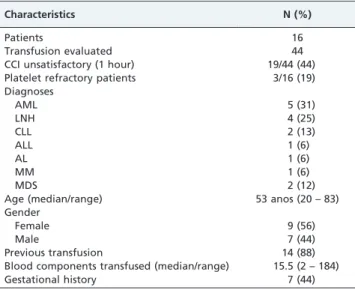
Sixteen prospective oncohematological patients were included in the study. Seven patients were male (44%) and nine were female (56%) with a median age of 53 years (range: 20 to 83 years). Fourteen patients (88%) had a history of previous transfusion and seven women (78%) had a history of previous pregnancies (median of 2.5 pregnancies; range: one to six). Regarding diagnosis, five patients had acute myelocytic leukemia, four had non-Hodgkin’s lym-phoma, two had chronic lymphocytic leukemia, one had acute lymphocytic leukemia, one had non-classified acute leukemia, one had multiple myeloma and two had myelo-dysplastic syndrome. Table 1 presents a detailed characteri-zation of the patients.
Regarding clinical condition, 50% of the patients had presented with infection in at least one episode, 31% fever, 31% moderate to severe bleeding, 19% a palpable spleen, 13% transfusion reaction, and 13% were taking amphoter-icin, 6% were taking heparin and 38% vancomycin.
Evaluation of the Transfused Platelet Concentrates A total of 44 transfusion episodes were evaluated. Of these, 28 (64%) were random donors PC, 18 of them (64%)
Table 1 -Clinical characterization of the oncohematologic patients in the present study.
Characteristics N (%)
Patients 16
Transfusion evaluated 44
CCI unsatisfactory (1 hour) 19/44 (44) Platelet refractory patients 3/16 (19) Diagnoses
AML 5 (31)
LNH 4 (25)
CLL 2 (13)
ALL 1 (6)
AL 1 (6)
MM 1 (6)
MDS 2 (12)
Age (median/range) 53 anos (20 – 83) Gender
Female 9 (56)
Male 7 (44)
Previous transfusion 14 (88)
Blood components transfused (median/range) 15.5 (2 – 184)
Gestational history 7 (44)
filtered and irradiated, four (14%) only filtered, four (14%) only irradiated, and two not filtered and not irra-diated. In 16 episodes (36%), the transfused PC were single donor apheresis (AP) and all of them were irradiated (Table 2). There was no significant difference in the number of irradiated bags for each PC type (p = 0.072). Storage time was five days or less for all PC.
Incompatible platelets according to the ABO system were used in only three transfusion episodes, all of them by apheresis (p,0.042).
Evaluation of the Response to Platelet Transfusion Unsatisfactory CCI was found in 54% of the PC transfu-sions and in 25% of the AP transfutransfu-sions. This difference was not significant (p = 0.113; Table 2).
Platelet Alloimmunization
Nine of the 16 subjects studied (56%) presented positive alloantibody results. PIFT analysis showed that eight patients (50%) presented positive results, 19% presented inconclusive results and 31% presented negative results. Median age was lower among positive individuals (50.5 years; range: 20 to 71 years) compared to negative ones (61 years; range: 36 to 83 years), but the difference was not statistically significant (p = 0.579). Also, no significant differences were observed regarding gender (p = 0.431), gestational history (p = 0.174) or transfusion history (p =
0.247) (Table 3). Of the three positive women (33%), two (29%) had a gestational history, one of them with a history of previous transfusions. In the male group, five patients (72%) had a positive PIFT result. One of them also had a positive result by the PRA-HLA test. All male patients had previous transfusion exposure (Table 3).
HLA class I PRA analysis showed positive results in three patients (19%): one male and two females. There was no significant difference between groups regarding age (p = 0.32), gender (p = 1.00), history of previous pregnancies (p = 0.55) or transfusion exposure (p = 1.00). The two positive female patients (22%) had a history of two and three pregnancies, respectively, and only one developed platelet refractoriness. The male patient had a history of 184 transfusions and was also positive by PIFT, as mentioned previously (Table 4).
Identification of Platelet Refractoriness
Platelet refractoriness was confirmed in three (19%) of the 16 patients evaluated. These patients (all of them female) presented both non-immunologic and immunologic causes (two with positive alloantibody tests and the third with an inconclusive test). The data regarding the three cases of refractoriness are presented in Table 5.
Table 2 -Description of transfusions regarding characteristics of platelet concentrates and platelet increment.
Characteristics Transfusion Episodes (N e %)
Type of PC Random Apheresis p
Number of transfusions 28 (64) 16 (36) -Units transfused (Mean¡SD) 6.96¡1.07 -
-Filtered 22 (79) -
-Irradiated 22 (79) 16 (100) 0.072 Filtered and irradiated 18 (64) - -Not filtered and not irradiated 2 (7) - -ABO incompatible 0 (0) 3 (19) 0.042 CCI unsatisfactory (1 hour) 15 (54) 4 (25) 0.113
PC = platelet concentrate; SD = standard deviation; CCI = corrected count increment.
Table 3 -Relationship between the presence of alloantibodies detected by the platelet
immunofluorescence test and demographic characteristics.
PIFT Negative
PIFT Inconclusive
PIFT Positive p
Patients; N (%) 5 (31) 3 (20) 8 (50) -Median age (range) 61 (36-83) 53 (38-67) 50.5 (20-71) 0.579 Gender; N (%)
Female 4 (44) 2 (22) 3 (33) 0.431
Male 1 (14) 1 (14) 5 (71)
Gestational history; N (%)
4 (57) 1 (14) 2 (29) 0.174
Previous transfusion; N (%)
3 (27) 1 (9) 7 (64) 0.247
PIFT = platelet immunofluorescence test.
Table 4 -Relationship between the presence of
alloantibodies detected by the panel reactive antibodies against human leukocyte antigen class I and
demographic characteristics.
PRA-HLA Negative
PRA-HLA Positive p
Patients; N (%) 13 (81) 3 (19) -Median age (range) 61 (20 – 83) 51 (48 - 53) 0.320 Gender; N (%)
Female 7 (78) 2 (22) 1.000
Male 6 (86) 1 (14)
Gestational history; N (%) 5 (71) 2 (29) 0.550 Previous transfusion; N (%) 9 (82) 2 (18) 1.000
PRA-HLA = panel reactive antibodies against human leukocyte antigen class I
Table 5 -Characterization of three patients with platelet refratactoriness.
Characteristic Patient 1 Patient 2 Patient 3
Age 67 34 48
Gestational history No Yes Yes
Previous transfusion Yes Yes No Transfusion reaction No Yes Yes
Diagnosis AML LNH AML
Bleeding No No Yes
Fever Yes Yes No
Infection identified No Yes Yes
Splenomegaly No Yes No
Use of medication
Amphotericin No Yes No
Vancomycin No Yes Yes
PIFT Inconclusive Positive Positive PRA-HLA Negative Negative Positive
DISCUSSION
Oncohematologic patients receive repeated platelet trans-fusions because of their intense and persistent thrombocy-topenia, with a consequent increased demand for PC which is not always available through hemotherapy services. This situation is even more serious when the patient develops refractoriness to the transfusion of these blood components. The frequency of refractoriness observed in the present study (19%) was close to that reported in the literature, which vary from 24% to 34%.2-4,9 Considering that the quality of the PC used may influence the transfusion response,10 a higher frequency of satisfactory increment was observed in the transfusion of PC obtained by apheresis (75%), as also reported in other studies.11,12 However, no
significant differences were observed, probably because of the small sample size. There may be variations as a result of the method used to obtain PC, type of storage solution, length of storage and the number of leukocytes present in the component.4,13,14It is also important to note that this is a prospective study carried out in a regional university hospital over fourteen months and cases of oncohematolo-gical patients are not very frequent.
The comorbidities present in the patients were those more commonly related to the lack of an adequate response to platelet transfusion. Regarding age, the median was lower among both refractory and alloimmunized individuals. Although nonsignificant, this difference was also observed in two other studies4,14and these facts have been attributed to greater immunologic activity in younger individuals and to the senescence of the immune system in the elderly.4
The sensitization of platelet and/or HLA class I antigens may occur as a result of previous pregnancies or transfu-sions. The alloantibodies produced may favor an early removal of platelets from the circulation, compromising the response to transfusion.4,14 Two of the three refractory patients had alloantibodies and a gestational history, supporting literature reports that a history of two or more pregnancies favors the development of alloantibodies and the occurrence of refractoriness.4,15 A study involving 66
females demonstrated that 58% of transfused patients with a history of pregnancy were alloimmunized, as opposed to only 23% of nulliparous patients.16 The other refractory patient had two inconclusive PIFTs suggesting alloimmu-nization with low alloantibody titers, a fact possibly related to her more advanced age4,14 since, despite no history of
pregnancy, she reported 21 previous transfusions, three of red blood cells and 18 of PC, a fact that might have contributed to her refractoriness, in addition to fever as an additional predisposing factor.
The PRA-HLA test is considered to be highly sensitive and specific for the identification of HLA class I alloanti-bodies compared to all other tests.17 Only three patients (19%) were positive to these alloantibodies. In two patients, the probable cause of immunization was the history of two and three pregnancies, respectively, as there was no long transfusion history. In the third case, the extensive transfu-sion history (about 184 PC transfutransfu-sions) of the male patient definitely favored alloimmunization, especially by exposure to non-leukocyte-depleted components. Leukocyte deple-tion removes cells that express allo-antigens, reducing the exposure to multiple HLA antigens, the number of antigen-presenting cells and patient sensitization.15 There was no
monitoring of the subsequent transfusions in this patient,
but a larger number of previous transfusions is known to be related to a smaller post-transfusion increment.4,14
The small number of anti-HLA antibodies observed in the present study may have been as a result of the leukocyte depletion of most of the previous transfusions. A study on platelet refractoriness and alloimmunization demonstrated that the routine use of leukocyte-depleted PC reduces the incidence of HLA alloimmunization in the general popula-tion from 70% to approximately 25%, and the frequency of allo-immune refractoriness from 15% to 5% among patients receiving chemotherapy when leukocytes are removed or inactivated.15
In contrast, the higher frequency of positive results obtained by the PIFT (50%) compared to the PRA-HLA test suggest alloimmunization to platelet antigens (HPA) or even to immunocomplexes or auto-antibodies because of the low specificity of the test, with labeling of nonspecific antibodies. Since there is no standardization of platelets regarding the HLA class I phenotype, this test is less sensitive for HLA class I antigens. However, in view of its rapid execution and practical nature, the PIFT is a useful tool for the investigation of alloimmunization. The presence of alloimmunization to HPA should be confirmed with more specific tests such as the Monoclonal Antibody Immobilization of the Platelets Antigens Assay (MAIPA), which was not used in the present study. However, this must not be the main cause of positive results since the literature demonstrates a lower frequency of alloimmunization to HPA than to HLA antigens.9,16 In addition, the small number of previous transfusions for males with a positive PIFT suggests a lack of correlation between PIFT results and the history of transfusion of these patients, supporting the hypothesis that at least some of these results were nonspecific. In agreement with this premise, another study has also demonstrated greater detection of alloantibo-dies by PIFT.17Although the test has low specificity, there is a lack of studies evaluating the clinical importance of the results of PIFT in cases of involvement of other alloantibodies or immunocomplexes and their influence on the response to platelet transfusion.
In general, 56% (nine) of the patients evaluated presented alloantibodies, in agreement with two previous studies that detected frequencies of 66% and 54%, respectively,18,19 although their frequencies were higher than those observed in other studies which reported frequencies of 7%, 19% and 29%.10,20,21Among the refractory individuals, the frequency of alloimmunization was 67%, whereas the literature reports frequencies of 25 and 43%16,22. Considering only alloimmu-nized individuals, the frequency of platelet refractoriness observed in the present study was 22%, whilst the TRAP15
study detected an inadequate response in 71% of the alloimmunized subjects.
However, the presence of alloantibodies is not a synonym of refractoriness and the immunosuppressed condition of these oncohematologic patients induced both by the under-lying disease and by chemotherapy should be considered.14 The small sample size limits our comparisons and the inference of statistical significance. However, we cannot rule out the relevance of a descriptive analysis of the results, especially if we consider that each patient should be evaluated in an individual manner in clinical practice.
is significantly associated with a low platelet increment.4,14 In this case, refractoriness was transient as the CCI became satisfactory on the third episode evaluated, when the patient no longer had fever.
Refractory patient 2 presented five different clinical complications (fever, infection, splenomegaly and the use of amphotericin B and vancomycin) and showed alloanti-body positivity only by PIFT. It is possible that all of these concomitant conditions affected the transfusion response. Also, considering the lack of specificity of the PIFT, we still do not know if, in this case, the transfusion response was impaired only by the clinical conditions.
Refractory patient 3 had important and persistent transva-ginal bleeding and infection and had been using vancomycin for some periods of time; three conditions known to influence the transfusion response in a negative manner.4,14,15It is still uncertain whether hemorrhagic complications interfere directly in terms of an unsatisfactory response to platelet transfusion.4,23,24 In addition, an important factor was alloantibody positivity determined by both PIFT and PRA-HLA, which certainly contributed to refractoriness.
Other studies have shown that the main patient-related factors that influence the efficacy of transfusion in a negative manner are: alloantibody positivity, at least two pregnancies, fever, infection, use of drugs such as ampho-tericin B and heparin, and bleeding.4,15,22
Kurz et al. observed that 70% of refractory oncohemato-logic patients presented clinical conditions or were using drugs known to affect CCI. In 52% of cases, refractoriness was associated with infection and most patients had alloantibodies against platelets25. The production of alloan-tibodies can be stimulated during an infectious episode,26 leading us to question whether this mechanism may be related to the more frequent occurrence of refractoriness in patients with infections.
Oncohematologic patients typically have clinical condi-tions and use medicacondi-tions that can interfere with the response to platelet transfusion.25The conditions observed in the three cases of refractoriness were those most commonly reported in the literature,4,15,22emphasizing the
importance of determining the causes of refractoriness in these patients as well as the presence of alloantibodies.
CONCLUSION
The present results demonstrate that alloimmunization and platelet refractoriness are not uncommon and that each patient should be assessed with particular attention to the immunologic and non-immunologic causes of these condi-tions. Blood services must be made aware of the importance of the development of measures that will prevent alloimmu-nization and permit the correct identification of refractoriness and adequate transfusion support for oncohematologic patients in order to guarantee the prevention and treatment of hemorrhagic events common in these patients.
ACKNOWLEDGMENTS
We thank Irene Gyongyver H. Lorand Metze for the availability of the Laboratory of Cell Markers in Blood Center at UNICAMP and Fernanda Gonc¸alves Pereira Cunha for the performing flow cytometry assay.
FUNDING
This work was supported by the Fundac¸a˜o de Amparo a` Pesquisa de Minas Gerais - FAPEMIG (Proc. EFP_00001463) and by the
Fundac¸a˜o Centro de Hematologia e Hemoterapia de Minas Gerais -HEMOMINAS.
REFERENCES
1. Schiffer CA, Anderson KC, Bennett CL, Bernstein S, Elting LS, Goldsmith M, et al. Platelet transfusion for patients with cancer: clinical practice guidelines of the American Society of Clinical Oncology. J Clin Oncol. 2001;19:1519-38.
2. Legler TJ, Fischer I, Dittmann J, Simson G, Lynen R, Humpe A, et al. Frequency and causes of refractoriness in multiply transfused patients. Annals of Hematology. 1997;74:185-189, doi: 10.1007/s002770050280. 3. Novotny VMJ. Prevention and management of platelet transfusion
refractoriness. Vox Sang. 1999;76:1-13, doi: 10.1046/j.1423-0410.1999. 7610001.x.
4. Slichter SJ, Davis K, Enright H, Braine H, Gernsheimer T, Kao K, et al. Factors affecting post-transfusion platelet increments, platelet refractori-ness, and platelet transfusion intervals in thrombocytopenic patients. Blood. 2005;105:4106-14, doi: 10.1182/blood-2003-08-2724.
5. Cameron B, Rock G, Olberg B, Neurath D. Evaluation of platelet transfusion triggers in a tertiary-care hospital. Transfusion. 2007;47:206-211, doi: 10.1111/j.1537-2995.2007.01090.x.
6. Shehata N, Tinmouth A, Naglie G, Freedman J, Wilson K. ABO-identical versus nonidentical platelet transfusion: a systematic review. Transfusion 2009;49:2442-53, doi: 10.1111/j.1537-2995.2009.02273.x. 7. Delaflor-Weiss E, Mintz PD. The evaluation and management of platelet
refractoriness and alloimmunization. Transfus Med Rev. 2002;14:180-96, doi: 10.1016/S0887-7963(00)80007-3.
8. Tinmouth AT, Semple E, Shehata N, Branch DR. Platelet immunopathol-ogy and therapy: a Canadian Blood Services Research and Development Symposium. Transfus Med Rev. 2006;20:294-314, doi: 10.1016/j.tmrv. 2006.05.008.
9. Fabris F, Soini B, Sartori R, Randi ML, Luzzatto G, Girolami A. Clinical and laboratory factors that affect the post-transfusion platelet increment. Transf Sci. 2000;23;63-8.
10. Novotny VMJ, Van Doorn R, Witvliet MD, Claas FHJ, Brand A. Occurrence of allogeneic HLA and non-HLA antibodies after transfusion of prestorage filtered platelets and red blood cells: a prospective study. Blood. 1995;85:1736-41.
11. Arnold DM, Heddle NM, Kulczycky M, Carruthers J, Sigouin C, Blajchman MA. In vivo recovery and survival of apheresis and whole blood-derived platelets: a paired comparison in healthy volunteers. Transfusion. 2006;46:257-64, doi: 10.1111/j.1537-2995.2006.00709.x. 12. Thon JN, Schubert P, Devine DV. Platelet Storage Lesion: A new
understanding from a proteomic perspective. Transfus Med Rev. 2008;22:268-279, doi: 10.1016/j.tmrv.2008.05.004.
13. Maurer-Spurej E, Chipperfield K. Past and future approaches to assess the quality of platelets for transfusion. Transfus Med Rev; 2007;21:295-306, doi: 10.1016/j.tmrv.2007.05.005.
14. Heim D, Passweg J, Gregor M, Buser A, Theocharides A, Arber C, et al. Patient and product factors affecting platelet transfusion results. Transfusion. 2008;48:681-7, doi: 10.1111/j.1537-2995.2007.01613.x. 15. The Trial To Reduce Alloimmunization To Platelets Study Group.
Leukocyte reduction and ultraviolet B irradiation of platelets to prevent alloimmunization and refractoriness to platelet transfusions. N Engl J Med. 1997;337:1861-9.
16. Kiefel V, Konig C, Kroll H, Santoso S. Platelet alloantibodies in transfused patients. Transfusion. 2001; 41:766-770, doi: 10.1046/j.1537-2995.2001.41060766.x.
17. Fontao-Wendel R, Silva LC, Saviolo CB, Primavera B, Wendel S. Incidence of transfusion-induced platelet-reactive antibodies evaluated by specific assays for the detection of human leucocyte antigen and human platelet antigen antibodies. Vox Sang. 2007;93:241-9, doi: 10. 1111/j.1423-0410.2007.00958.x.
18. Bajpai M, Kaura B, Marwaha N, Kumari S, Sharma RR, Agnihotri SK. Platelet alloimmunization in multitransfused patients with haemato-oncological disorders. Natl Med J India. 2005;18:134-6.
19. Kurz M, Knobl P, Kahls P, Greinix HT, Hocker P, Panzer S. Platelet-reactive HLA antibodies associated with low posttransfusion platelet increments: a comparison between the monoclonal antibody-specific immobilization of platelet antigens assay and the lymphocytotoxicity test. Transfusion. 2001; 41:771-4, doi: 10.1046/j.1537-2995.2001.41060771.x. 20. Nanu A, Taneja A. Alloimmunization to platelet transfusions in the India
patients. Indian J Med Res. 1992;96:112-4.
21. Arruda DMM, Silva SFR, Silva SL, Pitombeira MH, Campos HH, Mota RMS, et al. Aloimmunity against HLA class I antigens in patients with myelodisplastic syndrome and aplastic anemia. Rev Bras Hematol Hemot. 2008;30:18-23.
23. Nevo S, Enger C, Swan V, Wojno KJ, Fuller AK, Altomonte V, et al. Acute bleeding after allogeneic bone marrow transplantation: association with graft versus host disease and effect on survival. Transplantation. 1999;67:681-9, doi: 10.1097/00007890-199903150-00007.
24. Kerkhoffs JL, Eikenboom JC, van deWatering LM, van Wordragen-Vlaswinkel RJ, Wijermans PW, Brand A. The clinical impact of platelet refractoriness: correlation with bleeding and survival. Transfusion. 2008;48:1959-65, doi: 10.1111/j.1537-2995.2008.01799.x.
25. Kurz M, Greinix H, Hocker P, Kalhs P, Kno¨bl P, Mayr WR, et al. Specificities of antiplatelet antibodies in multitransfused patients with haemato-oncological disorders. Br J Haematol. 1996; 95:564-9.