Eliane Viana Mancuzo1, Walace Espada da Silva2, Nilton Alves de Rezende3
Abstract
Objective: To analyze the spirometry findings in patients undergoing bone marrow transplant, determining the importance of such findings in predicting postoperative pulmonary complications and looking for correlations with postoperative outcomes. Methods: The spirometry findings in 120 male and female patients, all above the age of 12, were evaluated retrospectively and compared in terms of the following parameters: the type of bone marrow transplant; the underlying disease; cytomegalovirus serology; source of the transplanted cells; smoking; pulmonary infection; history of lung disease; duration of the hematological disease; chemotherapy employed; conditioning regimen; acute or chronic rejection of the transplant; and post-operative mortality. Results: In the pre-operative spirometry, 16 patients (13.3%) presented alterations: 6 (5%) presented pure obstruction; 7 (5.8%) presented pure restriction; and 3 (2.5%) presented obstruction accompanied by a reduction in vital capacity. In the post-operative spirometry, 29 patients (24.2%) presented alterations. The chance of presenting post-opera-tive spirometric alterations was greater in patients presenting acute transplant rejection (p = 0.02), patients older than 30 (p = 0.02), female patients (p = 0.02) and patients receiving stem cells (p = 0.01). Having a history of lung disease was found to be associated with greater mortality, as was suffering from chronic transplant rejection. No relationship was found between pre-operative spirometric alterations and post-operative mortality. Conclusion: In bone marrow transplant patients, the alterations found through pre-operative spirometry were not predictive of post-operative pulmonary complications or mortality. Nor were such alterations determinant of whether or not a given patient was a good candidate for bone marrow transplant. Simple spirometry seems to be of little practical importance in the evaluation of such patients.
Keywords: Spirometry; Bone marrow transplantation/adverse effects; Bone marrow transplantation/mortality.
*Study carried out at the Universidade Federal de Minas Gerais (UFMG, Federal University of Minas Gerais) School of Medicine – Belo Horizonte (MG) Brazil. 1. Physician in the Pulmonology Department of the Universidade Federal de Minas Gerais (UFMG, Federal University of Minas Gerais) Hospital das Clínicas – Belo Horizonte (MG) Brazil.
2. Medical Student at the Universidade Federal de Minas Gerais (UFMG, Federal University of Minas Gerais) – Belo Horizonte (MG) Brazil. 3. Adjunct Professor of the Clinical Medicine Department at the Universidade Federal de Minas Gerais (UFMG, Federal University of Minas Gerais) – Belo Horizonte (MG) Brazil.
Correspondence to: Professor Nilton Alves de Rezende. Departamento de Clínica Médica da Faculdade de Medicina da UFMG. Al. Alfredo Balena, 190, CEP 30130-100, Belo Horizonte, MG, Brasil. E-mail: [email protected]
Introduction
Pulmonary complications constitute an important cause of morbidity and mortality after bone marrow transplant (BMT).(1) The use of pulmonary function
tests (PFTs) in pre-operative evaluation and post-operative monitoring, together with the identification of post-operative non-infectious complications, might allow the adoption of early preventive and therapeutic measures in patients at high risk.(2)
The main pulmonary functional alterations seen after BMT are as follows: obstructive ventilatory defects, which are characterized by reduced forced expiratory volume in the first second (FEV1) and a lower ratio between FEV1 and forced vital capacity (FVC), bronchiolitis obliterans being the pulmonary complication that results in the worst post-BMT prognosis; restrictive ventilatory defects, which are defined as a reduction in total lung capacity (TLC) and in vital capacity, with the FEV1/FVC ratio and
the ratio of forced expiratory flow between 25% and 75% of FVC to FVC (FEF25-75/FVC) both being either preserved or elevated, the most common factors asso-ciated with this condition after BMT being thoracic irradiation, pulmonary toxic chemotherapy, infections, idiopathic pneumonia, and graft-versus-host disease (GVHD); obstructive ventilatory defects with reduced FVC (in this case, the reduced FVC might be due only to the obstructive process or to associated restrictive process, and TLC measurement is necessary in order to make the diagnosis); mixed ventilatory defects, in which obstruction is accompanied by restriction, as determined by measuring TLC (among BMT patients, we might find some with bronchiolitis obliterans who develop concomitant pulmonary fibrosis); reduc-tion in the diffusing capacity of the lung for carbon monoxide (DLCO), which is the most common func-tional abnormality, occurring in approximately 50% of the patients, the risk factors being the same as those for restrictive ventilatory defects.(1-8)
Since the implementation of the BMT Clinic at the Hospital das Clínicas da Universidade Federal de Minas Gerais (HC-UFMG, Federal University of Minas Gerais Hospital das Clínicas) in July of 1995, simple spirometry with bronchodilator test is routinely performed in the evaluation of pre-opera-tive pulmonary function and in the monitoring of post-operative patients. Despite having been performed for over ten years, it is not exactly known how important these tests are in the early detection
and in the adoption of preventive or therapeutic measures in the treatment of post-BMT pulmonary complications. Therefore, the analysis of the progress of patients submitted to BMT at the HC-UFMG and undergoing pre-operative/post-operative spirometry might be important and could permit the adoption of new protocols for the evaluation of pulmonary function in this population.
Methods
This was a retrospective study in which we analyzed the medical charts of all patients submitted to BMT at the HC-UFMG in the period from July of 1995 to January of 2004. We included all patients over 12 years of age, of either gender, in spirom-etry results were obtained before and (at least once) following the BMT (after post-transplant day 100).
The spirometry tests were performed in the HC-UFMG Pulmonary Function Laboratory using a Collins spirometer with a universal respiratory valve (DS11a; Warren E. Collins, Inc., Braintree, MA, USA) and a Koko spirometer (92494; Ferraris Respiratory Europe, Hertford, UK). The volume-time and the flow-volume curves were obtained following the norms established in the Brazilian Thoracic Society Pulmonary Function Test Guidelines.(8) All spirometry test curves were
reviewed by the authors of this study.
The spirometry findings (vital capacity, FVC, FEV1/FVC, and the FEF25–75/FVC and FVC) were the variables of principal interest. The test results were classified as normal, obstructive, restrictive, or obstructive with a reduction in vital capacity.(8)
For this classification, we used the reference table devised by Pereira et al.(7) for male patients over
24 years of age and female patients over 20 years of age. For the remaining patients, those presenting values below 80% of the normal reference value were considered altered.(9) The independent
vari-ables analyzed were as follows: gender; age; the underlying diagnosis; cytomegalovirus serology of the donor and receptor; source of cells for the BMT; smoking; the use of pre-BMT chemotherapy; history of lung disease; pre- and post-BMT lung infection; duration of hematological disease; conditioning regimen used; use of total body irradiation (TBI); acute or chronic GVHD of the skin, mouth, eyes, liver, intestines, or lung; and mortality (defined as death at any time after post-transplant day 100).
toxic reaction to chemotherapy: hydroxyurea, cytosine arabinoside, daunorubicin, cyclophos-phamide, busulfan, bleomycin, methotrexate and cyclosporine.(1,10-13)
The information collected was entered into a data-base developed using the Epi Info program, version 6.04 (Centers for Disease Control and Prevention – CDC – Atlanta, GA, USA, public domain). The vari-ables presenting p ≤ 0.25 in the univariate analysis (chi-square test or Fisher’s exact test) were included in a logistic regression model, in which it was consid-ered that p < 0.05 indicated, in an independent manner, a statistically significant association.
The study design was approved by the UFMG Ethics in Research Committee (Process no. ETIC 43904, 17 November 2004).
Results
Of the 368 patients whose charts were analyzed, 134 did not undergo the post-transplant spirom-etry, 95 died before post-transplant day 100 and therefore also were not submitted to a second spirometry test, and 19 were excluded for being younger than 12 years of age at the time of the transplant. Therefore, 120 patients met the inclu-sion criteria and were included in this study. Of those 120, 52 (43%) were below the age of 30. The distribution of the sample was similar for both genders. The mortality rate was 10%. As to the diag-nosis of the underlying disease, 50% suffered from chronic myeloid leukemia. There were 24 patients who were smokers (20%), and 89 were submitted to pre-BMT chemotherapy (74%). Pre-BMT pulmonary infection was observed in three patients (2.5%). In 60 patients (50%), the underlying disease had been diagnosed less than a year prior to the BMT. None of the patients were submitted to TBI.
In this study sample, all of the transplants were allogeneic. Approximately one-third of the patients presented acute GVHD (at least one site), and two-thirds presented chronic GVHD. Post-BMT pulmonary infection occurred in 22.5% of the patients. Over 90% of the patients and donors tested positive for cytomegalovirus and had been treated with a conditioning regimen that included busulfan and cyclophosphamide (Table 1). Before the trans-plant, 16 patients (13.3%) presented spirometric alterations, and this number rose to 29 patients (24%) by post-transplant day 100 (Table 2).
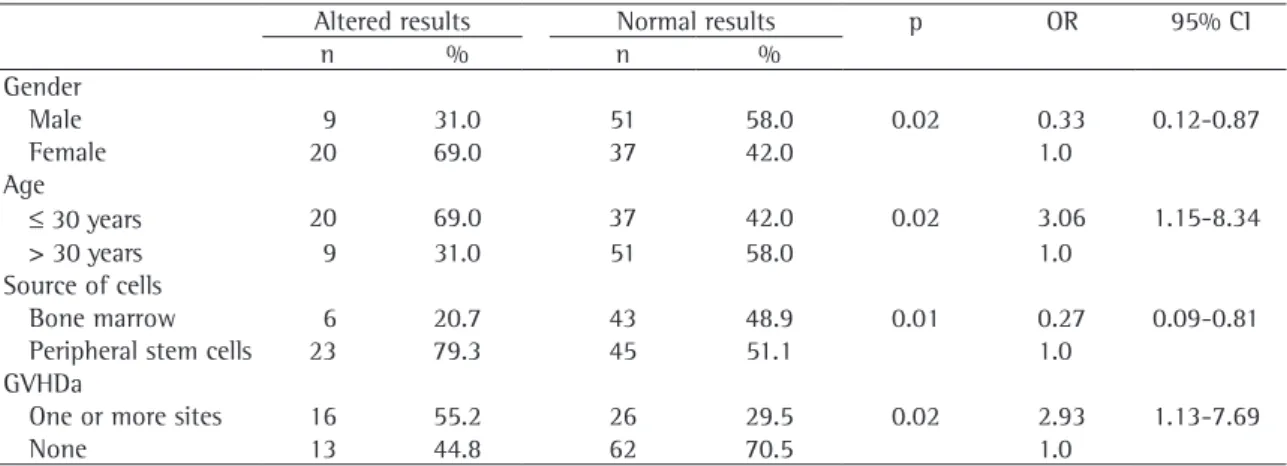
In the univariate analysis, the patients who had acute GVHD at one or more sites, were ≤ 30 years of age and were female had greater chances of presenting altered spirometry results on post-trans-plant day 100. Receiving peripheral stem cells also presented a statistical tendency toward an association with altered spirometry results (Table 3). A history of lung disease was statistically associated with higher post-operative mortality, and developing chronic
Table 2 - Results of spirometry before and after bone marrow transplant.
Pre-transplant
Post-transplant
day 100
One year after transplant
n % n % n %
Normal 104 86.7 88 73.3 20 16.7 Obstruction 6 5.0 10 8.3 8 6.7 Restriction 7 5.8 12 10.0 0 0.0 Obstruction with
reduction of FVC
3 2.5 7 5.8 6 5.0
Without tests 0 0.0 3 2.5 86 71.7 FVC: forced vital capacity.
Table 1 - Characteristics of bone marrow transplant and post-operative complications.
Characteristics n %
Type of transplant
Allogeneic 120 100.0
Prophylaxis for GVHD
Cyclosporine + methotrexate 119 99.2
Other* 1 0.8
Source of cells
Bone marrow 51 42.5
Stem cells 69 57.5
Conditioning regimen
Busulfan + cyclophosphamide 108 90.0
Other** 12 10.0
Post-operative complications GVHDa
Lung 0 0.0
One or more sites 44 36.7 GVHDc
Lung 8 6.7
One or more sites 80 66.7 Post-operative pulmonary infection
Yes 27 22.5
No 93 77.5
Table 3 - Comparison between post-transplant day 100 spirometry results and independent variables.
Altered results Normal results p OR 95% CI
n % n %
Gender
Male 9 31.0 51 58.0 0.02 0.33 0.12-0.87
Female 20 69.0 37 42.0 1.0
Age
≤ 30 years 20 69.0 37 42.0 0.02 3.06 1.15-8.34
> 30 years 9 31.0 51 58.0 1.0
Source of cells
Bone marrow 6 20.7 43 48.9 0.01 0.27 0.09-0.81
Peripheral stem cells 23 79.3 45 51.1 1.0
GVHDa
One or more sites 16 55.2 26 29.5 0.02 2.93 1.13-7.69
None 13 44.8 62 70.5 1.0
GVHDa: acute graft-versus-host disease; OR: odds ratio; 95% CI: 95% confidence interval.
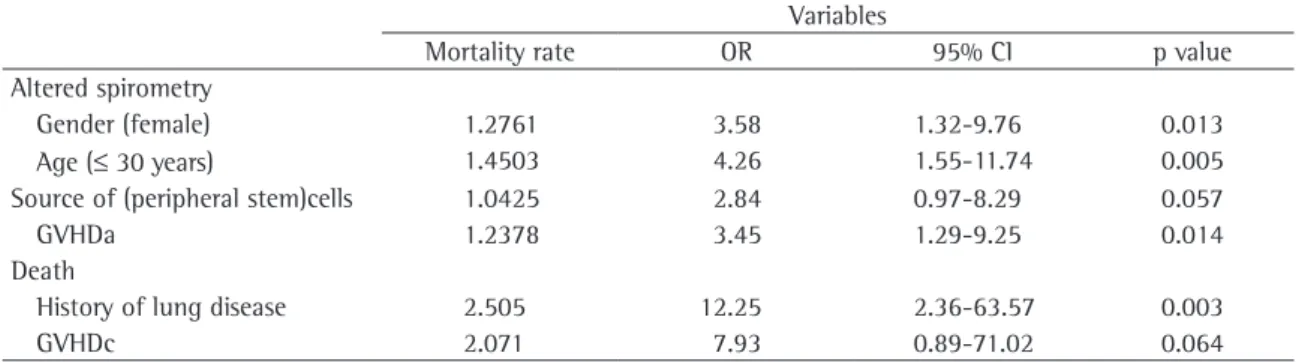
GVHD at one or more sites also presented a statis-tical tendency toward an association with higher mortality. The remaining independent variables analyzed did not show any statistical significance in relation to mortality (Table 4). In the multivar-iate analysis, it was determined that the chances of presenting altered spirometry results by post-trans-plant day 100 were greater for female patients aged 30 years or less, as well as for patients who had acute GVHD, than for the remaining patients. For all patients, a history of lung disease was the only vari-able associated with post-operative death in such patients (Table 5).
Discussion
In the international literature, as well as in the protocols of various health care facilities at which BMTs are performed, it is recommended that PFTs be conducted before the transplant and during the post-transplant follow-up period(14-20). The
argu-ment for doing these tests is that they are important for the diagnosis of post-operative non-infectious pulmonary complications and for the adoption of therapeutic measures and the consequent increase in patient survival.(1,2,4,10) However, this aspect
could not be demonstrated in our study. It is of note, however, that, of the 368 patients submitted to BMT at the HC-UFMG in the period under study, only 120 were analyzed, which might have affected the results of our research. Nevertheless, in a systematic review of the literature, we found that the majority of such studies have had small samples (of less than 100 patients).(14) We should
also mention the limitations of our study, which used the retrospective review of patient charts as a source of data and only evaluated spirometry find-ings, whereas the most important studies registered in the literature evaluated spirometry findings, TLC and the DLCO.(1,4,12-14,19,21)
The pulmonary function disorders seen in BMT patients are classically divided into obstructive defects, restrictive defects, and alterations in the DLCO, the last being the most commonly observed alteration.(1,4) The studies do not mention
obstruc-tion accompanied by a reducobstruc-tion in FVC. In our study, we observed that some patients, before and after the transplant, presented obstructive ventila-tory defect with reduced FVC. Since the TLC was not routinely measured, it was not possible to analyze whether the reduced FVC observed in these patients was caused by concomitant restriction or by air trapping. The protocol of the BMT Clinic of the HC-UFMG does not include routine measurement of the DLCO, thereby preventing its analysis.
The use of TBI is an important risk factor for PFT alterations before and after BMT.(2,13,15-18) In
this study, no patient received TBI before the trans-plant. This fact might have decreased the chances of pulmonary function alterations before and after the transplant. Some authors also reported post-transplant alterations in DLCO and TLC in patients submitted to TBI.(18,19)
complica-tions most frequently described in the literature, such as bronchiolitis obliterans, severe airflow obstruction, and post-operative infection.(20-25) Two recent studies
reported pre-operative pulmonary function alterations related to post-operative complications.(4,24) In those
studies, it was observed that an FEV1/FVC ratio lower
than 80% was related to a two-times greater risk of post-operative airflow obstruction. In our study, this aspect was not observed, which is in agreement with the findings of other authors who also found no asso-ciation between pre-operative functional alterations and post-operative complications.(26)
In the analysis of the risk factors associated with post-operative pulmonary alterations, we identified significant associations between such alterations and acute GVHD. This finding is in accordance with the literature, which shows a higher frequency of interstitial pneumonia in patients with acute GVHD.(13,19) Similarly, other authors reported acute
GVHD and chronic GVHD to be risk factors for alterations in post-BMT spirometry. However, those authors reported that this complication occurs predominantly in patients who are over 60 years of age,(24,27) unlike our study, in which being 30 years
of age or younger was the variable most frequently related to post-BMT functional alterations. In only one previously published study, age above 8 years was demonstrated as the only risk factor associ-ated with altered post-operative PFT.(28) It should
be noted that very young children are not able to perform spirometry in a satisfactory manner. Since we did not include patients below 12 years of age, this variable could not be compared with the find-ings in the literature.
Female patients presented a greater chance of presenting alterations in post-operative spirometry. Other authors also found an association between PFT alterations and being female.(29) However,
Table 4 - Risk of death among independent variables.
Death Survival p OR IC 95%
n % n %
Previous chemotherapy
Yes 10 83.3 81 75.0 0.72 1.67 0.31-11.9
No 2 16.7 27 25.0
History of lung disease
Yes 4 33.3 5 4.6 < 0.01 10.3 1.82-59.5
No 8 66.7 103 95.4 1.0
Pulmonary toxic reaction to chemotherapy
Did not use 2 16.7 28 25.9 1.0
Hydroxyurea 5 41.7 56 51.9 1.0 1.25 0.20-10.0
Other* 5 41.7 24 22.2 0.25 2.92 0.44-24.15
GVHDa
One or more sites 4 33.3 40 37.4 1.0 0.84 0.19-3.38
None 8 66.7 67 62.6 1.0
Spirometry at admission
Altered 2 16.7 14 13.0 0.67 1.34 0.00-7.79
Normal 10 83.3 94 87.0 1.0
Spirometry on post-transplant day 100
Altered 4 33.3 25 23.8 0.48 1.60 0.36-6.66
Normal 8 66.7 80 76.2 1.0
GVHDc
One or more sites 11 91.7 69 63.9 0.06 6.22 0.77-135.9
None 1 8.3 39 36.1 1.0
Post-BMT pulmonary infection
Yes 5 41.7 22 20.4 0.14 2.79 0.68-11.27
No 7 58.3 86 79.6 1.0
those authors found alterations only in the DLCO, a parameter not analyzed in our study.
In our analysis, we observed a tendency toward an association between post-operative spirometry alteration and having received peripheral stem cells for the transplant. Patients who receive stem cells have greater chances of GVHD(30) and, therefore, of
PFT alterations. However, to our knowledge, this association has yet to be described in the literature.
Although there are several reports of drug-related pulmonary toxicity and its relationship with PFT alterations,(2,12-13,19,21) we were unable to
demon-strate such an association in the present study. It is important to emphasize that many patients evalu-ated in our study did not undergo the spirometry test on post-transplant day 100, which might have jeopardized the analysis of the results.
Twelve patients (10%) died. We found no significant association between altered spirometry findings (pre- or post-operative) and mortality. This is in accordance with the results obtained by some authors, who also found no increase in fatal pulmo-nary complications.(3,12) However, in one of those
studies, DLCO lower than 80% and alveolar-arte-rial gradient higher than 20 mmHg were associated with higher mortality. The same authors, in another study, observed that restrictive defects or a reduc-tion greater than 15% in TLC at three months after the transplant were associated with a greater risk of death.(21)
The specific characterization of a history of lung disease can not be defined, since it was not included in the treatment protocol of most patients. The fact that these patients did not present altered spirom-etry findings can be explained, at least partially, by
Table 5 - Model of logistic regression for altered post-transplant day 100 spirometry findings and mortality. Variables
Mortality rate OR 95% CI p value
Altered spirometry
Gender (female) 1.2761 3.58 1.32-9.76 0.013
Age (≤ 30 years) 1.4503 4.26 1.55-11.74 0.005
Source of (peripheral stem)cells 1.0425 2.84 0.97-8.29 0.057
GVHDa 1.2378 3.45 1.29-9.25 0.014
Death
History of lung disease 2.505 12.25 2.36-63.57 0.003
GVHDc 2.071 7.93 0.89-71.02 0.064
GVHDa: acute graft-versus-host disease; GVHDc: chronic graft-versus-host disease; OR: odds ratio; 95% CI: 95% confidence interval.
the absence of measurement of the absolute pulmo-nary volumes and of the DLCO, which are more sensitive methods for diagnosing pulmonary func-tion alterafunc-tions. However, a history of lung disease was associated with post-operative mortality. This aspect reinforces the need to thoroughly analyze pulmonary function characteristics in patients who are candidates for BMT, since a significant asso-ciation between pulmonary problems and higher post-BMT mortality has been reported.(24) In that
study, the mortality rate reported for patients with airflow obstruction was 9% in three years, 12% in five years, and 18% in ten years.
Despite the considerable knowledge of pulmonary function alterations and pulmonary complications in patients submitted to BMT, the alterations in pre-BMT spirometry findings were not considered a contraindication to performing the procedure. Altered spirometry findings before BMT was not related to an increase in post-operative pulmonary complications. Despite the increase in post-BMT spirometric alterations, it was not possible to demonstrate that these alterations modified the evolution of the patients. It is noteworthy that, in the present study, altered DLCO, the complication most frequently found in BMT patients, was not analyzed. Therefore, spirometry, accompanied by the measurement of DLCO and TLC, should be eval-uated in prospective studies so that these important tests can be effectively incorporated into the pre- and post-BMT evaluation process.
Acknowledgments
do Brasil (CNPq, National Council for Scientific and Technological Development in Brazil) and the Comissão de Aperfeiçoamento Permanente de Ensino Superior (CAPES, Coordination of the Advancement of Higher Education) for providing financial support for this study.
References
1. Marras TK, Szalai JP, Chan CK, Lipton JH, Messner HA, Laupacis A. Pulmonary function abnormalities after allogeneic marrow transplantation: a systematic review and assessment of an existing predictive instrument. Bone Marrow Transplant. 2002;30(9):599-607.
2. Marras TK, Chan CK, Lipton JH, Messner HA, Szalai JP, Laupacis A. Long-term pulmonary function abnormalities and survival after allogenic marrow transplantation. Bone Marrow Transplant. 2004;33(5):509-17.
3. Ratanatharathorn V, Ayash L, Lazarus HM, Fu J, Uberti JP. Chronic graft-versus-host disease: clinical manifestation and therapy. Bone Marrow Transplant. 2001;28(2):121-9. 4. Chien JW, Madtes DK, Clark JG. Pulmonary function testing
prior to hematopoietic stem cell transplantation. Bone Marrow Transplant. 2005;35(5):429-35.
5. Cerveri I, Zoia MC, Fulgoni P, Corsico A, Casali L, Tinelli C, Zecca M, Giorgiani G, Locatelli F. Late pulmonary sequelae after childhood bone marrow transplantation. Thorax. 1999;54(2):131-5.
6. Nenadov Beck M, Meresse V, Hartmann O, Gaultier C. Long-term pulmonary sequelae after autologous bone marrow transplantation in children without total body irradiation. Bone Marrow Transplant. 1995;16(6):771-5.
7. Pereira CAC, Barreto SP, Simões JG, Pereira FWL, Gerstler JG, Nakatani J. Valores de referência para espirometria em uma amostra da população brasileira adulta. J Pneumol. 1992;18(1):10-22.
8. Sociedade Brasileira de Pneumologia e Tisiologia. Diretrizes para testes de função pulmonar. J Pneumol. 2002;28(3):1-221.
9. Knudson RJ, Lebowitz MD, Hgolberg CJ, Burrows B. Changes in the normal maximal expiratory flow-volume curve with growth and aging. Am Rev Respir Dis. 1983;127(6):725-34. 10. Quintas-Cardama A, Perez-Encinas M, Gonzalez S,
Bendana A, Bello JL. Hydroxyurea-induced acute interstitial pneumonitis in a patient with essential thrombocythemia. Ann Hematol. 1999;78(4):187-8.
11. Morgan M, Dodds A, Atkinson K, Szer J, Downs K, Biggs J. The toxicity of busulphan and cyclophosphamide as the preparative regimen for bone marrow transplantation. Br J Haematol. 1991;77(4):529-34.
12. Crawford SW, Petersen FB. Long-term survival from respiratory failure after marrow transplantation for malignancy. Am Rev Respir Dis. 1992;145(3):510-4.
13. Sutedja TG, Apperley JF, Hughes JM, Aber VR, Kennedy HG, Nunn P, Jones L, Hopper L, Goldman JM. Pulmonary function after bone marrow transplantation for chronic myeloid leukaemia. Thorax. 1988;43(3):163-9.
14. Mancuso EV, Rezende NA. [Pulmonary function testing in bone marrow transplantation: a systematic review] Rev Port Pneumol. 2006;12(1):61-9. Portuguese.
15. Ghalie R, Szidon JP, Thompson L, Nawas YN, Dolce A, Kaizer H. Evaluation of pulmonary complications after bone marrow transplantation: the role of pretransplant pulmonary function tests. Bone Marrow Transplant. 1992;10(4):359-65. 16. Little MT, Storb R. History of hematopoeitic stem-cell
transplantation. Nat Rev Cancer. 2002;2(3):231-8. 17. Carlson K, Backlund L, Smedmyr B, Oberg G, Simonsson
B. Pulmonary function and complications subsequent to autologous bone marrow transplantation. Bone Marrow Transplant. 1994;14(5):805-11.
18. Gore EM, Lawton CA, Ash RC, Lipchik RJ. Pulmonary function changes in long-term survivors of bone marrow transplantation. Int J Radiat Oncol Biol Phys. 1996;36(1):67-75.
19. Badier M, Guillot C, Delpierre S, Vanuxem P, Blaise D, Maraninchi D. Pulmonary function changes 100 days and one year after bone marrow transplantation. Bone Marrow Transplant. 1993;12(5):457-61.
20. Kotloff RM, Ahya VN, Crawford SW. Pulmonary complications of solid organ and hematopoietic stem cell transplantation. Am J Respir Crit Care Med. 2004;170(1):22-48.
21. Crawford SW, Pepe M, Lin D, Benedetti F, Deeg HJ. Abnormalities of pulmonary function tests after marrow transplantation predict nonrelapse mortality. Am J Respir Crit Care Med. 1995;152(2):690-5.
22. Clark JG, Hansen JA, Hertz MI, Parkman R, Jensen L, Peavy HH. NHLBI workshop summary. Idiopathic pneumonia syndrome after bone marrow transplantation. Am Rev Respir Dis. 1993;147(6 Pt 1):1601-6.
23. Kantrow SP, Hackman RC, Boeckh M, Myerson D, Crawford SW. Idiopathic pneumonia syndrome: changing spectrum of lung injury after marrow transplantation. Transplantation. 1997;63(8):1079-86.
24. Chien JW, Martin PJ, Gooley TA, Flowers ME, Heckbert SR, Nichols WG, Clark JG. Airflow obstruction after myeloablative allogeneic hematopoietic stem cell transplantation. Am J Respir Crit Care Med. 2003;168(2):208-14.
25. Santo Tomas LH, Loberiza FR Jr, Klein JP, Layde PM, Lipchik RJ, Rizzo JD, Bredeson CN, Horowitz MM. Risk factors for bronchiolitis obliterans in allogeneic hematopoietic stem-cell transplantation for leukemia. Chest. 2005;128(1):153-61.Chest. 2005;128(1):153-61. Erratum in: Chest. 2006;129(1):216.
26. Schwarer AP, Hughes JM, Trotman-Dickenson B, Krausz T, Goldman JM. A chronic pulmonary syndrome associatedA chronic pulmonary syndrome associated with graft-versus-host disease after allogeneic marrow transplantation. Transplantation. 1992;54(6):1002-8. 27. Schultz KR, Green GJ, Wensley D, Sargent MA, Magee JF,
Spinelli JJ, Pritchard S, Davis JH, Rogers PC, Chan KW, et al. Obstructive lung disease in children after allogeneic bone marrow transplantation. Blood. 1994;84(9):3212-20. 28. Leneveu H, Bremont F, Rubie H, Peyroulet MC, Broue A,
Suc A, Robert A, Dutau G. Respiratory function in children undergoing bone marrow transplantation. Pediatr Pulmonol. 1999;28(1):31-8.
29. Nysom K, Holm K, Hesse B, Ulrik CS, Jacobsen N, Bisgaard H, Hertz H. Lung function after allogeneic bone marrow transplantation for leukaemia or lymphoma. Arch Dis Child.Arch Dis Child. 1996;74(5):432-6.