FREE THEMES
1 Instituto Nacional de Saúde da Mulher, Criança e Adolescente Fernandes Figueira, Fiocruz. Av. Rui Barbosa 716, Flamengo. 22250-020 Rio de Janeiro RJ Brasil.
[email protected] 2 Escola Nacional de Saúde Pública Sergio Arouca, Fiocruz. Rio de Janeiro RJ Brasil.
The process of defining the hospital care profile
in federal hospitals in the city of Rio de Janeiro, Brazil
Abstract This article analyzes the process of shaping the care profile of federal hospitals in the city of Rio de Janeiro. This is a qualitative, descriptive study that draws on semi-structured interviews with hospital administrators. Data analysis used the Collective Subject Discourse ap-proach. Managers believe this process is the result of a set of emerging strategies, proposals and need for change, which result in adaptive reactions that hospitals develop with no coordination between them to resolve problems identified by profession-als and managers. The process is analyzed much more from a political point of view than from a rational and systemic one. Some of the experi-ence with the hospital mission, such as the focus on a strategic approach, already signals a more collegiate approach to defining the profile of care, where the hospital is one component of an inte-grated network of services, with a decision process that is less incremental and more integrating.
Key words Healthcare planning, Hospital
ad-ministration, Healthcare service management, Organizational change
Luciane Binsfeld 1
Francisco Javier Uribe Rivera 2
B
insf
Introduction
The hospital is the strategic space for reorganiz-ing the healthcare system. It is where much of the care is provided and concentrates most of the fi-nancial, material and human resources. Hospitals are also highly visible to society.
In recent years, important factors such as changing epidemiological, demographic and so-cial profiles, an increase in the use of technology, population aging and a need for greater integra-tion across the different services of the healthcare network have required changes in the model of care, which have directly impacting hospitals and their role in the system1,2.
In discussions about the role of hospitals, one of the main issues has to do with the profile of care provided by each hospital unit in the net-work, as this has a major impact on the model of care available within a given geography3,4. The
care profile comprises the full range of care or services provided by the hospital. Change means introducing a new service, a new disease/condi-tion or a new technology, as well as excluding, reducing or expanding the range of services of-fered.
This situation has led to a major discussion of hospital administration and the need to find suitable tools and better management that will broaden the capability of hospital administrators to handle the problems these organizations face.
We believe that by analyzing changes in the care profile of hospitals from the viewpoint of hospital administrators, we will be able to de-termine how hospitals define their care profile, and the factors and players involved. This ef-fort should help identify and improve planning mechanisms and breakthroughs that will enable a more rational and collegiate definition of this profile, favoring an offer of services that is better matched to the needs and demands of the pop-ulation.
The question that gave rise to the study was: “How does change happen in hospitals, and how is the care profile defined?”
Organizational strategy, planning
and change: basis for analyzing the process used to define the profile of hospital care
Analyses submitted since then are based on strategy and organizational change theories, and on academic output related to organizational theories and strategic management. For this rea-son we present the following considerations on these themes.
Strategy Definition and the Process of Organizational Change
According to Motta5, organizations have two
views of change. One of them is evolutionary, where change simply emerges – it is not inten-tional and will happen regardless of any guid-ance or direction. The other is intentional and planned, seeking to break from the organization’s current situation or position based on a decision to change.
Thus, if we admit that change is the product of pre-defined ideas, overall planning of the pro-cess will be more highly valued. If, on the other hand, we believe that problem solving is neces-sary because it creates new ideas, an important element of change is the reaction to problem sit-uations. Finally, considering that change emerges from circulating ideas, one tends to work with models that are less dependent on management programs. Three categories emerge from this analysis: strategic intent, adaptive reaction and continuous learning.
The main characteristic of a change process based on strategic intent is precisely the fact that there is intent to interfere in reality. Based on an analysis of the organizational context and external environment, it is assumed that, led by a planning process, organizations are able to de-ploy change and go from their current strategic position to a fully new perspective.
Adaptive reaction arises from identifying problem situations and the need to provide planned responses to these organizational lems. Change is faced based on concrete prob-lems, which does not mean that change planning is discarded, but innovation planning is reinforced based on the problems that exist. Believing in change means monitoring problems, as innova-tions are the fruit of concrete responses and the challenges imposed on companies5.
In the case of continuous learning, change emerges from innovative ideas that are already available within the organization and come from employee experiences. This outlook works with elements of the learning organization the-ory, where learning is viewed as the essence of change6,7.
According to Mintzberg8-10 there are four
ways to define a strategy. While in many cases a strategy is used merely as a plan, the author also works with the definition of pattern, position and perspective.
un-e C
ole
tiv
a,
22(1):209-220,
2017
derstanding in a number of fields, from military through management, and has two essential fea-tures: the strategy is developed before the actions to which it applies, and is developed in a conscious and purposeful manner9.
The second part of the idea is that if a strategy can be intended, as in the case of a plan, actions may also be derived from it. In this case, certain actions recur, configuring a pattern, as they are effective at resolving a problem. Thus, consistent behavior makes the strategy the result of a pat-tern, regardless of whether or not it was intended. Based on these definitions of strategy we can say that in the case of a plan one works with an intended strategy that is the result of a human project, and in the case of a pattern, with a strate-gy that is the result of human actions.
Thus two different concepts emerge regard-ing the origin of strategies in organizations. One is that strategies are deliberate, when there is pri-or intent, and another is that strategies emerge and develop with no intent. Within a given en-vironment of deliberate strategies these may or may not become a reality.
A position strategy regards a specific product in specific markets. In administrative terms, this definition is of a market strategy, a niche where resources are concentrated.
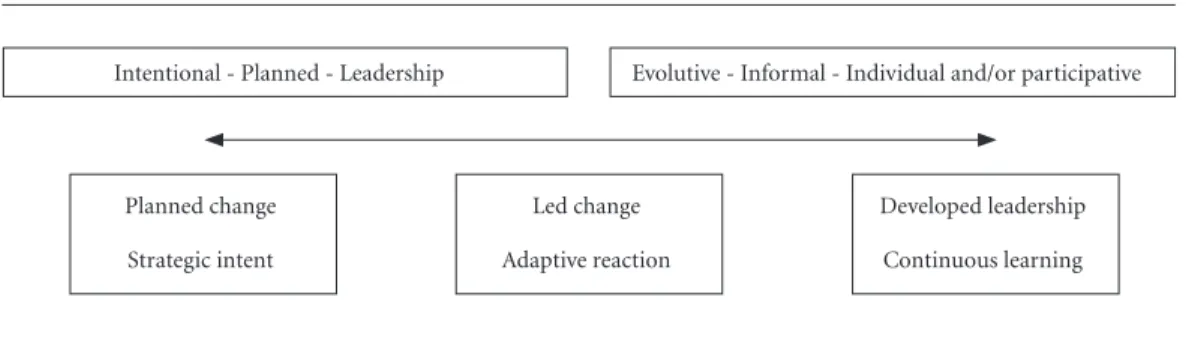
The change process itself is addressed using three basic approaches: the planned change, the led change and the developed change, all of which may be developed at a more micro or macro level. A planned change involves a set of elements to be followed, which may range from a macro level, such as strategic planning, to a more micro level, in the case of improvements in quality or staff training.
A led change is guided by a person or group of people with the authority to monitor and en-sure change. A developed change just happens, it is organic and led by people outside the
insti-tution’s core of authority, and are not formally managed as are the other two types.
The work of Mintzberg10 and Motta5
con-verge, although they differ in terms of the termi-nology used. Thus the concepts of how change emerges, whether intentional or evolutionary, formal and planned or informal, if arising from management or individuals and groups, are all present in the classifications of both authors and, if taken as extremes, could be represented as fol-lows in Figure 1.
Organizational outlooks, strategic management and profile of care
According to Lima11-13, another author that
looks at hospital organizations, the definition of objectives of hospital organizations has a natural perspective, as it depends on the external envi-ronment, on the priorities of the federal govern-ment, technological developments, epidemiology and population demand. Thus in a natural per-spective the organization is viewed as a living or-ganism that creates interdependent relationships with its internal sub-systems and the external en-vironment to ensure its survival.
As a result of this systemic vision, that these organizations are part of a network, goals cannot be defined internally alone, but require external regulation to ensure the integration and balance of the system as a whole.
The different people and groups that make up the organization must also be considered, as it is they who, based on individual and coalition goals, on a process of negotiation and dispute, will define the organization’s goals from a politi-cal point of view.
A rational perspective is required to enable organizations to clearly define their goals, rather than use generic coals that do not contribute to management decisions and actions.
Figure 1. Concepts on the format and leadership of organizational change.
Evolutive - Informal - Individual and/or participative Intentional - Planned - Leadership
Planned change
Strategic intent
Led change
Adaptive reaction
Developed leadership
B
insf
Thus, according to Lima11, it is based on an
integrating perspective that public healthcare organizations may be better understood, as they present characteristics of each of the different vi-sions of the organization.
A focus on strategic management of health-care, developed originally by Cremadez and Gra-teau14, and studied by Rivera15 and Artmann et
al.16 since the 1990s, considers that healthcare
organizations have characteristics that keep them from developing a management project based on an ideal standard. This standard should, when defining the mission, consider criteria of eco-nomic rationality, recognizing the external envi-ronment as a resource, and the need for internal integration and negotiation with the network.
These characteristics lead to two results: an incremental decisional practice, and an organi-zation that is centered on itself and its own envi-ronment, perceiving the external environment as a constraint.
The decisional practice is incremental be-cause decisions are made in series as a function of momentary pressure of the different hospital play-ers, with no view of the whole17. There is no
strat-egy formulation process prior to the decision, as the decision is a-hoc, with a juxtaposition of goals.
The focus on strategic management suggests an integrating decisional practice involving a larger number of players in the operating plat-form that defines the strategies, based on contin-uous planning of collective projects within col-laboration networks.
As a proposed methodology it presents the strategic approach, which proposes to rationally define the hospital mission, positioning it within the ideal perspective of a coordinated healthcare network15. This focus includes the hospital as
a proactive organization, focusing on the out-side environment and questioning a vision of self-sufficiency and the intention to cover all ar-eas of service.
To this end, a definition of a hospital unit’s mission is negotiated with the network and other establishments, thus transforming potential un-justified competition into collaboration.
Methodology
This effort is a study of multiple cases using a qualitative approach and methodology based on information collected in semi-structured inter-views18.
The field of investigation is made up of hos-pitals under federal management in the city of Rio de Janeiro: Hospital Federal do Andaraí, Hospital Federal de Bonsucesso, Hospital Federal de Ipanema, Hospital Federal da Lagoa, Hospital Federal dos Servidores and Hospital Federal de Jacarepaguá (Cardoso Fontes), which refused to participate.
Seventeen interviews were recorded with the authorization of interviewees, and later transcribed, resulting in 10 hours of recorded conversations and over 100 pages of transcrip-tion. Study participants are listed below, and are identified using codes in the outcome of this ef-fort. Hospital 1: Medical Coordinator, Head of Surgery, Head of Ambulatory Care and Head of Services; Hospital 2: Medical Coordinator, Head of Surgery and Head of Emergency Services; Hospital 3: 2 Heads of Service and the General Manager; Hospital 4: 1 Head of Service and the General Manager; Hospital 5: Medical Coordi-nator, Planning CoordiCoordi-nator, Care coordinator and, in the Department of Hospital Management (DHM) we interviewed the Coordinator of Care and the Coordinator of Planning. The number of participants varied between units, depending on how long it took for the unit to agree to partic-ipate in the study, and the availability of inter-viewees. The main subjects selected for this study were: Hospital Director, Coordinator of Care and Coordinator of Planning. Where these positions did not exist, or the holders were unavailable, the heads of service or department were included as participants.
To organize the data gathered in these inter-views we used the Collective Subject Discourse (CSD) developed by Lefrève et al.19.
According to those authors, CSD is a tech-nique to organize qualitative data that resolves a major impasse in qualitative research, to the extent that it provides systematic and standard-ized procedures to combine statements without reducing them to quantities20.
This technique consists of analyzing the con-tent of the interviews, extracting the core ideas or anchors and key expressions, based on which we search for similarities to build one or more summary discourses.
These four elements - Key Expressions (KE), Core Ideas (CI), Anchoring and Collective Sub-ject Discourse are considered the operators of this approach20. Key expressions are portions of
e C
ole
tiv
a,
22(1):209-220,
2017
Thus the collective subject discourse may be defined as a summary-discourse created with elements of discourses of similar meaning com-bined in a single discourse.
Results
Below are the results of the study split into two blocks: the process of hospital change and strat-egy definition, and the design of the care profile and organizational perspectives. In each block, the function of Analyzing the Collective Dis-course was made up of themes that contribute to a better understanding of the outcome.
Change processes in hospitals and strategy definition
When we discussed the main changes the interviewees perceive in the recent care profile of each hospital, we found two core themes in the collective subject discourse: the first are the changes themselves, both perceived and men-tioned by managers, and the second is made up of a set movements that, unlike the perception of change, were made to resist change (Chart 1).
Four different discourses emerged from the core ideas in the first theme, revealing the per-ception of change in the changing patient profile, a change that results from an increase or decrease in supply, and the direction towards higher com-plexity services.
The first discourse reveals a perception among interviewees that there have been chang-es in recent years, and units are prioritizing the development of activities or services of increased technological complexity.
CSD 6 - Discourse on change
and prioritizing high complexity services
...we started to prepare a strategic plan, look-ing to better define the care profile, and some of the services organized themselves to serve higher com-plexity cases. The maternity service for example, created a neonatal ICU and also started to handle pediatric transplantation.
The pediatric ICU is a distinction that helps qualify the Hospital. The coronary unit allows us to handle cardiac disease. But there are also simi-larities, such as in orthopedics. This also happened in the past, at some point this was built here.
Patients started coming in, cases became more complex and we started to care for these patients.
This resulted in an increase in high complexity sur-geries.
In the first core idea, change is presented as being the result of a decision made by players involved in strategic planning, and subsequently some of the services started to shift the focus of their activities.
The second part of the discourse mentions a number of existing technologies that are a compet-itive advantage for a given unit. In the perception of these managers, this points to a set of services in which more should be invested, as they already have a level of added complexity and the invest-ment has been made to organize the services.
When managers are asked about how the se-lection of the areas of the current care profile was made, they mention a process that happened his-torically, over time.
Another discourse based on manager per-ception of change is the increase in demand and change in population profile.
CSD 7 - Discourse of the changing patient profile and increase in demand
Cancer is epidemic among the population. The greatest demand is for vascular surgery. An-other demand that has increased significantly and become a public health problem is chronic renal disease. The population is aging and there aren’t enough hospital beds. There is a glaring increase in the number of elderly people around the world, and with the diseases of aging, when things get compli-cated they end up in the emergency room.
In this discourse, the main changes are the population demographic profile - an increase in the elderly and chronic problems. This has caused an increase in demand for hospital units; as the healthcare system does not have a suitable structure to care for this population, they resort to hospital emergency rooms.
CSD 8 - Discourse of the change
in supply due to expanded and new services
This grew slowly, at first all we had was clini-cal nephrology, then we opened a dialysis unit, and then started to do transplants. Burn victims for ex-ample, a group of plastic surgeons decided to create a service, a tiny nucleus that grew. In bariatric sur-gery we had a surgeon that decided to be a pioneer in this area, and now it’s one of the largest in the country. So it’s a very personal thing...
B
insf
deciding to introduce services. This is reiterated in the determination of the greater manager, and that had to be incorporated even if the unit pro-fessionals or management agree to structure this service in the hospital.
Services that grow and expand due to physi-cian initiative and the individual desire of profes-sionals to perform a given activity is significant evidence in the discourse, and results in the ser-vice expanding its supply within the network and becoming a reference.
The following discourse, by a coordinator of care, is highlighted as it is a good example of the question of changes in the supply of services as something that is not necessarily explained by population demand or management decision.
We have services in the hospital that imploded and nobody knows why, others grew and became huge services, and others shrank, and there is no reason one can point to: - Oh, the population didn’t need that. I don’t believe so, I believe that these ex-pertise just left randomly.
Chart 1. Summary of the CSD regarding recent changes in hospital profiles.
Theme 1 - Changes in recent years
CSD 1 - Discourse on change and prioritizing high complexity
CI 1 - Change by increasing the complexity of services provided, based on a strategic plan
CI 2 - Change due to the increase in specialization based on the increased value of higher complexity areas identified in the strategic approach
CI 3 - Change due to increased complexity to differentiate the network and continued teaching
CSD 2 - Discourse of the changing patient profile and increase in demand
CI 4 - Change as an increase in the demand for emergency, vascular disease, chronic renal and cancer care
CI 5 - Changes in the demographic profile due to population aging
CSD 3 - Discourse of the change in supply due to expanded and new services
CI 6 - Changes in service by medical initiative that subsequently expands and becomes a reference
CI 7 - Change resulting from added services as the network is unable to serve its patients or at the request of the MoH
CSD 4 - Discourse of the change in supply due to the loss of services or municipalization
CI 8 - Changes due to the loss of professionals resulting from limited investment in technology
CI 9 - Change due to services lost because the professionals involved retired or moved to another unit
CI 10 - Changes caused by municipalization and the lack of investment in the hospital
CI 11 - Change caused by municipalization that left the hospital depleted, with no equipment, input or staff
CI 12 - Change caused by municipalization and a decrease in the complexity of supply
CI 13 - Change due to MoH investments to recover hospital and resume services
Theme 2 - Resistance to change
CSD 5 - Discourse regarding the resistance to changes in care profile and internal changes in the services
CI 14 - Resistance to changing the hospital profile to a university hospital
CI 15 - Resistance to proposals for service reforms made by at the central level
CI 15 - Resistance to proposals for service additions made by at the central level
e C
ole
tiv
a,
22(1):209-220,
2017
Change frequently emerges in the discourse as something that happens, either in creating a service as something very personal, or a decrease in the supply as random evasion, linked to med-ical professionals and not to a decision made by hospital management.
CSD 9 – Discourse of the change in supply due to the loss of services
or municipalization
Municipalizaiton was chaos. The city did not invest in the hospital, it just wanted the SUS pass-alongs. We ended up with a hospital that was fall-ing apart. The number of beds reduced. Ultimately the hospital came to a halt and the emergency ser-vice was eliminated. The federal government inter-vened and rescued it. New investments were made. The number of surgeries started to climb again.
We realize that some of the changes in the care available are linked to external definitions, in this case specifically, to the period in which hospitals were managed by the city government. In some way or another, all of the interviewees in hospital units that experienced the municipaliza-tion process said this was a period in which there was a decrease in services offered due to the lack of investment.
CSD 10 – Discourse regarding
the resistance to changes in the care profile and internal changes in the services
In 1963, 64 there was a move to make this a university hospital but the professionals were against it and managed to thwart the idea.
The hospital started out with two surgery ser-vices - General Surgery 1 and 2. There were several initiatives to merge them but nothing ever came of it... Then you walk into a meeting room and the entire service walks in with the director: “I brought my professionals so they can state their disagree-ment... It just didn’t change because the hospital has a tradition built on the high complexity surger-ies performed by the doctors...
This discourse is a movement of resistance to proposed changes, and was found in the dis-course of players in several units. One of the in-terviewees mentioned that the main movement in the institution, since it was created, is not change but the resistance of a group of employ-ees who diverged and made it impossible for the project that would transform it into a university hospital to go forward.
In this case, the care profile of the hospital was not only the result of strategies for change, but of the strategies developed over time by a diverging group to impede change, bringing to light conflicting positions of the players in the organization and the scenario of which they are a part21.
Design of the care profile and organizational outlook
The previous theme presented the main changes observed by the interviewees. Based on these changes we will attempt a deeper analysis of what led change to happen and how they define the care profile of the units (Chart 2).
CSD 16 - Discourse of the change process from the point of view of the Hospital Man-agement Department (HMD)
We don’t really have suitable planning yet be-cause we go in bursts... We are experiencing a very disorganized healthcare system, which reflects in the population that goes to the units in search of all sorts of services. Because this demand, hospitals also grow in a disorganized manner, offering services in an attempt to minimize huge waiting lines. Often-times each units is trying to cope with its demand within its own universe, even if the services double in size. Most hospitals have no planning center.
In the perception of the HMD, change is not the result of an intentional process, but primar-ily the result of a need to meet demand, leading units to develop certain services and incorporate certain technologies. Hospital managers have the same perception.
CSD 17 - Discourse of the change process from the point of view of the hospitals
I believe the units organize themselves based on a number of things, but not much is the result of central planning.I believe that we adapt to needs as they arise. Normally we end up with things that re-ally don’t have an owner. The healthcare units de-velop their own expertise based on their healthcare professionals, and this leads to the disorganization we now see.
B
insf
One question that stands out and emerges in both discourses is a perception that the pro-cess happens in isolation at each unit, due to the search of individual professionals or managers for solutions to their problems or to remedy the population’s health, or because there is no inte-grated process across the city, state and federal units. Another recurring topic is the perception of duplicate offers between units.
Discussion
When we analyze the discourses, retrieving the three configurations of change proposed by Mintzberg and Lapel10 (planned, led and
de-veloped), we find that most of the changes per-ceived in recent years were developed, meaning they happened without necessarily being led by managers internal or external to the units. This is seen in the way managers describe change as something that happened and was not planned or monitored by groups or people in authority within the institution, which would be the case in a planned change.
One may also say, based on the concepts of the Mintzberg8,9 strategy, that the units have
cre-ated their care profile primarily through emerging strategies, with no decision or guidance prior to developing services or making changes to them, such as in a deliberate strategy. Motta5 points to
this question when he states that units tend to pro-mote change all the time, with no idea of the direc-tion they are going in or path they are following.
The only initiatives that seem to have been configured from more deliberate positioning strategies are those resulting from independent consulting efforts to apply planning methods. Their main role has been a search for orientation and leadership, privileging high complexity.
The other core ideas, although they too clude a perception of change, at least in the in-crease of complexity, the areas that make up the hospital’s care profile, and that became more complex, did not emerge from a decision or plan, but from consistent behavior over time, the addition of new technology and the increase in demand, which characterizes a strategy defined from a pattern.
This becomes clear when we realize that the discourses, both for increased and reduced sup-ply, are primarily provoked by changes in the de-cisions of the medical professionals, when they decide to start a new activity or leave the team.
Considering the three approaches to change proposed by Motta5 – strategic intent, adaptive
reaction and continuous learning –, it is fair to state, based on analyses of changes viewed as nec-essary by managers, that the pattern of intentional change in federal hospitals is adaptive reaction, where the development of new ideas is primari-ly the result of the need to solve problems, rather than the outcome of a planned process to interfere in the organization’s growth and development.
According to Mintzberg et al.10, strategy
de-velopment is addressed by often referring to change. Therefore, it has to do with change and not continuity.
Chart 2. Summary of CSD regarding the determinants and factors that interfere in changing the profile of care.
Theme 1 - The care profile and the unit planning structure
CSD 6 - Discourse of the change process from the point of view of the Hospital Management Department (HMD).
CI 18 - Change is not the result of planning, but of individual of hospitals intent on serving their demand
CI 19 - Hospitals use no planning tools or methodology
CI 20 - Most hospitals have no structured planning center.
CSD 7 - Discourse of the change process from the point of view of the hospitals
CI 21 - Change is not the result of planning, it merely happens
CI 22 - The planning structure is incipient, and is more centralized in management
CI 23 - Hospitals have initiatives for improvement and support from independent consultants
e C
ole
tiv
a,
22(1):209-220,
2017
However, what we see in the discourse of these managers is that in hospitals, this type of movement happens not only in the case of change, but strategies are also developed as resis-tance to change.
This resistance is seen both to more radical changes, such as the transformation of a unit into a university hospital, and to more incremen-tal changes at the level of services or care profile. However, resistance seems to emerge primarily to avoid imposed strategies, which points to the fact that if the care emerges as the result of changes that “just happen”, it also emerges from strategies that allow the units to resist change proposed from outside.
These discourses also indicate a need for deeper analysis of how strategies are molded within hospital organizations, based on a polit-ical perspective and the fight for power. The dif-ficulty to introduce structural changes, arising from an intentional process, may be related to the fact that there are different power clusters within institutions, and the fight over projects results in the movements to resist change we found in this study.
Regarding management perception on the process for defining the care profile, this emerges as being not very rational or systemic. Units do not have planning tools that support these pro-cesses, and in most hospitals planning teams are incipient or relatively inactive.
The perception of the outside environment is that the system is disorganized, and that this interferes in the possibility of a more integrated approach to designing the care profile. Each unit incorporates technology and attempts to meet the demands of the population on its own, with no planning. This sends us back to the decision mak-ing process, which as shown in the strategic ap-proach, is still incipient in hospital organizations, as managers make decisions on an ad-hoc basis and in response to pressure from different players, with no formulated institutional strategy15,17,22.
According to Lima11,23, the process of setting
goals in government organizations has a natural perspective, due to their dependence on the envi-ronment. This dependence is found, for example, in the connection between these institutions and the goals and changes at the upper levels of gov-ernment and the other units located within the territory.
Regarding interference in the development of the institution’s care profile, what emerged from management discourses were spot decisions to
introduce a given service, but there was no ref-erence to a policy for federal units that would in some way guide hospital activities or changes.
Still with regarding natural perspective, hos-pitals are subject to other environmental factors, which in the discourses were recognized only as the pressure of demand and the pressure to add new technologies.
However, considering the characteristics of government organizations and the healthcare model, other units in the system should also be one of the factors taken into consideration when defining the care profile24.
What our analysis of the results reveals, is that today this process is still made on an ad-hoc basis by the hospitals, and the responsibility for solv-ing problems is not shared by the units, resultsolv-ing in processes that are fragmented and mismatched across hospitals.
To meet the demand of a given territory, and abide by the criteria of economic rationality, inte-gration and complementarity within the health-care system, it is important that the players with governability participate16,21,24,25 in the process,
helping define organizational goals, including the involvement of the professionals themselves, as these have a major influence on defining the care profile of hospitals8,9,17.
According to Dussault26, the best type of
management for these organizations would be more of a collegiate and consensual model, and not an authoritarian one. Such a model would involve professionals in formulating goals.
In a strategic approach, leading the process in a participative manner is in opposition to an ap-proached based on rules and guidelines, showing that se secure player accountability, projects must be the result of communicative processes and ne-gotiation16,24.
Regarding the risk of a possible politiciza-tion of management via political appointments, a reality in these units, Dussault26 suggests that,
to minimize institutional instability, projects be debated, with clear rules and agreements that re-spect the goals defined.
B
insf
Final Considerations
The definition of the care profile of a hospital is a critical aspect, both in terms of internal devel-opment strategy and its position in integrated healthcare networks.
Considering the configuration of the health-care system in Rio de Janeiro, with all spheres of government managing care providers, and where federal hospitals have been passed along between the spheres of management, creating a central management unit that could combine the units could benefit the local system.
However, the central authority cannot focus only on the changes that emerge from the need to solve problems, but tries to enable them by con-fronting the hospital units, as the trend will be to resist such changes.
In this case, some of the imposed changes could yield incremental or even more radical
changes in the configuration of internal systems, occasionally reverting to duplicate offers, but the rationale of shaping the care profile and leading unplanned, non-systemic change would contin-ue to prevail.
In hospital organizations, understood as pro-fessional organizations, the important role of internal players is already recognized27 for
defin-ing and implementdefin-ing the institutional mission, which requires the development of shared and communicated strategies, collective plans and continuous negotiation.
The discourses regarding resistance to change show that the dimension of power21 within
e C
ole
tiv
a,
22(1):209-220,
2017
Collaborations
L Binsfeld helped analyze the data and design and write the article. FJU Rivera and E Artmann worked in critical analysis, also helped draft the article
References
1. Barbosa PR. Gestão em saúde: o desafio dos hospitais como referência para inovações em todo o sistema de saúde. In: Feury S, organizador. Saúde e democracia: a luta do CEBES. São Paulo: Lemos Editorial; 1997. p. 143-162.
2. Malik AM, Novaes HDM. Situação e desafios do sis-tema hospitalar brasileiro. Editorial. Cien Saude Colet
2007; 12(4):822.
3. Cecílio LCO. Uma sistematização de tecnologia leve de planejamento estratégico aplicada ao setor governa-mental. In: Merhy EE, Onocko R, organizadores. Agir
em saúde: um desafio para o público. 2ª ed. São Paulo:
Hucitec; 2002. p 161-169.
4. Brasil. Ministério da Saúde (MS). Reforma do Sistema de Atenção hospitalar brasileira. Brasília: MS; 2004. 5. Motta PR. Transformação organizacional – a teoria e a
prática de inovar. Rio de Janeiro: Qualitimark; 2004. 6. Senge P. A quinta disciplina: arte, teoria e prática da
or-ganização de aprendizagem. São Paulo: Best Seller; 1990. 7. Rivera FJU. Reflexões sobre a subjetividade na gestão a
partir do paradigma da organizaçãoque aprende. Cien
Saude Colet 2001; 6(1):209-219.
8. Mintzberg H. Planejamento e estratégia. In: Mintzberg
H. Ascenção e queda do planejamento estratégico. Porto
Alegre: Bookman; 2004. p. 21-43.
9. Mintzberg H. Cinco Ps para estratégia. In: Mintzberg H, Lampel J, Quinn JB, Ghoshal S, organizadores. O
processo da estratégia. 4ª ed. Porto Alegre: Bookman;
2006. p. 23-29.
10. Mintzberg H, Lapel J. Transformando organizações. In: Mintzberg H, Lampel J, Quinn JB, Ghoshal S, organi-zadores. O processo da estratégia. 4ª ed. Porto Alegre: Bookman; 2006. p. 151-159.
11. Lima SML. Definição e implementação de objetivos nas organizações públicas de saúde. Rev Administração
Pública 1994;12(4):38-64.
12. Lima SML. Possibilidades e limites da contratualização para o aprimoramento da gestão e da assistência em hos-pitais: o caso dos Hospitais de Ensino no Sistema Único de Saúde brasileiro [tese]. Rio de Janeiro: Escola Nacio-nal de Saúde Pública; 2009.
13. Lima SML, Rivera FJU. A contratualização nos Hospi-tais de Ensino no Sistema Único de Saúde brasileiro.
Cien Saude Colet 2012; 17(9):2507-2521.
14. Cremadez M, Grateau F. Le management stratégique hospitalier. Paris: Inter Éditions; 1992.
15. Rivera FJU. A démarche estratégica: a metodologia de gestão do Centro Hospitalar Regional Universitário de Lille, França. Cad Saude Publica 1997; 13(1):73-80. 16. Artmann E. Enfoque démarche stratégique na gestão
hospitalar. In: Minayo MCS, Deslandes SF, organiza-dors. Caminhos do pensamento – Epistemologia e mé-todo. Rio de Janeiro: Editora Fiocruz; 2003. p. 227-323. 17. Rivera FJU, Artmann E. A dérmarche stratégique (ges-tão estratégica hospitalar):um instrumento de coor-denação da prática hospitalar baseada nos custos de oportunidade e na solidariedade. Cien Saude Colet
2003; 8(2):479-499.
18. Minayo MC. O desafio do pensamento. 6ª ed. São Paulo: Hucitec: 2000.
qualita-B
insf
tiva levada a sério. [on line]. São Paulo. 2003. [acessado 2009 mar 20]. Disponível em: http://hygeia.fsp.usp.br/ quali-saude/Discurso_o_que_e.htm
21. Rivera FJU, Artmann E. Planejamento e gestão em saú-de: conceitos história e propostas. Rio de Janeiro: Editora Fiocruz; 2012. Coleção: temas em saúde.
22. Rivera FJU. O enfoque de integração estratégica de Crémadez e Grateau e a gestão de recursos tecnoló-gicos e humanos. Rev Administração Pública 1998; 32(6):179-208.
23. Lima SML. O contrato de gestão e a conformação de modelos gerenciais para as organizações públicas de saúde. Rev Administração Pública 1996; 30(5):101-138. 24. Artmann E. Démarche Stratégique (gestão estratégica
hospitalar): um enfoque que busca a mudança através da
comunicação e solidariedade em rede [tese]. Campinas:
Faculdade de Ciências Médicas; 2002.
25. Artmann E, Andrade MAC, Rivera FJU. Desafios para a discussão de missão institucional complexa: o caso de um Instituto de Pesquisa em Saúde. Cien Saude Colet
2013; 18(1):191-202.
26. Dussault G. A gestão dos serviços públicos de saúde: características e exigências. Rev Administração Pública
1992; 26(2):8-19.
27. Artmann E, Azevedo CS, Sá MC. Possibilidades de apli-cação do enfoque estratégico de planejamento no nível local de saúde: análise comparada de duas experiên-cias. Cad Saude Publica 1997; 13(4):723-740.
Article submitted 14/07/2015 Approved on 05/10/2015