AR
T
CILE
1 Instituto de Estudos em Saúde Coletiva, Universidade Federal do Rio de Janeiro (UFRJ). Av. Horácio Macedo S/N, Ilha do Fundão. 21941-598 Rio de Janeiro RJ Brasil. [email protected] 2 Curso de Graduação em Enfermagem, Universidade Federal da Fronteira Sul. Chapecó SC Brasil. 3 Instituto de Medicina Social, Universidade do Estado do Rio de Janeiro. Rio de Janeiro RJ Brasil. 4 Curso de Ciências Econômicas, Universidade Federal da Santa Maria (UFSM). Palmeira das Missões RS Brasil. 5 Curso de Ciências Econômicas, UFSM. Palmeira das Missões RS Brasil.
The health regionalization process
from the perspective of the transation cost theory
Abstract This study analyzes the incidence of transaction costs in the regionalization process of health policies in the Brazilian federal system. In this work, regionalized health actions contract-ed and agrecontract-ed between fcontract-ederal agencies have as-sumed a transactional nature. A conceptual theo-retical essay of reflective nature was prepared with the purpose of questioning and proposing new approaches to improve the health regionalization process. The main considerations suggest that institutional management tools proposed by the standards and regulations of the Unified Health System have a low potential to reduce transaction costs, especially due to hardships in reconciling common goals among the entities, environment surrounded by uncertainty, asymmetries and in-complete information, bounded rationality and conflict of interest. However, regionalization can reduce the incidence of social and/or operational costs, through improved access to health and the construction of more efficient governance models.
Key words Regionalization, Health policy,
Uni-fied Health System, Federalism, Health services
Leyla Gomes Sancho 1
Daniela Savi Geremia 2
Sulamis Dain 3
Fabiano Geremia 4
Sanc Introduction
In Brazil, the configuration of health regions is institutionalized by the federative model in place, which conditions all the organization of the sys-tem. In this model, there are intrinsic controver-sial factors of intergovernmental competition and cooperation that influence the establishment of regionalized and hierarchical networks.
Since the beginning of the 1990s, the Unified Health System (SUS) has periodically published regulations that (re) created management tools in order to operationalize the regionalization of health actions and services. However, every time the federal government proposes a new tool, new hardships of adherence by the municipal and state managers emerge. In addition, the constant changes in management and governance tend to promote institutional insecurity, which can in-crease information asymmetries, uncertainties and, consequently, opportunistic actions, causing greater competition among the agents involved.
Regionalization is the organizational policy that guides decentralization of health actions and services and the negotiation and agreement pro-cess between managers in the three government levels and for which institutional arrangements and administrative political relations are vari-ables that permeate planning, management and organization of healthcare networks1.
The configuration of regionalized healthcare networks, with cooperation between federated entities, implies the existence of flows of infor-mation and financial and economic resourc-es rresourc-esulting from the agreement between thresourc-ese entities through the celebration of incomplete formal and/or informal “agreements” that invari-ably make them less efficient.
In this context, the Transaction Cost Eco-nomics (TCE) can provide subsidies to the anal-ysis of regionalization and agreement of health-care networks and the current intrinsic costs. This study discusses the decentralization of re-gionalized healthcare networks from the Brazil-ian federative model and considers its impact on the efficiency of services provided in the light of the transaction costs theory.
This article uses the term “service” referring to the availability of several types of procedures/ actions/activities in relation to healthcare and according to technological complexity (primary, secondary and tertiary care).
The first section of this article discusses health regionalization. The second section shows the
conceptual theoretical foundations of transac-tion cost and, finally, an analysis of the relatransac-tion- relation-ship between the factors determining transaction costs and Brazilian health system regionalization.
Unified health system regionalization
Recently, Brazilian health regionalization presupposes understanding the decentralization of power granted by the Federal Constitution of 1988 (CF/1988)2, its interdependence with the
sui generis typology of federalism implemented in the country and, finally, its implications in what concerns the specificity of the health policy. This is because, while the pre-CF/1988 federative system relied heavily on the relationship between the federal government and state governments, its replacement marks the growing importance of municipal governments, either as implement-ers of public policies by delegation and decon-centration of State power, or by its consecration as federative entity vested with full autonomy.
In Brazil, “municipalization at all costs”, to the detriment of the control and regulation exercised at state level of government, makes the process of agreement between government entities more cumbersome and complex, as well as deprives federal incentives for adherence to national and universal policies of their effectiveness3.
Dilemmas and conflicts of the federative or-ganization are of a multiple nature, particular-ly where fiscal and management autonomy are combined with decentralization by service hier-archies, networking and different functions be-tween governments, even more when associated to the population size and different public goods and services infrastructure supply.
SUS decentralization in the 1990s is marked by the process of transferring resources and competencies to the municipalities directly from the Federal Government, the main policymaker and financier of the health policy. This decade is also marked by the poor practice of cooperation mechanisms and disputes for more resources be-tween state and municipal governments for the management of health services. In addition, the strongly municipalized government structure faces major challenges in meeting SUS goals in the face of the extreme diversity and inequality of the Brazilian federation.
e C
ole
tiv
a,
22(4):1121-1130,
2017
of scale and productive capacity existing among municipalities, at the risk of loss of efficiency and consequent worsening of results”4.
In this context, and as the main guideline of decentralization, regionalization is resumed as one of the fundamental pillars of the SUS toward structuring and organization of health actions and services. It is also characterized by the con-solidation of a territorial basis for the planning and organization of regionalized and hierarchical healthcare networks that have distinct techno-logical densities and health services and services supply capacities.
After successive publications of regulatory standards in the 1990s and 2000s, the regional-ization policy was effectively rescued by the pub-lication of the Pact for Health5 in 2006. Actually,
the Pact for Health is a continuation of proposals made by the Operational Health Care Standards (NOAS), which were highly criticized when they were published in 2001 and 2002. The Pact for Health gathers a set of institutional and political reforms that are agreed between the three SUS managers and aims to establish a new level in terms of financing, new definitions of responsi-bilities, health goals and to agree commitments among health managers with a view to organiz-ing health care.
In 2006, with the launching of the Pact for Health, guidelines are recommended for the regionalization of the health system, based on strengthening the political agreement among the federated entities, especially in the municipal sphere, and on the national regions economic, cultural and social diversity in order to redefine health regions5.
Following the publication of the pact, the subnational entities had the opportunity to rees-tablish autonomy to define which services they would be able to provide and sign a term of co-operation through direct agreement between municipalities, states and the Federal Govern-ment. The pact took six years of negotiation and, when shyly implanted, was replaced by Decree n° 7.508/20116. This fact demonstrates the constant
changes to which agents responsible for the set-ting of the regionalized health care network are subjected, which leads to institutional insecurity.
In this respect, enactment of Decree Nº 7.508/20116, which aims to consolidate the
pro-cess of cooperative and supportive regionaliza-tion, also enables greater operational and insti-tutional support to the structuring of healthcare models in the health regions of the healthcare
network. The important feature of this mecha-nism is the responsibility given to federative en-tities in order to generate an effective access to the population to goods and services offered by contractualisation through the Organizational Contract of Public Action (COAP).
Transaction costs theory
Transaction costs are the “costs to plan, adapt and monitor compliance of tasks in productive activities”, as well as those associated with poor adaptation of agreement conditions, possible renegotiations and monitoring of compliance with agreements7. In theory, the purpose of TCT
is to analyze the conditions and consequences of transaction costs to the efficiency of the econom-ic system8.
Among the several conceptions already ex-plained by some authors in the literature, trans-action costs are, in short, those written in the elaboration and negotiation of agreements, in the measurement and enforcement of proper-ty rights, in the performance monitoring and in the organization of activities9. They are also
described as the cost of measuring the multiple valuated realms included in the transaction and those related to contractual execution10.
According to Williamson11, transaction costs
can be ex-ante, that is, drafting, negotiating and safeguarding the agreement, or ex-post, resulting from the adjustment and adaptations, which may even result in contractual disruption due to fail-ures, errors or self-interest of one of the parties.
The relationship between transaction costs and governance is widely reported in literature. However, its meaning has been expressed by dif-ferent connotations, which translate from orga-nizational arrangements to a strategy and a way of governing12. Governance contemporary
con-cept is no longer limited to state leadership, but also to direction of society through institutions and social stakeholders. Thus, governance refers to additional forms of social direction13,14.
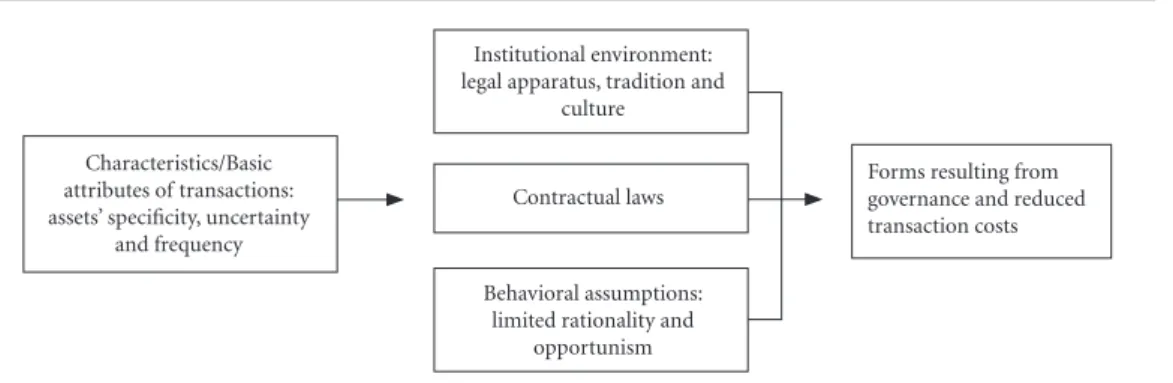
According to Williamson11, the governance
ratio-Sanc nality and opportunism interfere greatly in the conduction of a transaction15. Figure 1 shows the
model based on a study by Zylberstajn16.
Opportunism resulting from the contrac-tualisation process implies the recognition that agents not only seek self-interest, but also ap-propriate benefits associated with transactions, although the economic theory argues that agents behave in an unbiased manner in the pursuit of their own interests. Williamson states that op-portunism is responsible for the real or apparent conditions of information asymmetry, that is, in-formation is not available equally to the agents involved in a transaction.
As for limited rationality, Williamson11
as-serts that agents want to be rational, but they can only be so partially, since the environment sur-rounding their decisions is highly complex and affected by cognitive limits. In other words, lim-ited rationality leads to the design of incomplete agreements, which will be subject to renegotia-tion and for which agents will, as a precaurenegotia-tion, use safeguards and incentive mechanisms. From the standpoint of transactional efficiency, there-fore, it is necessary to implement mechanisms to adapt to the permanent conflicting scheme in contractual relations17.
Williamson18 addresses uncertainty in terms
of complexity of the events, which was mea-sured into three categories: the first – related to environmental contingencies, including the pref-erence of consumers and/or users; the second – related to lack of information; and the third, strategic or behavioral – related to opportunism.
The frequency of a transaction allows the development of a reliable commitment between agents, leading not only to reduced costs
associ-ated with collecting information, but also to the elaboration of complex agreements, which, in the end, restricts opportunists’ performance. Thus, “the greater the specificity of the assets, the great-er the frequency of transactions and the greatgreat-er the level of uncertainty, the greater the transac-tion costs”19.
When evidencing the registration of trans-action costs, one has the dilemma of collective action, which, as yet another implication, high-lights groups’ performance, or even social classes, in relation to the (in) adequate current institu-tions in the perspective of self-interest.
The collective action dilemma was first de-scribed by Olson20, who unveils the social
dilem-ma involved in the choice of decision-dilem-making interdependence circumstances, as well as pos-tulates that rational and selfish individuals do not act naturally for the production of a good. On the contrary, the natural form, with a view to increasing benefits, becomes non-cooperation, or rather, the adoption of a free rider stance, in which the need for goods does not guarantee the realization of collective action because the free rider acts as inhibiting factor to the point of preventing groups actions. Also according to Ol-son20, the solution to the dilemma is blocking the
free rider’s behavior by charging a transaction cost higher than that incurred if it cooperated in the production of the good.
In summary, the transaction cost economy shows that hierarchical governance arises to solve the problems caused by limited rationality and opportunism in the midst of an uncertain envi-ronment and subject to asset specificities. Deci-sion about the best coordination depends on the costs associated with the transactions.
Figure 1. Scheme of Induction of Forms of Governance.
Source: Zylberstajn16. Characteristics/Basic attributes of transactions: assets’ specificity, uncertainty
and frequency
Contractual laws
Behavioral assumptions: limited rationality and
opportunism Institutional environment: legal apparatus, tradition and
culture
e C
ole
tiv
a,
22(4):1121-1130,
2017
On the other hand, it also presupposes that in institutional environments surrounded by un-certainties, asymmetries and incomplete infor-mation, limited rationality, multiple objectives and conflict of interests, it is important to use a standardization tool, such as the preset of incen-tive and control tools, which includes the assign-ment of premiums, the application of sanctions and fines or audits.
In general, transaction costs are invariably re-lated to productive efficiency, as it reflects the be-havioral patterns of agents and the way in which economic activities are organized and coordinat-ed. In other words, reduction of transaction costs is obtained by both agents and organizational formats.
Transaction costs in the context of federalism and health regionalization
The issue of transaction costs has not yet been debated in the process of health regionalization in Brazil. The recurrent theme has been applied to the private health sector, especially when con-sidering health insurance companies and health plan operators21.
For the analysis of this context from the perspective of the TCT, the action or the health service (own/contracted and agreed) such as the transaction between the federated entities will be considered, which will provide elements of com-parison and discussion on the best governance structure to organize it among the different agents that work in public health management.
Chart 1 highlights transaction characteris-tics, which are accepted hypotheses to guide the analysis process. The specificity of assets involved in health services is high and physical structures and the mobilization of human capital are espe-cially complex.
There is great adherence of TCT to health actions and services, considering that all the main assumptions of TCT are within the scope of health regionalization. One should not forget that all rules and regulation of health actions or services involves an institutional conformation that is susceptible to uncertainty, as well as op-portunistic practices. In general, what directs the attribution of a high specificity of the asset is the understanding that the health actions or services at the regional level involve complex procedures.
According to the aspect discussed here, trans-action costs are higher or lower depending on the greater or lesser efficiency in the agreement and/or contracting of health services between
the federated entities. Thus, the TCT applied in the regionalization of the Brazilian health sys-tem can be understood from a general definition that these arise because of the cost of measuring the multiple realms valued and included in the transaction10. This is because, in health
region-alization, both the transaction costs arising from cooperation/competition and coordination be-tween the federated entities and those resulting from contracting are of interest in the discussion.
In order to stimulate reflection, the question of transaction costs’ incidence will be addressed under two different realms, namely, that of feder-alism vis-à-vis regionalization and that of estab-lishing a health care network vis-à-vis contrac-tualisation, considering the behavioral assump-tions, the attributes of the transaction and the governance structure. To that extent, the trans-action’s efficiency is given by the user’s access to comprehensive and quality health care in the perspective of a better institutional arrangement.
Anchored in the study by Axelsson et al.22,
the premise of the realm of the analysis that con-siders the processes of regionalization and (de) centralization is that the historical trend of the establishment of the health system determines how and where the transaction costs apply and how these, in a “two-way street”, determine or are determined by governance structures.
From the conceptual theoretical foundations, it is possible to discuss how the attributes of the transaction and the behavioral assumptions can interfere in the incidence of transaction costs in the setting of health networks from the regional-ization process, considering the peculiar Brazil-ian federalism.
depend-Sanc
ing on conciliatory mechanisms among the fed-erated entities.
The high incidence of norms and regulations implemented during the last years demonstrates the complexity and specificities of assets, asso-ciated with a certain level of uncertainty related to the regionalized provision of actions in the health services.
Thus, the implementation of the Pact for Health5 in 2006 and the enactment of
Presiden-tial Decree No. 75086 in 2011 led to the
establish-ment of two contractual agreeestablish-ment instruestablish-ments – the Management Term of Commitment (TCG) and the COAP, respectively, which provide that the analysis in relation to the object of the study be directed effectively in the perspective of the
per se contractual relation and that address-es the issue from the inherent characteristics of federalism – competition, cooperation and coor-dination. It is important to highlight that TCG, while being a contracting strategy between fed-erated entities, by reinforcing the accountability of municipal managers regarding access to health actions by the population, upheld the autonomy of municipalities regarding the definition of their policy.
Faced with the regionalization process, costs are impacted by the asymmetry of forces between the federated entities, the imbalance of powers and political, legal, technical, administrative and financing-related asymmetry, and, thus, this in-creased asymmetry hinders institutional coop-Chart 2. Federative duality and impacts on regionalization.
Federalism/
Regionalization
Federative Duality
Cooperation Competition
Impacts Positive Impacts Negative Impacts Positive Impacts Negative Impacts Health
Regionalization
Reconciliation of regional collective
interests
High dependency between federated
entities
Greater qualified productive force and
specialized services offer
Political Party and fiscal dispute
Optimization of the use of resources (greater distribution in the provision of
health services)
Lack of tools for the establishment of intergovernmental
agreements
Search for innovation and performance in management
Fragmentation and volatility of regional interests;
Inequality in the capacity to offer health services Results in
transaction costs
Reduced social and operational costs
Higher transaction costs
Reduced transaction costs
Higher transaction costs
Source: Prepared by authors (2016).
Chart 1. Transaction Characteristics Matrix.
Transaction Transaction realms Assumptions about human
conduct
Assets’ Specificity Uncertainty Frequency Limited
Rationality
Opportunism
Health action or service within health
regionalization
High High Recurrent High High
e C
ole
tiv
a,
22(4):1121-1130,
2017
eration and propitiates the “free rider” attitude, stemming from the impossible coordination of a collective action.
Despite the analysis of norms, resources, in-centives and cognitive constructs that are part of regulatory actions in the process of health regionalization, the institutional framework ob-served in most states is incipient. Certainly, this evidence suggests a reexamination in light of an analysis that qualifies the possible sources of transaction costs, as well as, consequently, in the state health regions.
In theory, the per se design of intraregional transactions resulting from agreements already implies ex-ante transaction costs; after all, the exercise implemented at this stage requires a range of information for which symmetry is in-dispensable. It should be noted that these costs are admissible. On the other hand, ex-post costs related to the normalization of the agreement in adaptation or adjustment-related periods, which are generally the result of institutional flaws, are undesirable and should be at least minimized, if not abolished.
The establishment of an agreement where agents have full knowledge of the information is a non-feasible condition. To this extent, informa-tion asymmetry, particularly uncertainty, arising from the lack of information related to the atti-tudes of the other party, not only reinforces the opportunistic behavioral assumption, but also the limited rationality, which, in synthesis, leads to the elaboration of an incomplete agreement that may ultimately lead to a contractual breach.
Considering the above, and according to an evaluation by Schneider et al23, several factors
contributed to the appearance of the behavioral assumptions and basic attributes of the transac-tions in relation to TCG. Authors argue that, by not complying fully with the mission it was de-signed for, mainly in relation to the coordination with the Regional Management Board (CGR), the Bipartite Interagency Committee (CIB) led to competition between municipalities for greater resources and increased delegation of functions from a given municipality to other municipalities in the region, which characterizes the free rider stance.
Although as a mere speculation and with a prerogative of reducing transaction costs, the COAP’s implementation should focus mainly on the regulation of the opportunistic behavior of the federated entities, since misused resources in a municipality or a health region give rise to inef-ficiency in the system as a whole. If one or a few
municipalities stand out positively as to efficien-cy, they may induce an opportunistic behavior of the others, since it will pass on health system costs to the region as a whole and, as a result, re-duce the generation of benefits.
COAP’s regulation presupposes the induc-tion of cooperative behavior, even via possible incentives. If cooperation does not prevail, there are still solutions through coercive sanctions. Thus, in order to avoid imposing a coercive sit-uation – which is undoubtedly not desirable – it is essential to consolidate a strong health gover-nance in the health region in order to reduce the implementation of envisaged sanctions.
Health care networks and
contractualization versus transaction costs
Faced with the multiple functionality of the health care services network and the heteroge-neity of stakeholders and interests, a complex governance structure must be surely consolidat-ed. Moreover, conforming this network may im-pose a significant transaction cost, since there is invariably asymmetric information between the federated entities, as well as contracts and agree-ments that could not cover all the complex rela-tions between the various agents that are part of the health care network24. The challenge,
howev-er, is to reflect to what extent maintenance of the network will also incur high transaction costs, as well as the extent to which elevated transaction costs will lead to the non-feasibility of its effec-tive establishment, noting that transaction costs are not to be confused with operating costs, but rather with costs of making the health care net-work efficient.
Sanc is much more complex and agreements are rarely effective.
These specificities can become a source of transaction costs (reinforcing the negative im-pacts on health regionalization, shown in Chart 2), since the existence of fictitious management devices can generate opportunistic practices by agents with greater political power.
These tools are strengthened in the Pact for Health5 and aim to empower the federative
de-centralization process of the SUS, recognizing the great regional differences, facilitating the reflection, and planning of the needs to achieve greater resolve in Primary Health Care (PHC) at the regional level and medium and high com-plexity in the macro-regional context.
According to Ordinance nº 399/2006 of the Ministry of Health (MS)5, health regions are
territorial clippings identified by municipal and state managers and approved in the BICs, accord-ing to social, economic, cultural, transport infra-structure characteristics, among other variables that can be aggregated25.
In this context, we highlight the regular func-tioning of the CIBs, consisting equally of State Health Secretariats (SES) officials and repre-sentatives of the National Council of Municipal Health Secretariats (CONASEMS); and of the Tripartite Commission (CIT), consisting of rep-resentatives from the Ministry of Health, the Na-tional Council of Health Secretaries (CONASS) and CONASEMS, which, since in the late 1990s, were fundamental to the decentralization of the SUS and managers’ understanding of their own federative responsibilities. It is worth mentioning that, during this period, CIBs and CITs approved the management modalities and healthcare goals of municipalities and states.
Reconciling the interests of a broad and het-erogeneous group of agents is complex and in-creased efficiency is unlikely, generating to some extent transaction costs. Thus, the construction of mechanisms that provide greater institutional, and even legal security would make transactions more efficient; in other words, it would allow greater cooperative efficiency between the feder-ated entities and, consequently, lower social and/ or operational costs.
SUS planning and management initiatives are supported by these commissions, which gath-er the divgath-erse demands of govgath-ernment sphgath-eres at a negotiating table and deliberate on the direc-tion of SUS decentralizadirec-tion and operadirec-tionaliza- operationaliza-tion. These settings are important innovations of the Brazilian federative model; they equalize the representation of interests of the three spheres of
government in the decision-making process. At-tention is drawn, however, to the power play be-tween spheres, especially among municipalities, which can lead to the disruption of managers.
Taking the current legal instrument as a refer-ence of the institutional complexity in the estab-lishment of regionalized and hierarchical health care networks, COAP is the instrument of collab-orative and solidary agreement to organize and integrate health actions and services, defining responsibilities, indicators and health goals, per-formance evaluation criteria, form of control and inspection of their execution and other elements necessary for the integrated implementation of health actions and services6.
It is expected that this legal instrument for the planning and management of health care networks will enable greater interconnection and integration between the regional health services so that the different levels of technological den-sities, physical structures and human resources are coordinated and distributed as facilitators of access to health. In this agreement, CIRs are the management bodies and must act as integrators of regional policies.
According to Chart 1, we can classify the rela-tions of cooperation between agents as a specific asset whose complexity is an impact factor in the evaluation of transaction costs in health region-alization and particularly in the establishment of health care networks.
With respect to opportunism, considering the hypothesis that this is a characteristic of econom-ic agents, both complex agreements with possi-ble gaps, omissions and errors, and obligations agreed within the health regions can be either disregarded by the agents, in case of no interest in the transaction, or else it will require adapta-tions to maintain the relaadapta-tionship between the parties26. This consideration must be addressed
not only in the perspective of the relationship be-tween federated entities, but also in the relation-ship between public and private entities.
Limited rationality, another aspect to be con-sidered in the establishment of health care net-works, is not only due to incomplete information, but also to the lack of agents’ cognition, which leads to misprocessing in relation to a more effi-cient transaction; this is particularly aggravated by uncertainty and opportunistic behavior. In other words, limited rationality influences op-portunistic behavior and hampers investment decisions on specific assets.
The recurrence/frequency of transactions leads to a level of reliability between the parties26.
con-e C
ole
tiv
a,
22(4):1121-1130,
2017
stitution of tools for implementing plans and agreeing on health goals, together with the con-stant changes in the institutional setting prevent greater reliability among the federated entities and, consequently, impact on the level of effi-cient construction of the regionalized health care network.
Final considerations
In this study, health actions and services were as-sumed as analysis category for the evaluation of the health regionalization transaction cost. The importance of knowing and recognizing this cost toward achieving the best possible performance regarding the management of common interest functions in the covered regions brings to light, among other factors, the need to introduce verti-cal or horizontal integration, or even the conso-nance of both, the new coordination of cooper-ation agreements between the federated entities and the establishment of collective action coordi-nation, particularly because, in terms of distrib-uting benefits produced, information symmetry and negotiation conditions, the representation of citizens’ interests, the implementation of agree-ments and, consequently, the lack of transaction costs presuppose theoretical circumstances that hardly occur at individual level or simultaneously.
Health regionalization requires the establish-ment of complex arrangeestablish-ments within intergov-ernmental and intraregional relations, and, thus, it is imperative to institutionalize robust gover-nance structures with adequate incentives that address both autonomy and cooperation and/or competition, as well as management with a view to achieving objectives of common interest.
This study did not pretend to qualify all the sources of transaction costs incurred in health regionalization, but to indicate the main factors that influence the incidence of these costs. In general, the broad institutional construction im-plemented during the last two decades hampers the definition of solid governance models that reduce information asymmetries, uncertainties and opportunistic practices of certain federated entities.
The agreement and establishment of region-alized health actions or services, as set by the fed-erative model, shows positive effects that improve efficiency in the provision of services and reduc-tion of operareduc-tional costs, through the specialized
supply of health actions and services between the different agreeing agents. These impacts can be quite broad, with emphasis on the qualification of the supply, in the constant search for innova-tions and management performance, as well as conciliation of regional collective interests.
However, this same model may have negative effects, in particular due to the lack of tools for the establishment of intergovernmental agree-ments. Thus, the creation of a governance model that shows adequate legal and institutional secu-rity can improve efficiency in the health region-alization process and, consequently, considerably reduce transaction costs.
Another negative impact worth mentioning are political-partisan and fiscal disputes. This is difficult to solve, since it involves a large variety of interests. Fiscal disputes, also understood as mechanisms for financing health actions and ser-vices, can be reduced through governance mod-els that improve allocative efficiency.
In short, the construction of an institutional environment that provides greater security for cooperative actions among agents is essential to improve the health service delivery network, es-pecially to ensure a certain stability in the defini-tion of financing sources with financial and eco-nomic responsibilities for each federated entity.
Collaborations
LG Sancho and DS Geremia participated in the design and outline of the study, writing the pa-per, drafting the preliminary version, critical-ly reviewing and approving the final version. S Dain participated in the design, critical review and approval of the final version. F Geremia and CJS Leão participated in the writing of the paper, critical review and approval of the final version.
Acknowledgments
Sanc References
1. Viana ALA, Lima LD, organizadores. Regionalização e relações federativas na política de saúde do Brasil. Rio de Janeiro: Contra Capa; 2011.
2. Brasil. Constituição da República Federativa do Brasil de 1988. Diário Oficial da União 1988; 5 out.
3. Dain S. Os vários mundos do financiamento da Saúde no Brasil: uma tentativa de integração. Cienc Saude Co-let 2007; 12(Supl.):1851-1864.
4. Dourado DA, Elias PEM. Regionalização e dinâmica política do federalismo sanitário brasileiro. Rev Saude Publica 2011; 45(1):204-211.
5. Brasil. Ministério da Saúde (MS). Portaria nº 399/GM, de 22 de fevereiro de 2006. Estabelece o Pacto pela Saú-de 2006 – Consolidação do SUS. Brasília; Diário Oficial da União 2006; 23 fev.
6. Brasil. Decreto 7.508 de 29 de junho de 2011. Regula-menta a Lei nº 8.080, de 19 de setembro de 1990, para dispor sobre a organização do Sistema Único de Saúde - SUS, o planejamento da saúde, a assistência à saúde e a articulação interfederativa, e dá outras providências. Brasília: Diário Oficial da União 2011; 20 set.
7. Siffert Filho NF. A economia dos custos de transação. Revista do BNDES 1995; 2(4):103-128.
8. Fiani R. Teoria dos Custos de Transação. In: Kupfer D, Hasenclever L, organizadores. Economia Industrial: fundamentos teóricos e práticos no Brasil. Rio de Janeiro: Elsevier; 2002. p. 267-286.
9. Chueng S. On the New Institutional Economics. In: Chueng S, editor. Contract Economics. Blackwell: Lars Werin and Hans Wijkander; 1990. p. 48-75.
10. North D. Custos de Transação, instituições e desempenho econômico. Rio de Janeiro: Instituto Liberal; 1994. 11. Williamson OE. The Economic Institutions of
Capital-ism. New York: The Free Press; 1985.
12. Marques EC. Government, Political Actors and Gov-ernance in Urban Policies in Brazil and São Paulo: Concepts for a Future Research Agenda. BPRS 2013; 7(3):8-35.
13. Schneider V. Redes de políticas públicas e a condução de sociedades complexas. Civitas – Revista de Ciências Sociais 2005; 5(1):29-58.
14. Ribeiro JM, Alcoforado F. Mecanismos de governança e o desenho institucional da Secretaria de Saúde do Mu-nicípio do Rio de Janeiro (RJ), Brasil.Cienc Saude Colet 2016; 21(5):1339-1350.
15. Williamson OE. Transaction Cost Economics. In: Rich-ard S, Robert W, editors. Handbook of Industrial Orga-nization. Amsterdam: North Holland; 1989. p. 135-182.
16. Zylberstajn D. Estruturas de governança e coordenação de agrobusiness [tese]. São Paulo: Universidade de São Paulo; 1995.
17. Fiani R. A natureza multidimensional dos direitos de propriedade e os custos de transação. Economia e Socie-dade 2003; 2(21):185-203.
18. Williamson OE. Market and Hierarchies: Analysis and Antitrust Implications. New York: The Free Press; 1975. 19. Meirelles DS. Teorias de mercado e regulação: por que
os mercados e o governo falham? Cadernos EBAPE. BR 2010; 8(4):644-660.
20. Olson M. The Logic of Collective Action – Public Goods and the Theory of Groups. Cambridge: Harvard Univer-sity Press; 1971.
21. Ribeiro JM. Restrições de informações, custos de tran-sação e ambiente regulatório em saúde suplementar. In: Montone J, Castro AJW, organizadores. Regulação e Saúde. Rio de Janeiro: Ministério da Saúde (MS); 2004. p. 147-177. vol.3. tomo I.
22. Axelsson R, Marchildon GP, Repullo-Labrador JR. Ef-fects of decentralization on managerial dimensions of health systems. In: Saltman RB, Bankauskaite V, Vrang-bæk K. Decentralization in Health Care: strategies and outcomes. Maidenhead: Open University Press; 2007. p. 141-166.
23. Schneider A, Peralta JAG, Both V, Brutscher V. Pacto pela Saúde possibilidade ou realidade? 2ª ed. Passo Fun-do: Editora IFIBE; 2009.
24. Gomes BMA. Política de regionalização do turismo em Minas Gerais: uma análise sob a ótica dos custos de tran-sação. Lavras: UFLA; 2006.
25. Santos L, Andrade LOM. SUS: quando um sistema de saúde nacional e único na sua conformação organiza-tiva foi implantado num país federativo. Exigência de novos paradigmas administrativos. Saúde em Debate 2006; 30(73/74):189-204.
26. SilvaAA, Brit EPZ. Incerteza, racionalidade limitada e comportamento oportunista: um estudo na indústria brasileira. RAM, Rev. Adm. Mackenzie 2013; 14(1):176-201.
Article submitted 17/05/2016 Approved 04/08/2016