Correspondence: Dr. Camilo Machado, Restorative and Prosthetic Dentistry, The Ohio State University, Columbus, Ohio USA. Tel: +1-614-247-8408. Fax: +1-614-292-9422. e-mail: [email protected]
Human Enamel Nanohardness, Elastic Modulus
and Surface Integrity after Beverage Contact
Camilo MACHADO1
William LACEFIELD2 Aaron CATLEDGE3
1Restorative and Prosthetic Dentistry, Ohio State University, Columbus, Ohio USA
2Department of Prosthodontic and Biomaterials, University of Alabama at Birmingham, Birmingham, Alabama USA
3Department of Physics, University of Alabama at Birmingham, Birmingham, Alabama USA
This study evaluated nanohardness, elastic modulus and surface roughness of human enamel after contact with citric beverages. Human enamel samples were assigned to 3 groups according to the type of beverage used: carbonated drink, orange juice and tap water (control). Surface roughness was assessed using a profilometer, and nanohardness and elastic modulus were recorded using a nanoindenter. The pH of the beverages was measured before and after citric contact during 5 weeks. Means(SD) were as follows: Carbonated drink: elastic modulus decreased from 111.6(14.5) to 62.3(10.3) GPa, nanohardness decreased from 4.62(0.67) to 1.28(0.46) GPa, roughness increased from 5.30(2.39) to 6.86(2.56) µm, and the pH changed from 2.69(0.35) to 2.29(0.24); Orange juice: elastic modulus changed from 115.15(12.94) to 92.11 GPa (13.83), nanohardness from 5.54(1.48) to 3.18 GPa (0.64), roughness from 5.26(2.27) to 6.73(2.25) µm, and pH from 3.46(0.20) to 3.03(0.14); Tap water (control): elastic modulus changed from 117.87(22.3) to 107.91(20.05) GPa, nanohardness from 4.35(1.66) to 4.28(0.93) GPa, roughness from 5.76(3.11) to 6.11(2.65) µm, and pH from 7.97(0.28) to 8.11(0.21). In conclusion, soft drink exposure caused a significant decrease in nanohardness and elastic modulus. The pH of the soft drink was more acidic from 5°C to 37°C. Orange juice showed a similar trend but, surprisingly, it had less effect on hardness, elastic modulus and roughness of enamel than the carbonated drink.
Key Words: enamel, nanohardness, elastic modulus, surface roughness, citrics.
INTRODUCTION
Citrus fruits are found in the daily diet of many people, some of the more common being orange, pineapple, lemon, tangerine and grapefruit. A number of acidic fruit juices that are part of everyday diet have been implicated as important causes of erosion of tooth structure (1,2). The pH level of soft drinks and its buffering effect have been thoroughly investigated. Edwards et al. (3) found that fruit-based carbonated drinks have more erosive potential than other carbon-ated drinks, with flavored waters having the same erosive potential as fruit-based carbonated drinks. When calcium lactate was added to Coca-Cola® there was significantly reduced tooth erosion in rats compared to unaltered Coca-Cola® after 5 weeks of contact (4).
Most of the experimental work to determine the effect of citrus fruits on enamel has been focused on beverages. Efforts to protect tooth deterioration from erosive substances have included decreasing consump-tion of acidic foods and carbonated drinks (5,6). Citrus foods like fruits, candies and carbonated beverages are common in contemporary diets. Research has demon-strated that there is a strong correlation between citrus candy, citrus soft beverages and enamel loss (1,5). It has been found that the microhardness of composite resin remained stable up to 1 month of beverage expo-sure, but decreased significantly at the second month (7). Temperature and exposure time affect mechanical properties of human enamel (8-10).
nanoindenter with a Berkovich diamond tip with a nominal radius of 5,000 nm has been widely used. A nanoindenter measures the hardness and elastic modu-lus of a material on an extremely small surface scale of 50 nm. The nanoindenter technique is also essentially non-destructive because the indentations that are made are too small to be seen except with a high power optical or atomic force microscope. The nanoindenter system is equipped with an atomic force microscope that is useful in imaging the indentations or the surface of a material in general (11).
The purpose of the present study was to evaluate the nanohardness, elastic modulus and surface integrity of human enamel after citrus drink contact.
MATERIAL AND METHODS
Thirty enamel slabs (5 mm x 4 mm x 1.5 mm) were obtained from buccal intact non-grounded sur-faces of freshly extracted unerupted human third mo-lars using a diamond disc (Isomet, Buehler Ltd, Evanston, IL, USA) with copious water cooling. The samples were mounted in clear polymethylmethacrylate cylin-ders, initially immersed in tap water at 37°C oven for 48 h, and were randomly assigned to 3 groups (n=10) according to the type of beverage in which they were immersed: a carbonated drink (Sprite®; The Coca-Cola Company Atlanta, GA, USA), an orange juice-based drink (Minute Maid®; The Coca-Cola Company) and tap water (control).
The samples immersed in carbonated drink and orange juice were removed daily from the tap water and immersed in the fresh beverages at 5°C, and kept at room temperature for 30 min every day during 5 consecutive weeks. The samples were maintained in tap water at 37°C when were not in contact with fresh beverages (carbonated drink and orange juice). The surface integrity (roughness) test was performed with profilometry and quantified in micrometers before the samples were immersed in the specified beverages and after 5 weeks of contact. Average roughness (Ra) is the arithmetical mean of surface integrity. Profilometry showed maximum and minimum lines drawn at the highest peak and lowest valley. The mean line was determined by equating the areas defined by the profile curve above and below the minimum and maximum lines. The distance from the mean line to the contours of this profile edge (z) as a function of incremental
length (x) was used to directly calculate a center-line average roughness value (Ra) using the following equa-tion: Ra =1/L∫L
oz (x)dx, along the measurement length (L). The nanoindentation hardness and the elastic modulus tests used a nanoindenter XP® (MTS Systems Corporation, Oak Ridge, TN, USA) with a Berkovich diamond tip with a nominal radius of 5,000 nm (5 µm), and a force of 1.5X10⁻³N producing 10 nanoindentations
per sample. An atomic force microscope (AFM) (MTS
Systems Corporation) was used to obtain visual evi-dence of the indentations on the enamel surfaces. Nanohardness and elastic modulus measurements were performed before and after immersion of the samples, and the results were recorded in gigapascals (GPa). The equation used to calculate hardness was: H = P/Ap, where P is the work done by an indentation load and Ap the projected contact area of the indentation. The elastic modulus or Young’s modulus is the constant between stress and strain. The modulus of elasticity was inter-preted as the slope of the stress-strain graph using the equation: E=σ/ε, where, σ is the elastic stress and ε is the elastic strain.
The acidity of the beverages and tap water (control) was measured with a pH meter (Check-Mite pH-30®; Corning Incorporated, Corning, NY, USA) daily before and after immersion of the enamel samples. Before and after beverage exposure data [pH, surface integrity (roughness), nanoindentation hard-ness and elastic modulus)] were recorded, and means and standard deviation (SD) were calculated. The data of each physical property were analyzed for differences using an one-way analysis of variance followed by the Post-Hoc Tukey-Kramer test, using a confidence level of <0.0001, <0.49, <0.0001 and <0.0001 to determine the mean differences for pH, surface integrity, nanohardness and elastic modulus, respectively.
RESULTS
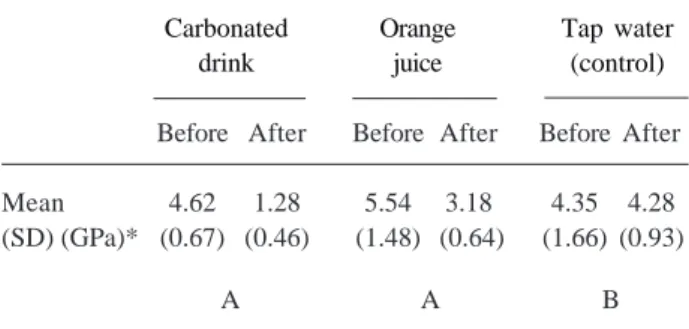
integrity for any of the groups. The nanoindentation hardness test data showed statistically significant lower values (p<0.0001) for the two experimental groups. There was a statistically significant reduction in the elastic modulus (p<0.0016) for the carbonate drink group compared to the orange juice and control groups. The carbonated beverage had a greater effect on the nanohardness and elastic modulus of the human enamel samples compared to the orange juice.
DISCUSSION
Chemical composition of an acidic drink is clearly an important factor in the mechanical properties of
enamel. Drinks that contain citric acid have been shown to be more erosive than those containing phosphoric acid (12). Factors such as pH, liquid environment and temperature affect physical properties, such as elastic modulus, hardness and surface roughness of human enamel. This study evaluated those physical properties after contact with citrus beverages. Although in vitro tests may not reflect intraoral conditions, findings under controlled conditions are helpful and can be applicable to clinical performance.
This study immersed enamel samples in the tested beverages during 30 min following a similar protocol to the ones used by West et al. and Barbour et al. (8,10), who used periods of immersion ranging from
Table 1. pH values of the beverages before and after immersion of human enamel samples.
Carbonated Orange Tap water
drink juice (control)
Before After Before After Before After
Mean 2.69 2.29 3.46 3.03 7.97 8.11
(SD)* (0.35) (0.24) (0.20) (0.14) (0.28) (0.21)
A A B
*Differences among mean values were significantly different at p<0.0001. Groups with different letters are significantly different (Tukey-Kramer grouping).
Table 2. Surface roughness of human enamel before and after beverage contact.
Carbonated Orange Tap water
drink juice (control)
Before After Before After Before After
Mean 5.30 6.86 5.26 6.73 5.76 6.11
(SD) (µm)* (2.39) (2.56) (2.27) (2.25) (3.11) (2.65)
A A A
*Differences among mean values were significantly different at p<0.49. Groups with different letters are significantly different (Tukey-Kramer grouping).
Table 3. Nanoindentation hardness of human enamel before and after contact with the beverages.
Carbonated Orange Tap water
drink juice (control)
Before After Before After Before After
Mean 4.62 1.28 5.54 3.18 4.35 4.28
(SD) (GPa)* (0.67) (0.46) (1.48) (0.64) (1.66) (0.93)
A A B
Differences among mean values were significantly different at p<0.0001. Groups with different letters are significantly different (Tukey-Kramer grouping).
Table 4. Elastic modulus of human enamel before and after contact with the beverages.
Carbonated Orange Tap water
drink juice (control)
Before After Before After Before After
Mean 111.6 62.19 115.15 92.11 117.87 107.91 (SD) (GPa)* (14.46) (10.33) (12.94) (13.83) (22.30) (20.05)
A B B
10 to 30 min. The results showed a significant decrease in the pH of the soft drinks when changing the tempera-ture from 5°C to 37°C (8-10). These findings have a significant clinical relevance due to the fact that com-monly soft drinks are served cold and temperature suddenly increases when the beverage is consumed, and reaches oral environment.
Nanoindentation is a very selective and non-destructive test for obtaining hardness and elastic modu-lus data from very hard materials. The use of an AFM verifies that the indentation was made on surfaces without gaps, or Retzius striae. Despite the broad use of the nanoindentation technique in engineering and phys-ics, its use in dentistry has not been popular until recently. Nevertheless, authors like Barbour et al. (10) used nanoindentation hardness and AFM to correlate soft drink consumption with softening of human enamel. Many investigators have confirmed the negative effect of carbonated drinks on human enamel (1,6,7,13-18). This is in agreement with the results of this study, which revealed that the carbonated drinks decreased the physical properties (hardness and elastic modulus) of human enamel. The explanation for this decrease may be erosion of enamel; erosion is defined as a loss of tooth substance by chemical processes not involving bacteria (1,6). This study showed that the soft beverage has greater effect, decreasing mechanical properties of human enamel than orange juice which is in agreement with the results of Larsen and Nyvad (4).
Acidic foods and drinks are considered impor-tant factors in erosion of human enamel (1,2). However, Meurman and Frank (12) found that unpolished enamel was less liable to erosion than polished enamel under low pH due to the structure of enamel that greatly modify the progression of dental erosion on an in vitro test. This study showed that changes in temperature caused the pH of carbonated drink and orange juice to become more acidic. Maupome et al. (6) stated that the acidicity effect of carbonated beverages is mainly due to phos-phoric acid.
The results of the present study did not reveal statistically significant changes of the surface integrity, a different finding from the results of dissolution in terms of depth of erosions reported by Larsen and Nyvad (16). However, further research should be conducted with new measurement systems, such as laser systems. There is also a need for more visual evidence with AFM analyses and for measurement of hardness and elastic
modulus using nanoindentation techniques.
The findings of this in vitro test lead to the conclusion that: 1. Human enamel nanohardness signifi-cantly decreased to about 1/3 and 1/2 of its initial value after contact with the carbonated soft drink and the orange juice, respectively; 2. Elastic modulus of human enamel decreased more in the carbonated drink (Sprite®) than in the orange juice; 3. Exposures to soft drink or orange juice for 5 weeks did not significantly affect the surface integrity of human enamel when measured by profilometry; 4. The pH of the soft drink and orange juice dropped from low to very low (acidic values) with a temperature change from 5°C to 37°C.
RESUMO
Este estudo avaliou a nanodureza, módulo de elasticidade e rugosidade de superfície do esmalte humano após contato com bebidas ácidas. Amostras de esmalte humano foram divididas em três grupos de acordo com o tipo de bebida utilizada: refrigerante gaseificado, suco de laranja e água potável (controle). A rugosidade de superfície foi avaliada usando-se um perfilômetro e a nanodureza/módulo de elasticidade utilizando-se um nanoindentador. O pH das bebidas foi medido antes e após a exposição das amostras por 5 semanas. Os valores médios (DP) foram: Refrigerante Gaseificado: o módulo de elasticidade diminuiu de 111,6(14,5) para 62,3(10,3) GPa; a nanodureza diminuiu de 4,62(0,67) para 1,28(0,46) GPa, a rugosidade de superfície aumentou de 5,30(2,39) para 6,86(2,56) µm, e o pH sofreu uma alteração de 2,69(0,35) para 2,29(0,24); Suco de Laranja: módulo de elasticidade sofreu alteração de 115,15(12,94) para 92,11(13,82) GPa; a nanodureza de 5,54(1,48) para 3,18(0,64) GPa, a rugosidade de superfície de 5,26(2,27) para 6,73(2,25) µm, e o pH sofreu uma alteração de 3,46(0,20) para 3,03(0,14);
Água Potável (Controle): módulo de elasticidade sofreu alteração
de 117,87(22,3) para 107,91(20,05) GPa; a nanodureza de 4,35(1,66) para 4,28(0,93) GPa, a rugosidade de superfície de 5,76(3,11) para 6,11(2,65) µm, e o pH de 7,97(0,28) para 8,11(0,21). Como conclusão, a exposição ao refrigerante provocou uma diminuição significante na nanodureza e no módulo de elasticidade do esmalte. O pH do refrigerante foi o mais ácido entre 5°C e 37°C. A exposição ao suco de laranja mostrou uma tendência similar, contudo o seu efeito sobre a nanodureza, módulo de elasticidade e rugosidade de superfície foi menos pronunciado.
ACKNOWLEDGEMENTS
The authors would like to thank Dr. Robert Rashid for his help with statistical analysis, and Dr. Stephen Rosenstiel for his help in the preparation of this manuscript.
REFERENCES
potential of some beverages. Caries Res 1995;29:349-354. 2 . Zero DT. Etiology of dental erosion - extrinsic factors. Eur J
Oral Sci 1996;104:162-177.
3 . Edwards M, Creanor SL, Foye RH, Gilmour WH. Buffering capacities of soft drinks: the potential influence on dental erosion. J Oral Rehabil 1999;26:923-927.
4 . Beiraghi S, Atkins S, Rosen S, Wilson S, Odom J, Beck M. Effect of calcium lactate in erosion and S. mutans in rats when added to Coca-Cola. Pediatr Dent 1989;11:312-315. 5 . Dodds M, Peggy P, Rodriguez D. The effect of some Mexican
citric acid snacks on vitro tooth enamel erosion. Pediatr Dent 1997;19:339-340.
6 . Maupome G, Diez de Bonilla J, Torres-Villasenor G, Andrade-Delgado LC, Castaño VM. In vitro quantitative assessment of enamel microhardness after exposure to eroding immersion in cola drink. Caries Res 1998;32:148-153.
7 . Badra VV, Faraoni JJ, Ramos RP, Palma-Dibb RG. Influence of different beverages on the microhardness and surface rough-ness of resin composites. Oper Dent 2005;30:213-219. 8 . West NX, Hughes JA, Addy M. Erosion of dentine and enamel
in vitro by dietary acids: the effect of temperature, acid
character, concentration and exposure time. J Oral Rehabil 2000;27:875-880.
9 . Eisenburger M, Addy M. Influence of liquid temperature and flow rate on enamel erosion and surface softening. J Oral Rehabil 2003;30:1076-1080.
10. Barbour ME, Finke M, Parker DM, Hughes JA, Allen GC, Addy M. The relationship between softening and erosion caused by soft drinks at a range of temperatures. J Dent 2006;34:207-213.
11. Xu HH, Smith DT, Jahanmir S, Romberg E, Kelly JR, Thomp-son VP, et al.. Indentation damage and mechanical properties of human enamel and dentin. J Dent Res 1998;77:472-480. 12. Meurman JH, Frank RM. Progression and surface
ultrastruc-ture of in vitro caused erosive lesions in human and bovine enamel. Caries Res 1991;25:81-87.
13. Rytomaa I, Meurman JH, Koskinen J, Laakso T, Gharazi L, Turunen R. In vitro erosion of bovine enamel caused by acidic drinks and other foodstuffs. Scand J Dent Res 1988;96:324-333.
14. Grobler SR, Senekal PJ, Laubscher JA. In vitro demineraliza-tion of enamel by orange juice, apple juice, Pepsi Cola and Diet Pepsi Cola. Clin Prev Dent 1990;12:5-9.
15. Jarvinen VK, Rytomaa II, Heinonen OP. Risk factors in dental erosion. J Dent Res 1991;70:942-947.
16. Larsen MJ, Nyvad B. Enamel erosion by some soft drinks and orange juices relative to their pH, buffering effect and con-tents of calcium phosphate. Caries Res 1999;33:81-87. 17. Arnadottir IB, Saemundsson SR, Holbrook WP. Dental
ero-sion in Icelandic teenagers in relation to dietary and lifestyle factors. Acta Odontol Scand 2003;6:25-28.
18. Gaines CV, Bourne G, Anusavice KJ, Craciun V. Structural, mechanical and morphological changes in human tooth enamel due to demineralization, in surface and interfacial nanomechanics. In: Surface and Interfacial Nanomechanics. Edited by Cook RF, Ducker W, Szlufarska I, Antrim RF. Mater Res Soc Symp Proc, Warrendale, PA, 2007;1021E, paper #1021-HH05-02.