ASSOCIATION ANALYSIS BETWEEN CHILD
DEVELOPMENT RISKS AND CHILDREN EARLY SPEECH
PRODUCTION BETWEEN 13 AND 16 MONTHS
Análise da associação entre índices de risco ao desenvolvimento
infantil e produção inicial de fala entre 13 e 16 meses
Anelise Henrich Crestani(1), Anaelena Bragança de Moraes(1), Ana Paula Ramos de Souza(1)
(1) Universidade Federal de Santa Maria – UFSM- Santa
Maria (RS), Brasil.
Study conducted at the Postgraduate Course in Human Com-munication Disorders, Universidade Federal de Santa Maria – UFSM – Santa Maria (RS), Brazil, with a scholarship granted by Coordenação de Aperfeiçoamento de Pessoal de Nível Superior (CAPES – Coordination of Improvement of Higher Education).
Conlito de interesses: inexistente
mechanisms in mother-infant dialogues, that will be instrumental in rearing the baby in and by the language3, whose irst evidence is the baby’s early
lexical production. In this study, such production is taken as an index of how much the baby is doing
regarding the passing from the shown reference to the spoken one.
Studies have shown that laws in the psychic
constitution, as in the case of a baby with autism, may be seen in almost absence of protoconver-sation2. Therefore, there seems to be a relationship
between what is detected in the initial protoconver-sation, psychological risk and future constitution of the baby in language4. Thus, it is believed that
protocols to investigate psychic risks and/or risks to the child development may predict risks for language acquisition.
In these relationships of the I-you conjunction3
(infant-mother) in the initial dialogue, the assumption of a subject by the mother is a fundamental aspect, because initially she represents a key role in the
INTRODUCTION
From birth babies already show communicative signals in interactions with their mothers, called initial protoconversation between mother and baby1.
Such protoconversation is in the origin of dialogue, in which one can characterize the interlocutors (mother and baby), the speech shifts from the
mother and the baby’s “speech”, these being illed
in various ways such as vocalizations, gaze, babble, tonic-postural dialogue, among others2.
In an enunciable perspective, protoconversation is an element generating disjunctive and conjunctive
ABSTRACT
Purpose: to investigate the association between the presence of child development risk and children early speech production between 13 to 16 months of age, and the predictive value of child development risk inventory for language initial acquisition. Methods: the sample consisted of 52 mother-child
dyads, followed by cut study from 0 to 18 months, and on the evaluation of children’s lexical production
between 13 and 16 months through spontaneous memories of the mothers and the observation of child behavior. Data were organized in categories and analyzed through the STATISTICA 9.0 software.
Results: the initial acquisition of language, measured by the number of words spoken by the baby
differs signiicantly in the presence of risks to development in the irst phase (0-4 months) and
considering babies who were at risk in any of the four phases (0 – 18 months ), whereas babys at risk have production number of words statistically lower compared to those without risk. Conclusion:
through data analysis, the research demonstrated statistical association between child development
risk and language acquisition. Children with more risk have minus lexical production.
relationships occur, babies develop a strong bond with the mother or someone replacing her who makes visible the maternal role in the mother-child interactions. It is believed that at this time it is already possible to detect signs that something is not right and intervene if necessary9.
Therefore, the professional staff working in the care of children from their birth must be attentive to the ways of interaction developed in the family environment, by watching the actions and the reper-cussions of these on the child development10.
Some studies using CRIs for the Brazilian reality show that the presence of risk to development may
be related to dificulties in the feeding transition
of babies11, 12, the presence of Attention deicit
hyperactivity disorder (ADHD)13, maternal mood
changes14,15, and also affecting change in the initial
mother-baby protoconversation4.
Considering these assumptions, the present research proposes to investigate the association between the presence of risk to child development and initial production of speech of children between 13-16 months of age, in addition to analyzing the predictive value of risk indices of child development in relation to initial language acquisition.
linguistic interpretation of the actions of the baby who does not yet speak (infans). To capture such
enunciable relations, it was necessary to seek indices of risk for the development which had psycho-analysis as the epistemological basis. Clinical Risk Indicators (CRIs) in Child Development proposed in a Brazilian multicenter research5-7 are based on
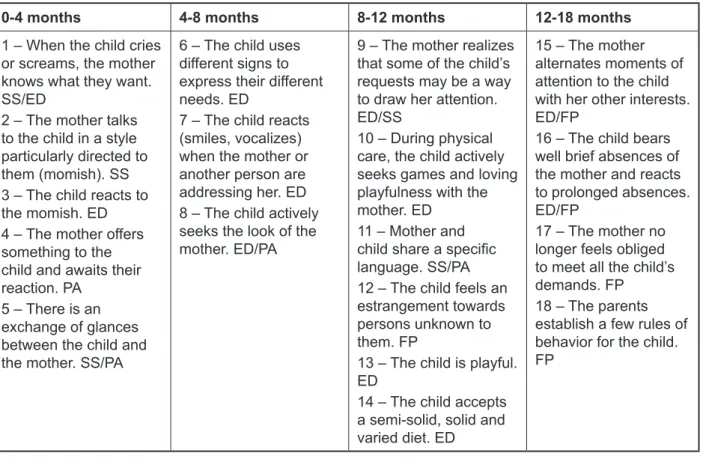
four pillars of the psychoanalytic theory about devel-opment: establishment of demand, supposition of a subject, alternating presence and absence and paternal function, which were designed on items to note in pediatric consultations in four stages (0-4 months, 4-8 months, 8-12 months, 12-18 months) (Figure 1).
Regarding such indicators (CRIs), they form
a set of indices which are observed in the irst 18
months of the child’s life, anchored in the psycho
-analytic theory, whose absence may indicate a disturbance of the evolutionary course of the child.
In this perspective, the index functions as a sign that
relates to others of the discursive network7.
By the bias of psychoanalysis and also the enunciable theory, the phase comprising the CRIs belongs to the time when the child is in full construction of their psyche and their subjectivity8.
Studies indicate that in this period, where the irst
0-4 months 4-8 months 8-12 months 12-18 months
1 – When the child cries or screams, the mother knows what they want. SS/ED
2 – The mother talks to the child in a style particularly directed to them (momish). SS 3 – The child reacts to the momish. ED 4 – The mother offers something to the child and awaits their reaction. PA
5 – There is an
exchange of glances
between the child and the mother. SS/PA
6 – The child uses different signs to
express their different
needs. ED
7 – The child reacts (smiles, vocalizes) when the mother or another person are addressing her. ED 8 – The child actively seeks the look of the mother. ED/PA
9 – The mother realizes
that some of the child’s
requests may be a way to draw her attention. ED/SS
10 – During physical care, the child actively seeks games and loving playfulness with the mother. ED
11 – Mother and
child share a speciic
language. SS/PA 12 – The child feels an estrangement towards persons unknown to them. FP
13 – The child is playful. ED
14 – The child accepts a semi-solid, solid and varied diet. ED
15 – The mother alternates moments of attention to the child with her other interests. ED/FP
16 – The child bears well brief absences of the mother and reacts to prolonged absences. ED/FP
17 – The mother no longer feels obliged
to meet all the child’s
demands. FP 18 – The parents establish a few rules of behavior for the child. FP
Final CRIs (KUPFER, 2008)
In this research, besides the spontaneous comments about words spoken by the baby, which was aimed at obtaining quantitative data of child vocabulary, one sought to observe, in home visits, mother-baby or other family member-baby scenes
of dialogue for the researcher to conirm that this
number actually showed the ability to use a declar-ative mechanism for co-reference in their verb form, i.e., the baby was producing recognizable words as a sign by the adult. This was achieved by means of observation during the interview for the CRI protocol,
and also by some ilming of adult-child interaction. In general, one observed more than 70 % of the lexical
items reported by mothers during the collecting session in observation of the dyad and/or dialogue
of the examiner with the child.
For purposes of analysis, was considered the ability or not of the child to produce words on a quantitative scale. Taking into account that the more words the child could produce the more they would be using the possibility of establishing a verbal co-reference, and the memory of the mothers is built
from natural conversational contexts, in which the
child regularly uses the same words in situations of communication with them.
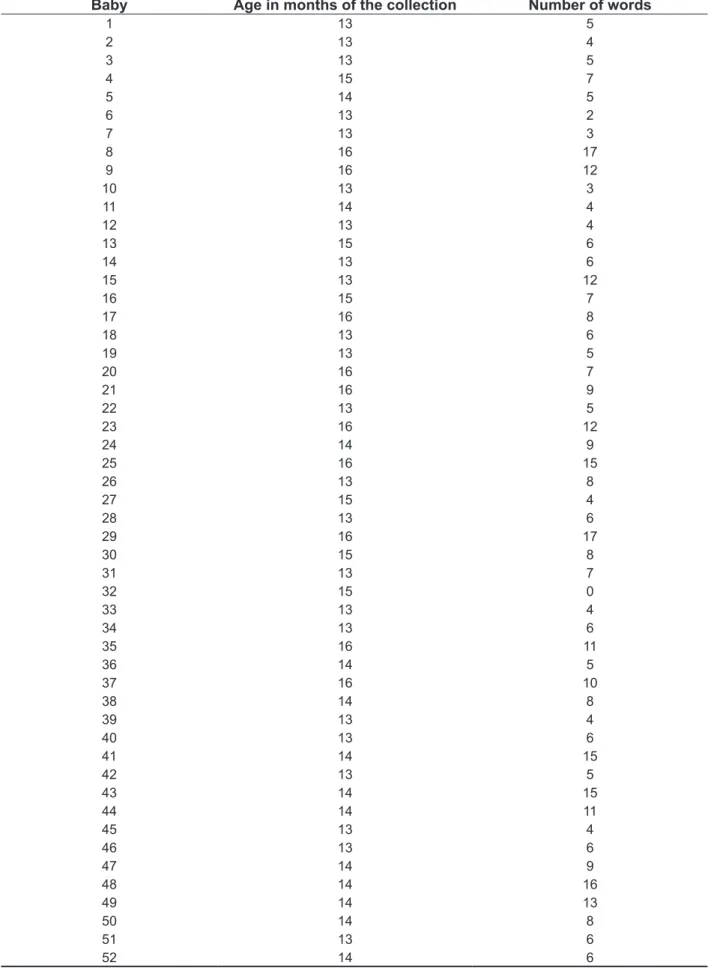
The pooled data, i.e., maternal remembrance and observation of the researcher, is presented in Table 1.
Such data was organized into categories of responses that were stored in a spreadsheet. For statistical analysis, the computer application used was STATISTICA 9.0. The categories used were:
• Analysis of standardization of age of children with and without risk to see if there was a statistical difference in age between the two groups;
• Number of words: where the mother indicated what the child was speaking at collection from her perspective, related to an obvious ability to verbally co-note during the observation of the
examiner. One considered the number of words
spoken by the child between 13 and 16 months;
• Regarding the CRIs, the children were separated into two major groups: no changed CRI, one or more changed CRls.
• Considering the great subdivision between presence and absence of risk, the groups were analyzed by age group of the indices (0-4 months, 4-8 months 8-12 months and 12-18 months) in its association with speech production between 13 and 16 months.
The quantitative data analysis was performed using descriptive and inferential statistics. The non-parametric Mann-Whitney U test was used,
with a signiicance level of 5 %.
METHODS
Mandatory ethical norms for research in humans have been used to conduct the research (Resolution 196/96 of the National Health Council – CNS), approved by the Ethics Committee of the University in which the study was conducted, in protocol number 0284.0.243.000-09. All subjects involved in the study were informed about the objectives and procedures, and afterwards read and signed the Statement of Informed Consent.
The sample consisted of 52 mothers and their babies, and full term, preterm or post-term babies were included, who passed the newborn hearing screening in a University Hospital from March to June 2010 and had a positive result. Children born
with malformations or syndromes were excluded
from the study and also babies whose mothers,
assessed by psychologists in the irst step of the
study, had a compromised psychic structure such as psychosis and schizophrenia.
The dyads were followed from the birth of the babies until 18 months of age, and this time corresponds to the time of collection of the Clinical Risk Indicators (CRIs) in Child Development. This collection started with 182 babies for the more general analyses, but only 52 were part of the study sample, because of the requirements for collecting of the four phases (zero to 18 months) of the protocol, together with the analysis of language in the step of 13 to 16 months, which seeks to capture the initial production of speech.
The collection of the CRIs was conducted in four phases, applying the CRIs corresponding to each phase, as shown in Figure 1. Therefore, the babies were seen between 0 and 4 months; between 4 and 8 months; between 8 and 12 months; and 12 and 18 months. Besides the natural observation of the CRIs
during observation of the dyad, a ilming was made,
lasting about ten minutes, to record the mother-infant interaction and enable a second assessment
of the CRIs by another experienced reviewer. If
there were any questions, the infants were retested within a range of up to one week.
In the step where the babies were aged between 13 and 16 months, the initial production of speech was collected during a visit by the researchers to the family home. The collection on this day included spontaneous comments by the mothers, given that
the babies had not expanded their vocabulary and
Table 1 – Age of observation (the researcher’s assessment and maternal memory) and production number of the babies’ words
Baby Age in months of the collection Number of words
1 13 5
2 13 4
3 13 5
4 15 7
5 14 5
6 13 2
7 13 3
8 16 17
9 16 12
10 13 3
11 14 4
12 13 4
13 15 6
14 13 6
15 13 12
16 15 7
17 16 8
18 13 6
19 13 5
20 16 7
21 16 9
22 13 5
23 16 12
24 14 9
25 16 15
26 13 8
27 15 4
28 13 6
29 16 17
30 15 8
31 13 7
32 15 0
33 13 4
34 13 6
35 16 11
36 14 5
37 16 10
38 14 8
39 13 4
40 13 6
41 14 15
42 13 5
43 14 15
44 14 11
45 13 4
46 13 6
47 14 9
48 14 16
49 14 13
50 14 8
51 13 6
Table 2 – Measurements of the ages of the children in the assessment of the communication performance regarding the Clinical Risk Indicators (CRIs) in Child Development
Range of CRIs Age (months)* p-value
Without risk With risk
0 – 4 14,0 ± 1,2 14,1 ± 1,2 0,847
4 – 8 14,1 ± 1,2 13,7 ± 0,6 0,766
8 – 12 14,1 ± 1,2 14,1 ± 1,2 0,918
12 – 18 14,1 ± 1,4 14,1 ± 1,1 0,874
0 – 18 14,0 ± 1,2 14,1 ± 1,2 0,649
CRIs = Clinical Risk Indicators (CRIs) in Child Development; *Average ± standard deviation (number of words); Without risk = children
without changed CRI; With risk = child that showed at least one changed CRI; **Signiicant by the U test of Mann-Whitney
Table 3 – Measurements of the verbal co-reference by the number of words in the range of 13 to 16 months regarding the Clinical Risk Indicators (CRIs) in Child Development assessed in the four phases of the CRIs
Age range (months) CRIs* p-value
Without risk With risk
0 – 4 8,2 ± 4,0 4,9 ± 3,5 0,024**
4 – 8 7,7 ± 4,2 6,3 ± 1,6 0,763
8 – 12 8,2 ± 4,4 6,7 ± 3,2 0,240
12 – 18 8,0 ± 4,2 6,2 ± 3,4 0,339
0 – 18 9,5 ± 4,3 6,3 ± 3,3 0,009**
CRIs = Clinical Risk Indicators (CRIs) in Child Development; *Average ± standard deviation (number of words); Without risk = children
without changed CRI; With risk = child that showed at least one changed CRI; **Signiicant by the U test of Mann-Whitney
RESULTS
Considering the possible linguistic effects of
children’s ages, it is worth noting that care was
taken to compare the ages of children at the time when communicative performance was assessed,
according to classiication of absence or presence
of risk in relation to these CRls of each step (0 – 4; 4 – 8; 8 – 12; 12 – 18), in order to verify if the
age of the children (13-16 months) would inluence
the communicative performance in the presence and absence of risk to child development, namely, the effects of different ages in the language were considered, as a child of 16 months generally speaks more than a child of 13 months.
Statistical analysis of the results in Table 2 indicated that the age of the children did not differ
signiicantly between risk and without risk, in all
ranges of the CRls tested (p value > 0.05). In verifying the babies that showed or not some changed CRI at some collection period (0-18 months), the result also showed that the age of the children did not differ for these two groups, with risk and without risk. This
made it possible to compare the groups in relation to the initial production of speech and results in the CRIs protocol.
In Table 3 above is the result of the analysis
comparing the children’s initial production of speech
and CRIs in each age group (0-18 months).
The results show (Table 3) that the range of assessment of the CRIs of zero at four months had
a statistically signiicant higher sensitivity to predict
differences between the initial number of words in relation to the CRIs because children at risk of development at this stage (changed CRIs) were the ones with the fewest words produced between 13 and 16 months.
Also the overall analysis of change of the CRIs during the 18 months (0-18 months) showed that the protocol as a whole could predict risks to language
development, in view of the signiicance observed
Regarding CRI 5, it is observed that the exchange
of glances is under no verbal communication between mother and baby and it can therefore be assumed that this aspect is the initial basis of proto-conversation that features both maternal investment
and the baby’s symbolic appetite19-21.
Assuming that the dialogue is the basic element of the language in the enunciable perspective used in this research3, the statistical association of the
CRIs in phase zero to four months may therefore
be justiied in the sample studied with the initial
production of speech searched between 13 and 16 months of the children.
This study proves, therefore, that both the
baby’s appetite and skills assessed in CRls, e.g.,
CRI 3: The child reacts to momish; IRDI 5: There
is an exchange of glances between the child and
the mother; IRDI 6: The child uses different signs
to express their different needs; IRDI 7: The child
reacts (smiles, vocalizes) when the mother or another person are addressing her; IRDI 8: The child actively seeks the look of the mother; IRDI 10: During physical care, the child actively seeks games and loving playfulness with the mother; IRDI 13: The child is playful, etc., as the parental investment
exempliied in the indices, e.g., IRDI 1: When the
child cries or screams, the mother knows what they want; IRDI 2: The mother talks to the child in a style particularly directed to them (momish); IRDI 4: The mother offers something to the child and awaits their reaction; IRDI 9: The mother realizes
that some of the child’s requests may be a way to
draw her attention; IRDI 17: The mother no longer
feels obliged to meet all the child’s demands; IRDI
18: The parents establish a few rules of behavior for the child, etc., and this is a factor that can interfere with the initial language acquisition. However, future studies that can establish a broader assessment of language of these children may deepen and qualify the analysis of the acquisition of language in children at risk for development in a combined perspective between the psychoanalytic and the enunciable
ields and provide further insight into the process of
early intervention.
It is believed that this research could be taken, however, as an indicator that there is a positive relationship between what is in the CRI protocol and the initial process of language acquisition, demon-strating the potential of the protocol used to predict risks of development of language acquisition.
The implication of this study suggests the impor-tance of implementing the CRI protocol in primary care services for maternal and child health, and the need for future research for the follow-up of infants who are at risk of child development until more advanced ages than this research proposed to investigate.
DISCUSSION
The results of this research show that the acquisition of language in its dimension of speech
production signiicantly correlates to the presence of
risks to child development, evidenced in the ongoing analysis of the four age groups of the collection of analyzed CRls. Thus, children at risk of development between zero and 18 months, produced statistically
signiicant fewer words than the ones without risk.
These results demonstrate the connection between psychological risk and/or development and
presence of risk to the acquisition of language. One
can not say that these children will develop language disorders, but that they are in a less favorable situation for such development than children without the presence of risk.
Regarding the analysis of the four phases that
constitute the CRIs, one can notice that the irst
phase comprising zero to four months of age of the child was more sensitive to capture a delay in
language acquisition. A possible explanation for
this result is that the indices of this important phase
signiicantly capture the functioning of the maternal position, because the maternal Other takes the baby’s manifestations, expecting that it is taken
as something to be read and not as something of
the observation ield17. The aforementioned aspect
could be observed in the analysis of each index of
phase I (0-4 months).
CRI 1, that is related to the mother knowing what the baby wants when they cry, assigns an interpretation in language attuned to the demands of the baby, which can facilitate the insertion of the baby in language functioning, according to several authors 4,12,14,15.
This is also connected to CRI 2, in which it is analyzed if the mother uses the momish, and to CRI
3, in which it is observed if the baby reacts to it. Both
relect the essence of protoconversation1,2. If they
are absent, they demonstrate that the initial mother-baby dialogue is not being well processed.
Some authors claim that the mother’s speech
is a rehearsal of who carries the maternal role of making sense of bodily impulses of the baby18, and
both the desire and the “no desire” of the mother
are expressed through her voice. It can be hypoth
-esized from the results of this research that the baby
who does not live this qualiied experience may not
be being inserted with the same magnitude in the world of language.
Also CRI 4 is in that context, as the mother is
related to being able to propose something and
giving time for the baby’s response, which may
Regarding the predictive value of each age group analyzed by the indices of risk to child
devel-opment, it was observed that CRIs of the irst phase
(0-4 months) are the best evidence that the initial production of speech, i.e., the absence of these indices, was crucial to the lower initial production of speech.
CONCLUSION
Considering the objectives of this research, it was observed that there was an association between the CRIs and the initial production of speech. Thus, infants at risk had lower initial production of speech than babies without risk.
REFERENCES
1. Laznik MC, Parlatto-Oliveira E. Em busca da
Melodia. Rev Mente e Cérebro. 2010;(2):56-61. 2. Mahdhaoui A, Chetouani M, Cassel RS,
Saint-Georges C, Parlato-Oliveira E, Laznik MC et al.
Computerized home video detection for motherese may help to study impaired interaction between infants who become autistic and their parents. International. Journal of Methods in Psychiatric Research. 2011;20(1):e6–e18.
3. Silva CLC. A criança na linguagem: enunciação e aquisição. Campinas: Pontes, 2009.
4. Flores MR, Beltrami L, Souza APR. O manhês e
suas implicações para a constituição do sujeito na linguagem. Rev Dist Comun. 2011; 23(2):143-52. 5. Kupfer MCM, Voltolini R. Uso de indicadores em pesquisas de orientação psicanalítica: um debate conceitual. Rev Psic Teor e Pesq. 2005;21(3):359-64.
6. Kupfer MCM. (coord) Relatório Cientíico inal: leitura da constituição e da psicopatologia
do laço social por meio de indicadores clínicos: uma abordagem interdisciplinar atravessada
pela psicanálise. Projeto temático FAPESp n.2003/09687-7, 2008.
7. Kupfer MCM, Jerusalinsky NA, Bernardino LMF, Wanderley D, Rocha PSB, Molina SE et al. Predictive value of clinical risk indicators in child
development: inal results of a study based on
psychoanalytic theory. Rev latinoam psicopatol fundam. 2010;13(1):31-52.
8. Pinto EB. Os sintomas psicofuncionais e as consultas terapêuticas pais/bebê. Estud psicol.
2004;9(3):451-7
9. Jerusalinsky, J. Enquanto o futuro não vem: a
psicanálise na clínica interdisciplinar com bebês.
Salvador: Ágalma, 2002.
10. Silva PL, Santos DCC, Gonçalves VMG.
Inluência de práticas maternas no desenvolvimento
motor de lactentes do 6º ao 12º meses de vida. Rev Bras Fisioter. 2006;10(2):225-31.
11. Vendruscolo JF, Bolzan GM, Crestani AH, Souza APR, Moraes AB. A relação entre o aleitamento, transição alimentar e os indicadores de risco para o desenvolvimento infantil. Rev Dist Comun. 2012;24(1):41-52.
RESUMO
Objetivos: investigar a associação entre presença de risco ao desenvolvimento infantil e produção
inicial de fala de crianças na faixa de 13 a 16 meses de idade e analisar o valor preditivo dos índices
de risco ao desenvolvimento infantil em relação à aquisição inicial da linguagem. Métodos: a amostra
foi constituída de 52 díades mães-bebês, seguidas em estudo de coorte de zero aos 18 meses, por
meio dos Índices de risco ao desenvolvimento infantil e avaliadas quanto à produção de fala entre 13 e 16 meses por meio de lembranças espontâneas das mães e da observação do comportamento
infantil. Os dados foram organizados em categorias e lançados para a análise estatística no aplicativo
computacional STATISTICA 9.0. Resultados: a aquisição da linguagem inicial, medida pelo número
de palavras faladas pelo bebê, difere de modo signiicante na presença de riscos ao desenvolvimento na primeira fase (0 – 4 meses) e considerando bebês que apresentaram risco em alguma das quatro
fases (0 – 18 meses), visto que bebês com risco apresentam número de produção de vocábulos esta
-tisticamente inferior em relação aos sem risco. Conclusão: pela análise dos resultados a pesquisa demonstrou associação estatística entre risco ao desenvolvimento infantil e produção inicial de fala. Quanto maior o risco menor a produção de fala.
DESCRITORES: Cuidado do Lactente; Fonoaudiologia; Fatores de Risco; Linguagem;
17. Pesaro ME. Alcance e limites
teórico-metodológicos da pesquisa multicêntrica de
indicadores clínicos de risco para o desenvolvimento infantil. [Tese] São Paulo (SP): Universidade de São Paulo; 2010.
18. Pierotti MMS, Levy L, Zornig SA. O manhês: costurando laços. Estilos da clínica.
2010;15(2):420-33.
19. Ferrari AG, Donelli TMS. Becoming a mother and preterm birth: considerations about the constitution
of motherhood in the context of very low birth weight. Contextos Clínic. 2010;3(2):106-12.
20. Pinheiro MG, Cunha MC. Voz e psiquismo: diálogos entre fonoaudiologia e psicanálise. Dist Comunicação. 2004;16(1):83-91.
21. Inafuku CK. From the unfeasible separation to the other possible treatment. The child question the treatment. Estilos da clinica. 2004;9(17):52-69. 12. Crestani AH, Souza APR, Beltrami L, Moraes AB.
Análise da associação entre tipos de aleitamento, presença de risco ao desenvolvimento infantil, variáveis obstétricas e socioeconômicas. J Soc Brasil Fonoaudiol. 2012;24(3):205-10.
13. Kupfer MCM, Bernardino LMF. As relações entre construção da imagem corporal, função paterna e
hiperatividade: relexões a partir da Pesquisa IRDI.
Rev Latinoam Psicopat Fund. 2009;12(1):45-58. 14. Beltrami L. Ansiedade materna puerperal e risco para alterações no desenvolvimento infantil. Santa Maria: 2011. [Dissertação] Santa Maria (RS): Universidade Federal de Santa Maria; 2011.
15. Carlesso JPP, Souza APR. Dialogia mãe-ilho
em contextos de depressão materna: revisão de
literatura. Rev CEFAC. 2011;13(6): 1119-26.
16. Bastos JC, Ramos APF, Marques J. Estudo do vocabulário infantil: limitações das metodologias tradicionais de coleta. Rev Soc Bras Fonoaudiol. 2004;9(1):1-9.
Received on: January 29, 2014 Accepted on: May 14, 2014
Mailing address:
Anelise Henrich Crestani R. André Marques, 185/301 Santa Maria – RS – Brasil CEP: 97010-041