SUMMARY
Objective: To analyze the costs of human immunodeiciency virus (HIV) outpatient treatment for indi-viduals with diferent CD4 cell counts in the Brazilian public health system, and to compare to costs in other national health systems. Methods: A retrospective survey was conducted in ive public outpatient clinics of the Brazilian national HIV program in the city of São Paulo. Data on healthcare services pro-vided for a period of one year of HIV outpatient treatment were gathered from randomly selected medi-cal records. Prices of inputs used were obtained through market research and public sector databases. Information on costs of HIV outpatient treatment in other national health systems were gathered from the literature. Annual costs of HIV outpatient treatment from each country were converted into 2010 U.S. dollars. Results: Annual cost of HIV outpatient treatment for the Brazilian national public program was US$ 2,572.92 in 2006 in São Paulo, ranging from US$ 1,726.19 for patients with CD4 cell count > 500 to US$ 3,693.28 for patients with 51 ≤ CD4 cell count < 200. Antiretrovirals (ARVs) represented approximately 62.0% of annual HIV outpatient costs. Comparing among diferent health systems during the same period, HIV outpatient treatment presented higher costs in countries where HIV treatment is provided by the private sector. Conclusion: he main cost drivers of HIV outpatient treatment in difer-ent health systems were: ARVs, other medications, health professional services, and diagnostic exams. Nevertheless, the magnitude of cost drivers varied among HIV outpatient treatment programs due to health system eiciency. he data presented may be a valuable tool for public policy evaluation of HIV treatment programs worldwide.
Keywords: HIV; antiretroviral therapy; highly active; costs and cost analysis; CD4 lymphocyte count;
health policy.
©2012 Elsevier Editora Ltda. All rights reserved.
RESUMO
Análise comparativa dos custos ambulatoriais em programas de tratamento de pacientes HIV
Objetivo: Analisar custos de tratamento ambulatorial de pacientes portadores do vírus da imunodei-ciência humana (HIV) com diferentes níveis de CD4 no sistema público de saúde brasileiro e compa-rar aos custos de outros sistemas de saúde. Métodos: Foi conduzida pesquisa retrospectiva em cinco ambulatórios especializados do programa DST/AIDS no município de São Paulo. Dados referentes à assistência ambulatorial para tratamento de pacientes HIV durante um ano foram obtidos em prontuá-rios médicos selecionados aleatoriamente. Preços dos recursos utilizados foram obtidos via pesquisa de mercado e bancos de dados do setor público. Informações sobre custos do tratamento ambulatorial de pacientes HIV em outros sistemas de saúde foram obtidos na literatura. Os custos anuais de tratamento ambulatorial de pacientes HIV em cada país foram convertidos em dólares norte-americanos no ano base 2010. Resultados: O custo anual de tratamento ambulatorial para pacientes HIV no programa público nacional foi US$ 2.572,92 em 2006 no município de São Paulo, variando entre US$ 1.726,19 para pacien-tes com CD4 > 500 e US$ 3.693,28 para pacienpacien-tes com 51 ≤ CD4 < 200. Medicamentos antirretrovirais (ARVs) representaram aproximadamente 62,0% dos custos de tratamento ambulatorial de pacientes HIV. Comparando-se custos entre diferentes sistemas de saúde no mesmo período, o tratamento ambulatorial de pacientes HIV apresentou custos superiores nos países onde a provisão do tratamento é realizada pelo setor privado. Conclusão: Os principais determinantes dos custos de tratamento ambulatorial de pacien-tes HIV são: medicamentos ARVs, outros medicamentos, proissionais de saúde e exames diagnósticos. No entanto, a magnitude de participação dos determinantes de custos nos programas de tratamento ambulatorial de pacientes HIV varia em decorrência da eiciência do sistema de saúde. Os dados apresen-tados constituem importante instrumento para avaliação de políticas públicas de saúde relacionadas ao tratamento de pacientes HIV mundialmente.
Unitermos: HIV; terapia antirretroviral de alta atividade; custos e análise de custos; contagem de linfócito CD4; política de saúde.
©2012 Elsevier Editora Ltda. Todos os direitos reservados.
Study conducted at Faculdade de Economia, Administração e Contabilidade da Universidade de São Paulo (FEA-USP), São Paulo, SP, Brazil
Submitted on: 05/01/2012 Approved on: 05/10/2012
Correspondence to:
Flavia Mori Sarti Av. Arlindo Béttio, 1000 São Paulo, SP, Brazil
CEP: 03828-000 [email protected]
Conflict of interest: None.
A comparative analysis of outpatient costs in HIV treatment programs
FLAVIA MORI SARTI1, MARISLEI NISHIJIMA1, ANTONIO CARLOS COELHO CAMPINO2, DENISE CAVALLINI CYRILLO1
INTRODUCTION
Highly active antiretroviral therapy (HAART), adopted in 1996, combines antiretroviral drugs (ARVs) to reduce morbimortality rates among human immunodeiciency virus (HIV) patients, resulting in prolonged life expectan-cy1-5 and increasing treatment costs.
Studies on costs of HIV treatment are usually per-formed through gross-costing techniques6-11, analyzing
speciic healthcare expenditures12-19, using private
perspec-tive20-24 or exclusively using the costs for ARV provision25-29;
all of which report general trends of HIV treatment costs. Although there is a general consensus on the consid-erable share of costs due to ARVs6-24,30, there is still lack
of evidence on the major cost drivers of HIV outpatient treatment for individuals in diferent categories of CD4 cell count, particularly regarding nationwide publicly-inanced HIV treatment programs, such as that of Brazil.
he Brazilian public program for HIV treatment was initiated in 1996 through ARVs distribution, prevention campaigns, and a healthcare program for sexually trans-mitted diseases (STD). In 2006, the program reached 180,000 individuals for HIV treatment within public health system. Currently, the Brazilian STD/ acquired immunodeiciency syndrome (AIDS) program provides inpatient and outpatient HIV treatment, including distri-bution of 17 HAART drugs31,32.
According to Teixeira et al.5, the program resulted in
decreased morbimortality and hospitalization rates; how-ever, it also increased the demand for outpatient services and should continuously increase government expendi-tures due to the HIV incidence of approximately 20,000 cases per year31,32.
Investigation on the cost composition of the Brazilian HIV program seems necessary to promote long-term pub-lic popub-licy sustainability. Considering that usually there are data limitations to provide guidance for government deci-sions, this article seeks to ofer evidence to contribute to strategic planning of public policies by analyzing the costs of HIV outpatient treatment for individuals with diferent CD4 cell counts within the Brazilian public program.
METHODS
CHARACTERISTICSOFTHE BRAZILIAN STD/AIDS PROGRAM he analysis was based on a retrospective survey conduct-ed in ive public outpatient clinics in São Paulo, Brazil. he municipal branch of the Brazilian STD/AIDS program in São Paulo, known as the Programa Municipal DST/AIDS de São Paulo (PMDASP), consists of 15 clinics for outpa-tient treatment, three diagnostic facilities, and one admin-istrative headquarters.
A micro-costing technique was used to perform costs estimates of HIV outpatient treatment for individuals with diferent CD4 cell counts within the program; based on
identiication, measurement, and valuation of resources required to provide the healthcare services demanded33,
from the public provider perspective.
he Brazilian STD/AIDS program is considered a mul-tiservice unit that provides HIV and STD outpatient treat-ments, HIV/STD diagnoses, and HIV/STD prevention activities. herefore, the program requires sets of speciic resources to provide healthcare services (healthcare-related inputs), and, additionally, a set of unspeciic resources shared among several activities (technical-administrative inputs).
Implementation of the micro-costing technique to per-form the analysis of costs derived from HIV outpatient treatment in the program encompassed three stages:
1. Identiication and measurement of speciic resourc-es necresourc-essary to provide HIV outpatient treatment, through inventory of medical procedures per-formed in a sample of patients during 2006, in order to estimate the technical coeicients of the inputs; 2. Identiication and measurement of unspeciic
re-sources necessary to support HIV outpatient treat-ment, via assessment of infrastructure and of the administrative sector within the program, and esti-mation of an overhead allocation factor;
3. Calculation of costs due to HIV outpatient treat-ment, through valuation of resources required using applicable prices and technical coeicients of inputs or overhead allocation factor, followed by addition of values and further data processing to account for inlation and exchange rates.
INVENTORYOFMEDICALPROCEDURES
SAMPLE
Sample size estimate was based on a population of 11,373 (67.7%) patients with CD4 cell count < 1,000 cells per µL at the beginning of the research in 2006, considering that CD4 cell count is usually adopted as a health status marker for HIV patients.
A two-stage sampling process was performed in order to assure representativeness. In the irst stage, ive settings of the program were selected using a stratiied purposive sampling method, in order to represent the variability of socio-demographic conditions in ive diferent regions of São Paulo. Distribution of patients according to CD4 cell count within each of the 15 clinical settings was tested, in order to verify similarity in relation to the distribution of CD4 cell count in the program.
Data on 441 (88.2%) medical charts were collected, mainly due to problems in the database from one of the selected clinical settings. Information provided in 370 (74.0%) medical charts was properly completed during 2006. Primary data analysis resulted in 352 (70.4%) pa-tients in continuous HIV outpatient treatment during 2006. Mean and variance tests were performed in order to assure sample representativeness, conirming the sim-ilarity hypothesis.
Inclusion criteria were: medical charts of individu-als in continuous HIV outpatient treatment during 2006, including one CD4 cell count at the beginning of the pe-riod and complete information on healthcare services provided. Exclusion criteria were: medical record in-complete or lost, patient’s death in 2006, CD4 cell count < 1,000, and abandonment or irregularity in HIV treat-ment (considering the registry of ARV withdrawals). he study was approved by the Ethical Committee of the Municipal Secretary of Health of São Paulo (Process 0135.0.162.000-06).
TECHNICALCOEFFICIENTSOFINPUTS
Healthcare services provided during one year of HIV outpatient treatment were registered in a questionnaire containing nine sections: 1) socioeconomic data; 2) ARV drugs prescription; 3) other medication prescription; 4) vaccines; 5) diagnostic exams, CD4 cell count, and viral load; 6) other exams; 7) health procedures performed; 8) dental treatments; and 9) other information.
Health professionals were trained to complete the questionnaire, in order to assure quality and standard-ization in data collection. Healthcare services registered in patients’ charts during 2006 were recorded in a single database and summarized as a set of medical procedures and medication annually supplied for integral medical assistance of HIV outpatient treatment.
Each medical procedure was split into the set of re-sources (e.g. needle, syringe, nurse time, and other) required to perform the health service, according to the technical coeicients of inputs reported in the medical literature.
Certain medical procedures (vaccination and medi-cation withdrawal) and exams (diagnoses) presented in-suicient evidence in the literature to support estimates of technical coeicients of inputs; therefore, two strate-gies were adopted. In the irst case, a focus group com-posed of health professionals collaborated to complete detailed information on technical coeicients of inputs for medical procedures. In the second case, the three dedicated diagnosis facilities within the HIV treatment program provided the accounting data necessary to per-form estimates of the economic costs of each exam.
ASSESSMENTOFINFRASTRUCTUREANDADMINISTRATIVESECTOR
Infrastructure and administrative resources appraisal was performed for the following categories of overhead: 1) real estate; 2) public utility services (water, electricity, tele-phone, and other); 3) administrative personnel; 4) other supporting services (cleaning and security); 5) technical and administrative support equipment; and 6) stationery and other oice supplies.
Estimates included the 15 outpatient clinics and one administrative headquarters within the program in the city of São Paulo.
Real estate was expressed as area occupied, according to information provided by the PMDASP. Public utility services consumed during 2006 were calculated according to invoice data. Human resources were calculated accord-ing to the PMDASP payroll. Other supportaccord-ing services were recorded through data in outsourcing contracts.
Technical and administrative support equipment were estimated according to basic infrastructure recommended for ambulatory assistance reported in a reference guide for healthcare services published by the Brazilian Ministry of Health. Compliance to recommendations was investigated by comparing references with the infrastructure observed
in loco. Stationery and other oice supplies were calculated
according to invoices information.
In order to properly distribute the share of infrastruc-ture and administrative resources among diferent health-care services provided within the program, an applicable rate of overhead allocation factor was estimated based on global expenditures and number of patients in follow-up during 2006.
he program covered 16,789 HIV patients and 4,317 STD patients in outpatient treatment in São Paulo during 2006; a global cost of US$ 63,876,528.60 (igures converted into 2010 U.S. dollars), encompassing US$ 2,552,545.29 (4.0%) for primary prevention and US$ 61,323,983.31 (96.0%) for outpatient treatment. Expenditures on out-patient treatment were distributed between HIV out-patients (86.9% of total cost) and other STDs patients (9.1% of total cost); the former rate was considered an appropriate over-head allocation factor to determine the share of unspeciic resources attributable to healthcare services performed for HIV outpatient treatment.
RESOURCESVALUATION
PRICESRESEARCH
Data collection regarding prices included the valuation of resources registered as medical procedures and as infra-structure/administrative sector.
health procedures (e.g. therapy, counseling, medical con-sultation, curatives, and other) were collected through market research at retail suppliers. Prices related to den-tal services, diagnostics, and other exams were gathered from public databases on government fees for payment of private providers. Prices related to other inputs required (e.g. infant formula, condoms, and other) were obtained through market research at retail suppliers.
Considering resources required for infrastructure/ administrative sector, prices of public utility services consumed during 2006 were based on total expenditures registered in the invoices. Expenditures on supporting ser-vices were gathered from the outsourcing contracts. Wages referring to human resources were obtained directly from the PMDASP payrolls. Prices of stationery and other oice supplies were collected from the invoices.
Real estate was valued according to the opportunity cost of rental in the area occupied. Technical and adminis-trative support equipment was valued according to market research conducted at retail suppliers. Obsolete equipment not found in market research was valued according to the inventory data from government accountancy systems provided by the Ministry of Health. Information on real estate and durable resource lifecycles was obtained from the Foundation Institute for Economic Research (Funda-ção Instituto de Pesquisas Econômicas — FIPE), which is responsible for cost of living estimates in São Paulo, in or-der to allow accounting for depreciation (corresponding to the amortization of the inancial capital in each period, inversely related to resource lifecycle), maintenance (con-sidered equivalent to depreciation), and daily opportunity costs due to inancial operations in acquisition, using the oicial long-term interest rate for social programs from the Brazilian Development Bank (Banco Nacional de De-senvolvimento Econômico e Social — BNDES).
COSTESTIMATES
Cost calculation of HIV outpatient treatment for indi-viduals with diferent CD4 cell counts within the Brazilian public program involved ive stages:
1. Obtaining the cost of medical procedures per-formed, multiplying the prices of inputs required by technical coeicients of inputs, and adding up medical procedures supplied to each patient during 2006;
2. Obtaining the cost of services provided by admin-istrative sector, multiplying the prices of inputs re-quired annually by the overhead allocation factor and, subsequently, dividing by the HIV patients’ visits registered in 2006;
3. Obtaining the cost of services provided by infra-structure, dividing the value of real estate or equip-ment by estimated lifecycle. Annual cost of infra-structure was multiplied by the overhead allocation factor and, subsequently, divided by HIV patients’ visits registered in 2006;
4. Annual costs attributable to the set of resources consumed in HIV outpatient treatment for each individual during 2006 were added and converted into U.S. dollars at the oicial exchange rate of De-cember 29, 2006;
5. Accumulated inlation rate until 2010 was applied in order to provide actual igures in 2010 U.S. dollars, according to the Consumer Price Index reported by the Bureau of Labor Statistics.
Annual costs of HIV outpatient treatment from the Brazilian public program in São Paulo were stratiied by CD4 cell count, considering major cost drivers according to categories. Literature research on studies analyzing the cost composition of HIV outpatient treatment in difer-ent international health systems was performed, in order to undertake a comparison across countries, considering only studies conducted through similar methodology and costing techniques.
RESULTS
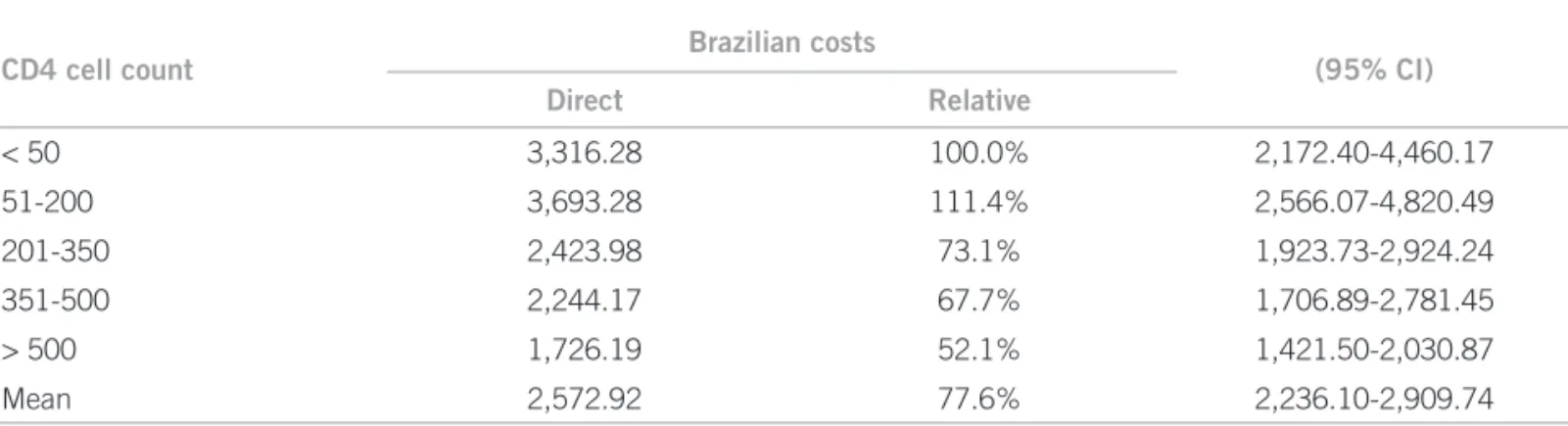
Annual costs estimated for HIV outpatient treatment with-in the Brazilian public program varied from US$ 1,726.19 for patients with higher CD4 cell count to US$ 3,693.28 for patients with 51 < CD4 ≤ 200 (Table 1).
CD4 cell count Brazilian costs (95% CI)
Direct Relative
< 50 3,316.28 100.0% 2,172.40-4,460.17
51-200 3,693.28 111.4% 2,566.07-4,820.49
201-350 2,423.98 73.1% 1,923.73-2,924.24
351-500 2,244.17 67.7% 1,706.89-2,781.45
> 500 1,726.19 52.1% 1,421.50-2,030.87
Mean 2,572.92 77.6% 2,236.10-2,909.74
Patients with higher CD4 cell count had lower outpa-tient costs, accounting for nearly half of treatment costs estimated for patients with lower CD4 cell count. HIV outpatient treatment costs declined slightly for individu-als with CD4 cell count ≤ 50 due to the decrease in ARV costs. Nevertheless, such shit in the structure of costs within the Brazilian public program is compensated by an increase in costs due to other healthcare services (such as dental care) within the program.
here were no signiicant diferences in costs of HIV outpatient treatment in relation to individuals’ gender and ethnicity. Regarding age group, average costs due to ARVs and exams were higher for younger individuals (Table 2).
Main cost drivers of HIV outpatient treatment in the Brazilian public program in São Paulo during 2006 were ARVs, medications other than ARV, health professional services, and diagnostic exams.
A signiicant proportion of HIV outpatient treat-ment costs was associated to ARV utilization, ranging from 55.8% of the annual outpatient treatment costs for individuals with CD4 cell count ≤ 50 to 66.8% of the annual outpatient treatment costs for individuals with 351 < CD4 ≤ 500.
Medications other than ARV represented 16.1% of the annual outpatient treatment costs for a typical HIV patient in the program, whereas the third cost category in terms of budgetary impact within the program was health pro-fessional services (8.7%). he proportion of costs due to medications other than ARVs presented broad variation across CD4 cell count strata, because of opportunistic ill-ness treatment.
he shit in cost composition within the Brazilian public program for individuals with CD4 cell count ≤ 50 appears to be related to the lower consumption of health professional services in the case of patients in worst health condition. However, medications other than ARV take a higher priority among patients with CD4 cell count ≤ 50, probably due to opportunistic infections.
Literature research on HIV outpatient treatment costs for HAART retrieved seven studies reporting details of healthcare costs from diferent countries from the late 1990’s until 2006-2007, based on micro-costing techniques using the public provider perspective16,17,19-21,30,34. One of
the studies did not report ARV costs within HIV treat-ment19, and one study failed to present detailed data on
HIV outpatient treatment costs20 and therefore both were
excluded from the cost composition comparison.
Table 2 – Annual costs of HIV outpatient treatment of the Brazilian public program in the major cost categories, according to demographic and epidemiologic characteristics. São Paulo, Brazil, 2006 (2010 USD)
n ARVs Other
medications
Health professionals
Diagnostic
exams Infrastructure
Other materials
Age
18-29 30 2,208.61 137.08 275.24 783.72 109.22 94.98
30-39 127 1,415.98 143.20 213.55 454.64 109.22 94.98
40-49 130 1,536.84 128.70 229.01 329.24 109.22 94.98
> 50 65 1,774.43 124.35 216.59 341.28 109.22 94.98
Ethnicity
White 187 1,478.89 142.91 220.49 394.30 109.22 94.98
Black 41 1,891.48 117.17 223.56 432.25 109.22 94.98
Mixed race 99 1,551.63 127.36 226.67 502.21 109.22 94.98
Other/missing 25 2,140.02 119.05 255.58 202.41 109.22 94.98
Gender
Female 136 1,351.84 139.86 226.86 462.60 109.22 94.98
Male 216 1,747.06 130.05 223.96 385.75 109.22 94.98
CD4 cell count
< 50 20 1,849.74 885.28 228.61 148.46 109.22 94.98
51-200 80 2,197.21 906.87 222.68 162.33 109.22 94.98
201-350 87 1,543.99 300.94 225.96 148.90 109.22 94.98
351-500 93 1,499.08 191.16 225.73 124.00 109.22 94.98
> 500 72 1,037.52 166.95 224.86 92.65 109.22 94.98
Mean 1,594.36 415.44 225.08 133.84 109.22 94.98
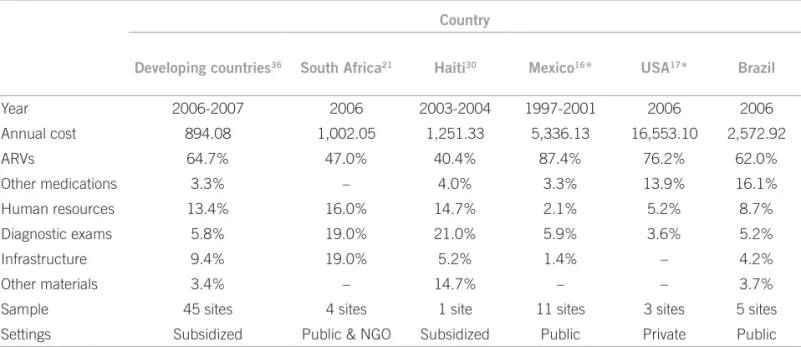
Cost drivers of HIV outpatient treatment in difer-ent health systems presdifer-ented a certain similarity regard-ing the share attributable to main cost categories (ARVs, medications other than ARV, health professional ser-vices, and exams). However, the cost composition of the Brazilian public program in São Paulo presented some diferences in relation to other countries (Table 3).
Additionally, the costs of HIV outpatient treatment in public programs16,21,30,34 were considerably lower
com-pared to HIV outpatient treatment costs in private set-tings for the same period17. Costs from the Brazilian
pub-lic program for HIV treatment in São Paulo during 2006 were equivalent to 10% to 20% of the costs reported in the USA study.
DISCUSSION
he results obtained regarding cost composition of HIV outpatient treatment from the Brazilian public program in São Paulo during 2006 match those of the litera-ture16,17,21,30,34, which indicate that the main cost drivers
in HIV outpatient treatment are, correspondingly: ARVs, other medications, health professional services, and diag-nostic exams. Nevertheless, the magnitude of cost drivers varied among HIV outpatient treatment programs due to health system eiciency, which may be associated with health inancing structure and scale.
In terms of HIV program inancing, the Brazilian public program for HIV treatment resembles the pub-lic inancing scheme described in the Mexican study16,
which provides publicly inanced healthcare services for HIV outpatient treatment, while the treatment for HIV patients in the USA is usually based on private out-of-pocket expenditures.
ARVs still represented a major part of HIV outpa-tient treatment costs in the Brazilian public program, independently of CD4 cell count stratum. Although the Brazilian public program for HIV treatment is oten discussed regarding ARV patents issues, a comparative study on ARV prices in Brazil and other low- to middle-income countries showed higher ARV prices in Brazil, especially in the case of locally-produced generic ARVs. Furthermore, the study shows that contrary to trends worldwide, generic ARVs prices have been increasing in Brazil since 200325.
Considering that cost estimates may be subject to diferent methodologies, the cost comparison among healthcare services provided for HIV patients in diferent health systems was performed cautiously, in order to ac-complish an adequate selection of studies that described in detail the costing techniques, estimation procedures, databases used, and perspective adopted.
According to Levy et al.35, less than 2% of
coun-try studies reporting costs of HIV treatment based on HAART provided “adequate data” or “useful estimates” to ensure “a meaningful statement about costs”. More-over, there are evidences of signiicant discrepancies be-tween model estimates and country specialists’ estimates on resource requirements for HIV care36.
Only ive studies reporting details of HIV outpatient costs based on micro-costing techniques using public provider perspective were retrieved from the late 1990’s to 2006-200716,17,19-21,30,34. Other studies on HIV treatment
costs were performed prior to HAART development, as properly summarized by Gebo et al.17. No study
pre-senting more recent data on HIV treatment costs was retrieved.
Country
Developing countries36 South Africa21 Haiti30 Mexico16* USA17* Brazil
Year 2006-2007 2006 2003-2004 1997-2001 2006 2006
Annual cost 894.08 1,002.05 1,251.33 5,336.13 16,553.10 2,572.92
ARVs 64.7% 47.0% 40.4% 87.4% 76.2% 62.0%
Other medications 3.3% – 4.0% 3.3% 13.9% 16.1%
Human resources 13.4% 16.0% 14.7% 2.1% 5.2% 8.7%
Diagnostic exams 5.8% 19.0% 21.0% 5.9% 3.6% 5.2%
Infrastructure 9.4% 19.0% 5.2% 1.4% – 4.2%
Other materials 3.4% – 14.7% – – 3.7%
Sample 45 sites 4 sites 1 site 11 sites 3 sites 5 sites
Settings Subsidized Public & NGO Subsidized Public Private Public
ARV, antiretrovirals; NGO, non-governamental organizations. *Based on weighted average of data presented in the studies.
CONCLUSION
Although cost comparison across diferent countries may be subject to some problems, due to both social context of the health system and methodology adopted for the cost estimates, this study aimed to illustrate the similarities and divergences in cost composition of HIV outpatient treat-ment provided in diferent national health systems, pre-senting the main costs drivers associated to various health inancing arrangements.
Public programs for universal HIV treatment, such as the Brazilian case, are widely recognized, but seldom analyzed in terms of economic costs. he few evidences available include government budgetary igures analysis through gross-costing technique5,31 or cost-efectiveness
analysis based on ARV prescriptions at patient level32.
Additionally, the mortality rates due to HIV in São Paulo have been declining notably since the program was started in 1990’s, decreasing from 21.2 to 7.9 deaths per 100,000 inhabitants during the period between 1991 and 2007, according to data from MonitorAIDS, a system from the Brazilian Ministry of Health designed to monitor the AIDS epidemics. he situation poses a challenge regard-ing strategies for public policy management in the health sector, in order to accomplish a balance between public i-nancing through taxation and healthcare provision for the population.
he present study was designed to comprise a primary tool for public policy evaluation, and its results may be a valuable source of information for HIV programs world-wide. he main limitation of the analysis is the absence of cost estimates for HIV inpatient treatment. Addition-ally, the representativeness of the sample was calculated to characterize a municipal branch of the Brazilian public program for HIV treatment located in São Paulo and thus some results may not be extrapolated to country level due to scaling efects.
REFERENCES
1. Bonnet F, Morlat P, Chêne G, Mercié P, Neau D, Chossat I, et al. Causes of death among HIV-infected patients in the era of anti-retroviral therapy in Bor-deaux, France, 1998-1999. HIV Medicine.2002;3:195-9.
2. Egger M, Hirschel B, Francioli P, Sudre P, Wirtz M, Flepp M, et al. Impact of new anti-retroviral combination therapies in HIV infected patients in Switzer-land: Prospective multicentre study. BMJ. 1997;315:1194-9.
3. Palella FJ Jr, Mdelaney KM, Moorman AC, Loveness MO, Fuhrer J, Satten GA, et al. Declining morbidity and mortality among patients with advanced human immunodeiciency virus infection. N Engl J Med. 1998;338:853-60. 4. Wolf M, Diomedi A, Morales O, Bidart T, Dabanch J, Bustamente C, et al.
Prospective follow-up of a HIV-infected population with and without access to anti-retroviral therapy: impact on survival and complications. Rev Med Chile. 2001;129:886-94.
5. Teixeira PR, Vitória MA, Barcarolo J. Antiretroviral treatment in resource-poor settings: the Brazilian experience. AIDS. 2004;18(Suppl.3):S5-S7. 6. Quentin W, König HH, Schmidt JO, Kalk A. Recurrent costs of
HIV/AIDS-related health services in Rwanda: implications for inancing. Trop Med Int Health. 2008;13:1245-56.
7. Gebo KA, Chaisson RE, Folkemer JG, Bartlett JG, Moore RD. Costs of HIV med-ical care in the era of highly active antiretroviral therapy. AIDS. 1999;13:963-9. 8. Hellinger FJ, Fleishman JA. Estimating the national cost of treating people with
HIV disease: patient, payer, and provider data. J Acquir Immune Deic Syndr. 2000;24:182-8.
9. Over M, Revenga A, Masaki E, Peerapatanapokin W, Gold J, Tangcharoensa-thien V, et al. he economics of efective AIDS treatment in hailand. AIDS. 2007;21(Suppl.4):S105-S16.
10. Cleary SM, McIntyre D, Boulle AM. Assessing eiciency and costs of scaling up HIV treatment. AIDS. 2008;22(Suppl.1):S35-S42.
11. Kumaranayake L. he economics of scaling up: Cost estimation for HIV/AIDS interventions. AIDS. 2008;22(Suppl.1):S23-S33.
12. Bozzette SA, Joyce G, McCafrey DF, Leibowitz AA, Morton SC, Berry SH, et al. Expenditures for the care of HIV-infected patients in the era of highly active antiretroviral therapy. N Engl J Med. 2001;344:817-23.
13. Garattini L, Tediosi F, Di Cintio E, Yin D, Parazzini F. Resource utilization and hospital cost of HIV/AIDS care in Italy in the era of highly active antiretroviral therapy. AIDS Care. 2001;13:733-41.
14. Purdum AG, Johnson KA, Globe DR. Comparing total health care costs and treatment patterns of HIV patients in a managed care setting. AIDS Care. 2004;16:767-80.
15. Chen RY, Accortt NA, Westfall AO, Mugavero MJ, Raper JL, Cloud GA, et al. Distribution of healthcare expenditures for HIV-infected patients. Clin Infect Dis. 2006;42:1003-10.
16. Bautista-Arredondo S, Dmytraczenko T, Kombe G, Bertozzi SM. Cost-ing of scalCost-ing up HIV/AIDS treatment in Mexico. Salud Públ México. 2008; 50(Suppl.4):S437-S44.
17. Gebo KA, Fleishman JA, Conviser R, Hellinger J, Hellinger FJ, Josephs JS, et al. Contemporary costs of HIV healthcare in the HAART era. AIDS. 2010; 24:2705-15.
18. Ghatnekar O, Hjortsberg C, Gisslén M, Lindbäck S, Löthgren M. Medical resource utilization and cost of HIV-related care in the highly active antiret-roviral therapy era at a University Clinic in Sweden. Pharmacoeconomics. 2010;28(Suppl.1):49-57.
19. Harling G, Bekker LG, Wood R. Cost of a dedicated ART clinic. S Afr Med J. 2007;97:593-96.
20. Krentz HB, Auld MC, Gill MJ, HVI Economic Study Group. he changing direct costs of medical care for patients with HIV/AIDS, 1995–2001. CMAJ. 2003;169(2):106-10.
21. Rosen S, Long L, Sanne I. he outcomes and outpatient costs of diferent mod-els of antiretroviral treatment delivery in South Africa. Trop Med Int Health.
2008;13:1005-15.
22. Bikilla AD, Jerene D, Robberstad B, Lindtjorn B. Cost estimates of HIV care and treatment with and without anti-retroviral therapy at Arba Minch Hospi-tal in southern Ethiopia. Cost Ef Resour Alloc. 2009;7:6.
23. Martinson N, Mohapi L, Bakos D, Gray GE, McIntyre JA, Holmes CB. Costs of providing care for HIV-infected adults in an urban HIV clinic in Soweto, South Africa. J Acquir Immune Deic Syndr. 2009;50:327-30.
24. Bratt JH, Torpey K, Kabaso M, Gondwe Y. Costs of HIV/AIDS outpatient ser-vices delivered through Zambian public health facilities. Trop Med Int Health. 2011;16:110-8.
25. Nunn AS, Fonseca EM, Bastos FI, Gruskin S, Salomon JA. Evolution of antiret-roviral drug costs in Brazil in the context of free and universal access to AIDS treatment. PLoS Med. 2007;4:1804-17.
26. Kitajima T, Kobayashi Y, Chaipah W, Sato H, Chadbunchachai W, huennadee R. Costs of medical services for patients with HIV/AIDS in Khon Kaen, hai-land. AIDS. 2003;17:2375-81.
27. Deghaye N, Pawinski RA, Desmond C. Financial and economic costs of scal-ing up the provision of HAART to HIV-infected health care workers in Kwa-Zulu-Natal. S Afr Med J. 2006;96:140-3.
28. Harling G, Wood R. he evolving cost of HIV in South Africa: changes in health care cost with duration on antiretroviral therapy for public sector pa-tients. J Acquir Immune Deic Syndr. 2007;45:348-54.
29. Hounton SH, Akonde A, Zannou DM, Bashi J, Meda N, Newlands D. Costing universal access of highly active antiretroviral therapy in Benin. AIDS Care. 2008;20:582-7.
30. Koenig SP, Riviere C, Leger P, Severe P, Atwood S, Fitzgerald DW, et al. he cost of antiretroviral therapy in Haiti. Cost Ef Resour Alloc. 2008;6:3.
31. Greco DB, Simão M. Brazilian policy of universal access to AIDS treatment: Sustainability challenges and perspectives. AIDS. 2007;21(Suppl.4):S37-S45. 32. Acurcio FA, Puig-Junoy J, Bonolo PF, Braga-Ceccato MG, Guimarães MD.
Cost-efectiveness of initial adherence to antiretroviral therapy among HIV infected patients in Belo Horizonte, Brazil. Rev Esp Salud Publica. 2006; 80:41-54.
33. Muennig P. Cost-efectiveness analyses in medicine and health care. San Fran-cisco: Jossey-Bass; 2002.
34. Menzies NA, Berruti AA, Berzon R, Filler S, Ferris R, Ellerbrock TV, et al. he cost of providing comprehensive HIV treatment in PEPFAR-supported programs. AIDS. 2011;25:1753-60.
35. Opuni M, Bertozzi S, Bollinger L, Gutierrez JP, Massiah E, McGreevey W, et al. Resource requirements to ight HIV/AIDS in Latin America and the Carib-bean. AIDS. 2002;16(Suppl.3):S58-S65.