SUMMARY
Objective: his study aims to evaluate Pontiicia Universidade Católica de São Paulo (PUC-SP) medical students’ perception of their preparedness to attend the internship course by comparing students who entered the internship in 2009, who were taught according to the traditional learning method, and those who entered the internship in 2010, who were taught according to the new method, i.e. problem-based learning (PBL). Methods: 50 traditional learning method students answered a standard Lickert scale questionnaire upon entering internship in 2009. In 2010, the process was repeated with PBL students. he questionnaire was based upon the Preparation for Hospital Practice Questionnaire. his questionnaire was evaluated by professors from three medical schools in Brazil regarding its applicability. he original questions were classiied according to the importance these professors attributed to them, and less impor-tant questions were removed. Scores obtained from the Student’s t-test were considered signiicant with p < 0.05. Results: A signiicant statistical diference was observed in 16 questions, and the traditional learning method students reported higher average scores. When questions were divided into dimensions, a signiicant statistical diference appeared in the dimensions “ social aspects of health”, “medical skills”, and “ethical concepts”; traditional learning method students again reported higher scores (p < 0.001 for all dimensions). Higher scores were also reported when the average of the answers to the whole question-naire was calculated. Conclusion: Traditional learning method students consider themselves to be better prepared for internship activities than PBL students, according to the following three comparative means: by analyzing the answers to each question, by grouping these answers into dimensions, and by calculating the means of answers to the whole questionnaire.
Keywords: Problem-based learning; curriculum; internship and medical residency; medical education; teaching.
©2012 Elsevier Editora Ltda. All rights reserved.
RESUMO
Método tradicional e aprendizado baseado em problemas: autopercepção do preparo para o internato
Objetivo: Este estudo visa avaliar a percepção dos alunos de Medicina da Pontifícia Universidade Cató-lica de São Paulo (PUC-SP) quanto ao seu preparo para cursar o internato, comparando os alunos que ingressaram no internato em 2009, no método tradicional, e aqueles que o iniciaram em 2010, no novo método, o aprendizado baseado em problemas (ABP). Métodos: Aplicou-se um questionário padroni-zado, respondido através de uma escala de Lickert, a cinquenta alunos do método tradicional, no início do internato, em 2009. Em 2010, o processo foi repetido com os alunos do novo método. O questioná-rio foi baseado no Preparation for Hospital Practice Questionnaire. Esse questionáquestioná-rio foi avaliado, no Brasil, quanto à sua aplicabilidade, por professores de três cursos de Medicina. As questões originais foram classiicadas de acordo com a importância atribuída por eles e as consideradas menos relevantes foram retiradas. Compararam-se os resultados por meio do teste t de Student com p < 0,05. Resultados:
Observa-se diferença estatística signiicante em dezesseis questões, sendo que os alunos do método tra-dicional apresentaram maiores médias. Quando se separam as questões em dimensões, nota-se diferença estatística signiicante em “aspectos sociais da saúde”, “habilidades clínicas” e “conceitos éticos”: os alunos do método tradicional demonstraram, novamente, maiores valores (p < 0,001 para todas as dimensões). Calculando-se a média de respostas do questionário inteiro, também observam-se maiores valores. Con-clusão: Conclui-se que os alunos do método tradicional se julgam melhor preparados para as atividades do internato do que os do ABP, nas três vias de comparação: analisando-se as respostas de cada questão, agrupando-as em dimensões e calculando-se a média de respostas do questionário inteiro.
Unitermos: Aprendizagem baseada em problemas; currículo; internato e residência; educação médica; ensino.
©2012 Elsevier Editora Ltda. Todos os direitos reservados. Study conducted at Pontifícia
Universidade Católica de São Paulo (PUC-SP) São Paulo, SP, Brazil
Submitted on: 02/07/2012
Approved on: 04/08/2012
Correspondence to: Laís Pereira Bueno Millan Pontifícia Universidade Católica
de São Paulo (PUC-SP) School of Health and
Medical Sciences Praça Dr. José Ermírio de Moraes, 290 Sorocaba, SP, Brazil CEP: 18030-095 [email protected]
Conflict of interest: None.
Traditional learning and problem-based learning: self-perception of
preparedness for internship
LAÍS PEREIRA BUENO MILLAN1, BEATRIZ SEMER1, JOSÉ MAURODA SILVA RODRIGUES2, REINALDO JOSÉ GIANINI3 1 Graduate Students, School of Health and Medical Sciences, Pontifícia Universidade Católica de São Paulo (PUC-SP), São Paulo, SP, Brazil 2 Associated Professor, School of Health and Medical Sciences, PUC-SP, São Paulo, SP, Brazil
INTRODUCTION
Active teaching-learning methodologies, including prob-lem-based learning (PBL), are a new education method employed in medical schools. Under this new method, students play a more active and fundamental role in their learning process. Educational tutoring is the most impor-tant activity: students are divided into small groups, con-sisting of approximately ten members, and monitored by an assisting medical tutor. In the beginning of the week, a certain problem is submitted to the students, and they subsequently discuss and raise questions concerning the case, and deine the objectives for study. By the end of the week they meet again, and share their indings and observations. In addition to tutoring, PBL allows direct contact between students and patients from the begin-ning of their education process, through case studies at the hospital, under the preceptor’s guidance.
McMaster University in Canada was a pioneer in the use of such methodology in the 1960’s, which was subse-quently adopted by Maastricht University, in the Nether-lands1,2.In 1985, the Harvard Medical School re-designed
its curriculum based on PBL principles³. In Brazil, some medical schools, such as the Faculdade de Medicina de Marília (FAMEMA) and the Universidade Estadual de Londrina (UEL) have already adopted the PBL method.
Despite its broad introduction in several universities worldwide, this new method and its efectiveness are still open to discussion. he newly introduced PBL method is still controversial in the educational community, par-ticularly in the medical ield, and some articles have been published on this subject. One of these studies was con-ducted in Canada, in 2008, and consists of a meta-anal-ysis in which several authors discuss the PBL method4.
In addition to the studies about PBL itself, other stud-ies compare it to the traditional, expositive class-based, method. In 2006, in Australia, the opinions of interns from the University of Sydney were evaluated through the Preparation for Hospital Practice Questionnaire (PHPQ) regarding their weaknesses and strengths, and their impressions were compared to those of the tradi-tional learning method students reported in a previous survey5.Another study with pediatrics residents made
qualitative analyses regarding the time spent in self-di-rected studies by students undergoing PBL sessions, and compared them to the analyses of the time spent by stu-dents in lectures6.
The PBL method was implemented by the Pontifí-cia Universidade Católica de São Paulo (PUC-SP) six years ago; at the beginning of this study, the traditional method was only used in the fifth and sixth years of the medical course.
his study aimed to compare the perception of students who entered internship in 2009 (traditional
learning method) to that of the students who entered in-ternship in 2010 (PBL method) in order to ascertain their preparedness for internship.
METHODS
his study was approved by the Ethics Committee of the School of Health and Medical Sciences of PUC-SP. All participants signed an informed consent.
A questionnaire based on the PHPQ consisting of 40 questions was submitted to the students. he questions related to eight important issues that allow for the evalu-ation of the students’ perception of their preparedness for internship activities5:
1. Interpersonal skills
2. Conidence and cooperation
3. Collaboration (bond amongst group members in or-der to care of patients)
4. Relationship with patients and practical skills 5. Scientiic knowledge (such as knowledge of illness
and of therapy)
6. Health prevention and promotion
7. Comprehensive concern (seeing the patient as a whole)
8. Self-directed study (evaluation of their own perfor-mance and identiication of learning requirements).
First, the questionnaire was evaluated for its appli-cability, through a Lickert type scale with four scales, by professors of PUC-SP, FAMEMA and the Medi-cal School of the Universidade de São Paulo (FMUSP). Ater the evaluation, nine questions were removed; those with more than 15 “moderately important” or “little im-portant” answers. In addition to these questions, those with four or more “little important” or “not important” answers were also excluded.
Subsequently, the questionnaire was submitted to 50 ith-year students admitted in 2009 (traditional learn-ing method) and 50 ith-year students admitted in 2010 (PBL method). he questionnaire consisted of 31 ques-tions designed to classify, on a Lickert type scale with four scores (minimum score 1, maximum score 4), the students’ perception of their ability to perform internship activities.
he Student’s t-test was used for the statistical evalua-tion of results, with p ≤ 0.05.
RESULTS
Question PBL Traditional p
Mean 95% CI Mean 95% CI
1. Evaluating family factors impact on illnesses 3.16 2.95-3.36 3.48 3.28-3.67 0.01
2. Dealing with job stress 2.76 2.56-2.95 3.06 2.82-3.29 0.02
3. Acknowledging their own medical limitations 3.44 3.28-3.59 3.40 3.21-3.58 > 0.05
4. Following basic surgical procedures 2.40 2.14-2.65 2.67 2.37-2.97 > 0.05
5. Discussing health risk activities with patients 3.46 3.29-3.64 3.48 3.27-3.68 > 0.05
6. Dealing with their own emotions in distressing medical situations 2.94 2.70-3.17 3.22 2.99-3.44 0.04
7. Dealing with most medical emergencies 2.29 2.10-2.48 2.58 2.35-2.80 0.02
8. Discussing important health care strategies with patients 3.28 3.06-3.50 3.53 3.33-3.72 0.04
9. Being responsible for their own learning 3.22 3.01-3.42 3.34 3.13-3.54 > 0.05
10. Justifying the use of medicines based on their mechanisms
of action 2.48 2.28-2.67 2.67 2.41-2.93 > 0.05
11.Continuously evaluating their own performance 3.18 2.99-3.36 3.04 2.78-3.29 > 0.05
12. Understanding illness relation to social conditions 3.32 3.13-3.50 3.52 3.31-3.72 > 0.05
13. Taking the patient’s ethnic/cultural history into account 3.18 2.97-3.39 3.40 3.14-3.65 > 0.05
14. Balancing job and personal life 2.74 2.50-2.97 3.34 3.13-3.54 0.00
15. Encouraging patients to improve life habits 3.34 3.15-3.52 3.58 3.37-3.78 0.04
16. Using basic scientiic knowledge to evaluate medical conditions 3.00 2.81-3.18 3.26 3.08-3.43 0.02
17. Evaluating their own educational experience 3.14 2.95-3.32 3.32 3.10-3.53 > 0.05
18. Carrying out physical examination eficiently 3.20 3.03-3.36 3.46 3.26-3.65 0.02
19. Staying calm in dificult situations 2.96 2.73-3.18 3.28 3.06-3.49 0.02
20. Investing time in developing their skills 2.91 2.73-3.10 3.02 2.79-3.24 > 0.05
21. Understanding the importance of group dynamics while working
together with the team 3.00 2.77-3.22 3.16 2.90-3.41 > 0.05
22. Selecting medications by taking costs, risks, and beneits
into account 2.53 2.29-2.76 2.66 2.39-2.92 > 0.05
23. Keeping computerized clinical data records 2.90 2.69-3.10 3.42 3.20-3.63 0.00
24. Taking the opportunities to encourage patients to have a
healthier lifestyle 3.16 2.96-3.35 3.58 3.38-3.77 0.00
25. Providing patients with knowledge through education 3.06 2.85-3.26 3.44 3.23-3.64 0.00
26. Treating the whole person, not just a disease 3.38 3.18-3.58 3.82 3.66-3.97 0.00
27. Dealing with a patient’s death 2.62 2.36-2.87 3.02 2.73-3.30 0.02
28. Being conident to ask more experienced doctors’ assistance
in interpreting investigations 3.66 3.51-3.80 3.62 3.53-3.90 > 0.05
29. Identifying their own education requirements 3.26 3.07-3.45 3.46 3.26-3.65 > 0.05
30. Being current with medical issues 2.84 2.65-3.00 3.06 2.83-3.28 > 0.05
31. Being in contact with a professional acting in the social ield
to talk about their patients, if necessary 2.60 2.31-2.88 3.18 2.92-3.43 0.00
PBL, problem-based learning; 95% CI, 95% conidence interval.
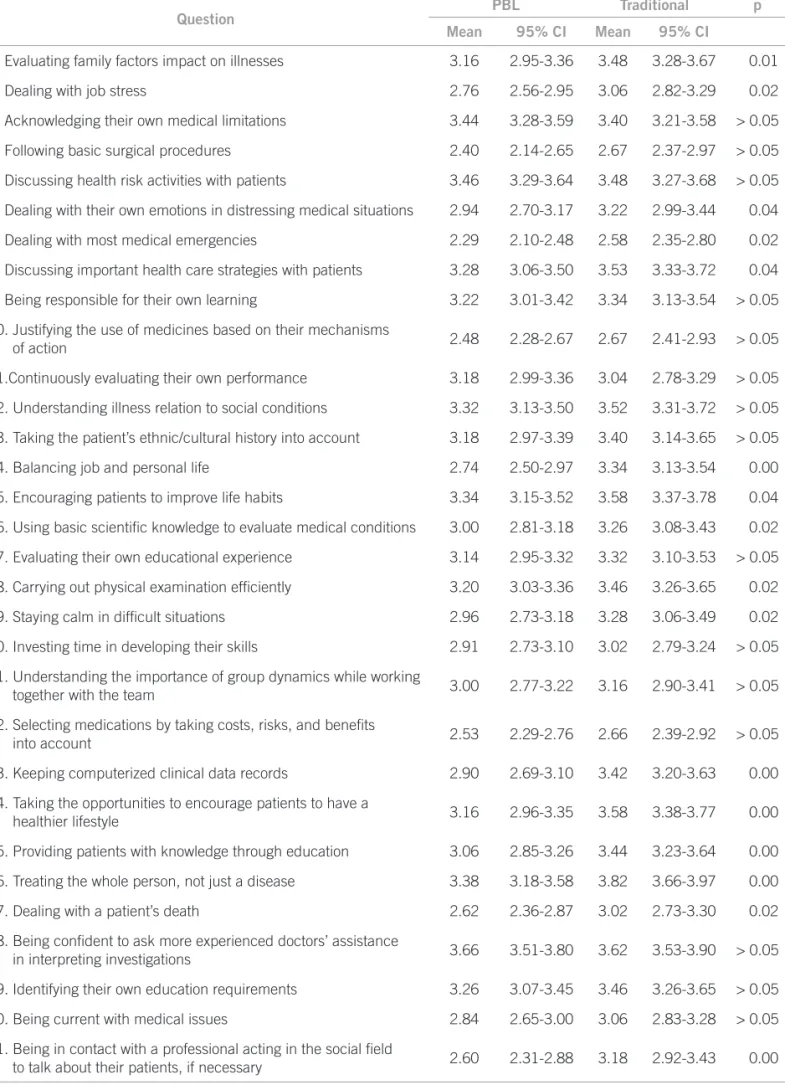
A signiicant statistical diference was observed in questions 1, 2, 6, 7, 8, 14, 15, 16, 18, 19, 23, 24, 25, 26, 27, and 31; traditional method students reported higher scores.
Additionally, the questions were also grouped in four dimensions:
1. Social aspects of health 2. Medical skills
3. Ethical concepts 4. Learning techniques
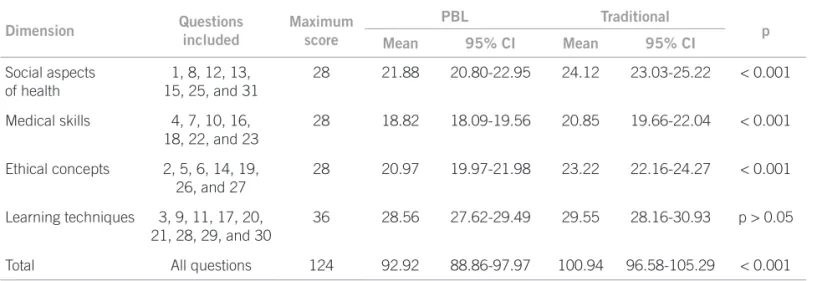
Subsequently, the average of the answers given by stu-dents in each dimension was calculated, as shown in Table 2.
A signiicant statistical diference was observed in the dimensions “social aspects of health”, “medical skills”, and “ethical concepts”; again, traditional learning method students reported higher scores.
DISCUSSION
Analyzing Table 1, it is clear that traditional learning method students demonstrated that they feel better pre-pared for internship activities when compre-pared to PBL students in several questions, to wit: 1, 2, 6, 7, 8, 14, 15, 16, 18, 19, 23, 24, 25, 26, 27 and 31.
he same conclusion may be reached from the inter-pretation of data described in Table 2. When the ques-tions are divided into dimensions, it can be concluded that students taught under the traditional learning method consider themselves to be better prepared in re-lation to “social aspects of health”, “medical skills”, and “ethical concepts”; no statistical diference could be as-certained in relation to “learning techniques” only. Fur-thermore, statistical signiicance could be ascertained when all answers were compared; traditional learning students considered themselves to be better prepared for the proposed activities.
he convenience sampling used in the study resulted in a statistical selection bias, which is explained by the diiculty to meet internship students, and thus question-naires were applied in certain medical meetings attended by a great number of students. herefore, it is possible that the sampling does not appropriately represent each group of students.
Table 3 shows a gender diference between both groups: in the traditional group, women’s participation was higher, while in the PBL group the results were more homogeneous. his fact may have inluenced research
Dimension Questions
included
Maximum score
PBL Traditional
p
Mean 95% CI Mean 95% CI
Social aspects of health
1, 8, 12, 13, 15, 25, and 31
28 21.88 20.80-22.95 24.12 23.03-25.22 < 0.001
Medical skills 4, 7, 10, 16, 18, 22, and 23
28 18.82 18.09-19.56 20.85 19.66-22.04 < 0.001
Ethical concepts 2, 5, 6, 14, 19, 26, and 27
28 20.97 19.97-21.98 23.22 22.16-24.27 < 0.001
Learning techniques 3, 9, 11, 17, 20, 21, 28, 29, and 30
36 28.56 27.62-29.49 29.55 28.16-30.93 p > 0.05
Total All questions 124 92.92 88.86-97.97 100.94 96.58-105.29 < 0.001
PBL, problem-based learning; 95% CI, 95% conidence interval.
Table 2 – Grades given by students for each dimension and in total – Sorocaba, 2009-10
Table 3 – Distribution of the students who participated in
the research according to type of curriculum, gender, and age – Sorocaba, 2009-2010
Traditional PBL
n % n %
Gender
Male 18 36 27 54
Female 32 64 23 46
Age (years)
21 – – 1 2
22 3 6 9 18
23 13 26 15 30
24 21 42 13 26
25 9 18 7 14
26 1 2 1 2
27 – – 3 6
28 2 4 – –
30 1 2 – –
36 – – 1 2
Total 50 100 50 100
outcomes since women may mature faster than men. Re-garding the age group of the students interviewed, the compared groups were similar: most were 23 or 24 years old, which slightly inluenced the results obtained. It is worthwhile mentioning that none of the students had failed inal exams.
Accordingly, several interpretations of the results can be made. Traditional learning students may have over-estimated the values attributed to questions, since they were aware of the research purpose: a comparison be-tween their learning method, which would be replaced, and a new, allegedly better, learning method.
On the other hand, questions about PBL’s constitu-tion failure may be raised. he strictness and the content of evaluations made on PBL method and its structural organization are also questionable. It is possible that PBL has not yet obtained the staf ’s efective adherence and participation.
It is also possible that students feel insecure towards the PBL method because it has been newly implemented. he ith-year students admitted in 2010 were the irst to be taught under the new method, which is still subject to changes for improvement purposes.
According to Koh, PBL undergraduate students are used to working in a poorly structured education envi-ronment and, therefore, are encouraged to work inde-pendently. Furthermore, they oten work in small groups, which encourages them to develop good communica-tion among themselves. hese capabilities may produce positive results while they perform internship activities7.
Nevertheless, in the “medical skills” dimension of this survey, it must be observed that PBL students feel less conident when compared to traditional learning method students. PBL students may feel insecure exactly because they are required to work on an independent basis in-stead of playing a secondary role in the learning process, since under the traditional method most of the curricular content is taught through expositive classes.
Moreover, concepts (satisfactory and unsatisfactory) are attributed to (a few) formal evaluations instead of nu-merical grades, under the new method. hus, students may have greater diiculties in evaluating whether the skills they have acquired are suicient to practice medi-cine, which may contribute to their lack of conidence. he self evaluation is an oten repeated situation since in all educational tutoring meetings students critique their own performance and that of the group, aiming to im-prove study dynamics. Because they are constantly evalu-ating themselves, which does not occur in the traditional method, PBL students might view their performance in a diferent manner.
Students may also develop a feeling that the tradi-tional method provides better education when compared
to PBL method. heir conidence would be provided by teachers, who represent the authority within the academ-ic environment by providing guidance, delimiting and securing the learning process.
On the other hand, several studies strongly suggest that PBL students are better prepared for medical prac-tice, according to their supervisors’ evaluation, as ex-plained in Neville’s meta-analysis4. However, PBL
stu-dents’ uncertainties apprehended from the current study are translated into a paradox, which may be understood through the idea suggested by Norman. Undergraduate PBL students are subject to undergoing uncertain situa-tions and on a long-term basis they may develop the abil-ity to deal with such diiculties, which is a very impor-tant tool for the medical practice8. Additionally, through
the experience they get from the medical practice, these students develop a critical proile, which may afect their self-evaluation. herefore, an intern that feels insecure in the face of challenges is given the opportunity to mature within a learning environment before becoming a doctor. he literature lacks information that would allow for a proper comparison between both learning methods in relation to students’ admission to internship. his may be explained by the fact that there is only one ideal occa-sion for comparing both groups: it is when the last tradi-tional course group and the irst PBL course group enter internship. Ater this occasion, the comparison between both groups is less reliable because of the temporal dis-tance from the emotional experience the students had. However, notwithstanding this diiculty, further studies about the issue are needed. It would also be appropriate to correlate the results obtained in this study with formal evaluations conducted by preceptors, since the limitation here was the ascertainment of the students’ preparation for internship solely from the students’ point of view.
It is important to point out that the subjective experi-ences of each individual strongly inluence their percep-tion of their own performance. herefore, the complex self-criticism process translates into a limitation to the interpretation of the results obtained.
It is important to outline that although feeling coni-dent, students may not be actually able to put into prac-tice all things they intend to; conidence and knowledge are not synonymous.
CONCLUSION
REFERENCES
1. McMaster University. Canada: About McMaster. [cited 2011 jun 15]. Available from: http://www.mcmaster.ca/welcome/aboutmac.cfm.
2. Maastrich University. Netherlands: history – Maastrich University; 2010. [cited 2011 jun 5]. Available from: http://www.maastrichtuniversity.nl/web/ Main/AboutUM/History.htm.
3. Lowry S. Making change happen. BMJ. 1993;306:320-22.
4. Neville AJ. Problem-based learning and medical education forty years on. Med Princ Pract. 2009;18:1-9.
5. Dean SJ, Barrat AL, Hendry GD, Lyon PMA. Preparedness for hospital prac-tice among graduates of a problem-based, graduate-entry medical program. Med J Aust. 2003;178:163-6.
6. Ozuah PO, Curtis, J, Stein REK. Impact of problem-based learning on resi-dent’s self-directed learning.Arch Pediatr Adolesc Med. 2001;155:669-72. 7. Koh GC, Khoo HE, Wong ML, Koh D. he efect of problem-based learning
during medical school on physician competency: a systematic review. Can Med Assoc J. 2008;178:34-41.