w w w . r b o . o r g . b r
Original
Article
Effect
of
removal
and
reinsertion
of
force-closed
stems
on
deformation
of
total
hip
arthroplasty
夽
Sandro
Griza
a,∗,
Luiz
Sérgio
Marcelino
Gomes
b,
André
Cervieri
c,
Telmo
Roberto
Strohaecker
daUniversidadeFederaldeSergipe,SãoCristóvão,SE,Brazil
bServic¸odeCirurgiaeReabilitac¸ãoOrtopédicaeTraumatológica,Batatais,SP,Brazil cUniversidadeLuteranadoBrasil,Canoas,RS,Brazil
dUniversidadeFederaldoRioGrandedoSul,PortoAlegre,RS,Brazil
a
r
t
i
c
l
e
i
n
f
o
Articlehistory:
Received2December2014 Accepted30March2015 Availableonline21January2016
Keywords:
Arthroplasty,hip Prosthesisdesign Mechanicalphenomena
a
b
s
t
r
a
c
t
Objectives: Thisstudyinvestigatedremovalofaforce-closedstem,doneinordertoimprove acetabularexposureduringrevision,withreinsertionafterwards.Itisunknownhowmuch thisproceduremodifiesthestem/cementinterface.
Methods:Threetaperedstemmodelswereimplantedintocompositefemurs.Straingauges wereembeddedinthemedialaspectofthecementmantleandinseveralpositionsonthe outersurfaceofthefemurs.Thedeformationwasmeasuredduringstaticloading,which wasappliedattwodifferenttimes:afterimplantationandafteronemillionloadingcycles, followedbystemremovalandreinsertion.Thettestwasperformed.Thedifferencesin deformationwerecompared(atp≤0.05)betweenthetwostaticloadingtimesandamong
thethreestemdesigns.
Results:Nosignificantdifferencesindeformationwerefoundafterthetwoloadingtimesfor thethreemodels.Nosignificantdifferencesintheinitialdeformationsofthethreemodels werefoundformostofthegaugesattachedtothefemurs.
Conclusions: Reinsertionoftheforce-closedstemdoesnotaltertheloadtransmissionfrom thestemtothecementandtothesurfaceofthefemur,evenafteronemillionloadingcycles. ©2016SociedadeBrasileiradeOrtopediaeTraumatologia.PublishedbyElsevierEditora Ltda.Allrightsreserved.
Efeito
da
remoc¸ão
e
reinserc¸ão
de
hastes
tipo
force-closed
nas
deformac¸ões
da
artroplastia
total
de
quadril
Palavras-chave:
Artroplastiadequadril Desenhodeprótese
r
e
s
u
m
o
Objetivos:Estudodaremoc¸ãodehastedotipoforce-closedeasuareinserc¸ãoposteriorpara aumentaraexposic¸ãodoacetábulodurantearevisão.Nãoéconhecidooquantoesse pro-cedimentomodificaainterfacehaste/cimento.
夽
WorkperformedwithinthePostgraduateProgramonMetallurgical,MiningandMaterialsEngineering,PhysicalMetallurgyLaboratory, DepartmentofMetallurgy,UniversidadeFederaldoRioGrandedoSul,PortoAlegre,RS,Brazil.
∗ Correspondingauthor.
E-mails:[email protected],[email protected](S.Griza).
http://dx.doi.org/10.1016/j.rboe.2015.03.016
Fenômenosmecânicos
sômetrosdedeformac¸ãoforamembebidosnoaspectomedialdomantodecimentoeem diversasposic¸õessobreasuperfícieexternadosfêmures.Asdeformac¸õesforammedidas durantecargasestáticas,asquaisforamaplicadasemdoisdiferentesmomentos:apósa implantac¸ãoeapósummilhãodeciclosdecarga,seguidopelaremoc¸ãoereinserc¸ão.O testetfoifeito.Asdiferenc¸asentreasdeformac¸õesforamconfrontadascomp≤0,05entre
osdoismomentosdecargaestáticaeentreostrêsprojetosdehastes.
Resultados: Nãoforamencontradasdiferenc¸assignificativasnasdeformac¸õesapósosdois momentosdecargaparaostrêsmodelos.Nãoforamencontradasdiferenc¸assignificativas nasdeformac¸õesiniciaisdostrêsmodelosparaamaioriadosextensômetrosaderidosaos fêmures.
Conclusões: Areinserc¸ãodehastedotipoforce-closednãoalteraatransmissãodecargada hasteparaocimentoeparaasuperfíciedofêmur,mesmoapósummilhãodeciclos.
©2016SociedadeBrasileiradeOrtopediaeTraumatologia.PublicadoporElsevier EditoraLtda.Todososdireitosreservados.
Introduction
Polished,tapered,cementedandglue-freestemsarewidely appliedintotalhiparthroplasty. Thesestemsfunctionasa conicalinterferenceassembly,inamannerknownas “force-closed”.1Theoretically,giventhatthereisnostrongchemical
bondbetween themetal stem and the polymercement, it shouldbepossibletoremovethestemfromthecementand obtainthesameinterfacialinteractionafteritsreinsertion.
In the caseof acetabularrevision, removal ofthe stem isofinterestbecausethisincreasesthe degreeofexposure ofthe acetabulum and reduces the duration of the opera-tion.Naborsetal.2conducteda10-yearclinicalfollow-upon
24casesofacetabularrevision,inwhichforce-closedstems wereremovedandreinserted.Nabors etal.2 andBelletal.3
alsoevaluatedtherotationalstabilityofthestemsthrough mechanicaltestsanddidnotfindanyevidentlossofstem sta-bilitycausedbythereinsertion.Nonetheless,changesatthe interfacebetweenthestemandcementmayoccurafterstem reinsertion.4Thesmallinterfacialspacesthatmayariseafter
theresidualtensionsinthecementhaverelaxedpossiblydo notproduceanysignificantchangestotherotationalstability ofthestemovertheshortterm.However,thesespacesmay producechangestoloadtransmissionfromthestemtothe cement.Normanetal.5discoveredthatchangestothe
interfa-cialinteractionbetweenthestemandcementhadaprofound influenceonalterationstothedeformationsthatwere trans-ferred to the cement and to the femur. Measurements of electricalresistancethroughtheextensometrytechnique(i.e.
usingstraingauges)canbeusedtodetectsuchalterationsto thesedeformations.
The present study had the objective of ascertaining whethertherewereanychangestodeformationseitherinthe cementorinthefemurafterremovalandreinsertionofthe stem.Ifthedeformationsoftheprimaryarthroplastydidnot differsignificantlyfromthedeformationsafterthe reimplan-tation, thiswould beastrong indicationthat theinterface betweenthestemandcementhadbeenpreservedandthat removalandreinsertionwasasafeprocedurefroma mechan-icalpointofview.
Materials
and
methods
Commerciallyavailableforce-closedstemsmadeofstainless steel(ASTMF138)weresuppliedbythemanufacturer(MDT Implantes,RioClaro,SP,Brazil).Thestemsdifferedfromeach otherregardingtheirtransversegeometryandtheirtapering angles and planes(Fig. 1). Theimportantgeometric differ-encesbetweenthestemswerethefollowing:groupA(Spoac®): proximalthicknessof12.25mm,taperingof1◦15′andcircular cross-sectionalgeometry;groupB(Maxima®):proximal thick-nessof12mm,doubletapering(4◦30′ and1◦ onthe lateral andmedialfaces,respectively,and3◦12′inthelateralplane) andrectangularcross-sectionwithroundedcorners;groupC
(SpoacNC®):proximalthicknessof13mm,tripletapering(3◦, 3◦30′and3◦53′,respectively,inthefrontal,lateraland trans-verseplanes)andarectangularcross-section withrounded corners.Twostemsfromeachgroupwereimplantedinlarge syntheticfemurs(3306PacificResearchLabs).
Implantation
The appropriatestem sizewas selected bymeans of tem-plates and the medullary cavity was obstructed by means ofapolyethylenerestrictor.Bonecement(SimplexP, Styker-Howmedica-Osteonics) was introduced into the medullary cavityinaretrogrademanner,usingasyringe.The implan-tationwasperformedbyanexperiencedsurgeon(LSMG).
Measurementsondeformations
Extensometers measuring electrical resistance (i.e. strain gauges)wereattachedbothtothefemursandtothecement, inspecificpositionsofthetestbody,inordertoenable mea-surementoflargedifferencesindeformationwhenalterations totheinterfacebetweenthestemandcementoccurred.5
Fig.1–Thethreestemmodels.Fromlefttoright,conicalstem(groupA),doublytaperedstem(groupB)andtriplytapered stem(groupC).Thecentralfigureshowscross-sectionsthroughthestems.Thefigureontherightshowsanextensometer (straingauge)attachedtothecementlayerclosetothetipofastem.
extensometers(Kyowa KFG02120C111-N15-C02). The exten-someterswereattachedtothecementlayersandtothefemurs usingsimilarprotocols.6 Cementlayerswereappliedatthe
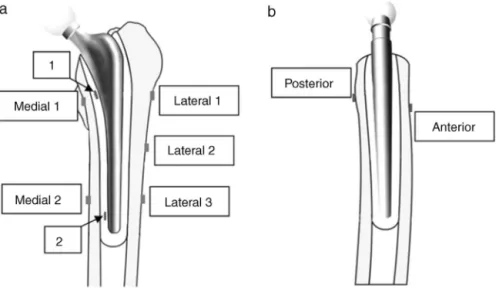
proximalanddistallevelsofeachstembeforeits implanta-tion,soastoenableattachmentoftheextensometers.The cementlayersweresandeddownuntilathicknessof1mm wasreached.Theextensometerswereappliedtothelayers onthemedialfaceofthestems.Oneoftheseextensometers attachedtoastematdistallevelbeforeimplantationis pre-sentedinFig.1.Theextensometerswerethenallembeddedin thecementlayerduringtheimplantationandtheyremained insidethislayerafterremovalofthestems.Thepositionsof theextensometersarepresentedinFig.2.
Thedeformationsweremeasuredbymeansofan acqui-sition board (HBM MGCplus). All the extensometers were calibratedbymeansofprecisionelectricalresistors(Vishay Micro-measurements).
Load
The distalcondyles ofthe femurswere fixedin asupport devicesoastoensureposteriorinclinationof9◦ andlateral inclination of10◦. The condyleswere embeddedin PMMA resin aftertheyhad been properly fixedusing screws.The testbodieswere loadedinto aservohydraulictestmachine (MTS810,MTSCorporation,USA).Staticloadswereapplied totheheadsofthestemsafterimplantationandafter reim-plantation. Tenstatic loadblockswere appliedatarateof 2300N/minuntilreaching2300N,andthis wasfollowedby one minute of load-bearing and a further minute of load relief. Eachdeformation valuewas represented bythe dif-ference betweenmaximumandminimumvaluesproduced because of the static load blocks. The mean deformation causedbythetenloadblockswasusedforanalysis.Sine-wave cyclicalloadslimitedbetweenminimumpeaksof230Nand
maximumpeaksof2300Nwereappliedaftertheinitialstatic loads.Loadingfrequenciesgoingfrom7Hztoamaximumof onemillioncycleswereused.
Removalandreinsertion
Theprocedureofremovalandreinsertionofthestemswas conductedafterapplicationofthecyclicalloads.Thestems were removed by means of an appropriate extractor tool. Threehoursaftertheirremoval,thestemswerecarefully rein-sertedintothecavityofthecementlayerandweresubjectedto afinaltimeofstaticloading.Theremovalandinsertion proce-durewasconductedbythesamesurgeonwhohadperformed theprimaryimplantation.
The deformations were measured during static load application, both afterthe primary implantationand after reinsertion of the stems. The differences in deformation between the two loading times and between the initial deformationsmeasuredinthethreestemmodelswere com-paredby means ofthe t test, using asignificance level of
p≤0.05.
Results
Four embedded extensometers were damaged during the primaryimplantation.Thedamagewasdonetotwo exten-sometersinatestbodyingroupB,oneextensometeringroup A(position2)andoneextensometeringroupC(position1). Nonetheless,itwaspossibletomakecomparisonsbetween positions1and2,respectively,ingroupsAandC.No signifi-cantdifferencesinthedeformationsmeasuredinthecement andinthefemurwerefoundincomparingthetwoloading times(Table1).Fig.3showsthedeformationsmeasuredby the embeddedextensometersand also thosemeasured on themedialandlateralsurfacesofthefemurs.Thecomparison betweenthedeformationsbeforeandafterreimplantationcan beseeninthefigure.
Acomparisonbetweenthethreestemmodelsregarding the initialdeformations ofeach positionmeasured on the femurswasalsomade.Table 1showsthatingroup A,the deformations tended to decrease after reinsertion of the conical stems, while in group C, the deformations in the medialandlateraldirectionsinthetriplytaperedstemsalso decreased.On theother hand,it couldbeseen thatinthe doublytaperedstems(groupB),thedeformationstendedto increaseafterreinsertion,atmanyofthepositionsmeasured, except in the lateral direction. However, significant differ-ences between stems B and C were observed only in the medial2positionandintheposteriorposition(Table1and
Fig. 4). None ofthe other comparisons between the three stemspresentedanysignificantdifferences.Fig.3alsoshows thattherewasgreaterdeformationclosetothe topsofthe stems (medial 2 and lateral 3 positions, in all three stem models.
Giventhatonlytwomeasurementsensorsshowed signifi-cantdifferencesbetweenstemsBandC,weperformedlinear regressionanalysisinwhichthethreestemmodelsweretaken tobelongtoasinglegroup.Thisregressionalsopresenteda
strongcorrelation,withacoefficientoflinearityof0.91and T
–3000 –2500 –2000–1500–1000 –500 500 1000 1500 2000 Lateral 1
Lateral 2
Lateral 3 Medial 2
Strain (µm/m) Strain (µm/m)
2 1
–1627 176
339
331 313 171 435
829
1012
1113 1144 765
941
1267
1490
1607 1626 1368
1424
–1758
–2012 –1997 –1951 –2030
–564
–667
–698 –682
–1894
–2117
–2476 –2348
–1793 –1913
Medial 1
0 0
Stem A, deformations after reinsertion
Stem A, initial deformations
Stem B, deformations after reinsertion
Stem C, deformations after reinsertion
Stem B, initial deformations
Stem C, initial deformations
Stem A, deformations after reinsertion
Stem A, initial deformations
Stem B, deformations after reinsertion
Stem C, deformations after reinsertion
Stem B, initial deformations
Stem C, initial deformations
Fig.3–Deformationsmeasuredusingtheembeddedextensometersandthoselaidoutonthemedialandlateralfacesof thefemurs.
–1200 –1000 –800 –600 –400 –200 0 –1500 –1000 –500 0
–727
–561 –683 –740
–664 –754
Anterior
–905
–789 –1087 –1228
–814 –803 Stem A, initial deformations
Stem A, deformations after reinsertion
Stem B, deformations after reinsertion
Stem C, deformations after reinsertion
Stem B, initial deformations
Stem C, initial deformations
Stem A, initial deformations
Stem A, deformations after reinsertion
Stem B, deformations after reinsertion
Stem C, deformations after reinsertion
Stem B, initial deformations
Stem C, initial deformations Posterior
Fig.4–Deformationsmeasuredontheanteriorandposteriorfacesofthefemurs.
inclinationfromthestraightlineof1.03forthedeformations measuredusingtheembeddedextensometers,anda coeffi-cientof0.98andinclinationof0.96forthedeformationson thesurfaceofthefemurs(Fig.5).
–3000 –3000 –2500 –2000 –1500 –1000 –500 500 1000 1500 2000
0
–2000 –1000
Embedded extensometers Surface of femur
0 –1000
yo=0.9568x –92.713 R2=0.9787 ye=1.0262x +30.257
R2=0.9149
Initial deformations (µm/m)
Deformations after reinsertion (
µ
m/m)
–2000
Fig.5–Linearregressioncomparingdeformationscaused bytheinitialstaticloadsandbythestaticloadsafter reimplantation,forthethreestemgroups.Thesymbol“ye” referstotheembeddedextensometers,whilethesymbol “yo”referstotheextensometerslaidoutontheexternal surfaceofthefemurs.
Discussion
Inthepresentstudy,thepotentialforalterationstothe defor-mationstransferredfromthestemtothecementlayerandto thefemur,causedbyremovalandreinsertionofthestem,was investigated.Althoughthispracticehasbeenusedinseveral situations inordertofacilitateexposureofthe acetabulum inrevisionsurgicalprocedures,withoutanyadverseclinical consequences,itstillneedstobeconfirmedthatthispractice doesnotinterferewitharthroplastyfromamechanicalpoint ofview,inordertoavoidproblemsthatmightariseoverthe longterm.Threeestablishedmodelsofforce-closedstemwere testedwiththeaimofascertainingwhetherallthreemodels had the same mechanical behavior. These stem only pre-sentedsubtledifferencesindesign.Force-closedstemssuch astheExeterstemhaveshownexcellentlong-termresults.7In
thesemodels,thestemmigratesbecauseoftheabilityofthe cementtoflowandthisenablesloadtransmissionthrough thecementtothefemurinamorehomogenousmanner.8,9
Subtledesignmodificationstoforce-closedstemshavebeen conceivedoverrecentdecades.Examplesofsuchalterations includethosethatculminatedintheconceptionofthe dou-blytaperedExeterUniversalstemandtriplytaperedC-stem.10
taperinganglesandplanesmayinterferewiththerigidityand stabilityofthestem.Theymayalsoaffecttheloadtransmitted fromthestemtothecementandfinallytothebonetissue.
Thetechniquesusedinourstudyhavebeenwidelyused in tests that seek to predict differences in the mechanics of arthroplasty.6,11,12 Moreover, alterations to the interface
betweenthestemandcementcaneasilybedetectedthrough usingextensometers.5Thequantityofonemillionloadcycles
waschoseninordertoencouragecementflowcharacteristics andstemmigration,inanattempttosimulatewhatoccurs
invivo.
Someextensometersembeddedinthe cementwerelost duringthe study.Nonetheless,it wasstillpossibletomake acomparisonbetweenpositions1and2inrelationtostems AandC,respectively.Thecomparisonsbetweenthe deforma-tionsduetotheinitialloadsandthoseafterthereinsertion,for theembeddedextensorsandforthoselaidoutonthesurface ofthefemurs,didnotshowanysignificantdifferences.
Thecomparisonsofthedifferentpositionsonthefemurs betweenthethreestemmodelsregardingthedeformations duetotheinitialloadsindicatedthatthereweresignificant differencesbetweenstemsBandCinthemedial2position andontheposteriorface.Thesedifferencesmayhavebeen related to the subtle differences in stem design. Although thesethreestemmodelspresentgeometricaldifferences,this hasnotbefoundtoproduceanysignificantdifferencesintheir clinicalperformances.1,9 Thedesigndifferencesdidnotgive
risetodifferencesinthemajorityofthedeformationsthatwe measured.Moreover,consideringthatwemade21 compar-isonsofdeformationbetweenthethreemodels,ourfindingof significantdifferencesatonlytwopositionsisaverysmall pro-portion.Forthisreason,thelinearregressionanalysiscould beperformedwiththethreemodelsinasinglegroupof force-closedstems.Theregressionanalysisshowedthattherewasa strongcorrelationbetweenthedeformationsmeasuredbefore andafterthereinsertion.
Somelimitations ofthe present study need tobe high-lighted.Syntheticfemursaredifferentfromnaturalfemurs. However,various studies haveshown that the mechanical propertiesofsyntheticfemursaresimilartothoseofnatural femurs.Furthermore,syntheticfemursreducethevariationof theresults,sincetheyaremanufacturedfromastandardized model.
Thegreatestlimitationofthepresentstudywasthatonly twotestbodiesfromeachstemgroupwereassessed.However, sincenosignificantdifferenceswerefoundincomparingthe deformationsbeforeandafterreimplantation,inanyofthe extensometerpositionsforthesetwotestbodies,andsince the linearregression analysis presentedstrong correlation, wedecidedtoconcludetheexperimentswithonlytwotest bodiespergroup.Inthelinearregressionanalysis,thethree modelswereputtogetherinasinglegroupandthenumber oftestbodiesforthisanalysisthusincreasedtosix.Ifthere wereanyalterationsattheinterfacebetweenthestemandthe cement,thesewouldbeseenthroughdispersionofthelinear regressionand/ordistancingoftheunitinclinationfromthe straightline,andfromtheinterceptofthelineonthe coordi-nateaxis.InclinationandR2thatareclosetoone(variations lowerthan 10%)and smallinterceptvalues(valuessmaller thantwoordersofmagnitudeofthedeformationsmeasured)
indicated good concordancebetween the two timesof the statictests.6
Another importantlimitationisthat inclinicalpractice, particlesandfluidsmayenterthecementcavityand/orthe stembeforestemreinsertion,andthiswasnotinvestigatedin thepresentstudy.Therefore,theresultsareapplicableonlyin casesinwhichboththecavityandthestemcanbeprotected fromtheseparticlesandfluidsbeforereinsertion.
Theresultsfromthisstudyprovideagoodindicationofthe permanenceoftheinterfacebetweenthestemandcement, andalsotheinterfacebetweenthecementandfemurafter thereinsertion.Somestudieshaveindicatedthatalterations totheseinterfacespromotelargedifferencesindeformations, both ofthe femurand of thecement.5 Crowninshield and
Tolbert13 conducted a study on both glued and non-glued
stem/cementinterfaces.Theyusedathinlayerofepoxyresin topromotereliablegluingofthestemtothecement. Alter-ationstotheinterfacialrelationshipwerereflectedinchanges tothedeformationmeasuredinthecementthatwereashigh as100%.Studieshaveshownthatforce-closedstemsmigrate because ofthe abilityofthe cementto flow,although this does notrepresent anindicationofloosening ofthestem. On the contrary,cement flow may ensure good interfacial contactbetweenthestemandthecement.Thisbehavior pro-motes load transferthroughthe cement tothe femurina morehomogenousmanner,andthistheoreticallypreserves the quality ofthe femurforlong periods.1,9,14–16 There are
nostrongchemicalbondsbetweenthemetalstem andthe polymercement.Therefore,asshowninourstudy,itis possi-bletoremovethestemandthenobtainthesameinterfacial interactionafterthereinsertion.
This study showed thatthe greatest deformations were closetothedistallevel(medial2andlateral3positions),for allthreemodels.Thedeformationsinthecementshowed val-uesgreaterthan1000m/m.Theseresultsarecomparableto thoseofseveralotherstudiescitedinthisarticle.
Conclusions
Taking into account the experimentalconditions that had beenproposedforthepresentstudy,reinsertionofthesame force-closed stem did not alter the transmission of defor-mation atthe interface betweenthe stem and cement or, consequently,tothesurfaceofthefemur.Removaland rein-sertionofthesteminthecementlayerdidnotsignificantly alterthemechanicsofthearthroplasty,evenafteronemillion cycles.
Conflicts
of
interest
Theauthorsdeclarenoconflictsofinterest.
Acknowledgements
r
e
f
e
r
e
n
c
e
s
1. ShenG.Femoralstemfixation.Anengineeringinterpretation ofthelong-termoutcomeofCharnleyandExeterstems.J BoneJointSurgBr.1998;80(5):754–6.
2. NaborsED,LiebeltR,MattinglyDA,BierbaumBE.Removal andreinsertionofcementedfemoralcomponentsduring acetabularrevision.JArthroplasty.1996;11(2):
146–52.
3. BellCG,WeinrauchP,PearcyM,CrawfordR.Invitroanalysis ofexeterstemtorsionalstability.JArthroplasty.
2007;22(7):1024–30.
4. GrizaS,UekiMM,SouzaDH,CervieriA,StrohaeckerTR. Thermallyinducedstrainsandtotalshrinkageofthe polymethyl-methacrylatecementinsimplifiedmodelsof totalhiparthroplasty.JMechBehavBiomedMater. 2013;18:29–36.
5. NormanTL,ThyagarajanG,SaligramaVC,GruenTA,Blaha JD.Stemsurfaceroughnessalterscreepinducedsubsidence and“taper-lock”inacementedfemoralhipprosthesis.J Biomech.2001;34(10):1325–33.
6. StolkJ,VerdonschotN,CristofoliniL,ToniA,HuiskesR.Finite elementandexperimentalmodelsofcementedhipjoint reconstructionscanproducesimilarboneandcementstrains inpre-clinicaltests.JBiomech.2002;35(4):499–510.
7. LingRS,CharityJ,LeeAJ,WhitehouseSL,TimperleyAJ,Gie GA.Thelong-termresultsoftheoriginalExeterpolished cementedfemoralcomponent:afollow-upreport.J Arthroplasty.2009;24(4):511–7.
8.NormanTL,ShultzT,NobleG,GruenTA,BlahaJD.Bonecreep andshortandlongtermsubsidenceaftercementedstem totalhiparthroplasty(THA).JBiomech.2013;46(5):949–55.
9.EkET,ChoongPF.Comparisonbetweentriple-taperedand double-taperedcementedfemoralstemsintotalhip arthroplasty:aprospectivestudycomparingtheC-Stem versustheExeterUniversalearlyresultsafter5yearsof clinicalexperience.JArthroplasty.2005;20(1):94–100.
10.WroblewskiBM,SineyPD,FlemingPA.Tripletaperpolished cementedstemintotalhiparthroplasty:rationaleforthe design,surgicaltechnique,and7yearsofclinicalexperience. JArthroplasty.2001;168Suppl.1:37–41.
11.CristofoliniL,TeutonicoAS,MontiL,CappelloA,ToniA. Comparativeinvitrostudyonthelongtermperformanceof cementedhipstems:validationofaprotocoltodiscriminate betweengoodandbaddesigns.JBiomech.
2003;36(11):1603–15.
12.NewAM,TaylorM,WroblewskiBM.Effectofhipstemtaper oncementstresses.Orthopedics.2005;28Suppl.8:s857–62.
13.CrowninshieldRD,TolbertJR.Cementstrainmeasurement surroundinglooseandwell-fixedfemoralcomponentstems.J BiomedMaterRes.1983;17(5):819–28.
14.VerdonschotN,HuiskesR.Theeffectsofcement-stem debondinginTHAonthelong-termfailureprobabilityof cement.JBiomech.1997;30(8):795–802.
15.HuiskesR,BoeklagenR.Mathematicalshapeoptimizationof hipprosthesisdesign.JBiomech.1989;22(8-9):793–804.