Synthesis, antibacterial and cytotoxic activities of new biflorin-based
hydrazones and oximes
Luciana G. da S. Souza
a, Macia C. S. Almeida
a, Telma L. G. Lemos
a,⇑
, Paulo R. V. Ribeiro
b, Edy S. de Brito
b,
Vera L. M. Silva
c, Artur M. S. Silva
c,⇑
, Raimundo Braz-Filho
d, José G. M. Costa
e, Fábio F. G. Rodrigues
e,
Francisco S. Barreto
f, Manoel O. de Moraes
faDepartamento de Química Orgânica e Inorgânica, Universidade Federal do Ceará, Campus do Pici, 60451-970 Fortaleza, CE, Brazil bEmbrapa Agroindustria Tropical, R Dra Sara Mesquita, 2270, 60511-110 Fortaleza, CE, Brazil
cDepartment of Chemistry & QOPNA, University of Aveiro, 3810-193 Aveiro, Portugal
dLaboratório de Ciências Químicas, Universidade Estadual do Norte Fluminense Darcy Ribeiro, 28013-602 Campos dos Goytacazes, RJ, Brazil eLaboratório de Pesquisa de Produtos Naturais, Universidade Regional do Cariri, 63105-000 Crato, CE, Brazil
fDepartamento de Fisiologia e Farmacologia, Universidade Federal do Ceará, 60430-270 Fortaleza, CE, Brazil
a r t i c l e
i n f o
Article history:
Received 6 October 2015 Revised 24 November 2015 Accepted 26 November 2015 Available online 27 November 2015
Keywords:
Biflorin Hydrazones Oximes Antibacterial Antitumoral
a b s t r a c t
Biflorin1is a biologically active quinone, isolated fromCapraria biflora. Five new biflorin-based nitrogen derivatives were synthesized, of which two were mixtures of (E)- and (Z)- isomers: (Z)-2a, (Z)-2b, (Z)-3a, (Z)- and (E)-3b, (Z)- and (E)-3c. The antibacterial activity was investigated using the microdilution method for determining the minimum inhibitory concentration (MIC) against six bacterial strains. Tests have shown that these derivatives have potential against all bacterial strains. The cytotoxic activity was also evaluated against three strains of cancer cells, but none of the derivatives showed activity.
Ó2015 Published by Elsevier Ltd.
Quinones represent a wide and varied family of secondary
metabolites of natural occurrence. The interest in these substances
has been intensified in recent years due to their pharmacological
importance and great structural variety. Many natural and
syn-thetic quinone derivatives possess potent and varied
pharmacolog-ical effects such as antitumor,
1–3anti-inflammatory,
4,5analgesic,
6antifungal,
7,8and trypanocidal
9,10activities.
Biflorin
[6,9-dimethyl-3-(4-methylpent-3-en-1-yl)benzo[
de
]
chromene-7,8-dione]
1
is a prenylated
ortho
-naphthoquinone
isolated from the roots of
Capraria biflora
L. species. There two
naphthoquinone
isomers,
ortho
-naphthoquinones
and
para
-naphthoquinones. They are widespread in the plant kingdom
and, due to its redox properties they can interfere in different
biological oxidative processes.
11Several naphthoquinones were
found to exhibit interesting range of pharmacological properties
such as antimicrobial,
12,13antiviral,
14antifungal,
15trypanocidal,
16antimalarial,
17,18and anticancer
19activities. Some
ortho
-naphtho-quinones, are trypanosomatid growth inhibitors with high
cytotoxic activity.
20Specifically, biflorin has shown antitumor
3,21and antibiotic activities.
22,23Recent studies have shown that this
compound also presents anticancer melanoma type activity
24as
well as anti-metastatic potential,
25being able to inhibit tumor
colonization.
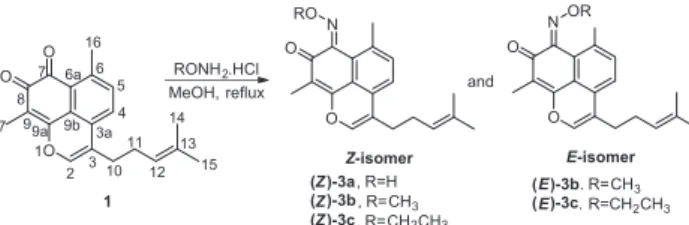
Herein we present our results on the study of the reactivity of
biflorin
1
, towards different nucleophiles (hydrazines and
hydrox-ylamines) (Scheme 1). Novel nitrogenated derivatives of biflorin
1
were obtained, aiming to study its chemistry and the potential
pharmacological activities of the new derivatives
2
and
3
.
First efforts were focused on the reaction of biflorin
1
with
aryl-hydrazine derivatives (Scheme 2).
26,27The reaction of biflorin
1
with phenylhydrazine hydrochloride resulted in the formation of
the corresponding hydrazone
2a
in moderate yield (42%).
27When using 2,4-dinitrophenylhydrazine, the corresponding
hydrazone
2b
was obtained in good yield (63%), thus confirming
the more nucleophilic character of the terminal nitrogen of
2,4-dinitrophenylhydrazine.
27Despite the possibility of the
nucleophilic attack of hydrazine derivatives on any of the carbonyl
carbons C-7 or C-8 of
1
, only hydrazone compounds
2
were formed,
resulting from the nucleophilic addition to the more electrophilic
carbonyl group (C-7).
http://dx.doi.org/10.1016/j.bmcl.2015.11.095
0960-894X/Ó2015 Published by Elsevier Ltd.
⇑
Corresponding authors. Tel.: +55 85 3366 9369; fax: +55 85 3366 9782 (T.L.G.L.); tel.: +351 234 370 714; fax: +351 234 370 084 (A.M.S.S.).E-mail addresses:[email protected](T.L.G. Lemos),[email protected](A.M.S. Silva).
Contents lists available at
ScienceDirect
Bioorganic & Medicinal Chemistry Letters
Then the reaction of biflorin
1
with substituted amine
hydrochlorides
28–30was carried out and led to the formation of
oxime derivatives
3
, in good yields (51–63%),
30also resulting from
the nucleophilic addition to the more electrophilic carbonyl group
(C-7) (Schemes 1 and 3). The structures of all compounds were
confirmed by NMR spectroscopic techniques (
1H,
13C, COSY, HSQC
and HMBC) as well as by high resolution mass spectrometry
(HRMS) analysis.
27,30In this type of reactions it is possible to obtain a mixture of the
(
Z
)- and (
E
)-diastereomers. The configuration of the obtained
prod-ucts was confirmed by NMR. The
1H NMR spectra of the
hydra-zones
2a
and
2b
(Scheme 2) indicated that only the (
Z
)-isomer
was formed. The (
Z
)-configuration of these hydrazones was
estab-lished by observation of an intramolecular hydrogen bond forming
a six membered ring (Fig. 1), evidenced by the signals at
d
17.23
and 17.42 ppm (N
A
H
O) in the
1H NMR spectra of hydrazones
2a
and
2b
, respectively.
27The same applies to the oxime derivative
3a
, where it is observed a signal at
d
19.91 ppm (O
A
H
O)
30related to the hydrogen bond forming the six-membered ring, in
which only the (
Z
)-isomer is formed (Fig. 1).
In the synthesis of methyloxime
3b
and ethyloxime
3c
it was
observed the formation of a mixture of the two (
Z
)- and (
E
)-iso-mers (Scheme 3). The
1H NMR spectrum of the mixture showed
the presence of both (
Z
)- and (
E
)-isomers in the ratio 2:3 in both
cases, with methyloxime and ethyloxime. These mixtures were
evidenced by the presence of pairs of singlets at
d
4.17 (OC
H
3)
and 4.18 ppm (OC
H
3) assigned to the (
Z
)-
3b
and (
E
)-
3b
isomers,
and the pair of quartets at
d
4.42 (OC
H
2CH
3) and 4.46 ppm (OC
H
2-CH
3), assigned to the (
Z
)-
3c
and (
E
)-
3c
isomers, respectively.
30These mixture of isomers can be easily separated by column
chro-matography, but they are gradually converted into the mixture
immediately after its separation into individual isomers.
31All derivatives, including biflorin
1
,
32,33were tested for
antibac-terial activity against six bacantibac-terial strains, Gram-positive and
Gram-negative, by employing the microdilution method.
34,35The
corresponding minimum inhibitory concentration (MIC) values
are shown in
Table 1.
Previous studies reported the biflorin
1
antibacterial activity
against Gram-positive and Gram-negative bacteria.
22,23In this
work it was possible to prove this activity with very satisfactory
MIC values (in terms of clinical MIC
6
1.024
l
g/mL),
36for all
strains of bacteria, using as positive control the antibiotics
Amika-cin (
Ami
), Gentamicin (
Gen
) and Neomycin (
Neo
). The most
satis-factory results were observed against strains of
Proteus vulgaris
(ATCC 13315), with a MIC value of 16
l
g/mL, showing to be more
efficient than antibiotics used as positive control, and for
Entero-coccus faecalis
(ATCC 4083), with values MIC 32
l
g/mL, similar to
that of Gentamicin (
Gen
).
The hydrazones were susceptible to all strains, yielding the best
result for the hydrazone
2a
, with the MIC value of 256
l
g/mL for
Staphylococcus aureus
(ATCC 25923), similar to MIC value of
Amika-cin (
Ami
). The MIC values for hydrazones were well above the
val-ues of biflorin
1
which was used as a standard.
The oximes showed more satisfactory results for all strains of
bacteria, among which methyloxime
3b
and ethyloxime
3c
showed
greater sensitivity against
Enterococcus faecalis
(ATCC 4083), with
MIC values of 32
l
g/mL and 16
l
g/mL, respectively, and
Staphylo-coccus aureus
(ATCC 25923) with MIC values 32
l
g/mL, both. The
MIC values of methyloxime
3b
and ethyloxime
3c
were similar
or even better than those of biflorin
1
, and antibiotics used as
pos-itive control, suggesting that the modifications made on the
biflorin structure led to an increase of the antibacterial potential
for these derivatives.
Cytotoxic activities in vitro of novel derivatives of biflorin
1
were evaluated using three human cancer cell lines, SF-295
(glioblastoma), OVCAR-8 (breast cancer) and HCT-116 (colon).
37,38An intensity scale was used to assess the cytotoxic potential of the
samples tested; being considered samples without activity, with
little (cell growth inhibition 1–50%), moderate (cell growth
inhibi-tion 50–75%) and a high activity (growth inhibiinhibi-tion 75–100%). The
experiments were analyzed according to the mean ± standard
deviation of the percentage of inhibition of cell growth using the
GraphPad Prism program.
Doxorubicin (
Dox
) was used as a positive control, in addition to
biflorin
1
which has a high cytotoxic activity. The activity analysis
was performed by the MTT method used in the screening program
at the National Cancer Institute of the United States (NCI)
39and
allows to easily set the cytotoxicity of the substances.
40The results
obtained indicate that these derivatives showed no activity (Fig. 2),
suggesting that the carbonyl modification caused inactivation of
the substances against cancer cells.
O O O 3a 4 5 6 16 9b 9a 17 9 8 7 13 12 11 10
2 3 15
14 O N O N H R R O N O RO 1
a) R= H b) R= NO2
2 3 a) R= H
b) R= CH3
c) R= CH2CH3
1 6a Formation of hydrazones Formation of oximes
Scheme 1.Synthesis of biflorin derivatives: modification in carbonyl C-7.
O O O 1 3a 4 5 6 16 6a 9b 9a 17 9 8 7 13 12 11 10
2 3 15
14
1
and NHNH2.HCl
R O N O N H R R O N O N H
(Z)-2a, R=H (Z)-2b, R=NO2
Z-isomer E-isomer(Not formed) R
R
MeOH, r.t
R
(E)-2a, R=H (E)-2b, R=NO2
Scheme 2.Synthesis of biflorin-based hydrazone derivatives2a,b.
O O O 1 3a 4 5 6 16 6a 9b 9a 17 9 8 7 13 12 11 10
2 3 15
14 1 and O N O RO O N O OR
(Z)-3a, R=H (Z)-3b, R=CH3 (Z)-3c, R=CH2CH3
Z-isomer E-isomer (E)-3b. R=CH3 (E)-3c. R=CH2CH3 RONH2.HCl
MeOH, reflux
Scheme 3.Synthesis of biflorin-based oxime derivatives3a–c.
O N O O H 3a O N O N H NO2 NO2 2b O N O N H H H 2a
δ17.23 δ17.42 δ19.91
Figure 1.Hydrogen bond forming the six-membered ring in (Z)-isomers2a,2band
Acknowledgments
The authors thank CNPq and CAPES (Brazil) for financial
support and study grants and also to the University of Aveiro
and the FCT/MEC (Portugal) for the financial support to the
QOPNA
research
Unit
(FCT
UID/QUI/00062/2013),
through
national funds and where applicable to those co-financed by
the FEDER, within the PT2020 Partnership Agreement, and
the Portuguese NMR Network. Finally, they thank Embrapa
Agroindustria Tropical, Ceará, for the high-resolution mass
spectrometry analysis.
References and notes
1. Silva, M. N.; Ferreira, V. F.; de Souza, M. C. B. V.Quím. Nova2003,26, 407. 2. Asche, C.Mini-Rev. Med. Chem.2005,5, 449.
3. Vasconcelos, M. C.; Bezerra, D. P.; Fonseca, A. M.; Pereira, M. R. P.; Lemos, T. L. G.; Pessoa, O. D. L.; Pessoa, C.; Moraes, M. O.; Alves, A. P. N. N.; Costa-Lotufo, L. V.Biol. Pharm. Bull.2007,30, 1416.
4. Almeida, E. R.; Silva-Filho, A. A.; Santos, E. R.; Lopes, C. A.J. Ethnopharmacol. 1990,29, 239.
5. Acosta, S. L.; Muro, L. V.; Sacerio, A. L.; Monteagudo, G. L.; Penã, A. R.; Okwei, S. N.Acta Farm. Bonaerense2003,22, 53.
6. Acosta, S. L.; Muro, L. V.; Sacerio, A. L.; Penã, A. R.; Okwei, S. N.Fitoterapia2003, 74, 686.
7. Gafner, S.; Wolfender, J.-L.; Nianga, M.; Stoeckli-Evans, H.; Hostettmann, K. Phytochemistry1996,42, 1315.
8. Tandon, V. K.; Maurya, H. K.; Mishra, N. N.; Shukla, P. K.Eur. J. Med. Chem.2009, 44, 3130.
9. Ferreira, V. F.; Jorqueira, A.; Souza, A. M. T.; Silva, M. N.; Souza, M. C. B. V.; Gouvêa, R. M.; Rodrigues, C. R.; Pinto, A. V.; Castro, H. C.; Santos, D. O.; Araújo, H. P.; Bourguignon, S. C.Bioorg. Med. Chem.2006,14, 5459.
10. Menna-Barreto, R. F. S.; Beghini, D. G.; Ferreira, A. T. S.; Pinto, A. V.; Castro, S. L.; Perales, J.J. Proteomics2010,73, 2306.
11. Tonholo, J.; Freitas, L. R.; De Abreu, F. C.; Azevedo, D. C.; Zani, C. L.; De Oliveira, A. B.; Goulart, M. O. F.J. Braz. Chem. Soc.1998,9, 163.
12. Didry, N.; Pinkas, M.; Dubreuil, L.Ann. Pharm. Fr.1986,44, 73.
13. Riffel, A.; Medina, L. F.; Stefani, V.; Santos, R. C.; Bizani, D.; Brandelli, A.Braz. J. Med. Biol. Res.2002,35, 811.
14. Sendl, A.; Chen, J. L.; Jolad, S. D.; Stoddart, C.; Rozhon, E.; Kernan, M.; Nanakorn, W.; Balick, M.J. Nat. Prod.1996,59, 808.
15. Ferreira, M. P. S. B. C.; Cardoso, M. F. C.; Silva, F. de. C.; Ferreira, V. F.; Lima, E. S.; Souza, J. V. B.Ann. Clin. Microbiol. Antimicrob.2014,13, 26.
16. Pinto, A. V.; Castro, S. L.Molecules2009,14, 4570.
17. Sharma, A.; Santos, I. O.; Gaur, P.; Ferreira, V. F.; Garcia, C. R.; da Rocha, D. R. Eur. J. Med. Chem.2013,59, 48.
18. Rezende, L. C.; Fumagalli, F.; Bortolin, M. S.; Oliveira, M. G.; Paula, M. H.; Andrade-Neto, V. F.; Emery, F. S.Bioorg. Med. Chem. Lett.2013,23, 4583. 19. Shukla, S.; Srivastava, R. S.; Shrivastava, S. K.; Sodhi, A.; Kumar, P.Appl.
Biochem. Biotechnol.2012,167, 1430.
20. Paulino, M.; Alvareda, E. M.; Denis, P. A.; Barreiro, E. J.; Sperandio da Silva, G. M.; Dubin, M.; Gastellu, C.; Aguilera, S.; Tapia, O.Eur. J. Med. Chem.2008,43, 2238.
21. Wisintainer, G. G. N. S.; Simões, E. R. B.; Lemos, T. L. G.; Moura, S.; Souza, L. G. S.; Fonseca, A. M.; Moraes, M. O.; Pessoa, C.; Roesch-Ely, M.; Henriques, J. A. P. An. Acad. Bras. Ciênc.1907,2014, 86.
22. (a) Gonçalves de Lima, O.; D’Albuquerque, I. L.; Loureiro, P.; Carmona, C. L.; Bernard, M. Z. Rev. Quim. Ind. 1953, 22, 2; (b) Gonçalves de Lima, O.; D’Albuquerque, I. L.; Loureiro, P.; Carmona, C. L.; Bernard, M. Z.Rev. Quím. Ind.1954,249, 28.
23. Santana, E. R. B.; Ferreira-Neto, J. P.; Yara, R.; Sena, K. X. F. R.; Fontes, A.; Lima, C. S. A.Molecules2015,20, 8595.
Table 1
Values of the minimal inhibitory concentration (MIC) of biflorin1and derivatives2a,band3a–cagainst six bacterial strains
Bacterial strains MIC (
l
g/mL)1 2a 2b 3a 3b(Z)/(E) 3c(Z)/(E) Ami Neo Gen
Enterococcus faecalis(ATCC 4083) 32 512 512 256 32 16 256 128 32
Proteus vulgaris(ATCC 13315) 16 P1024 512 512 64 512 512 512 64
Escherichia coli(27) 256 P1024 P1024 512 128 128 128 128 512
Escherichia coli(ATCC 10536) 128 P1024 512 P1024 P1024 512 512 512 128
Staphylococcus aureus(ATCC 25923) 64 256 512 256 32 32 256 32 32
Staphylococcus aureus(358) 128 P1024 512 P1024 64 64 256 32 8
HCT-116
2a 2b 3a 3b 3c 1
Dox
0 25 50 75 100
% growth inhibition
SF-295
2a 2b 3a 3b 3c 1
Dox
0 25 50 75 100
% growth inhibition
OVCAR-8
2a 2b 3a 3b 3c 1
Dox
0 25 50 75 100
% growth inhibition
Figure 2.Cell growth inhibition percentage (% CI) of the samples1,2a,band3a–cin three tumor cell lines. Values are means ± standard deviation.
24. Montenegro, R. C.; Vasconcellos, M. C.; Barbosa, G. S.; Burbano, R. M. R.; Souza, L. G. S.; Lemos, T. L. G.; Costa-Lotufo, L. V.; Moraes, M. O.Toxicol. In Vitro2013, 27, 2076.
25. Carvalho, A. A.; Costa, P. M.; Souza, L. G. S.; Lemos, T. L. G.; Alves, A. P. N. N.; Pessoa, C.; Moraes, M. O.Life Sci.2013,93, 201.
26. Campos, V. R.; Santos, E. A.; Ferreira, V. F.; Montenegro, R. C.; Souza, M. C. B. V.; Costa-Lotufo, L. V.; Moraes, M. O.; Regufe, A. K. P.; Jordão, A. K.; Pinto, A. C.; Resende, J. A. L. C.; Cunha, A. C.RSC Adv.2012,2, 11438.
27. General procedure for the synthesis of hydrazones2a,b. Hydrazones2a,bwere synthesized following the methodology described by Campos and coworkers.26 The appropriate arylhydrazine hydrochloride (0.2 mmol) was added to a solution of biflorin1(0.1 mmol, 30.8 mg) in MeOH (2 mL). The mixture was stirred for 24 h at room temperature. After this period, the reaction mixture was concentrated under reduced pressure and the resulting residue was taken in dichloromethane and purified by TLC, using hexane and dichloromethane (4:6 v/v) as the eluent.
The reaction of biflorin 1 (0.1 mmol, 30.8 mg) with phenylhydrazine hydrochloride (0.2 mmol, 29.0 mg) yielded (16.7 mg, 42%) of an orange solid (Z)-6,9-dimethyl-3-(4-methylpent-3-en-1-yl)-7-(2-phenylhydrazono)benzo [de]chromen-8(7H)-one (2a): mp 115–117°C; IR (KBr): 3400, 2925, 1600, 1495, 1470, 1190 cm1.1H NMR (500.13 MHz, CDCl
3)d= 1.58 (s, 3H, H-14), 1.72 (s, 3H, H-15), 2.10 (s, 3H, H-17), 2.30 (q,J= 7.1 Hz, 2H, H-11), 2.46 (t,
J= 7.1 Hz, 2H, H-10), 2.83 (s, 3H, H-16), 5.19 (m, 1H, H-12), 6.94 (s, 1H, H-2), 7.12–1.16 (m, 2H, H-4 and H-40), 7.38–7.49 (m, 5H, H-5, H-20, H-30, H-50and H-60), 17.23 (s, 1H, N-H) ppm.13C NMR (125.77 MHz, CDCl3)d= 7.4 (C-17), 17.9 14), 25.7 15), 26.7 11), 27.6 10), 27.9 16), 111.7 9), 116.3 (C-20and C-60), 116.5 (C-3), 117.7 (C-40), 119.3 (C-9b), 123.1 (C-12), 124.5 (C-4), 128.3 (C-3a), 129.5 (C-50and C-30), 130.2 (C-6a), 131.5 (C-7), 133.0 (C-13), 134.8 (C-6), 135.1 (C-5), 139.3 (C-2), 143.1 (C-10), 160.0 (C-9a), 179.2 (C-8) ppm. ESI+-HRMS: calculated for C
26H27N2O2 [M+H]+: 399.2073. Found: 399.2071 [M+H]+.
The reaction of biflorin1(0.1 mmol, 30.8 mg) with 2,4-dinitrophenylhydrazine hydrochloride (67%) (0.1 mmol, 29.0 mg) yielded (30.8 mg, 63%) of a brown solid (Z )-7-(2-(2,4-dinitrophenyl)hydrazono)-6,9-dimethyl-3-(4-methylpent-3-en-1-yl)benzo[de]chromen-8(7H)-one (2b): mp 246–248°C; IR (KBr): 3425, 2920, 1600, 1430 cm1.1H NMR (500.13 MHz, CDCl
3)d= 1.60 (s, 3H, H-14), 1.81 (s, 3H, H-15), 2.11 (s, 3H, H-17), 2.33 (q,J= 7.2 Hz, 2H, H-11), 2.55 (t,
J= 7.2 Hz, 2H, H-10), 2.86 (s, 3H, H-16), 5.19 (t,J= 7.2 Hz, 1H, H-12), 7.09 (s, 1H, H-2), 7.39 (d,J= 8.1 Hz, 1H, H-4), 7.56 (d,J= 8.1 Hz, 1H, H-5), 8.26 (d,J= 9.4 Hz, 1H, H-60), 8.48 (dd,J= 2.4 and 9.4 Hz, 1H, H-50), 9.21 (d,J= 2.4 Hz, 1H, H-30), 17.42 (s, 1H, N-H) ppm.13C NMR (125.77 MHz, CDCl
3)d= 7.5 17), 17.9 (C-14), 25.7 (C-15), 26.9 (C-11), 27.5 (C-10 and C-16), 112.5 (C-9), 116.5 (C-3), 117.4 (C-60), 120.7 (C-9b), 121.8 (C-4), 122.7 (C-12), 123.2 (C-30), 128.9 (C-6a), 129.2 (C-3a), 129.6 (C-50), 133.0 (C-20), 133.4 (C-13), 136.4 (C-5), 137.0 (C-6), 138.5 (C-7), 140.0 (C-2), 140.5 (C-40), 144.2 (C-10), 161.4 (C-9a), 180.3 (C-8) ppm. ESI+-HRMS: calculated for C
26H25N4O6 [M+H]+: 489.1774. Found: 489.1770 [M+H]+.
28. Oliveira, M. F. Contribuição ao Conhecimento Químico das Espécies Tabebuia serratifolia Nichols e Tabebuia rosea Bertol; Universidade Federal do Ceará: Fortaleza, Ceará, Brazil, 2000; p 1 (Ph.D. thesis).
29. Silva, A. R.; Herbst, M. H.; Ferreira, A. B. B.; Silva, A. M.; Visentin, L. C.Molecules 2011,16, 1192.
30. General procedure for the synthesis of oximes3a–c. The oximes were synthesized following the methodology proposed by Oliveira and coworkers.28,29Biflorin1 (0.1–0.16 mmol) was added to a methanolic solution (1–2 mL) of the appro-priate amine hydrochloride (0.1–0.16 mmol) under magnetic stirring. The reaction mixture was left at reflux (70°C) for a period of 6 h. After this period the reaction mixture was evaporated to the dryness. The obtained residue was taken in dichloromethane and purified by TLC using hexane/ethyl acetate (6:4 v/v).
The reaction of biflorin1(0.16 mmol, 50.0 mg) with hydroxylamine hydrochlo-ride (0.16 mmol, 11.1 mg) yielded (31.9 mg, 58%) of an orange residue (Z )-7-(hydroxyimino)-6,9-dimethyl-3-(4-methylpent-3-en-1-yl)benzo[de ]chromen-8(7H)-one (3a): IR (KBr): 3400, 2920, 1600, 1530, 1030 cm1. 1H NMR (500.13 MHz, CDCl3)d= 1.59 (s, 3H, 14), 1.72 (s, 3H, 15), 2.03 (s, 3H, H-17), 2.32 (q,J= 7.2 Hz, 2H, H-11), 2.54 (t,J= 7.2 Hz, 2H, 10), 2.70 (s, 3H, H-16), 5.18 (t,J= 7.2 Hz, 1H, H-12), 7.09 (s, 1H, H-2), 7.36 (d,J= 8.1 Hz, 1H, H-4), 7.53 (d,J= 8.1 Hz, 1H, H-5), 19.91 (s, 1H, N-OH) ppm.13C NMR (125.77 MHz, CDCl3)d= 6.9 (C-17), 18.0 (C-14), 25.1 (C-15), 26.9 (C-11), 26.8 (C-16), 27.5 (C-10), 110.7 (C-9), 117.8 (C-3), 119.7 (C-9b), 121.3 (C-4), 122.8 (C-12), 128.0 (C-6a), 128.9 (C-3a), 133.5 (C-13), 136.9 (C-5), 138.5 (C-6), 147.4 (C-7), 139.8 (C-2), 163.2 (C-9a), 179.5 (C-8) ppm. ESI+-HRMS: calculated for C
20H21NO3[M +H]+: 324.1601. Found: 324.1600 [M+H]+.
The reaction between biflorin1(0.1 mmol, 30.8 mg) andO -methylhydroxy-lamine hydrochloride (0.1 mmol, 8.35 mg) yielded (21.3 mg, 63%) of an orange residue, consisting of a mixture of (Z )-7-(methoxyimino)-6,9-dimethyl-3-(4-methylpent-3-en-1-yl)benzo[de]chromen-8(7H)-one (Z-3b) and (E )-7-(methoxyimino)-6,9-dimethyl-3-(4-methylpent-3-en-1-yl)benzo[de]chromen-8 (7H)-one (E-3b): IR (KBr): 3410, 2930, 1600, 1195, 1015 cm1. (Z-3b):1H NMR (500.13 MHz, CDCl3)d= 1.59 (s, 3H, 14), 1.71 (s, 3H, 15), 1.95 (s, 3H, H-17), 2.25 (m, 2H, H-11), 2.47 (m, 2H, H-10), 2.61 (s, 3H, H-16), 4.18 (s, 3H, OCH3), 5.18 (m, 1H, H-12), 6.93 (s, 1H, H-2), 7.24 (d,J= 8.6 Hz, 1H, H-4), 7.35 (d,
J= 8.6 Hz, 1H, H-5) ppm.13C NMR (125.77 MHz, CDCl
3)d= 7.5 17), 17.9 (C-14), 24.0 (C-16), 25.7 (C-15), 27.0 (C-11), 27.1 (C-10), 64.8 (OCH3), 112.4 (C-9), 115.7 (C-3), 121.2 (C-4), 121.4 (C-9b), 122.9 (C-12), 128.0 (C-6a), 128.8 (C-3a), 133.1 (C-13), 134.9 (C-5), 138.2 (C-6), 139.7 (C-2), 147.3 (C-7), 160.1 (C-9a),
178.9 (C-8) ppm. (E-3b):1H NMR (500.13 MHz, CDCl
3)d= 1.59 (s, 3H, H-14), 1.71 (s, 3H, H-15), 1.96 (s, 3H, H-17), 2.25 (m, 2H, H-11), 2.27 (s, 3H, H-16), 2.47 (m, 2H, H-10), 4.18 (s, 3H, OCH3), 5.18 (m, 1H, H-12), 6.47 (s, 1H, H-2), 7.33 (s, 1H, H-4), 7.33 (s, 1H, H-5) ppm.13C NMR (125.77 MHz, CDCl
3)d= 7.6 (C-17), 17.9 (C-14), 23.0 (C-16), 25.7 (C-15), 27.0 (C-11), 27.1 (C-10), 63.7 (OCH3), 110.5 (C-9), 115.5 (C-3), 121.3 (C-9b), 122.8 (C-12), 123.2 (C-4), 126.3 (C-6a), 127.6 (C-3a), 133.2 (C-13), 133.5 (C-5), 140.1 (C-2), 140.7 (C-6), 151.5 (C-7), 160.5 (C-9a), 185.2 (C-8) ppm. ESI+-HRMS: calculated for C
21H24NO3[M+H]+: 338.1756. Found: 338.1753 [M+H]+.
The reaction of biflorin1(0.1 mmol, 30.8 mg) with O-ethylhydroxylamine hydrochloride (0.1 mmol, 9.75 mg) yielded (17.9 mg, 51%) of an orange residue, consisting of a mixture of (Z )-7-(ethoxyimino)-6,9-dimethyl-3-(4-methylpent-3-en-1-yl)benzo[de]chromen-8(7H)-one (Z-3c) and (E )-7-(ethoxy-imino)-6,9-dimethyl-3-(4-methylpent-3-en-1-yl)benzo[de]chromen-8(7H )-one (E-3c): IR (KBr): 3395, 2915, 1600, 1185, 1050 cm1. (Z-3c):1H NMR (500.13 MHz, CDCl3)d= 1.43 (m, 3H, CH3), 1.59 (s, 3H, H-14), 1.71 (s, 3H, H-15), 1.95 (s, 3H, H-17), 2.25 (m, 2H, H-11), 2.47 (m, 2H, H-10), 2.61 (s, 3H, H-16), 4.42 (q,J= 7.1 Hz, 2H, OCH2), 5.16 (m, 1H, H-12), 6.93 (s, 1H, H-2), 7.24 (d,
J= 8.2 Hz, 1H, H-4), 7.35 (d,J= 8.2 Hz, 1H, H-5) ppm.13C NMR (125.77 MHz, CDCl3)d= 7.5 (C-17), 14.8 (CH3), 17.9 14), 24.3 16), 25.7 15), 27.0 (C-11), 27.4 (C-10), 72.8 (OCH2), 112.5 (C-9), 115.6 (C-3), 121.4 (C-9b), 121.5 (C-4), 122.9 (C-12), 128.8 (C-6a), 128.0 (C-3a), 133.1 (C-13), 134.9 (C-5), 138.0 (C-6), 139.7 (C-2), 147.0 (C-7), 159.9 (C-9a), 178.7 (C-8) ppm.
(E-3c):1H NMR (500.13 MHz, CDCl
3)d= 1.35 (t,J= 7.1 Hz, 3H, CH3), 1.59 (s, 3H, 14), 1.71 (s, 3H, 15), 1.96 (s, 3H, 17), 2.25 (m, 2H, 11), 2.27 (s, 3H, H-16), 2.46 (m, 2H, H-10), 4.46 (q,J= 7.1 Hz, 2H, OCH2), 5.16 (m, 1H, H-12), 6.96 (s, 1H, H-2), 7.33 (s, 1H, H-4), 7.33 (s, 1H, H-5) ppm.13C NMR (125.77 MHz, CDCl3)d= 7.6 (C-17), 14.6 (CH3), 17.9 (C-14), 23.3 (C-16), 25.7 (C-15), 27.1 (C-11), 27.4 (C-10), 72.2 (OCH2), 110.5 (C-9), 110.6 (C-3), 121.3 (C-9b), 122.8 (C-12), 123.0 (C-4), 126.4 (C-6a), 127.6 (C-3a), 133.2 (C-13), 133.5 (C-5), 140.0 (C-2), 140.6 (C-6), 150.7 (C-7), 160.5 (C-9a), 185.4 (C-8) ppm. ESI+-HRMS: calculated for C22H26NO3[M+H]+: 352.1919. Found: 352.1913 [M+H]+. 31. Nicolaides, D. N.; Gautam, D. R.; Litinas, K. E.; Hadjipavlou-Litina, D. J.;
Kontogiorgis, C. A. J.Heterocycl. Chem.2004,41, 605.
32. Souza, L. G. S.; Almeida, M. C. S.; Monte, F. J. Q.; Santiago, G. M. P.; Braz-Filho, R.; Lemos, T. L. G.Quim. Nova2012,35, 2258.
33. Plant Material:The speciesCapraria bifloraL. (Scrophulariaceae) was collected in Itapiúna, Ceará, Brazil and was identified by Dr. Edson Nunes. A voucher specimen (No. 30848) was deposited in the Herbarium Prisco Bezerra of the Biology Department of the Federal University of Ceará.
Isolation of biflorin:The isolation of biflorin1was performed as described by Souza et al.32Air-dried powdered roots (700 g) were extracted with petroleum ether and the solvent was evaporated under reduced pressure to yield 1.7 g of extract. The extract (1.0 g) was chromatographed on silica gel by elution using binary mixtures of hexane/EtOAc and EtOAc/MeOH, with increasing polarity. Fourteen fractions were collected with a volume of 200 mL. Fractions 8–10 were pooled according to thin-layer chromatographic (TLC) analysis, yielding 58 mg of biflorin1.
34. NCCLS (2006): Clinical and Laboratory Standards Institute, Performance standards for antimicrobial susceptibility testing, 16th Informational Supplement, CLSI document M100-S16, CLSI, Wayne, PA, 2006.
35. Antibacterial activity evaluation:The antibacterial activity of the samples was evaluated using the broth microdilution method based on the document M100-S16 (CLSI, 2006)34for bacteria. In the tests, six strains of Gram-positive,
Enterococcus faecalis(ATCC 4083),Staphylococcus aureus(ATCC 25923), and multidrug-resistantStaphylococcus aureus(358) and Gram-negative, Escher-ichia coli(ATCC 10536),Proteus vulgaris(ATCC 13315) and multidrug-resistant
Escherichia coli (27) were used. The Oswaldo Cruz Foundation-FIOCRUZ provided the six standard bacteria strains used.
The bacterial strains were activated in the midst Brain Heart Infusion Broth (BHI) for 24 h at 35 ± 2°C. Next, a bacterial suspension was prepared in BHI at 3.8%, corresponding to the turbidity of 0.5 McFarland scale (1108CFU/ mL). Then the suspension was diluted to 1106CFU/mL in BHI broth at 10%, and volume of 100
l
L, and homogenized in microdilution 96 well plates, plus different concentrations of the samples resulting in a final inoculum of 5105CFU/mL. The samples were solubilized in distilled water and DMSO to obtain a stock solution of 1024l
g/mL. The final concentrations of the samples were in the culture medium 512–8l
g/mL. The tests were performed in triplicate. The plates were incubated at 35 ± 2°C for 24 h. The antibacterial activity was detected using a colorimetric method by adding 25l
L of the resauzurin staining (0.01%) aqueous solution to each one of the wells at the end of the incubation period. The minimal inhibitory concentration (MIC) was defined as the lowest extract concentration able to inhibit the bacteria growth, as indicated by resauzurin staining (dead bacterial cells are not able to change the staining color by visual observation—blue to red). The antibiotics Amikacin, Gentamicin and Neomycin were utilized as a positive control.36. Nascimento, P. G. G.; Lemos, T. L. G.; Bizerra, A. M. C.; Arriaga, A. M. C.; Ferreira, D. A.; Santiago, G. M. P.; Braz-Filho, R.; Costa, J. G. M.Molecules2014,19, 1317. 37. Mosmann, T.J. Immunol. Methods1983,65, 55.
Samples were diluted in DMSO and tested at a concentration of 5
l
g/mL. Cells were plated at a concentration of 0.1106cells/mL for strains SF-295 and OVCAR-8 and 0.7105cells/mL for the strain HCT-116 and incubated for 72 h in an oven. Subsequently the samples were centrifuged and the supernatant was removed. Then 150l
L of 3-(4,5-dimethyl-2-thiazol)-2,5-diphenyl-2H-tetrazolium bromide (MTT) solution were added and the plates were incubated for 3 h. The absorbance was measured after dissolution of the precipitate with 150l
L of DMSO in platespectrophotometer at 595 nm. Cell viability was evaluated by reduction of the yellow dye (MTT) to a blue product as described by Mosmann.37 Biflorin1and Doxorubicin, each one were utilized as a positive control. 39. Skehan, P.; Storeng, R.; Scudiero, D.; Monks, A.; McMahon, J.; Vistica, D.;
Warren, J. T.; Bokesch, H.; Kenney, S.; Boyd, M. R.J. Natl. Cancer Inst.1990,82, 1107.
40. Berridge, M. V.; Tan, A. S.; McCoy, K. D.; Wang, R.Biochemica1996,4, 14.