JSCS–3887 615.281–188
Original scientific paper
Synthesis, characterization, chelation with transition metal
ions, and antibacterial and antifungal studies of the 4-[(
E
)-
-phenyldiazenyl]-2-[(
E
)-(phenylimino)methyl]phenol dye
NURCAN KURTOGLU*Kahramanmaraş Sütçü İmam University, Department of Textile Engineering, Avşar campus, 46050, Kahramanmaraş, Turkey
(Received 26 November 2008, revised 12 January 2009)
Abstract:New Ni(II), Cu(II) and Co(II) complexes were synthesized with the bidentate azo-azomethine dye, 4-[(E)-phenyldiazenyl]-2-[(E)-(phenylimino)me-thyl]phenol (dmpH), which was prepared by the reaction of 2-hydroxy-5-[(E)-phenyldiazenyl]benzaldehyde with aniline in EtOH. The syntheses of the metal chelates of the azo-azomethine dye were realized by the precipitation techni-que. The synthesized metal complexes were characterized by elemental ana-lysis, molar conductance measurements, as well as infrared and UV-Vis spectral data. Based on these characterizations, the metal complexes of the transition metal ions may be formulated as [M(dmp)Cl(H2O)] where M = Ni(II), Cu(II) and Co(II). The metal complexes were formed by the coordination of N and O atoms of the ligand. The molar conductance values of the Ni(II), Cu(II) and Co(II) complexes of the bidentate ligand indicate their non-ionic character. The free ligand and its metal complexes were tested for their in vitro antimicrobial properties against eight bacteria: Escherichia coli, Staphylococcus aureus, Klebsiella pneumoniae, Mycobacterium smegmatis, Pseudomonas aeruginosa, Enterococcus cloacae, Bacillus megaterium, and Micrococcus luteus, and three fungi, Kluyveromyces fragilis, Rhodotorula rubra and Saccharomyces cerevi-siae, in order to assess their antimicrobial potential. The [Ni(dmp)Cl(H2O)] chelate exhibited high activity against all the bacteria and fungi, except Rhodotorula rubra.
Keywords: azo dye; azo-azomethine; transition metals; spectroscopy; antimic-robial activity.
INTRODUCTION
Colorants, which include chromophores of dyes usually consisting of C=C, N=N, C=N, and aromatic and heterocyclic rings, containing oxygen, nitrogen or sulfur, have been widely used as dyes owing to their versatility in various fields
and high technologies, including textiles, paper, leather, plastics, biological stain-ing, lasers, liquid crystalline displays, ink-jet printers, and in specialized applica-tions, such as food, drug, cosmetic and photochemical productions.1–4 Dyes used before the nineteenth century were either of vegetable (i.e., weld, madder, indigo) or animal origin (i.e., cochineal, shellfish) and belonged to various chemical types, such as flavonoids (yellow), anthraquinones (red) and indigoids (blue and violet).5 These chemical types of anthraquinoid dyes provide the most important red dyes and lakes used in artistic paintings. Synthetic dyes are extensively used in industry and a vast amount of the dyes produced enter the environment as waste material.6 The main synthetic dye classes include azo, anthraquinone and triarylmethane dyes which constitute more than half of the dyes used in industrial applications. Azo dyes are widely used in the textile industry and are the largest and most versatile group of synthetic organic dyes, with a tremendous number of industrial applications.7
Schiff base metal complexes have the ability to reversibly bind oxygen in epoxidation reactions,8 biological activity,9,10 catalytic activity in hydrogenation of olefins11,12 and photochromic properties.13 Also, Schiff bases can be used in the degradation of organic compounds14 and in radiopharmaceuticals.15
In previous studies, the synthesis and characterization of various bidentate compounds and some of their properties were investigated.16–20 In this article, because of the importance of azo-azomethine compounds and in continuance of present interest in the syntheses of azo and azomethine compounds, the syn-theses, complex formation and characterization using different techniques, in par-ticular the elemental analyses, molar conductivity, infrared and electronic spec-troscopy, of 4-[(E)-phenyldiazenyl]-2-[(E)-(phenylimino)methyl]phenol are
re-ported. The ligand was synthesized by the reaction of 2-hydroxy-5-[(E )-phenyl-diazenyl]benzaldehyde with aniline in EtOH solution at the boiling point. Its com-plexing ability with Ni(II), Cu(II) and Co(II) salts was examined. The structure of the metal chelates is proposed.
EXPERIMENTAL Reagents
Aniline and salicylaldehyde were purchased from Aldrich. 2-Hydroxy-5-[(E)-phenyldia-zenyl]benzaldehyde was prepared as described previously.21-23 NiCl
2⋅6H2O, CuCl2⋅2H2O and CoCl2⋅6H2O (Merck) were used as purchased with no additional purification. All solvents were of reagent grade and used without further purification.
Physical measurements
Synthesis of 4-[(E)-phenyldiazenyl]-2-[(E)-(phenylimino)methyl]phenol, dmpH (1)
The azo-azomethine compound was prepared according to a literature method (Fig. 1).16 Aniline (0.043 g, 50 mmol) and 0.104 g (0.460 mmol) 2-hydroxy-5-[(E)-phenyldiazenyl]-benzaldehyde were dissolved in 75 mL absolute EtOH with a few drops of glacial acetic acid as a catalyst. The solution was refluxed for 5 h and then left at room temperature. After cool-ing, the azo-azomethine dye was obtained as orange microcrystals. The microcrystals were fil-tered off, washed with 20 mL of cold absolute EtOH and then dried.
Fig. 1. Preparation of the azo-azomethine dye.
Synthesis of [Ni(dmp)Cl(H2O)] (2)
A methanolic solution (15 mL) of (0.040 g, 1.66×10⁻⁴ mol) nickel(II) chloride was added to 15 mL of a clear solution of dmpH (0.050 g, 1.66×10⁻⁴ mol) in 10 mL MeOH. The resulting mixture was refluxed for 4 h on a water bath. The volume was reduced to half by slow eva-poration. After cooling, the red colored complex precipitated out, which was filtered off, washed several times with EtOH and dried in vacuo.
Synthesis of [Co(dmp)Cl(H2O)] (3)
com-plex was obtained as a reddish brown precipitate. The product was filtered off, washed with cold EtOH and then dried under vacuum.
Synthesis of [Cu(dmp)Cl(H2O)] (4)
Copper(II) chloride hexahydrate (0.0524 g, 3.08×10⁻⁴ mol) dissolved in MeOH (10 mL) was added to a hot solution of the azo-azomethine ligand (0.0928 g, 3.08×10⁻⁴ mol) dissolved in MeOH (20 mL). The pH was adjusted to 5–6 using alcoholic sodium hydroxide (0.010 M). The resulting solution was stirred and heated on a hot plate at 70 °C for 30 min. The volume of the obtained solution was reduced to one-half by evaporation. One day later, a greenish brown colored solid of the complex formed, which was filtered, the solid washed with cold EtOH and Et2O and finally dried under vacuum.
Biological studies
The azo-azomethine dye and its metal complexes were evaluated for both their in vitro antibacterial activity against Escherichia coli, Staphylococcus aureus, Klebsiella pneumoniae, Mycobacterium smegmatis, Pseudomonas aeruginosa, Enterococcus cloacae, Bacillus mega-terium and Micrococcus luteus, and their in vitro antifungal activity against Kluyveromyces fragilis, Rhodotorula rubra and Saccharomyces cerevisiae by the disc diffusion method.24,25
RESULTS AND DISCUSSION
Synthesis of the coordination compounds
The dye, 4-[(E)-phenyldiazenyl]-2-[(E)-(phenylimino)methyl]phenol was
prepared by reacting aniline with 2-hydroxy-5-[(E )-phenyldiazenyl]benzaldehy-de, obtained by treating a solution of aniline with salicylaldehyde in EtOH me-dum with an aqueous solution of NaNO2 at –5 °C. The structure of the azo-azo-methine dye was demonstrated by a combination of analytical, spectroscopic and single crystal X-ray studies. The level of impurity in the product was checked by thin layer chromotogropy. The single crystal structure of the azo-azomethine ligand has been reported and discussed in a previous paper.16 In methanolic solution (pH 5–6), the ligand undergoes deprotonation to form 1:1 mononuclear complexes with Ni(II), Co(II) and Cu(II) metal ions:
dmpH + MCl2⋅xH2O → [M(dmp)Cl(H2O)] + HCl+ xH2O
Characterization and analytic data of the ligand and the complexes
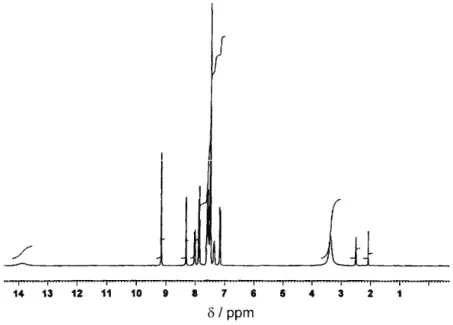
4-[(E)-phenyldiazenyl]-2-[(E)-(phenylimino)methyl]phenol, dmpH (1). Yield: 0.12 g (85 %). m.p. 137–138 °C. Anal. Calcd. for C19H15N3O (301.3 g/mol): C, 75.73; H, 5.02; N, 13.94 %; Found: C, 75.64; H, 5.09; N, 13.86. FTIR (KBr, cm–1): 3420 (Ar–OH), 3049 (Ar–C–H), 1620 (–CH=N–), 1346 (–N=N–). 1H-NMR (DMSO-d6, δ / ppm): 13.87 (1H, s, –OH), 9.17 (1H, s, –CH=N–), 8.32–8.30 (2H,
d, J = 9.1 Hz, Ar–H), 8.04–7.99 (5H, dd, J = 8.9 Hz, Ar–H), 7.88–7.85( 1H, d,
J = 8.6 Hz, Ar–H), 7.62–7.57 (5H, m, Ar–H). UV–Vis (EtOH, λmax / nm): 272
C=C), 326 (π→π*, –CH=N–), 343 (π→π*, –N=N–), 360 (n→π*, –CH=N–), 460 (n→π*, –N=N–). ΛM = 13 Ω–1 cm2 mol–1.
[Ni(dmp)Cl(H2O)] (2). Yield: 65 %. m.p. 225 °C. Anal. Calcd. for
C19H16ClN3NiO2 (412.50 g/mol): C, 55.32; H, 3.91; N, 10.19 %; Found: C, 55.07; H, 3.69; Cl, 8.44; N, 10.42 %. FTIR (KBr, cm–1): 3415 ν(OH), 3064 ν(Ar–C–H), 1618 ν(C=N), 1350 ν(–N=N–), 941, 569 ν(Ni–O), 447 ν(Ni–N). UV–Vis (DMF, λmax / nm): 229 (π→π*), 279 (π→π*), 347 (n→π*), 363 (n→π*), 443 (d→d). ΛM = 15 Ω–1 cm2 mol–1.
[Co(dmp)Cl(H2O)] (3). Yield: 69 %. m.p. 258 °C. Anal. Calcd. for
C19H16ClCoN3O2 (412.74 g/mol): C, 55.29; H, 3.91; Cl, 8.59; N, 10.18; Co, 14.28 %; Found: C, 55.35; H, 3.68; Cl, 8.71; N, 9.96; Co, 14.07 %. FTIR (KBr, cm-1): 3439 ν(OH), 3039 ν(Ar–C–H), 1613 ν(C=N), 1382 ν(–N=N–), 563 ν(Co–
O), 447 ν(Co–N). UV–Vis (DMF, λmax / nm): 235 (π→π*), 293(π→π*), 346 (n→π*), 428(n→π*), 605(d→d), 669(d→d). ΛM = 25 Ω–1 cm2 mol–1.
[Cu(dmp)Cl(H2O)] (4). Yield: 71 %. m.p. >250 °C. Anal. Calcd. for
C19H16ClCuN3O2 (417.35 g/mol): C, 54.68; H, 3.86; Cl, 8.49; N, 10.07; Cu, 15.23 %; Found: C, 54. 55; H, 3.74; Cl, 8.27; N, 10.16; Cu, 15.32 %. FTIR (KBr, cm–1): 3458 ν(OH), 3058 ν(Ar–C–H), 1611 ν(C=N), 1379 ν(–N=N–), 530 ν(Cu–O), 455 ν(Cu–N). UV–Vis (DMF, λmax / nm): 234 (π→π*), 274 (π→π*), 352 (n→π*), 370 (n→π*), 412 (d→d). ΛM = 21 Ω–1 cm2 mol–1.
The structures of the ligand and corresponding complexes were elucidated based on 1H-NMR, IR and UV–Vis spectra, elemental analysis and molar con-ductivity. In the complexes, the chloride ions were found to be coordinated to the metal ions as confirmed by the conductivity measurements.
Solubility and molar conductance
All of the metal chelates, [Ni(dmp)Cl(H2O)], [Cu(dmp)Cl(H2O)] and [Co(dmp)Cl(H2O)] are stable in air and soluble in DMF and insoluble in water and n-hexane. Single crystals of the metal chelates could not be isolated from any organic solution, thus no definite structures can be described. However, the ana-lytical, spectroscopic and conductivity data enabled possible structures to be predicted as shown in Fig. 2. The molar conductance values of the complexes 2–4
in DMF were in the range 15–25 Ω–1 cm2 mol–1, indicating that they are non-ele-ctrolytes.
Elemental analyses
The elemental analysis results of the complexes of the ligand 1 are in good
Fig. 2. The proposed general struc-ture of the metal chelates.
1H-NMR spectrum of the ligand
Proton nuclear magnetic resonance spectral analysis was performed for the synthesized dye which provided further evidence for the structural characteristics of the dye. The 1H-NMR spectrum of the dye showed a signal at δ 13.87 ppm.26 This chemical shift can be attributed to hydrogen bonded O–H proton. The al-dehyde compound containing an azo group exhibited a peak in its 1H-NMR spec-trum at δ 10.32 ppm as a singlet belonging to the proton of the –CHO group. However, the aldehyde peak disappeared in the azo-azomethine dye. The proton of the azomethine group appeared at δ9.17 ppm as a singlet (Fig. 3). The 1H-NMR spectrum of the dye showed d peaks at δ 8.32–8.30 ppm (H-3), a dd at δ8.04– –7.99 ppm (H-5) and a d at δ7.88–7.87 ppm (H-6), which are attributed to phe-nyl protons, including the –OH group.22 These results show that the azo-azome-thine dye shifts to the enol-imine form. The multiple peaks appearing at δ 7.62– –7.57 ppm are also attributed to aromatic protons.2
IR spectra
The IR spectra of the complexes were studied to characterize their structures. The IR spectra of the dmpH ligand 1 and its metal complexes were taken as KBr
pellets.
The ligand spectrum revealed a broad band at 3420 cm–1 corresponding to the vibration of the O–H group present in the structure.2 The band observed at 3049 cm–1 is due to the presence of aromatic C–H bonds in the structure. Espe-cially, the band observed at 1620 cm–1 indicates the azomethine (–CH=N–) group, which was not present in the starting material but forms in the resulting product as a result of the condensation reaction.27 This band is shifted in the me-tal chelates toward lower frequencies because of the coordination of the nitrogen to the metal ion. This fact can be explained by the withdrawing of electrons from nitrogen atom to the metal ion on coordination. The band observed at 1346 cm–1 is an indication of the –N=N– group. The peak at 3420 cm–1 in the spectrum of the ligand corresponding to the OH group was observed at 3415 cm–1 in the spectrum of 2. The peak observed at 3064 cm–1 is due to the aromatic C–H group in the complex. The peak at 1618 cm–1 is due to C=N. These values are in good accordance with the values cited in the literature. The peak appearing at3420 cm-1 in the IR spectrum of the ligand corresponding to OH group was observed to ap-pear at 3439 cm–1 in the IR spectrum of 4. The peak aromatic C–H group was observed at 3039 cm–1. The peak at 1613 cm–1 corresponds to the vibration mode of the C=N group. The peak appearing at 3420 cm–1 in the spectrum of the ligand, corresponding to the OH group, was observed at 3458 cm–1 in the IR spectrum of 3. The peak corresponding to the imine group appeared at 1611 cm–1. The peaks appearing at 530 and 455 cm–1 were attributed to the Cu–O and Cu–N groups. In the infrared spectra of the complexes, bands assigned to M–O and M–N were identified between 569–530 cm–1 and 455–447 cm–1,respectively.28
Electronic spectra
The electronic spectra of the dye and its metal chelates were recorded in both EtOH and DMF between 200 and 800 nm. The room temperature UV–Vis ab-sorption spectrum of the synthesized dye (dmpH) displayed mainly five bands observed within the range 200–800 nm in EtOH and DMF solution. The first band at 272 nm as a shoulder was assigned to the moderate energy π→π* transition of the aromatic ring, while the second band at 320 nm is due to the low energy π→π* transition of the –CH=N– group.
The peaks belonging to the azomethine group in the spectra of 2, 3 and 4
respecti-vely.29 These transitions were observed at 360 and 460 nm in DMF solutions, respectively. The peaks belonging to the –N=N– group in the spectra of the com-plexes 2, 3 and 4 appeared at 363, 389 and 370 nm, respectively. The d–d tran-sition bands in the spectra of the azo-azomethine dye complexes were observed at 412–605 nm. The spectroscopic data obtained in this work agreed well with the results of previous studies.
Biological activity
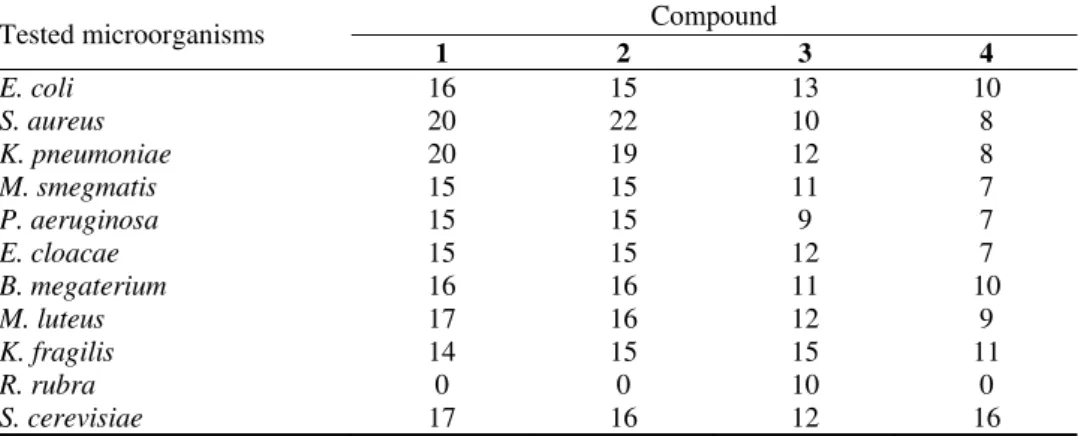
The antibacterial and antifungal activity of the new azo-azomethine chelates were tested by the disc diffusion method. The antibacterial and antifungal acti-vities of the compounds against eight bacteria, namely E. coli, S. aureus, K. pneumoniae, M. smegmatis, P. aeruginosa, E. cloacae, B. megaterium and M. lu-teus, and three fungi, namely K. fragilis, R. rubra and S. cerevisiae, are presented in Table I. The results showed that the compound dmpH exhibited high activity against all the tested bacteria and fungi, except for R. rubra. The dye, compound
1, showed the highest effect against S. aureus and K. pneumoniae among all the tested bacteria and S. cerevisiae among all the tested fungi. Compound 2 was quite effective against all the tested bacteria and fungi, with the exception of R. rubra, as in the case of compound 1. However, compound 2 had the highest effect only against one bacterium, namely S. aureus, showing an inhibition zone of 22 mm. It is also clear from the data in Table I that compound 3 exhibited high activity against all the tested bacteria and fungi, showing an inhibition zone of 9– –15 mm. Compound 4 exhibited moderate activity against all the tested bacteria and fungi, except for R. rubra. The copper complex showed the highest effect against E. coli and B. megaterium among all the tested bacteria and S. cerevisiae
among all the tested fungi.
TABLE I. Antibacterial and antifungal activities (mm) of the synthesized dye and its com-plexes
Tested microorganisms Compound
1 2 3 4
E. coli 16 15 13 10
S. aureus 20 22 10 8
K. pneumoniae 20 19 12 8
M. smegmatis 15 15 11 7
P. aeruginosa 15 15 9 7
E. cloacae 15 15 12 7
B. megaterium 16 16 11 10
M. luteus 17 16 12 9
K. fragilis 14 15 15 11
R. rubra 0 0 10 0
CONCLUSIONS
In this work, an azo-azomethine dye ligand, 4-[(E)-phenyldiazenyl]-2-[(E)- -(phenylimino)methyl]phenol (dmpH), derived from 2-hydroxy-5-[(E )-phenyldi-azenyl]benzaldehyde and aniline in EtOH, and some of its transition metal com-plexes were prepared. The analytical data and spectroscopic studies suggested that the complexes had the general formula of [M(dmp)Cl(H2O)], where M is nickel(II), cobalt(II) or copper(II). The molar conductance measurements of the complexes showed their non-electrolytic nature. According to UV–Vis and IR data, the phenylazo-linked azo-azomethine dye was coordinated to the metal ion through the azomethine nitrogen and oxygen atom of the hydroxyl group in sali-cylaldehyde.
Based on the above results, the structure of the investigated coordination compounds can be formulated as in Fig. 2. The studied metal chelates exhibited high activity against S. cerevisiae.
, Ј , Ј Ј ,
Ј Њ Ј 4-[(Е )-]-2-[(Е)-( ) ]
NURCAN KURTOGLU
Kahramanmaraş Sütçü İmam University, Department of Textile Engineering, Avşar campus, 46050, Kahramanmaraş, Turkey
Ni(II), Cu(II) Co(II)
4-[(Е)- ]-2-[(Е)-( ) ] (dmpH), 5-[(Е)- ]-2- EtOH.
- .
,
UV–Vis .
[M(dmp)Cl(H2O)] M = Ni(II),
Cu(II) Co(II). N .
Ni(II), Cu(II) Co(II)
. in vitro
: Escherichia coli, Staphylococcus aureus, Klebsiella pneumoniae, Mycobacterium smegmatis, Pseudomonas aeruginosa, Enterococcus cloacae,
Bacillus megaterium Micrococcus luteus, : Kluyveromyces fragilis, Rhodotorula
rubra Saccharomyces cerevisiae, .
[Ni(dmp)Cl(H2O)] , Rhodotorula rubra.
(( 26. 2008, 12. 2009)
REFERENCES
2. H. Kocaokutgen, M. Gur, M. S. Soylu, P. Lonnecke, Dyes Pigm. 67 (2005) 99
3. P. Gregory, High-technology applications of organic colorants, Plenum Press, New York, 1991, p. 1
4. S. C. Catino, R. E. Farris, in: Concise Encyclopedia of Chemical Technology, M. Grayson, Ed., John Wiley & Sons, New York, 1985, p. 142
5. W. Nowik, Encyclopedia of separation sciences, Academic Press, London, 2000, p. 2602 6. H. Zollinger, Color Chemistry – Synthesis, Properties and Application of Organic Dyes
and Pigments, VCH Publishers, New York, 1987, p. 1436
7. H. Ollgaard, L. Frost, J. Galster, O. C. Hansen, Survey of azo-colorants in Denmark: consumption, use, health and environmental aspects, Ministry of Environment and Ener-gy, Denmark and the Danish Environmental Protection Agency, No. XX, 1998, p. 147 8. M. S. El-Medani, O. A. M. Ali, R. M. Ramaden, J. Mol. Struct. 738 (2005) 171
9. S. Ren, R. Wang, K. Komastu, P. B. Krause, Y. Zyrianov, C. E. McKenna, C. Csipke, Z. A. Tokes, E. J. Lien, J. Med. Chem. 45 (2002) 410
10. M. T. H. Tarafder, M. A. Ali, N. Saravana., W. Y. Weng, S. Kumar, N. U. Tsafe, K. A. Crouse, Transition Met. Chem. 25 (2000) 295
11. J. Colman, L. S. Hegedu, Principles and Applications of Organotransition Metal Chemis-try, University Science Book, Herndon, VA, 1980
12. J. Zhan, B. Zhan, J. Liu, W. J. Xu, Z. Wang, Spectrochim. Acta A 57 (2001) 149 13. W. Liu, Y. Zou, Y. Li, Y. G. Yao, Q. J. Meng, Polyhedron 23 (2004) 849
14. H. Yoon, T. R. Wagler, K. J. O’Connor, C. J. Burrows, J. Am. Chem. Soc. 122 (1990) 4568 15. M. A. Green, H. Luo, P. E. Fanwick, Inorg. Chem. 37 (1998) 1127
16. M. Aslantaş, N. Kurtoğlu, E. Şahin, M. Kurtoğlu, Acta Crystallogr., Sectıon E: Struct. Rep. Online E63 (2007) O3637
17. M. Kurtoğlu, N. Birbiçer, U. Kimyonşen, S. Serin, Dyes Pigments 41 (1999) 141 18. N. Birbiçer, M. Kurtoğlu, S. Serin, Synth. React. Inorg. Met. Org. Chem. 29 (1999) 1353 19. N. Kurtoğlu, M. Kurtoğlu, S. Serin, Synth. React. Inorg. Met. Org. Chem. 29 (1999) 1779 20. N. Kurtoğlu, D. Şenol, Asian J. Chem. 20 (2008) 1986
21. M. S. Refat, I. M. El-Deen, H. K. Ibrahim, S. El-Ghool, Spectrochim. Acta. 65 (2006) 1208 22. M. Odabaşoğlu, Ç. Albayrak, R. Özkanca, F. Z.Akyan, P. Lonecke, J. Mol. Struct. 840
(2006) 71
23. S. Çakır, E. Biçer, M. Odabaşoğlu, Ç. Albayrak, J. Braz. Chem. Soc. 16 (2005) 711
24. C. H. Collins, P. M. Lyne, Microbial Methods, University Park Press, Baltimore, 1970, p. 422 25. M. Kurtoglu, E. Ispir, N. Kurtoglu, S. Serin, Dyes Pigments 77 (2008) 75
26. K. Nejati, I. Z. Rezvani, New J. Chem. 27 (2003) 1665 27. V. P. Singh, P. Gupta, J. Coord. Chem. 61 (2008) 1532