PRELIMINARY EXPERIENCE WITH EXTRAPERITONEAL ENDOSCOPIC
RADICAL PROSTATECTOMY THROUGH DUPLICATION OF THE OPEN
TECHNIQUE
M. TOBIAS-MACHADO, MARCO T. C. LASMAR, JIMMY J. A. MEDINA, PEDRO H.
FORSETO JR, ROBERTO V. JULIANO, ERIC R. WROCLAWSKI
Section of Urology, ABC Medical School, Santo Andre, Sao Paulo, SP
ABSTRACT
Objective: To describe surgical and functional results with extraperitoneal laparoscopic radical prostatectomy with duplication of the open technique, from the experience obtained in the treatment of 28 initial cases.
Materials and Methods: In a 36-month period, we prospectively analyzed 28 patients diag-nosed with localized prostate cancer undergoing extraperitoneal laparoscopic radical prostatectomy. Results:Mean surgical time was 280 min, with mean blood loss of 320 mL. As intraoperative complications, there were 2 rectal lesions repaired with laparoscopic suture in 2 planes. There was no conversion to open surgery. Median hospital stay was 3 days, with return to oral diet in the first post-operative day in patients. As post-post-operative complications, there were 3 cases of extraperitoneal uri-nary fistula. Two of these cases were resolved by maintaining a Foley catheter for 21 days, and the other one by late endoscopic reintervention for repositioning the catheter. Five out of 18 previously potent patients evolved with erectile dysfunction. The diagnosis of prostate cancer was confirmed in all patients, with focal positive margin occurring in 3 cases. During a mean follow-up of 18 months, 2 patients presented increased PSA, with no clinical evidence of disease.
Conclusion: Laparoscopic radical prostatectomy is a laborious and difficult procedure, with a long learning curve. Extraperitoneal access is feasible, and it is possible to practically duplicate the principles of open surgery. The present technique can possibly offer advantages in terms of decreased blood loss, preservation of erectile function and prevention of positive margins.
Key words: prostatic neoplasms; prostatectomy; retroperitoneum; endoscopy
Int Braz J Urol. 2005; 31: 228-35
INTRODUCTION
Early experiences with laparoscopic radical prostatectomy were developed by transperitoneal approach. The surgery was first reported by Schuessler et al. in 1992, but technical difficulties prevented the diffusion of its practical application (1). In 1998, Guillonneau & Vallencien (2) introduced the technique of descending laparoscopic radical
pros-tatectomy with transperitoneal access, which was re-produced by other services. According to the authors, the initial access to seminal vesicles and ligation with-out section of the venous complex were essential tech-nical modifications that made the technique’s stan-dardization and feasibility of the laparoscopic tech-nique easier.
(ELRP). Except for the initial dissection of seminal vesicles, the employed technique followed the prin-ciples of the French technique, by sectioning the venous complex and the urethra at the final step of prostatic ablation. Bollens et al. (4) described the first series with a larger number of cases using this tech-nique. In Brazil, laparoscopic radical prostatectomy has been developed in a few centers, being almost exclusively performed by transperitoneal approach.
The present work aims to demonstrate the feasibility of performance, as well as to describe the initial results of the laparoscopic extraperitoneal tech-nique, using the terms classically described by Walsh (5).
MATERIALS AND METHODS
Between February 2001 and February 2004, we studied 28 patients with clinically localized pros-tate adenocarcinoma, diagnosed by digital rectal ex-amination, PSA and ultrasound-guided prostate bi-opsy. Mean age was 66 years (55-73), with mean body mass index of 24 (19-35). Twenty-five (89.3%) had ASA surgical risk II and 3 patients were ASA I
(10.7%). Two patients had previously undergone tran-surethral resection of the prostate, 3 had a history of inguinal herniorrhaphy and another 3 had undergone previous surgery with access to the abdominal cav-ity.
Tumor staging through abdominal and pel-vic computerized axial tomography and bone scin-tigraphy was performed when the serum level of pros-tate specific antigen (PSA) was higher than 10 ng/ mL or when Gleason score was higher than or equal to 7. Patients with localized disease were selected.
Mean prostate volume as obtained by transrectal ultrasonography was 51 g (33-74). Mean PSA in this series was 8.0 ng/mL (3-17 ng/mL). Clini-cal stage was T1c in 11 patients (39.3%), T2a in 10 patients (35.7%) and T2b in 7 patients (25%).
Among the entire sample, 11 patients (39.3%) presented Gleason score 7 or higher, 14 patients (50%) had Gleason 6, and 3 patients (10.7%) had Gleason 5 (Table-1).
Laparoscopic pelvic lymphadenectomy was performed when PSA was higher than 10 ng/mL and in patients with Gleason score above 7.
We have described surgical time, blood loss, intraoperative complications, conversion rate, hospi-tal stay, time until returning to oral diet, convales-cence period, post-operative complications and his-topathological data of the specimen.
Patients were divided into 2 groups in order to assess the learning curve. The first twenty patients formed the first group and the remaining 8 the sec-ond group. Patients were followed up on an outpa-tient basis and assessed at 7, 14 and 30 days follow-ing discharge from hospital, and then every 3 months during the first 2 years, with clinical examination and PSA measurement. Following this period, follow-up was biannual. Mean follow-up was 18 months.
Mean blood loss was obtained by estimating the amount of blood that was aspired during the pro-cedure.
Potency was assessed through the capacity of maintaining penile rigidity sufficient for sexual intercourse (Item 5 from IIEF). Pre-operatively, 10 patients (35.7%) had erectile dysfunction while 18 patients (64.3%) had preserved erectile function. In order to assess continence, we considered the criteria Table 1 – Demographic data and preoperative
character-istics of patients undergoing extraperitoneal endoscopic radical prostatectomy with duplication of open technique.
Number of patients Age (years) Body mass index
ASA surgical risk (patients) Prostate volume - ultrasound (cc) Prostate Specific Antigen (ng/mL)
Gleason Score > 7
6 5
Clinical stage T1c
T2a T2b
28 66 (55-73) 24 (19-35) I (10.7%); II (89.3%)
51 (33-74) 8.0 (3-17)
N patients 11 (39.3%) 14 (50.0%) 03 (10.7%)
proposed by Turk et al. (6) and the time to recovery of continence.
All patients were operated at a Brazilian teaching institution by a single surgeon, who was fa-miliar with extraperitoneal access, and was aided by an assistant with expertise in laparoscopy and a train-ing resident doctor for controlltrain-ing the camera. The protocol was started after previous experience of the surgeon in assisting transperitoneal laparoscopic radi-cal prostatectomy in 30 patients.
The adopted surgical technique was per-formed through 5 ports, through extraperitoneal space, practically duplicating all steps used in con-ventional open radical prostatectomy (7). All patients received prophylaxis for venous thrombosis with low molecular weight heparin up to 48 hours following surgery and mobilization in bed after the first 24 hours. Penrose drain was used in all patients, being removed when the output was lower than 100 cc in 24 hours.
RESULTS
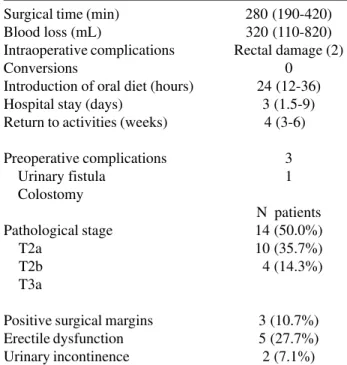
Results are summarized in Table-2.
Mean surgical time was 280 minutes (190-420). In the first group, mean surgical time was 340 minutes (290-420). Mean time for prostate ablation was 200 minutes (170-220) and mean time for vesicourethral anastomosis was 140 minutes (80-160). In the second group, mean surgical time was 220 min-utes (190-260 min) with mean time for prostate abla-tion being 140 minutes (90-160 min) and 80 minutes (45-110) for vesicourethral anastomosis. Laparoscopic obturator lymphadenectomy was performed in 8 pa-tients with mean additional time of 42.5 minutes (35-50).
Mean blood loss was 320 mL (110-820). The patient that lost 820 mL of blood was the second in the series and required transfusion during surgery. Mean blood loss for the first and the second groups was respectively 500 and 140 mL.
Among intraoperative complications, there were 2 rectal lesions, which were laparoscopically sutured in 2 planes of 3-0 polyglactin. The complica-tions occurred in the first group. There was no con-version to open surgery in this series.
Analgesia was offered with paracetamol and ketoprofen during the first 24 hours and, following this period, only if the patient complained of pain. Nine 9 (35.7%) patients require re-administration of ketoprofen. Only 3 (10.7%) patients used opioids due to more significant pain.
Mean time until restitution of oral diet was 24 hours (12-36 hours).
Patients had a median hospital stay of 3 days (1.5-21).
On the seventh postoperative day, a cystog-raphy was performed and the Foley catheter was re-moved after confirming that there was no extravasa-tion of urine. If any urine escape persisted, a new cystography was performed on the 14th post-opera-tive day. Patients were discharged from hospital with the Foley catheter. Mean period of catheter mainte-nance was 11 days in the first group and 7 days in the second one.
Of the 2 cases presenting rectal lesion, one required reoperation for loop colostomy on the 4th postoperative day. Extraperitoneal urinary fistulas
Table 2 – Surgical data from patients undergoing extraperitoneal endoscopic radical prostatectomy with duplication of open technique.
Surgical time (min) Blood loss (mL)
Intraoperative complications Conversions
Introduction of oral diet (hours) Hospital stay (days)
Return to activities (weeks)
Preoperative complications Urinary fistula
Colostomy
Pathological stage T2a
T2b T3a
Positive surgical margins Erectile dysfunction Urinary incontinence
280 (190-420) 320 (110-820) Rectal damage (2)
0 24 (12-36)
3 (1.5-9) 4 (3-6)
3 1
N patients 14 (50.0%) 10 (35.7%) 4 (14.3%)
occurred in 3 patients, with 2 cases being resolved by maintaining the Foley catheter for 21 days. The third case presented high-output urinary fistula, where we observed loosening of the vesicourethral anastomo-sis due to improper positioning of the balloon. This case required endoscopic repositioning of the cath-eter, with resolution within 4 days from the interven-tion.
Mean volume of the removed specimen was 44 g (31-76) and the histological diagnosis of pros-tate adenocarcinoma was confirmed in all patients. Pathological stage was T2a in 14 patients (50%), T2b in 10 patients (35.7%), T3 in 4 patients (14.3%). Three patients with T3 stage showed focal involvement in the lateral margins. Local or systemic clinical recur-rence was not evidence in the study period. Patho-logical result for patients undergoing lymphadenec-tomy was negative to neoplasia in all patients. Two patients with pT3 stage had biochemical recurrence with PSA levels of 1.0 and 1.2 ng/mL 6 and 18 months following surgery, and were rescued by external ra-diotherapy. There was no event leading to the suspi-cion of clinical recurrence.
Functional Results
Fourteen patients (50%) showed complete urinary continence until the third month. On the sixth month, another 8 (28.6%) patients were continent. When assessing the remaining patients after 12 months, 4 (14.3%) of those who used 2 day pads and one night pad gained continence. Thus, after one year, 92.9% of the patients were completely conti-nent.
Of the 2 (7.1%) incontinent patients, 1 was diagnosed with stenosis of the vesicourethral anasto-mosis and underwent endoscopic treatment, with good results concerning urethral permeability. One patient is still incontinent using 4 day pads and 2 night pads and currently has a surgery planned in order to place an artificial sphincter.
The preservation of the neurovascular bundle was performed bilaterally when PSA was lower than 10 ng/mL or when no lateral nodule was palpable on the digital rectal examination. Of the 18 patientswith pre-operative potency, 2 presented intraoperative macroscopic features of extracapsular tumor, which
prevented preservation of the nervous bundle. The patient was considered as definitely impotent when he was not able to achieve erection, both spontane-ously or with the use of oral or intracavernous drugs, within a 1-year period.
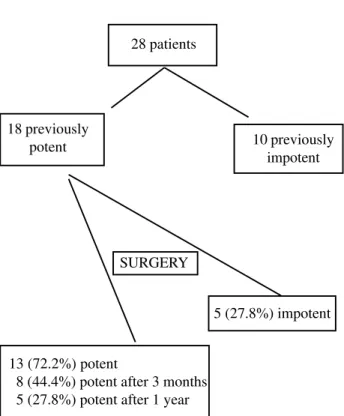
Eight patients (44.4%) recovered potency up to the third month and another 5 (27.7%) recovered their potency within one year. Among the 13 potent patients, 6 required inhibitors of type 5 phosphodi-esterase in order to maintain an adequate sexual in-tercourse.
The remaining five (27.7%) patients, where the use of oral medication or intracavernous injec-tions was not effective within 1 year following the surgery, have surgical plans for placing a penile pros-thesis (Figure-1).
Figure 1 – Sexual function of patients undergoing extraperitoneal endoscopic radical prostatectomy with duplication of open tech-nique.
28 patients
18 previously
potent 10 previously impotent
SURGERY
5 (27.8%) impotent
13 (72.2%) potent
COMMENTS
Recently, laparoscopic radical prostatectomy has been introduced aiming to decrease operative morbidity, while keeping the functional and oncologi-cal features of conventional technique (1).
Laparoscopic technique offers advantages, especially concerning the access to deeper organs that are surrounded by bony structures, where the surgical field is too limited for open surgical maneuvers. It al-lows better viewing due to magnification and selec-tive illumination of the structures, thus increasing the accuracy of dissection and favoring more delicate tech-nical maneuvers. Therefore, the potential for preserv-ing neurovascular and muscular structures is increased (8). Robotic assistance, when available, allows better stabilization of image, reducing surgical time and re-fining the confection of the vesicourethral anastomo-sis. (9).
Some authors have demonstrated that laparoscopic radical prostatectomy provides func-tional and oncological results that are comparable with the open technique, however with significant decrease in blood transfusion rate, shorter hospital stay and faster recovery (8,10). Guillonneau et al. in 2002, in a series of 567 patients, reported that 82.9% did not present complications, stating that this access has lower morbidity than open retropubic surgery (10). Subsequently, the same authors on the following year, now with 1000 patients, concluded that the laparoscopic radical prostatectomy presents satisfac-tory results concerning tumor control and biochemi-cal recurrence, in addition to being comparable to the open technique in terms of follow-up and results (11). In 2002, Salomon et al. showed in their work that, after one year, laparoscopic prostatectomy resulted in urinary continence in 90% of patients and preserva-tion of potency in 58.8% and up to 83.8% in the sub-group of patients under 60 years old (12). Rozet et al. found similar results in 2004, with the extraperitoneal laparoscopic approach (13).
The strictly extraperitoneal laparoscopic radi-cal prostatectomy has gained higher acceptance worldwide. It combines the benefits of the laparoscopic approach (less painful, lower morbid-ity, faster recovery, better cosmetic effect) with the
advantages of the open retropubic surgery. It reduces the risks of damaging intraperitoneal organs, pro-longed adynamic ileus, intracavitary tumor spread, as well as bleeding or urine extravasations into the peritoneal cavity. Some authors also believe that it allows better dissection of the neurovascular, as dem-onstrated in other series (14,15).
One limitation of the extraperitoneal access is the reduced working place for manipulating the forceps, especially when performing aspiration or when there is peritoneal perforation. The majority of difficulties are overcome with training and adapta-tion to the reduced working place by the surgeon, as well as with the proper withdrawing and exposure of structures by the assistance.
The majority of centers that use extraperitoneal access employ an antegrade technique. According to this technique’s adepts, the position of the camera and working forceps in relation to the prostate would pro-mote greater difficulties for performing the surgery by retrograde access. With the approached used in the present study, the proximal retraction of the catheter by the assistant allows the elevation of the prostate apex and proper visualization of the retroprostatic space, as occurs in the open technique.
Though CO2 absorption is slightly higher in the extraperitoneal approach, no clinically significant adverse hemodynamic or respiratory effects have been found, when compared with the transperitoneal ap-proach (16).
The intraoperative and oncological results of transperitoneal and antegrade extraperitoneal laparoscopic radical prostatectomy were compared by Cathelineau et al. (17), who considered them equiva-lent. Though the surgical time was significantly shorter in extraperitoneal approach, these authors concluded that the selection of access should depend on the surgeon’s expertise and training. Erdogru et al. (18) verified this equivalence as well, recommend-ing the extraperitoneal approach in particular for cases of obesity, previous abdominal surgery and require-ment of concomitant inguinal hernia repair.
In 2003, Dubernard et al. (19) published an extraperitoneal approach characterized by retrograde dissection of the prostate, releasing the retroprostatic space immediately after the ligation of the dorsal vein complex and urethral sectioning. The technique em-ployed in our work differs from the one described by those authors due to control of “back flow” and liga-tion of the postero-lateral pedicle of the prostate with polymer clips. The dissection of the neurovascular bundle is performed in retrograde and antegrade di-rections, similarly to the technique described in 2004 by Su et al. (20). Additionally, the vesicourethral anas-tomosis is performed with a continuous suture form-ing 2 hemicircumference as described by Van Velthoven et al., thus reducing the learning curve and providing greater safety as for the anastomosis’ final results (21).
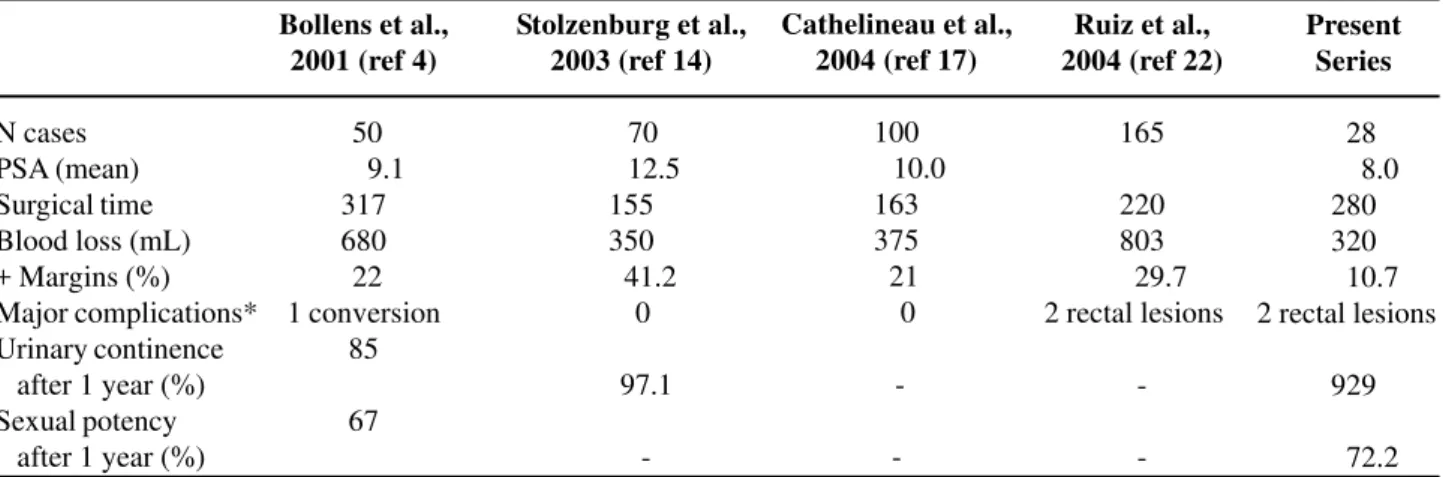
The surgical time obtained in this work was comparable to other world series on preliminary ex-perience (4,6). We have also observed a decrease of 120 minutes in mean total surgical time in the last cases, with the possibility of further reductions as the learning curve is overcome.
Blood loss was lower in this sample than in some other series from the literature (4,17), with low transfusion rate. This fact can result from the famil-iarity with already known steps from open surgery technique, in addition to using clips in the prostate pedicles (Table-3).
Analgesia and hospital stay were similar to other results reported in the literature (4,6,15).
The most serious complication in this sample was rectal damage, probably related to the initial retroprostatic dissection and the learning curve.
Post-operative complications were urinary fis-tulas, however they had no major repercussion on the general status and were easily resolved in all patients, advantages that are attributed to the extraperitoneal approach. The occurrence of subcutaneous emphysema is quite frequent, however its clinical repercussion is not significant, if there is proper intraoperative anes-thetic management, with good hydration and hyper-ventilation in order to avoid hypercarbia.
In relation to oncological control, the extraperitoneal approach seems to offer the same early oncological results, with shorter surgical time. Ruiz et al. (22) in a comparative series of trans- and extraperitoneal laparoscopic prostatectomies ob-served that oncological control and positive margins were similar, though cases operated by extraperitoneal access had been preoperatively classified as more aggressive.
Our initial impression is that it is possible to reduce the index of positive margins in the learn-ing curve when compared with other series of laparoscopic radical prostatectomy. We believe that the technique described in this study offers clearer visualization of the prostate contour, since the
pros-Table 3 – Data from some early series on extraperitoneal endoscopic radical prostatectomy.
N cases PSA (mean) Surgical time Blood loss (mL) + Margins (%) Major complications* Urinary continence after 1 year (%) Sexual potency after 1 year (%)
Bollens et al., 2001 (ref 4)
50 9.1
317 680 22 1 conversion
85
67
Stolzenburg et al., 2003 (ref 14)
70 12.5
155 350 41.2
0
97.1
-Cathelineau et al., 2004 (ref 17)
100 10.0
163 375 21 0
-Ruiz et al., 2004 (ref 22)
165
220 803 29.7 2 rectal lesions
-Present Series
28 8.0
280 320 10.7 2 rectal lesions
929
72.2
tate is fixed to the pelvic floor only by its lateral pedicles at the end of the procedure. The reduced rate of positive surgical margins seem to be an ad-vantage with this technique, however, the small num-ber of cases and the preoperative selection of pa-tients for this approach do not allow a definitive conclusion.
Functional control, as characterized by con-tinence, showed no major differences when compared with other world series (4,15). However, Eden et al. reported that urinary continence happened earlier with the extraperitoneal approach due to larger dissection and consequent bladder denervation that occurs in the transperitoneal approach (23). In relation to sexual potency, results were quite satisfactory, which can be explained by the clear identification of the pedicle and the use of clip in the prostate pedicles, thus pre-venting the heat to be transmitted to the neurovascu-lar bundle.
CONCLUSION
Extraperitoneal laparoscopic radical prostate-ctomy with duplication of the open technique is fea-sible, even with a recognized learning curve.
This technique can offer potential advantages concerning the reduction in blood loss, preservation of erectile function and prevention of positive surgi-cal margins during the learning curve.
The overall complication rate is compatible with other early series of laparoscopic radical pros-tatectomy. Urinary fistulas show benign evolution, without prolonged ileus and spontaneous closure only by maintaining the bladder catheter.
REFERENCES
1. Schuessler WW, Schulam PG, Clayman RV, Kavoussi LR: Laparoscopic radical prostatectomy: initial short-term experience. Urology. 1997; 50: 854-7.
2. Guillonneau B, Vallancien G: Laparoscopic radical prostatectomy: the Montsouris technique. J Urol. 2000; 63: 1643-9.
3. Raboy A, Ferzli G, Albert P: Initial experience with extraperitoneal endoscopic radical retropubic prostate-ctomy. Urology. 1997; 50: 849-53.
4. Bollens R, Vanden Bossche M, Roumeguere T, Damoun A, Ekane S, Hoffmann P, et al.: Extraperitoneal laparoscopic radical prostatectomy. Results after 50 cases. Eur Urol. 2001; 40: 65-9. 5. Walsh PC, Donker PJ: Impotence following radical
prostatectomy: Insight into etiology and prevention. J Urol. 1982; 128: 492-7.
6. Turk I, Deger S, Winkelmann B, Schonberger B, Loening SA: Laparoscopic radical prostatectomy. Technical aspects and experience with 125 cases. Eur Urol. 2001; 40: 46-52; discussion 53.
7. Tobias-Machado M, Forseto Jr P, Medina JA, Watanabe M, Juliano RV, Wroclawski ER: Laparoscopic radical prostatectomy by extraperitoneal access with duplication of the open technique. Int Braz J Urol. 2004; 30: 221-6.
8. Turk I, Deger S, Winkelmann B, Brettschneider P, Roigas J, Wille A, et al.: Radical prostatectomy in clini-cally localized prostate carcinoma. Pro Laparoscopic approach. Urologe A. 2002; 41: 48-54.
9. Gettman MT, Hoznek A, Salomon L, Katz R, Borkowski T, Antiphon P, et al.: Laparoscopic radical prostatectomy: description of the extraperitoneal ap-proach using the da Vinci robotic system. J Urol. 2003; 170: 416-9.
10. Guillenneau B, Rozet F, Cathelineau X, Lay F, Barret E, Doublet JD, et al.: Perioperative complications of laparoscopic radical prostatectomy: the Montsouris 3-year experience. J Urol. 2002; 167: 51-6.
11. Guillonneau B, El-Fettouh H, Baumert H, Cathelineau X, Doublet JD, Fromont G, et al.: Laparoscopic radical prostatectomy: oncological evalution after 1.000 cases at Montsouris institute. J Urol. 2003; 169: 1261-6. 12. Salomon L, Anastasiadis AG, Katz R, De La Taille A,
Saint F, Vordos D, et al.: Urinary continence and erec-tile function: a prospective evaluation of functional results after radical laparoscopic prostatectomy. Eur Urol. 2002; 42: 338-43.
13. Rozet F, Arroyo C, Cathelineau X, Barret E, Prapotnich D, Vallancien G: Extraperitoneal standard laparoscopic radical prostatectomy. J Endourol. 2004; 18: 605-09; discussion 610.
14. Stolzenburg JU, Truss MC, Do M, Rabenalt R, Pfeiffer H, Dunzinger M, et al.: Evolution of endoscopic extraperitoneal radical prostatectomy (EERPE) - tech-nical improvements and development of a nerve-spar-ing, potency-preserving approach. World J Urol. 2003; 21: 147-52.
radi-cal prostatectomy: initial experience after 70 proce-dures. J Urol. 2003; 169: 2066-71.
16. Meininger D, Byhahn C, Wolfram M, Mierdl S, Kessler P, Westphal K: Prolonged intraperitoneal versus extraperitoneal insufflation of carbon dioxide in patients undergoing totally endoscopic robot-assisted radical prostatectomy. Surg Endosc. 2004; 18: 829-33. 17. Cathelineau X, Cahill D, Widmer H, Rozet F, Baumert
H, Vallancien G: Transperitoneal or extraperitoneal approach for laparoscopic radical prostatectomy: a false debate over a real challenge. J Urol. 2004; 171: 714-6.
18. Erdogru T, Teber D, Frede T, Marrero R, Hammady A, Seemann O, Rassweiler J: Comparison of transperitoneal and extraperitoneal laparoscopic radi-cal prostatectomy using match-pair analysis. Eur Urol. 2004; 46: 312-9.
19. Dubernard P, Benchetrit S, Chaffange P, Hamza T, Van Box Som P: Retrograde extraperitoneal laparoscopic
prostatectomy (R.E.I.P). Simplified technique (based on a series of 143 cases. Prog Urol. 2003; 13: 163-74. 20. Su LM, Link RE, Bhayani SB, Sullivan W, Pavlovich CP: Nerve-sparing laparoscopic radical prostatectomy: replicating the open surgical technique. Urology. 2004; 64: 123-7.
21. Van Velthoven RF, Ahlering TE, Peltier A, Skarecky DW, Clayman RV: Technique for laparoscopic running urethrovesical anastomosis: the single knot method. Urology. 2003; 61: 699-702.
22. Ruiz L, Salomon L, Hoznek A, Vordos D, Yiou R, de la Taille A, et al.: Comparison of early oncologic re-sults of laparoscopic radical prostatectomy by extraperitoneal versus transperitoneal approach. Eur Urol. 2004; 46:50-4; discussion 54-6.
23. Eden CG, King D, Kooiman GG, Adams TH, Sullivan ME, Vass JA: Transperitoneal or extraperitoneal laparoscopic radical prostatectomy: does the approach matter? J Urol. 2004; 172: 2218-23.
Received: December 14, 2004 Accepted after revision: April 29, 2005
Correspondence address:
Dr. Marcos Tobias-Machado Rua Graúna, 104 / 131